Sophie, Countess of Ségur (née Countess Софья Фёдоровна Ростопчина; Saint Petersburg, 1 August 1799 - Paris, 9 February 1874) was a French writer of Russian birth.
She is best known today for her novel Les Malheurs de Sophie ("Sophie's Misfortunes"). The action takes place in a castle in the French countryside during the Second French Empire, where Sophie lives with her parents Mr and Mrs de Réan. Curious and adventurous, she does one silly thing after another, with the critical help of her cousin Paul, who is good and tries to show her the right path. She has two friends, Camille and Madeleine de Fleurville, 'good little girls' whom she tries hard to imitate. But she will learn that life is not a bed of roses ... Therese Martin (1873-1897), known as St. Therese of Lisieux, was an avid reader as a child of the novels of the Countess of Segur.
The novels of the Countess of Ségur were published from 1857 to 1872 in the "Bibliothèque rose illustrée" by the publishing house Hachette. They were collected together in 1990 under the title Œuvres de la comtesse de Ségur in the collection "Bouquins" (publisher: Robert Laffont).
Un bon petit diable Les Malheurs de Sophie Diloy le chemineau Mémoires d'un âne Jean qui grogne et Jean qui rit Le Mauvais Génie François le bossu Les Caprices de Gizelle Pauvre Blaise La Fortune de Gaspard Quel amour d'enfant ! Les Petites Filles modèles La sœur de Gribouille Blondine Après la pluie, le beau temps
Another volume of French literary fairy tales under my belt!
Madame la Comtesse de Ségur isn't as good a tale-weaver as Madame d'Aulnoy, however, mostly because she's way more romantic, more straightforward in her plots, which have an unequivocal feel-good quality about them, and her characterisation is at best two-dimensional and heavily archetypical, with little variance. And besides, she relies a lot more on Deus ex machina resolutions, never daring to rack her characters over the coals and avoiding bittersweetness.
Nonetheless, her salon tales are still creative, entertaining, and lovely. My personal favourite was Ourson, a story that reminded me a bit of East of the Sun and West of the Moon in the broadest of senses, because they're not really alike besides a certain element in common. And in this edition, each tale is illustrated by V. Sterrett, which should make for a nice addition to any folktale collection.
I fell in love with this book and honestly, they don't give it much credit here in the U.S. I read all the fairy tales as a child and they are a permanent part of my library. These french tales are the foundation of our Disney movies. The book has great visuals and descriptions. The stories are timeless and unique. They have good lessons to be learned. The grammar is impeccable! I really wish they would make this a leather bound. The stories are about enchanted woods, princesses, magical animals, quests, fairy godmothers and morale. You have never read a book like this one and I'm sure that both your child and yourself will find it very amusing. I definitely believe that you should buy this book for your collection. The illustrations are very nice. It really is timeless classic.
I read the original, illustrated by Virginia Frances Sterrett. There's no other way to go! ✨✨✨✨✨
It is difficult when reading a dominion free kindle book to judge some older works. You lack the charm of the illustrations which in some cases can totally change your view of the book. This kindle, a free classic, lacks the illustration and just presents the text. The fairy tales in this collection are very French and somewhat in the tradition of the French Salon stories. I say in the spirit because while all the characteristics are their there is a je ne sais quoi missing from them that exists in the stories of Mde d’Aubony or L’Heritier. Perhaps it is because all of the heroines are so blah and blonde and good and exactly like. Where the other Salon writers all have good heroines but in the great ones there is something different. The best tale, for me, in this collection was the story of Orison, he that looks like a bear, because why the character of Violette is almost like the other princesses that populate this volume, she sacrifices her beauty for him, loves him despite his ugliness, and he loves her when she becomes ugly. The two also remember a faithful servant unlike another member of their family. There is a rather interesting Cinderella variant in this collection.
I was surprised by the level of suspense of several of these tales - I actually found myself nervous at the outcome. The illustrations are whimsically beautiful - like something out of a dream. The language is a bit dry, but I'm sure that has more to do with something being lost in translation.
Que ça larmoie ! Que c'est manichéen ! Que c'est sexiste ! Que ça déborde de bons sentiments ! Commencerais-je à sortir (enfin) du joug des contes de fées ?^^ J'avoue que je n'ai pas été aussi enchantée que je pensais que je le serais, accélérant même ma lecture à la fin de chaque conte en marmonnant des "blablablas", "et bien sûr", mais bon, ça reste une plongée amusante dans les contes de mon enfance.
Comtesse de Ségur, Παραμύθια με νεράιδες για μικρούς και μεγάλους
Μτφ. Μαρία Γυπαράκη Εκδ. Librofilo & co & Μαρία Γυπαράκη
Η αλήθεια είναι ότι αγαπώ τα παραμύθια, κι ετσι απήλαυσα ιδιαίτερα αυτές τις νεραϊδοιστορίες του Γαλλικού ρομαντισμού, εμποτισμενες, όμως, και με το Ρωσικό διδακτισμό, αφού η Comtesse de Ségur, ήταν Ρωσίδα πριγκίπισσα που έφυγε από την πατρίδα της, καταλήγοντας στη Γαλλία, με όλη της την οικογένεια, όταν ο πατέρας της έπεσε σε δυσμένεια.
Μαγεμένα δάση, μοχθηροί γονείς, κακοί μάγοι, καλές και καλές νεράιδες, καλοι βασιλιάδες, πριγκηποπουλα αλλα και φτωχιπαιδα με μεγάλη καρδιά συνθέτουν την πολύχρωμη εικόνα αυτών των ιστοριών.
I love these obscure french fairy tales that are unknown to Americans. The book is nearly impossible to find at any library but I managed to find it online. I love how everyone's name in this book resembles their character, it reminds me of A Pilgrim's Progress. The morals of the stories are not hard to see at all. The first story remind me of the dangers of the french court in a more childlike and fantastical sense. In the first story, the wicked stepmother bribes Blondine's friend teaching children that no one is to ever be trusted much like it would have taught to the children of the court. Family loyalties were only for those of the same blood and only under circumstances beneficial to the family. The throne always spelt the blood of those in the way to their desires whether they be good and kind or otherwise. In court, one must always be weary of those whom hold the power to give you away in marriage and or put you in a tower, both examples are shown in this story. Blondine and the parrot is also an example of not knowing where your loyalties lie in court. Many children were sent to other great households or to court but loyalties were a fickle thing and there were always secrets even within the most dear friendships. And one must always be careful of the council of those whom may actually be an enemy in disguise. But most humorously, Blondie is blonde and is good while her sister Brunette is a brunette and is bad. People do not change much and even those that haven't read this book have this preconceived notion, this is the reason why there are so many bleached blonde brunettes in America. My mother is a natural blonde and even she has tried to get me to dye my hair but NO thanks; it's an American thing. The story of Blondine and Brunette teaches them various lessons about obedience and patience. Their education is a large one and arduous one that it would be better if they just skipped those years altogether. The story of Henry's quest to the mountain teaches male children to love their mothers, to be brave, to helpful of those in need, to be hard workers, to be patient and to not chew tobacco. This story has enchanting characters such as four different geniis, a fairy and animal friends. His education is baking, wine making, game hunting, fishing and cooking. His journey kind of reminded me of The Pilgrim's Progress because of all the obstacles he had to conquer to reach the garden of life. Or perhaps, Dante's Inferno to save his dear love from the clutches of death. The story of the princess Rosette teaches children to be obedient and good-natured. Her education is a hard one of learning reading and writing, keep accounts (mathematics), different languages, musical instruments, and how to draw. This story teaches you that a princess should keep her skin fair and spot free by not running around in the sun where one gets a tan or freckles. The story of Rosalie teaches children to obey their parents and not be curious of the thing which are forbidden to them. Of course, children always disobey but there are consequences to their actions and they learn of the evils of the world. The story of Ourson teaches children about sacrifice and loyalty to one's family and friends.
(#37 in my Year of Reading Women) Prettily written, but the stories don't half go on (I like my fairy tales to be under ten pages long - brevity is part of their charm) and ultimately I got sick of not only the perfectness of the "good" characters but also how restrictive and tyrannical much of the behaviour expected of them is (one girl is instructed (and later rewarded for) to keep her curiosity under control - not nosiness or peering into other people's business, but curiosity, whereas I think that curiosity is super important). These stories suggest that doing what you're told without questioning is of far more value.
So, historically interesting and mildly diverting and prettily written, but not stories I'd be wanting any children of mine to be learning life lessons from.
I feel like I read a different book than everyone else, because I thought it was horrible and sexist and half the stories were about emotionally abusing girls. I'm a little bit sorry for anyone who grew up reading about how being curious was going to get everything and everyone you loved killed, so instead you should force yourself to be a submissive and passive girl who does everything your menfolk tell you to do. Because these stories really went out of their way to drive those ideas home.
I don't actually have a copy of this book, but I read the entire thing online, and believe me, it's AWESOME! There are only five fairy tales, but they're all pretty good and very well-written. The illustrations (which are kinda trippy, but in a good way!) also add charm to the stories.
My personal favorite is "Blondine, Bonne-Biche, and Beau-Minon", which I liked so much I almost forgot to read the rest of the book. It has such amazing imagery and an intriguing plot. I also like how some of the stories are connected to each other. The last story, Ourson, mentions characters from Blondine, Bonne-Biche, and Beau-Minon. I also like that the majority of the characters have names, so it doesn't feel like yet another fairy tale with a nameless princess and a nameless Prince Charming.
All in all, a great book recommended for just about anyone who loves fairy tales!
This book of fairy tales is extraordinary (and reminds me that I really need to learn how to take better care of these old darlings). The engravings are amazing, and Sophie Rostopchine (a.k.a. La Comtesse) has an amazing story herself. This, her first work of fiction (apparently there was a children's health book and a children's Mass book before this one), was pubished when she was well past 50 years old. And to top all that off, the book itself has a nice, spidery inscription from an Isabel Wallace ("Paris France 1869")! I love this one!
Lovely fairy tales written by the Comtesse de Segur. My favorite is about Ourson and Violette which influenced me a lot. Been reading these since January. Beautiful artwork by Virginia Frances Sterrett who died way too young. A great addition to my fairy tale collection.
Beautiful illustrations, but the stories are an odd combination of depressing, uplifting, and unintentionally goofy. There was a "Prince Marvelous" involved.
Should be renamed "Horrible Tales." Unnecessary cruelty inflicted on children to brainwash / indoctrinate them to be unquestioningly obedient to adults. What a load of pap.
This is a wonderfully beautiful, entertaining book of fairytales. My favorite tale is the first. I deducted one star only because of the "ugly, wicked sisters" motif in one of the tales. I get tired of that theme, and it doesn't sit well, as obviously attractive people can be evil as much as unattractive ones. But, as in many fairy, tales, this theme is meant to highlight how wicked the characters are rather than teach that unattractiveness equals evil.
Buku cerita yang menjadi peneraju utama filem-filem Disney. Ada beberapa kisah sudah difilemkan dalam Disney.
Cerita yang unik biarpun latar belakangnya memiliki unsur klasik. Terlalu banyak pengajaran yang boleh diambil. Ini bukan buku cerita kanak-kanak rasanya. Ia lebih kepada buku cerita untuk anak remaja. Agak panjang, tapi tak begitu membosankan. Kekal rasa enjoy dari awal hingga akhir pembacaan.
Old. Too much killing of animals for plumes etc. also too much emphasis on beauty and glamor as virtues. Sexism not too bad. Reliance on magic too much. But. The germs of the stories are wonderful, and marvelous retellings could be written. Ourson is especially full of the kinds of details that would be fun for a modern writer to explore, esp. if told from the perspective of Passerose, the servant woman.
Interesting reference, in 'Ourson,' to Puss in Boots: "By his avidity and opulence he ground down the poor workmen who could only find employment with this new Marquis of Carrabas." Also if this one were rewritten the author would have to address the three years that Ourson restricted Violette to the farm for her safety (she had one encounter in the woods, as a teen, though she'd been safe enough there as a child).
Other stories just not as interesting, as written. Art style is fine' if you like the cover you'll like the interiors. Not particularly recommended (unless you're an author looking for an idea.)
Voilà, je m'essaie à lire à voix haute la Comtesse de Ségur à ma fille, elle vient d'avoir quatre ans. Ces livres étaient mes préférés lorsque j'étais enfant, je suis curieuse de voir comment ma puce y réagira et ce que j'en penserait moi-même en tant qu'adultes.
Nous avons entamé la lecture il y a deux jours et avons donc deux chapitres de lu, ma fille me bombarde de question sur les personnages, sur qui est gentil, qui est méchant, sur le pourquoi de leurs comportements et de leurs actions mais en même temps elle semble apprécier.
voilà c'est terminé et je dois avouer que j'ai terminer la dernière histoire seule. À 4 ans, je me rends compte que ma fille est encore un peu trop jeune pour les contes de la comtesse de Ségur, les histoires sont complexes et les descriptions sont parfois interminables... Surtout les descriptions des robes et des bijoux qui ont fini par me taper sur les nerfs. La dernière histoire, celle d'ourson est celle que j'ai le plus apprécié peut-être parce que l'ayant lu seule j'ai pu maintenir un rythme raisonnable?
Enfin, je suis un peu déçue par l'expérience et attendrait un peu que ma fille grandisse avec de renouveler mais je garde espoir que "Les malheurs de Sophie" saura un jour la captiver...
What a wonderful fairy book this is. It had themes on sacrifice, penance, perseverance, foolishness, greed, jealousy, pride, gluttony, unconditional love, temptation, curiosity, humility, and several more. It doesn't have any kind of foolish love sentiments. Especially the story about Ourson and Violette, who loved him in spite of his hideousness. In the same way Ourson loved and adored Violette so much that he right away refused Violette taking up his curse so that he could become handsome.
A really beautiful book and I'd highly recommend it for children and teenagers.
Old French Fairy Tales is a wonderful and timeless book by Sophie, the Countess of Ségur, containing five beautiful fairy tales: Blondine, Good Little Henry, Princess Rosette, The Little Gray Mouse and Ourson.
Unlike the usual fairy tales, which are only a few pages long, these old French fairy tales are long, detailed and with a thicker plot and a clear, strong lesson to be learnt.
I recommend this books to anyone who loves fairy tales.
Wonderful book, and very fun to read. Keep a dictonary near you though,I am shamed to say that I found myself looking up a couple words. If you like wimsy and happyends, and don't mind brushing up on some vocabulary, you'll enjoy this book!
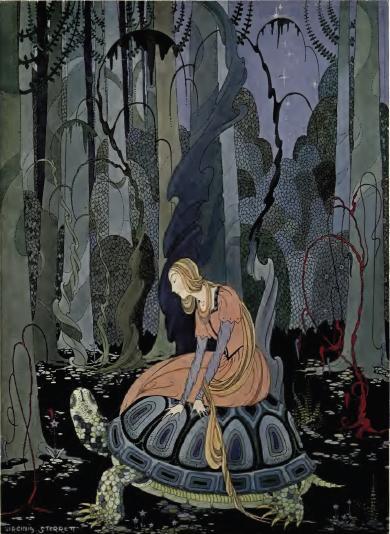
. دیوانهی تصویرگریش شدم. خیلی به مینیاتورهای ایرانی شبیهه. حتی در بعضی تصویرها با اینکه شخصیتها بلوند هستن چشمهای شرقی دارن. پنج قصه داره که قصهی آخر رو خیلی دوست داشتم. داستان شاهزادهای که نفرین شده و پوست خرس داره و فقط وقتی این نفرین ازش برداشته میشه که یه نفر جز مادرش عاشقانه دوستش داشته باشه و حاضر شه پوستش رو با پوست اون عوض کنه. نکتهی جالب این بود که در نهایت این شاهزاده با دخترعموش ازدواج میکنه. که تا جایی که خبر دارم در مسیحیت محرم حساب میشن و ازدواجشون خلاف شرعه. هرچند ممکنه تو فرانسه احکامشون متفاوت باشه. . این یکی از تصویرهای قصهی Blondine. Bonne-Biche, and Beau-Minon .