On the eve of the very first Christmas, an old grandmother is busy tidying her home when a bright star illuminates the sky. Soon three wise men arrive and invite Babushka to join them in their travels—following the star in search of a newborn babe, the Prince of Peace. But there are dishes to be washed, and floors to be swept, and Babushka is too absorbed in her work to leave her home with presents for the baby Jesus.
The next day, when Babushka tries to follow the men, she cannot find their tracks. Instead, she finds a little girl shivering in the cold, and a little boy, his tummy rumbling with hunger. Babushka walks and walks, and everywhere she goes she finds children in need of toys to play with or a shawl to keep them warm. And to each one, she offers a gift from her basket and a smile of light and love.
With beautiful illustrations evoking folk art traditions and sensitive storytelling, Babushka tenderly reminds us that nothing is more important during the holiday season than taking the time to show love for one another. This timeless Russian tale will warm your heart and fill you up with the joyful, generous spirit of Christmas.
Sky Pony Press, with our Good Books, Racehorse and Arcade imprints, is proud to publish a broad range of books for young readers—picture books for small children, chapter books, books for middle grade readers, and novels for young adults. Our list includes bestsellers for children who love to play Minecraft; stories told with LEGO bricks; books that teach lessons about tolerance, patience, and the environment, and much more. While not every title we publish becomes a New York Times bestseller or a national bestseller, we are committed to books on subjects that are sometimes overlooked and to authors whose work might not otherwise find a home.
Dawn Casey traveled in Africa and Asia before working in a garden studio, publishing multicultural children's books. She now dreams up her own stories, inspired by the everyday magic of the world. She lives with her husband, two little ones, and a tabby cat.
(Source: I received a digital copy of this book for free on a read-to-review basis. Thanks to Lion Hudson Plc and NetGalley.)
This was a nice children’s story about a woman named Babushka and her part in the Christmas story. The pictures were colourful, and the story did keep my 4-year-old interested.
When I was a kid, my parents bought us a bunch of lovely hardbound books of Russian stories that had been translated to English/Hindi, which the whole family immensely enjoyed reading. Babushka too is a retelling of a Russian folktale and it brought back memories of reading those lovely Russian gems as a kid! It's the story of an old lady Babushka, who lives with her cat and spends all her time tidying up her place. I want to stop there as the story is very short in itself, but coupled with some gorgeous illustrations, made for a lovely Christmassy read!
With this I'm signing off for the year. See you all next year! Happy New Year, everybody! :) Adios amigos! :D
This is a charming traditional Russian Christmas story. Dawn Casey’s retelling of the Babushka story is truly a wonderful piece of storytelling. The Babushka woman is similar to the American Santa Claus. She travels the world giving children a present. In many ways, the story is similar to that of Santa Claus.
Casey’s retelling is poetic without being strictly poetry. It is childlike, but there is wonderful humor there. In 15 pages, Babushka comes across as far more than an old woman obsessed with house work. There is kindness and wisdom there. The addition of a cat is brilliant.
The combination of Casey’s story telling with Hall’s artwork reminds one of the Rankin/Bass Christmas specials, but with a cute facto toned down just a little and the light factor turned up. The book gives off a feeling of warmth. Actually, it’s like Rankin/Bass crossed with a Russian lacquer box. Like the writing, there are wonderful details in the illustration – from the three wise men, to the sleigh, to the townsfolk.
This is a retelling of the classic Russian Christmas story of Babushka. Babushka is a very busy old woman, keeping her home neat and tidy. One winter night the three wise men stop in. They invite her to join them on their journey to meet the newborn king. Babushka is too busy to join them. A few days later, she sets off to find them. She meets others on her journey. It is said that she is still looking for him.
This is a beautiful story with beautiful illustrations!
Thank you to NetGalley and Lion Children’s Books for the opportunity to read and review this book.
I love the tale of Babushka but unfortunately, the illustrations aren't all that nice. This has got to be the worst depiction I've ever seen of Mary. You can't just change the way the Jewish people look. Moreover, if you want to know what the Jewish people looked like back then, read descriptions of them in the bible, look at Luke's painting, research oral depictions from the church (catholic)...
Naturally I had to read this book outloud in my Russian accent ;-)
I actually wasn't too excited with this book. Reading it in my Russian accent made it more fun because I automatically omit words as if I were a non-native English speaker (I have no idea how that happens... when I speak in my Russian accent it just comes naturally) so it was more entertaining, but the story was kind of boring and I felt the book ended rather abruptly. Did Babushka ever find the baby? It was like she just gave up on that and the book just ended.
I read this again, alone, and honestly it's really delightful? The first time I read it I thought it was going to be about how she missed the opportunity because she was too busy and end up shaming busyness except it wasn't. It was somehow a love letter to busyness and also rest, to missing an opportunity only to find more ways to help others. It's odd but I love it.
Reread 2025: Okay so a year later and honestly I'm so in love with this book. Such a perfect New Year's read honestly. I want to read it every January.
Busy cleaning her house one winter's night, Babushka doesn't see the star in the sky, or hear her neighbors cries of awe. But when three richly-dressed men stop at her home to rest, she feeds them her soup and listens to their tales of a newborn baby, the Prince of Peace and Lord of Light, whom they seek. Declining their invitation to accompany them on their quest, she soon comes to regret her decision, and gathering all manner of gifts, sets out in their footsteps. In the process, she encounters many children in need, dispensing gifts to them along her way...
This story, which is often erroneously presented as a traditional Russian folktale, has been presented in a number of other picture book versions, including Ruth Robbins and Nicolas Sidjakov's Caldecott Medal-winning Baboushka and the Three Kings, Charles Mikolaycak's Babushka: An Old Russian Folktale, Arthur Scholey and Helen Cann's Baboushka: A Christmas Folktale from Russia, and Elena Pasquali and Lucia Mongioj's The Tale of Baboushka: A Traditional Christmas Story. I say erroneously because apparently this story does not have its roots in Russian lore, and does not actually reflect a Russian tradition involving a holiday gift-giver. The story is very similar to traditional folktales from Italy (see Tomie dePaola's The Legend of Old Befana), as well as the Dominican Republic (see Julia Alvarez & Ruddy Núñez' El mejor regalo del mundo: La Leyenda De La Vieja Belen / The Best Gift of All: The Legend of La Vieja Belen), but I have it from reliable sources that there is no Russian variant of the story. Rather, this Russified version of the tale comes from American author Edith M. Thomas' 1907 poem Babushka (A Russian Legend), taken from her collection, Children Of Christmas. I am unsure as to Thomas' sources, but apparently there was also a play based upon her poem.
In any case, although not actually a Russian tale, I have retained this on my "Russian folklore" shelf, simply because it is so often described and cataloged that way, and because it is of interest, I think, to those interested in the subject. Leaving all that aside, I found this version by British author/illustrator team Dawn Casey and Amanda Hall quite lovely, and I enjoyed reading the story, and perusing the soft, pastel illustrations, done in watercolor and crayon. Although I cannot recommend it as a folktale, I do recommend it to those seeking Christmas fairy tales for younger children.
This is the second picture book I've read, recounting the same traditional tale of Babushka.
Basically, the writing is good and the illustrations catch the eye. But will you Goodreaders like this story?
Here's a sample of the very direct, no-frills, clever, writing style:
KNOCK! KNOCK! KNOCK! Even Babushka couldn't miss that. There in the doorway stood three men, richly dressed in silk and velvet.
Babushka was so busy cleaning, she never got to see the Christ child.
MY REACTION
Is this story supposed to establish that the grandmother was more a Martha than a Mary? And this makes her beautifully spiritual?
Mainly, both times I've read this book, I have not been impressed. Rather I have noted how often women's lives have been defined physically.
1. If young, their beauty matters. 2. If an adult, their fertility matters. 3. If elderly, like Babushka, they'd better earn their keep by housecleaning.
There must be more to life than this. There must be more to women's lives than this.
At least, that's what I believe. Now that humanity is no longer living in the Age of Faith but in the Age of Awakening -- which began Dec. 21, 2012 -- maybe women will be more likely to use their full potential in life. Men, too.
RATING THIS BOOK
My policy is to rate books in terms of the intended readers. This book is for those who like one or more of these:
* Christmas stories * Stories about the Christ Child * Stories from Russia * Tales from long ago * And tales of good women, in their place. For Babushka, her place means that she must clean, clean, clean.
SO FIVE STARS.
It takes all kinds to make a world of Goodreaders.
Babushka is busy keeping a clean house, but of course welcomes "three men, richly dressed in silk and velvet" into her home when they ask to rest a while. As the men eat her soup and warm themselves by her fire, they tell her they are traveling to see "a newborn king", "the prince of peace", and "the light of love". They ask her to come with them; "what," said Babushka, "without washing the dishes?" The men leave and Babushka heads to bed after cleaning up. She has a dream that night and decides she will go see baby Jesus. In the morning she packs toys and food before heading out on her journey, but she cannot find her way in the daylight! Since she is not busy with household chores or "bustling" and can be "simply still", she hears someone nearby gathering firewood. The girl gathering firewood is shivering and Babushka gives the girl her shawl. A while later she finds a boy packing away his fishing net and, when she learns he did not catch anything, she gives him the food she had packed. As she travels Babushka gifts toys to children who have none. The book ends with "Babushka is still journeying. And everywhere she does, she gives a gift. Her basket is full, and her heart is light. Her heart is shining with Light of Love, like a bright star in midwinter." I appreciate that a children's book was made out of this folktale.
This is a picture book retelling of the Russian folktale about an old woman's endless search for the Christ child.
Babushka lives in a tiny village, and her entire life is devoted to housework. Then one Christmas Eve, there is a knock at her door, and it is three richly dressed travelers seeking shelter. Babushka invites them in and gives them supper.
The mysterious gentlemen tell her that they are on a journey to find a newborn king. They invite her to join them, but she refuses, and they depart, vanishing into the snowy night.
Later than night Babushka dreams of the infant whom they sought. She experiences a profound regret upon waking and sets off, bearing gifts. Unable to find the three travelers or the Christ child, Babushka forever continues her search, giving gifts to children whom she encounters along the way.
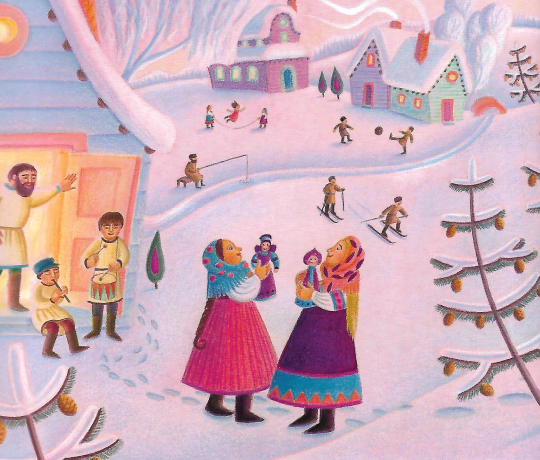
The illustrations are done in watercolor and crayon, using a pastel color palate. They are whimsical with traditional Slavic elements reworked in a modern style.
This picture book retells a Christmas Russian folktale. One Christmas Eve, the Three Wise Men pay a visit to an elderly woman. They tell her how they are following a star to find baby Jesus and invite her to join them. She declines but regrets her decision and sets off after them. Thus, she is transformed into an immortal figure on an endless search.
In Orthodox Christianity, time is circular, so the fact that the Nativity of Christ and the Adoration of the Magi occurred over a thousand years prior to the events of the story isn't as problematic as it would seem.
Later retellings blend the character of Babushka with St. Nicholas, or Santa Claus, and depict her bringing gifts to children. In earlier versions, Babushka either simply looked sorrowfully at every child she met because s/he was not the one she sought or gave a gift to each infant in case the baby was the Christ Child.
I recommend this story for the moral, but not necessarily authenticity. First, the Three Wise Men would likely not have passed through Russia on their way to Bethlehem. Second, there's a question of whether this is truly a Russian folktale or perhaps whether it's the Italian story La Buffana, translated into Russian, then translated back into English, perceived as a Russian folk tale.
In any case, the book eschews pursuing vanity and / or tireless tasks like housecleaning and celebrates connecting with your community. Specifically, Babushka serves children she meets along her journey, a very Christ-like thing to do. You might pick this book up for a unique angle and outsider's perspective on a classic Christmas tale.
1.) No awards 2.) Appropriate grade levels: Preschool-2nd grade. 3.) Original 3 line summary: While cleaning her home one night, an old woman is approached by three visitors. These three visitors are following a star in the sky while in search of a newborn child. The old woman is asked to go on this adventure in search of this newborn child. 4.) Overall, I enjoyed reading this folktale. However, the subject of religion would need to be taken into consideration if this is read aloud to a classroom of students. Otherwise, this would be a good story to read around the Christmas holiday. 5.) One in class use would be having students create their own fictional short stories.
Absolutely wonderful story! It's about Babushka opening her home to the 3 kings who are on their way to meet Jesus. It doesn't mention the word Jesus, but other names for the new baby. If you know the story of the 3 kings then you'll know they are talking about Jesus when he was born. I loved this story because there are not many Russian/Ukrainian holiday books out there and this being a Russian story makes a great addition to any holiday collection. The illustrations are awesome and I love that it shows the clothing Russians wore back in the day. I also got Ukrainian vibes since the clothing is also very similar.
We grabbed a bunch of Christmas books at the library to use in our nightly reading, and were pleasantly surprised by this treasure. I wasn't familiar with this folktale, but loved the message it conveys of the joy we feel when we give to others. The Christmas star and the wise men make an appearance, and change the woman's focus from her own surroundings to others. The style of illustrations give the characters a rounded look reminiscent of matryoshka dolls. To make this book even more delightful, my 4-year-old triplets think the word "babushka" is the funniest-sounding thing ever.
Delightful retelling of Russian story, tapping into the appearance of the Magi following a special star in search of the Christ Child, and the elderly woman traveling and giving gifts in Santa-like style to children along her path. Wonderful, warm illustrations. This book kept my young grandsons easily engaged and noticing the details, like the cat. A very nice addition to Christmas reading.
This is a retelling of the traditional Russian Christmas legend about Babushka--who is too late in deciding to join the Magi on their journey to Bethlehem. Beautifully illustrated with soft colors and patterns that are reminicent of matroushka dolls, this version is appropriate for younger readers. Tie-in with Christmas Around the World emphasis.
The Russian story of the woman who was too busy cleaning to go with the wise men to visit the Christ Child. When she does head out, she's lost their trail. But she finds people along the way who need her presents.
This was the second book we read about this folktale. This rendition is well done and even if you w already read a book about this legendary figure, this one is worth picking up. My 5 year old enjoyed it.
Definitely has a folk-lore feel to it. As usual with folk-lore, there are random details that probably had something to do with the story a long time ago but don't anymore after decades or even centuries of re-telling. Not terribly impressed, but it was okay.
I really loved the pictures in this book until I got to the manger scene. I love the Russian story of Babushka but the way that the holy family was depicted is incorrect.
An interesting story about a granny who means to follow the Three Wise Men to the Christ child, but loses her way and ends up becoming a Santa like figure.