Jump to ratings and reviews
Rate this book

Unto this Last: Four Essays on the First Principles of Political Economy

Rate this book
First and foremost an outcry against injustice and inhumanity, "Unto this Last" is also a closely argued assault on the science of political economy, which dominated the Victorian period. Ruskin was a profoundly conservative man who looked back to the Middle Ages as a Utopia, yet his ideas had a considerable influence on the British socialist movement. And in making his powerful moral and aesthetic case against the dangers of unhindered industrialization he was strangely prophetic. This volume shows the astounding range and depth of Ruskin's work, and in an illuminating introduction the editor reveals the consistency of Ruskin's philosophy and his adamant belief that questions of economics, art and science could not be separated from questions of morality. In Ruskin's words, 'There is no Wealth but Life.'

97 pages, Paperback

First published January 1, 1860

104 people are currently reading
1725 people want to read

About the author

John Ruskin

3,786 books490 followers
Librarian Note: There is more than one author by this name in the Goodreads database.

John Ruskin was an English writer, philosopher, art historian, art critic and polymath of the Victorian era. He wrote on subjects as varied as geology, architecture, myth, ornithology, literature, education, botany and political economy.
Ruskin was heavily engaged by the work of Eugène-Emmanuel Viollet-le-Duc which he taught to all his pupils including William Morris, notably Viollet-le-Duc's Dictionary, which he considered as "the only book of any value on architecture". Ruskin's writing styles and literary forms were equally varied. He wrote essays and treatises, poetry and lectures, travel guides and manuals, letters and even a fairy tale. He also made detailed sketches and paintings of rocks, plants, birds, landscapes, architectural structures and ornamentation. The elaborate style that characterised his earliest writing on art gave way in time to plainer language designed to communicate his ideas more effectively. In all of his writing, he emphasised the connections between nature, art and society.
Ruskin was hugely influential in the latter half of the 19th century and up to the First World War. After a period of relative decline, his reputation has steadily improved since the 1960s with the publication of numerous academic studies of his work. Today, his ideas and concerns are widely recognised as having anticipated interest in environmentalism, sustainability and craft.
Ruskin first came to widespread attention with the first volume of Modern Painters (1843), an extended essay in defence of the work of J.M.W. Turner in which he argued that the principal role of the artist is "truth to nature". From the 1850s, he championed the Pre-Raphaelites, who were influenced by his ideas. His work increasingly focused on social and political issues. Unto This Last (1860, 1862) marked the shift in emphasis. In 1869, Ruskin became the first Slade Professor of Fine Art at the University of Oxford, where he established the Ruskin School of Drawing. In 1871, he began his monthly "letters to the workmen and labourers of Great Britain", published under the title Fors Clavigera (1871–1884). In the course of this complex and deeply personal work, he developed the principles underlying his ideal society. As a result, he founded the Guild of St George, an organisation that endures today.

Ratings & Reviews

What do you think?
Rate this book

Friends & Following

Create a free account to discover what your friends think of this book!

Community Reviews

5 stars
75 (28%)
4 stars
94 (36%)
3 stars
70 (26%)
2 stars
14 (5%)
1 star
8 (3%)
Displaying 1 - 30 of 42 reviews
Profile Image for Rex.
281 reviews49 followers
July 9, 2019
“THERE IS NO WEALTH BUT LIFE.”

Why read Ruskin? He made beautiful art and was highly influential in his own time, but his name has acquired a patina of association with all that was ludicrous and idealistic in the Victorian temperament. Why, particularly, read these four short essays, which mark Ruskin’s first major intrusion in print on social issues and an attack on the doctrines of the classical economists?

One could cite Unto This Last’s influence on thinkers as diverse as Mohandas Gandhi, Wendell Berry, and John Milbank. Ruskin was a lapsed Christian during this period of his life, but his prose is saturated with Biblical allusions and religious urgency (the title of this volume comes from Matthew 20), and his work is often associated with the tradition of Christian Socialism. It is fair to point out that many of Ruskin’s ideas would not pass muster with the modern Left. Ruskin was a firm believer in free trade, property rights, and the virtues of social hierarchy. Moreover, although his prose won some enthusiasts in generations past and turns up many delightful maxims, it is at times rather a hindrance. He engages in some awkward wordplay, as when he defines wealth as “the possession of the valuable by the valiant,” which out of context would be highly misleading and may not be very helpful in any case. Some of his language may also throw off today’s reader, as when he uses the term “state” in the old sense of political community, not referring to a coercive central institution, or when he stumps for “manly character.” Nevertheless, for those of us drawn to seek socially and ecologically sensitive alternatives to neoliberalism, there is still much of value to discover in Ruskin’s moral clarity and vision.

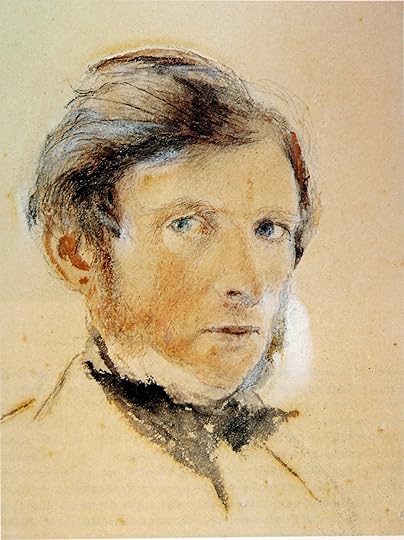
1861 self-portrait

The first essay, “The Roots of Honor,” opens with a critique of the pretensions of the political economists. In particular, Ruskin argues that their theories, whatever their internal logic, fail to properly account for “social affection” and real-world human behavior. “It does not absolutely or always follow,” Ruskin writes, “that the persons must be antagonistic because their interests are.” It is unselfishness and cooperation, not self-seeking and conflict, that naturally result in the greatest benefit for all, and healthy human households and societies always have the bond of affection at their core. Admittedly, capitalism poses a problem, because it is difficult to imagine such affection obtaining between the capitalist and his workers; however, Ruskin proposes, this may be ameliorated by a just organization of labor. In Ruskin’s view, all workmen should be paid alike a living wage at a fixed rate, with good work incentivized only by greater prospect of employment. But what about fluctuations in demand, which cause capitalists, seeking to maintain profits, to grow and shrink their workforces commensurately? We must learn to honor the workers who lay down their lives for our sustenance as we do soldiers who defend the state. Ruskin notes that his society demands selflessness in doctors and clergymen even as it expects selfishness in merchants and capitalists. This is senseless. Merchants and capitalists have as much of a duty to society as those other professions, to provide and suffer for it if necessary. They must be willing to abstain from false advertising, create quality products, respond to their workers’ needs, and take personal losses for the good of the whole. “As he would… treat his son, [the factory master] is bound to treat every one of his men.”

“The Veins of Wealth” goes on to criticize the political economists who claim theirs is a “science of getting rich.” Ruskin makes a distinction between political economy and mercantile economy. The former refers to “the production, preservation, and distribution, at fittest time and place, of useful or pleasurable things.” The latter “signifies the accumulation, in the hands of individuals, of legal or moral claim upon, or power over, the labour of others.” Capitalists who have amassed a fortune in trade or industry may be experts in the latter and yet know nothing of the former. Moreover, Ruskin points out, the accumulation of property by individuals implies no necessary benefit to society. “Riches” are meaningless apart from poverty, that is, without special access to a dependent labor base that can actualize the rich man’s ownership. Too wealthy a general population or too large an apex increases competition among employers and so reduces the ability of particular individuals to control others’ labor. “The art of becoming ‘rich,’ in the common sense, is… ‘the art of establishing the maximum inequality in our own favor.’” Ruskin believes that economic inequality can be beneficial, but it must be the right sort of inequality, gotten as just reward for service and applied to benefit of the nation. Certain kinds of inequality are consequences of a real and substantial loss for everybody, as he illustrates with a parable of castaways who divide up needed labor on a deserted island. “The whole question, therefore, respecting not only the advantage, but even the quantity, of national wealth, resolves itself finally into one of abstract justice.” Commercial competition always involves winners and losers; “buy low, sell high” is inherently exploitative. A wiser law is necessary if the nation is to truly prosper. Here Ruskin hints at his main thesis for the volume: “it may be discovered that the true veins of wealth are purple—and not in Rock, but in Flesh—perhaps even that the final outcome and consummation of all wealth is in the producing as many as possible full-breathed, bright-eyed, and happy-hearted human creatures.”

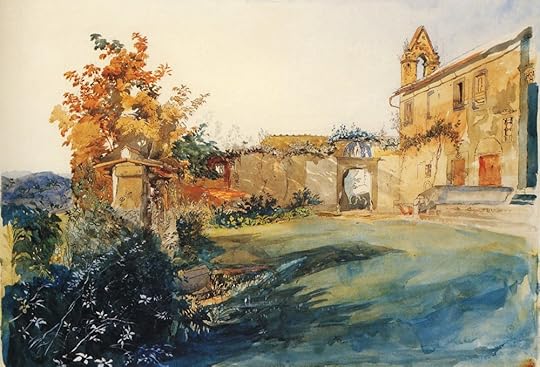
The Garden of San Miniato near Florence

“Qui Judicatis Terram” (a reference to the Wisdom of Solomon 1:1) posits that definite moral principles can be applied successfully in trade. The Biblical Solomon (to whom Ruskin refers tongue-in-cheek as a “Jew merchant… held also in repute for much practical sagacity”) offers us many aphorisms on wealth that cut against the habits of the capitalists. Economists suppose themselves wise for having learned that supply follows demand, as water runs downhill. But in fact, the flow of wealth can be directed by human forethought, just as the torrent can be channeled by humans for good or evil. Again, our “getting rich” may involve either negative or positive consequences for other human beings, and adherence to the divine law of justice is needed to ensure we tend toward the latter. This starts with “just payment,” that is, a wage equal to or greater than the value of our own labor given in exchange. A just wage system would create opportunities for economic mobility by breaking the concentration of wealth around a few big employers who can force workmen to compete to the bottom against one another. This is not, Ruskin asserts, about social equality, which he does not believe in, but about “secure possession of property”: “Whereas it has long been known and declared that the poor have no right to to the property of the rich, I wish it also to be known and declared that the rich have no right to the property of the poor.”

The final essay, “Ad Valorem,” is the longest of the four. Ruskin himself called it “probably the best I shall ever write.” Here Ruskin backtracks to define four terms: Value, Wealth, Price, and Produce. He starts with seeking definitions in Ricardo and Mill; of course he is dissatisfied with both, and sarcastic remarks ensue. Instead, Ruskin turns to etymology. He defines valuable (from valere) as “availing towards life.” If a thing’s true value is defined not by its worth in exchange but rather by its intrinsic properties, “the real science of political economy… is that which teaches nations to desire and labor for things that lead to life.” Wealth, according to J. S. Mill, is about “possession of useful articles”—yes, but what does it mean to possess or to be useful? Ruskin explains that real possession is a matter of degree, depending on the ability of the possessor to use it; use is the opposite of abuse, indicating service to the whole political community. Thus true wealth is measured by the capacities and integrity of the possessor as much as the possessed. A difficulty ensues, for “while the manly character and material value only form wealth by their conjunction, they have nevertheless a mutually destructive operation on each other.” Noble souls are often indifferent to material value, and material value tends to corrupt noble souls. The resulting distribution of riches will be socially disastrous if left to supply and demand. Defining price or exchange value gives Ruskin the opportunity to distinguish between profit and acquisition. Profit in the literal sense of material increase only arises from labor, by which goods are multiplied through construction or discovery. What merchants call “profit” is actually “a certain quantity of the produce of the other’s labor”— which the merchant can only acquire by taking advantage of “the ignorance, powerlessness, or heedlessness of the person dealt with.” A true economics, which promulgates just price, would seek to eliminate disadvantage in exchange. How do we pin down a price that will fulfill this demand? We must look to labor, which is in its essence a struggle for life—survival, for Ruskin, but also much more.

Genuine production, then, is the creation of life, and the prosperity of a nation is contingent on the extent to which its labor is dedicated to means of life. This requires capital that generates substances “good for life”—bulbs should produce flowers, not just more bulbs. “The Political Economy of Europe has hitherto devoted itself wholly to the multiplication… of bulbs. It never saw, nor conceived, such a thing as a tulip.” “All essential production is for the Mouth; and is finally measured by the mouth…. The final object of political economy, therefore, is to get good method of consumption, and great quantity of consumption: in other words, to use everything, and to use it nobly.” Political economists are “dazzled by coin-glitter as birds by the fowler’s glass,” for “their minds are continually set on money-gain, not on mouth-gain.” But money is just the shadow of wealth, not its substance. For Ruskin, it matters very much whether one is paid to grow a peach or forge a bombshell, for while the labor price may be the same, one creates and the other destroys. “The worst of it, for the peasant, is that the capitalist’s consumption of the peach is apt to be selfish, and that of the shell, distributive…. It is, therefore, the manner and issue of consumption which are the real tests of production…. For as consumption is the end and aim of production, so life is the end and aim of consumption.” The political economy Ruskin envisions would aim to create “the greatest number of noble and happy human beings,” which can only be achieved by allowing not merely sustenance but also virtue to penetrate to all classes of society. This must involve, as Ruskin concludes, education and the conservation of nature—“Men can neither drink steam, nor eat stone…. The world cannot become a factory, nor a mine.”—as well as an individual commitment to simplicity and the pursuit of peace rather than acquisition.

The presence of a wise population implies the search for felicity as well as for food.... No scene is continuously and untiringly loved, but one rich by joyful human labour; smooth in field; fair in garden; full in orchard; trim, sweet and frequent in homestead; ringing with voices of vivid existence. No air is sweet that is silent; it is only sweet when full of low currents of under sound — triplets of birds, and murmur and chirp of insects, and deep-toned words of men, and wayward trebles of childhood. As the art of life is learned, it will be found at last that all lovely things are also necessary; — the wild flower by the wayside, as well as the tended corn; and the wild birds and creatures of the forest, as well as the tended cattle; because man doth not live by bread only, but also by the desert manna; by every wondrous word and unknowable work of God.
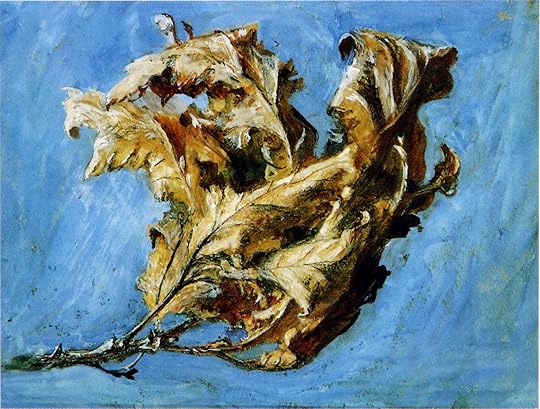

Fast sketch of withered oak
Profile Image for W. Littlejohn.
Author 35 books188 followers
October 14, 2009
Brilliant stuff all the way through, and chock-full of powerful, pithy quotables. Ruskin makes a powerful and eloquent argument for an economics based on Christian principles of justice, honour, and self-sacrifice, and in the process debunks many of the myths of capitalist theory. Ruskin does all this while rejecting socialism, and insisting on the importance of private property and free trade. So, conservatives ought to be willing to listen.

Of course, while many of his practical applications are intriguing and make great sense, others seem dubious and problematic. Also, while firmly founded on a self-consciously Biblical morality, his argument is rarely explicitly Biblical or theological, and thus his proposals depend too much on the general goodwill of mankind. Finally, some might object that Ruskin's model of a good society is somewhat paternalistic, but I think this charge is easily rebutted.

I took away the fifth star and then added it back, when I discovered that my enthusiasm for this text was shared by John Hughes and John Milbank, so apparently I wasn't just being too easily impressed.

You can see a fuller sketch of the argument of the book here: http://johannulusdesilentio.blogspot....
Profile Image for Matthew A LaPine.
Author 2 books83 followers
December 1, 2025
If you measure this by what Ruskin does not understand, this book is deeply flawed. If you measure this by what he does, it’s a treasure. It still speaks to the complacent economic orthodoxy of pure self-interest.
Profile Image for Emma Papworth.
16 reviews1 follower
Read
January 22, 2022
In this first essay of 'Unto This Last' Ruskin is preoccupied with the question of individual conscience. He believes that society can be transformed only when the individual is reformed, thus personal honesty will lead to social honesty. Ruskin’s theory of political economy is based on an ethical code of life; an amoral person is likely to act against the general interests of society.

'That country is the richest which nourishes the greatest number of noble and happy human beings; that man is richest who, having perfected the functions of his own life to the utmost, has also the widest helpful influence, both personal and by means of his possessions, over the lives of others.'
Profile Image for woodshadows.
46 reviews5 followers
July 15, 2012
Nice, short introduction to some of the formulating ideas that would later prove so influential in Gandhi's life and its subsequent impact upon world events.
Profile Image for Vineet Jain.
69 reviews3 followers
May 13, 2022
To see beyond infinitely hazy layer of unthought thoughts and to put the findings into even imperfect principles is a task only very few have capability to do in a decade. Mr. Ruskin in this book uncovers many aspects of political economy which must have been admired my many over the years. My favourite turns out to be: it’s not how much you produce, but how much you consume that defines the wealth of a nation. Extended to an organization, it perhaps mean that it’s about how much of your produce would be consumed by them is guiding light for your decisions. An important learning!
Thank you Mr Ruskin!
Profile Image for Krupa Gadhvi.
3 reviews15 followers
March 3, 2017
I can see why Gandhi held this book in such high regards now.However, Its practical relevance in current geopolitical and economic landscape is debatable.
Profile Image for Preetam Chatterjee.
7,236 reviews391 followers
May 20, 2024
This work consists of four essays: (1) The Roots of Honour, (2) The Veins of Wealth, (3) Qui Judicators Terram, (4) Ad Valorem. In these essays, Ruskin deals with the problem of wages, the relation of the employers and the labourers and the true nature of wealth, consisting not in material products but in “the producing of as many as possible full-breathed, bright-eye Wand happy hearted human creatures.”

The whole work is, in actual fact, an attack on the predominant system of political economy. The main aim of the author is to expose the materialism of the age and to draw the attention of industrialists and the leaders of the state to give more attention, to the spiritual side of man’s life than merely to his physical needs.

This book was considered at the time of its publication as the beautiful vaporing of an unreasonable idealist. To the materialists of the age, interested in money-earning, the work seemed positively impracticable. However, the latter socialists found a hard core of astuteness in the book and worked out its doctrines in actual practice.

Much of what Ruskin had set out to advocate, is now an accomplished fact in liberal democracies all around the world. The message of this book has been imbibed in the fullest measure possible. It is more and more recognised that machines tend to demoralise and dehumanise man and that means must be sought to make man the master and not the servant of the machines.

The great value of this work lies principally in the direction of labour-reform. Ruskin chalks out a full programme for improving the conditions of labourers and their relationships with the capitalists. The author stresses the need of establishing training-schools for labourers and pleads for the eradication of joblessness from the ranks of the workers by providing them opportunities for work.

For the old and workers, Ruskin advocates the establishment of comfortable homes where they may be able to receive proper attention. All this has to be done in justice and not in charity because “labour serves his country as truly as does soldier or statesman and a pension should be no more disgraceful in one ease than in the other.”

This work was first contributed to Cornhill Magazine in the form of articles, but so great was the hullabaloo at the novel economic views of the author, that Thackeray, the editor of the had to discontinue the publication of Ruskin’s papers. It was later on published by a an audacious publisher after its appearance in Fraser’s Magazine, edited by Froude.
16 reviews
December 28, 2023
If only I’d known of this delightful book during my undergrad, when I was first exposed to the soulless economics of Smith and Mill.

To give a flavour of Ruskin’s bite: “I should have regretted the need of pointing out inconsistency in any portion of Mr. Mill’s work, had not the value of his work proceeded from its inconsistencies. He deserves honour among economists by inadvertently disclaiming the principles which he states, and tacitly introducing the moral considerations with which he declares his science has no connection. Many of his chapters are, therefore, true and valuable; and the only conclusions of his which I have to dispute are those which follow from his premises.”

But more important than any takedown of Mill or Smith, are the positive teachings that Ruskin provides, teachings that cast a “magic spell” on Gandhi and inspired the likes of Tolstoy and Proust. Ruskin urges us to endeavour to pay others a living and equitable wage, to strive to calculate the just price. The fees we charge are not the object of our lives and this is equally true of the merchant as it is of the doctor or teacher. The object of the doctor is to heal, that of the teacher to educate, and that of the merchant to provide for the community. Yes a fee is necessarily charged and due, but that does not make profit one’s object.

Ruskin’s definition of terms in the final essay recalls familiar Socratic lessons regarding the essential connection between value, knowledge and virtue. The value of a thing depends (at least) equally on the capacity and disposition of the person who possesses it as it does on any inherent properties of the thing itself. Good things are only good if we know how to use them properly. Without knowledge and virtue, possessions do no good to the possessor.

According to Ruskin: “We need examples of people, who, leaving Heaven to decide whether they are to rise in the world, decide for themselves that they will be happy in it, and have resolved to seek - not greater wealth, but simpler pleasure; not higher fortune, but deeper felicity; making the first of possessions, self-possession; and honouring themselves in the harmless pride and calm pursuits of peace.”
Profile Image for James Violand.
1,268 reviews75 followers
October 16, 2018
Unto This Last (read 8/9/11) Other Essays (read 10/15/18)
Ruskin was a pompous, liberal Utopian and Christian socialist. He abhorred capitalism. Workers would never benefit from such an unnatural construct. Capitalism was not founded upon Ruskin’s analysis that all value was based upon the time labor put into any product. He painted a bucolic worker’s tranquility once his system was implemented instead of the emerging realm of capitalists who put no labor into anything (it was therefore an unnatural aberration to reward them). Government should ensure the correct balance to increase man’s comfort. This would require a government controlling the means of production so that the true selfless nature of humanity could blossom. If only everyone would utilize his theory of political economy, virtue would prevail.
Wow.
He had little grasp on reality and a pathetic knowledge of history. He asserted that ancient Greece and Rome denigrated wealth! The United States refuted his condemnation of capitalism. But, then again, in the essay on Law and Governments, he belittled America during the (then current) Civil Was as a failure and cited Carlyle’s prophecy of 1850 that it would break apart due to diverse selfish interests and a queer constitutional arrangement.
So why should anyone read him? Perhaps it will persuade the reader that theorists – including Marx – are not sustained by evidence.
Profile Image for shivangi bhasin.
16 reviews1 follower
Read
May 19, 2021
For me, the book has clear highlights and lowlights and that’s only because I’m personally more comfortable with inquiries into abstract ideas than data and statistics.

This collection is an attempt to poke holes into what was considered the rule book of political economics at the time, and I truly enjoyed Ruskin’s deconstruction and re-articulation of age-old ideas; in my mind, this is the closest thing to “originality” i.e. the update of tradition by giving it due credit while leaving one’s own imprint upon its wisdom.

Where I got lost was, like I have stated earlier, when Ruskin goes into specific concepts or makes allusions to other texts which I have not read. And I also felt that some points were repeated unnecessarily throughout the collection but I understand the necessity of doing so, especially if these essays were originally published separately.

Overall, I got a taste of the greatest ideas of history and a sense of why the world is what it is today. Ruskin doesn’t complicate the simple things in life and, likewise, doesn’t oversimplify the complexity of what it means to generate wealth in a nation. It is rare to find a genuine understanding of what it means to be truly human in a discussion about wealth and I feel fortunate to have found Ruskin’s work. I plan on re-reading this again both for its profundity as well as the fact that a single reading simply won’t do justice to the ideas contended with by Ruskin.
June 8, 2025
📘 Unto This Last
✍️ ผู้เขียน: จอห์น รัสกิน
📚 ผู้แปล: ประสิทธิ์ ตั้งมหาสถิตกุล
🏛 สำนักพิมพ์: สำนักพิมพ์สมมติ
ฝากเพจ: เรื่องเล่าจากหน้ากระดาษ


“เงินซื้อทุกอย่างไม่ได้ และอำนาจก็ไม่สามารถรักษาทุกสิ่งไว้ได้”
คือสารสำคัญที่ John Ruskin พยายามสะท้อนผ่านความเรียงทั้ง 4 บทของ Unto This Last งานเขียนชิ้นเล็กแต่ทรงพลังที่ตั้งคำถามถึง “คุณธรรมในระบบเศรษฐกิจ” อย่างลึกซึ้งและแหลมคม

ในศตวรรษที่ 19 ท่ามกลางกระแสทุนนิยมรุ่งโรจน์ Ruskin ยืนอยู่ตรงข้าม เขาวิพากษ์สังคมที่ให้ค่ากับผลกำไรมากกว่าคุณค่าความเป็นมนุษย์ เขาย้ำว่าความร่ำรวยที่แท้จริง ไม่ได้อยู่ที่การสะสมทรัพย์เพื่อส่วนตน แต่คือการสร้างระบบที่ทำให้ “ทุกคนสามารถอยู่ดี กินดี ไปพร้อมกัน”


🧠 4 หลักใหญ่ที่ Ruskin กล่าวถึง ได้แก่:

1. ศักดิ์ศรีของแรงงาน
ทุกอาชีพไม่ว่าจะเป็นลูกจ้างหรือเจ้านาย ควรได้รับการปฏิบัติด้วยเกียรติและความเป็นธรรม
2. ความรับผิดชอบของนายทุน
นักธุรกิจที่ดีไม่ใช่แค่สร้างกำไร แต่ต้องห่วงใยคุณภาพชีวิตของผู้ใต้บังคับบัญชา
3. บทบาทของชนชั้นต่างๆ ในชาติ
เหมือนกับ “ทหาร-พระ-หมอ-นักกฎหมาย-พ่อค้า” ที่ต่างมีภารกิจรับใช้สังคม
4. แนวคิดเรื่องความมั่งคั่งที่ยั่งยืน
ความรวยไม่ใช่เรื่องของโชคหรือเล่ห์กล แต่เกิดจากการผลิตที่มีคุณธรรม การจัดการอย่างยั่งยืน และไม่เอาเปรียบผู้อื่น


💬 รัสกินเขียนด้วยภาษาที่เสียดสีแต่ซื่อตรง เขาสังเก���และขุดลึกถึงแก่นปัญหาเศรษฐกิจ สังคม และศิลปวัฒนธรรม เขาเป็นทั้งนักวิจารณ์วรรณกรรม นักคิดด้านศิลปะ และผู้มีจิตวิญญาณเพื่อสังคม ผลงานชิ้นนี้จึงไม่ใช่แค่บทความเศรษฐศาสตร์ แต่คือบทสวดของความหวัง ที่เรียกร้องให้โลกกลับมาฟังเสียงของ ความยุติธรรม ความเท่าเทียม และความรักที่เงินซื้อไม่ได้


🔖 สำหรับผู้อ่านยุคใหม่ที่อยากเข้าใจรากเหง้าของความเหลื่อมล้ำทางเศรษฐกิจ หรือแม้แต่แนวคิดของ “ธุรกิจที่มีจริยธรรม” หนังสือเล่มนี้คือคำตอบในเชิงปรัชญาและศิลปะที่ทรงพลังมากที่สุดเล่มหนึ่ง


📌 “Unto This Last” คือบททวนความเป็นมนุษย์ท่ามกลางโลกทุนนิยมที่สับสนวุ่นวาย และอาจเป็นจุดเริ่มต้นให้เราตั้งคำถามกับระบบที่เราอาศัยอยู่ในทุกวันนี้

______

เล่มบาง…แต่ไม่เบาเลยสักนิด
อ่านจบพร้อมอาการ “ปวดหัว มึนตึ๊บ จดยิกๆ” เพราะเนื้อหาเข้มข้นระดับต้องใช้สมาธิสุดตัว เหมือนกำลังเดินผ่านป่าทึบทางปรัชญาเศรษฐกิจที่ไม่คุ้นเคยเลยสักนิด

เราไม่ใช่คนที่อ่านหนังสือเศรษฐศาสตร์หรือการเมืองบ่อยๆ ด้วยซ้ำ นี่จึงเป็นเล่มแรกที่ทำให้รู้สึกว่า “โอ้โห…โลกนี้มีคนที่คิดลึก คิดไกลแบบนี้ด้วย”

ถึงจะอ่านยาก เพราะภาษาเก่าหน่อย และเนื้อหาอยู่ไกลจากความคุ้นเคยพอสมควร แต่เมื่อพยายามเปิดใจ ก็จะเห็นว่ารัสกินพยายามตั้งคำถามสำคัญว่า

“จะเกิดอะไรขึ้น…ถ้าเศรษฐศาสตร์ไม่ใช่แค่เรื่องของตัวเลข แต่เกี่ยวกับ ความถูกต้อง และ ความเท่าเทียม?”
Profile Image for Andrew Figueiredo.
350 reviews14 followers
April 2, 2023
A very good book that has only gotten more relevant in the (many) years since it was put together. While sometimes his essays get a bit disorganized, together Ruskin's pieces coalesce into a consistent set of economic principles derived from a deep faith and an abiding sense of justice. Ruskin questions the economic doctrines propounded by major thinkers like JS Mill, David Ricardo, and Adam Smith. Ruskin defines wealth as something life-giving and eschews the profit-only mentality common in neoliberal accounts of economics. Throughout, he speaks on behalf of political economics as a discipline originating from religion and sociology, laying bare the fact that every form of economic thought has its own morality. Even if the solutions Ruskin proposes in some of his essays are near-impossible or especially unwieldy today, his criticisms of mainstream economics are worth revisiting in a time of immense political ferment across the West.
Profile Image for Jonathan Honnor.
49 reviews2 followers
Read
October 29, 2025
Ruskin's passionate belief in the cultivation of taste and especially the nobility and value of the human soul, and that such a value both should not and cannot be simply removed when considering the questions of economics, is inspiring and still remains very important today. The fact that the more concrete and context-reliant Ruskin over the more abstract Mill reminds us has triumphed in the 20th century in influence on issues of political economy such as minimum wage (to the point that these essays can at times feel too obvious because minimum wage is now so much taken for granted) both gives us hope that what Ruskin believed so passionately should survive (which is ultimately nothing less than Life itself) will continue to be valued by the valorant, and hopefully should reawaken us from delirious, anti-humanistic, neoliberal, technocapital, thanatotic nightmares...
Profile Image for Kiwi Comiendo Kiwi.
40 reviews
May 21, 2025
"El arte de hacerse "rico", en el sentido común, no consiste absoluta ni finalmente en acumular mucho dinero para uno mismo, sino también en idear cómo lograr que nuestros prójimos tengan menos. En términos precisos, es "el arte de establecer la máxima desigualdad a nuestro favor"

John Ruskin evidencia cómo un conservador inglés, sin ninguna afinidad por aquello que llaman socialismo, es capaz de demostrar, con un acento petulante, una escritura ampulosa y palpitaciones cristianas, cómo el capitalismo industrial es un sistema injusto de control y dominio sobre las personas. Las monedas del bolsillo de los ricos sólo tienen valor por el vacío del bolsillo de los pobres.

Este libro atenta contra aquella política económica que se presenta a sí misma como un sistema inalterable de conceptos naturales, que rigen sobre la vida humana con tanta indiferencia como la ley de la gravedad o el principio de Arquímedes. La economía, nos dice Ruskin, no está eximida de obedecer a los principios de la justicia y al sermón del monte. Aseverando las falencias morales de la política económica, el autor expone que la verdadera y única riqueza es la felicidad humana, y que la incesante reproducción del capital (tan absurda como la utilización de hachas para construir más hachas) recorriendo un tedioso camino sin nunca llegar a saciar la necesidad humana no es más que indulgencias en la jerga de algunos chupatintas insensatos.

No es muy largo y provee una interesante (si bien anticuada) crítica al capitalismo desde el punto de vista de un gentleman victoriano. El lenguaje es claro y excesivamente bello a la vez que penetrante y crítico.
Profile Image for Steve.
1,451 reviews103 followers
June 16, 2017
This is perhaps Ruskin's most famous short book on society and economy. He proposes a different kind of "third way" economics based, not on the pursuit of wealth and individual gain in themselves, but upon our vocation/work as service in community where the goal is to provide mutual services in return for income in order to be able to subsist.

Ruskin was trying to avoid socialism, of which he is highly critical, and at the same time the profiting seeking of big businesses.

Of course many large Victorian businesses did in fact provide for their workers beyond the minimum or the essentials. For this see the marvellous story of the Guinness family.
235 reviews19 followers
May 6, 2018
A short but tremendously important meditation on a Christian approach to economics. In his preaching, Jesus gave us the fearful picture of the dead rising up to judge the living: in this book, we can hear the voice of all Christian and classical wisdom rising up to pronounce judgment on Ruskin's society and ours. Sometimes Ruskin's holy ventriloquism conjures up the spirit of Socrates or Seneca, and sometimes of Isaiah or Ambrose: but the call to us is the same, a call back to humanity and sanity and away from the world of "sophisters, economists, and calculators" whose birth Burke beheld and shuddered.
44 reviews
April 28, 2023
John Ruskin makes many good points in his essays, yet gets so lost in attempting to define the issues that his summaries and conclusions feel lackluster.

There were many highlights in each essay I marked to refer back to and on their own these hold much weight, but on a whole most of what he writes is difficult to get through.

I can see why what he was writing would have been considered controversial back in the day, but it still fails to challenge many of the biases it holds in regards to religion and the military.

Overall a very interesting read, but not one that personally clicked for me!
107 reviews4 followers
June 3, 2017
"There is no wealth but life." A cri de coeur for a more humane political economics. Ruskin writes with verve, alternating between critiques of economists of his day and calls for a consideration of human affection and virtue in our economic practice. It's some the best bible-laced social criticism that I've read. (Though that's probably not saying much)
Profile Image for Abbas Khan.
74 reviews4 followers
September 6, 2025
When I was reading Gandhi's book, "In search of truth" I came across Gandhi saying that he had read this book. That's when I jumped into reading this book. I found this book very hard to comprehend because of its writing style. Meanwhile, during reading I consult chatgpt to assisting me unsestand some phrases.
Profile Image for Megan Krone.
40 reviews
February 7, 2023
Honestly, I don't know how much of this I understood. I read it for class, and we haven't discussed it yet. It definitely had some critiques of capitalism and models of compensation for labor, but it's also clearly written from a privileged viewpoint.
Profile Image for Iqra Tasmiae.
439 reviews44 followers
February 3, 2019
Would like to re-read the book.
This entire review has been hidden because of spoilers.
Profile Image for Ken Ross.
Author 35 books27 followers
April 24, 2019
Great read, especially for the young and rebellious who are interested in political and social history.
Profile Image for Andy.
1,318 reviews48 followers
November 25, 2019
interesting series of essays on political economics and the need for them to be supported by ethical concerns. less survival of the fittest, more emphasis on mutually beneficial systems
Profile Image for Nicholas.
83 reviews8 followers
November 25, 2019
This book, which is a spirited defence of humanity in the face of value-maximising political economics, raises many questions which remain unanswered today.
12 reviews
February 19, 2021
Tried reading the essays but read a summary instead. Although a very tough read, the ideas are eye-opening.
Profile Image for Jm.
30 reviews
March 18, 2025
I’m sure this is nice if ur a socialist and/or believe in god ❤️ I will not expand on where I stand on either of those things!❤️
Displaying 1 - 30 of 42 reviews

Can't find what you're looking for?

Get help and learn more about the design.