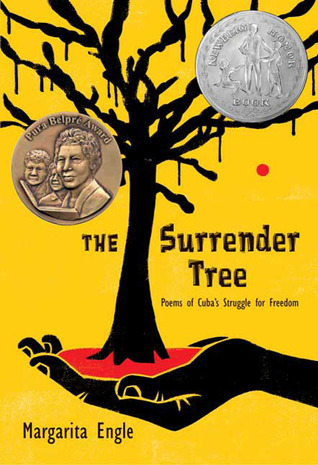
An evocative, emotional, but also often bravely optimistic verse-novel introduction to Cuban history and especially Cuba's rather violent and devastating struggle for independence, for freedom and sovereignty from Spain, Margarita Engle's The Surrender Tree (which won a Newbery Honour designation in 2009) not only features a lyrically beautiful text, the fact that the author's, that Engle's verses show the musings, the thoughts and actions of different players in the struggle for independence juxtaposed gives (or rather strives to give) a more balanced, less potentially prejudiced and partisan account/viewpoint. And while most readers' hearts will and also naturally should beat for and be with individuals like Rosa, José and Silvia, the escaping slaves, the peasants who are being displaced, also reading and textually encountering in The Surrender Tree the thoughts of some of the main antagonists, of the aptly named Lieutenant Death and Spanish officials, this certainly does give a more uniform and equal presentation, with much important historical background information (as one needs to be aware of and appreciate both sides of a given conflict, of a given historical period in order to understand and comprehend and Margarita Engle definitely understands and also provides this with and in The Surrender Tree).
Now the added bonus of an Author's Note personalises the featured, often tragic but always interesting and essential information presented with and by Engle's verses (as her maternal great-grandparents were amongst the Cuban peasants ordered to leave their villages and lands and be forcefully relocated to some of the so-called reconcentration camps described and presented in The Surrender Tree). And combined with an extensive historical note, a timeline, and appreciatively, also a solid list of references for further reading and research, I do warmly and highly recommend The Surrender Tree to and for anyone who is interested in the history of Cuba and enjoys novels-in-verse (although with the caveat that while The Surrender Tree is considered and marketed as being children's literature, I would not necessarily consider it suitable and even all that easily understandable for readers below the age of at least ten or eleven, and that there is no upper limit either, since in my humble opinion, The Surrender Tree is basically also a book that I would unhesitatingly suggest to and for interested adults, for ages ten to onwards so to speak).
However, while The Surrender Tree as an entity, as a presented story penned by Margarita Engle is definitely worth a glowing and full five star rating from me, the truth and fact that I did originally purchase The Surrender Tree not only to learn about the struggle for Cuban independence (and because I generally much enjoy Engle's verse novels) but also (and even primarily) to be able to practice my rather rusty Spanish (as both the Spanish and the English versions are featured in their entirety in my, in this here edition of The Surrender Tree), that the poems of The Surrender Tree are NOT featured in a dual-language, in a parallel text format is really and truly a bit of a majorly huge disappointment for me (as I keep having to flip back and forth if or rather when I try to read the English in conjunction with and to the Spanish text, and it would indeed be oh so much more user-friendly and less frustrating to have the English and the Spanish versions appear side by side and not one after the other). And while this annoyance does of course in NO WAY make me not appreciate and not massively adore and even love The Surrender Tree as a verse novel, as a wonderful introduction to Cuba and Cuban history, the way the Spanish and English sections have been set up, have been featured is definitely frustrating enough for me to personally now only consider a high three star final rating (five stars for the contents of The Surrender Tree, for Engle's poems, for the supplemental details, but only a grudging two star rating for how the Spanish and English components have been featured, for the fact that The Surrender Tree is not what I had wanted and expected and is thus not really a true dual-language format by any stretch of either my imagination or my textual and language learning needs).