Holy hand grenades! Edo is flooded, and by flooded, we mean crazy-flooded. Bridges are crumbling, rivers are washing past retaining walls, and everything in Edo is floating away, including our vengeful ronin, his foe, and his little boy. In an ironic show of samurai respect, little Cub Daigoro gets saved by the conniving Retsudo Yagyu. And proving he can lend a hand, too, Lone Wolf Ogami pulls someone to safety as well — but maybe he should have let him drown. Eventually, the two opposing master swordsmen dry off and go head to head in a sword fight of a thousand stances and couple of days length. This seems like it could be the deciding bout between the two, unless that nasty, Abeno Kaii gets in the way, and he seems to do that a lot lately.The true meaning of Bushido, the warrior code, oozes from every page of this volume. A little boy desperately attempts to drag his ronin father to safely, even if it costs him his own life; that same wandering samurai and his mortal enemy work together to save the frostbitten fingers of the same little boy, knowing they will eventually match swords again in a battle to the death; another samurai bites his own tongue, killing himself and locking a dark secret in his grave. The code of the samurai is complex and rich with irony, which is why so few carry this code through life. But as we draw closer to the conclusion of this epic struggle, the true bushi are stepping forth and showing their colors. It will truly be a fight to the finish. So, in these final days, a ronin and his young boy will visit the grave of their murdered wife and mother. It just might be the last Spring the two will share, like the many petals falling from branches.
This volume contains the following stories: Child of the Fields In These Samll Hands Kaii Triumph The Last Cherry Blossoms Stone Upon Stone
Kazuo Koike (小池一夫, Koike Kazuo) was a prolific Japanese manga writer, novelist and entrepreneur.
Early in Koike's career, he studied under Golgo 13 creator Takao Saito and served as a writer on the series.
Koike, along with artist Goseki Kojima, made the manga Kozure Okami (Lone Wolf and Cub), and Koike also contributed to the scripts for the 1970s film adaptations of the series, which starred famous Japanese actor Tomisaburo Wakayama. Koike and Kojima became known as the "Golden Duo" because of the success of Lone Wolf and Cub.
Another series written by Koike, Crying Freeman, which was illustrated by Ryoichi Ikegami, was adapted into a 1995 live-action film by French director Christophe Gans.
Kazuo Koike started the Gekika Sonjuku, a college course meant to teach people how to be mangaka.
In addition to his more violent, action-oriented manga, Koike, an avid golfer, has also written golf manga.
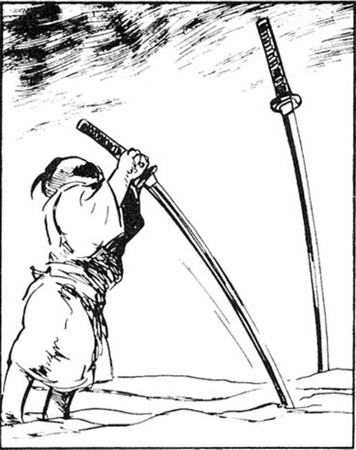
Two swords buried into the ground: a samurai blood oath to return to the field of battle and fight your adversary to the death. Ogami Itto and Retsudo Yagyu have already crossed swords in direct duel, three times I believe, and every time something happened to interrupt their unique obsession in killing each other. The previous album was all about their supposed final duel, ending in a draw when the poison administered to the blades made its way into the blood of the duellists and left not two, not three, but four collapsed bodies in the freshly fallen snow. Are they all dead? Itto, the Yagyu, the child Daigoro and the poisoner Abe Tanoshi? This album will explain to us why we need a few more books before we reach the conclusion of this epic series.
Child of the Fields
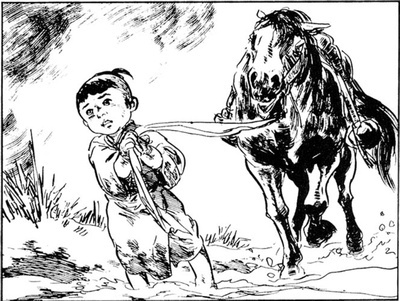
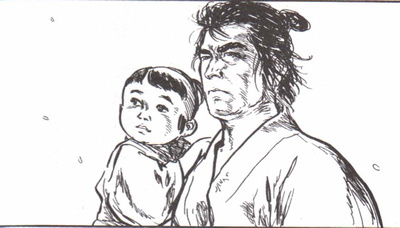
The first to wake up from the collapse is little Daigoro, who desperately tries to wake up his father, with little success and with a lot of pain in his frost-bitten hands and feet. But Daigoro is a true samurai, despite his pint size and his young age, so he can go on when most grown-ups would give up in despair. He somehow captures a horse, ties up his father to the bridle and drags him out of the freezing swamp. All of this with numb, paralyzed hands and feet! From this feat of determination that rivals many of his father’s sword flourishes, the story follows the wake-up of the rest of the frozen ‘corpses’ and they depart together for R & R at the Yagyu residence, at the express invitation of Retsudo. Left behind are the two swords buried point down into the ground, promising a third, or fourth, round in the death match.
In These Small Hands
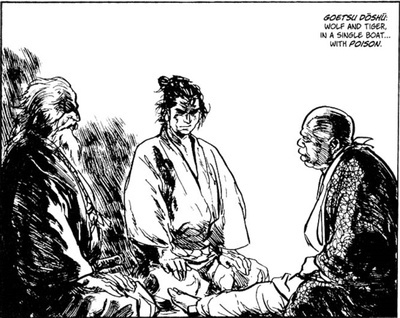
The Yagyu mansion is empty save for the four combatants. Retsudo considers that his samurai honour demands that he gives shelter to his enemies until the small boy can be cured of his severe frostbite and fever. And the only one who can do this is apparently Kaii, the poisoner, whose powders have the power to heal, not only to kill. The threat of exposure of his duplicity, as well as his instinct for self-preservation, makes the Tanoshi fellow comply, reluctantly and still boiling over with nefarious plans to destroy the two samurai who despise him and his lack of integrity.
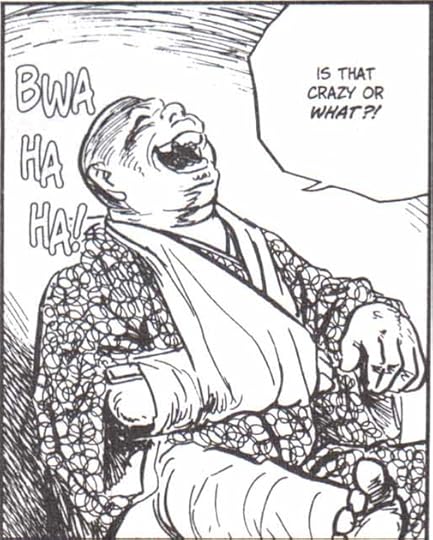
The story underlines for me the major change in the series that happened three or four albums back: The absolute Evil Overlord Retsudo has been white washed and made over into an honourable adversary, strict follower of the bushido code and thus a worthy adversary for the flawless hero, the Tiger against the Wolf. All his wickedness and treachery have been transferred to this Abe Tanoshi, who has taken over the role of Evil in the economy of the story. I disliked this parody of a character from the first appearance, feeling that he brings down the overall quality and my personal enjoyment of the series, but it looks like I am stuck with him: he has been dismissed as dead at least five times so far, and in each instance the creators brought him back, more ludicrous and more annoying than his previous incarnation. Oh, well! we continue with ...
Kaii Triumphant
Misfortune favours the bold and the devious. Tanoshi discovers the infamous Yagyu letter as he treats the small boy for frostbite. He immediately follows the implications and the reasons Ito has not used it to destroy his adversary in this manner: it is not the way of the samurai. A samurai exacts revenge with his sword and not with secret deals in castle rooms. But the Kaii is not a samurai: he goes with the letter straight to the highest authority in the land, the only person who can protect him from the wrath of the Yagyu. If there is any betrayal here, it better be done by him.
The Last Cherry Blossoms The weather plays funny games in these late albums. A couple of days after the frost wave, spring is here. While Kaii gallops with his letter to the Edo Castle, Retsudo and Itto set up a return to battle in two days time and then part ways. Between them, the blossom of the cherry trees falls like gentle snowflakes, reminding them of the fleeting mirage of life. This is the time for a samurai to say goodbye to the world and prepare to die for his beliefs.
The Lone Wolf and his son try to visit the shrine of their beloved wife and mother, killed in the first album by the treachery of the Yagyu, but the new owners of the Itto mansion have razed it to the ground. The pilgrimage ends up by a flowing river, where the cherry petals continue to fall, probably for just one more day.
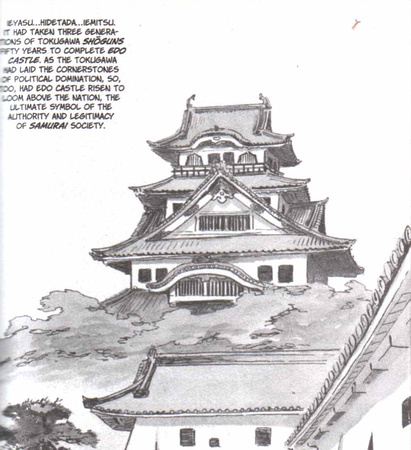
Stone Upon Stone Retsudo receives an urgent summons to Edo Castle – the massive pile of stone that cements the absolute rule of the Shogun over the land. He is confronted with the secret letter and brought face to face with Kaii in the Shogun’s private rooms.
Accused of treason, the last of the Yagyu tries to bluster his way out of his predicament and claim everything he did was for the glory of his master. The master is not convinced, and calls for the matter to be judged in the highest court of law by his retainers. Both Retsudo and Kaii make their pleas, but the resolution is left to the next album. If the Yagyu is condemned to death for treason and if the Lone Wolf is arrested for openly walking the streets of Edo, those two swords may remain forever buried into the ground.
Although a lull in the actions brings the crux of the story to a halt, political intrigues drive the rest of the story in a satisfactory motion all the way to the Shogun! Deep inside the exquisite confines of Edo Castle, treachery is exposed and verbal backstabbings unfurl across almost every panel.
Most notably featuring Toshiro the Poisoner who is ever evolving unto a Gollum-esque creature, the complexity of internal rabbit holes ensures at least 4 more heart-pumping volumes.
‘Child of the Fields’: Daigoro, Itto, and Retsudo lie unconscious as the snow falls around them on the dueling grounds. Daigoro awakens and even though he is suffering from frostbite he shows his mettle and resourcefulness as he does all he can to get his father away from the cold that will soon kill him. Eventually both Itto and Retsudo also awaken as the boy collapses, and both enemies decide to once again temporarily put aside their differences as they race to bring the boy to safety in the hopes that he can be healed. Abe is also found by the Tiger and the Wolf and they enlist his aid in the hopes that a poisoner can also heal.
‘In these Small Hands’: I’m not sure if Abe’s method for curing frostbite has any basis in reality…it seems pretty unlikely to me, but the poisoner uses his skills to cure Daigoro in the hopes that Itto and Retsudo will let him live. As he is caring for the boy Abe stumbles upon the secret of the Yagyu letter. Retsudo’s disdain of Abe is such that, after taunting him for not being bushi, he lets the poisoner go once again under threat of death should he interfere again in the affairs of his betters, not knowing that he is setting in motion the possible downfall of all of his hopes.
‘Kaii Triumphant’: Abe goes to the Shogun himself and reveals the secret of the Yagyu letters hoping to bring down the spy master and attain his position and power. When confronted with the evidence the Shogun’s head of the secretariat kills himself and the shogun calls for Retsudo to appear before him.
‘The Last Cherry Blossoms’: Itto and Retsudo part, on almost amicable terms, and promise to meet each other again in two days’ time to resume their duel. Meanwhile Itto is recognized in the city and followed by the police, while Retsudo receives a mysterious night visitor with news that could spell the end of the Yagyu.
‘Stone Upon Stone’: Retsudo appears before the shogun who confronts him with the evidence of his treachery. Retsudo denies any knowledge of the mysterious letters even when Abe appears and denounces him. Forcing the hand of the shogun, Retsudo is ordered to appear before the high court where he continues to deny knowledge of the letters while at the same time inferring that the divulgence of any secret, whose ultimate goal is supposedly to safeguard the Tokugawa regime, would result only in the downfall of the government. Yet again Retsudo forces a stalemate in the decision of his fate, but Abe contends that he can provide proof that will result in the death of the final Yagyu.
In some ways this volume advanced the plot significantly, while at the same time much of the action seemed to be on hold. Retsudo is definitely an intriguing character: at times diabolical and willing to use any means necessary to achieve his ends, he can also appear a man of honour willing to look beyond himself. I haven’t quite decided if this is a reflection of his having a multi-faceted character, or just the authors bending the character to fit the story they want to tell. Abe is also interesting, though in a perhaps more one-sided way. I don’t think the fact that he is meant to be seen as irredeemably evil and selfish is ever in question, but there are times when he seems almost pitiable as we see that, in his eyes at least, all of his actions were done in the name of succeeding in a society that would otherwise have cast him out for not being a ‘true’ member of the upper classes.
The volume opens with a superb chapter containing almost no text, showcasing Daigoro, whose resilience in extreme conditions is breathtaking. The fight between Itto and Retsudo is on hold – a pause that only those who follow the Bushi’s path can afford – and shows us Retsudo in a different light.
There is no action in this volume, but the tension builds sharply due to the machinations of the treacherous Abe, who complicates the situation as the end of the series draws ever closer.
A quiet volume, but not one which is void of soul and meaning. Instead, Kazuo Koike writes a bushido-ful chapter and this is the one which doesn't involve any swordfight. Bushido, or the way of the samurai is present in the samurai's heart everytime, not only in fights, not only when making decisions or doing gestures, but in everything, and that includes the most menial jobs.
The Yagyu letter plot has also advanced here. Thanks to Abe's strategy and uncanny luck, it gas reached the shogun himself. He strike during a truce between the wolf and the tiger, whilst they (including Daigoro) are still recovering from the epic duel which has just ended last volume.
Volume 24, yes it may indeed a bloodless volume, adds interesting polistical elements in the story. In light of the discovery of the letters, what would be the ultimate fate of the Yagyu clan?
Diğerlerine nazaran nispeten daha sessiz bir bölümdü. Retsudo ve Itto ha düzello yaptı ha yapacak derken kitaplar birbirini kovalıyor. Centilmenliklerine ve birbirlerine olan saygılarına söyleyecek gerçekten hiçbir şey yok. Yine çok başarılı portreler, yine çok başarılı tarihi arkaplan. Edo'da sarayın inşası için getirilen taşlardan bu taşların nasıl döşendiğine, Yagyu mektuplarının sırrından dişleri parmakla fırçalama detayına kadar.
In the previous volume, everybody died at the end. So this volume begins with them all somehow getting back up. Then, before Ogami and Yagyu can renew their fight, the Poisoner finds the secret to the Yagyu letter and tells the emporer, taking the story in a different direction.
El segundo combate entre Ito y Retsudo se ha postergado. Los cuerpos de Ito, Daigoro y Retsudo han sucumbido al veneno y al frío. Nuevamente hay una tregua. ¿Cómo poder describir a Tanome Abe...? ¿Un hombre testarudo, un necio o un perseverante, o por el contrario, un imbécil que no entiende de honor? Los hilos de poder que ha creado Retsudo por tanto tiempo al interior del shogunato lo mantienen con vida, así su clan esté diezmado. Parece que el destino quisiera que Ito Ogami y Retsudo Yagyu no se enfrentaran más. Retsudo es llamado al castillo de Edo por el shogun.
Aprovecho que mi tablet kindle se dignó en encender para actualizar todo esto por aquí. Y ¿que puedo decir de esta entrega de la obra? Pues en realidad que es una de esas entrega que uno puede llegar a pensar que la acción iba a primar aquí, pero no fue así. La trama de palacio, al final, fue lo que predominó la recta final del tomo.
Another superb volume in the series that finds Ogami Itto's and Yaygu Restudo's truce threatened by outside forces. Kazuo Koike finds more layers in their conflict, as the two have settled to finally end their feud in honor, only for outside actors to try and stop them. He provides nice reflection for each as well, as Yaygu starts to realize how much his feud with Itto has cost him. It is matched by Goseki Kojima's superb art, which is nicely realistic and gritty. Remains one of the finest manga series ever.
Another good volume showcasing the depth of bushi lifestyles alongside the belief systems of samurai, coupled with some interesting history about the construction of Edo castle.
It’s clear now how the series has slowed down a bit, and the final battle gets delayed. However, it’s not necessarily a bad delay. The political intrigue is interesting, and the writing and flow is well done.
Interesting volume of LWaC that finds our heroes(?) recuperating with Yagyu, the very man who wants them both dead. Looks like things are being set up really nicely for an epic (albeit drawn-out) final battle.
"Child of the Fields" Der kleine Daigoro zeigt wieder einmal, dass er aus dem gleichen Holz wie sein Vater geschnitzt ist. Trotz Erfrierungen versucht er, Itto zu retten - und denkt dabei trotzdem noch an das ausstehende Duell und das Versprechen, das sich die zwei Duellanten gegeben haben.
"In These Small Hands" Lernen Retsudo und Itto nichts aus ihren Fehlern? Wieder lassen sie Kaii ziehen, aus Dankbarkeit, weil er Daigoro heilen konnte. Und trotzdem ist sein erster Gedanke wieder, wie er ihnen in den Rücken fallen kann, denn er hat den geheimen Yagyu-Brief gefunden...
"Kaii Triumphant" Der Shogun empfängt Kaii, der sich sofort daran macht, ihm Worte wie Gift ins Ohr zu träufeln. Und er scheint Erfolg zu haben mit seiner Strategie, sowohl Itto als auch Retsudo aus dem Weg zu räumen.
"The Last Cherry Blossoms" Der Todgeweihte Itto möchte noch einmal in seinem alten Heim am Schrein beten - und auch Retsudo bekommt Besuch aus der Vergangenheit. Eine grafisch wirklich toll gemachte Szene zeigt, wie sehr die Aura Ittos auf die normalen Bürger und auch Polizeibeamte wirkt - der Zeichner muss Itto nicht mehr selbst zeigen, sondern nur noch die Reaktionen der Bürger.
"Stone Upon Stone" Retsudo wird in das Schloss von Edo zitiert, um dem Shogun selbst Rechenschaft abzulegen, und vor dem Hohen Rat soll er seinen Verrat eingestehen. Doch so leicht lässt sich ein alter Wolf nicht ins Bockshorn jagen, und seine Abwehr der Vorwürfe führt dazu, dass das Duell zwischen Itto und Retsudo vielleicht an prominenter Stelle stattfinden werden muss.
Die wellenförmige Erzählweise führt hier wieder zu einem ruhigeren Band, der sich wieder stark auf die Charakterzeichnung, insbesondere Retsudos, konzentriert. Das Ende ist nun mehr als je offen - wie sollen sich Itto und Retsudo duellieren können, wenn sie am Hof in Edo unter Beobachtung stehen? Ich kann das Ende kaum abwarten.
Después de un enfrentamiento que no ha terminado, el Shogún recibe la prueba de que el Clan Yagyu es el poder tras el poder. Retsudo ha sido descubierto y el Shogunato se prepara para enfrentarse a los espías del clan. Después de un titulo compuesto solo de imagenes, vuelve a encenderse la intriga.
117. Hijo del campo 118. Esas pequeñas manos 119. El triunfo de Abe 120. Las últimas flores 121. En la construcción de piedra
So the happening on #23 turns out as something even more incredible than we think. This volume is all about to be a Samurai, their codes and beliefs. Truly remarkable. Probably should be read more times, to catch the full meaning of this volume.
This is such a masterful story. Abe Tanoshi, the poisoner, struggles with the differences in class. His internal dialogue reveals so much about culture in Japan at this time.