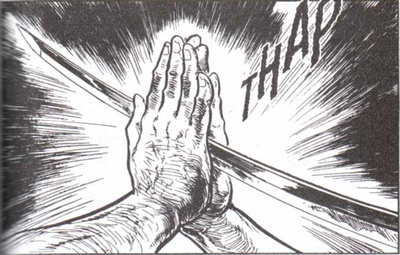
It's the end of the long path the ronin father and son have been on since the boy's birth. Through unimaginable violence and bad weather, across hundreds of miles of blood-soaked roadbeds, over years of tragedy and anguish, to this final 320 pages of still-epic story, Itto and Daigoro have kept us holding on to what little hope exists in a world where honor is all but forgotten and warriors are obsolete. It's a bloody battle all the way to the finish, with dramatic twists and turns right up to the final page. Stay with us as we conclude the translation of what will always be considered one of the finest examples of comic-book mastery ever created, Lone Wolf and Cub.
Kazuo Koike (小池一夫, Koike Kazuo) was a prolific Japanese manga writer, novelist and entrepreneur.
Early in Koike's career, he studied under Golgo 13 creator Takao Saito and served as a writer on the series.
Koike, along with artist Goseki Kojima, made the manga Kozure Okami (Lone Wolf and Cub), and Koike also contributed to the scripts for the 1970s film adaptations of the series, which starred famous Japanese actor Tomisaburo Wakayama. Koike and Kojima became known as the "Golden Duo" because of the success of Lone Wolf and Cub.
Another series written by Koike, Crying Freeman, which was illustrated by Ryoichi Ikegami, was adapted into a 1995 live-action film by French director Christophe Gans.
Kazuo Koike started the Gekika Sonjuku, a college course meant to teach people how to be mangaka.
In addition to his more violent, action-oriented manga, Koike, an avid golfer, has also written golf manga.
Even the road to Hell, or Meifumado as it is known in this saga, must end somewhere and this is the end of the line for the journey of Lone Wolf Ogami Itto and for his son Daigoro. If you’ve read the previous twenty-seven albums, you probably already have some idea about the outcome of the last duel. I’ve sort of spoiled it for myself by reading some online commentaries halfway through my reading the manga, but then the authors themselves have dropped some rather heavy hints in the last couple of episodes. Anyway, for what it’s worth: don’t read my final review before finishing the lecture on your own: there might still be some surprises left for these final panels.
Corpse Tree
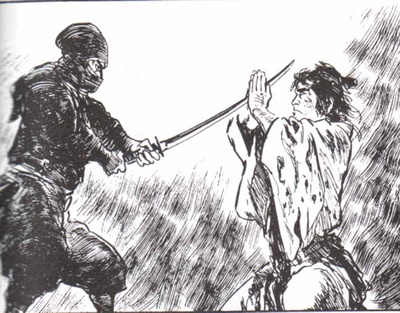
The previous album ended in a rather explosive manner, with the Yagyu last ninjas blowing themselves up in the air, trying to save their master from having to come in person to the field of battle. Apparently there are a few blades of grass still standing, those who have run out of explosives. And they have a new tactic in attacking the lone warrior with sheathed swords and heavy clubs. The ‘grass’ is still dying like, what else, blades of grass under the reaper’s blade, but they know something Ogami Itto doesn’t The devious plot almost succeeds, laying a grievous wound in Itto’s shoulder. But the attack has cost the lives of all the ninjas save for their leader. It is the turn of this leader to learn that the Lone Wolf remains just as deadly when he is bleeding to death and holding just a stump instead of a katana.
As for the title, this final album operates throughout with symbols. Most of them are explained, but some still remain obscure for me despite the amazing effort of the authors to describe the intricacies of bushido. For example, I still don’t know what the significance of the flute song is: clearly a death dirge, but what is the context? The Corpse Tree references the sacred tree under which Buddha reached illumination. The ‘grass’ use the wood of this tree to make rosaries, a pledge to lay down their lives at the command of their master. Itto uses one of the rosaries he takes from a dead ninja and puts it around Daigoro’s neck – his own pledge to fight to the death.
Flute and Wave
Daigoro is desperate when he tries to stem the blood flow from his father’s shoulder in vain, so it’s time for another lecture about re-incarnation and honour and sacrifice. According to Itto, all the waters that flow over the earth will eventually reach the ocean, our lives like the waves, coming and going, living and then dying for all eternity ... or something like this. But the job is not yet done: Come Retsudo! So long as these limbs move and my eyes see ... until my final drop of blood falls, this battle shall not end!
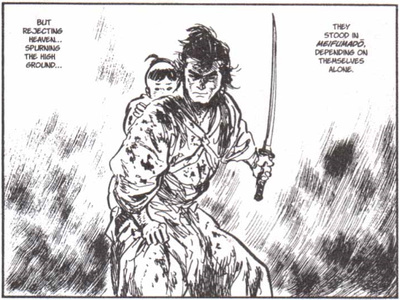
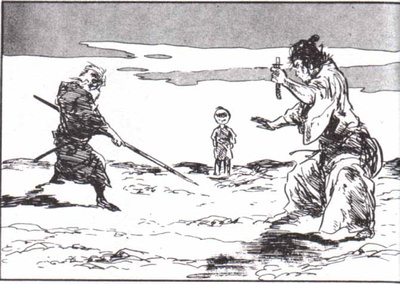
Apparently Retsudo hears the call and decides to finally make an entrance, all dressed in black against the white of the mourning clothes worn by Itto and Daigoro. He comes to the field of death playing the flute for all the family and retainers he lost, but his eyes take in all the little details that give him an edge, like the absence of the dothanuki sword and his heavily bleeding adversary. It should be a walk in the park for Retsudo, but he is not fighting a human being, he is facing instead his worst nightmare, a true demon from Meifumado with a single purpose in the last hours of his life: to make sure the Yagyu clan is destroyed for good.
The Lotus Throne
While the two samurai are engaged in their titanic battle, the authors felt the need for a reprise that takes us around a sleepless Edo – everybody, from the lowest gambling house to the mansions of the daimyo and to the Shogun’s palace is waiting for the outcome of the battle. Bets are made, but none of them are favouring the Lone Wolf while private armies watch each other carefully, waiting for a wrong step or for an excuse to intervene. The Shogun is torn between his loyalty to the devious Retsudo and the advice of his councillors who warn of a civil war if he takes sides in a battle of honour.
Empty Stirrups
The tension in Edo is too intense for waiting, so everybody and their uncle grab arms, horses and pennants and heads out to witness the duel in person, with the Shogun leading the procession.
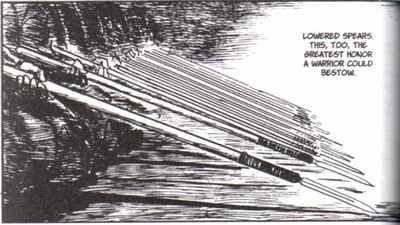
What could very easily become the spark that ignites a civil war turns into a celebration of ‘bushi’ spirit [ you could very well call the whole series a celebration of bushido] . The empty stirrups and the lowered lances are the way the warriors of Japan express their awe and respect for martial prowess and integrity. The whole town has gathered thus to pay homage to Lone Wolf, who continues to defy the odds with bare palms and more guts than blood left inside his battered body.
Arms
No more story, no more tricks [Ok, only one more!]
The creators like this sword capture so much they use it about a dozen times in this album. I use it myself, as less revealing than the other options I had here .
I think I speak for many fans of the series when I say I feel more let down than relieved at the final panel: I truly wanted the journey to continue, somehow, despite the clear signs it cannot go on. There are some questions I have about what happens next, and I know there are several sequels and variations written about the lone samurai who peddles his talents as an assassin and drives his small son in a wooden cart across the byways of medieval Japan. But I am wary of trying them, wanting to preserve the experience I had with the original. I would rather re-read these twenty-eight albums all over again, even I I don’t put in the work to review each one individually. I know it will still be a five star trip, no matter how familiar I am with the characters and the setting. A truly memorable achievement for its creators.
A bit of a rushed finish: one more chapter would have been needed, I think, to give a good epilogue to the story and its themes and see what the surviving characters ended up doing after the fact. So that's another strike against the pacing of the final volumes, just in the opposite direction - too little time spent on something rather than too much.
But overall, this is indeed a titanic star in the night-sky of comic books and manga, well worth of its reputation.
Powerful. After 8300 pages of combat, betrayal, and treachery, I've reached the end of the story. Ogami Itto and his son Daigoro face off against Yagyu Retsudo while the nation looks on.
I had questioned some of the writing choices in previous volumes - sometimes the antics of the new villain, Abeno-Kaii Tanoshi, in Vols. 20-26 were tiring - but now at the end, it all makes perfect sense. The Buddhist concept of karma drives the last eight volumes of the series. Itto had been framed for treason by Yagyu, and rightfully deserved justice. At the same time, though, Itto's vendetta caused hundreds of innocent people to die. Similarly, Yagyu, although loyal to the shogun, was never able to admit that he had grown corrupt. Both of these men brought bad karma down upon themselves - they did not deserve an easy battle. The figure of Abe Tanoshi was that bad karma epitomized, sent by the unseen mechanisms of the universe to punish Itto and Yagyu. Abe complicated the feud between Yagyu and Itto, preventing the two men from facing one another, and finally revealing Yagyu's treachery to the shogun - something that Itto had decided NOT to do, since he felt he had caused enough political discord.
But I believe that Itto, in this series's cosmology, has more good karma propelling him along than bad, and that is why Abe served a second purpose for good karma. By revealing Yagyu's treachery to the shogun, Abe forced the shogun to take a side in the feud between Itto and Yagyu. The shogun chose Yagyu, thereby coming down on the side of corruption and government incompetence (arguably the central motif of the series). This in turn made the daimyo and the people restless and angry, causing hundreds of samurai to rise up against the shogun in a protest of his poor leadership. So, to trace a through-line here, Abe Tanoshi forced all the key supporting characters to face the truth. The shogun came face to face with rebellious citizens, forcing him to see just how much Japanese society had withered under his rule. The people found out just how corrupt the shogun was, but also saw that he was willing NOT to slaughter the masses, in the end, to preserve his control.
In the end, the shogun and the rebellious samurai face each other and weep, for the state of their country, for the evil of Yagyu and the social system that brought them all to this place, and for the titanic final duel between Yagyu and Itto. Two men, fighting out a private feud, against an enormous backdrop of karma, politics, and honor.
The series writers brought things to a really incredible finish in Volume 28, drawing together the many thematic threads of the series. In particular, the symbolism of the final pages - rebels and shogun forced to face each other, all secrets out in the open, brought there by the visible feud of Itto and Yagyu and the unseen forces of karma symbolized by Abe - was striking both on a visual and a thematic level. And what high drama when Itto Ogami finally falls dead, unable to kill Yagyu! When little Daigoro takes up a spear and rams it into Yagyu, it feels as though the torch has passed. The cub has become the wolf, taking his father's place.
The death of Yagyu, coming right as he forgives Daigoro (and, implicitly, Daigoro's father), draws the saga to a satisfying, yet ambiguous, close. The corruption and plots that Yagyu set in motion die with him on the battlefield, thereby eliminating the dark forces within the shogunate. Yagyu's death actually strengthens the shogun, but the shogun will have to live with the knowledge that the people so hated Yagyu and the government that they were ready to rebel. The shogun has been humbled. Meanwhile, the people and dissenting samurai will be satisfied that Yagyu is dead, and can now return to their lives, knowing the shogun has been humbled and that they will not need to break social conventions in order to overthrow the shogun.
Of course, there is ambiguity in the last six pages. The feudal Japanese social order, with its fixed caste system and brutal requirement of seppuku for even minor breaches of etiquette, remains. Although the shogun and the masses have a temporary truce - one side humiliated, the other empowered - the feud could always flare up again. And here I wonder if the series was meant to be an allegory about Japan in the late 1960s (a theory raised in an essay at the end of one of these volumes): The system is flawed, and people recognize it, yet it endures. Were the authors holding up Ogami Itto as a symbol of what their nation should be - some lost bit of honor and goodness that has been destroyed, but should be reclaimed?
Powerful stuff for a comic book. The ending of Lone Wolf and Cub will stay with me for a long time.
Here at the end of all things, I can’t help but be thankful it all happened. Across an impressively voluminous 140+ issues, all stretched out over just a few years in the early to mid 70’s, Koike and Co.’s work of historical fiction doesn’t merely hold up but continues to brilliantly shine nigh 50 years down the road.
As always, the deft sword work amazes. As also, the emotional connectives glow too. However, when they’re combined, that is when Lone Wolf and Cub truly shines at its highest luminosity. Combining the fictional with the real, the excellence is inseparable at all levels.
As incredibly awe-inspiring as it all really is, the greatest lesson of this series is that as Watchmen (a decade down the road) ironically presented in its deconstruction of such, comics (while they typically have been) don’t have to be insipid spandex-laden boyhood fantasies – which are utterly deserving of their puerile stereotypes and thus disdained as such by intelligentsia and lay-readers alike. Conversely, the melding of images and words can be a perfectly legitimately way not to just tell a story, but as this gem exoneratingly exposits, can tell a truly seminal one.
Firmly binding the sacred with the profane, the sublime with the lurid, the graceful with the bloodletting, a deeply human story emerges to delight, entertain, and inspire awe almost half a century down the road.
Bravo! The golden duo, Kazuo Koike and Goseki Kojima has created a truly remarkable masterpiece not just in manga, but in literature as a whole. Let me just write this for the record: after reading Gabriel Garcia Marquez' creations, I have never thought I would feel this so much satisfaction again in reading. The Lone Wolf and Cub, in all its glorious 28 volumes definitely gives its readers a unique experience - a VIP trip to feudal Japan and front row set to the most exhilarating swordfights that ever graced the literary world.
Why is it and how can be that Lone Wolf and Cub is that good, so good that it single-handedly increased my overall average rating here in GR by a handful of notches? There is no sole answer for that. The best and fastest answer I could give is that you have to experience it for yourself. Stop reading this text and go grab that first volume, read until the very last chapter of the last volume. By then you will understand what I am feeling.
The Lone Wolf and Cub is waaaay more than a revenge story set in the Tokugawa era of Japan. It talks about so many things. It is a story between a father and his son who has to fight all those who come against them, be it ninjas, samurais and ronins, or the murderous weather. It is chock-full of assassination episodes where you won't tire seeing Itto Ogami carrying out such. It is also a highly political-historical work, where the hierarchy of Japan's government are embedded in the series' fictional political strife and scandals. Lone Wolf and Cub is both a tragedy and celebration of bushido, or "the way of the samurai". Tragedy because tons and tons of warriors have been killed following the code, with a significant amount of deaths were carried out by men and women who despise doing the kill, yet code adherence forces them to do so. This is also a celebration of bushido because there are so many characters in this series (including Itto Ogami and his arch-nemesis Retsudo Yagyu) whose actions reek of high respect to the code. It is also huge tome of religious references, from shinto belief, Buddhism, to meifumado, to poetic references to the stars, the wind, the wave.
But above all, the whole manga is raved by its action. The artwork perfectly captures the swiftness in each stroke of the sword, the efficiency of the blade as a killing instrument and the bloodbath it leaves after the fight. The Lone Wolf and Cub after all is a fight between two true samurais.
I have read Samurai Executioner and yet to read Path of the Assassin, both of which are works of the golden duo Koike and Kojima. All I can say is that Samurai Executioner, a great series nonetheless, pales in comparison with the Lone Wolf and Cub. The Lone Wolf and Cub has a special place in my reader heart.
The last chapter, oh yeah. The series did not fail to surprise until the very last pages of the last chapter of the last volume. It is a perfect conclusion, after being so invested reading the story. It was worth all the time I have given in reading it.
To Mr. Koike and (the late) Mr. Kojima, arigatou gozaimasu! You have my respect and admiration.
The saga of Lone Wolf and Cub finally comes to a conclusion (sort of…more on that later). Is it with a whimper or a bang?
The Corpse Tree: Itto reaps the last of the Yagyu Grass, but is greatly wounded in the process.
Flute and Wave: Itto, sorely wounded and with his Dotanuki blade broken to the hilt, must now face Retsudo, last of the Yagyu.
The Lotus Throne: all of Edo from the Shogun to the common people, aware of the battle taking place on the nearby strand of the Hatcho river, await the outcome of the titanic struggle. The government is frozen by indecision: the Shogun’s supporters side with Retsudo, while his enemies with Itto. Should the Shogun be seen to move then a private blood feud will become marked as a political action and the delicate political order could be broken as each side joins in the battle and the status quo erupts into chaos.
Empty Stirrups: the Shogun makes his move and the rest of Edo follows suit as all converge on the Hatcho strand whether it be to aid the Shogun or to stop him at all costs. As they arrive all stop in amazement: Itto and Retsudo appear to be caught in stalemate, neither able to overcome the will and strength of his opponent.
Arms: The end…?
So…I won’t go into spoilers here, but the ending to this saga is perhaps both satisfying and a bit of an anti-climax. So much ink (not to mention blood) has been spilled to reach this point in the story that I’m not sure what ending could have been perfect. That said, I do think it was a very good ending and may indeed be the only one that could have possibly worked. All I’ll say is that there’s a reason this story is called “Lone Wolf AND Cub” and that the two remaining members of the Ogami clan are seen as a unit. Was it a whimper? Not at all, though it was certainly not quite the crescendo one might have expected. Was it a bang? Not quite this either, though it was ultimately rather satisfying and certainly follows the logic of what has come before.
Why is this only a sort of conclusion? Well, it appears that there was a continuation of the saga, "New Lone Wolf and Cub", penned by the same writer (Kazuo Koike), but with a different artist. I have to admit that I was dubious when I heard this. What’s the point? More of the typical milking of a classic property for more coin? Perhaps, but I have the first volume and we’ll see what I think…can the saga possibly continue in a satisfying way? It’s certainly possible. Gotta admit though, I am still a little dubious.
This book actually broke my heart. I wasn't the same for weeks. Somewhere around book 15, this series grabs you by the boo-boo and won't let you go until you have been emotionally manhandled. This series is WORTH EVERY MINUTE of reading.
I finally finished Lone Wolf and Cub. The classic Manga that took me more then 20 years to finish. Not because i did not like it, but because i was a very stuborn kid on a mission, to find every volume in pocket size. This year i found Manga number 27, and i decided to reread the entire 28 volume series thats 8700 pages long. Volume 28 (if you slide) i owned for a good 10? 15 years, it became a obssesion for me, to find that last one but i also did not wanted to overpay. I have seen suckers selling it for 115 dollar, beyond crazy ! I could have read the story online but every time i decided not to. When i visited a comic store or con i was always on the lookout. And this Manga has been on my mind for years. It was glorious to finally finish it, bittersweet, but happy. At one time i was like i will never know the end and i was even fine with it, like a samurai almost.. I started this series as a young 15 year old longing for a samurai book, and all the times i moved i brought them with me. Lone Wolf and Cub will always be very important to me, and i will definitely reread this series again in the future. But for now i am still Flying high on that ending.
Toplam neredeyse 8300 sayfalık muhteşem bir seri daha bitti ve yenisi gelmeyecek. Gerçekten Lone Wolf and Cub serisinin derinliğine girebilecek, hem hikayesi, hem çizimleri, hem tarihi arkaplanıyla geçebilecek bir serinin kolay kolay bir daha geleceğini sanmıyorum.
Phew, twenty-eight volumes of Lone Wolf & Cub finished—while I’ve made many attempts, this is my first complete run through.
The art is as wide-screen as it comes. I get why greats like Miller were so enamored by it.
Some choices were made in the translation, particularly in how it assigned certain English dialects to the peasantry, which took me a minute to grapple with. To say nothing of the volley of repeating outcomes or scenarios early on, which pulled me out of the story. Still, I pressed on, watching Itto and Daigoro become so imdominatable that their very gaze is nearly as deadly as Dotanuki steel.
This series is beautiful. Grand. Flawed. Maybe even a touch overlong. Yet somehow haunting. A work so mad I’m not sure it could be whittled down into something tighter or more succinct without losing its identity—even though there are parts, if it were me, that I would cut. Some of that is a direct reflection of how breathtaking the highs were…
"Yakında babanın bedeni sessiz bir cesede dönüşecek ama dalgalar gibi, benim de yaşamım sona ermeyecek. Dalgalar gibi, babanın yaşamı da bir sonraki yaşamın kıyısına sürüklenecek. Bedeni ölecek ama ruhu sonsuza kadar yaşayacak. Seninki de öyle, Daigoro. Bizim hayatımız yok edilemez, ölümsüzüz! Bu dalga kırılıp kanlar içinde kalsa bile asla sinme. Gözlerim kapansa dudaklarım mıhlansa bile korkma. Yeniden doğuş dünyasında ben hala senin baban olacağım. O dünyada ve bütün dünyalarda benim oğlum olacaksın. Sonsuza kadar Baba-Oğul olacağız."
20 years after my first full read through, LONE WOLF AND CUB retains its rightful place in my personal pantheon as a masterpiece. While individual volumes may show some wear and tear with some of the individual chapters, collectively Koike and Kojima have fashioned a visual narrative of beauty, violence, grace and poetry in their long form meditation on honor and vengeance within an historical and cultural perspective at a specific moment in time. Their masterful handling of Time, Space, framing and movement recalls Kurasawa and Leone at their finest. Highest recommendation.
The end of the series. It’s been great. I didn’t enjoy it when the plot moved away from being more self contained adventures to an ongoing battle but I was won over after a little while.
Ni Gozu ni Mezu, que son los guardianes de las puertas del inframundo, saben quién será el vencedor en esta confrontación. Los Kusa han recurrido a técnicas deshonestas y desleales: la Dotanuki está rota. Ito y Daigoro ceden a un impulso propio del hombre, derraman unas cuantas lágrimas, aun así permanecen imperturbables en el camino del meifumado. Baku camina a sus anchas por Edo en esta noche. Edo está en vilo, nadie duerme pensando en quién ganará. Incluso este entrenamiento privado entre Ito y Retsudo movilizó las fuerzas de todo el país creando simpatías por ambos bandos. Ito Ogami representa el descontento y la rabia por la corrupción del gobierno. En este ajedrez político Ito Ogami ha puesto en jaque mate al shogun y a su gobierno. Y ha quedado expuesta la necedad del shogun, quien es un sirviente más de los Yagyu. Su trono de loto es compartido. Tokugawa es un espectador más. Todos somos un espectador más.
“El río fluye hacia el mar. Sus aguas se convierten en olas grandes y luego en olas pequeñas, una y otra vez, yendo y viniendo sin cesar… La vida es como las olas. Nacen, viven, mueren y renacen… Dentro de poco, mi cuerpo se convertirá en un cadáver silencioso. Iré al muelle del otro mundo y renaceré. Aunque mi cuerpo muera, mi vida continuará… igual que la tuya. Nosotros no morimos. Continuaremos vivos toda la eternidad. Si mi piel se abre y mi sangre se derrama, no pierdas la cabeza. Si mi cuerpo cae al suelo, no te acobardes. Si mis ojos se cierran y mis labios se sellan, no tengas miedo. En el otro mundo, seguiré siendo tu padre. En el otro mundo, seguirás siendo mi hijo. Tú y yo seguiremos siendo padre e hijo para toda la eternidad”.
Having read all 28 volumes of this magnificent endeavor twice... I will only say that no reviews will do it justice. This is hands-down one of the greatest works that have ever been distilled from the human mind onto paper! No surprise then that it spawned a series of movies and seemingly endless Samurai movies...
Y llego el final. Como dije, me sorprende que ese fuera el uso de los Kuza. Sobre el final, creo que fue adecuado, y cierra muy bien el manga, me ha gustado, tanto este volumen como el manga en su totalidad.
I've just spent the last few months going through the whole 28 issues. At over 300 pages each, that's been well over 8000 pages total. That's a lot of comics by any measure, and I'm happy to have made it to the end. This review is thus for the whole series, not just this volume.
My first contact with Lone Wolf and Cub was back in the late 80s/early 90s (so, pre-Internet) via scattered issues bought at newspaper stands -- I liked it immediately for the strong black-and-white drawings and immersive take on feudal Japan society, politics and culture. Sadly it was discontinued after a few months (it was a local translation from the original First Comics edition, which was itself interrupted) and I didn't get more than a small, thought-the-keyhole glimpse at the story's arc. You can imagine how happy I was to find the complete series available, over 30 years later, thanks to the Internet.
Anyway, now that I've read it in its entirety, I'm kinda divided: the strong drawing and immersive story are still there and as impressive as ever, but two faults have become apparent: first, the main character being painted as a kind of superman, capable of slaying armies of literally hundreds of opponents, is a strain on even the strongest suspension of disbelief; and second, the plot sometimes feels too thin, as if stretched over too many pages -- e.g, the final duel between the protagonist and its nemesis crawls thorough almost 200 pages(!), it feels like the authors didn't want the story to end.
Weighting in its strong and weak points, my final rating is 3.5 stars, which I round up to 4.
Just finished my marathon of manga reading. This set has been sitting on my shelf for a couple of years and I'm really glad I just got to it. It's an amazing story of a man and his son on a quest for revenge against, basically, the whole of Japan. It's beautiful, violent, and full of the honor of Samurai.
It starts off as sort of "assassination of the week" stories, but quickly turns into one of the most epic revenge stories ever written. And, at the heart of all of it, is Daigoro, the three year old son of Ogami Itto, a disgraced Samurai avenging his wife's death and the destruction of his house's name. Daigoro is heartbreakingly cute and, for every time that he is a stoic Samurai's son, he is also just a little boy who wants a normal life. One without bandaging up his father's wounds and watching him kill hundreds of people.
I've only read through two other manga: Rurouni Kenshin and Akira. All three have been great and have made me want to find more that are just as good. I feel like I might have found the three best, though.
Quintessential samurai story/comic. Lone Wolf & Cub is cool, while still being able to have content beyond action or contrived melodrama.
Personally, I think it is best when it is telling the less plot laden stories of "regular" people who interact with Lone Wolf & Cub, and so I was less of a fan of the last 5+ volumes or so where it is much more focused on the primary plot and is essentially a protracted duel with constant interruptions, especially by a sudden secondary villain who is alternately comic relief, gross, and pathetic - much of this felt unnecessary.
For the majority of the series, I really appreciated that no matter how skilled an enemy might be, the battle is not going to last for huge amounts of time clanging swords together. This was sort of dropped at the end as well. Still, it ended up with a solid conclusion in the last volume.
The art and use of panels in a cinematic way really give the series as a whole a level that raises it above its rather lurid occasionally nearly pulpy content.
And so, it’s over. Part of me agrees with others to an extent that it may feel a little anti-climatic — at the least, an epilogue would be nice.
On the other hand, I like it, thinking it completely lays to rest what the series intended to do. A sprawling epic about familial relationships, honor, and Edo period Japan, it ends as a truly impressive feat to tie it all together.
With that in mind, I can’t help but be left wanting just a little more, and will probably check out New Lone Wolf and Cub at some point. However, I remain a little dubious to not let this story rest. Likewise, I know that NLW&C has its own sequel which has yet to be put in English.
As the rest of the series, the artwork is absolutely gorgeous.
The way everything ended didn't sit that well with me. Imagine if Daigoro had punched Retsudo in the nuts, instead of just worthlessly clinging to his leg. In fact, Daigoro is one of the few things that never sat well with me. The boy apparently can't properly speak and Itto never teaches him anything, not even fighting, which you'd assume he'd pass down.
Anyway, I just felt that keeling over from too many wounds was a sad and inglorious ending to Ogami Itto.
Also really missed some kind of wrap up. It just...ends.
This entire review has been hidden because of spoilers.
The epic conclusion to a story that can only be described as EPIC!
Kazuo Koike's story is nothing sort of amazing; full of intrigue, and action, but also examining various aspects of Japanese culture and, the relationships and connections of the different players.
Goseki Kojima's art is absolutely astounding in its beauty, whether finely lined details, subtly blurred greys, or starkly blacked silhouettes. Each volume includes many pages that would be magnificent pieces to be framed and hung on a wall.
This whole book would have been like the last 15 minutes of an action movie. It started to read very quickly & the tension mounted accordingly. The last two pages will stick with me for quite a while. I had read several books in this series before, but I'd never been able to get my hands on the last couple and I'd never read the whole thing in order. I am almost certainly going to revisit this often.
Sem duvida o melhor mangá/quadrinho/obra prima que ja li na vida! Tão violento , sangrento, dramático, poético, romântico e lindo o mesmo tempo! Desfecho mais que a altura da obra como um todo, final surpreendente! Fica na memória como uma das melhores coisas que já fiz na vida! Ler por completo essa obra!