Jump to ratings and reviews
Rate this book

The Thirty Years War

Rate this book
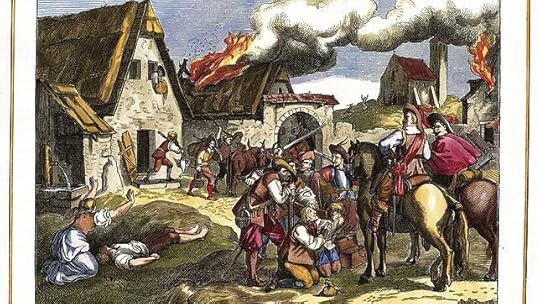
Europe in 1618 was divided between Protestants and Catholics, and Bourbon and Hapsburg, as well as empires, kingdoms, and countless independent states. After angry Protestants tossed three representatives of the Holy Roman Empire out the window of the royal castle in Prague, world war spread from Bohemia with similar abandon and relentless persistence, destroying European powers from Spain to Sweden as they marched on the contested soil of Germany. Fanatics, speculators, and ordinary people found themselves trapped in a nightmarish world of famine, disease, and seemingly unstoppable destruction. The Thirty Years War was a turning point in the making of modern Europe and the modern world: out of it came the system of nation-states that remains fundamental to international law. C.V. Wedgwood's magisterial book is the only comprehensive account of the war in English, as well as a triumph of scholarship and literature. Includes maps and charts.

520 pages, Paperback

First published January 1, 1938

396 people are currently reading
8543 people want to read

About the author

C.V. Wedgwood

49 books74 followers
Dame (Cicely) Veronica Wedgwood OM DBE was an English historian who published under the name C. V. Wedgwood. Specializing in the history of 17th-century England and Continental Europe, her biographies and narrative histories "provided a clear, entertaining middle ground between popular and scholarly works."

Ratings & Reviews

What do you think?
Rate this book

Friends & Following

Create a free account to discover what your friends think of this book!

Community Reviews

5 stars
1,201 (41%)
4 stars
1,164 (39%)
3 stars
444 (15%)
2 stars
90 (3%)
1 star
15 (<1%)
Displaying 1 - 30 of 334 reviews
Profile Image for Matt.
1,052 reviews31.1k followers
August 30, 2024
“The war solved no problem. Its effects, both immediate and indirect, were either negative or disastrous. Morally subversive, economically destructive, socially degrading, confusing in its causes, devious in its course, futile in its result, it is the outstanding example in European history of meaningless conflict. The overwhelming majority in Europe, the overwhelming majority in Germany, wanted no war; powerless and voiceless, there was no need even to persuade them that they did. The decision was made without thought of them. Yet of those who, one by one, let themselves be drawn into the conflict, few were irresponsible and nearly all were genuinely anxious for an ultimate and better peace. Almost all…were actuated rather by fear than by lust of conquest or passion of faith. They wanted peace and fought for thirty years to be sure of it. They did not learn then, and have not since, that war breeds only war…”
- Cicely Veronica “C.V.” Wedgewood, The Thirty Years War

When I picked up C.V. Wedgewood’s The Thirty Years War, I knew exactly two things about the subject. First, its approximate length; second, that it was a horror show, which greatly depopulated swaths of continental Europe. Having finished this, I now know a slight bit more. Still, if you were to ask me to explain the war – its causes, its sequence of events – I would point to something, tell you to look, and then run away when your eyes were averted.

Obviously, this is history, not quantum physics, but it’s still a complicated event. It lasted decades; it flowed across a fractured Germany that resembled a sheet of glass dropped on the ground; and it involved a huge cast of characters who lived, died, and were replaced over and over again. It was difficult – at least for me – to keep straight all the different kings, margraves, landgraves, and electors, as well as their relationships to each other within the power structure of the Holy Roman Empire.

Thankfully, The Thirty Years War is written in such a way that it is a pleasure to read, even if the details can be overwhelming. The reason is that Wedgewood consistently focuses on the human element in the tale, emphasizing how men and women – from royals to soldiers to peasants – shaped or were impacted by the conflict.

***

The Thirty Years War had a number of causes, none of them worth killing over. It grew out of religious instability between Catholics and Protestants. It involved the question of who would sit the throne of Bohemia. It saw the Spanish Hapsburgs and the French Bourbons vying for dominance in central Europe.

And it began with – of all things – the defenestration of two Catholic representative of Emperor Ferdinand II in the city of Prague. Somehow, the two men, along with a servant, survived being pushed out of a castle window. Millions of others, though, would not be so lucky in the years to come. “Total war” is often thought of as a recent innovation. It is not. Hundreds of years before William Sherman’s march through Georgia, or the depredations of area bombing of the Second World War, rampaging armies flattened the countryside, sacking towns and villages, stealing food, and leaving in their wake famine and disease.

***

The Thirty Years War proceeds chronologically, in date-stamped chapters that do a lot to help with orientation over the decades. Wedgewood starts by setting out the context of the war, and then goes into great detail about the struggle between Ferdinand II and Frederick V over the kingship of Bohemia. Less than a hundred pages into this 500-page volume, we get to the aforementioned defenestration.

From there, we are off to war, and things get very, very grim.

***

The Thirty Years War was originally published in 1938, on the eve of another European cataclysm, and Wedgewood clearly sensed the ominous direction of the winds. As a result, she writes almost as those she is warning everyone about the awful consequences found acceptable in order to achieve or keep power. Though she suggests that some of the higher casualty estimates were exaggerated for the sake of propaganda, she is very clear that the Thirty Years War represented one of the nadirs of humankind. Humankind being what it is, that’s saying something.

In presenting this story, Wedgewood is very sensitive to the plight of those caught up in the maelstrom, the nameless and the powerless, who fell prey to the whims of a small elite who cared less for them than for the inanimate pawns on a chessboard. For obvious reasons, those who suffered the most left behind the least documentary evidence. Thus, it is hard to know exactly what went through the mind of a farmer who had his crops carted away, his house and barn burned, his sons killed, his wife assaulted, and himself left to die of the plague. Still, Wedgewood provides evocative passages on the destruction wrought by mercenary armies, which represented nothing so much as armored locusts, moving from place to place, stripping it of food, stealing what could be carried, and torching the rest.

***

Wedgewood belongs to that vanishing species of historians for whom writing was an art, and not simply a practical means of communicating whatever tidbits they’d found in the archives. While she had verifiable academic bona fides – including an incredible facility for different languages – this has become a classic due to its literary merit.

The Thirty Years War has exceptional biographical portraits of the major players, giving them memorable characterizations that go a long way to helping remember them. Wedgewood is also very good at delivering satisfying set-pieces, whether that is the fall of a city, the clash of armies, or three guys getting hurled out of a window. When it comes to the battles, we don’t have a ton of first-person accounts – this being long before the age of mass literacy – but she makes do with what she has.

***

When history is done right, it makes the long-ago feel like yesterday. The Thirty Years War was waged at varying intensity levels from 1618 to 1648. That’s pretty distant. Yet Wedgewood bridges the gap with the humanness of her narrative. For all the folly, discord, and violence on display, she maintains a degree of empathy for those involved. She also draws from this panorama of slaughter and waste important lessons about the dubiousness of warfare as a means of resolving disputes. These lessons – of course – have been ignored many times since the Peace of Westphalia, and will continue to be ignored well into the future.
Profile Image for Warwick.
Author 1 book15.4k followers
February 26, 2015
Before I started this, the sum total of my knowledge on the Thirty Years War did not extend much further than being able to guess its duration. In my defence, it turns out that the causes and motivations of this conflict were rather baffling even at the time – indeed even to those involved. One of the most startling facts in here is the revelation that, when all sides met in 1645 to discuss terms for peace, it took them nearly twelve months of debate just to agree on what exactly the previous quarter-century of fighting had been all about. National integrity? Religious freedom? Self-aggrandisement? Dynastic feuding? Why, yes…to all of the above.

The very geography is confused. ‘Germany’ at the time meant the Holy Roman Empire – summed up most memorably by Voltaire as being neither holy, nor Roman, nor an empire – which in 1618 comprised a patchwork of semi-independent Central European margraviates, duchies and principalities of varying religions and allegiances. Its boundaries were not clear. It claimed to include, for instance, the Swiss Confederation, which had actually been functionally independent for a long time – while the King of Bohemia, which was nominally a separate state, retained his voting privileges within the Empire. ‘The system,’ as Wedgwood puts it, ‘had long ceased to conform to any known definition of a state.’

Across this politically hazy landscape strides an assortment of politically weak figures – spies and diplomats, acquisitive landgravines, petty princelings and mercenary warlords, most of them not so much prosecuting the war as merely failing to stop it. The most obvious tension is the three-way religious split between Lutherans, Calvinists and Catholics. But the underlying dynastic struggle cut across denominations: what was in fact being realised was the long-running power play between the Bourbons and the Habsburgs. Like a proto-Vietnam, Germany was used by the superpowers of France and Spain to further their war against each other. This is why, despite the religious motivations of many of the local leaders, Catholic France was happy to ally with Protestant Sweden if it meant taking the Habsburgs down a peg or two.

The super-armies that resulted from these opportunistic alliances were beyond the control of any state. The idea of a national standing army was then in its infancy – indeed it's one of the concepts that the Thirty Years War has been said to have brought about – and most soldiers were mercenaries, coming from a whole range of different countries and of dubious loyalty even at the best of times. They roamed around, switching sides now and again depending on who paid better, laying waste vast swathes of the country. The cumulative impact was tremendous: crops were trampled, villages were destroyed, all food and money was funnelled into driving the mass of soldiery, and German peasants were stuck with plague, famine and near-constant starvation.

At Calw the pastor saw a woman gnawing the raw flesh of a dead horse on which a hungry dog and some ravens were also feeding. In Alsace the bodies of criminals were torn from the gallows and devoured; in Zweibrücken a woman confessed to having eaten her child. Acorns, goats' skins, grass, were all cooked in Alsace; cats, dogs, and rats were sold in the market at Worms. In Fulda and Coburg and near Frankfort and the great refugee camp, men went in terror of being killed and eaten by those maddened by hunger. Near Worms hands and feet were found half cooked in a gipsies' cauldron. Not far from Wertheim human bones were discovered in a pit, fresh, fleshless, sucked to the marrow.


Out of the maelstrom, a new kind of Europe emerged – one dominated less by dynasties and religions than by the growing idea of the nation state. Not just borders, but motivations seemed to have shifted. Wedgwood warns that this idea can be overstated, but she states it well:

A new emotional urge had to be found to fill the place of spiritual conviction; national feeling welled up to fill the gap. […] The terms Protestant and Catholic gradually lose their vigour; the terms German, Frenchman, Swede, assume a gathering menace.


CV Wedgwood sounds like an interesting character and I rather love her old-school, no-nonsense, technically excellent prose style. If nothing else this book is a masterpiece of historical synthesis, drawing on and citing innumerable primary sources in English, French, German and others. Still, to me at least it's not so essential as a narrative that I wouldn't be prepared to give it up in favour of a more modern treatment that benefits from more recent research.

But lots to explore here, and plenty of astonishing anecdotes and characters to be uncovered. Personally, I liked Christian of Brunswick, who had to have an arm amputated after a nasty injury. He went through with the amputation publicly, to a fanfare of trumpets, and promptly had a medal struck with the inscription Altera restat ["I've still got the other one"]!
Profile Image for William2.
859 reviews4,046 followers
July 17, 2023
The Peace of Augsburg of 1555 had ensured the coexistence of the landed German princes, many of whom were Lutheran, under the Catholic Hapsburg King Charles V. The Thirty Years War was largely the war of the Counter-Reformation. It was started in 1618 by Ferdinand II, whose rise to the monarchy was marked by great dubiety on the part of his German Electors, among others. He wanted lands lost during the Reformation returned to the Church (Edict of Restitution), as well as the reconversion of "strayed" Catholics, often by coercive means. Until the Thirty Years War Germany was by and large a Hapsburg possession. The war ended that forever. Be advised, this is a product of the great-white-male school of historiography. Taken on its own terms it's quite wonderful, but don't look here for insight into the peasantry or the plight of women. There are other texts for that. Author C.V. Wedgwood brings a degree of focus and narrative drive to these extraordinarily complex events that reminds me very much of Barbara Tuchman. That's high praise indeed. Wedgwood also has as fine and nimble a gift for the counterfactual scenario as I've ever come across. First rate!
Profile Image for Katia N.
710 reviews1,110 followers
March 9, 2020
A political history of the devastating disastrous conflict in the 17th century written by a young female historian just before another devastating disastrous conflict affecting almost the same territory and going global but 300 years later.

It has been long time I had this book on my shelf. And it has attracted me for two reasons: firstly, my lack of knowledge of this period of European history (17th century) and secondly, historiographic perspective. This book has been written by a young female historian just before another devastating disastrous conflict (World War II 1939-1945) which has affected almost the same territory and more but 300 years later. Respectively, I was interested to find out how she wrote history at that time.

I’ve never heard about this 30 years war before. Or so I thought until i’ve started reading this book. But then I realised I did. It was when I was around 11 years old reading The Three Musketeers We had a very popular TV movie in Russia as well. And I still remember the episode of three musketeers and d'Artagnan (apparently the real historical figure as well) were protecting La Rochelle fortress from the devious supporters of Cardinal Richelieu. Of course i was passionately on the side of the courageous musketeers. That war between the gougenots and the catholics in France was taking place at the same time as the 30 years war. There is a certain overlap in historical characters notably Richelieu, but also Buckingham, the favourite of James I, as well and some others.

Back to the present, or should we say, to the more remote past. This book has appeared to be a straightforward, well written narrative history of the conflict. If one requires an introduction to this war, it might still be useful. The scholarship and diligence of Wedgwood is out of the question. It is also quite entertaining in its own way and easy to read. She is very good in portraying the relevant historical figures. She normally starts with the description of their character and appearance, so it is easy to imagine a human being beyond the pure history. Sometimes though she is getting slightly carried away. For example, Wallenstein, the one of the key military leaders on the side of the Empire, is “the old sick” man when he was barely 50. While for Bernard, “his harsh virtues one would not deny”. But his engraving shows “egoistic mouth”. I wonder how “egoistic mouth” is supposed to look like and who from our current politicians possess this inhibiting deformity.

I wish she would spend more time writing about the impact on the society and the ordinary people. She does not do it enough. But when she does it, she is effective in portraying the scale of devastation and how the contemporary armies looked like. Reading her, I could barely imagine the chaos and terror the ordinary people felt while the armies where moving around dragging a train of non-combatants behind including children and women, leaving decease everywhere, stealing, plundering and ruining everything not to leave any stuff for the other side.

I mention briefly only one episode. After the breaking the siege, the Imperial army sacked the city of Magdeburg in 1631. Unpaid, the soldiers were given the permission to plunder the rich city. The chaos of violence insured in the process of which the fire has started. At the same time soldiers went even more out of control. “They were reports of gang rape of minors and tortures” (Wiki). Out of 25 thousands people only 5 thousands survived. Ironically, but maybe not surprisingly, the army was destroyed in the process as well. Though incomparable, it has reminded me how Napoleon has started to lose in Russia after Moscow’s fire; or how Hitler has lost eventually at Stalingrad. It seems, the war does not change through the centuries. Only the weapons do.

However, if one is really interested in the history of the 30 years war, this book has got a lot significant limitations. It focuses on the events and historical figures, so it is a narrow political history. Respectively it brushes over social, cultural and economic side. It does not pay any significant attention to the courses of the conflict or at least simplify them to the actions of certain individuals like Fredrich of Palatine, Wallenstein, Gustav Adolfus, the King of Sweden. She does not attempt too much interpretive work. But when she does, it is not convincing.

For example, “the political effects of the war were more distinct than its social and economic results.” It is about the conflict lasting 30 years where around 8 min people perished and practically all area of modern Germany was devastated.

Or: “The absolutist and the representative principle were losing the support of religion; they gained that of nationalism. The term Protestant or Catholic lost their vigour, the terms German, Frenchman or Swede assume a gathering menace. The struggle between the Hapsburg dynasty and its opponents ceased to be conflict of two religion and became the struggle of nations for a balance of power.” I think, she is looking at the 17th century from the perspective of pre-war years of the 20th century or maybe even little earlier - 19th century when the nationalism was properly formed. I am not convinced the national agenda was there just yet all together at all.

Sometimes, she succumbs to national stereotypes which look slightly anachronistic as well: “With Arnim (a Saxon general) the heart was stronger than the mind and that rigid, almost tragic sense of honour, the “aufrichtigkeit” which knows no compromise, the strength and the undoing of the German, stood between him and the betrayal which might have saved his country”. Did he know that Germany is his country not Saxony? So “sense of honour” and “no compromise” is a typical German feature?

In spite of these limitations, I think it is a worthwhile book to read. It is especially the case if you are interested in historiography. It represents now the document of its time (late 30th of the 20th century). It shows how people were writing history and how this has changed. And it gives to a non-historian like me a very good idea about the key players and sequence of events in the 30 years war.
Profile Image for David.
161 reviews1,747 followers
May 17, 2012
1. What is the Thirty Years War?

This is admittedly a half-baked and unfair question—but it's a necessary one too, if only to get one's foot in the door. It's a bit like asking, What is World War I? In response, we can certainly list the belligerent nations, we can outline the (ostensible) military and political goals, we describe the significant events and battles, and we can offer up some (partially speculative, partially causal) analysis of how the war affected and determined that which followed it, but does this compilation of fact and critical analysis satisfactorily answer the question? Or does it merely lead to other, more complex questions which nag at us until we arrive some overly simplified, discrete 'essence' of the conflict, predominantly ideological in nature, which tidies up the practical messes that arise out of a long-lasting, far-reaching war?

But to hell with postmodernist qualms. I'll stick my toe in the cold waters of the provisional and attempt an answer. Keep in mind that I only became conscious of the Thirty Years War (as anything but a name) earlier this year, so I lay no claims to authority. I am a student. This is the yield of my studies, however incomplete:

The Thirty Years War (1618 to 1648) began as an internal crisis and civil war within the Holy Roman Empire and ended in an international war fought largely on German soil. In the early 1600s, the Holy Roman Empire was an odd agglomeration of royal domains, electorates, free cities, duchies, landgraves and other territorial units in Central Europe, centered in present-day Germany and Austria but incorporating portions of other modern nations, such as eastern France and the Czech Republic, as well. I say that the HRE (Holy Roman Empire) is odd for many reasons—chief among them (1) that it did not incorporate Rome, (2) that although its leadership fought on behalf of Roman Catholicism, the Pope was actually against the ruling family, thus problematizing the adjective 'Holy,' (3) that the Emperor was elected by the prince-electors of the Empire, some of whom were Protestant, ambivalent about the integrity of the Empire, and openly antagonistic toward the imperial authority, (4) and that the Emperor could claim only very limited power in that he was bound to certain decisions of a 'Diet' (or congress of the prince-electors) and his military forces were relatively weak, ineffectual, and therefore unable to enforce imperial decrees. (In fact, some of the princes of the Empire had stronger armies at their disposal than the Emperor did.) Obviously, you can tell from this cursory description of the HRE in 1618 that it is a heterogenous, decentralized entity ripe for conflict.

It is also difficult, from the vantage of modernity, to discuss the HRE in that it fails to conform to any of our notions of nationhood (or even Empire, really). It's just this giant mish-mash of indistinct, variable territories governed not with respect to national integrity, but only with regard to the self- aggrandizing and often mercenary interest of their respective rulers. Maximilian, the Duke of Bavaria, for instance, had his own dynastic and territorial interests at heart when he switched sides during the war. His land was ravaged, his people were brutalized and on the verge of revolt, but he thought only of his own political and territorial preservation; after all, he wanted to accumulate as much land as possible—even scorched, ruined land—to leave to his heirs. There was no Bavarian national feeling in the way that we might understand it today.

Against the volatile background, we need only the match to light the tinder. And that match was a Protestant German prince's attempt to 'usurp' the throne of Bohemia after the Emperor already laid claim to it himself (in circumstances too complicated to go into here). The Emperor's partisans were thrown out of a castle window in Prague, and this touched off a civil war within the Empire in which (for the most part) the Protestant princes fought the Emperor and the Catholic princes.

It's worth noting that the Holy Roman Emperors during the war were Ferdinand II and, later, Ferdinand III, who were members of the House of Habsburg, which also (but separately and distinct from the HRE) ruled Spain. Naturally other European powers were extremely threatened by the power of the Habsburgs—the Bourbon dynasty of France most especially, since it was hemmed in on both sides by the Habsburgs. Thus, the civil war in time blossomed into a greater European war, which in various intervals involved France, Spain, Sweden, Denmark, the (Dutch) United Provinces, and the Spanish Netherlands. (Did I leave out anyone? Oh, yeah. Maybe some Italian duchies were involved for short periods.)

In the end, although Sweden played a significant role in the war, it seemed to culminate in a dynastic battle between the Habsburgs (and their allies) and the Bourbons (and their allies) that, some suggest, marked a shift in European conflict, generally speaking, from religious warfare to proto-nationalist warfare. Needless to say, between the foreign powers and the German territories, there are too many reversals of fortune and changes of sides to retell here, but suffice it to say that it did not end well for the Habsburgs. The war effectively marked the end of a Spain as a major world power, Emperor Ferdinand III was forced to cede parts of the HRE to French and Swedish authority, and some electorate lands were returned to their previous Protestant rulers. Although the HRE was surely already in decline, the Thirty Years War gave it another swift kick in the ass. Besides the territorial loss, much of the empire was utterly wasted, plague and famine ravaged entire populations, and the various armies horribly abused the locals as they passed through: burning their towns, raping their women, stealing their food and valuables, and killing them indiscriminately. (Often the armies were as abusive to the people of their own lands as they were to their adversaries.) Cannibalism and disease were widespread. To say the least, it was not a fun time to be a German.

2. What about the book?

Well, I went through this looong-ass discussion of what the war is so that you might be able to tell whether it sounds interesting to you. If the above portion of this review makes you want to know more (and—trust me—there's a lot more to know), then pick up C.V. Wedgwood's The Thirty Years War. At over five hundred pages (in the NYRB edition), it is certainly thorough, especially during the first twenty years of the war, but it is also quite accomplished as a narrative. I don't know whether you've noticed this or not, but most historians are unfortunately not good writers. While they're bursting with facts, interpretations, and insight, they are unable to put them together in a clear or interesting fashion. Often they bog us down with too much detail, trying to show off with all their research; at other times, they assume that the reader already has a thorough knowledge of the background—which is probably the worst trait of all in a historical writer. If I were already well-versed in history, I probably wouldn't need your stinkin' book to begin with.

To be fair, Wedgwood is sometimes guilty of assuming you already know stuff that you might not know. That's also why I provided a general overview of the war (and the HRE) above—for dummies like me who might, for instance, have a difficult time grasping the structure of the HRE. At other times, she is fond of printing short quotations in their original Latin or French without an English translation. I hate that. I mean, really, really hate that. Why do you assume I know the same languages as you, C.V.? (She does offer German translations, however. Why is this? We're supposed to know Latin and French but not German? Give me a list of the prerequisites before I start, okay?) Anyway, don't let this worry you because the untranslated quotes are inconsequential. You don't need them to make sense of the history. (I also fault NYRB here. When you reprint these books, you should correct the oversights. Add editorial footnotes, you idiots.)

Another gripe with Wedgwood: She's a British intellectual. No, this isn't a fault, per se... but how do you imagine that a 1930s British intellectual, born to privilege, would talk? If you answered, 'With a stick up her ass,' you are correct. While she moves the narrative along nicely, her diction is starchy and unpersonable. It's like Queen Elizabeth wrote a book. Maybe this won't bother English people as much, but sometimes in my fantasies I sought her out so that I could remove the long steel pole from her sphincter.

Another quibble (again with NYRB)... There are two maps toward the beginning of the book. Unless you are well-versed in Central European geography of the 1600s, you will often refer to these maps. There's only one (BIG) problem: a great deal of the center of both maps is lost in the binding! It certainly doesn't help that a lot of the action happens in these lost territories. How can any non-moronic book publishing company want to reprint these 'classics' and yet not correct these major problems? I don't care if you just copied the old typesetting, NYRB; you need to REDO the maps because they are stupid and nonfunctional as they are. So I advise all readers to look for maps of the HRE during the Thirty Years War online (there are many), print one, and tuck it into the front of your book for future reference. You have to do this extra work because the NYRB people are kind of idiots, I guess.

3. Hey! You've said a lot of bad stuff about this book! What's with the four stars?

Despite all that stuff, I really enjoyed reading it—and as I said before, it's very, very difficult to find well-written historical books about subjects you're interested in, so I have to grade a little on the curve. In fact, this book made me want to read more about the Holy Roman Empire. So I went to Amazon and discovered there's not much about the subject (specifically) in print. This branched off into quite a few other related topics I wanted to know about—but likewise there were few or no books available, and if a book was available, all of the reviewers seemed to hate it with the burning passion of a thousand suns.

So do you see what I mean? This book is great, relatively speaking. It's about an interesting subject, it's reasonably coherent, the pacing is just right, and it sparks interest in related topics. Therefore, it gets four stars. Mind you, I don't know that I would have wanted to spend a lot of time partying with C.V. Wedgwood. But some people you want to learn about the HRE from, and some people you want to get drunk and watch Birdemic: Shock and Terror with. If you ever meet someone who fulfills both needs, start worshiping them because it might be a messiah of some sort.
Profile Image for Clif Hostetler.
1,280 reviews1,033 followers
July 13, 2013
I read this book in preparation for a trip to Europe to trace the wandering route of by wife's ancestors. Both her and my ancestors benefited from the Thirty Years War. That's because the devastation caused by the war depopulation much of central Europe making farm land available to people from neighboring regions. Therefore in the mid 1600s following the end of the Thirty Years War, both our ancestors migrated out of the Swiss Canton of Bern into the neighboring Alsace region. Their Anabaptist religion made them unwelcome in Switzerland, but having some open farm land to settle on probably contributed to their willingness to move. In subsequent years my wife's ancestors and mine migrated in divergent directions, but I won't go into that here.

The Thirty Years' War occurred from 1618 to 1648 and involved most of the countries of Europe though most of the famine, disease, and devastation caused by the war occurred in Central Europe (i.e. modern day Germany).

Obviously, a war that lasts thirty years cannot be described in any meaningful detail in a review such as this. Wikipedia has a good summary of the war. So what follows are some things that caught my attention that in many cases varied from my understanding of the war prior to reading the book.

Was the war caused by the Reformation?
The Reformation had occurred nearly a hundred years earlier and the fighting between the German Lutherans and Catholics had ended with the 1526 Diet of Speyer which was later ratified as The Peace of Augsburg (1555). So the causal relationship between the Reformation and the Thirty Years War was indirect.

Was it a war between the Catholics and Protestants?
Broadly speaking it was, but both sides were divided by multiple interests and jealousies. The Catholics were divided between the Spanish/Holy Roman Emperor (Habsburg), the French (Bourbon), and various Catholic German states with the Pope usually working to prevent the Habsburg from becoming too powerful. The Protestants were divided between the Calvinist and Lutherans (Peace of Augsburg made no provisions for the Calvinists). Furthermore, the Protestant side was divided between hundreds of semi-independent German States, Sweden, Denmark, and Holland; All of which were very jealous of each other's power and were resistant to any person or state from their side becoming too powerful. It was common for soldiers doing the fighting (and sometimes their leaders) to switch sides whenever they were taken captive. In the last phase of the war it evolved into a proxy war between France and Spain, both of which were nominally Catholic. Religion was a factor in the war, but secluar interests were paramount.

Why was Spain involved in Germany?
I was surprised how much the conflict between Holland and Spain was involved in the war. I always thought the Dutch got their freedom from Spain in 1609 when fighting in the Dutch revolt ended. But the Dutch Revolt was ended with a truce that had an twelve year time limit. Everybody knew that Spain was planning to use this twelve year period (1609–1621) to better their military position in order to retake possession of the United Provinces (Netherlands). In order to assure future military success against the Dutch, Spain needed a military supply/trade route through the German states (generally along the Rhine River) that stretched from Northern Italy to the Low Countries. Spain and Austria (both Habsburg dynasties) therefore were very much concerned that countries in that region be either neutral or sympathetic to their interests. Meanwhile, the Dutch helped finance the Protestant cause in Germany in order to prevent this from happening.

The beginning of the Thirty Years' War is traditionally attributed to a very colorful event commonly referred to as The Second Defenestration of Prague. It happened on May 23, 1618 when four Catholic Lords Regents and their secretary were thrown out of a third floor window by leaders of the Bohemian Revolt. The fall was about 70 feet (21 meters). The men survived which Catholics attributed to the miracle of angels catching them. Protestants attributed their survival to their landing in a heap of horse manure. Modern historians think they were probably saved by their coats and uneven castle walls that slowed down their fall.

Negotiations for the end of the war dragged on for over three years while fighting continued. If the military position of the Emperor Ferdinand III had not been deteriorating the war would have gone on longer. The book has a long discussion at the end discussing the results of the war. Historians argue about the reported losses in population and material devastation. Apparently, some of the contemporaneous records have been shown to be exaggerations. Ironically, the position of the peasants improved after the war because the drop in population gave their labor increased economic importance and value.

The book includes the following summary of the war:
"The peace of Westphalia was like most peace treaties, a rearrangement of the European map ready for the next war. ... The war solved no problem, its effects both immediate and indirect were either negative or disastrous. Morally subversive, economically destructive, socially degrading, confused in its causes, devious in its course, futile in its results, it is the outstanding example in European history of meaningless conflict."
Indeed, it was like all wars.
Profile Image for B. P. Rinehart.
765 reviews293 followers
June 8, 2019
"The responsibility for the catastrophe is so diffused as to defy any effort to localize it. In a sense every man and woman of influence in every German state must stand accused of the dreadful lethargy which allowed the war to spread. Yet the greater the power the greater the responsibility, and the accusation must be heaviest against those who could in fact have stopped the war and did not.

"The war solved no problem. Its effects, both immediate and indirect, were either negative or disastrous. Morally subversive, economically destructive, socially degrading, confused in its causes, devious in its course, futile in its result, it is the outstanding example in European history of meaningless conflict.
"


Book 2 of my personal reading challenge complete (I'll talk more about that at the end of the review).
One of the most ghastly killing sprees in human history, The Thirty Years War was pathetic and meaningless contest between first the Hapsburgs and other German princes and then the Hapsburgs and the Bourbons. In the end it only confirmed what was the likely path for Germany and Europe anyway--though in some cases it did see Central Europe go backwards). It was interesting how we stereotypically look at certain parts of Africa today when comparing The Holy Roman Empire during the period in this history. It proves to me once again that today's overlords were once somebody's slaves--something that surprises no one who actually knows and looks at this world and history empirically. The insanity at how thoroughly feudalism and caste devalued human life is worth remembering given that this war ended as slavery and colonialism started picking-up in the Atlantic world. The volunteer/mercenary/conscript soldiers were even worst than the "free companies" of the 14th Century who at least made it clear they were marauding bandits. The destruction, plundering, rape, murder, plague, and displacement would not be equaled until World War I. The epic levels of cannibalism that resulted from the famines out-strip anything that we are casually taught about the Seige of Leningrad. As bad as it all was, the indifference of the rulers in an age when ideas of human rights, rules of warfare, and basic universal liberty were unheard of. Frederick VII & Ferdinand II came and went, Gustavus Adolphus & Cardinal Richelieu came and went, while the peasant-folk suffered. I can very easily see the Atlantic Slave Trade and European colonialism being started by rulers like these.

"There must come a point beyond which human mind, singly and collectively, is unable to register further suffering or to sink to further degradation. The accumulated mass of social evidence on the Thirty Years War proves that that point is far to reach. By the time the congress met at Münster it had been reached."

As fascinating as the subject is, I really want to talk about the writer. Wedgewood wrote this book on the eve of WWII and you can feel it on almost every other page. Few times have I ever read a history book that was written so passionately and with a sense of urgency. I don't think she really thought she could convince anybody, but I think she felt she had to get her feelings about war and conflict out for-the-record. Her grand thesis seems to be that war is never worth it, if any peace can be achieved. She gives countless examples from this war to support her argument and while one may not be totally convinced in the idea that a bad peace is better than war (remember she was writing this while Neville Chamberlain was Prime Minister), I still can't help but admire the strength of her conviction. You can only dream to feel that strongly about something and be able to write scholarly about it.

Here is her quote on German nationalism after the war: "The nationalist regrets the change; an ill-founded belief in the merits of purity blinds him to the virtues of the foreign and the hybrid. Are the arts to be so bounded by the meaningless frontiers of geography...Are we to stop our ears to the music of the eighteenth century because it derived so much from lands beyond the German border?"

This is the second book I'm reading in my personal reading challenge/survey of white history--using Europe rather than the United States as my case study. So far I've read A Distant Mirror: The Calamitous 14th Century and my next book in this series will be a return to Barbara W. Tuchman with The Proud Tower: A Portrait of the World Before the War 1890-1914 which takes us into Europe in the era of imperialism and rabid-nationalism, before it all goes to absolute hell.

"The overwhelming majority in Europe, the overwhelming majority in Germany, wanted no war; powerless and voiceless, there was no need even to persuade them that they did. The decision was made without thought of them. Yet of those who, one by one, let themselves be drawn into the conflict, few were irresponsible and nearly all were genuinely anxious for an ultimate and better peace. Almost all--one excepts the King of Sweden--were actuated rather by fear than by lust of conquest or passion of faith. They wanted peace and they fought for thirty years to be sure of it,.

They did not learn then, and have not since, that war breeds only war.
"
Profile Image for Vicky Hunt.
968 reviews102 followers
September 26, 2018
Sauerkraut or Roast Beef?

From the time of the uprisings in Prague, with the King's agents being tossed out the windows 70 feet down, and Ferdinand's being deposed and appointed as HRE, to the acceptance of the throne as King of Bohemia by Frederick, who soon had to flee to the Hague after only a Winter as King, to the sacking of Magdeburg with all its horror, to Wallenstein's assassination, to the Peace of Westphalia; the Thirty Years War was third in total loss of life in Europe only less than that in the Two World Wars. Wedgwood covered the details of all the events in story format, with the result that it reads like a novel, rather than a history book. She gives a macro account, emphasizing the interaction between the major political players, and the political causes of a war that on the surface was a religious war between the Catholics, the Lutherans, and the Calvinists.

But, the aligning of sides in the ensuing wars quickly reveal that the fight was politically motivated; foremost by Dynastic desires of the Hapsburgs and Bourbons, and secondly by nations wishing to assert their own prominence in European affairs. Of course, the result was a decision to quit fighting and freedom of religious choice, and eventually separation of church and state.

Sweden grew to prominence in European affairs as a result of their involvement in these wars. In the end, it was said that the Swedes alone were responsible for 2000 castles being destroyed, as well as 18,000 villages, and 1500 towns. Because Wedgwood sticks with a big picture storytelling mode, you lose some of the basic facts and details. For example, Gustavus Adolphus was known as the Father of modern warfare because of his innovations in artillery on the battlefield, as well as having made major reforms in government in Sweden. But, the details of this would be found in other books. The last book I read on the Vikings, on the other hand, did not read like a story, but was more of a history book, listing details and facts. I say that, not as a criticism of either style, but to inform of what to expect from this book. If you are looking for something that puts it all together in a sensible way, then this is a good source for that. And, it provides an indepth analysis of the political situation... higher order thinking skills.

Wedgwood does a good job of portraying the human consequence of the suffering that resulted from these battles. My title refers back to a statement purportedly made by Frederick's wife when he was trying to decide if he should accept the request of the Bohemians to become their replacement king. She supposedly responded that she would rather eat sauerkraut with a king than roast beef with an elector, which was his position. Frederick's decision to accept the throne of Bohemia was a major turning point that led to the ensuing war. By the time the Peace was drawn up, many of the people living had known only warfare their whole lives. Stretching from 1618-1648, it was soon followed by the modern era of world history.

I read this book for my stop in Sweden on my Journey Around the World in 80 Books for 2018. I chose the topic of the Thirty Years War on the advice of my son, who pointed out the importance of that war in raising Sweden to a prominent position in Europe. I didn't really remember it from my study of the Reformation. High School was ... well... a long time ago for me. And, he is like an encyclopedia of geography and history for me in my reading. Because he retains factual data in large amounts, he is rather good at drawing general conclusions based on all that data. So, I usually ask him before I ask my Google Assistant. (And, Google Assistant is really a great thing, too. It's easy to forget she's not human when she responds to my questions with a question.) My son also suggested the Russo-Finnish War of 1939-1940 for my stop in Finland, which will be next. The book I've selected for that looks intriguing... a Winter War, just like the Winter King and Queen that figured into the telling of this book.

I enjoyed this in the Audible format. (The Kindle/ written text, didn't seem necessary, since the vocabulary is simple enough for the casual reader to follow by ear alone. And, the Kindle seems overpriced.) It was narrated by Charlton Griffin in an old school booming 'radio' voice, with fanfare music at the opening of chapters.
Profile Image for Beth.
1,431 reviews197 followers
dnf
February 11, 2023
Two pages after a hopeful update, I'm done. The prose is dry as dust, there's about 5000 places and 5000 people--all kings and generals--to try (and fail) to keep track of, and I can't retain anything from one page to another, never mind attempting to do so for 500 pages. Every persnickity little factoid slides out of my brain within seconds, even after multiple rereads.

It isn't just lingering resentment of the rote, "war and power is all humanity has to say for itself" approach to history I had to cope from from 8th-11th grade that's making me DNF this, though that is certainly a factor. (I've come to enjoy some nonfiction in the intervening years, despite the false start.) All respect to the author--a woman academic who hadn't even reached age 30 when she wrote this book!--but this is of a type that I'm never going to appreciate.
Profile Image for Emiliya Bozhilova.
1,911 reviews380 followers
February 25, 2025


”Морално пагубна, икономически съсипваща, социално деградираща, объркана по своите причини, подмолна в своя ход, безполезна в своя резултат, [трийсетгодишната война] е изключителният пример в европейската история за безсмислен конфликт.”

***
Едва ли може да се обобщи по-добре един от най-разрушителните конфликти в западноевропейската история. Трийсетгодишната война - дала първия си залп през 1618 г. в Прага и приключила официално с вестфалския мирен договор от 1648 г. (неофициално - 1654 г., когато се изтегля последният воюващ гарнизон) - е изключително благодатно поле за поуки в ретроспекция. Които си остават, разбира се, предимно неусвоени.

Това е последната чисто религиозна война на континента ни, и първата с национални наченки. Тя маркира окончателно Севера като протестантски и Юга като католически. Тя бележи финансовия банкрут на две могъщи държави, от които едната - Испания - е настояща империя, а Франция на Бурбоните и умелия кардинал Ришельо е предстояща такава. Тя бележи залеза на Хабсбургите в Испания и засилването им в Австрия. Тя бележи окончателния край на свещената римска империя на Карл Велики (в която няма много римско, а предимно германско), и раждането на австроунгарската империя, позната до 1918 г. Както и появата на редица немски княжества, които чак през 19 век ще тръгнат към обединение. Швейцария и Нидерландия формално получават независимост, след като отдавна де факто я упражняват.

Причините за избухването и хода на войната са толкова объркани и променливи, че проследяването им е задача с повишена трудност. Грубо обобщено, през повечето време католическите Испания и Франция пряко и непряко водят война на територията на днешна Германия, в която се намесва и протестантска Швеция, а немските принцове (част от тях католици, част от тях - протестанти) и австрийският император (католик) често са в ролята на пионки… В хода ѝ освен ясната разграничителна линия католици - протестанти има още безброй други:

✔️ протестантите се делят на калвинисти и лютерани, които трудно се понасят едни други;

✔️ немските протестанти далеч не всички са въодушевени от краля на Швеция като защитник на протестантската вяра, когато той съвсем не по братски като цена за защита на вярата се устремява да си прибере Германия като шведски протекторат;

✔️ испанските хабсбурги са в скрит конфликт с австрийските си братовчеди и често им вършат мечешки услуги, но докато перуанското сребро финансира касапницата, разбирателството върви;

✔️ католическа Франция на Ришельо решително подкрепя и финансира … протестантската кауза, и дори сключва съглашения с протестантска Швеция. Римският папа често пък удобно забравя да подкрепи католическите хабсбурги на Испания (защото е италианец);

✔️ наемническите армии в конфликта са огромни, неуправляеми и изумително смесени - протестанти се бият в католическата армия и обратно, гъмжи от чужди наемници от Франция, Англия, Швейцария, Италия, че даже и Турция. Генерали печелят огромни придобивки, за да ги загубят в една битка или от една болест. Израстват поколения без мирен спомен.

Тази война не решава много неща, но за сметка на това докарва приливни и несекващи вълни от чума, тиф, холера, глад, разрушения, грабежи, мародерство и страшни зверства в днешни Германия, Чехия, Словакия, Швейцария. Мирът идва заради умората на подстрекателите. А подстрекатели са почти всички правителства и корони в тази част на континента.

***
Задачата на авторката на обхване конфликта във всичките му разнообразни аспекти е амбициозна.

С някои тя се е справила добре. Цената за обикновените хора е нееднократно посочена, както и незаинтересоваността на германските принцове, австрийския император и всички останали, които не я понасят пряко. Психологическите портрети на основните участници са запомнящи се, макар и да клонят към порядъчна субективност. Езикът е жив и пълен с елегантни афоризми. Проучването е детайлно и референциите са на няколко езика.

Това, което обаче се губи в обилието от остроумни фрази и картечно изреждаме на всякакви събития, уви, са взаимовръзките. Уеджууд избира хронологичното претрупване с изредени всевъзможни събития, без обаче да ги поставя винаги в ясен контекст. Картината се е получила досадно накъсана и неясна.

Книгата е писана през 1938 г. и това доста ѝ личи. “Расовият” анализ на последствията е повдигащ вежди от днешна гледна точка. Имперската пристрастност също дразни - за Уеджууд опитът на Фердинанд II да разпростре католическата си империя из протестантските немски княжества е пълен само с предимства, като се неглижира религиозното “прочистване”. Авторката се опитва да бъде обективна, представяйки ужасите, причинени от всички, но леката тенденциозност е доста видима. А като опрем и до изцяло английските версии на всички немски, холандски, чешки и даже португалски и испански имена, връзката се губи окончателно.

Като цяло, избраният подход всеки 2-3 години да се съдържат в по една глава не работи. Става твърде претрупано. И Уеджууд се отклонява към теми и години, които вече е покрила или тепърва ще покрива, което нарушава силно смисловата цялост и хронологията. Болшинството от изводите обаче са валидни и днес.

————————————
▶️ Цитати:

🗡️ “one task of the political historian is to show the repercussions of policy on the lives of the governed and to arouse in the reader imaginative sympathy with those multitudes of fellow beings who were victims as well as actors in the events of the past.”

🗡️“The great majority of the people remained powerless, ignorant, and indifferent. The public acts and private character of individual statesmen thus assumed disproportionate significance, and dynastic ambitions governed the diplomatic relations of Europe.”

🗡️“Periods of transition are always periods of mismanagement;”

🗡️“Men wanted certainties, not more causes for doubt, and since the discoveries of science perplexed them with strange theories about the earth on which they walked and the bodies they inhabited, they turned with all the more zeal to the firm assurances of religion.”

🗡️“a great state in its decline may yet be more powerful than a small state not yet arrived at greatness.”

🗡️“force was everywhere the proof of true faith.”

“Ferdinand’s policy combined cunning with boldness; he undermined the Protestants by civil disabilities, seduced the younger generation by education and propaganda, and gradually tightened the screw until the Protestants realized too late that they had no longer the means to resist. ”

🗡️“he (John George) was one of those who, seeing both sides to every question, have not the courage to choose.”

🗡️“He (Ferdinand II) had not the imagination which grasps the meaning of famine, fire and sword in their effect on individuals, and he resembled the greater number of his contemporaries in thinking it more dreadful that the Protestant soldiery should spike out the eyes of an image of the Virgin than that they should hunt the peasants into their burning houses”

🗡️“There ought to be some difference made between friend and enemy’, lamented Frederick, ‘but these people ruin both alike . . ”

🗡️“Popular liberty was unknown, before, during, and after the war.”

🗡️“Oxenstierna served his government and his King with all his powers, but both they and the times exacted the wrong service.”

🗡️“Gustavus was one of those born conquerors to whom peace is an ideal state, always for excellent reasons unattainable. ”

🗡️“He (Ferdinand III) was too clever to be happy, not clever enough to be successful. ”

🗡️“A new emotional urge had to be found to fill the place of spiritual conviction; national feeling welled up to fill the gap.
The absolutist and the representative principle were losing the support of religion; they gained that of nationalism. ”

🗡️“The terms Protestant and Catholic gradually lose their vigour, the terms German, Frenchman, Swede, assume a gathering menace. The struggle between the Hapsburg dynasty and its opponents ceased to be the conflict of two religions and became the struggle of nations for a balance of power. A new standard of right and wrong came into the political world.”

🗡️“the Cross gave place to the flag,”

🗡️“throughout the course of history the patriot has often merged into the adventurer, the adventurer into the patriot,”

🗡️“ In Moravia, government officials and local landowners allied themselves with wandering marauders and shared the booty.”
Profile Image for David.
744 reviews1 follower
July 17, 2020
After the expenditure of so much human life to so little purpose, men might have grasped the essential futility of putting beliefs of the mind in judgement of the sword. Instead, they rejected religion as an object to fight for and found others... They did not learn then, and have not since, that war breeds only war.

Let us be agreed that The Thirty Years War was complicated, protracted, and epically disastrous. Its inherent conflicts were religious, economic, dynastic, territorial, nationalistic, and feudal. Its recorded history is spotty, and what does exist is often unreliable. So kudos to Dame Cicely Veronica Wedgwood for this comprehensive narrative which remains in print more than 80 years after initial publication. She is as sharp as a tack.

She's also dry as a bone. Despite the occasional inclusion of lurid detail, this is a sober, thorny chronology. The information is detailed, dense, and no-nonsense most of the time. It was work to read and absorb but I picked it up because I wanted to know more about this period in European History. In that regard, this book delivered.

3.5 stars
Profile Image for Φώτης Καραμπεσίνης.
434 reviews221 followers
October 26, 2018
Ο 30ετής πόλεμος είναι μια από τις πλέον σκοτεινές και ταραχώδεις περιόδους της ευρωπαϊκής ιστορίας, με σημαντικές επιπτώσεις στη διαμόρφωση της σύγχρονης Ευρώπης. Σε πρώτο επίπεδο, η σύγκρουση Καθολικών-Προτεσταντών σε μια πολυδιασπασμένη Γερμανία με ανίσχυρη κεντρική εξουσία, την οποία υποκαθιστούσαν ανεπαρκώς οι Γερμανοί πρίγκηπες, ο καθένας με την προσωπική του ατζέντα.
Πίσω από τη σύγκρουση αυτή υπέβοσκε η σταθερή διαμάχη Αψβούργων και Βουρβόνων, οι πρώτοι υποστηριζόμενοι από την πάλαι ποτέ κραταιά ισπανική αυτοκρατορία που σταδιακά έφθινε συμπαρασύροντας τους συμμάχους της, ενώ η δεύτερη άρχιζε να παί��νει τη θέση της στη "σκακιέρα". Και αυτό, χάρις στο "υπέρλαμπρο άστρο" ενός από τους σημαντικότερους διπλωμάτες στην ιστορία, του καρδιναλίου Ρισελιέ (ο H. Kissinger στο εξαιρετικό του έργο "Διπλωματία" αναλύει διεξοδικά τον ρόλο του).
Εντωμεταξύ, έρμαια των μεγάλων δυνάμεων της εποχής, των θρησκευτικών τους πεποιθήσεων, αλλά και των προσωπικών τους συμφερόντων, οι πρίγκηπες της Γερμανίας παρακολουθούσαν αμέτοχοι, συχνά άβουλοι ή μετέχοντες ενεργά κατά περίπτωση, μια διαμάχη που για 30 ολόκληρα χρόνια ταλάνιζε την επικράτειά τους.
Και, τέλος, ο λαός (χωρικοί, αστοί), εργαλεία-μαριονέτες στα σχέδια των ισχυρών, ευρισκόμενοι στη μέση των μαχών και των λεηλασιών που διεξάγονταν άτυπτα από μισθοφορικούς (ως είθιστο την εποχή εκείνη) κυρίως στρατούς, υφιστάμενοι χωρίς λόγο και με ελάχιστες αιτίες τη βία όλων, τη σιτοδεία, τον αφανισμό της παραγωγής και της ύπαρξής τους.
Το ιστορικό αυτό έργο ολοκληρώνεται με τη σταδιακή μετάβαση από τη θρησκεία και τους πολέμους της, στην ανερχόμενη εθνική συνείδηση και τους ακόμα πιο άγριους πολέμους της. Και με μια θλιβερή υπενθύμιση: Οι άνθρωποι που είχαν τις τύχες των εθνών στα χέρια τους (αλλά και οι πολλοί που τους ακολούθησαν) δεν κατάλαβαν τότε, μα ούτε και μετέπειτα, πως ο πόλεμος δεν φέρνει ποτέ την ειρήνη, αλλά ακόμα περισσότερο πόλεμο.

Τελειώνοντας το βιβλίο αυτό θυμήθηκα την περιγραφή του W. Benjamin για τον Άγγελο της Ιστορίας (όπως απεικονίζεται στο Angelus Novus του Klee). Στην υδατογραφία αυτή, ο Άγγελος έχει στραμμένο το κεφάλι του προς τα πίσω, με έκφραση φρίκης, με μάτια γουρλωμένα, καθώς ατενίζει έντρομος το παρελθόν: "Όπου εμείς αντιλαμβανόμαστε μια αλυσίδα γεγονότων, αυτός βλέπει μία μοναδική καταστροφή που συνεχίζει να συσσωρεύει το ένα ερείπιο πάνω στο άλλο".
Αυτή είναι, εν πολλοίς, η εικόνα της ιστορίας - ταυτόχρονα με εκείνη των προσδοκιών, των εφευρέσεων, του αργού και σταθερού βηματισμού προς το μέλλον, όποιο κι αν είναι αυτό.
Profile Image for DoctorM.
842 reviews2 followers
October 13, 2014
A classic work, and one I'm thrilled is finally back in print. I first read Wedgwood's "Thirty Years War" when I was high school--- probably because I'd just seen a long-forgotten film called "The Last Valley" with Michael Caine as a mercenary captain in the later years of the war. Wedgwood's account of the war was my introduction to Central Europe in the early modern era, and an introduction to figures like Gustavus Adolphus and Richelieu and the doomed Wallenstein. It's a very British book--- her views of religion and politics are those of an Oxford-educated British liberal born in 1910 who was looking at the shadows closing in on Europe in the late 1930s. "The Thirty Years War" was first published in 1938, and Wedgwood's account of a central Europe devastated by a war where a few fanatics and a great many well-meaning but stubborn fools refused to allow peace to be made or reason to prevail was shaped by what was waiting in the wings. It's a very British book, and I don't say that as a criticism. The book is underlain by a sense of humane values--- the Oxford values of reason and moderation ---and Wedgwood is saddened and appalled but never surprised by what happens after 1618. Her account of the chaotic last decade of the war (or wars--- contemporaries saw what was happening as a series of overlapping wars, from the Pyrenees to Poland ---makes the point that here was the worst of all possible worlds. Every player--- Sweden, the Habsburgs, the French, the Spaniards, the German princes, the Dutch ---was willing to have a peace settlement...just as long as they could get one more (just one more!) advantage, however small, for their side. It's a finely written book, and the accounts of the great events--- the Defenestration of Prague, the flight of the hapless Winter King from Bohemia, the deaths of Wallenstein and Gustavus Adolphus ---are masterful. Seventy-five years on, there are academic works and specialist studies that have challenged Wedgwood's views about the social effects of the wars, but her work is still the best place to start for anyone who wonders why the Germanies remained fragmented until Bismarck's day or why a French cardinal and the Pope were the paymasters of a Swedish Lutheran warrior-king fighting the Habsburg emperor, the supposed champion of Catholicism. It's a fine read, and a classic. NYRB books has done a very good thing in reprinting it.
Profile Image for Caroline.
910 reviews310 followers
September 7, 2014
Here is a region that is nominally a country, but actually a collection of small states loosely bound and with no central government per se, although it is part of a larger political alliance.. It is split by religious divisiveness, but with intermixed populations ruled by princes who could dictate their subjects’ allowed religion (cuius regio, eius religio). Suddenly the religious question heats up, there are succession issues, princes start to barter for power and land, outside powers tiptoe in to keep their own larger enemies in check, and soon all hell breaks loose. God forbid you’re a peasant--your grain will be seized, your house destroyed, and you will wander the land begging. Armies lay waste to the land.

Yes, it’s 17th century Germany. Or, it’s...

This is very well written. Wedgwood manages to keep a narrative thread going through all of the battles, strategizing, politics, marriage arrangements, and negotiations. I listened to it, and was able to keep track of most of the generals, princes and battles without constantly referring to a map (although it’s handy to have one nearby). The Brits are so good at conveying battle grounds, plans, and the actual fighting.

History in the United States is actually pretty simple. We don’t have long-standing disagreements with very many people over our land, since we basically wiped out the previous residents and/or purchased the territory. We made friends with the only country with which we actually had a serious fight inside our borders.

This book, on the other hand, gives one some idea of the start of the many many layers of dead bodies, obsolete treaties and resentments that lay across a chunk of Europe and that serve as background to yet more wars in modern times. (Note that the book was published in 1938, when the harvest of WWI devastation and reparations was about to be reaped.) The war started as a power struggle between the German princes and Austria, with some religious element orginating in Bohemia, and ended as a full blown proxy war between the Bourbons and the Hapsburgs. Sweden chips in to see what she can get out of it, specifially land on the Baltic Sea. Here Germany ends up separated from the Holy Roman Empire and enemies with Austria. Germany is cut off from the mouth of its major rivers. The groundwork for Prussia is laid. Germany is devastated by this war, setting its development back generations. Spain is reduced to relatively minor status, France rises to greater power.

I was glad to understand more about some of the famous men (and one woman) who played important roles but sped by in one paragraph in high school history books (ah, the sixties, deathbed of college breadth requirements. I never took a college history course.) Wallenstein, Richelieu, Mazzarin, Gustavus Adolphus, Spinola, Tilly, a peck of John Georges/Williams and Ferdinands, and a smart regent mother for one of the german princes who played a cagy game and came out ahead--sorry I didn’t get her name while listening.

Wedgwood finishes with a very good chapter on the meaning of the war. She is clear that it was unnecessary, that early statesmanlike actions by John George or Maximilian instead of their waffling or selfishness (respectively) could have stopped it early on. She also marshalls the statistical evidence that was available to her to assess the more drastic claims of death and destruction, and comes up with more moderate estimates but still allows for phenomenal losses. (Her descriptions of plague, torture and famine throughout the book are devastating.) She concludes that it forms the transition from religious to national wars, starting as one and ending as the other.

I think this is probably a 4.5, but will reflect more on where it stands relative to my other reading. It is certainly magisterial history in the British tradition of Gibbon, written for the reader but with careful scholarship. I recommend it. It will make useful background reading for Simplus Simplicissimus, Wallenstein, Cyrano de Bergerac, I Promosi Sposi.
Profile Image for Czarny Pies.
2,828 reviews1 follower
August 24, 2019
C.V. Wedgwood ( OM, DBE, FBA, FRHist) was acknowledged in her day to be one of the great historian's of her era. Her "The Thirty Years War" is a magnificent work of political and diplomatic history that was written in a style that was wildly out of fashion at the time I arrived at university in the 1970s. Nonetheless, the book's qualities are still quite stellar. She clearly delineates the personalities of the leading players in the struggle and makes it clearly what their objectives were as the events on the battlefield altered the options open to them.

Wedgwood believes the peace of Augusburg of 1655 had created the conditions for the Catholics and Lutherans to peacefully co-exist so that in 1618 when the 30 Years War broke out; religion was no a sufficient source of contention to have sustained such a lengthy war. Thus the 30 Years War was nothing more than a struggle for power conducted by the Holy Roman Emperor, the four prince electors, the King of Sweden and Cardinal Richelieu of France. In this regard, Wedgwood was simply expressing what she had found in her sources. None of the correspondence or statements of any of the parties suggested that they were interested in anything other than protecting or increasing their power and territory.

To accept Wedgwood's argument one must agree with her initial assessment that the defenestration of Prague was a small incident of a relatively routine nature that the political powers should have been able to resolve without armed conflict. She could be right. Many experts feel that in 1914 the European political class should have been able to resolve the issue of the assassination of the Archiduke Ferdinand without such a war.

Wedgwood's approach also assumes that history is essentially made by those who possess political power. At the time I was an undergraduate, the historical profession took the opposite position maintaining that economics, religion and intellectual trends drove historical development. I have a hard time rejecting the view that was taught to me when I was a student. However, Wedgwood marshalls very strong evidence to support her thesis that the 30 Years War was nothing more than a very long period of politcal bungling during which opportunities for a peace that would have benefitted all parties were consistently squandered.

Wedgwood's book may be old-fashioned but as a narrtive of the political manoeuvring of the 30 Years War, it may never be supplanted. It is a highly enjoyable work for anyone willing to accept its limitations.
1,451 reviews42 followers
October 8, 2015
After finishing this book I almost had to go back to the very start and remind myself of how the awful conflict started in the first place. In no way is this a reflection on the abilities of C.V. Wedgwood, who throughout the entire gory mess gives a compelling clear summary of it all. Even better she is a historian who has a clear point of view and moves beyond a dry recital of the facts. The theme in the thirty years war is being ruled by aristocratic morons who in are inured from the consequences of their selfish bloodthirsty in humane actions results in horrifying misery for everybody else.

Or as the author puts ever so much more eloquently "an object lesson on the dangers and disasters which can arise when men of narrow hearts and little minds are in high places"

Essentially flamed by religious intolerance the thirty years war kicked off when the Bohemians rose up in revolt of their Catholic Habsburg rulers and punctuated this by chucking some Catholic administrators out of the window of Prague castle thereby giving Catholic, Lutheran, and Calvinist Dukes, Princes, Kings and Emperors the impeteus to seek additional power and set off war devastating for all but those who caused it. France, Spain and Sweden above all entered the battle to protect or further enhance their European power and what started as a religious civil war became the proxy battleground within Europe. Or again to quote from the author

"As there was no compulsion towards a conflict which, in despite of the bitterness of parties, took so long to engage and needed so much assiduous blowing to fan the flame, no right was vindicated by its ragged end. The war solved no problem. It's effects, both immediate and indirect , were either negative or disaster out. Morally subversive, economically destructive, socially degrading, confused in its causes, devious in its course, futile in its result, it is the outstanding example in European history of meaningless conflict."

A great book and if may once again go to the Wedgewood well "They did not learn then, and have not since that war breeds only war".
Profile Image for Myke Cole.
Author 26 books1,737 followers
August 24, 2015
This book deeply affected me. So much so, it's actually hard to provide an objective review of its literary/historical merits.

I wrote a blog post about it. http://mykecole.com/blog/2015/08/for-...

Your mileage will probably vary from mine, but do yourself a favor and read it (the book, not my blog post, though you can read that too) anyway.
Profile Image for Christopher Saunders.
1,048 reviews958 followers
January 15, 2022
Few events in European history are as daunting as the Thirty Years’ War (1618-1648), a head-spinning spiral of religious and sectional conflict that ravaged the continent with a thoroughness not seen until the Second World War. C.V. Wedgwood’s The Thirty Years’ War does an admirable job making sense of this war for lay readers, even if some of the details remain obscure. What’s clear enough is that the war started from an arcane sectional dispute within the Holy Roman Empire, where the Catholic Elector of predominantly Protestant Bohemia was ousted in a religiously-motivated coup (the Defenestration of Prague) which triggered a German civil war that came to involve, more or less, the entire continent. Involving various German principalities, Hapsburg Austria and Spain, the Vatican and France, Sweden and other small nations (Poland, the Netherlands, Denmark) either sucked into or seeking to take advantage of the conflict, it took on outsize proportions through inertia, spite and stubbornness on the part of all belligerents. By the time the war ended in 1648 with the Treaty of Westphalia, few involved even remembered what was at stake, let alone what started the conflict; the main political impact was hastening the decline of the Hapsburgs and assuring French supremacy in western and central Europe for two centuries. For such cynical dividends did millions of Europeans, mostly Germans, suffer and die, leaving scars that (inevitably) ensured future conflicts.

Writing in the 1930s, Wedgwood drew on memories of the First World War which undoubtedly color her sour view of the conflict. She demonstrates that any higher motives triggering the war were quickly swallowed in a vortex of madness in which “the perverted cruelty of mankind…found horrible expression.” Armies ravaged the countryside, spreading rape, murder and plunder that left millions dead (some regions of Germany lost nearly half their population) and countless others traumatized and destitute. Peasants starved, endured plague and famine, resorting to banditry and cannibalism to stay alive, occasionally organizing full-scale revolts which incited further reprisals. Wedgwood provides sketches of the war’s major players, from Sweden’s Gustavus Adolphus (a brilliant ruler at home destined to spread suffering abroad) to France’s Cardinal Richelieu (a political mastermind who saw, in this baroque conflict, a chance to make France Europe’s supreme power) and the various German generals, princes and princesses who incited and guided the conflict. But the book is most compelling when chronicling the dread experiences of ordinary Europeans, from foot soldiers to farmers, who bore the cost of their masters’ ambition and avarice. A masterful narrative of one of humanity’s lowest, least-glorious points.
Profile Image for Colleen Browne.
409 reviews128 followers
November 3, 2022
I read to page 200 and realized that this book is not worth my time. It is so boring and so dry without any meaningful analysis that I have decided to find another book on the topic to read. Two hundred pages of names, places, children of kings, and wives of kings do not do enough for me. I kept waiting for Wedgwood to get to the meat of the issues that caused and precipitated the war but there is very little of that. There is a comment here and there about how it is the end of the peace leading the reader to believe that she is actually going to say something that will make the reader understand the war. I admit, I knew very little about the Thirty Years War before picking up the book but I do not know much more now. For such a momentous event in Europe, one should have at least an inkling of understanding. I would not recommend the book to anyone who does not already have a firm grasp about the war.
Profile Image for Kurishin.
206 reviews5 followers
January 26, 2016
As a chronological history of The Thirty Years War, this book succeeds; however, that achievement should be a minimum and Wedgwood refuses to go beyond. We are awarded smatterings of character analysis and occasional analysis of events as they pertain to events that follow shortly after. There is no big picture maintenance and there is little analysis done on how The Thirty Years War shaped Europe in its wake.
Profile Image for Josh Friedlander.
831 reviews136 followers
March 9, 2020
A magisterial, narrative history that flows smoothly like fiction, a bit like The Fall of Constantinople 1453, or ultimately Gibbon. Wedgwood wrote this during 1936-8, when Germany's past was becoming all too topical. She portrays the ravages of the war on the peasantry (which, as horrible as they were, may have been slightly exaggerated by contemporaries). She also draws on great portrayals of the ruling personalities involved, coming up with lines like this: "Born, like Elizabeth of England, under a conjunction of Saturn and Jupiter, Wallenstein’s stars gave him a peculiar mixture of weakness and strength, vice and virtue." One theme of the book was that the war wasn't really about the ostensive religious conflict involved, but about the balance of power between the great (Catholic) powers of Europe - Habsburg, Bourbon, and the Papal States. Richelieu lent French aid to the Protestant sides and brought about the protracted stalemate that ended Spain as a major power (arguably at the Battle of Rocroi). At the dawn of modernity, religious absolutism faded to be replaced by nationalist identity and a greater role for scientific reason. There's a great passage to that effect, which I couldn't make shorter than this, but it's a chance to share some of Wedgwood's stellar prose.
While increasing preoccupation with natural science had opened up a new philosophy to the educated world, the tragic results of applied religion had discredited the Churches as the directors of the State. It was not that faith had grown less among the masses; even among the educated and the speculative it still maintained a rigid hold, but it had grown more personal, had become essentially a matter between the individual and his Creator
Inevitably the spiritual force went out of public life, while religion ran to seed amid private conjecture, and priests and pastors, gradually abandoned by the State, fought a losing battle against philosophy and science. While Germany suffered in sterility, the new dawn rose over Europe, irradiating from Italy over France, England, and the North. Descartes and Hobbes were already writing, the discoveries of Galileo, Kepler, Harvey, had taken their places as part of the accepted stock of common knowledge. Everywhere lip-service to reason replaced the blind impulses of the spirit.
A new emotional urge had to be found to fill the place of spiritual conviction; national feeling welled up to fill the gap.The absolutist and the representative principle were losing the support of religion; they gained that of nationalism. That is the key to the development of the war in its latter period. The terms Protestant and Catholic gradually lose their vigour, the terms German, Frenchman, Swede, assume a gathering menace. The struggle between the Hapsburg dynasty and its opponents ceased to be the conflict of two religions and became the struggle of nations for a balance of power. A new standard of right and wrong came into the political world. The old morality cracked when the Pope set himself up in opposition to the Hapsburg Crusade, and when Catholic France, under the guidance of her great Cardinal, gave subsidies to Protestant Sweden. Insensibly and rapidly after that, the Cross gave place to the flag, and the ‘Sancta Maria’ cry of the White Hill to the ‘Viva España’ of Nördlingen.
Profile Image for Matt.
748 reviews
January 22, 2020
War is hell, just imagine it lasting for an entire generation with armies crisscrossing the same ground again and again producing famine, depopulation, and disease all in the name of religion, nationalism, and then finally simple greed. C.V. Wedgwood’s The Thirty Years War covers nearly a half century of history from the causes that led to the conflict through its deadly progression and finally it’s aftereffects.

From the outset Wedgwood sets the German domestic and the continental political situations in focus by stating that everyone was expecting war but between Spain and the Dutch while the German economy was on the decline due to the rise of new trading patterns over the course of the last century. It was only with the succession of the Bohemian throne and the ultra-Catholic policies of the Ferdinand II after his election that started the war everyone knew was coming, sooner and further east than expected. The war began as a purely religious conflict that saw the Catholic German princes led by Emperor Ferdinand crush the Protestant opposition because many of the Protestants decided not to help one another until it was too late due to political conservatism that Ferdinand used to his advantage. It wasn’t until Gustavus Adolphus and the Swedes entered the conflict a decade later that the conflict turn slowly from religious to international and an extension of the Bourbon-Habsburg in which the former used first allies then their own troops to prevent the encirclement of France by both branches of the Habsburgs. The negotiations for the end of the war took nearly five years and would change as events in the field would change strategies until finally allied members of the Bourbon and Habsburgs would cut deals with the other side to quickly break deadlocks and achieve peace but how it took almost six years to stand down the armies to prevent chaos.

Wedgwood’s narrative historical style keeps the book a very lively read and makes the war’s progress advancing even when she’s relating how the continuous fighting was affecting the German population. She is very upfront with the men, and a few women, who influenced the conflict throughout it’s course from the great kings of Ferdinand II, Christian IV of Denmark, and Gustavus to the great princes Maximillian I of Bavaria, John George of Saxony, and Frederick Henry of Orange to the mercenary generals that gained in importance as the conflict continued like Albrecht von Wallenstein to finally the political masterminds of Richelieu and Mazarin. With such a large historical cast, Wedgwood’s writing keeps things simple and straight for the read thus allowing the conflict’s long drawn out nature to fully impact the reader and how it affected those out of power. And in describing the aftereffects, Wedgwood disarms many myths about the effects of the war that over three hundred years became considered fact.

The Thirty Years War by C.V. Wedgwood is an excellent narrative history of a conflict that saw the end of one kind of conflict and the beginnings of another with interesting personalities that fought and conducted policy around it while also showing the effects on the whole population. If you’re interested in seventeenth-century history or military history, this book is for you.
Profile Image for Marks54.
1,566 reviews1,227 followers
March 8, 2022
This is a classic historical work on the 30 years war that seems to have been reissued. I may have even read parts of the book a long time ago. The author was a British historian who wrote wonderfully. I have been increasingly interested in this war - literally a European civil war (or a German civil war with friends). Why? I am not sure. Perhaps it stems that the known world is descending into a pit and there seems to be nothing to do about it. This war, in terms of damage, casualties, economic and cultural impact, is a precursor to WW1 and WW2. If anything, the almost continuing conflict in the world between 1914 and 1945 qualifies as the second thirty years war. As to the contemporary relevance of the war, OK the weapons systems were more primitive, but when it comes to armies of soldiers who look like you do but are invading and killing and plundering, ask the people in Kviv if there is any relevance.

Looking at the 30 years war also raises questions of names for historical writing. The two guys thrown out the window in Prague probably did not think in terms of a 30 year conflict. Indeed, the war (or series of wars) could not have been labeled as it is today until long after it ended. For a modern example, WW1 was not called the First World War until there was a second one (It was called “The Great War” instead). Examining the 30 years war in detail shows it to be a hugely complex set of battles, troop movements, and alliances that seems impossible to keep straight in ones head. (Seriously, it you read about this war, have a map or two handy!). The war was long, violent, destructive, and bloody.

Professor Wedgwood follows the wars through to the end with the Peace of Westphalia, which ended up structuring relations among European states until the French Revolution and even afterwards. The style is more descriptive than analytic, although there is analysis. One might be tempted to see this as a weakness but given the complexity of the conflict, the time frame, and the numbers of actors involved, it was an achievement to provide a fine account of what happened and when/how events were linked in both time and space.

It is emptying and pointless to pigeonhole the conflict as religious - concerned with conflicts between Catholics and two types of Protestants. This would be a huge mistake. Wedgwood makes it clear that religion was only a part of the conflict. Struggles between dynasties were also critical, as were the beginnings of nationalism and the push to ensure sovereignty rights for the German Principalities. …and then there were the personalities - the different kings, popes, emperors, and generals who all seemed to be pursuing their own personal agendas in one way or another. Each of the chapters in Wedgwood’s book could provide the basis of entire areas of historical research - and many have.

This book is a terrific introduction to the 30 years war and well worth the time of a motivated reader.
Profile Image for Bryan--The Bee’s Knees.
407 reviews69 followers
April 11, 2020
This review was written for Amazon in 2013.

There are many things to like about Dame Cicely Veronica Wedgwood's account of the Thirty Years War--most are obvious, a few are more relative, but regardless, it seems to me that anyone interested in this time period can do much worse than Ms. Wedgwood's account. Written in 1938 (on the cusp of another European tragedy), the author's ability to relate the facts in a coherent manner, as well as to maintain control over the overwhelming cast of characters would be a mark of success in and of itself, yet Ms. Wedgwood goes one better by developing the narrative structure of these interrelated events not only to make it comprehensible, but to give it an emotional thrust.

This is the sort of historical storytelling that has the most appeal to me. With copious sources, clear and compelling prose, and a straightforward design where literary devices to 'hook' the reader are few and forgivable, it begins with a brief summation of the European situation circa 1618, and then rationally proceeds through the charnel house that the German lands became after three decades of war. Ms. Wedgwood seems to have accomplished something rather rare in historical accounts--The Thirty Years War is neatly placed between superficial analyses and popular accounts, and that of dry academic tomes which might not be able to kill a subject that is already dead, but surely pound the nails into the coffin. This account is lively AND thorough.

No expert on the time am I--that's what I wanted the book for. Some cursory research about it reveals that it is still considered one of the best books on the subject--if not definitive, then at least authoritative. What might make this one's best choice will depend on what aspect of the war is most important. Ms. Wedgwood's account is primarily concerned with the political maneuvering between the Hapsburgs, the German Princes, the Bourbons and the Swedes. Important battles, while detailed, are not exhaustively examined. Cultural repercussions of the war are briefly noted, and the plight of the common peasant is mentioned often, though it feels somewhat restrained, as if to conform to 1930's sensibilities. Nor does the author seek to provide easy answers for the war's beginning or continuation; there are, of course, reasonable conclusions that can be drawn based upon personalities and the subsequent actions they took, but the author focuses much less on the 'why it happened' and more on the 'how it happened'.

A last note worth mentioning; Ms. Wedgwood wrote a short introduction to her work in 1956, which I thought raised an interesting and probably overlooked point when considering historians as a group. Paraphrased, she says that since THE THIRTY YEARS WAR was written in 1938, its content reflects to some degree the fears and concerns of its author, and that other historians from other time periods exhibit analogous influences. Thus, a historian writing about the Thirty Years War in our time would quite naturally concentrate on aspects of the war which somehow touched on her contemporary concerns, perhaps such as religious strife, globalization, and terror; all of which there was certainly plenty of to go around from 1618 to 1648. While I think this is something to keep in mind as I go forward and read other historical accounts, I also think that, even if she were reacting in some way to the pressures of her day, Ms. Wedgwood's point of view is both timeless and universal.
Profile Image for Steve.
97 reviews
October 1, 2022
What stays with me from reading The Thirty Years War is the utter devastation wrought on what was later to become Germany. The Civil War gave us Sherman's march to the sea and the intentional trail of devastation meant to shatter the south's will to fight. The military leaders Tilly, Wallenstein, Arnim and Gustavus Adolphus subjected the civilian population to 30 years of continuous plunder and pillaging as they struggled to feed and pay their armies. Hundreds of marches, sieges, burned homes and destruction of crops. Years and years of famine. Cities in which 90% of the population was killed or driven away. Wedgwood describes the extent of the plague and hunger:

At Calw the pastor saw a woman gnawing on the raw flesh of a dead horse on which a hungry dog and some ravens were also feeding. In Alsace the bodies of criminals were torn from the gallows and devoured; in the whole Rhineland they watched the graveyards against marauders who sold the flesh of the newly buried for food; at Zweibrucken a woman confessed to having eaten her child. Acorns, goats' skins, grass, were all cooked in Alsace; cats, dogs, and rats were sold in the market at Worms. In Fulda and Coburg and near Frankfurt and the great refugee camp, men went in terror of being killed and eaten by those maddened by hunger...


Meanwhile the rulers of Hapsburg Austria, Bavaria, Bohemia, France, Spain, Sweden, the Palatinate, Saxony, and the rest of the aristocracy played a grand game with their mercenary armies.

Yet, despite the weight of the subject matter, The Thirty Years War is an amazingly absorbing, readable, riveting book. It will help you understand what was, at its time, the first world war, and the foundation for subsequent battles between Germany, France, Spain, Austria, Poland, etc. At the same time the book will sweep you along with its tale of heroes and villains; a King who fought at the front of his army and avaricious generals who schemed only after personal wealth; rulers who, in the name of their Christianity, declined peace; ministers who wage war and at the same time arrange royal marriages to further their countries interests. Great stuff!
Profile Image for Lynn Silsby.
65 reviews5 followers
September 9, 2015
Very readable and non-dry. Amazing how much I either forgot or didn't learn in the first place from stuff that was ostensibly covered in AP European History or other classes. So, I'm appreciative for this piece of ever-so-gradually-chipping-away-at my ignorance. It was fun to look up the portraits of the major characters on Google Images as they were introduced and discussed.

As much as Wedgwood recognizes the sufferings of the ordinary little people and just how destructive these years of war were, the book is still spending most of its time talking about the major figures and going through all the big hits from their perspective. I find myself wishing that there was a parallel book to read, telling the history from the perspective of those who weren't really the actors but rather the sufferers. I want to hear about what it was like to be inside those sieges. What it was like to have the armies hit your town. What it was like to feel like your best or only option was to take up with the marauders. What it was like for those whose who had to flee their homes and towns and how they managed to live on the margins of the conflict. About what they turned to for solace or explanation. About what their lives were like before the war, and how the war impacted the daily lives of even those who weren't at the immediate flashpoints.
Profile Image for Fearless Leader.
251 reviews
August 28, 2019
The Thirty Years War. Ostensibly a war of Protestant versus Catholic, but in truth that was little more then the backdrop of the geopolitical arena. The war itself was caused and prolonged by three forces (1) mercenary commanders on both sides seeking glory (and money), (2) the independence of the German princes from the central control of the Emperor, and (3) a European power struggle between the Bourbon and Hapsburg dynasties. At some points all or just one of these factors kept the war going, although it was not until the French, Spanish and Austrian armies came head to head did the war become a tragedy.

If you are expecting a comprehensive history of the time look elsewhere. This is a political history of the times. If you thought that one of the most complicated wars in European history could be unpacked in a few hundred pages, you are wrong. For what it is, it is excellent. The tone and verbiage of the history is exactly what you’d expect from a Brit; and it was a joy to listen to. My one complaint is that the author assumes to much about the motivation of the different characters. Although often she tries to tone down the “exaggerations” other historians have made.
Profile Image for Jonfaith.
2,145 reviews1,745 followers
June 3, 2011
This book was loved, without a doubt, despite the lack of causality, it was a narrative feast of how.
Profile Image for Alexander.
186 reviews1 follower
August 29, 2025
I liked this book. Some of the meta parts of the book are honestly the most fascinating - sources from the time being so unreliable, the author writing it in 1938 on the cusp of global war.

I was expecting a bit more military detail, but this classic piece of history is heavily focused on the politics of all the various kings, princes, lords, bishops, and emperors and how a military campaign might affect a given negotiation rather than the campaign itself being described in anything but the most cursory of detail.

There's a lot of fascinating information presented in these pages, which at times is thrilling and at others dry. It's a great foundation for closer readings of specific historical figures, or battles that you might find in other tomes.
Displaying 1 - 30 of 334 reviews

Join the discussion

Can't find what you're looking for?

Get help and learn more about the design.