

What do you think?

Ivan the Terrible
Czar Ivan IV (1530-1584), the first Russian ruler to take the title czar , is known as one of the worst tyrants in history, but few people among the general public know how he got such an infamous reputation. Relying on extensive research based heavily on original Russian sources, this definitive biography depicts an incredibly complex man living in a time of simple, harsh realities. Robert Payne, the distinguished author of many historical and biographical works, and Russian scholar Nikita Romanoff, describe in vivid and lively detail Ivan's callous upbringing; the poisoning of his second wife and the murder of his son; his obsession with religion and sin; his predilection for mass murder, evidenced by his massacre of 30,000 citizens of Novgorod; yet his remarkable intelligence as a ruler, supporting the growth of trade and expanding Russia's borders.
520 pages, Paperback
First published January 1, 1975
About the author
Robert Payne
321 books36 followersPierre Stephen Robert Payne was born December 4, 1911, in Saltash, Cornwall, the son of Stephen Payne, a naval architect, and Mireille Louise Antonia (Dorey) Payne, a native of France. Payne was the eldest of three brothers. His middle brother was Alan (Marcel Alan), and his youngest brother was Tony, who died at the age of seven.
Payne went to St. Paul's School, London. He attended the Diocesan College, Rondebosch, South Africa, 1929-30; the University of Capetown, 1928-1930; Liverpool University, 1933-35; the University of Munich, summer, 1937, and the Sorbonne, in Paris, 1938.
Payne first followed his father into shipbuilding, working as a shipwright's apprentice at Cammell, Laird's Shipbuilding Company, Birkendhead, 1931-33. He also worked for the Inland Revenue as an Assistant Inspector of Taxes in Guilford in 1936. In 1937-38 he traveled in Europe and, while in Munich, met Adolf Hitler through Rudolf Hess, an incident which Payne vividly describes in his book Eyewitness. In 1938 Payne covered the Civil War in Spain for the London News Chronicle, an experience that resulted in two books, A Young Man Looks at Europe and The Song of the Peasant.
From 1939 to 1941 Payne worked as a shipwright at the Singapore Naval Base and in 1941 he became an armament officer and chief camouflage officer for British Army Intelligence there. In December, 1941, he was sent to Chungking, China, to serve as Cultural Attaché at the British Embassy.
In January, 1942, he covered the battle of Changsha for the London Times, and from 1942 to 1943 he taught English literature at Fuhtan University, near Chungking. Then, persuaded by Joseph Needham, he went to Kunming and taught poetry and naval architecture at Lienta University from 1943 to 1946. The universities of Peking, Tsinghua, and Nankai had converged in Kunming to form the University at Lienta. It was there that Payne, together with Chinese scholars and poets, compiled and co-translated The White Pony.
In China Payne met General George C. Marshall, Chiang Kai-shek, and Mao Tse-tung, who was elusive and living in the caves of Yenan, all of whom later became subjects for his biographies. From his time in China also came the autobiographical volumes Forever China and China Awake, and the historical novels Love and Peace and The Lovers.
From China, Payne briefly visited India in the summer, 1946, which resulted in a love for Indian art. Throughout his life, Payne retained a love for all forms of oriental art.
He came to the United States in the winter of 1946 and lived in Los Angeles, California, until he became Professor of English and Author-in-Residence at Alabama College, Montevallo, 1949-54. He was the founding editor of Montevallo Review, whose contributors included poets Charles Olson and Muriel Rukeyser. He became a naturalized U.S. citizen in 1953.
In Spring, 1949, Payne visited Persia with the Asia Institute Expedition. He received an M.A. degree from the Asia Institute in 1951.
In 1954 Payne moved to New York City, where he lived the rest of his life, interrupted once or twice a year by travel to the Middle East, the Far East, and Europe, mostly to gather material for his books, but also to visit his mother and father in England. His very close literary relationship with his father is documented in the hundreds of highly personal and informative letters which they exchanged.
In 1942, Payne married Rose Hsiung, daughter of Hsiung Hse-ling, a former prime minister of China. They divorced in 1952. In 1981, he married Sheila Lalwani, originally from India.
Over a period of forty-seven years Payne had more than 110 books published. He wrote his first novella, Adventures of Sylvia, Queen of Denmark and China, when he was seven years old. Payne's first publication was a translation of Iiuri Olesha's Envy, published by Virginia and Leonard Woolf's Hogarth Press in 1936. A year later, T.S. Eliot published his novel The War in the Marshes under
Payne went to St. Paul's School, London. He attended the Diocesan College, Rondebosch, South Africa, 1929-30; the University of Capetown, 1928-1930; Liverpool University, 1933-35; the University of Munich, summer, 1937, and the Sorbonne, in Paris, 1938.
Payne first followed his father into shipbuilding, working as a shipwright's apprentice at Cammell, Laird's Shipbuilding Company, Birkendhead, 1931-33. He also worked for the Inland Revenue as an Assistant Inspector of Taxes in Guilford in 1936. In 1937-38 he traveled in Europe and, while in Munich, met Adolf Hitler through Rudolf Hess, an incident which Payne vividly describes in his book Eyewitness. In 1938 Payne covered the Civil War in Spain for the London News Chronicle, an experience that resulted in two books, A Young Man Looks at Europe and The Song of the Peasant.
From 1939 to 1941 Payne worked as a shipwright at the Singapore Naval Base and in 1941 he became an armament officer and chief camouflage officer for British Army Intelligence there. In December, 1941, he was sent to Chungking, China, to serve as Cultural Attaché at the British Embassy.
In January, 1942, he covered the battle of Changsha for the London Times, and from 1942 to 1943 he taught English literature at Fuhtan University, near Chungking. Then, persuaded by Joseph Needham, he went to Kunming and taught poetry and naval architecture at Lienta University from 1943 to 1946. The universities of Peking, Tsinghua, and Nankai had converged in Kunming to form the University at Lienta. It was there that Payne, together with Chinese scholars and poets, compiled and co-translated The White Pony.
In China Payne met General George C. Marshall, Chiang Kai-shek, and Mao Tse-tung, who was elusive and living in the caves of Yenan, all of whom later became subjects for his biographies. From his time in China also came the autobiographical volumes Forever China and China Awake, and the historical novels Love and Peace and The Lovers.
From China, Payne briefly visited India in the summer, 1946, which resulted in a love for Indian art. Throughout his life, Payne retained a love for all forms of oriental art.
He came to the United States in the winter of 1946 and lived in Los Angeles, California, until he became Professor of English and Author-in-Residence at Alabama College, Montevallo, 1949-54. He was the founding editor of Montevallo Review, whose contributors included poets Charles Olson and Muriel Rukeyser. He became a naturalized U.S. citizen in 1953.
In Spring, 1949, Payne visited Persia with the Asia Institute Expedition. He received an M.A. degree from the Asia Institute in 1951.
In 1954 Payne moved to New York City, where he lived the rest of his life, interrupted once or twice a year by travel to the Middle East, the Far East, and Europe, mostly to gather material for his books, but also to visit his mother and father in England. His very close literary relationship with his father is documented in the hundreds of highly personal and informative letters which they exchanged.
In 1942, Payne married Rose Hsiung, daughter of Hsiung Hse-ling, a former prime minister of China. They divorced in 1952. In 1981, he married Sheila Lalwani, originally from India.
Over a period of forty-seven years Payne had more than 110 books published. He wrote his first novella, Adventures of Sylvia, Queen of Denmark and China, when he was seven years old. Payne's first publication was a translation of Iiuri Olesha's Envy, published by Virginia and Leonard Woolf's Hogarth Press in 1936. A year later, T.S. Eliot published his novel The War in the Marshes under
Ratings & Reviews
Friends & Following
Create a free account to discover what your friends think of this book!
Community Reviews
Displaying 1 - 30 of 38 reviews

January 7, 2022
Ivan luxuriated in torture, pools of blood, stiffening corpses. This was the world where he was most at ease and enjoyed his greatest triumphs. More than one of the oprichniki attested to his full-throated joy when the blood of his victims spurted on his face. It was as though he was happy only when he was inflicting the ultimate degradation on defenseless and innocent peoples. He was mad and evil, and there was no remedy for his madness. The evil would endure through all the remaining years of his reign.
This book is really grim. That quote barely scrapes the surface of the awful things recounted in it. I always guessed that the common image of Ivan the Terrible as an unhinged tyrranical psychopath was a figment of the popular imagination. I think that is true of many of the Roman tyrants, such as Caligula and Nero, and also true of a lot of the more terrible figures of the twentieth century (Stalin springs to mind: undoubtedly a cruel and murderous man, but by no means a cartoonish tittering sadist).
All that aside, it really does appear that Ivan the Terrible was even more outlandishly horrible than I had ever imagined. This is actually a very good narrative history book, and I'm a little surprised that it isn't more widely read. It possess that rare combination of being both accessible to read, and well-sourced. However, I would recommend going into it with a strong stomach. Payne and Romanoff certainly don't delight in the gory details of Ivan's practices, but they don't hold back either.
This book is really grim. That quote barely scrapes the surface of the awful things recounted in it. I always guessed that the common image of Ivan the Terrible as an unhinged tyrranical psychopath was a figment of the popular imagination. I think that is true of many of the Roman tyrants, such as Caligula and Nero, and also true of a lot of the more terrible figures of the twentieth century (Stalin springs to mind: undoubtedly a cruel and murderous man, but by no means a cartoonish tittering sadist).
All that aside, it really does appear that Ivan the Terrible was even more outlandishly horrible than I had ever imagined. This is actually a very good narrative history book, and I'm a little surprised that it isn't more widely read. It possess that rare combination of being both accessible to read, and well-sourced. However, I would recommend going into it with a strong stomach. Payne and Romanoff certainly don't delight in the gory details of Ivan's practices, but they don't hold back either.

March 9, 2014
Russian history intrigues and captivates me. In this biography of the Russian Tsar, Ivan who became known as The Terrible, the authors present a very complex and puzzling personality. On the one hand, Ivan maintained a very deeply religious devotion to the Russian Orthodox Church, and had a powerful awareness of God's judgment, and on the other hand, he became so full of his own power and importance, that he rejected all the "Christian" rules of morality and ethics in his own personal life where he murdered and pillaged and waged a war of terror in his own country with no thought for what it meant to his own soul.
His father died when he was a very young man, thus elevating him to the throne of Russia at an early age. He had many counselors and boyars (ruling nobility), however, who made all decisions for him in the early days before his coming of age. At some point, this frustrated him to the point that when he did become Tsar in his own right, he eventually did away completely with all other councils. He ruled autocratically. Having come through an illness that nearly took his life, Ivan appeared to have made a change for the better. He promised God that in thanks for saving his life, he would rule with more compassion and practice mercy and tolerance. It was during this time that he led his army against the Muslim Tatars who threatened to take over much of Russian territory and bring their Muslim faith to bear in Russia. His victories against the Tatars were seen as preserving the Orthodox Russian faith from Muslim influence. This was, however, short lived. After the death of his first wife, Anastasia, Ivan seems to have completely lost his mind. Whatever "taming" influence she had brought to his life (and she did have a marvelously civilizing effect on him), was lost upon her death and he blamed others for her death. He began going on rampages of killing and torture to root out people he thought were plotting against his throne. He became a very tortured and insanely sadistic and paranoid murderer. The last chapters of his life are a picture of a man who is addicted to violence and torture and murder and wealth and the effect this had on him was to reduce him to a paranoid mad friendless and unhappy wreck of a man.
The true heroes of this period of Russian history were the many Russian Orthodox priests and religious monks and Church leaders who stood up to Ivan and spoke truth to him when it meant becoming a martyr for doing so. And the vast majority of regular Russian people who were constantly told that their Tsar was appointed by God, suffered terribly under this truly manic dictator. I've read a fair amount of Russian history, and the amount of deep suffering that has been experienced by the Russian people at the hands of their leaders, is truly in my opinion astounding. The amazing thing is that, especially during Ivan the Terrible's reign, they endured the cruelties and the sufferings so stoicly and with minimal resistance.
Just as an aside, I have been following Russia's aggression in Ukraine with great interest. This biography takes place in the 1500's and even back then Russia was fighting to gain that Crimean area (from the Tatars at that time). Some things never change !!
His father died when he was a very young man, thus elevating him to the throne of Russia at an early age. He had many counselors and boyars (ruling nobility), however, who made all decisions for him in the early days before his coming of age. At some point, this frustrated him to the point that when he did become Tsar in his own right, he eventually did away completely with all other councils. He ruled autocratically. Having come through an illness that nearly took his life, Ivan appeared to have made a change for the better. He promised God that in thanks for saving his life, he would rule with more compassion and practice mercy and tolerance. It was during this time that he led his army against the Muslim Tatars who threatened to take over much of Russian territory and bring their Muslim faith to bear in Russia. His victories against the Tatars were seen as preserving the Orthodox Russian faith from Muslim influence. This was, however, short lived. After the death of his first wife, Anastasia, Ivan seems to have completely lost his mind. Whatever "taming" influence she had brought to his life (and she did have a marvelously civilizing effect on him), was lost upon her death and he blamed others for her death. He began going on rampages of killing and torture to root out people he thought were plotting against his throne. He became a very tortured and insanely sadistic and paranoid murderer. The last chapters of his life are a picture of a man who is addicted to violence and torture and murder and wealth and the effect this had on him was to reduce him to a paranoid mad friendless and unhappy wreck of a man.
The true heroes of this period of Russian history were the many Russian Orthodox priests and religious monks and Church leaders who stood up to Ivan and spoke truth to him when it meant becoming a martyr for doing so. And the vast majority of regular Russian people who were constantly told that their Tsar was appointed by God, suffered terribly under this truly manic dictator. I've read a fair amount of Russian history, and the amount of deep suffering that has been experienced by the Russian people at the hands of their leaders, is truly in my opinion astounding. The amazing thing is that, especially during Ivan the Terrible's reign, they endured the cruelties and the sufferings so stoicly and with minimal resistance.
Just as an aside, I have been following Russia's aggression in Ukraine with great interest. This biography takes place in the 1500's and even back then Russia was fighting to gain that Crimean area (from the Tatars at that time). Some things never change !!

October 23, 2015
It is hard to be the kind, or in this instance the Tsar, when you know not whom to trust and/or believe. Ivan the Terrible was indeed just as his title describes him: terrible. It is easy to understand how he became such with his parents dying when he was quite young and him living under a ruthless regency. It is interesting to imagine what he might have been if his first wife had not died so young as there are suggestions that she kept him balanced. It is too bad that women's lives were not documented in more details in the 1400s-1800s. I found myself wondering as I read what was going on in other parts of the world during Ivan's reign of terror and at the moment I began to wonder the author included references to Europe and England. Ivan was infatuated with England and with Queen Elizabeth in particular and attention is given to this relationship. The first part of the book about Ivan's childhood read quite well. The middle portions on the battles grew quite tiresome. The last third about his waning years once again picked up speed. I was reminded, that with Ivan, as with Henry VIII, absolute power corrupts absolutely.

November 27, 2022
Bet you didn’t think that Ivan the terrible became the joker after his first wife died, well he did. He got drunk and hung out with clowns (even dressing up as one) and then killed a few people with his own hands. This book also includes magical farting tatars, the Moscow ghouls, and how much Ivan would have loved the Beatles. My only criticism of the book is that sometimes it gets a little too storytelly rather than historical, but it’s definitely fun.

Want to Read
December 15, 2013Description: Czar Ivan IV (1530-1584), the first Russian ruler to take the title czar, is known as one of the worst tyrants in history, but few people among the general public know how he got such an infamous reputation. Relying on extensive research based heavily on original Russian sources, this definitive biography depicts an incredibly complex man living in a time of simple, harsh realities.
Robert Payne, the distinguished author of many historical and biographical works, and Russian scholar Nikita Romanoff, describe in vivid and lively detail Ivan's callous upbringing; the poisoning of his second wife and the murder of his son; his obsession with religion and sin; his predilection for mass murder, evidenced by his massacre of 30,000 citizens of Novgorod; yet his remarkable intelligence as a ruler, supporting the growth of trade and expanding Russia's borders.
Robert Payne, the distinguished author of many historical and biographical works, and Russian scholar Nikita Romanoff, describe in vivid and lively detail Ivan's callous upbringing; the poisoning of his second wife and the murder of his son; his obsession with religion and sin; his predilection for mass murder, evidenced by his massacre of 30,000 citizens of Novgorod; yet his remarkable intelligence as a ruler, supporting the growth of trade and expanding Russia's borders.

December 5, 2016
Why yes, I did pick up this book during my latest reread of Dorothy Dunnett's The Ringed Castle just so I could understand Ivan and 16th century Russia better. I just kept thinking how sad Lymond must have been as Ivan sank into madness and cruelty . . . (yes, I know, Lymond is fictional.)
October 13, 2025
read for school it wasn’t that bad just boring asf and this guy had issues
March 2, 2023
Terrific biography of Ivan the Terrible. Though the epithet terrible doesn’t even cut it to describe the gruesome and tyrannical reign of Ivan IV. He should have been called a psychopathic murderer let loose on his own subjects. While most rulers tried to create a lasting legacy built on order and prosperity, Ivan IV turned on his own subjects and freely tortured and killed them just because he can. I think Robert Payne and Nikita Romanoff did a pretty good job to paint the psychological outlook of Ivan IV’s countless deranged acts. This book could even be part of a valuable study on what created a narcissistic psychopath and how Ivan abused his position in power to satiate his deep-rooted insecurity.
It’s insightful to know that Ivan IV’s many cruel acts were definitely the result of his own inability to overcome or made peace with what happened to him in his childhood, during the boyar regency. Ivan suffered under the volatile court politics and boyar regime. He had been told and firmly believed that he was a God-anointed Tsar and yet he was treated as a mere puppet, a plaything for the powerful boyars. The impressionable young Ivan, who at that age must have looked up to any senior guardians near him as his parental figure, witnessed the death of his closest guardians in quick succession in which they were always replaced by indifferent boyars. And here was how Ivan’s psychology formed: outwardly, he believed that he is a worthy Tsar because of his birth and bloodline but inwardly, lacking in empathy because empathy was never given to him when he was still a child, he became an insecure coward whose favourite hobby was torturing vulnerable men and women. Though it seems that he was quite level-headed in his early reigns, I think the seed was always there. It just needed a switch to ignite his personality turnaround and the switch was when his first wife, Anastasia, died.
Perhaps, the most galling out of all Ivan’s disgraced conduct was how he still fervently prayed and genuinely believed that God ordained him to kill innocent people whom he really thought were traitors. For half of his reign and until his death, he excessively slaughtered his own subjects without restraint and only dared to kill those who were vulnerable (civilians and priests were not spared at all and they also bore the heaviest of Ivan's punishment). Ivan was only fearsome when facing weak imagined opponents. When the real threat came from the Tatars or Livonia, he scurried away (just like his oprichniki), hiding behind his much braver military generals whom he despised.
It’s fitting that when Ivan IV died, his legacy was plunging the Rus lands into the beginning of the Time of Troubles because, in his anger, he killed his own son (his only capable heir). Unfortunately, not enough historical assessment of the people beside Ivan who, directly or indirectly, influenced the course of Muscovite political history. I’d like to know more about Malyuta Skuratov and Boris Godunov, how they came of service with Ivan IV and became his favourites. All things considered, this book is a recommended reading for those curious about the awful deeds Ivan the Terrible had done.
“He was living on sufferance, in fear and trembling. His mother worshipped him, his nurse dotted on him, Obolensky talked to him, and now they were all swept away. Guards were set over him to watch and report on all his actions and everything he said: his only weapons were cunning, secrecy, and the knowledge bred into him that he was indeed the rightful Lord and Grand Prince of Russia.” ~A Child on the Throne, page 39-40.
It’s insightful to know that Ivan IV’s many cruel acts were definitely the result of his own inability to overcome or made peace with what happened to him in his childhood, during the boyar regency. Ivan suffered under the volatile court politics and boyar regime. He had been told and firmly believed that he was a God-anointed Tsar and yet he was treated as a mere puppet, a plaything for the powerful boyars. The impressionable young Ivan, who at that age must have looked up to any senior guardians near him as his parental figure, witnessed the death of his closest guardians in quick succession in which they were always replaced by indifferent boyars. And here was how Ivan’s psychology formed: outwardly, he believed that he is a worthy Tsar because of his birth and bloodline but inwardly, lacking in empathy because empathy was never given to him when he was still a child, he became an insecure coward whose favourite hobby was torturing vulnerable men and women. Though it seems that he was quite level-headed in his early reigns, I think the seed was always there. It just needed a switch to ignite his personality turnaround and the switch was when his first wife, Anastasia, died.
Perhaps, the most galling out of all Ivan’s disgraced conduct was how he still fervently prayed and genuinely believed that God ordained him to kill innocent people whom he really thought were traitors. For half of his reign and until his death, he excessively slaughtered his own subjects without restraint and only dared to kill those who were vulnerable (civilians and priests were not spared at all and they also bore the heaviest of Ivan's punishment). Ivan was only fearsome when facing weak imagined opponents. When the real threat came from the Tatars or Livonia, he scurried away (just like his oprichniki), hiding behind his much braver military generals whom he despised.
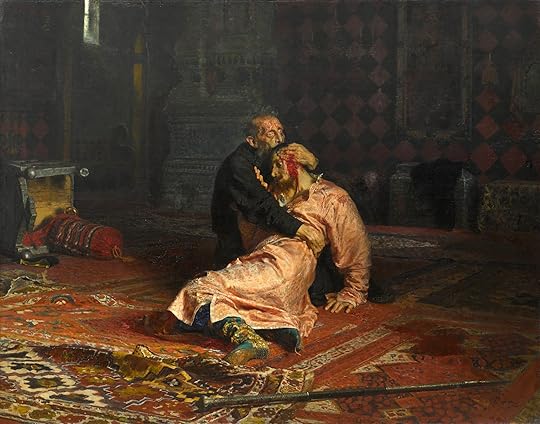
Ivan the Terrible and His Son, Ivan Ivanovich on 16 November 1581, painted by Ilya Yefimovich Repin. In a fit of rage, Ivan IV struck his son’s head with his iron staff. Shortly thereafter, after three days, his son passed away.
It’s fitting that when Ivan IV died, his legacy was plunging the Rus lands into the beginning of the Time of Troubles because, in his anger, he killed his own son (his only capable heir). Unfortunately, not enough historical assessment of the people beside Ivan who, directly or indirectly, influenced the course of Muscovite political history. I’d like to know more about Malyuta Skuratov and Boris Godunov, how they came of service with Ivan IV and became his favourites. All things considered, this book is a recommended reading for those curious about the awful deeds Ivan the Terrible had done.

April 22, 2023
This book was super amazing I thought. I got the longest available one I could find on this man and it was worth it. It was a quick read and super fun for a decently long book at around 433 pages. Ivan IV or Ivan the Terrible was a complex man who I didn’t much know about before reading this book. He certainly did brutal and terrible things but it’s more complex than he was just born bad. His parents died at a young age and he was raised in a pretty bad environment, boyars and council members constantly vying for control and power and using him as a puppet head probably had a big negative impact on him. Once he came to power at 15 he learned he had to be pretty hard and cruel to get what he wanted. He took khazan and astrakhan at a young age, thought admittedly he didn’t have a super big involvement, he was not super courageous. After that he was a pretty normal person in his 20s. Then the reign of terror came in his late 30s and early 40s where he ruled brutally. He killed thousands of people with his secret police/military type group and was super cruel to his own people. He killed town fulls of people and murdered men women and children. He claimed to have deflowered a thousand virgins and was a pretty wicked dude. He disbanded the secret police, oprichnina, I think is correct spelling and went back to ruling without them in his 40s to 50s. He was still cruel at times and tried to make alliances with England which never came to total fruition, but he was better than the terror previously. His younger brother dying, his first wife and him killing his son, a spur of the moment type thing, all had huge influences on him and how he acted. He was a ruthless man who brought the country of Russia to ruin sometimes with the Tartars, Lithuanians, poles, Swedes, etc. He was a complicated man who was admittedly pretty terrible in his rule. Persecuting the orthodox faith but still claiming to be appointed by God and a devout Christian, his life is riddled with contradictions and hardships. This book was a fun read and I recommend it to anyone who likes history, Russia, or a combination of both. It was quick as well too. This book about Ivan was really good and I hope to read more from this author soon!
5/5
5/5
This entire review has been hidden because of spoilers.
July 3, 2022
I don't think I would reread this since it's not exactly pertinent to my personal studies but the origins of "Tsardom" and what the concept of a Tsar culturally entails is worth knowing. 16th century Russia was met with its own sort of Iconoclast Controversy just like the Byzantine Empire was (though not as pronounced), which is neat. It's also worth knowing about the interactions between the emerging Russian Empire and the waning remnant states of the Mongol Empire. Ivan himself is only worth learning about in regard to the cultural precedents his actions set. I'm more interested in the people who took a stand against Ivan, which is compelling especially considering that this is pre-Charles I of England. But unlike Oliver Cromwell with Charles I, Philip II's efforts to stop Ivan failed and everybody died. The end.

April 20, 2022
A thorough investigation of one of the deadliest autocrats in history, this book pulls no punches while being very fair in its portrayal of the subject. From a difficult and confusing childhood to a death after recognizing his wrongs, Ivan Vassiliovich was a man of complicated emotions who was raised in an environment of fear for his throne and life. One will see that there was a time where Ivan was forgiving and loving. One key moment snapped his peace and unleashed a man who could destroy half of a Russian city while presenting himself as the ultimate caring leader of an empire he was struggling to maintain. Ivan’s life displays the interaction between nature and nurture. Definitely worth the read.
January 25, 2019
A great read. At times it can be hard to imagine that Tsar Ivan did all these terrible things, but the text goes into pretty good detail of the atrocities being committed by the Tsar. Sometimes they include full conversations and quotes from the Tsar which I’ve always wondered as to how they know word for word what was said. Sometimes even in situations where a notetaker would not be present are quotes attributed to the Tsar. Overall a great book, and an easy read to boot.
October 14, 2025
Genuinely for the first 50% I was thinking, "Okay, maybe "The Terrible" sobriquet was really just an overstatement, he's not that bad". Well, after reading about over 4,000 deaths Ivan committed, my opinion has definitely changed. Really good book, I liked how the history was presented narratively and conversationally.

July 28, 2017
It took a while to convince me of his terrible nature, but the compilation of ancient texts and illustrations that support the central conceits turn this non-fiction work into a realm of sincere greatness.
December 24, 2024
A solid overview of what led up to Ivan being terrible. It has a lot of useful maps and diagrams to help visualize some of the information in the books. Recommend for anyone wanting to learn about Russian History and Ivan the Terrible.

February 15, 2019
Couldn't put it down.

June 10, 2023
Have you ever just browsed the history textbook section at a university to see what other classes were reading? I have. This book was the result, and I was not dissapointed.
September 17, 2024
Eye opening and entertaining non fiction read about one of Russia’s most prolific figures
September 30, 2025
Had to read for school but found it very interesting compared to other biographies. Would recommend.
May 3, 2026
Ivan was actually terrible. I was consistently thinking “how is this not 17 movies but fast and the furious is”. What a crazy ass dude. 10/10 glad he’s dead
February 5, 2019
This book is a must read.. It's well written and an insane story. Ivan the Terrible belongs in the same peer group as Hitler, Stalin and Mao. He wiped out entire cities by unleashing his army of psychopaths called oprichniki. Ivan was 100% secure in the idea that every inch and every soul inside Russia belonged to him. He was abused and exploited by his Regents as a child. I'm surprised they didn't just kill him. But he was obviously affected bc he exacted revenge not just on the Regents, but on the entire boyar class. His brutality and bloodshed became infamous across Europe. And yet he was convinced that he was unfairly maligned and that all his victims had betrayed him and deserved their punishments. Ivan considered himself a martyr. He even left Moscow and "quit" his position as tsar in what seemed like a ploy to get both boyars and peasants to find him and beg him to return.
The writing styles of these bios range from casual and maybe what you'd today call Popular History to books that feel more academic,, and this one skews to the former, but feels like a book written by history professors as much as scholars. It's a fun read and a unique story. I LOLd many times at Ivan's rudeness, tempestuousness and pettiness. Things he said and did. One rival king sent Ivan two highly critical books from Europe about Ivan with the note "read what they're saying about you in Europe." He was trolling him.
The irony is that Ivan was highly educated and began his reign looking like a decent, intelligent tsar. But he went downhill after his first wife died.
The writing styles of these bios range from casual and maybe what you'd today call Popular History to books that feel more academic,, and this one skews to the former, but feels like a book written by history professors as much as scholars. It's a fun read and a unique story. I LOLd many times at Ivan's rudeness, tempestuousness and pettiness. Things he said and did. One rival king sent Ivan two highly critical books from Europe about Ivan with the note "read what they're saying about you in Europe." He was trolling him.
The irony is that Ivan was highly educated and began his reign looking like a decent, intelligent tsar. But he went downhill after his first wife died.

January 16, 2017
I came Ivan the Terrible through my interest in Soviet-era Russian history and the obvious parallels between him and Stalin, who sought to rehabilitate his reputation in the 1940s.
This biography is really good and really surprising in its detail about Ivan's life, given that he lived almost 500 years ago. It shows how deeply runs the Russian tradition of the strong-willing despot. Here's a ruler who could kill his own son, and countless, countless others, and still hold on to power until his death. I was also struck at the two sides of Ivan, which to modern eyes simply can't exist together: a brutal and torturous paranoiac, an a reverent man whose existence was surrounded by the trappings of the Orthodox Church. Very strange indeed.
There is just so much about him that Stalin reproduced:
"When Ivan punished his officers of state, he rarely gave precise reasons. It was enough that his suspicions had been aroused, that they had acted in a manner incomprehensible to him, that he had taken a sudden and unreasoning dislike for them. He believed he had a good nose for smelling out treachery and he thought he could recognize a traitor even before he became treacherous. So with Novgorod; he felt under no necessity to proclaim the reasons that led him to believe that Russia would benefit by a general massacre of the inhabitants. The reasons could be invented later, if anyone dared ask for them."
This biography is really good and really surprising in its detail about Ivan's life, given that he lived almost 500 years ago. It shows how deeply runs the Russian tradition of the strong-willing despot. Here's a ruler who could kill his own son, and countless, countless others, and still hold on to power until his death. I was also struck at the two sides of Ivan, which to modern eyes simply can't exist together: a brutal and torturous paranoiac, an a reverent man whose existence was surrounded by the trappings of the Orthodox Church. Very strange indeed.
There is just so much about him that Stalin reproduced:
"When Ivan punished his officers of state, he rarely gave precise reasons. It was enough that his suspicions had been aroused, that they had acted in a manner incomprehensible to him, that he had taken a sudden and unreasoning dislike for them. He believed he had a good nose for smelling out treachery and he thought he could recognize a traitor even before he became treacherous. So with Novgorod; he felt under no necessity to proclaim the reasons that led him to believe that Russia would benefit by a general massacre of the inhabitants. The reasons could be invented later, if anyone dared ask for them."

September 12, 2016
The name Ivan the Terrible conjures up all sorts of visions. For me, these visions have always been mostly unreal. When touring the Kremlin, we heard of him throwing cats out of the high windows of the Palace of Facets. Stories to scare children.
In truth, Ivan left a path of blood and killing that wouldn't be surpassed until the 20th century. But it took him a while to get there. The book may as well be split into two parts. Before the death of his wife Anastasia he was a good and able leader. Within weeks of his wife's death, he was a paranoid sociopath with unlimited power. He remained this way until he murdered his own son not long before his own death.
It's difficult to compare Ivan to Stalin or Hitler or Pol Pot. In the largest sense, Ivan didn't kill nearly as many people. Those 20th century villains were responsible for millions of deaths, but didn't actually do any of the killing by their own hands. Ivan was thrilled by killing, he liked having the blood of his victims splatter onto his own face. He reveled in devising new ways to torture and kill.
And, of course, he was a devout Christian, defender of the Orthodox faith. And in his final days he knew he'd be forgiven by God.
In truth, Ivan left a path of blood and killing that wouldn't be surpassed until the 20th century. But it took him a while to get there. The book may as well be split into two parts. Before the death of his wife Anastasia he was a good and able leader. Within weeks of his wife's death, he was a paranoid sociopath with unlimited power. He remained this way until he murdered his own son not long before his own death.
It's difficult to compare Ivan to Stalin or Hitler or Pol Pot. In the largest sense, Ivan didn't kill nearly as many people. Those 20th century villains were responsible for millions of deaths, but didn't actually do any of the killing by their own hands. Ivan was thrilled by killing, he liked having the blood of his victims splatter onto his own face. He reveled in devising new ways to torture and kill.
And, of course, he was a devout Christian, defender of the Orthodox faith. And in his final days he knew he'd be forgiven by God.
July 7, 2012
“Terrible” doesn’t begin to describe the evil behind this Tsar. The level of violence and bloodshed is overwhelming in its intensity and cruelness. All Tsars believed to be chosen by God, therefore, rules didn’t apply to them on any level, but Ivan’s extravagances and thirst for blood impregnated his Tsardom like no other.
The contrast with Ivan’s religiosity is nauseating and jaw dropping. More than a Tsar, Ivan is an insane serial killer in the annals of russian history. Only thing memorable about his Reign, as far as I’m concerned, is the construction of Saint Basil’s Cathedral.
Positives:
Medium Paced.
Intriguing at times.
Negatives:
Christian Moulton’s (Amazon’s review) exposes his concerns about the inaccuracy of certain aspects of this biography. In particular, religious practices. That alone makes me wonder about the rest of the book.
Although famous for killing his son, this biography barely mentions the fact.
The contrast with Ivan’s religiosity is nauseating and jaw dropping. More than a Tsar, Ivan is an insane serial killer in the annals of russian history. Only thing memorable about his Reign, as far as I’m concerned, is the construction of Saint Basil’s Cathedral.
Positives:
Medium Paced.
Intriguing at times.
Negatives:
Christian Moulton’s (Amazon’s review) exposes his concerns about the inaccuracy of certain aspects of this biography. In particular, religious practices. That alone makes me wonder about the rest of the book.
Although famous for killing his son, this biography barely mentions the fact.
October 8, 2012
This was an engaging book from start to finish. While I knew that he was named Ivan the Terrible,I never realized how truly terrible he was. The level of slaughter and violence that he perpetuated was breathtaking even by Russian standards. It is amazing how the people and the nobility accepted it without rebellion or resistance. It shows the power of a monarch who effectively claims that he is backed by god. This bookmoved quickly and did not gloss over the details which made for an awesome read.

June 19, 2023
Biography on the first Tsar of Russia, Ivan the Terrible. Describes Ivan being surrounded by violence throughout his youth, leading into him being a vicious adult with a broad imagination when it came to violence. Also gets into Ivan’s deep devotion to Eastern Orthodox religiosity and how the then underdeveloped and largely rural Russian society as a whole viewed their Tsar as a figure to be viewed with religious awe and devotion. Also gets into Ivan’s mental state getting worse dealing with continual wars of conquest as an adult as well as a few personal tragedies in his life.

October 14, 2013
Very interesting book about Ivan the Terrible. It is amazing the horrors and fear the Russian people have had to endure over such a long time. Much of Ivan's paranoia and disregard for human life are later reflected in the behavior of Stalin. Many Russians were killed over both men's perception that everyone was after their power and the only way to control people was through fear. Also, incredible is how many descriptions, letters, and relics have survived from the time of Ivan.

March 3, 2010
This book is a different type or era for me to read on. Many many names that are the same and can be very confusing. Mind boggling how this man did so many great things, such as having his hand in some of the most extravagant cathedrals built in Russia that still stand today, can turn into one of the most vengeful and killer of this time. Very heavy read, but good to learn about history right?
Displaying 1 - 30 of 38 reviews