

What do you think?
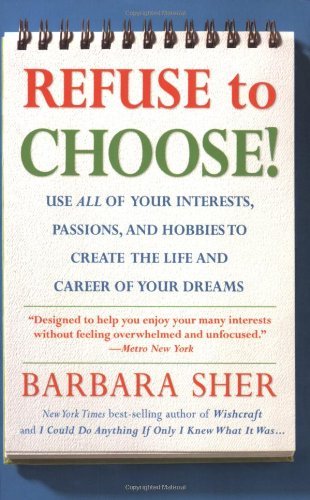
Refuse to Choose!: Use All of Your Interests, Passions, and Hobbies to Create the Life and Career of Your Dreams
Don't know what to do with your life? Drawn to so many things that you can't choose just one? New York Times best-selling author Barbara Sher has the answer--do EVERYTHING!
With her popular career counseling sessions, motivational speeches, workshops, and television specials, Barbara Sher has become famous for her extraordinary ability to help people define and achieve their goals. What Sher has discovered is that some individuals simply cannot, and should not, decide on a single path; they are genetically wired to pursue many areas. Sher calls them "Scanners"--people whose unique type of mind does not zero in on a single interest but rather scans the horizon, eager to explore everything they see.
In this groundbreaking book, readers will learn:
• what's behind their "hit and run" obsessions
• when (and how) to finish what they start
• how to do everything they love
• what type of Scanner they are (and which tools they need to do their very best work)
With her popular career counseling sessions, motivational speeches, workshops, and television specials, Barbara Sher has become famous for her extraordinary ability to help people define and achieve their goals. What Sher has discovered is that some individuals simply cannot, and should not, decide on a single path; they are genetically wired to pursue many areas. Sher calls them "Scanners"--people whose unique type of mind does not zero in on a single interest but rather scans the horizon, eager to explore everything they see.
In this groundbreaking book, readers will learn:
• what's behind their "hit and run" obsessions
• when (and how) to finish what they start
• how to do everything they love
• what type of Scanner they are (and which tools they need to do their very best work)
288 pages, Paperback
First published January 1, 2006
About the author
Barbara Sher
32 books313 followersLibrarian Note: There is more than one author in the Goodreads database with this name.
Barbara Sher was a speaker, career/lifestyle coach, and best-selling author of seven books on goal achievement. Her books have sold millions of copies and been translated into many languages. She had appeared on Oprah, The Today Show, 60 Minutes, CNN, and Good Morning America and her public television specials aired regularly in the United States. Sher lectured at universities, Fortune 100 companies and professional conferences all over the world.
Sher's latest book, Refuse to Choose (Rodale 2006) is a step-by-step program designed for "scanners", people with many interests who are unable to decide on a single direction for their lives.
wiki courtesy
Barbara Sher was a speaker, career/lifestyle coach, and best-selling author of seven books on goal achievement. Her books have sold millions of copies and been translated into many languages. She had appeared on Oprah, The Today Show, 60 Minutes, CNN, and Good Morning America and her public television specials aired regularly in the United States. Sher lectured at universities, Fortune 100 companies and professional conferences all over the world.
Sher's latest book, Refuse to Choose (Rodale 2006) is a step-by-step program designed for "scanners", people with many interests who are unable to decide on a single direction for their lives.
wiki courtesy
Ratings & Reviews
Friends & Following
Create a free account to discover what your friends think of this book!
Community Reviews
Displaying 1 - 30 of 382 reviews

November 5, 2011
I think it will be difficult to write a review of this book without exceeding the 20,000 character limit. But I'll try.
Refuse To Choose! is about Scanners - people who simply cannot immerse themselves in just one career for their whole lives. Scanners have so many interests (and find new ones just about every day) that they often have trouble focusing on any one interest for an extended period of time. I know I fit in with this group, because in the process of composing this review, I alt-tabbed to my TODO listthree four times to make notes on new ideas I had. I always do things like that. For years I thought I was broken, that I'd never complete anything, that I'd never amount to anything. That I'd spend so much time planning new projects that I'd never finish my existing ones. And yet, I've already finished quite a few projects.
At times it really feels like the author knows who I am. She lets readers like me acknowledge that we're different, and then reassures us that there is nothing wrong with that. In fact, it puts people like me in good company with the likes of Aristotle, Ben Franklin, and Leonardo da Vinci. It's perfectly okay to be an artist, writer, musician, mathematician, and inventor. Go ahead and be a chef, painter, photographer, and a physics teacher. You shouldn't have to choose one thing to stick with for the rest of your life. You really can do everything. At least, that's the message of the book.
Once you acknowledge that you are a Scanner, and that it's okay to be different, then you learn about different types of Scanners. The author acknowledges that everyone will fit at least two of the Scanner types she lists. And that's where the real strength of this book lies. Once you've identified what types you are, you can learn ways to make yourself more efficient, and career options that will keep you motivated and excited.
As for me, I found that I'm part "Plate-Spinner" and part "Serial Master". This is a little humorous, because I've often said I have too many things "on my plate," when in reality that is my greatest strength: the ability to manage several projects simultaneously. The most surprising thing I found was in the Serial Master category, which I figure is a smaller portion of my Scanner abilities. But even that small part of me explained something that I hadn't figured out yet. Most of what the author suggests are things I've already been doing for a couple of years now -- with the exception that I've gone digital with the vast majority of the methods. I figured out most of these things on my own. But I wonder how much more I could have accomplished in my life if I had read this book ten or fifteen years ago.
While I'm forced to agree with the author that there are great benefits to writing and sketching things by hand, I've found some success with having notes, diagrams, and TODO lists on my computer. This is one area that she almost never mentions. Perhaps she hasn't found decent software to help manage what she wants to do in life. Personally, I found I wasted too much time (and paper!) copying my TODO lists to less messy sheets of paper. Not to mention the time I wasted trying to decipher my handwriting. Having my lists on my computer (where I do the vast majority of my work anyway) makes things neater and more efficient for me. I would like to see either an updated version of this book or an additional book that discusses ways to organize yourself digitally. Why print out things from Wikipedia and tape them in a Scanner Daybook if you can just copy and paste the link into something like Microsoft OneNote, Evernote, or BasKet?
Overall, I found the book to be very motivating and thought-provoking. Like I said, I had already discovered all the methods she suggests for my types of Scanner, and have been using them for a while now. But if you've ever been told you need to choose a career, or if you have a pile of unfinished things that make you sad, or you find you just can't stop reading random articles on Wikipedia... grab a copy of this book. It could just change your outlook on life.
Refuse To Choose! is about Scanners - people who simply cannot immerse themselves in just one career for their whole lives. Scanners have so many interests (and find new ones just about every day) that they often have trouble focusing on any one interest for an extended period of time. I know I fit in with this group, because in the process of composing this review, I alt-tabbed to my TODO list
At times it really feels like the author knows who I am. She lets readers like me acknowledge that we're different, and then reassures us that there is nothing wrong with that. In fact, it puts people like me in good company with the likes of Aristotle, Ben Franklin, and Leonardo da Vinci. It's perfectly okay to be an artist, writer, musician, mathematician, and inventor. Go ahead and be a chef, painter, photographer, and a physics teacher. You shouldn't have to choose one thing to stick with for the rest of your life. You really can do everything. At least, that's the message of the book.
Once you acknowledge that you are a Scanner, and that it's okay to be different, then you learn about different types of Scanners. The author acknowledges that everyone will fit at least two of the Scanner types she lists. And that's where the real strength of this book lies. Once you've identified what types you are, you can learn ways to make yourself more efficient, and career options that will keep you motivated and excited.
As for me, I found that I'm part "Plate-Spinner" and part "Serial Master". This is a little humorous, because I've often said I have too many things "on my plate," when in reality that is my greatest strength: the ability to manage several projects simultaneously. The most surprising thing I found was in the Serial Master category, which I figure is a smaller portion of my Scanner abilities. But even that small part of me explained something that I hadn't figured out yet. Most of what the author suggests are things I've already been doing for a couple of years now -- with the exception that I've gone digital with the vast majority of the methods. I figured out most of these things on my own. But I wonder how much more I could have accomplished in my life if I had read this book ten or fifteen years ago.
While I'm forced to agree with the author that there are great benefits to writing and sketching things by hand, I've found some success with having notes, diagrams, and TODO lists on my computer. This is one area that she almost never mentions. Perhaps she hasn't found decent software to help manage what she wants to do in life. Personally, I found I wasted too much time (and paper!) copying my TODO lists to less messy sheets of paper. Not to mention the time I wasted trying to decipher my handwriting. Having my lists on my computer (where I do the vast majority of my work anyway) makes things neater and more efficient for me. I would like to see either an updated version of this book or an additional book that discusses ways to organize yourself digitally. Why print out things from Wikipedia and tape them in a Scanner Daybook if you can just copy and paste the link into something like Microsoft OneNote, Evernote, or BasKet?
Overall, I found the book to be very motivating and thought-provoking. Like I said, I had already discovered all the methods she suggests for my types of Scanner, and have been using them for a while now. But if you've ever been told you need to choose a career, or if you have a pile of unfinished things that make you sad, or you find you just can't stop reading random articles on Wikipedia... grab a copy of this book. It could just change your outlook on life.

May 1, 2012
I read this more for affirmation than for practical advice. I don't know if I'll use all the techniques Barbara Sher recommends for pursuing lots of interests at once (though I do like the sound of having several "avocation stations" -- little wheeled file carts with work surfaces on top so you can have multiple projects ready to go for whenever the whim strikes you). But what I really did like about this book was the permission it gives to go ahead and be interested in lots of stuff, to move from one thing to the next when one wants to. Coming from a very academic background, in which one's career is supposed to be one's Grand Passion in Life, or at least a Very Big Thing, I found it such an incredible relief to have someone tell me, in effect, that it's OK if I just want a pleasant, reasonably interesting job that'll allow me plenty of time to pursue the other stuff I'm interested in, and that that doesn't mean I'm lazy or stupid or lacking in something.

May 25, 2017
yes , actually i am a multi potential scanner . and i thank you for making somewhere for us . a home to belong

May 6, 2021
This book had a few ideas I thought were worth giving a try and that's all, the rest was chocolate coated blabbing. But even with that, I think it's a decent enough book if you are looking for affirmations and inspiration that liking many things is OK. It is validating, but otherwise, there are no facts and no clear logic, doesn't seem to have any research either.
There was a lot of labelling which didn't seem necessary and I didn't like. I felt like the author was trying to fill the book with clever words and labels for types of people just to gain more credibility.
I'm off to get a job as a PA with a family that owns their own art collection and will let me manage that. Ciao. Oh, and to get 30 binders.
There was a lot of labelling which didn't seem necessary and I didn't like. I felt like the author was trying to fill the book with clever words and labels for types of people just to gain more credibility.
I'm off to get a job as a PA with a family that owns their own art collection and will let me manage that. Ciao. Oh, and to get 30 binders.
September 22, 2009
If you are the type of person that jumps from interest to interest and you either have judgments around that, want to find a job suited to you, or just want to know it's okay to do that, this book rocks.
I don't have ADD, but I feel like I do because I just LOVE learning. But I've been trying to stop jumping from thing to thing because it's culturally alienating. Well now I feel proud of my insatiable appetite for learning, I feel more confident looking for jobs and less pressured into finding my ONE career for life. I want to do it all.
This book really cleared up some things for me and I recommend it to anyone who is still saying "I don't know what I want to be when I grow up." Chances are, you are ALREADY that person. Celebrate it!
I don't have ADD, but I feel like I do because I just LOVE learning. But I've been trying to stop jumping from thing to thing because it's culturally alienating. Well now I feel proud of my insatiable appetite for learning, I feel more confident looking for jobs and less pressured into finding my ONE career for life. I want to do it all.
This book really cleared up some things for me and I recommend it to anyone who is still saying "I don't know what I want to be when I grow up." Chances are, you are ALREADY that person. Celebrate it!

February 17, 2018
Anecdotal and syrupy
The core argument is that some people are “scanners” with multiple interests, and these people are genetically different in some magic way. However, there was no clear evidence to support this. The book consists of mostly anecdotes and questionable logical fallacies. I agree that nobody should feel terrible about themselves, but the writing style was incredibly syrupy and overly optimistic. Having multiple hobbies and not wanting one core focus is cool, but the book made it sound like “being a scanner” somehow excuses somebody from all bad behavior - missing appointments, not following through on commitments to others. Perhaps the title should’ve warned me about the writing style. I would not recommend the book, and I prefer self-help books based in science and psychology.
The core argument is that some people are “scanners” with multiple interests, and these people are genetically different in some magic way. However, there was no clear evidence to support this. The book consists of mostly anecdotes and questionable logical fallacies. I agree that nobody should feel terrible about themselves, but the writing style was incredibly syrupy and overly optimistic. Having multiple hobbies and not wanting one core focus is cool, but the book made it sound like “being a scanner” somehow excuses somebody from all bad behavior - missing appointments, not following through on commitments to others. Perhaps the title should’ve warned me about the writing style. I would not recommend the book, and I prefer self-help books based in science and psychology.

July 14, 2010
Where I got the book: my local library.
My name is Jane, and I . . . am a Scanner.
At last someone has put a name to what I tend to think of as my Low Boredom Threshold. My ability to get interested in a great many different things has resulted in a good many careers (some carried on simultaneously), far too many hours in higher ed. and a general feeling of frustration that I’ll never be able to get my life “together.” It wasn’t until I rather unexpectedly quit a job in 2009 (long story) and, instead of rushing to find another one, allowed myself a few weeks to think about what I really wanted, that it occurred to me the one thread that had always run through my jobs was writing. It was either what people hired me for or what they discovered I was good at after a short while on the job. “Jane, you are a writer,” I said to myself. And I was right! I’d finally discovered the activity that never got boring because there was always something new to write about and always something about writing to learn.
Barbara Sher gives the name Scanner to those of us who have multiple interests and don’t want to spend their lives working on one career. How we envy those who are engaged enough in their everyday jobs to stick with them, working their way up the career ladder to the merry tune of promotions and pay raises. We thought we’d finally found our niche, and here we are a year later, bored out of our skulls. What’s the solution?
Sher comes up with several. She tells us that we really can have it all, if we look at our lives the right way. Many of her suggestions for careers and productivity techniques suited to our particular needs are so mouthwatering I wanted to get started on all of them right away . . . heh . . . . Of course no guru can suggest a course of action that suits every reader perfectly, and I quickly found myself thinking about how to adapt one or two of her ideas to my own working methods. I made a list of the most likely techniques in my Daybook. I shall forever be grateful to Barbara Sher for the idea of a Daybook, which has become my go-to place to write down all those lists and brainstorming that kept invading my journal, to the point where I’d stopped journaling because it was annoying me. Now I can download all that stuff into my Daybook and maybe I can begin journaling again.
Sher identifies several different kinds of Scanner—I thought it was hilarious that every time I started a new chapter about a different kind of Scanner I thought “Oh hey, that’s so me.” Because we’ve got these brains that go in all sorts of different directions—mine never works quite the same from one day to the next. I’m finally learning to appreciate the value of being able to read about something, connect it to something else and come up with a completely new idea—now I just have to learn how to turn those ideas into something solid that I won’t get bored with. The way I describe it is that my brain fizzes—it seems to need new ideas like a whale needs plankton, and excretes them at high speed like—what, exactly, do whales poop out? On some days, that is, when I’m not so overwhelmed that the fog descends and I can barely get anything done.
Anyone who’s followed my reviews for a while will know that I generally get very snarky over self-help books but this one, I liked. I’m going to stick my neck out and give it five stars for being a self-help book that was actually worth my attention from cover to cover, even if I did find it a bit heavy on examples at times. It might even be worth re-reading at some point in the future.
My name is Jane, and I . . . am a Scanner.
At last someone has put a name to what I tend to think of as my Low Boredom Threshold. My ability to get interested in a great many different things has resulted in a good many careers (some carried on simultaneously), far too many hours in higher ed. and a general feeling of frustration that I’ll never be able to get my life “together.” It wasn’t until I rather unexpectedly quit a job in 2009 (long story) and, instead of rushing to find another one, allowed myself a few weeks to think about what I really wanted, that it occurred to me the one thread that had always run through my jobs was writing. It was either what people hired me for or what they discovered I was good at after a short while on the job. “Jane, you are a writer,” I said to myself. And I was right! I’d finally discovered the activity that never got boring because there was always something new to write about and always something about writing to learn.
Barbara Sher gives the name Scanner to those of us who have multiple interests and don’t want to spend their lives working on one career. How we envy those who are engaged enough in their everyday jobs to stick with them, working their way up the career ladder to the merry tune of promotions and pay raises. We thought we’d finally found our niche, and here we are a year later, bored out of our skulls. What’s the solution?
Sher comes up with several. She tells us that we really can have it all, if we look at our lives the right way. Many of her suggestions for careers and productivity techniques suited to our particular needs are so mouthwatering I wanted to get started on all of them right away . . . heh . . . . Of course no guru can suggest a course of action that suits every reader perfectly, and I quickly found myself thinking about how to adapt one or two of her ideas to my own working methods. I made a list of the most likely techniques in my Daybook. I shall forever be grateful to Barbara Sher for the idea of a Daybook, which has become my go-to place to write down all those lists and brainstorming that kept invading my journal, to the point where I’d stopped journaling because it was annoying me. Now I can download all that stuff into my Daybook and maybe I can begin journaling again.
Sher identifies several different kinds of Scanner—I thought it was hilarious that every time I started a new chapter about a different kind of Scanner I thought “Oh hey, that’s so me.” Because we’ve got these brains that go in all sorts of different directions—mine never works quite the same from one day to the next. I’m finally learning to appreciate the value of being able to read about something, connect it to something else and come up with a completely new idea—now I just have to learn how to turn those ideas into something solid that I won’t get bored with. The way I describe it is that my brain fizzes—it seems to need new ideas like a whale needs plankton, and excretes them at high speed like—what, exactly, do whales poop out? On some days, that is, when I’m not so overwhelmed that the fog descends and I can barely get anything done.
Anyone who’s followed my reviews for a while will know that I generally get very snarky over self-help books but this one, I liked. I’m going to stick my neck out and give it five stars for being a self-help book that was actually worth my attention from cover to cover, even if I did find it a bit heavy on examples at times. It might even be worth re-reading at some point in the future.
October 10, 2011
The initial "You're a Scanner! It's okay! You're SPECIAL!!" intro got a bit tedious. I think that’s because the author self-identifies as one and is giddy with the thought that “it’s not wrong to be this way!” Like other readers, I think some people would grab onto these ideas as excuses. But some people will grab on to anything they can distort or interpret in extreme ways, so I don’t think that fact invalidates the general idea. (I would call that a “slippery slope” argument, btw.)
The early chapters that most resonated with me were Ch 5 (“Too busy to do what I love.” - starting on p 62), Chapter 6 (“I won’t do anything if I can’t do everything.”) and Chapter 7 (“I can’t get started.”)
In those chapters, I think that some of her strategies/advice work for procrastinators, perfectionists, and people who simply have not learned to tune into their own desires. As someone who has fit all of those descriptions at varied times, I found them useful. “The Big List” was telling - as she predicted, it wasn’t nearly as big as I thought. While all the ideas presented won’t work for me, even a few would make the time spent reading worth it.
Overall, here are my Big TakeAways:
1) Reassurance and reminding. There are a lot of tools I already use, and they work for me. The book reminded me of some, or suggested new spins for making them more useful. I liked that.
2) New tools that look promising, which makes it worth the read right there to me.
3) Most importantly, a Big Picture Structure to think about and use for my own life.
What do I mean by that third one? Well, for each type of Scanner, she proposes a Life Design Model, potential Careers, and some specific tools that might serve them. I like these descriptive terms.
The life design talks about how you structure your time to fit your natural inclinations, so that you can be happy and productive. The one that caught my attention was the “physician model”, (p. 156), where you spend a few days a week doing one thing, a few days a week doing another type of thing, and a couple weeks a year doing something-completely-different. That maps well to academia too, but being conscious about it may make it…well, fit better. I’ve already become aware that I need certain things in each day/week to feel good about myself, and the term “Life Design Model” and the examples are helping me to translate that knowledge into action.
In terms of potential careers, she talks about specific ones, but she also talks about some ways of classifying them (mixed - my logical-classifying-self would break them out a bit). The ones that caught my attention here were “The umbrella job”, which lets you do varied things under it, “the good-enough-job,” which just brings in enough $$ for you to manage (without sapping your soul) so you can do the stuff you care about, and the “multiple streams of income” where you make a bit here and a bit there, and get by that way. I think I have had sequential “umbrella jobs” up to now. That may be what I look for next… Or not, since I’m at a transitional point in life. I like being able to think about them this way. (Not a full list, of course - I’m focusing on what-I-found-useful.)
And of course, the shiny tools made me happy. I have a mind like a magpie, attracted to bright shiny ideas, especially in the form of models and metaphors. Plenty of that to amuse me.
To;dr version: despite the tediousness of the intro “you’re different/speshul” bit, I found this book useful and would recommend it to others.
The early chapters that most resonated with me were Ch 5 (“Too busy to do what I love.” - starting on p 62), Chapter 6 (“I won’t do anything if I can’t do everything.”) and Chapter 7 (“I can’t get started.”)
In those chapters, I think that some of her strategies/advice work for procrastinators, perfectionists, and people who simply have not learned to tune into their own desires. As someone who has fit all of those descriptions at varied times, I found them useful. “The Big List” was telling - as she predicted, it wasn’t nearly as big as I thought. While all the ideas presented won’t work for me, even a few would make the time spent reading worth it.
Overall, here are my Big TakeAways:
1) Reassurance and reminding. There are a lot of tools I already use, and they work for me. The book reminded me of some, or suggested new spins for making them more useful. I liked that.
2) New tools that look promising, which makes it worth the read right there to me.
3) Most importantly, a Big Picture Structure to think about and use for my own life.
What do I mean by that third one? Well, for each type of Scanner, she proposes a Life Design Model, potential Careers, and some specific tools that might serve them. I like these descriptive terms.
The life design talks about how you structure your time to fit your natural inclinations, so that you can be happy and productive. The one that caught my attention was the “physician model”, (p. 156), where you spend a few days a week doing one thing, a few days a week doing another type of thing, and a couple weeks a year doing something-completely-different. That maps well to academia too, but being conscious about it may make it…well, fit better. I’ve already become aware that I need certain things in each day/week to feel good about myself, and the term “Life Design Model” and the examples are helping me to translate that knowledge into action.
In terms of potential careers, she talks about specific ones, but she also talks about some ways of classifying them (mixed - my logical-classifying-self would break them out a bit). The ones that caught my attention here were “The umbrella job”, which lets you do varied things under it, “the good-enough-job,” which just brings in enough $$ for you to manage (without sapping your soul) so you can do the stuff you care about, and the “multiple streams of income” where you make a bit here and a bit there, and get by that way. I think I have had sequential “umbrella jobs” up to now. That may be what I look for next… Or not, since I’m at a transitional point in life. I like being able to think about them this way. (Not a full list, of course - I’m focusing on what-I-found-useful.)
And of course, the shiny tools made me happy. I have a mind like a magpie, attracted to bright shiny ideas, especially in the form of models and metaphors. Plenty of that to amuse me.
To;dr version: despite the tediousness of the intro “you’re different/speshul” bit, I found this book useful and would recommend it to others.
May 30, 2012
I thought her suggestions of careers often unrealistic, I'll never use half her suggestions (some of which would just add to the clutter, IMHO), and she's a bit too much of a cheerleader for me, so why did I give the book five stars? Because I have read a ridiculous number of "figure out your career" kinda books, and she is a breath of fresh air. In my teen years, I loved the idea of marrying someone who, like me, wasn't interested in "a career," and then sending each other to school, repeatedly, as we switched careers our whole lives. This is the first "figure out your career" kinda book I've read where I get the impression the author could even understand that dream.
And while she is over-optimistic about the money some scanners could earn, she also recognizes that some people just don't care about money or prestige, and that that's okay. I've run across books for artists or actors that do that, but never a generic career kinda book. And I don't think it's just people who see themselves as artistic who feel that way, so it's nice to see it recognized that someone who could succeed as a real estate salesperson or whatever could be just as excited by a career where they don't make the big bucks, and nice to see someone say that it's okay to make that choice.
When I was a kid, What Color Is Your Parachute was considered revolutionary because he recommended figuring out your true passion and getting a job doing what you love. The other career books around back then were more about figuring out what you could do that would make good money. While there's a sense where this book is kind of retro -- finding a "Good Enough" job was pretty standard before Parachute -- it's also revolutionary as a career manual by encouraging people to not choose a career, or to make the most important thing in their lives something that doesn't earn money.
Where Parachute said, "You can be a success by doing what you love," Refuse to Choose makes a pretty good case for the idea that our current definition of "being a success" is a bad plan for many and should be abandoned. The people most in need of the knowledge that the "pursuit of happiness" is not the same as "finding the perfect career" are much more likely to read this book than the many books on other subjects that make that point.
And while she is over-optimistic about the money some scanners could earn, she also recognizes that some people just don't care about money or prestige, and that that's okay. I've run across books for artists or actors that do that, but never a generic career kinda book. And I don't think it's just people who see themselves as artistic who feel that way, so it's nice to see it recognized that someone who could succeed as a real estate salesperson or whatever could be just as excited by a career where they don't make the big bucks, and nice to see someone say that it's okay to make that choice.
When I was a kid, What Color Is Your Parachute was considered revolutionary because he recommended figuring out your true passion and getting a job doing what you love. The other career books around back then were more about figuring out what you could do that would make good money. While there's a sense where this book is kind of retro -- finding a "Good Enough" job was pretty standard before Parachute -- it's also revolutionary as a career manual by encouraging people to not choose a career, or to make the most important thing in their lives something that doesn't earn money.
Where Parachute said, "You can be a success by doing what you love," Refuse to Choose makes a pretty good case for the idea that our current definition of "being a success" is a bad plan for many and should be abandoned. The people most in need of the knowledge that the "pursuit of happiness" is not the same as "finding the perfect career" are much more likely to read this book than the many books on other subjects that make that point.

Read
February 11, 2025DNF 10% in... It was clear from the prologue that I wasn't going to find this book relatable (I should've done more research before buying it) so I skipped to a couple of interesting chapters in the hopes of bringing home some practical applications. I did not find anything particularly helpful in what I read, unfortunately. Moving on...

July 2, 2014
I appreciated aspects of this book, but mostly it was pretty silly.
I recognize that "hey, you display these behavioural traits, here are some ways to make them work for you" is not a good way to sell a book. No--you must be labeled as a unique category of being, and then be offered a "revolutionary program" that will change your entire relationship with yourself. There was a lot of emphasis on how people-who-like-to-do-lots-of-things are "just wired differently!" and have "unique" brains that "just don't work like other people's!", while never once mentioning where this information about neurological difference came from.
Suggestions for managing one's host of creative projects literally included "buy thirty binders" and "have a desk for each project," which can really only work if you are single and live in a McMasion.
"Quotes" from people she's helped were just ridiculous. Again, I acknowledge this is a conceit of the self-help genre, but page after page of "I used to do all of these well-articulated bad things, but now I will ask a lot of leading questions [always in an 'astonished' tone] and come to a deep realization about myself in one succinct paragraph" was tiresome.
Finally, the optimistic careers section rings very, very hollow post 2008.
I sound meaner than I intend to though - in many ways Sher's message is really useful and liberating: you don't actually want to do a million things, you just want to do maybe 50, and that's possible. Some of them can be taken more seriously than others, and you should feel free to walk away from a project once it's no longer exciting to you - finishing doesn't have to be the goal of every hobby.
I recognize that "hey, you display these behavioural traits, here are some ways to make them work for you" is not a good way to sell a book. No--you must be labeled as a unique category of being, and then be offered a "revolutionary program" that will change your entire relationship with yourself. There was a lot of emphasis on how people-who-like-to-do-lots-of-things are "just wired differently!" and have "unique" brains that "just don't work like other people's!", while never once mentioning where this information about neurological difference came from.
Suggestions for managing one's host of creative projects literally included "buy thirty binders" and "have a desk for each project," which can really only work if you are single and live in a McMasion.
"Quotes" from people she's helped were just ridiculous. Again, I acknowledge this is a conceit of the self-help genre, but page after page of "I used to do all of these well-articulated bad things, but now I will ask a lot of leading questions [always in an 'astonished' tone] and come to a deep realization about myself in one succinct paragraph" was tiresome.
Finally, the optimistic careers section rings very, very hollow post 2008.
I sound meaner than I intend to though - in many ways Sher's message is really useful and liberating: you don't actually want to do a million things, you just want to do maybe 50, and that's possible. Some of them can be taken more seriously than others, and you should feel free to walk away from a project once it's no longer exciting to you - finishing doesn't have to be the goal of every hobby.

July 26, 2012
For you, if you feel a lifetime isn't nearly long enough to pursue all your interests and make use of all your abilities.
Barbara Sher addresses those of us with a multitude of interests and talents, the ones who swooned when they got a look at the course catalog in college, the ones who wanted to major in all of human knowledge. Not only does she describe us so accurately that I felt the book was about me personally, but every chapter had insights and techniques I could (and did) put to use immediately.
We have a unique set of problems to go with our thirsty minds, such as feeling so overwhelmed by the possibilities that we don't know where to start. Or feeling we can never study as many things as deeply as we want to, so why try? Not only did I recognize much about myself that I hadn't ever put into words, but as soon as I did she began to expand my thinking in a way that freed me from much self-criticism. Limiting beliefs I hadn't ever examined were laid out on the page, and then illuminated with such insight that they disappeared, the way the dark disappears when you turn on the light.
When I read a book with "exercises" I almost never do them. Except this time, when I couldn't wait to get out my pen. I learned something useful about myself from each one. There are lots of practical suggestions for making room in our lives for all our riches, and keeping track of them too! This book gave me new hope (and practical new ways) for actually learning and doing all those wonderful things I feel so drawn to. And in just one lifetime.
Barbara Sher addresses those of us with a multitude of interests and talents, the ones who swooned when they got a look at the course catalog in college, the ones who wanted to major in all of human knowledge. Not only does she describe us so accurately that I felt the book was about me personally, but every chapter had insights and techniques I could (and did) put to use immediately.
We have a unique set of problems to go with our thirsty minds, such as feeling so overwhelmed by the possibilities that we don't know where to start. Or feeling we can never study as many things as deeply as we want to, so why try? Not only did I recognize much about myself that I hadn't ever put into words, but as soon as I did she began to expand my thinking in a way that freed me from much self-criticism. Limiting beliefs I hadn't ever examined were laid out on the page, and then illuminated with such insight that they disappeared, the way the dark disappears when you turn on the light.
When I read a book with "exercises" I almost never do them. Except this time, when I couldn't wait to get out my pen. I learned something useful about myself from each one. There are lots of practical suggestions for making room in our lives for all our riches, and keeping track of them too! This book gave me new hope (and practical new ways) for actually learning and doing all those wonderful things I feel so drawn to. And in just one lifetime.

March 22, 2013
Do you have trouble sticking with anything or are interested in so many things you can't focus on just one? Do you get bored as soon as you learn how to do something? Are you unwilling to commit to a specific career path so work at low-paying jobs instead? Do you keep changing your mind about what you want to do and end up doing nothing? Do you quit because you think you'll miss out on something better?
If you said yes to any of these, chances are good that you're a Scanner. The term itself describes people who constantly scan the horizon, always looking and excited to explore the next thing – or everything.
In Refuse to Choose: A Revolutionary Program For Doing Everything That You Love, Barbara Sher explains, “Unlike those people who seem to find and be satisfied with one area of interest, you're genetically wired to be interested in many things, and that's exactly what you've been trying to do. Because your behavior is unfamiliar—even unsettling—to the people around you, you've been taught that you're doing something wrong and you must try to change...What you've assumed is a disability to be overcome by sheer will is actually an exceptional gift. You are the owner of a remarkable, multitalented brain trying to do its work in a world that doesn't understand who you are and doesn't know why you behave as you do.”
This book is designed to help Scanners understand themselves, reverse years of misunderstanding, and teach them tools to become more confident, productive people.
There are several types of Scanners and Ms. Sher describes each and provides tools for motivation and productivity, choices of lifestyle, and types of careers that fit best, all illustrated by dozens of examples from her decades as a speaker, career/lifestyle coach, and best-selling author.
If you look around the internet, Scanners are also called Renaissance people, Multipotentialites and probably a dozen other labels. There's advice out there, but nothing with the wide range of practical information I found in this book.
If you said yes to any of these, chances are good that you're a Scanner. The term itself describes people who constantly scan the horizon, always looking and excited to explore the next thing – or everything.
In Refuse to Choose: A Revolutionary Program For Doing Everything That You Love, Barbara Sher explains, “Unlike those people who seem to find and be satisfied with one area of interest, you're genetically wired to be interested in many things, and that's exactly what you've been trying to do. Because your behavior is unfamiliar—even unsettling—to the people around you, you've been taught that you're doing something wrong and you must try to change...What you've assumed is a disability to be overcome by sheer will is actually an exceptional gift. You are the owner of a remarkable, multitalented brain trying to do its work in a world that doesn't understand who you are and doesn't know why you behave as you do.”
This book is designed to help Scanners understand themselves, reverse years of misunderstanding, and teach them tools to become more confident, productive people.
There are several types of Scanners and Ms. Sher describes each and provides tools for motivation and productivity, choices of lifestyle, and types of careers that fit best, all illustrated by dozens of examples from her decades as a speaker, career/lifestyle coach, and best-selling author.
If you look around the internet, Scanners are also called Renaissance people, Multipotentialites and probably a dozen other labels. There's advice out there, but nothing with the wide range of practical information I found in this book.
October 3, 2009
I just love Barbara Sher and wrote her and she actually replied and gave me advise.
Her books are about living your wishes and dreams. And it's good advise.
I'm reading all of her books and waiting for more.
And I'm reading them all a second time. Her advise is right up my alley. I love lists, being on task, charts, schedules and accomplishing things. She talks about childhood dreams and how they keep coming back and don't feel you can't accomplish anything. She tells us how and uses people she's helped do so. I love biographies so these little snippets help me to see I can do it too. She puts every blocker in the way and shows you how to get it out.
Yes, I will travel the world. It might take time but after all that's all we have in the end.
Her books are about living your wishes and dreams. And it's good advise.
I'm reading all of her books and waiting for more.
And I'm reading them all a second time. Her advise is right up my alley. I love lists, being on task, charts, schedules and accomplishing things. She talks about childhood dreams and how they keep coming back and don't feel you can't accomplish anything. She tells us how and uses people she's helped do so. I love biographies so these little snippets help me to see I can do it too. She puts every blocker in the way and shows you how to get it out.
Yes, I will travel the world. It might take time but after all that's all we have in the end.

January 21, 2019
I thought the book was good because it validated me for some of my “scanner” behaviors. I think if I read this in my 20’s it would be eye opening. In my 30’s it’s validating.
I thought it was good to hear other points of view. However the 2nd half of the book is trying to identify prescribed scanner types and what to do if you have these traits and it got tedious. I pushed thru and finished the book through. I think it could’ve been said with less words. I would’ve rated it a 4 if it wasn’t so repetitive towards the end.
I thought her info about how specialists came about with the Space Race.
I liked the book and respected what the author had to offer.
I thought it was good to hear other points of view. However the 2nd half of the book is trying to identify prescribed scanner types and what to do if you have these traits and it got tedious. I pushed thru and finished the book through. I think it could’ve been said with less words. I would’ve rated it a 4 if it wasn’t so repetitive towards the end.
I thought her info about how specialists came about with the Space Race.
I liked the book and respected what the author had to offer.
May 16, 2015
Stumbling on to this book at the age of 44 leaves me with feelings of relief and despair. How did I not ever find this author before? But I'm glad I did. This book helped me see that I'm not flawed, I've been using the wrong tools to measure myself.

August 20, 2013
I was really interested in the concept of this book, and the author sounds like she's a very good life coach. The style of the book, however, was very chaotic. She spent a great deal of time simply telling feelings and experiences and very little making any clear conclusions. It would have been great if it were intended simply as stories from her life, and if I wasn't specifically looking for the help and solutions she continually promised throughout the book.
I don't write many online reviews, but I was frustrated by the useful concept and intentions of the author combined with the very poor organization and editing of the book. I would have loved to help her edit the book and come out with a more useful end product. Also, I think I would have learned more about the subject.
Overall, I did get a few ideas for organizing that is complementary to this style of learning. I hope this book is more helpful for others than it was for me.
I don't write many online reviews, but I was frustrated by the useful concept and intentions of the author combined with the very poor organization and editing of the book. I would have loved to help her edit the book and come out with a more useful end product. Also, I think I would have learned more about the subject.
Overall, I did get a few ideas for organizing that is complementary to this style of learning. I hope this book is more helpful for others than it was for me.

November 20, 2018
I thought the writing was boring. It repeated a lot of the same ideas and I ended up skimming a lot of it. I don't think I am a full scanner either. Only about 80% of what she said applied to me. And most of her suggestions are things I already do. Several people recommend this book to me but I didn't really find it well written or applicable.

January 3, 2024
I'm not sure if I will use much information from this book, but it's mainly the 'permission' to enjoy and pursue multiple (lots of) hobbies and interests that has made a difference for me.

September 28, 2010
This book has real potential to change my life. Many self-help books are 'good' because of what psychologists call the Barnum Principle. That says that if you make things generic enough, what you say is bound to apply to just about anybody. However, this book is *not* like that. This book is specific enough that most people will find that it doesn't apply to them at all. But it definitely does apply to me. Barbara Sher defines several types of what she calls Scanners. There are Indecisives, Specialists and Masters, as well as sub categories within each one. Scanners are people who scan through various interests and careers, not being content to settle on any one thing for long. This, in contrast to the type of people who are perfectly happy being a banker during the day, reading finance books at night, and joining investing clubs with their free time. Scanners might be in a cooking club, work as a freelance writer for software, and train monkeys in their free time. I am most definitely a Scanner.[return][return]Being 'diagnosed' as a Scanner is extremely relieving for most of us, because society is constantly telling us to settle. Knowing that there are many others like us and that being a Scanner isn't a disease feels great. But that wouldn't really do much if she didn't also provide Scanners with a lot of tools that help us to be both happy and productive as a Scanner. There are two main approaches that she takes. The first is to possibly find a career path or a single career that provides the variety a Scanner needs. The second can be done at the same time, or can be done on it's own. That is, get a "Good Enough Job" that pays the bills and *enables* variety in regular life even if it doesn't provide it as a vocation. [return][return]She teaches a lot of other tools that both foster and manage the Scanner nature. One example is the "LTTL" tool. That provides the Scanner the ability to Learn, Try, Teach and Leave a given interest rather than feeling forced to commit for a lifetime. To help that be acceptable, she explains that all people leave a given activity, relationship, or job when they have received what is the reward for them. For Scanners, in most cases, learning the thing to some varying level of competency (thus the different types of scanners) is the reward we are looking for in an activity. Once we have learned it to our desired level, we are done with it and the activity becomes boring and excruciating to endure for us. This last point was a real eye-opener for me. I'm not lame, or a flake, it's just that once I've learned enough about something, there is no longer any reward in it for me. Once I reach that point, further involvement is so painful, I become almost incapable of learning more or progressing further.[return][return]Barbara Sher also presents a lot of other valuable tools such as the Life's Work Bookshelf and a system of record keeping that helps a Scanner keep track of all their fast coming and fast going ideas.[return][return]If you think you might be a Scanner, you would be making a huge mistake not to devote some time to looking through this book (scanning it maybe?). It will take me a long time to process and incorporate all the things that I learned, but man was this book written for me!

August 27, 2016
Я с большим нетерпением приступала к этой книге, поскольку долгое время не могла понять, что со мной не так и как жить с обилием различных интересов. Оказалось, что я не одинока в своей проблеме, что это нормально и, более того, мое мышление - мышление сканера (такое определение Барбара Шер дала таким людям, как я) в какой-то степени уникально. Именно об этом идет речь в первой половине книги, которая является мотивационной. Далее рассматриваются различные типы и подтипы сканеров, и я довольно быстро определила, к какому типу отношусь. Про остальные типы читала больше из любопытства, хотя это уже было не так интересно. Не могу сказать, что узнала много нового для себя в тех методах и способах, которые Барбара предлагает моему типу, потому что я к ним пришла самостоятельно, на интуитивном уровне, еще до чтения книги, просто теперь подхожу к ним более осознанно. Касаемо предлагаемых профессий - тоже спорно. Их невозможно использовать как рецепт, потому что большинство из них в наших российских реалиях довольно трудно применить. Они, скорее, хороши в качестве идеи или направления мысли.
Как итог могу сказать, что книга действительно мотивирует, вдохновляет, меняет в какой-то степени твое сознание в лучшую сторону, учит не бояться всего того множества увлечений, к которым тебя манит, помогает структурировать и организовать твою деятельность, но готового решения проблемы не дает. По крайней мере, для себя я его не нашла. Но это не плохо - есть о чем поразмышлять.
Как итог могу сказать, что книга действительно мотивирует, вдохновляет, меняет в какой-то степени твое сознание в лучшую сторону, учит не бояться всего того множества увлечений, к которым тебя манит, помогает структурировать и организовать твою деятельность, но готового решения проблемы не дает. По крайней мере, для себя я его не нашла. Но это не плохо - есть о чем поразмышлять.

June 30, 2021
Will come back to this at some point.

April 19, 2018
It's rare to read a book that changes the way I see myself, but this book has accomplished just that very thing. All my life I've struggled with the feeling of dissatisfaction, unable to settle on just one thing. I've never really had just one calling, and I've always felt inferior because of it, as if there was a piece of me missing. But Barbara Sher has changed all that. I'm not defective, I'm gifted with curiosity. I'm not flighty, I'm blessed with the unusual abilities of a scanner. I'll never settle on just one thing, and that's okay. To be satisfied, I need to use all my gifts and explore all my ideas, even if it's only for a little while. This book is chock full of wonderful ideas to help and inspire people like me who simply want to devour the world, who can't get enough of learning and trying new things. You're not defective! You're special. And with the ideas in this book you can find a new way of appreciating your unique way of experiencing the world.

June 20, 2020
*4.5 stars
When I was in school, it was the most demoralising, panic-inducing burden to be pressured to figure out "what I wanted to do when I grow up". I was rebellious enough to choose not to go to university, instead entering into the world of work at age 18 (voluntary work for the first ten months). School and qualifications had meant nothing to me. I did not know what I wanted to do when I grew up. School had also crowded out my ability to recognise, value, explore and embrace what my own interests were (because they would have been nothing to do with school at that time and seemingly nothing to do with jobs or careers, or else were interests I protected from such a dull, arduous endeavour). Although I did more or less land myself in jobs that I enjoyed for the most part (the latest one I've been doing for 18 years now bar 3.5 years off when I had my daughter), I spent my 20s agonising over "what I want to do when I grow up", desperately wishing I could find that one "passion" or "calling", like I'd been led to believe everyone should have. My 30s, now a mum, I spent studying (over 9 years) with the Open University, purely for my own interest with no intention for it to lead to a career, in order to fill up my free time with something meaningful and ultimately bagging myself a BSc (Hons) in Geosciences. I enjoyed it, but it was nevertheless STILL a distraction from really discovering for myself what my own interests were (other than geology, of course).
Enter my 40s (I'm 44), and I finally made peace with the fact that I have a Good Enough Job, not quite full time, that I usually enjoy, with nice people, that leaves me enough time and energy to be a mum, keep house, and try and follow my own interests as well. I had come to the conclusion by the time I read this book that I didn't actually need to find one true passion, that a Good Enough Job was, well, good enough, and that life outside work was fun enough, fascinating enough, full enough to keep me happy. I have stopped trying to find "what I want to do when I grow up", my only problem now being how on earth to fit in everything that I want to do, outside of work and being mum, and how to motivate myself to do them!
If I had read this book in my teens and 20s, it would have been revelationary, it would have changed my life and my self esteem, it's a shame in a way that I did not find it sooner. But it was very satisfying nodding along and recognising myself in it. I have also got other things from the book that I hadn't yet realised - the most helpful aspect for me so far was the encouragement to think about what the commonalities might be between all my interests, what draws me to certain things, what motivates me to keep going with them, and I have had quite a few lightbulbs with regards to that, that will help me to dive even more into my interests, and those interests that I've never quite managed to spend time on. (I'm a Sybil type, a 'cyclical scanner', with a group of interests that I keep returning to, though I do get drawn into new rabbit holes now and then!) I haven't fully dove into trying the things that Barbara suggests so I will be revisiting it all for some time to come, I think.
The first half of the book is the debunking of conventional ideas, and descriptions of what being a Scanner is like, introducing some of the tools etc, while the second half is a chapter each for a certain type of Scanner, starting with the problems and challenges they face (using the anecdotes and experiences from 'real' people) and concluding with tools they could use to dive into their interests, and what kinds of jobs and careers they might look into. I admit I skimread a lot of those chapters, partly because as I said, the career/job conundrum is no longer an issue for me, and partly because of course I don't identify with all the types (though I do recognise in myself a few aspects from each).
I do like the anecdotal way the book is written, it's like going on a journey meeting lots of different people with their different lives, interests, experiences (people interest me anyway...). It's possibly a tad too anecdotal in a way, it doesn't feel solidly research-based or even survey-based (the mention of 'genetics' for example is extremely casual, with no evidence to back up the claim! I think her point there is to emphasise that: you're wired this way, embrace it and don't feel ashamed of it or try to change to fit what you think you 'should' be doing. I like that she tries to find solutions to fit the person, not the other way round).
I would have liked a clear table and maybe bullet-pointed description of all the types together, to compare them, as it did get a tad confusing reading chapter after chapter and figuring out the differences myself. One single questionnaire to lead you to the type of Scanner you most likely are would have been cool too, though the questions at the beginning of each chapter helped. But then, I like stuff like that. I don't necessarily think it's a good thing to put people into boxes but it's fun! I like that there were bits I could take from all the different types of Scanners, even though I identified most strongly with the Sybil.
Barbara Sher died in May this year, something I didn't realise until halfway through the book. There's absolutely no doubt that she did a lot of great work to help change many people's lives for the better, and I feel a little sad that I'm not able to try and seek her out now to share my own experience of her book. :3
When I was in school, it was the most demoralising, panic-inducing burden to be pressured to figure out "what I wanted to do when I grow up". I was rebellious enough to choose not to go to university, instead entering into the world of work at age 18 (voluntary work for the first ten months). School and qualifications had meant nothing to me. I did not know what I wanted to do when I grew up. School had also crowded out my ability to recognise, value, explore and embrace what my own interests were (because they would have been nothing to do with school at that time and seemingly nothing to do with jobs or careers, or else were interests I protected from such a dull, arduous endeavour). Although I did more or less land myself in jobs that I enjoyed for the most part (the latest one I've been doing for 18 years now bar 3.5 years off when I had my daughter), I spent my 20s agonising over "what I want to do when I grow up", desperately wishing I could find that one "passion" or "calling", like I'd been led to believe everyone should have. My 30s, now a mum, I spent studying (over 9 years) with the Open University, purely for my own interest with no intention for it to lead to a career, in order to fill up my free time with something meaningful and ultimately bagging myself a BSc (Hons) in Geosciences. I enjoyed it, but it was nevertheless STILL a distraction from really discovering for myself what my own interests were (other than geology, of course).
Enter my 40s (I'm 44), and I finally made peace with the fact that I have a Good Enough Job, not quite full time, that I usually enjoy, with nice people, that leaves me enough time and energy to be a mum, keep house, and try and follow my own interests as well. I had come to the conclusion by the time I read this book that I didn't actually need to find one true passion, that a Good Enough Job was, well, good enough, and that life outside work was fun enough, fascinating enough, full enough to keep me happy. I have stopped trying to find "what I want to do when I grow up", my only problem now being how on earth to fit in everything that I want to do, outside of work and being mum, and how to motivate myself to do them!
If I had read this book in my teens and 20s, it would have been revelationary, it would have changed my life and my self esteem, it's a shame in a way that I did not find it sooner. But it was very satisfying nodding along and recognising myself in it. I have also got other things from the book that I hadn't yet realised - the most helpful aspect for me so far was the encouragement to think about what the commonalities might be between all my interests, what draws me to certain things, what motivates me to keep going with them, and I have had quite a few lightbulbs with regards to that, that will help me to dive even more into my interests, and those interests that I've never quite managed to spend time on. (I'm a Sybil type, a 'cyclical scanner', with a group of interests that I keep returning to, though I do get drawn into new rabbit holes now and then!) I haven't fully dove into trying the things that Barbara suggests so I will be revisiting it all for some time to come, I think.
The first half of the book is the debunking of conventional ideas, and descriptions of what being a Scanner is like, introducing some of the tools etc, while the second half is a chapter each for a certain type of Scanner, starting with the problems and challenges they face (using the anecdotes and experiences from 'real' people) and concluding with tools they could use to dive into their interests, and what kinds of jobs and careers they might look into. I admit I skimread a lot of those chapters, partly because as I said, the career/job conundrum is no longer an issue for me, and partly because of course I don't identify with all the types (though I do recognise in myself a few aspects from each).
I do like the anecdotal way the book is written, it's like going on a journey meeting lots of different people with their different lives, interests, experiences (people interest me anyway...). It's possibly a tad too anecdotal in a way, it doesn't feel solidly research-based or even survey-based (the mention of 'genetics' for example is extremely casual, with no evidence to back up the claim! I think her point there is to emphasise that: you're wired this way, embrace it and don't feel ashamed of it or try to change to fit what you think you 'should' be doing. I like that she tries to find solutions to fit the person, not the other way round).
I would have liked a clear table and maybe bullet-pointed description of all the types together, to compare them, as it did get a tad confusing reading chapter after chapter and figuring out the differences myself. One single questionnaire to lead you to the type of Scanner you most likely are would have been cool too, though the questions at the beginning of each chapter helped. But then, I like stuff like that. I don't necessarily think it's a good thing to put people into boxes but it's fun! I like that there were bits I could take from all the different types of Scanners, even though I identified most strongly with the Sybil.
Barbara Sher died in May this year, something I didn't realise until halfway through the book. There's absolutely no doubt that she did a lot of great work to help change many people's lives for the better, and I feel a little sad that I'm not able to try and seek her out now to share my own experience of her book. :3

November 9, 2015
If only I had read this book a few decades ago, when I felt overwhelmed with choices.
As it is, reading this book now affirms my rather convoluted life path and gives some tools for organizing the various interests that i try to balance.
As it is, reading this book now affirms my rather convoluted life path and gives some tools for organizing the various interests that i try to balance.

April 15, 2020
I was promised an antidote to the exhausting frequency of me switching hobbies and projects, but all I got was 1980s career advice mixed with insultingly naive Disney channel “accept yourself” rhetoric.

May 9, 2013
Great read for people who have lots of interests, bounce from idea to idea, and want to find more time to do them all. Now if I can just get organized enough to get started. Scanners, unite!
April 5, 2021
This book is probably my most recommended book of all time, in any category. When I say it changed my life, I’m not kidding. All of my life, I’ve wanted to do, well, everything. I don’t know if you’ve noticed (I have), but the current consciousness (western, at least) tends to think everyone needs to pick one thing and stick with it. This isn’t an accurate representation of the world, obviously, but it’s out there, the same way that “boys can’t like pink” is out there, and inaccurate, to say the least. For me, “pick one thing and stick with it” was as damaging as “boys can’t like pink” can be. I spent my childhood being asked what I wanted to be when I grew up; every time I’d have a different answer and the adult asking would say, “Didn’t you say you wanted to be an insert-other-job-here?”
“Well, I want to be both and/or all of those things,” wasn’t an answer.
Enter, this book. Barbara Sher points out that this “one thing and one thing only“ approach doesn’t fit everyone, and in fact never fit some of the most well-known minds in history. The first part of the book is focused on helping people like me come to terms with the fact that we are normal even if we don’t fit the current mold. For the first time in my life, I felt seen. The second part of the book is focused on figuring out how people like this think, focusing on different iterations on the theme, from people who have 17 different things they want to do every day, to people who want to dive into a career for 5 years and then move on to something else for another 5 (or 10 or 2), then rinse and repeat. The best part? Within this section, Sher explains different productivity or focus methods for each archetype, and never once says “Just pick one.” I personally fit a few molds, and pulled tactics from every archetype.
Even if this doesn’t sound like you, I’d bet reading this book would give you insight into some people you know who can’t seem to choose. Maybe they’re not made to.
“Well, I want to be both and/or all of those things,” wasn’t an answer.
Enter, this book. Barbara Sher points out that this “one thing and one thing only“ approach doesn’t fit everyone, and in fact never fit some of the most well-known minds in history. The first part of the book is focused on helping people like me come to terms with the fact that we are normal even if we don’t fit the current mold. For the first time in my life, I felt seen. The second part of the book is focused on figuring out how people like this think, focusing on different iterations on the theme, from people who have 17 different things they want to do every day, to people who want to dive into a career for 5 years and then move on to something else for another 5 (or 10 or 2), then rinse and repeat. The best part? Within this section, Sher explains different productivity or focus methods for each archetype, and never once says “Just pick one.” I personally fit a few molds, and pulled tactics from every archetype.
Even if this doesn’t sound like you, I’d bet reading this book would give you insight into some people you know who can’t seem to choose. Maybe they’re not made to.

December 4, 2019
Do you mean maybe I'm not a failure?
"ماذا تريد أن تكون عندما تكبر؟"
تقريبًا لم يفلت انسان من هذا السؤال عندما كان طفلًا. عن نفسي... كنت دومًا أحاول الهرب من الكبار الذين ينتظرون مني إجابة حاسمة عليه. يستفسر أبي أو أمي أو معلمي أو جميع من حولي عن ميولي ومواهبي كي يساعدونني على تنميتها وصقلها، لكنهم كانوا يغفلون عن أنني كطفل لم تتعد سنوات عمري أصابع اليدين، مازلت أستكشف الحياة من حولي، أتلمّس طريقي وأجرّب أن أجد في نفسي ميلًا له، كان لدي رغبات مختلطة، لكنهم كانوا يطلبون دومًا اختيارًا واحدًا فقط. ولهذا فكان من الطبيعي أن أشعر بالارتباك كلما سمعت هذا السؤال. أنظر إلى أقراني فأجد أن كل واحد منهم جاهز بالإجابة، فهناك من يود أن يكون مهندسًا أو مُعلّمًا أو طيّارًا أو إطفائيًّا أو طبيبًا أو رائد فضاء! وللأمانة تمنّيت أن أكون جميعهم!
رابط المراجعة بشكل مُنسّق
my link text
ومع كل إجابة أسمعها أحاول أن أتخيّل نفسي فيها وأتساءل إن كانت سيناسبني ذلك الاختيار كي أكمل حياتي به أم لا. كنت غالبًا أجد نفسي تائهًا بلا أي جواب. عندما أعلنت إجابتي "لا أعرف"؛ واجهت حينها سخرية من الجميع، "كيف لا تعرف؟" "ألا ترى زملائك يعرفون؟" "لابد أن تحدد". فاعتقدت أن المشكلة تكمن في نفسي لأنني لا أستطيع تحديد ميولي تجاه مهنة أو هواية أو مادة أدرسها. وولد داخلي إحساس بالفشل، وبأنني شخص غريب عمّن حولي.
"I Imagined them looking at me like I was an idiot"
زادت حيرتي عندما توجّب عليّ الاختيار بين الصف العلمي أو الأدبي، أخبروني بأن هناك طريق واحد فقط يجب أن أسلكه، فعجزت عن تحديده لأنني شعرت بانتمائي لكلا الاتجاهين. كنت أصغر من أدرك مسؤولية اتخاذ ذلك القرار. لكنني اتخذته بالنهاية بمبررات طغت عليها العاطفة، وعشوائية التفكير. كلما تقدّمت في العمر، مررت بمواقف تعيّن عليّ فيها الاختيار، اختيار الكلية أو الجامعة، اختيار تخصص، اختيار وظيفة. سبّب ذلك لي ذلك هاجسًا مستمرًا يطاردني طوال سنوات حياتي. وأقر بأنه قد دفعني في كثير من الأحيان إلى اتخاذ قرارات بشكل اضطراري -حتى وإن لم تكن لدي رغبة حقيقية تجاهها- تحت ضغوط بحتمية الاختيار.
"I've been trying to conform to the worldview that there is only one true path and I was supposed to find it at 18!"
أعترف أنني كنت أرغب في التعلم أكثر مما كان مفروضًا عليّ، وكنت أهدف إلى التنوّع في ممارسة الهوايات أكثر مما كان يُتاح لي. لهذا ظل السؤال الذي سكن داخلي وعاش معي كل هذه السنوات "لماذا يتوجّب عليّ أن أختار؟"
مُتأخّرًا جدًا قرأت كتاب ارفض أن تختار " Refuse to choose" للكاتبة الأمريكية باربرا شير “Barbra Sher”، وذلك بعد أن رشحه لي بعض الأصدقاء عندما كنت أتحدث عن هواياتي العديدة التي أمارسها، والتي قد لا يربطها -ظاهريًا- رابط واحد.
عندما بدأت في قراءة الكتاب لم أتوقع أن أكتشف أن هناك من هو مثلي، شخص يشعر بالذنب كونه حائرًا بين الاختيارات لا يستطيع تحديد حسم أمره، لديه كل يوم رغبة في تجربة شيء جديد، يتنقل بين الهوايات حتى وإن لم تكتمل مشاريعه. اكتشفت أيضًا أنني أنتمي إلى تصنيف واحد فقط من بين الكثير من تصنيفات تقع جميعها تحت اسم واحد كبير يُسمّى " الأشخاص متعددي المواهب" أو كما تطلق عليهم الكاتبة اسم Scanner.
"You'll notice I didn't use the word "or" because Scanners don't love to do one thing or the other; they love them all."
الكاتبة والتي كانت تعاني منذ صغرها من إجبار المجتمع لها دائمًا على الاختيار، منذ أن كانت في المدرسة أو الجامعة عندما تم إجبارها على اختيار قسم للتخصص فيه، رغم أنها لم تجد في نفسها ميلًا لشيء واحد فقط، وإنما رغبة في التعلّم لأكثر من مادة تنتمي لأكثر من قسم. قامت بجمع قصص الكثير من أصحاب المواهب المتعددة مثلها لتبرهن بها أن عدم القدرة على الاختيار ليس ضروريًا أن يكون شيئًا سلبيًا، وإنما قد تكون كفاءة استثنائية لبعض الأشخاص الذين في استطاعتهم الجمع بين أكثر من هواية أو أكثر من شغف أو حتى أكثر من عمل.
تُقسّم الكاتبة أصحاب المواهب المتعددة إلى أحد عشر نوع، يختلف كل نوع منهم حسب رغباته وقدراته الذهنية أو تفضيلاته أو نوع العمل الذي يضمن له تحقيق شغفه. وحسب كل تصنيف أو نوع منهم تشرح الكاتبة شرحًا مُفصّلًا للأدوات اليومية التي يمكن أن تساعد أصحاب هذا النوع في اختيار النمط اللازم لدعمهم خلال طريقهم لإنجاز ما يرغبون في تنفيذه، كما تُبيّن الوظائف والأعمال المناسبة لكل نوع والتي تمنح أصحابه مساحة من الحرية لأغراضهم.
"One path will never be enough for you."
لكنني انتبهت إلى أن هناك مشكلة ضخمة وقعت فيها الكاتبة في الجزء الثاني من الكتاب، والذي قامت فيه بتصنيف أصحاب المواهب المتعددة. هذا التوسع الكبير في التحليل خلق نوعًا من التشتيت لدى القارئ، والذي وجد نفسه -كصاحب موهبة- في أكثر من تصنيف بل في معظم التصنيفات التي قرأها في الكتاب. وبالتالي لم يعد في استطاعته تشخيص التوصيف الصحيح الذي ينتمي له بشكل واضح. بالإضافة إلى أن ذلك قد صنع خلطًا في مفاهيم مثل الالتزام في المواعيد أو احترام التعاقدات، أو تحمّل المسؤولية، وذلك لأن التصنيفات الفضفاضة التي صنعتها الكاتبة قد تعطي القارئ انطباعًا خاطئًا بأن أي تقصير من طرفه ما هو إلا ميزة قابعة داخله لكن من خلال زاوية أخرى. وقد يكون ذلك صحيحًا في بعض الأحيان، لكن على الجانب الآخر قد يعطي ذلك القارئ مبررًا كي يمنح نفسه العذر من خلال التنقّل بين حدود التصنيفات من أجل الهرب من واجبات والتزامات عليه.
وجدت أيضًا أن الكثير من الحلول التي أشارت لها الكاتبة غير عملية، وبعضها غير مناسب لبعض المراحل العمرية، كما أن بعض هذه الحلول لا يمكن تنفيذها في بعض المجتمعات. كما لاحظت أن الكثير من الاقتراحات التي أوردتها الكاتبة في الكتاب يغلب عليها طابع التفاؤل المفرط، لكن ذلك لا ينفي وجود اقتراحات مفيدة وممتازة بالفعل.
بعد انتهائي من قراءة الكتاب، خلصت إلى أن داخل كل منا مهارات متعددة، وخبرات مختلفة، وسُبل متنوعة لتنفيذ أحلامنا. بيد أن هناك توليفة خاصة تُميّز كل انسان عن أي انسان آخر. تركيبة تجمع أفكاره وآراءه وتأملاته وتراثه واعتقاداته وعادات مجتمعه. تضمن هذه التركيبة تفرّد كل تجربة إنسانية لأي محاولة لاتّباع الشغف وتحقيق الأمنيات، حتى وإن تشابهت أهدافهم.
غيّر هذا الكتاب بعض قناعاتي، وجعلني أثق في آرائي التي كانت تناسبني تمامًا لكنني كنت أخفيها خشية الانتقاد من مجتمع لديه طريقة تفكير واحدة لا تقبل الحياد عنها. أدركت أخيرًا أن الحياة تتسع لاتخاذ قرارات عديدة حتى وإن بدت مصيرية، فالزمن مفتوح للتجربة ولإعادة التجربة. وأن فوات أوان محاولة جديدة ليس سوى وهم يقبع في عقولنا أو عقول من حولنا ممن يثبطون عزيمتنا.
لهذا ففي رأيي أننا لا يمكن أن نجبر شخصاً أن يختار أن يعيش حياة لا يجد نفسه فيها، فالإنسان كائن يحرّكه البحث عن سعادته الخاصة، ويتقدّم في الحياة من خلال تجاربه الحرة التي لا تنتهي. يجب أن ندرك أنه لا يمكن تطبيق أسلوب وحيد على جميع الأشخاص، هذا ببساطة لأننا لسنا شخصًا واحدًا. إن طباعنا البشرية متنوعة بشكل ثريّ يكاد لا يتكرر. لهذا فمن الظلم أن يتم خضوعها جميعًا لنهج ثابت يفرضه المجتمع عليها.
يجب أن نترك المجال لأطفالنا كي يقوموا بالتعبير عن آراءهم ورغباتهم دون تأثير أو ضغط عليهم. ينبغي أن نمنح لهم الفرصة كي يرسموا طريقهم بأنفسهم وأن نكون بجوارهم فقط من أجل أن نقدّم لهم الدعم كي ننمي لديهم مهارة القدرة على الاختيار.
الكتاب يقع في 288 صفحة، الجزء الأول من الكتاب كان ممتعًا، إلا أن الجزء الثاني كان فيه الكثير من الإطالة، أما الجزء الأخير فقد شعرت فيه بالملل. لكن ذلك قد يعود إلى أن الكاتبة أفردت بإسهاب وصف وشرح تحديد الأدوات اليومية لكل نوع من تصنيفاتها، وذلك من أجل أن يكون الكتاب مرجعًا يوميًا لكل متعدد للمواهب يجد نفسه في هذا الكتاب.
تقييمي للكتاب 3 من 5
رابط المراجعة بشكل مُنسّق
my link text
أحمد فؤاد
23 تشرين الثاني نوفمبر 2019

January 26, 2008
Very Much Enjoyed! Sher has an enthusiasm for life in all of it's diversities and it's great to realize "hey, I'm like that too!"
The Scanner Daybook is one of my favorite suggestions. It's basically an idea book. As an avid journaler, I've had idea books in the past and was glad for the reminder.
The second half of the book focuses on the careers that Scanners may be interested in. This was less useful to me, but there were still good tips interspersed to keep me reading.
Sher tells a great story about spending time with her kids, they were rollerblading, they all fell down in a heap in the grass and laughed wildly. She realized her kids were happy because she was happy. "Doing what you love isn't a privilege; it's an obligation... By denying yourself the right to do what makes you happy, you may be depriving others of a shot at their happiness..." :)
...November 2010... *nods, nods* So many ideas for keeping your many projects organized.
...April 2015... This is a book that I must re-read every few years. I have so many ideas and projects going, but sometimes I get stuck trying to figure out what TO DO: there's so much! where do I start! This book reminds me that I _CAN_ do EVERYTHING! I can do many projects at once, in the same manner that I read several books at the same time... one project today, another project tomorrow, something else on the weekend. It's a nice reminder.
The Scanner Daybook is one of my favorite suggestions. It's basically an idea book. As an avid journaler, I've had idea books in the past and was glad for the reminder.
The second half of the book focuses on the careers that Scanners may be interested in. This was less useful to me, but there were still good tips interspersed to keep me reading.
Sher tells a great story about spending time with her kids, they were rollerblading, they all fell down in a heap in the grass and laughed wildly. She realized her kids were happy because she was happy. "Doing what you love isn't a privilege; it's an obligation... By denying yourself the right to do what makes you happy, you may be depriving others of a shot at their happiness..." :)
...November 2010... *nods, nods* So many ideas for keeping your many projects organized.
...April 2015... This is a book that I must re-read every few years. I have so many ideas and projects going, but sometimes I get stuck trying to figure out what TO DO: there's so much! where do I start! This book reminds me that I _CAN_ do EVERYTHING! I can do many projects at once, in the same manner that I read several books at the same time... one project today, another project tomorrow, something else on the weekend. It's a nice reminder.
Displaying 1 - 30 of 382 reviews