Жена броди из улиците на Манхатан и сред великолепието и какофонията на огромния град с изящен копнеж размишлява върху рискованата любовна афера, която току-що е започнала. Малко ирландско момиче и майка му с въодушевление приемат поканата за гости у семейство Кулан, но – въпреки многообещаващия зелен жоржет, сребърните обувки и приказните вечерни партита на домакините – си тръгват разочаровани. Ирландец в Северен Лондон връща лентата на живота си и отново се вижда като младо момче, което заедно с другарите си копае улиците на града, но мечтае за митичното злато – примирен аутсайдер както в Ирландия, така и в Англия, но който дълбоко в сърцето си носи спомена за родината.
С типичния си лиризъм, с могъщото описание на места и природа и със завладяващото, често пъти покъртително разбиране на хората с техните желания и вътрешни противоречия този нов, дързък сборник с разкази на Една О’Брайън е изпълнен със страст, болка и красота.
“В продължение на половин век Една О’Брайън е водещият талант на ирландското въображение. Никой друг жив ирландски писател не може да се сравнява с нея по стил, жизненост и дълбочина на смисъла. Тя неизменно и безпощадно точно показва кои сме.”
Edna O’Brien was an award-winning Irish author of novels, plays, and short stories. She has been hailed as one of the greatest chroniclers of the female experience in the twentieth century. She was the 2011 recipient of the Frank O’Connor Prize, awarded for her short story collection Saints and Sinners. She also received, among other honors, the Irish PEN Award for Literature, the Ulysses Medal from University College Dublin, and a lifetime achievement award from the Irish Literary Academy. Her 1960 debut novel, The Country Girls, was banned in her native Ireland for its groundbreaking depictions of female sexuality. Notable works also include August Is a Wicked Month (1965), A Pagan Place (1970), Lantern Slides (1990), and The Light of Evening (2006). O’Brien lived in London until her death.
Collection of eleven stories, typically each was around twenty pages long with Shovel Kings nearly forty and Plunder not even ten pages. Some of the stories had been published previously "in slightly different form" but it is not made clear which ones.
Shovel Kings is set in London, possibly you can guess where the story Manhatten Medley is set; the remaining nine all take place in Ireland. I was generally uncertain as to when as the stories seemed to be contemporary timeless to me, a few might have taken place in the second half of the twentieth century, there weren't many temporal markers and nothing as crude as the mention of a politician to locate the stories with a precise date, which is quite interesting coming after reading Balzac's sarrasin in which he is absolutely clear that he wants the reader to know that the framing party is taking place circa 1830 in Paris. Quite a few of the stories touch on migration and in a sign of the changing economic times in Ireland several feature characters who have returned to Ireland from elsewhere bringing back secrets with them.
OK, lets chat about the important stuff. the collection is called Saints and Sinners presumably after the second story in the collection which is simply called Sinners and if there are sinners or a sinner in that story is a question of perspective. I felt that the thematic unity of the collection was expressed in the story Manhatten Medley: "Then she said something poignant. She said that the reason love is so painful is that it always amounts to two people wanting more than two people can give.". This manifests itself as you might expect in cases of romantic (or Romantic) love, but also in parent & child, cousin to cousin, migrant to country of birth, Person to person - in the sense of the desire for friendship, as well as admiring reader and admired poet relationships. I don't think this theme is present in the story Inner Cowboy but that is probably just because I haven't spotted it yet. The great thing about this theme is that you can see its potential for drama, both internal and interpersonal - and these are generally stories of pain and the absence of happiness, or at best happiness snatched away before the main character has a chance to fix their teeth into it. They are all sharp, poignant stories and I gorged myself on them greedily as though they were a box of chocolates, and as though they were a box of chocolates that I had greedily gorged myself on, I felt a bit sick afterwards . Some of the stories are more memorable than others. I liked the detail in two stories of how Fortune tellers in Ireland are found in woods - though I can imagine that detail dates the stories a bit, as random patches of woodland don't strike me as great places to find customers - your modern market orientated fortune teller needs to move into the urban environment if not online to be able to offer their product to the broadest market - I doubt that dog walkers or the occasional forestry worker could provide even a modest fortune teller with the income for tea that they would need for their work.
More Sinned Against than Sinning A review of the Back Bay Books (US) paperback (May 9, 2011) of the Faber & Faber (UK) paperback (earlier 2011?).
[4.2 average rating of the 11 stories, rounded down to a GR 4] This was an excellent selection of short stories, several of which were self-referential and/or alluding to O'Brien's other works. Many were of families or individuals that were hard done by life. Thanks to friend Karan for finding this in a used book store! We've been seeking out O'Brien books since seeing Blue Road: The Edna O'Brien Story at #TIFF24 this year.
The following are individual story ratings and synopses. They are setups only and not spoiler blocked. 1. Shovel Kings ***** An unnamed narrator listens to the life story of Rafferty, an Irishman gone old doing road work and construction in London with all the other “Shovel Kings”, boys from Ireland who came looking for work and never went back. “I thought of the Shovel Kings, and their names suddenly materialized before me, as in a litany – Haulie, Murph, Moleskin Muggavin, Turnip O’Mara, Whisky Tipp, Oranmore Joe, Teaboy Teddy, Paddy Pancake, Accordion Bill, Rafferty and countless others, gone to dust.”
2. Sinners **** The proprietor of a bed and breakfast suspects inappropriate activities by the family who stays with her for the night and is cold with them the following morning. “the daughter ran back to pick up the money, then stuck her tongue out in brazen defiance.”
3. Madame Cassandra ***** A woman goes to a fortune teller who isn’t at home in her caravan, but the woman sits down on the doorstep and talks about her marriage and the infidelities of her husband regardless. In a possible reference to O’Brien’s first novel THE COUNTRY GIRLS. (1960), the husband is called Mr. Gentleman.
4. Black Flower *** Mona meets up with Shane when he is released from prison. He was one of the men whom she had taught in painting classes. Having served his time, he is still a target for retribution by various forces related to the Troubles. “Hard to think that in the valleys murder lurked.”
5. Plunder *** A family is harried and assaulted by occupying forces during the course of an annexation by a so-called Fatherland. The exact country and time are not specified, leaving it to the reader’s imagination. “Many and terrible are the roads to home.”
6. Inner Cowboy ***** A simple minded sort is set up as the fall-guy for an industrial accident gone wrong. Soundtrack includes the miner’s song Working Man although for some reason the words are changed to “Walking Man”. “Then Curly’s voice, sweet and boyish, filled the chapel as a tape of his party piece was played and the mourners wept openly.”
7. Green Georgette *** A mother and daughter are finally asked to call on the new upper class family in the neighbourhood after helping them out in an emergency. The encounter proves to be disappointing. “She repeated her old adage about old friends and new friends – when you make new friends, forget not the old, for the new ones are silver, but the old ones are gold.”
8. Manhattan Medley **** A New York City woman reminisces about her absent lover who has gone back to England. Various party and street encounters are detailed. “Then she said something poignant. She said the reason that love is so painful is that it always amounts to two people wanting more than two people can give.”
9. Send My Roots Rain **** Spinster librarian Miss Gilhooley waits at a hotel for an appointment with a poet. She reminisces about her life. “She turned to poets as she would to God. Gerard Manley Hopkins was her favorite poet at that time and the line she repeated again and again was “O thou Lord of life, send my roots rain.”
10. My Two Mothers ***** Knowing a bit about O’Brien’s biography, this reads very much like her reconciling her feelings about her own mother. “I wait for the dream that leads us … to fields and meadows, up onto the mountain, that bluish realm, half earth, half sky, towards her dark man, to begin our journey all over again, to live our lives as they should have been lived, happy, trusting, and free of shame.”
11. Old Wounds ***** Again, knowing O’Brien’s real-life story through her autobiography Country Girl (2012) and the recent Blue Road documentary, this reads like a reconciliation with estranged family. This is the final story in this collection, the balance of the book is an interview and a discussion guide.
SAINTS AND SINNERS was written in big words on the chalkboard behind me. I should have gone in somewhere else. I like colors and gray areas, not white on black! It wasn't a good sign, as far as signs go.
I didn't want to relive my school days. I didn't want to relive guilt days (vicariously, to be honest), family days and culture days. Not like this. I snuck into the classroom to poke around for a catch up book about sentence structure and grammar (please not Francine Prose's book!). How was I to know that I was going to feel like I was back in the dreaded classroom facing down things I was supposed to already know about?
Saints and Sinners. Oh fuck. Way to get big about it. I didn't take anything, all right!
"There's been some kind of a mistake. I'm not supposed to be here," I gulp, preparing to back out the door empty handed. What kind of a classroom is this?
It's a self importance because it is Irish writing classroom! I'm not interested in one day a year parade things, or one place things, or one hair and eye color things. Throw in a recessive gene so at least there's a chance at a surprise in here. Get me out of here! I want to read the Scots too! This is bad. By the looks of things they've already picked their oh so IMPORTANT representative writer...
"Mariel Cathleen?" The teacher reads off the name tag that features both my first and middle name. This is a nightmare. I'd rather have been naked than wearing a name tag with my name on it. "You don't understand. I don't have Irish roots. I'm one of the people that denies her Irish roots (that I don't have!). It's too trendy. Cathleen just sounded good!"
"Mother of Seamus?" I check my name tag. There's no mention of my dog, which seems an oversight for some reason. The brogueish teacher has psychic powers, obviously. "That was a joke! My old dalmatian killed all my previous pets with Harry Potter names and..." (It's a good thing they don't know about my black and tan jokes when I had dachshunds. I made them for my doberman, as well. I'm a sinner. I make bad jokes and habitually reuse them.) This is no use. I can name five Irish musical acts. It looks like I'm stuck for two hundred and forty two pages of short stories that reminded me of why I used to avoid short story collections. They felt too much like someone trying to impress somebody else for the sake of either school or prizes (maybe both). Pretty and my mind won't force itself to tell somebody else what they want to hear. I don't know what they want to hear because I must have skipped school that day. "I took the sonogram! It's a baby. It has a heart, feet, hands and eyes. I can't see if it has red hair. I don't know if it is Irish or not. Do we need all of these stories to get the sonogram facts and then see whatever it is we want to see about the rest of it? Is it going to be a pretty baby, a pro footballer and happy? This is why I used to hate short stories! That one picture doesn't say all of that. Wouldn't it be enough to put the hope there?" I don't say this because I'm standing and although all eyes are not on me I am tongue tied. It is hard to put into words about what I only feel vaguely, because the stories were not enough for me to grasp.
The room is not empty yet all of the desks are labelled as if they are afraid that someone else will come in and claim their spots. Everyone except for me is dressed to the nines in emerald green and Jack Daniels perfume. Just in case anyone missed that this is an Irish affair. "It would have been better if they were people first, is all I'm saying," was all I said.
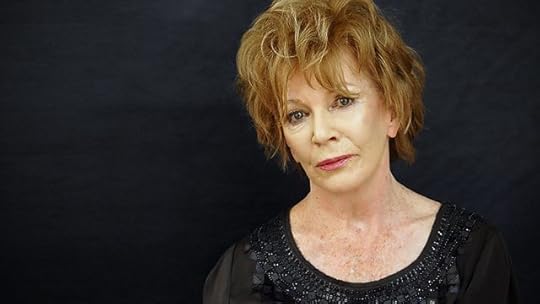
Edna O'Brien is sitting in the middle wearing too much makeup. I try to tell her that my friend Paul Bryant thinks she's easy on the eyes (the least I could do is put in a word).
I should have known. The teacher's pets are there.
"One great virtue of Edna O'Brien's writing is the sensation it gives of a world made new by language.... A lyric language which is all the more trustworthy because it issues from a sensibility that has known the costs as well as the rewards of being alive." His statue on his desk reads "Seamus Heaney" and "Citation, Lifetime Achievement Award". How come he gets a gold statue? That's not fair! And, what a kiss ass.
Edna might be blushing or she applied more blush. Seriously, the photo on the book jacket is in black and white and I can see the makeup. There's nothing wrong with that, or anything. I'm just annoyed by it whenever I flipped to the back to read the kiss asses. She's puckered up. (I'm being pissy. It's difficult to get into new writers when they come packaged in hype.)
Great, there's more. "Edna O'Brien has, for a half-century, been the advance scout for the Irish imagination. There is no living Irish writer who compares in terms of style, stamina, depth, or meaning. She has consistently been the necessary edge of who we are. She is a riverrun writer, bringing us back and propelling us forward- continuing, always, to create arias of belonging."
Colum, please speak for yourself. I glance around the room to make sure the filmmaker of Once isn't hiding in a corner somewhere to chime in (what an example of ass patting that film was! I predicted the scene of the comatose producer putting down his newspaper in amazement by how amazingly talented the filmmaker/singer/writer/actor was). This seems like his scene.... No? Deep breath...
Yeah, there are pretty sentences in these stories. But there was a weird feeling of what SHOULD be in almost every story (Inner Cowboy was good. I'll get back to that when I want to make my getaway). The shoulds smothered the life out of the mights. This is a collection about (yes, I see the words on the blackboard! Lay off, kiss ass Colum!) Irish walks of life, right? A pretty sentence won't grow anything without a green thumb (yeah, put the Irish green thumb up the ass of life, the guy from Once who just strutted into the room on the arm of Bono. I freaking knew it!).
These aren't bad stories. I don't want to force myself to look for some approved meaning in there that I don't think was necessarily there. In "Black Flower" one man kills and he is killed in turn for a reprisal. Why should there be more reprisals in the countryside? Why, if you are going to write about stuff that could happen, are the endings so much how it is? A girl is gang raped by invading soldiers in 'Plunder'. She will recognize the others like herself on the hard walk around the Earth. What will they do when they are together? Why are they defiled because of something that happened to them? Why should the men have been able to take away everything? Why was there an everything to take? "As children we were told that why we have a dent in our upper lip is because when we are born an angel comes and places a forefinger there for silence, for secrecy." Silence doesn't have to be born.
I had a feeling about Edna O'Brien that she wanted stuff to happen. Something to happen and prove meaning of something else. Men love equal to women because one man who was unfaithful twenty years of his marriage found out that his wife had cheated on him. He cries and they make love and promises to each other. They had already made promises to each other. What does that have to do with all men and women? If you asked me I would have said it was shock that what he took for granted wasn't entirely his. That's not love, in my eyes.
"Mixed in with my longing was a mounting rage. Our lives seemed so drab, so uneventful. I prayed for drastic things to occur- for the bullocks to rise up and mutiny, then gore one another, for my father to die in his sleep, for our school to catch fire, and for Mr. Coughlan to take a pistol and shoot his wife, before shooting himself." From "Green Georgette" about a family that wasn't as well to-do (or high society. I guess that's more or less the same thing) as it wanted to be. Ah, those should have beens... The daughter who wishes these things takes after her mother. Her mother wants to be told she's right. The daughter wants to tell others she's right. Hence the status symbols. The pacing of their wants, their daily rhythms felt lying around to me.
I've read elsewhere that O'Brien's mama did not approve of her writing and it was a pride thing for the author. I don't know about that. If "My Two Mothers" is indeed autobiographical that colors the story with more "I won!" than I had already read it to have... "It remains unfinished, which is why I wait for the dream that leads us beyond the ghastly white spittoon and the metal razor, to fields and meadows, up onto the mountain, that bluish realm, half earth, half sky, towards her dark man, to begin our journey all over again, to live our lives as they should have been lived, happy, trusting, and free of shame." That's the end of the story. Another should be! The whole story that came before it was "I don't have to hear what you have to say." She's imagining what would have been said instead of a willingness to have heard it when it was offered. A wanted to hear imagining... Her mother writes her hundreds or thousands of not to be read for twenty years letters as if begging to be understood. The reply is this story, I guess. Ouch. The daughter had promised to never leave, to visit again. She does not and she doesn't just tell her mother that she is not going to see her mother again. It was telling that she blames her mother for her failed marriage to a man she had had an affair with (for respectability). The mother had predicted it would fail. If she had no problem asserting her own life authority, why was this her mother's fault? Why is the dream about her mother when she had not spoken herself? Did it hurt that the mother predicted failure, didn't approve of writing? Or is the triumph of being right the only thing that mattered? The mother's letters want for her daughter (things she doesn't especially want, such as a chandelier). My grandmother is a lot like this. It makes me feel suffocated. If I did what she wanted she would only push it more. I get the avoidance. She told kid me that she had to lie to strangers about me to have stories to be proud of. I can only tell it from my own side, not hers. I know I'll remember that when I think of her for the rest of my life. It doesn't mean I won anything to hold onto it. It doesn't mean she had the last word. That's not how these things work. Memories fade in and out. Sometimes because you bring them back up and other times it is like vomit. As far as having a say? What does that matter if it hurts. I'm not even sure what this story wants except for a dream to end and someone to be right. Telling both sides, from the side of one. Can there be such a thing as right? It did feel unsettling that one who refused to listen gets to have the word. Whatever I took from this it wasn't dreams! (Colm probably loved it.)
'Old Wounds' is about family feuds. The kind that doesn't make sense to outsiders and probably not much sense to anyone who didn't accept it before a time they'd question it. The family liked her and she is invited to be buried beside them. It's flattering. Buried as taking sides? Why, I asked myself, did I want to be buried there? Why, given the difference and gnawing perplexities? It was not love and it was not hate but something for which there was no name, because to name it would be to deprive it of its truth. I don't like the endings of these stories. They feel like classroom or award show ass kissing to say you said something you didn't actually say. I'll question it instead of being afraid to look stupid. What does being buried have to do with anything? You can't wait to erect a monument to your life? "They chose me." It could say that. "We avoided questions. We all knew the same answer and if you have to ask you don't belong here." Whatever death means I don't think it has anything to do with togetherness. That was life!
I liked 'Inner Cowboy'. There was a message in there about despoiling Ireland and greed, but it didn't have to stand for anything to know that the little boy Curly had his life ruined. He didn't know what the big picture was. It was his life. And it was over.
Who knows what all people of any place represent? I want to know what they hope for, as unfinished. If people are, saints or sinners or anything else they could possibly be, they should be a bit of life that is in between the author and the reader. If they are have a might... Classrooms and pulpits and decorations are not for me anymore. I'm not going to get it here. (It's no use. Bono is passing around bottles of pernod and bragging about his close ties with presidents.)
Now and then, I remember I like short stories and read some. On the cover of my copy of Saints and Sinners, Alice Munro describes Edna O'Brien's as "the most beautiful, aching stories of any writer, anywhere" and, if she's right, this collection is certainly representative, a good choice for my introduction to her work.
Nearly every story is of an Irish woman whose heart has been wounded by some form of love. The popular Irish Catholic devotional image of the sacred heart of Jesus, pierced by a lance and wrapped in thorns, would serve as a good graphic representation of these stories, if an ironic one. O'Brien's first book, the 1960 novel The Country Girls, was publicly burned by the priest in her home parish and it was condemned by the Archbishop of Dublin, leading the Irish Censorship Board to ban it, for suggesting that women had sexual feelings and lives.
I particularly liked "Send My Roots Rain", which draws its title from a line of a Gerard Manley Hopkins poem, in which librarian Miss Gilhooly reflects on the ups and, alas, more downs of her past romantic life, while waiting to meet a famous poet in the restaurant of a grand Dublin hotel, and "My Two Mothers", apparently a very autobiographical story of O'Brien's conflicted relationship with her own mother.
The stories are unrelentingly dark and you should avoid them if that doesn't sound appealing, or read only one or two at a time. This isn't a new favorite title for me, but I'm glad I read it and I plan to read more of O'Brien's work, maybe starting with The Country Girls trilogy.
Description: Edna O'Brien is one of the most distinguished writers and figures in the world of letters. Since emerging from Ireland in the early 1960s with 'The Country Girls', her many novels including 'Girl with Green Eyes', 'House of Splendid Isolation' and 'In The Forest' have attracted both praise and controversy. 'Saints and Sinners' is her eagerly awaited new collection.
1/3 Madame Cassandra
2/3 Black Flower
3/3 My Two Mothers
2* The Light of Evening 3* Saints and Sinners 3* Mrs Reinhardt
In this collection of stories, Edna O'Brien's prose is fierce and precise, whether the subject is a lonely librarian waiting for a favorite poet, a ditch digger, or a slow-witted hardware store helper. She seems always to find a description that gets at the heart of a place or character, her dialogue is both crisp and true to the speaker (even when threatening to turn poetic, something that eludes lesser writers), her people sound and look like they have lives outside the confines of her fiction. At her best, what other writers might glide by as routine she turns into something revealing: a bog or dirt being shoveled, the rant of a vicious businessman or the consoling words of a hotel porter to the disappointed librarian. It is when O'Brien strays from the concrete, including plot, that all that talent becomes showy, as with the wandering narrative of "Manhattan Medley". Otherwise, she has the keenest of eyes, the wisest of ears. In "Plunder" she seems to anticipate the subject of her most recent novel, which is about the Balkan wars. That story, of a girl trying to survive an insanely brutal war in a nameless country, is close up, personal, and harrowing. I challenge those who sit in comfort to watch the faux terror and the TV-room horror of "The Walking Dead" or "Game of Thrones" to read "Plunder" and get a sense of what it feels like to be confronted by true evil.
Initially my response to Edna O'Brien’s Saints and Sinners: Stories (kindle Edition) was that I had no particular memories of any of it, barely a couple of weeks after finishing. Coming to write this review, I remembered first that this is a book of unhappy people. They are trapped in drunkenness, frozen in time waiting for a lover, lost to poverty, victims of war, or some other form of internal despair.
Edna O’Brien is an exception writer. She builds the mood She is true to her characters and is capable of surprise. For example: Why exactly is a widowed owner of a bed and breakfast so upset with her happy guests? The answer is elegantly delivered, at once unexpected and obvious. All marks of skilled writing.
So why 3 stars. A book of unhappy people may be justified many ways. Some people like unhappy stories the same way some people like the blues. Some will say she is giving voices to people who maybe did not know they were otherwise unheard. I found it unrelenting. I needed someone to have those famous Smiling Irish Eyes. I recently learned and forgot a technical expression for the way Russian writers can excel at depression. Edna O’Brien holds true to a long standing literary tradition of unhappy Irish people. Ok. But could we let in a little sunshine?
Edebiyat üzerine söylenen beylik lafların nihayeti yoktur. Bunlardan biri de, edebiyatın ötekinin ve ötekiliğin deneyimini sunarak ben ile ben-olmayan arasına bir halat germesidir. Ben-olmayan’ın deneyimi okundukça halatın boyu kısalır. İnsan kendisini ve ötekini bu karşılaşma ile tanır. Halat kaybolur. Tüm edebiyata mal edilebilecek beylik laflardan biridir bu. Ama özellikle çeviri edebiyatta ve insanlık durumu üzerine yazılan metinlerde kendisini belli etmeyi pek sever.
Edna O’Brien, İrlanda edebiyatının duayen yazarlarından... 60’larda yazmaya başladığı “Taşralı Kızlar” serisi, kadın cinselliğine dair cesur sahneleri nedeniyle muhafazakar İrlanda’da yasaklanıp yakıldıktan sonra O’Brien, Kraliçenin diyarında yaşamaya başlar. Lord Byron ve James Joyce üzerine birer incelemesi ve Virginia Woolf hakkında bir oyunu ve gerçek teröristler, seri katiller ve tecavüz zanlıları üzerine çalışıp yazdığı romanları ve öyküleriyle tanınıyor. İrlanda edebiyatındaki kıdemli yazar statüsünü ise 90’a yaklaşan yaşına değil de, kadınlık deneyimini, cinselliği ve kadın karakterlerin iç seslerini İrlanda kurgusunun bir parçası haline getirmesine borçlu.
Azizler ve Günahkârlar adlı öykü derlemesi ise yayımlandığı yıl Frank O’Connor Uluslararası Öykü Ödülü’ne layık görülmüş. Azizler ve Günahkârlar’daki öykülerden seslenen kadın anlatıcılar bize edebiyatın o bağlayıcı gücüyle, gergin birer halat uzatıyor. Her ne kadar O’Brien anavatanı İrlanda’da yaşamasa da, oralı hikayeleri anlatmaya devam ediyor. İngiltere’deki göçmen işçilerin az maaş, sürgün hissi ve ucuz birayla tükenen hayatları artık edebiyatın ve sinemanın klişelerinden biri olsa da, bir insanlık durumu olarak bugün de yaşanmaya devam etmesi bakımından uzun yaşayacak temalardan biri. Bu haliyle de O’Brien’ın öykülerinde de yerini almış. Kendi hayatından devşirdiği -muhafazakar ailenin yazar olmak isteyen kızı- temasının da yine her devirde karşılığı var. Kadın anlatıcıların perspektifiyle eski gönül yaraları, aldatan kocaların çıkmazları, akrabalarla kopan ipleri tekrar bağlama çabalarının beyhudeliği, siyasi mahkumlar ve masum olduğu halde suçlananların hikayeleri, başkalarının deneyimine dair bilgimizin halesini genişletiyor. O’Brien’ın karakterleri, herkes gibi: Radikal iyiler ve kötüler yerine “hem o hem de o” olan, iyilik ile kötülük arasında savrulan, geçmişin yaralarını iyileştiremeden geleceğin orta yerine düşen karakterler... O’Brien’ın kendilerine yazdığı rolü oynamakla meşguller.
O’Brien’ın kurduğu sahne ise oldukça karanlık, melankolik ve karamsar. Ada yağmurlarının ve Britanya semalarından eksik olmayan bulutların hissedildiği öyküler, boğucu bir nem gibi okurun üzerine çörekleniyor. Karşılaştırmak belki doğru değildir ama B. Shaw ve O. Wilde gibi İrlandalı yazarların kinayeli sesinden yükselen ince ironi ve aman vermez eleştiri, O’Brien’ın sesinde yılgın ve ümitsiz bir hale bürünüyor. O büyük kafaların adanın göğünü delercesine konuşan kudretli sesi ve üslubu karşısında O’Brien sonraki nesillerin kuraklığında kendi sıradanlığını kutsamaya çalışan küçük insanı temsilen sahne alıyor gibi.
I love O’Brien’s stories, and I know I shall return to them again and again because they do not unfold easily, necessarily, the first time. In “Shovel Kings,” a first-person narrator recalls another character (Rafferty) who then tells the story—rather by way of being interviewed by the narrator. Interesting approach, and I’m not sure why it is so effective. If Rafferty tells the story himself, alone, then perhaps there is inherent some sort of weakness in it. If the narrator alone tells about Rafferty without his input . . . then again the story is weak for it.
In “Black Flower,” I like how O’Brien develops the character in such a manner that is so facile—but isn’t really. The black flower is a subtle metaphor for the man, but also the malaise existing between the two factions. “The petals were soft, velvety black, with tiny green eyes, pinpoints, and there was something both beautiful and sinister about it” (76).
“Old Wounds” is the story I like best in this collection. Love it, in fact. The lazy back-and-forthness through time, I suppose. The wounds, the healing of the wounds, the wounds again. Fight, make up. Like many families. Wounds. Heal.
From BBC Radio 4 - Afternoon Drama: Edna O'Brien is one of the most distinguished writers and figures in the world of letters. Since emerging from Ireland in the early 1960s with 'The Country Girls', her many novels including 'Girl with Green Eyes', 'House of Splendid Isolation' and 'In The Forest' have attracted both praise and controversy. 'Saints and Sinners' is her eagerly awaited new collection.
CONTENTS: Madame Cassandra Black Flower My Two Mothers
Edna O'Brien's mother did not approve of her daughter's literary pursuits, "[My mother] did not know me. She did not understand the compulsion to write..."
O'Brien was born in 1930 in Country Clare, Ireland. The years immediately after her birth are ones O'Brien characterizes as a time full of "economic despair." The financial misfortunes of the O'Brien family was something that particularly irked Edna's mother. For her parents had not always been poor. In fact, Edna's father's side of the family had once been a prominent and wealthy family from Boston, but according to Edna the family wealth was "frittered" away.
One gets the sense that the succession of misfortunes, the "economic war, animals sold for next to nothing...no money to fertilize the field, no machinery to work" that befell the O'Brien's left her mother the most hardened. O'Brien describes her mother as someone who was "to some extent broken." She felt her mother had a "fear that [her daughter] was on the road to perdition."
In "Saints and Sinners", the theme of family distance and damaged love is a recurring one.
A central paradox in these stories is that O'Brien is both a worshipper of words (words "were of themselves animate, and when grouped together [have] an alchemy to them"), who at that same time creates vast distance between her characters- a distance so vast as to be insurmountable with the use of language.
In "My Two Mothers", the most autographical of any of the stories in this collection, "the female narrator recollects a series of memories about her late mother. She writes of a recent dream, "My mother's hand is on the razor and then her face comes into view, swimming as it were towards me...to cut the tongue out of me."
The mother's pain and jealousy, or what the narrator perceives to be the mother's pain and jealousy, stands opposed to the daughter's desire to communicate through words. The "two mothers" of the story are the narrator's dream mother and her real mother.
The irony of "My Two Mothers" is that the narrator's mother, who aimed to "cut" the creative voice out of her daughter, is at the same time a source of words and inspiration for the narrator- for she is the topic of the story. The mother in her attempt to squash her daughter's creative spirit unwittingly does the exact opposite. The pull to create stands above all.
"Manhattan Medley" is the tale of a love affair, told through a series of letters that one gets the impression were never sent. They are a diary disguised as letters, a self-indulgent attempt to understand. The letter's female author writes, "We would not enter into a marriage that must by necessity become a little stale, a little routined." The affair reveals itself as the empty vessel the protagonist throws herself into headfirst. She is lonely. This is a story of flight, of letters and words that never reach their intended recipient.
The power, and simultaneous inadequacy, of language. Moral ambiguity. Mist-covered bogs. "Old Wounds". Love lost. A final paradox of the collection of short fiction is its title: "Saints and Sinners". The world of these stories is anything but morally black and white. The title tempts the lazy reader. Its irony serves almost as an admonition: readers who see black and white, who see only saints and sinners in these stories or in life do not have a proper grasp of the power, and shortfalls, of humanity's best attempts to communicate.
Something I've noticed in my travels is that "foreign life" is not as foreign to me as "city life." I'm a small town girl, and I learn more about a culture by visiting its own small towns.
One of the stupider things I did during my time in Ireland was go looking for goat cheese in Belturbet. I was on a determined tour of ALL NINE counties of Ulster, dammit, and cheese was the only motivation I could scare up for visiting poor little County Cavan.
I arrived in Belturbet by bus one afternoon in April. Having read about the award-winning Corleggy goat cheese in a guidebook, I stopped in the grocery store and asked for "the local cheese." In return, I received a blank stare.
I wound up stowing my rucksack behind a gravestone in the cemetery, with a dated note on top saying I would be back for it. I stood in the intersection on the hill in the middle of the town and looked for other options.
I walked in every direction. I walked west, in the direction I had come from, and saw many goats and sheep who had possibly produced the milk for said cheese. I walked east, and came across a smaller store that also did not carry "the local cheese." I walked north, and ventured into a dead end near a construction site. As I turned around, one of the construction workers called out, "Welcome to Ireland!"
I walked back south to the churchyard and retrieved my bag. It had started to rain by that time, and I was standing in a puddle at the bus stop when the Dublin connection finally arrived. "Where yeh going?" the driver asked when he opened the door.
"Anywhere but here," I said, and climbed on board.
'Saints and Sinners' by Edna O'Brien - short stories
I found this book languishing and brought it home to read and appreciate. O'Brien's prose is completely authentic and deliciously colourful. I really run out of superlatives there, and find myself wishing I could write as she does. Expert at conjuring places, feelings, emotions.
The protagonists in this collection are all, in some way, uncompleted, frustrated or unresolved. Unhappy as they were towards the end of reading, I also found myself becoming impatient with O'Brien's insistence on the unhappiness of the human condition, as if earnest 'realism' only dictates that we should all be held down. Surely, in the law of averages, there must be people who are naturally content, even happy, and a fair smattering who are blissed out, just occasionally? It is surely not realistic to portray a world in which everyone is unhappy.
That irked. Perhaps it is the old Catholic guilt trip, not something that I ever noticed in O'Brien's writing before.
Nevertheless, a very worthy collection, beautifully observed.
My first book for the 2016 Challenge. The book has a blue cover and I got it from the library. It’s a book of short stories of Ireland. Edna O’Brien is a much acclaimed author, often praised for her beautiful writing and stories about women, but I’m sorry to say that while her writing is excellent I found the stories mostly sad and grim. There were too many sad and mixed up people trying to get through hard circumstances and not always succeeding. There was a man just out of prison, meeting with his wife and he is shot dead on the first day out. The wife knows that the shootings will go on and on in revenge. A mob of soldiers rape a girl. Curly won a thousand pounds but he got mixed up with Donie, who was a bad lot and Curly ended up drowned in a bog. A woman waits and waits for a poet she idolises to have afternoon tea with her. And so on… The stories stretched my heart and I felt the grimness of lives in poverty, disappointments in love, or just plain any and misery. Maybe I should try some of her other books.
In each of these short stories, PEOPLE GET DISAPPOINTED. That is what you need to know about them. It's utterly amazing that O'Brien is able to depicted so many disappointed people, disappointed in in so many different ways by life. Each time, you wonder if the character might get what they want or find something satisfying, but they don't, really, and you don't care because it's so beautifully written. My favorites are "Sinners," "Inner Cowboy," "Black Flower," and "Green Georgette," and "Old Wounds".
This was a re-read for me, in audio form this time, because I'm a sucker for disappointed Irish people.
As with most short story collections, some of them are better than others. But "My Two Mothers" was heartbreakingly good, and many of the others were beautiful. Having never read Edna O'Brien before, I picked this up because of jacket blurb from Alice Munro, who is one of my favorite living authors. Munro had this to say, "Edna O'Brien writes the most beautiful, aching stories of any writer, anywhere."
I suspect I would have given this at least one more star if I had read it rather than listened to it. I kept losing track of characters and getting bogged down in descriptions that I probably would have enjoyed on the page. But I didn't really connect with most of the characters, and many of the story endings left me with a "that's all?" sentiment. That said, I can still tell that Edna O'Brien is brilliant.
Grappig om te merken waarom ik even twijfel tussen vier en vijf sterren. De reden is, dat de verhalen van O’Brien niet direct comfortabel zijn. Het maakt me ervan bewust dat we gewend zijn geraakt aan een omfloerster soort proza. Maar ook aan levensproblemen van een andere orde. In deze verhalen gaat het om honger en armoede in Ierland, om terreur en dreiging. Maar toch ook over familiegeschiedenissen, felle verliefdheid, klasseverschillen, buitenstaanders. Zo rijk zijn deze verhalen en zo verschrikkelijk goed geschreven. Fel realisme, is dat de goede term?
I saw James Wood's review of O'Brien's most recent novel, The Little Red Chairs, a month ago, and it looked great, it looked like something I'd really enjoy reading, but, alas, hardcover it was, so I "settled" with learning more about Edna O'Brien and bought this fantastic collection of short stories.
Wow, just wow. Pain from bygone decades roil through this collection. O'Brien gives voice to the voiceless, whether mildly retarded blue collar laborers or the many single women gone a bit funny and neurotic from prolonged solitude. She uses free indirect style to bounce adeptly from character to character, story to backstory, imbuing her pitiable characters with quiet dignity, and precisely capturing both buried, subconscious feelings and elusive, nontraditional relationships.
These stories, like most of O'Brien's writing, are fundamentally Irish, I'm told. I wouldn't know, being neither English nor Irish. On a personal note, "My Two Mothers," with its notes of regret at increasingly forgetting your own mother, really moved me, and I would have cried for twenty minutes then gone to shower to soothe my inflamed face, had I not been sitting on an airplane. Instead, I allowed myself four tears, failed at discretely dabbing the coarse, economy class plane napkin under my eyes and nose, and looked out on the brilliantly lit playground of childish imaginations.
I guess the title sums up this book better than anything else can. It's about human beings. Not some who are sinners and some who are saints but all of us who are both saints and sinners at the same time. I love the way the author gets right under the skin of her characters; we think, feel, suffer, rejoice with them as they go through life. Obviously, in a collection of this kind some of the stories will appeal more than others. My particular favourite was "Send My Roots Rain." I love the way the author slowly revealed elements of her character's backstory until everything just fell into place. As a short-story writer myself, I'm going back to this one to study just what made it work.
A very moving collection of short stories, each one a little gem. Absolutely nothing here indicates these are written by a writer of O'Brien's age. What is it that makes that impression? Alice Munro's more recent stories focus very much on being older so I guess that because O'Brien has chosen subjects that are not all related to looking back over life we don't think about that either, we focus on what she wants us to think about.
The topics are wonderful. How children view the world, mother's and daughters, family feuds, how long cherished dreams can be so hard to fulfil. It is a great collection.
These stories by one of Ireland's most celebrated writers force the reader to examine relationships, unrequited love, family bonds, and issues of social class. Where do we belong in this world? How do memories persist and impact our daily lives? How does environment affect behavior? O'Brien addresses all of these issues and more in this small but powerful book of eleven short stories set in or related to Ireland.
Wonderful use of the language. These are not examples of that, however, just passages that resonated with me, although all her short stories vary, she is not cynical but forthright.
"Of all the things that can be said about love, the strangest is when it strikes. For instance, when I saw you once in a theater lobby in London and you struck me as a rather conventional man. I thought there is a man with a wife and undoubtedly two motorcars, a cottage in the country to which he repairs at weekend, one car stacked with commodities, wine, cheeses, virgin olive oil, things like that, a man not disposed to dalliances. Maybe like my friend you have sat up with a wife one entire night, atoning, and maybe it seemed as if everything was forgiven, but something always remains and festers."
"When one is smitten, what does one want imparted and what hidden? If for instance, you say, 'I am hell to live with,' it has a certain bravura to it. Does it simply mean that you are lazy and sullen indoors, expect someone else, a wife or a servant, to pour the coffee of to put a log on the fire, but that you show yourself to best advantage when visitors are heard coming up the path, just as you are decanting the choicest wine? How I hate these games and subterfuges. Sunday lunches, Sunday dinners, Sunday teas, the gibberish that gets trotted out. A woman telling the assembled guests how clever her Dave is, while notching up grievances inside. It's ubiquitous. I was with a couple one Sunday when the wife pronounced on some book of poetry whereupon her husband said, 'Have you read it?' and oh the look, the withering look, that she gave back him, saying have YOU read it, and in the icy aftermath, the hatred congealed."
I have read quite of few of Edna O'Brien's novels over the years. This collection of short stories was very well done. The collection of 11 stories is principally set in Ireland or concern Irish people living elsewhere (London and New York City. Some of the better stories here are Shovel Kings, Sinners, Manhattan Medley. Send my Roots Rain, My Two Mothers and Old Wounds. The collection was published in 2011 and it exemplifies all of the artistry that O'Brien demonstrates in her novels.
The language alone makes this book worth reading. This collection of short stories had a few that I am not sure I fully understand but all of them were beautiful examples of the use of the English language. There are not many authors who write on this level.
Note: this piece contains spoilers for the opening story "Shovel Kings"
Scientific fact. I have the best mother in the world. Another scientific fact. My mother is one of the best readers in the world. I went through a phase as a manic sixteen year old of trying to keep up with her, but to no avail. I’d say she averages 100 - 110 books a year, though given the rate she’s burning through Edna O’ Brien’s back catalogue, we could be in for a record-breaking 2024. When I asked her to do an interview with me on O’Brien, she looked at me with great concern and said “But I haven’t read all of her books yet.” That’s Mam.
Spencer: When did you first become aware of Edna O’ Brien’s work?
Mam: Bizarrely, my father, who was a very conservative Catholic, gave me a copy of The Country Girls, which was considered scandalous. This was in the seventies when I was in my teens. At the time, I thought it was quite dated but I am looking forward to reading it again to see what all the fuss was all about.
Spencer: Why was The Country Girls considered scandalous and why do you think it seemed dated when you read it?
Mam: I think there was a huge change in attitudes towards women and sexuality between the sixties and the seventies. I was surreptitiously buying copies of Cosmopolitan magazines. I thought I was very au fait with sexual matters. My memories of The Country Girls was that it was very…girls stayed virgins until they were married, men were sexual predators, very old fashioned, but I could be wrong. It was decades ago.
Spencer: Do you want to talk more about your father and that story he wrote that you think might be about Edna O’ Brien?
Mam: My father was a writer. He wrote in English and Irish. He was a product of his time in that he was a very conservative catholic. I know he and my mother practiced the rhythm method which resulted in seven children, maybe three of whom were not planned. He was always expounding on religious and sexual matters to an embarrassing degree. We’d get lectures about outrageous women, including Edna O’ Brien. She was a witch in our house. First of all, I think one of the problems for my father is that she was an extremely beautiful, sexy-looking woman. Secondly, she was an extremely successful writer and he was very jealous. Thirdly, she was more or less hunted out of Ireland. Copies of The Country Girls were burned in her native County Clare. I don’t know exactly the story, but her books were banned, so he regarded her as a cailín dána, or a very bold girl. He wrote a story called “The Island”.1 I must say here that because of my relationship with my father, I’ve never actually read one word he wrote, but I do remember that this short story was made into a television play, and we were all sat in front of the tv to look at it. I do remember that it was about an Irish woman writer who’d returned from England, who’d written scurrilous things about Ireland. Two country men, very frightening men, cute hoors if you know what I mean, brought her out on a boat and drowned her. I think, I’m not sure, but I think this woman writer was supposed to be Edna O’ Brien. So I don’t understand how he gave me The Country Girls to read, but then wrote this story. Also, that this story was broadcast by RTE. The whole thing is bizarre.
Spencer: So why do you think he gave you that book to read?
Mam: I have no idea. The first possibility is that maybe he wanted to teach me about female sexuality. But then it occurred to me that maybe he wanted to teach me about how dangerous men were, which might fit it in better with the whole Edna O’ Brien was a wicked witch thing. But I don’t know.
Spencer: We’re going to focus in on the story “Shovel Kings”. Explain to me why this is such a great story.
Mam: O’ Brien’s writing style is absolutely beautiful. She’s extremely fluid. I feel a deep engagement with her characters. The basic theme of the story is that the narrator, who I think is also Irish, comes to befriend an old man Rafferty, an Irish emigrant, who came over forty years earlier and worked digging trenches for telephone companies. It’s a very poignant, sad, tender story.
Spencer: You were making a point to me about the class difference between the two characters
Mam: The narrator tells very little about herself. It sounds like O’ Brien herself. She meets Rafferty on the way to an appointment with her analyst. This puts her in a different social position from him.
Spencer: You could imagine if he knew she was going off to an analyst, he’d mock her about it.
Mam: He wouldn’t know what an analyst was. Her life is so different from his, yet she connects deeply with him.
Spencer: In that story, Rafferty moves back to Ireland very briefly and it doesn’t work out. So he doesn’t feel at home in London and he doesn’t feel at home in Ireland.
Mam: It’s a devastatingly sad portrayal of a person living in isolation. He’s decades away from Ireland. He tells us about the hardship of his life digging trenches. One time he sees a poor Irishman decapitated by one of the pieces of machinery. A lot of the foremen are Irish and are brutish to them, so it’s not Irish good, English bad. He’s delighted to get an opportunity to go back and be a minder of an old man. But it doesn’t work out and it’s desperately sad. He also tells a story about how before he moved to London, his mother told him that she loved him more than anyone else, more than her husband, more than her daughters. She was telling him this the night before he was to leave, and in those days, they knew they were leaving forever. Later on, the mother dies. He wants to go back to Ireland to the funeral. The narrator meets him and he tells her he never got there. I think he got as far as Holyhead and ended up in a pub. He couldn’t face it. At the end of the story, they part ways, and he says to the narrator “Mind yourself”, and she tells us that she knew he was incapable of having a relationship with somebody he loved, because that meant heartbreak for him. The other thing I wanted to say is that when she first sees him, he has a little green harp in his lapel and a guardian angel in his other lapel. She asks him what it’s about and he says “well, the harp is because I’m Irish, and the angel is because we all have a guardian angel” and by the end of this story you know this man did not have a guardian angel.
Spencer: The story reminded me of the Shane MacGowan song “Lullaby of London”. But there’s another singer who reminds you of Edna O’ Brien.
Mam: Sinéad O’ Connor. I’m a huge fan of her. It was her anniversary there recently. She’s another woman who like Edna O’ Brien spoke the truth about Ireland and was ostracized. On her death, everybody was mad about her, but Sinéad died in London on her own. The strange thing about women who will stand up and criticize Ireland and the Catholic church and what it has done to women and children, they leave Ireland in disgust, but also carry a deep passionate love of Ireland. They love and they hate the place they came from. It seems to me a peculiarly Irish state of being. I think Sinead had it, I definitely see that Edna O’ Brien had it. She looks with a wry humor over the power priests had over young girls and how they were supposed to conduct themselves. Yet at the same time, she has a great love of Ireland. So that’s what she had in common with Sinéad.
Spencer: O’ Brien always identified as Irish?
Mam: Absolutely. Loved Ireland. She’s written a book called “Mother Ireland” which I’m looking forward to reading. And could I add, this brings me back very neatly to the story my father wrote about her. She is going to be buried in Holy Island on Lough Derg and her body will be brought over on a boat, which I think is a beautiful thing. If my father is really up in heaven, I hope he’s looking for forgiveness.
Spencer: Tell me about your emotional reaction when Edna O’ Brien died.
Mam: I was taken aback by how deeply I felt. I felt really heartbroken. I think I felt heartbroken because no matter how many awards she got, no matter how many Irish critics came around to lauding her work, I still feel she felt deeply hurt at the way she was treated by Ireland. As an Irishwoman, I identify with that. I’m 66, I was brought up in a very Irish Catholic family. I married at twenty to my great regret. Even if you haven’t been abused by a priest or had to go to England for an abortion, an Irishwoman of my vintage has suffered because of the Catholic oppression of women in Ireland. I also felt an enormous amount of anger, which you are probably hearing in my voice.
Spencer: Any other books you want to mention?
Mam: I’m finishing “Girl with Green Eyes”, which was published in 1962, when I was four. When I looked at the publication date, I thought, oh my god, this is going to be really old-fashioned. But it is such an enjoyable romp. It’s about this girl with green eyes and red hair (I think based on Edna) and her friend Baba and they go up to Dublin and the protagonist falls in love with an older man, a protestant. Her father hears about it back in Clare. Some of his friends kidnap her and bring her back home because she’s not supposed to be consorting with a protestant. It sounds really dated. I don’t know if a reader in their twenties would relate to it, but I understand the attitudes that she’s portraying. There’s also a huge element of farce about it. At one stage. she tries to have sex with the older man, but she’s afraid of sex, and they try a few times and when the father arrives she tries to fire a gun at him and it doesn’t work and she says “how could this man love me? I can’t fire a gun or make love”. Could I also add that O’ Brien’s descriptions of the countryside are absolutely lyrical, Yeatsian. She wrote a biography on Joyce. I’ve ordered another book she wrote on Joyce’s women. She has a Joycean approach to depicting consciousness, which is what draws you in so much.




 http://www.bbc.co.uk/programmes/b01061hy
 1/3 Madame Cassandra


