Ever wanted to take apart the microwave to see how it works? Crack open your computer and peek inside? Intrigued by how things work? So are we! That's why we're dissecting all kinds of things from rubber erasers to tractor beams! Read along as National Geographic Kids unplugs, unravels, and reveals how things do what they do. Complete with "Tales from the Lab," true stories, biographies of real scientists and engineers, exciting diagrams and illustrations, accessible explanations, trivia, and fun features, this cool book explains it all!
This is a super book for kids. The sense of humor the author brings makes the reading fun while sharing educationally pertinent information about how specific things work in today's world. Bits of scientific history are thrown in making the journey toward achievement to market an item understandable.
The illustrations just pop out at the reader grabbing attention and pointing to exciting information. There is a plethora of things to explore the inner workings. It should be understood, though, that this is a children's book and the complexities of how things work is not the actual goal. It is general, and understandable to ages 7 to 10, amount of knowledge. It will, however, be good reading for older kids and adults as well. A great addition to home, school, and public libraries and one not to be missed. We expect no less from a National Geographic Kids publication!
DISCLOSURE: I received a complimentary copy to facilitate this review of my opinions which are freely given, without compensation.
For children who love to know how things work, this book would be a fabulous gift. I learned a great deal about a lot of things that I knew very little about, even things I use every day such as refrigerators, microwaves, and smart boards. I had no idea that hover boards and tractor beams are on the verge of becoming reality. Other topics covered in the book include surfing, roller coasters, escalators, submarines, and rockets. The amount of knowledge in this book is staggering. Each topic is covered in six page spreads that include a funny photograph with caption, intriguing questions, diagrams, explanations and fun facts. Each section also includes a science experiment that the reader can perform that demonstrations a scientific principle associated with the topic being discussed. A few scientist profiles are mixed in with the different sections. This is a book that any scientific-minded reader could spend many hours happily engaged with.
Picked this up at a Little Free Library. It’s obviously a book for kids, by the National Geographic Society, which not only describes the inner workings of a number of mechanical/electric devices but also things like hot-air balloons and the Space Shuttle. The accompanying illustrations and pictures are very well presented, with vibrant colors. And there are supplementary materials, such as a large poster of the Space Shuttle taking off, and an activity booklet with games and puzzles related to the articles. So then, we have articles on such diverse things as traffic lights, multi-speed bicycles, garage-door openers, a smoke detector, (early) video games such as Pong, a compass, lasers, and musical instruments. Very informative and engaging. Well, now, it must be kept in mind that this book was published in 1983, before the advent of such things as high-speed and realistic video games, and cell phones (with cameras and clocks embedded therein). SO, we have articles about cameras with film in ‘em, analog alarm clocks, calculators, and toasters. Gave me a big chuckle when I read them, as my own kids were young when this was published. All in all, a very fun read. I’d recommend this book, although I would surmise that there are updated versions of it indeed, the version supplied by Goodreads seems to be much more contemporary). Still fun for the adults, though. Four stars.
Have your kids ever wondered how the microwave heats that after school Hot Pocket they can't wait to eat? See pages 60-61. Or how their teacher made so many copies of the same test that they forgot to study for? Pages 94-99 may not help them with their test, but it will explain the mechanics of a copy machine. Or have they ever asked you why the roller coaster they are speeding along in doesn't just dump everyone on to the ground below? See pages 122-29. These and so many other mysteries are explained to kids, often with humor, in simple terms, with illustrations, photographs, diagrams, trivia and even Try This! suggestions readers can do to more fully understand the principles being explained. There is also a Glossary and a Find Out More section with suggestions for the super curious reader. This is most definitely not like the dry science-y books of my youth, but a very up-to-date, very savvy book that is sure to please every kid from the budding scientist to the not so science minded, simply because there is something of interest for everyone in it. How Things Work is a great addition to a child's personal library, and would also be a great addition to any classroom library as well as home schooling situations.
This book is amazing for anyone who loves to discover what is contained within the things we use, see and experience all the time. There is so much to read about and learn. You can explore and read your way through or chose to read the chapters and/or areas of interest one at a time. The chapters include: Beam Me Up, Home is Where the Fridge Is, School of Cool, Extreme Fun, Here to There and Even More. I have been reading this book for a while now and every time I read it I learn a bit more. I just love how well organized this book is. There is a well detailed glossary and an index, that allows the reader to easily find areas of interest. There are tidbits of information for quick reference too, which is great for creating talking points with the kids. I love this book so much and I cannot wait to use this book over the winter with my kids and to teach them all about the science contained in this awesome book. Just because we are stuck inside does not mean we need to be bored!
buku yang informatif dan sebagian besar mudah dipahami disertai foto dan ilustrasi untuk menjelaskan proses kerja benda-benda ada petunjuk dan panduan untuk mempraktekan sendiri hal-hal yang dilakukan benda yang kita kenal dengan alat sederhana meski ditujukan untuk anak-anak, pembaca muda dan dewasa juga bisa menikmati dan memahami hal-hal yang belum diketahui atau hanya tahu sedikit untuk menambah wawasan
My kids love this book and refer to it often. It shouldn't be a surprise since it's National Geographic, but the photos are incredible! Here's my review: http://agoodreid.blogspot.com/2017/07...
My daughter read this book from cover to cover. Excellent photos and explanations. Very interesting and keeps the attention of young readers and older readers alike! Enjoyed learning about tricks, submarines, invisibility, hoverboards, etc. Highly recommended!
This book is fun to read and gives a lot of interesting facts about machines. Also this book is set in chapters and has things that you can make and to do.
This entire review has been hidden because of spoilers.
Does your child love to take things apart to see how they work? Do they constantly ask why or how something is made or created? Do you think they could create the next big invention? Then this book is for them!
Ask any teacher and STEM is what everyone is talking about in the education world. These are where the jobs are going to be when our kids graduate and how educators are focusing their lessons. STEM stands for Science Technology Engineering and Math...four areas educators are focusing on for both boys AND girls in the classroom. I personally like STEAM, adding Arts into the teaching as well as I believe they are just as important to the mind and body.
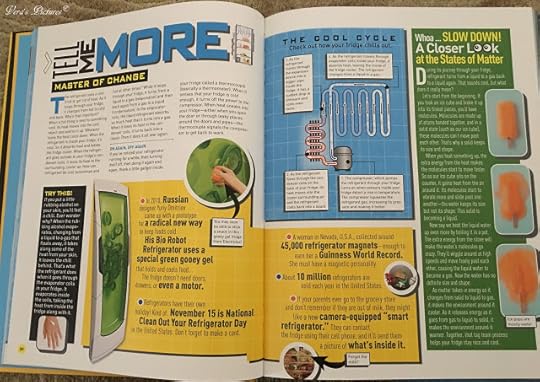
National Geographic and Resler feed every kid's question with the answers they've been looking for. How do refrigerators work? Find a pretty cool explanation in this book. Is your child wanting to be a roboticist? Meet Helen Greiner, an engineer, computer scientist, and roboticist in this book. Need to explain the importance of flushing the toilet to your boys (I STILL have issues in my house), then show your kids how a toilet and plumbing works with this book. There are even "Try This" experiments you can do at home with everyday household objects to learn...you guessed it....how something works.
The pages are full of easy to understand flowcharts and quick facts about a variety of topics. Some of my favorites to learn about were how a robot vacuum works (I've been wanting one) and how various instruments make music. There are even sections on roller coasters, surfing, and tightrope walking.
This book explains it all. So, if you have a child that asks a lot of Why? and How? questions, get them this book!
How do things work? If you’re curious about an iPod, flying machines, an oven or even roller coasters to name a few, this guide is for you. Cool photos, fun facts and lots of questions with all the answers can be found throughout these pages.
Myth: Alligators can swim through toilet pipes and bite you in the butt. Fact: No, they don’t because they live in wetlands, marshes and ponds in the southern United States.
How do erasers work? Pencils are made with graphite. An eraser is made from rubber which is stickier than graphite which grabs and lifts the graphite off the paper.
The information and the way it’s formatted can be a little overwhelming, but large illustrations that pick apart the topic are easy to follow. The Try This boxes present experiments kids can try themselves. Just the Facts and Inner Workings show how the specific topic works. There are also bios of engineers, inventors and scientists along with real life stories of amazing inventions and unbelievable innovations. Anything and everything that you can imagine is in this guide. Parents and teachers will love sharing this with inquisitive young readers.
Know a kid who’s constantly taking everything apart to see how it works? This is the book for her or him. It’s loaded with gadgets and how they work; fun facts; in-depth pieces on technology and how it works; profiles of scientists and innovators, and yes, experiments that are totally safe to try at home (with adult supervision, please). Learn how a tablet really works, how an aquarium works to keep fish healthy and happy, even how a toilet works, complete with diagram. Design a roller coaster with your kids – it’s easier than you think! Because it’s a NatGeo Kids book, you know the writing is great; it speaks to kids in easy, clear, fun language that educates and never talks over their heads or down to them. The photos are amazing, and the dog on a surfboard (page 131) is worth the cost of the book all on its own.
This is supposed to be a book for children, but grown adults can learn a lot from it, too. For example, now I know why the toilet at work won't flush properly (there isn't enough water in the tank to start the siphon effect). I am going to give this book to my nephew. Hopefully, it will help my sister as well! (Bonus points: there's a Porsche in it). I received this book for free through Goodreads Giveaways.