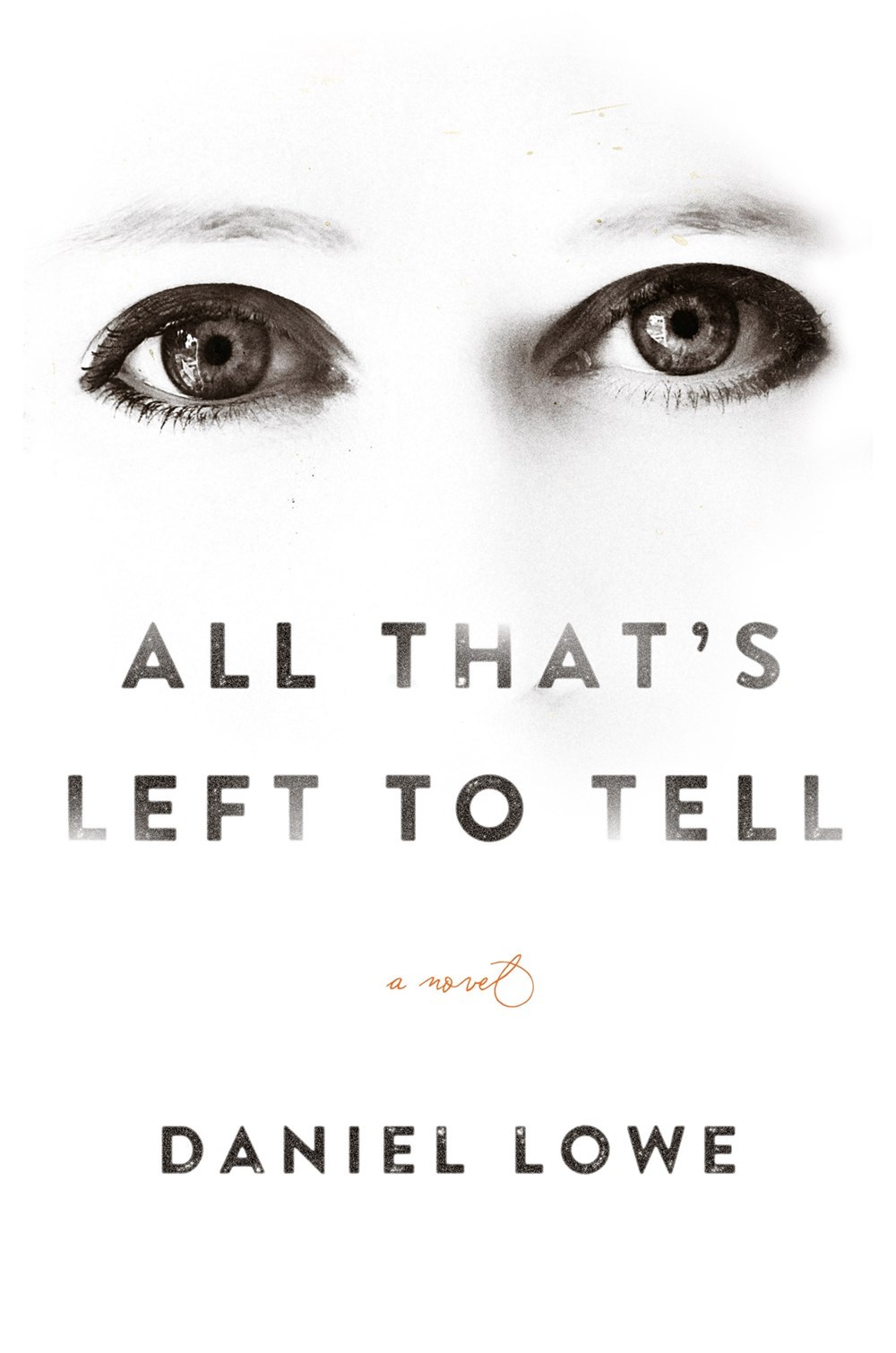
Room meets The Crying Game: a haunting, luminous debut novel about a man and his relationship with his daughter, his captor, his past, and his future.
All That’s Left to Tell is a debut novel about Marc Laurent, a mid-level executive taken hostage in Karachi. Aside from his guards, his only interaction is with a mysterious woman he knows as Josephine. In their first meetings, Josephine tells Marc that they’ve called his company, they’ve called his ex-wife, whom else can they call for ransom money? Marc says there is no one else. And then Josephine asks Marc a question that is even more frightening than his captivity—why didn't he go home last month for his daughter's funeral, after she was murdered?
So begins a bizarre yet somewhat comforting ritual, in which every night Josephine visits Marc in his cell. She tells him stories, including stories about what would have happened had his daughter not been murdered. Marc, in turn, begins to tell his own stories, in which his daughter is alive. And soon it’s not clear which storyline is real, and which is imagined, and if it even matters. Throughout the course of these stories (and stories within stories), father and daughter start to find their way toward understanding one another once again.
Atmospheric and exquisitely structured, Daniel Lowe’s searing debut is a tribute to the redemptive power of storytelling.
An man is captured and held prisoner in Pakistan, guarded by two men and at first it seems they are trying to ransom him for money. At night though, a woman wearing a hijab, comes in, after Marc is blindfolded unable to see her, only hear his voice. She knows details from his life, how? We never know. On hearing of his daughter's supposed death, she begins to weave together a story, whereby Claire doesn't die but leads an alternate life. So the book rotates between these stories and Marc's time in captivity.
Okay, I think I am missing something here. Well written definitely, understand it enforces the importance of story telling but the story itself, I neither liked, nor disliked it. Quite frankly, I have no idea, or not much, of what this book is supposed to be, what it represents. Incredibly strange, so many things we never learn. Flummoxed. Over my head, perhaps. Don't know. So there you have it, my somewhat non review. Three stars for the writing and the contemplation.
This novel was initially difficult to get into, partly because it was difficult to understand. Within the first few chapters, I found myself rereading sentences for comprehension and realizing that they were structured strangely, actually difficult to follow. I considered dropping the book after the first 50 pages. For a story set in the real world, it was difficult to suspend disbelief; any intrigue and mystery were too far-fetched. But finally, around the sixth or seventh chapter, there was some shift and the writing improved. The story also finally became more involved. However, the appeal quickly died for other reasons. There were details imagined in stories that the storyteller couldn't have known (e.g. how Marc's father smoked his pipes). Characters made strange decisions, decisions that were more weird than intriguing. Though the writing improved, the overall story became odd. The plot seemed to grow in complexities and mystery, but without forward-momentum. Ultimately, a great deal was left unresolved. Who exactly was Josephine and how did she find herself in her position? What was the purpose of their storytelling? (Surely not to comfort a man soon to die, given the content?) What happened to Azhar? Finally, there were moments throughout the book that seemed included for shock value alone. A lingering incestuous kiss became a recurrent theme throughout the novel. A woman imagined and described to a father a fantasy where three men gang-raped his daughter. I recognize that disturbing things happen in our world, but I don't wish to read about them in detail without any redeeming reason. I would not recommend this book to anyone. The writing improved, the story deteriorated, and it ultimately felt like a waste of time because I was appalled and there was no resolution, redemption, or reason. If there's a message in that - if it was intended for any reason - it was not made clear to the reader. 1.5 stars. I read it as an Advance Reading Copy.
This entire review has been hidden because of spoilers.
Marc has been kidnapped in Pakistan. Two men take turns guarding him. Whenever the interrogator comes into the room, Marc is blindfolded. The interrogator is a woman who says he can call her Josephine. At first, Josephine tries to learn how they can collect the ten million dollar ransom. But then she starts to question him about his severed relationship with his daughter, Claire, who recently was murdered. She asks Marc to tell her stories about Claire, which Marc reluctantly and painfully does. Then Josephine starts to tell Marc imaginary stories about Claire’s future if she hadn’t died. In Josephine’s story, Claire is on her way to visit her dying father, who she hasn’t seen in 15 years. She is now married with a child but is traveling alone. She picks up a hitchhiker, Genevieve, who has her own stories to tell. Genevieve tells Claire stories of the life that Marc may have led during her absence.
Marc’s reality is distorted by the blindfold and he finds comfort in hearing the stories of the life Claire went on to live and can almost believe them to be true. Likewise, the reader’s reality is distorted and sometimes it can be difficult to keep in mind which story is “true”. But then again, it really doesn’t matter which story is true. I became completely engulfed in each story. The author moves smoothly from Marc in prison to the imagined Claire on her way to see her dying father to the imagined Marc who has remarried. That may sound a bit complicated but the author writes in such a way that it’s all very clear. I felt like I was dreaming as I read these stories. What power the written word has, even to bring the dead alive again. It was almost as though the power of these stories could re-arrange reality itself.
I couldn’t be more impressed by this author. It’s hard to believe that this is his debut novel though I do see that he’s a writing teacher and that his stories and poems have been published in literary magazines. His is a name to watch out for. This is a literary work of art, unlike anything I’ve ever read before. Most highly recommended.
This book was given to me by the publisher in return for an honest review.
Beautifully written. I wanted to love it. It's a story within a story within a story and so on. The problem for me came in when the real stories started blending in with the made up ones and pretty soon you could not tell which end was up. I would go back and read it again and think-wait, what? And that happened many times. Then Claire started narrating her own story. So I am guessing that overall this is the father's fantasy of what if things had been different and that's why they find each other in the end-when they are both dead? I don't know. There are a LOT of unresolved questions: what happened to the captor that went missing near the end? Why was Josephine so invested in the story telling? The author did keep repeating several themes---lingering kiss from father to daughter and women who looked masculine and men that looked feminine. Not sure why. So if this had a clever ending, I would have been ready to love it, but it just left me going WTF? Did she not really die? Was Claire Josephine? Are they both dead? Too confusing and unclear.
thank you Netgalley! and thank you Elizabeth Strout for the form letter praising this book. I love her so I checked into this and am so glad I did because I have been (for a while now) in a book rut. Nothing will stick for me. But this one I couldn't put down. It's seriously contending as one of my top books ever. It's a mind-fuck though. Like, story within story within story type of book but you get sucked in and it just works and you follow along until the end, at which point you're like WTF!! but in a really good way. Sigh, so sad it's over. But, so as not to give much away it's a suspending disbelief in the best of ways, and I say this after having tried to read Nutshell. I'm all for wanting to learn about what a fetus thinks but the voice didn't work for me, too uppity or smug or something. Anyway, this book is about Claire, the daughter of Marc who is has been captured by some people in Pakistan. He's being held captive and is visited by a woman who talks to him and because- why not?- he talks to her back and from the little bit of information she gets from him she spins this whale of a tale about his daughter, who died a month previously- and whom marc did not go back to America to the funeral and he's now going through all the memories of what led him to come to a point where he wouldn't go to her funeral. So the stories that this woman who calls her self Josephine - are of Claire as she would be had she lived. And this fictitious Claire lives in California and has a 3 year old daughter and she's not talked to her dad in 15 years but when she learns of him being in a hospital she takes a road trip to see him. Enter Genevieve.... IT just feels so real.. The stories that Josephine tells. And how does she know all this? It got to a point where I couldn't tell what was real and what was made up. But it comes together. And it's not simple nor complicated. It's just really really good.
I had the opportunity to read an advance reader's copy of this novel, the first by Daniel Lowe (his short stories have appeared in a number of literary and little magazines over the years). This is a provocative, powerful and deeply absorbing work of fiction, one that challenges not only the assumptions we have about human relationships, but also the assumptions we often have about storytelling, imagination and what it means for something to be 'real.'
The narrative here is timely and artfully constructed: a midlevel executive, Marc Laurent, at a US corporation is kidnapped in Pakistan, apparently for ransom. "Apparently," because his kidnappers couldn't have made a poorer choice - estranged, adrift and emotionally disconnected from family, work and history, it's not clear that there's anyone who would ransom him - or that, when push comes to shove, he'd even welcome being returned to a life he seems, in the first third of the novel, to be anesthetized to.
It's only when he begins, almost against his will, to engage in conversation with one of the kidnappers, a woman called 'Josephine,' that Marc's estrangement from the world begins to make sense - to the reader, to Josephine and to himself. Their conversations are initially transactions - is he really worth anything, and if so, to whom? - but begin to grow more intimate, as Josephine draws from him stories that serve as points of departure for her own storytelling.
It is at this point that it becomes clear to the reader that this is not a straightforward novel at all, and that it is as much about how we use language to capture what we hold dear as it is about captive and captor. Prodded by Josephine and facing, blindfolded, an uncertain fate, Marc reveals more, perhaps, to Josephine than he has even told himself, and in return, she takes the novel into the realm of the imagination. She tells Marc stories of his own life, sometimes interwoven with what he has told her, but more and more, in which the characters, including Marc, take on lives of their own.
That we are drawn, willingly, into a world where lives and events are purely conditional - we have nothing but the power of the storyteller to sustain us - is testimony to Lowe's exceptional skill with language and its nuance. It's something of a surprise to use words like 'stark' or 'spare' to describe a novel that is told mostly in intimate conversation between a man and a woman in a small room, but the success of the narrative derives in large part from being drawn into this intimacy: they hold each other rapt in the strands of their stories, forestalling - perhaps? an inevitable end.
The power of the stories they tell each other is almost incredible - less like overhearing an intimacy and more like listening to someone under the influence of hypnosis or what spy novels used to call 'truth serum.' An early review alluded to Scheherazade - I'm reminded more of Beckett, or James Joyce (there is an Irish bleakness to the prose), where what is 'real' is what the reader is drawn into believing he is imagining.
It is a nuanced release at the end of the novel - an emotional conclusion, rather than a corporeal one. If stories preserve lives, then Marc - and Josephine - live on.
A lovely and masterfully crafted novel, intricate and painfully human.
The writing is masterful. I couldn't believe that this was Daniel Lowe's first book. It's a very sad read when MarcLaurent a Pepsi executive is held hostage. One of my favourite lines were. You're not talking to Saabir, who thinks all Americans are wealthy. I know what kind of money your family doesn't have. And I don't think for a minute the Pepsi corporation is going to hand over ten million dollars for a mid- level executive. Easier to promote someone else than sell that many cans of soda.
I am thoroughly impressed that an author can deliver so many stories through just two narrators, Marc and Josephine. It was easy to read, easy to follow the threads, and it left me completely flummoxed, even more so the epilogue. So many questions are left unanswered but life is like that. Claire in trying to wrestle with her loss of memory says of what she knows and has experienced so far "It's like waking to a life someone dreamed for you. Maybe, at some point, that's partly true for everyone." All we know is that Claire didn't die, or did she? Thanks NetGalley for letting me read this.
Marc Laurent is a hostage in Afghanistan. Every night, he is blindfolded and tied up and then visited by Josephine, who asks him questions. At first their conversations are of a hostile nature, but soon Josephine and Marc are discussing more personal matters, such as his daughter back home, and their nightly ritual becomes something of a comfort for them both. All That’s Left to Tell is a powerfully unsettling, gripping novel.
Marc Laurent has been taken hostage while working for Pepsi in Karachi, Pakistan. While being held prisoner, one of his captors, a woman whom he's told to call Josephine, asks him why he didn't return home for the funeral of his 19-year-old daughter Claire, who had been murdered the month before. Then over the next few nights, Josephine weaves together a story of a future Claire who had survived her attack and gone on to make a life for herself. So this is really a story within a story within a story wrapped around a story.
My issue with it, however, is that people don't really talk like they do in Lowe's book. I understand it's a book about storytelling, but I've yet to meet, in this day and age, a master storyteller who's able to evoke times and places and events so vividly, and to have her audience absorbing all she's being told without question. The reality just isn't there. We've got entire chapters with one character telling a story, and this character is a character in Josephine's story, who may just be a figment of Marc's imagination -- because who's to say what's reality in this book?
I personally didn't care for the main plot, in which Marc is kidnapped in Pakistan. For me, that's a little too much manipulation and a little too much of Islamophobia; it's too much an issue in real life, so I don't care to have it in my books as well.
While I can appreciate the writing, I feel that Lowe's storytelling would have been better served in traditional prose, not as a character speaking aloud to an audience.
So... I find this book impossible to rate by the star system. I was intrigued by the story in the first chapter and found it difficult to put down; yet , I was also baffled by much of it. The writing is evocative , even mesmerizing at times. It is a tale of the profound importance of storytelling. The stories are primarily told by two narrators. As most of my reader friends know, I am not one who loves an unreliable narrator so at times I found myself arguing with part of a story. What is real , what is not. I am not sure that you are meant to know or even if it is necessary to know but being me, I needed to know. I still don't know. I cannot wait for others to read it so that I can see their opinions however I do not want to add any spoilers since I think it is important to read it without knowing too much. Great book for book club, in my humble opinion.
To me this book was the literary equivalent of an Escher drawing. It's all about a story embedded within a story intertwined with a story...you get the drift. It's a book about storytelling. I'm querulous as to why it was all based on the act of a kidnapping because in the end that doesn't seem to be the heart of the story and the premise of the kidnapping held such a different promise for the book. I enjoyed some of the storytelling but not all of it and I felt it wasn't pulled together well enough. There were too many inconsistencies and knowledge on the part of one character that was wholly not believable.
The stories inside the framing story are all quite good - I began to care for the "imagined" Marc, Kathleen, Claire and the others. But the framing story - where Marc is held hostage and converses with Josephine - is overwrought and serves too obvious and contrived of a thematic purpose to the whole of the story.
This was a slog The actual writing was beautiful but the plot was so incredibly confusing it just lost me. I had to read some reviews to make sure I wasn’t missing something huge and obvious - I wasn’t
Marc is kidnapped and held hostage in Pakistan. He is then visited by Josephine who asks why he didn’t go to the funeral of his daughter who was murdered the month previous. She then tells the story of Claire in the future as though she lived and then within this story is another story about Marc told by someone Claire picks up while hitch hiking.
Yes it’s as confusing as it sounds and I have no idea if they all were dead or alive at the end and neither does anyone else from the reviews I read!
What a wonderful surprise this novel was. I had little expectations going into it: in fact, I barely knew what the plot was about (aside from "man in Middle East has a weird relationship with kidnapper"). I honestly don't even remember why this was on my TBR. Probably saw it recommended somewhere, but I have no memory of this at all.
I think that this being marketed as a thriller is going to hurt it. I say that a lot recently, but I think it's really true. So many novels with any layer of mystery are shoved in the "thriller" genre when they really don't belong. Sure, there is suspense here, there's mystery and intrigue, but it's a slow burn and 100% character driven. In fact, there is little in the way of plot at all. A man, Marc, is kidnapped in Pakistan and spends all of the book talking to Josephine, one of his captors. But Josephine is not interrogating him, she simply wants to know about Marc's relationship with his recently deceased teenage daughter, Claire.
Marc tells Josephine stories about Claire's childhood, and Josephine weaves for him a story of future-Claire that will never be. In this story, 35-year-oldClaire is on a road trip to visit Marc on his deathbead, and picks up a traveler named Genevieve. At some point along the way, Genevieve starts telling Claire stories... about Marc. Sounds a little confusing? It's meant to. There are so many layers to the tales that Josephine and Marc (and Genevieve) start weaving that they being to overlap for the reader in unexpected ways. At times, it's hard to know who is really telling the story and who is simply listening to it.
There is a layer of the surreal here, of course, because why would Josephine even care about Marc's child? Why was he kidnapped in the first place, if he is not rich enough to ransom and not famous enough to draw attention? Why did Marc not travel home for his daughter's funeral? Half of the time I expected magical realism elements to come into play, but the story is mostly grounded in reality. It reminded me of In Pinelight: A Novel, another beautiful book about memory and the power of stories. But don't come into this expecting a final chapter that gives you all the answers: the ending is very open-ended, and I think there are a lot of different ways to interpret this story (which really fits the themes).
This was a beautiful, powerful reading experience and definitely one of my favorites of the year so far.
I was able to read an advance copy of this fine novel, which turns the basic story-telling convention -- verisimilitude -- on its head. One is never quite sure what to believe, until finally, one understands that what to believe is not to believe. The novel is composed of stories within stories that often don't add up, but the degree of feeling that Mr. Lowe nonetheless manages to infuse into the tale is astonishing, given his method. It's as much a book about story-telling as anything else, and challenges readers to question the expectations they bring to a novel, a form that "All That's Left to Tell" suggests may be so tired as to require some serious shape-shifting. What lingers long after reading is the powerful truth that although memory always deceives, forgetting isn't possible.
This book had me so confused....it is a story within a story within a story...it is the story of Marc a hostage in Pakistan, it is the story of Claire ( Marc's dead daughter ) and her alternative reality and Marc's life in that alternative reality...than we have Josephine, Marc's interrogator who also tells stories...this book blurs the lines of what you think is actual and what is the other narrative...I gave it 3 stars because Daniel Lowe certainly has written a dizzing tale...
I would like to thank Goodreads on giving me the opportunity to read this book...
2.5 Stars. What an odd book! While I appreciated the wonderfully crafted writing, and I honestly wanted to embrace the whole "power of storytelling "thing, the strange structure was just too much for me. I found it exhausting to continue reading, and I just wanted to give up. I didn't give up, but neither did I find redemption in the end.
Well this was a different read for me. I am not quite sure what happened. I am left baffled to say the least. I am reminded of my college days when I did not listen to the professor and I thought "what the hell is he talking about?? What did I miss because I don't get it!" Story telling is the premise of the book but again I am just plain lost with this book.
A captivating read! I found the more I read this book, the more intrigued I became. The author creates a complex web of characters, that by the end leave you wanting more. I hope to read more from this author!
This is a difficult book to sum-up, but I’ll do my best!
Marc Laurent, having been taken hostage in Pakistan, receives a visitor every night. He is bound and blindfolded, and then a woman named Josephine comes to question him. To begin with, she only wants to know who to contact to ransom him, but soon her questions become more difficult, more probing, as she asks why he didn’t go home for his daughter, Claire’s, funeral. Josephine begins to tell Marc a story about his daughter’s life had she not been killed, and in turn Marc starts to tell his own stories about Claire’s life. As truth and fantasy become so mixed that Marc can no longer tell which is real, a father and daughter start finding ways to understand each other again.
All That’s Left to Tell is a compelling slow-burner, and truly fascinating. Like Marc, I found myself utterly pulled in by Josephine’s stories, and desperate to find out what happened to Claire despite knowing it wasn’t real. There are stories within stories and trying to work out which were true and decipher the meaning behind Josephine’s story-telling was both fun and frustrating.
Not knowing which parts were real and which were made-up made this book a unique read: mysterious, engaging and unlike anything I’ve read before. It is skilfully written and completely engrossing, despite the plot not being very eventful or exciting. I highly recommend it.
This is a story told in two voices - a father (Marc) imprisoned for ransom in Pakistan and his estranged daughter (Claire) who he has not seen in years. Decades later the narrative follows Claire in a cross country journey to visit her dying father. Two other major characters are Marc's female inquisitor in Pakistan and a woman hitchhiker that Claire picks up during her cross country trip. During the course of the book we see insight into the backgrounds of the major characters. The book is well written and thought provoking but more thought provoking than action packed.
haunting. exquisite prose and storytelling. This story is like an Escher drawing- so many storylines that crossed, interwove- what is true? What isn't true? Was his daughter Claire dead? Who was the woman interrogator? Why did Claire basically abandon her parents for years? Did the main character die? If so, why was he killed? I had to slow down and read carefully to keep the characters straight, sort of. Lots of philosophical reflection on life, death, relationships, love, being present in the moment.
Never have I cared less about people in a book. The stories might have been interesting, but I found them irritating. I didn't buy that a man who was kidnapped would allow himself to be mentally tortured, let alone drawn into a story about his dead daughter. I didn't believe that a businessman wouldn't go home for his murdered daughter's funeral. The whole thing rests on a premise that, if you don't believe possible, leaves no room for empathy.
I don’t know what I just read. I was interested in the beginning, and then all the storytelling began, and I quickly lost interest. What was real? What was a story? What was a fictional story inside a fictional story? Who was Josephine? How did she know things? Was Marc ultimately killed? Was Claire? What happened to the one guard we never saw again? What was the point?
This intriguing story begins with Marc being held hostage in Pakistan by a group that hopes to raise money through his ransom. No money is forthcoming, however, and a woman who is one of his captors begins asking him about his life, and particularly about his daughter, Claire, who has recently died, presumably to find new targets from whom to demand ransom. Over time they begin telling each other stories about Claire, and stories are told within stories, until one loses track of what is "real" and what is invented. Fascinating!
Very powerful read. I couldn't turn the pages fast enough. We all have a story and sometimes allow ourselves to be held captive to our pain but shouldn't keep fighting to heal.