In The Plague, Elkhadem plays a variation on one of his favorite motifs, the journey. As El-Gabalawy notes in his critical introduction, the novella is "based on the pattern of Boccaccio's Decameron, which begins with the flight of ten people from plague-stricken Florence" . Elkhadem's protagonists, seven men and three women, happen to meet in a visa office as they attempt to flee from the endemic oppression and brutality that plagues Egypt under Nasser's tyrannical regime. The range of characters—an engineering student, a teacher of French, a young bride, a businessman, a journalist, an actress, a naive young man, an academic, a housewife, and a commander of a military prison—creates a cross section of Egyptian society. These men and women chat about themselves as they wait to receive their exit visas, just as Boccaccio's characters recount tales to pass time. However, the autobiographical stories presented in The Plague, unlike the tales of the Decameron or the recollections of Elkhadem's protagonists in From Travels of the Egyptian Odysseus and Ulysses's Hallucinations or the Like, are told before, not after, the characters leave their homeland. Thus, hope, anxiety, and fear pervade and infect the speeches and thoughts of Elkhadem's most recent protagonists as they anticipate the prospects of self-imposed exile.
Saad Elkhadem (1932-2003) was born in Cairo, Egypt, where he grew up and received his Bachelor of Arts degree. He earned his doctorate in Graz, Austria, and then worked for the government in both Egypt and Switzerland for a short while before teaching at the University of North Dakota. In 1968, he was hired as an associate professor in the Department of German at the University of New Brunswick (Canada) where he taught German and comparative literature. He spent the rest of his career there, attaining Professor Emeritus status in 1995.
Elkhadem produced more than twenty-three books, of which fourteen are fiction (some are banned in Egypt), and the rest are reference books. He also translated works from German and Arabic into English, including in some instances, some of his own, such as Ajnihah min Rasas/Wings of Lead (1971/1994) and Rijal wa Khandzir, Men and Pigs (1967/1977), much in the tradition of Brecht and Beckett, who were themselves writers/translators of their own writing. Moreover, Elkhadem was an editor and an eminent publisher
Best I could do re-quality, as the pages are a really odd size! Let me know if there are any problems
I have uploaded this for sharing as: 1. It is long out of print, with no indication of ever being reprinted; 2. Second hand copies are almost impossible to find; and 3. I think it an important work, and one that deserves to be read.
My hope is that anyone downloading will write a review and keep their eyes and ears open for other works by this author.
Should the copyright owner read this, please let me know if you wish me to delete the pdf and I will do so immediately.
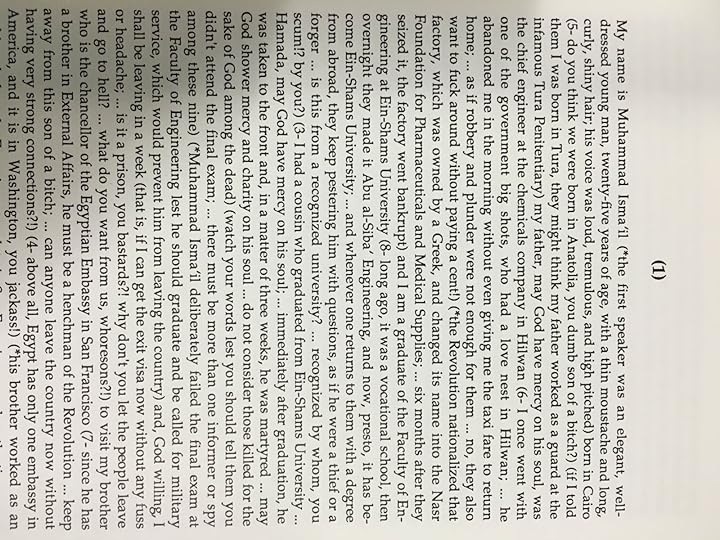
The first page
Out of print and impossible to find (and I had to add it to the GR database). Well worth reading and, at only 33 pages long, pdfable. Will scan and upload in the next day or two and then anyone interested can check it out.
10 chapters, 10 characters, numbered 1-10 - Each chapter the narrative of one character, interrupted by the others, each of whom is represented by a number (see the first page above for an example of how it works)
This micronovel is a reworking of (The) Decameron, translated into a modern day Egypt featuring ten characters who loathe one another, speaking brief vignettes about their lives that are interrupted by the internal rants of the others floating in the narrative space. A startling blast of bile and a refreshing stab of innovation from a nation never invited into the avant-garden.
"...this is a part of the nature of revolutions...there must be leaders who alone hold the reins of power and authority;...there must be gigantic plans and tremendous projects;...there must be traitors and criminals and spies who deserve to be burned alive;...and ultimately there must be sacrifices and victims and immolations like yours truly;...this is also part of the nature of revolutions;" (34)
I will say that Saad Elkhadem's The Plague is important though not enjoyable. How could it be considering the subject matter?
El Gabalawy's introduction discusses the text more skillfully then I. But briefly: Ten characters await their travel visas, in order to flee Nasser's Egypt. Apparently they are instructed to introduce themselves to each other. They do. That part of the text is brief and formal. But parenthetically, we get the characters' thoughts, feelings, trepidations and accusations, in addition to an omniscient 3rd person narration which gives us some sharp descriptions and the future fates of the characters. There the richness presides in some (unexpected?) vulgarity (rawness?) of Cairene dialect.
Elkhadem's characters describe, perspectivally, and with head-hanging accuracy, a time whose interpretation varies perspectivally. Just consult the history books. My old high school text book (and Wikipedia currently) treats Egypt's second president, Gamal Abdel Nasser, with almost unwavering praise. And those who know better know that nothing is ever this simple, but take this, perhaps the only negative line from the current Wikipedia article: "Nasser's detractors criticize his authoritarianism, his government's human rights violations, his populist relationship with the citizenry, and his failure to establish civil institutions, blaming his legacy for future dictatorial governance of Egypt." (Accessed 2/9/16)
What does that mean? Does it mean enough when the next line says that historians praise Nasser as one of the towering political figures of the 20th century Middle East?
I don't pretend to know enough about the region's history or even the current political/social/economic life (though I consider myself a reader of history and try to stay informed on world political affairs via foreign and domestic news sources) to be a fair judge, but when a work like this challenges the popular American view, I am full of despair and disquiet. Though none of this is unexpected.
What should we take away from Saad Elkhadem's brave experimental prose?
It is banal to say that all major political revolutions have human costs, or that one must judge from a historical distance. It is not only banal, it is sickening, because for me to pen those lines, I need to have my thumbs. So in my temporary paralysis, I grieve the blood and the loss. I wonder what can provide the human animal the impetus to keep writhing.
Adorno would tell me that the trick is not to let my own powerlessness stupefy me, but to think on this subject is stupefying. Do I even have the perspective to accommodate a valid viewpoint? Or am I forever isolated from my brothers and sisters?
Right now, in my country the politicians are talking about expanding Guantanamo, about bringing back water boarding, about a terrifying response to "terror". Is it criminal to observe the cycle of violence and call for a politics that respects human rights?
I've been convinced ages ago ; how to employ the parenthesis. You'll know it from Coover's Gerald's Party. In my own (personal?) usage, it's about the best thing I can come up with in English as somewhat comparable to the German verschachteltesatz. Thoughts sort of get stacked upon one another, with height, while the page allows words only to trail one another, in breadth and width (ever try to get a shelf dimension from someone who can't get those three dimensions straight (depth, height, width)). Every word you'll want to use you'll want to qualify, and not merely with a single adjective ; your choice words require phrasal qualification. Not that there's anything wrong with that.
In The Plague we get the parenthesis employed in the same manner and for the same purpose that the indented line is employed in Vollmann's The Dying Grass ; to layer consciousnesses upon the page. You see the parenthesis equally at home, then, in both the macro- and the micro-.
You've been paying attention recently since the unEARTHing of this text a few weeks ago so I won't rehash the whole set up. Ten chapters. Ten characters. In which each introduces him/herself to the other nine in a room awaiting exit visas. As each such character speaks in the main sentence, s/he is interrupted parenthetically by (zB) :: a) him/herself with internal thoughts which open that ironic gap between utterance and intention ; b) one of the other nine characters, often with serial parentheses (because, we're certain that at least one of the other nine is a spy), each id'd with a numeral ; and c) an omniscient someone who knows both past and future of each of the ten characters (marked with an *). The result is an almost unheard of precision and economy of expression.
No mind that the characters are fleeing a specific political situation in a specific country ; but much more the indication of the more or less universal predicament of the refugee. Fear and hope.
As noted in the introduction, this book is structured to parallel the Decameron - 10 individuals (seven men, three women) fleeing the plague. In the Decameron they are of course fleeing the plague, but here the plague they are fleeing is the totalitarian rule of Nasser. The ten individuals are gathered at the visa office an hour before it opens, and pass the time by introducing themselves.
There are 10 chapters, each being assigned to one of the character's introductions. The introductions themselves are brief, but are punctuated with parenthetical unspoken narratives. These parenthetical narratives occur in the present speaker's mind (for unmarked parentheticals), in another character's mind (for parentheticals beginning with a number, that number corresponding to the other character's chapter number), or meta-authorial third person narratives (designated with an *) that either provides description of the speaker, or - more importantly - describes what will eventually happen to the speaker.
The chapters are all a mass of parenthetical thoughts and statements with very sparse introductions mixed in. The author does a fantastic job of capturing the paranoia and mistrust that despotism breeds, as well as the doubt, jealousy, and resentment which it also produces.
The book - short though it might be - is exceptionally accomplished, and provides deep characterization for each of the 10 individuals on which it focuses. Many thanks to friend Jonathan for unearthing this gem, and then going even further by providing a scan of the text, available here:
I've got one more by Saad Elkhadem on the shelf which I'll be reading probably tomorrow, and a few more of his winging their way to me, based entirely on the strength of this. Read it.
Saad Elkhadem draws inspiration for his story from Boccaccio’s Decameron, but with seven men and three women as main characters, who instead of plague are running away from the cruel Nasser’s regime. As they are sitting in an immigration center, waiting to get their visas approved, these ten people from different backgrounds and of different occupations, start chatting to while away the time. Elkhadem employs a very innovative and interesting stylistic technique in representing their stories. Each story is narrated from the first person perspective, as every character narrates his/her story in a mostly embellished and hopeful way; stories are often interrupted by their inner monologues, where the reader has the insight into the narrators’ psyche, their real reasons for leaving, their cautiousness and hesitation, founded on fears that others might work for government and report them to the authorities. One’s story is also interrupted by the inner monologues of other people in the room, where we can see how judgmental and envious most of them are of their previous life in Egypt and their “bright future” outside of the country, while others are being hopeful, cursing the regime and praying they have the same happy fate. However the story is also interrupted by the voice of the writer himself, who gives his grim, realistic account of the story and their future after each of them fleas Egypt. Main themes of the stories are politics and religion; the cruelty of the regime that has no mercy for anyone who opposes it and social differences based on religious believes that lead to inequality, conflicts, poverty etc. that force them to leave the country they are born in, the country their family and friends live in, to leave their jobs, some of them are lucky to have, that will be taken over by the incompetent followers of the regime, their studies, because knowledge is no more being valued, as they try their luck as complete strangers in a foreign country. Sounds familiar, doesn’t it?
«and we'll live there in total happiness and peace ... and fuck Egypt and everyone in it.»
«I don't know why these bastards prevent people from leaving and hold them as if they had the plague and must be kept in quarantine ... the whole country is in quarantine ... the whole nation is under house arrest ... oh, if I could just set foot abroad, I would never come back again.»
A beautiful modernist novella that should be much more relevant, especially today... Read it!
short but ultra dense 'micro novel' from this criminally under read egyptian writer. 10 characters in an emigration waiting room monologue their thoughts and feelings about life under Nasser, interrupted and interspersed by parenthesis indicating the often profanity filled thoughts and reactions of the other characters as well as their ultimate fates after leaving the country. extremely formally accomplished stuff.