

What do you think?
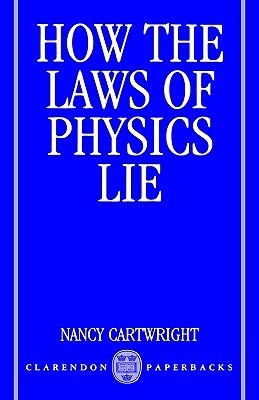
How the Laws of Physics Lie
In this sequence of philosophical essays about natural science, the author argues that fundamental explanatory laws, the deepest and most admired successes of modern physics, do not in fact describe regularities that exist in nature. Cartwright draws from many real-life examples to propound a novel distinction: that theoretical entities, and the complex and localized laws that describe them, can be interpreted realistically, but the simple unifying laws of basic theory cannot.
230 pages, Paperback
First published June 9, 1983
Ratings & Reviews
Friends & Following
Create a free account to discover what your friends think of this book!
Community Reviews
Displaying 1 - 12 of 12 reviews

May 28, 2016
This is an amazing book. Although Cartwright touches on the topic of scientific laws (theories) and the limit of their applicability she approaches this not with Karl Popper in mind but J.S. Mill. So her statements have an applicability beyond science that touches on logic, mathematics and reasoning itself. She presents a weaker view challenging the undecidability of quantum mechanics as a mathematical artifect (something David Bohm and somewhat like Karen Barad as well) but her basic questioning rips through the "natural" assumptions which scientists and the public often adopt. By doing so she allows a greater critical perspective on how to "do" science. This may be frightening for people because in as much as we know there is also much we do not know; in fact the two are proportional to one another as the more knowledge cuts and defines the more it carves out negative areas of unknowning. The basic mix up she starts with is pretty profound: the difference between causation and explanation.
Even though the writing is dense it remains very approachable. After the first chapter I was definitely hooked; this is a book that offers rich treasures to anyone who wishes to actually critically look at our world and how we have a choice in how we arrange the information we get.
Even though the writing is dense it remains very approachable. After the first chapter I was definitely hooked; this is a book that offers rich treasures to anyone who wishes to actually critically look at our world and how we have a choice in how we arrange the information we get.

June 22, 2026
It’s sterile to debate with Paul Feyerabend overly much yet—on account of the greater intricacy of her ideas—stimulating to engage with Nancy Cartwright. Some of her maverick claims may appear prima facie no less controversial but she reasons to them while with Feyerabend we get only cheap skepticism and polemics. In contrast, Cartwright often will support her arguments about specific models by recourse to the formulae themselves. A good place for the uninitiated to start would be How the Laws of Physics Lie (Oxford University Press, 1983), which reprints several of Cartwright’s major early papers. For her later views see our forthcoming review of The Dappled World: A Study of the Boundaries of Science (Cambridge University Press, 1999).
What thesis does Cartwright intend to press with such a sensational title? Ever since the Scientific Revolution of the seventeenth century, the Western mind has been gripped with fascination over the orderliness of nature, as—so the story goes—expressed through immutable laws of the kind just then being unveiled by Kepler and Galileo. The eighteenth-century English poet Alexander Pope encapsulated the common view among his countrymen when he penned this celebrated epitaph:
Nature and Nature’s laws lay hid in night:
God said, Let Newton be! and all was light.
Indeed, the ball was only commencing its roll when Pope wrote his memorable couplet. The succeeding two centuries were to witness a triumphal march of science, culminating with the revolutions of relativity and of quantum theory. How then can Cartwright dare to have the temerity to gainsay so much evident progress? Perhaps one could put it this way: her anti-foundationalist skepticism could be the symptom not of too little, but rather of too much knowledge, a plethora of discoveries ranging over all manner of scientific disciplines. For the more we amass of verified, it is true, knowledge into many diverse facets of the empirical world, the harder it becomes to manhandle it all under the umbrella of a single overarching discourse that pretends to explain everything!
The key to appreciate where she is coming from is to recognize the distinction between theoretical versus phenomenological. In the parlance of theoretical physicists, a phenomenological law corresponds to a set of formulae with which we can compute and arrive at predictions in conformity with observation, but in which the terms employed do not necessarily enjoy much credit as reflective of anything we judge to be true of the real world. In contrast, a theoretical model involves symbols that refer to entities we have cause to judge really exist and embodies a description of how these entities interact among themselves, from which one can eventually extract (usually by appeal to other already established results) the numerical predictions that can be compared to the observed phenomena. What may be troubling to the purist is that, while a theoretical model indeed produces empirical predictions in the end as well, it does so by invoking theoretical terms that may be somewhat distant from anything to which the experimenter has direct access in the laboratory. Now, Cartwright wryly observes in this connection that
The great explanatory and predictive power of our theories lies in their fundamental laws. Nevertheless the content of our scientific knowledge is expressed in the phenomenological laws. [p. 100]
For her, the words ‘great explanatory and predictive power’ do not necessarily connote a compliment! Clearly, Cartwright’s sympathies lie with the hard kernel of reality one undoubtedly fastens upon with a confirmed phenomenological law, as opposed to the squishiness of theories propounding supposedly fundamental laws we never get to inspect up close, in their nakedness, but only through the dark glass of a long chain of reasonings. Nevertheless, she is not entirely dismissive of the value of theory. The following concluding paragraph summarizes well the nuanced position she has reached at this stage in her career:
Fundamental laws are supposed by many to determine what phenomenological laws are true. If the primary argument for this view is the practical explanatory success of the fundamental laws, the conclusion should be just the reverse. We have a very large number of phenomenological laws in all areas of applied physics and engineering that give highly accurate, detailed descriptions of what happens in realistic situations. In an explanatory treatment these are derived from fundamental laws only by a long series of approximations and emendations. Almost always the emendations improve on the dictates of the fundamental law; and even the steps of the derivation are frequently not dictated by the facts. This makes serious trouble for the deductive-nomological model, the generic-specific account, and the view that fundamental laws are better. When it comes to describing our real world, phenomenological laws win out. [p. 127]
To internalize the force behind comments such as these, one really should follow Cartwright’s extensive preceding discussion of Pauli’s master equation in the Markov approximation and its implications for the Lamb shift (which everyone today remembers as a victory of quantum electrodynamics without, probably, knowing anything about the morass of approximations that make possible its observation by means of microwave instruments).
Knowing all this, one can guess how Cartwright feels about the idealizations that are omnipresent in any theoretical treatment of a physical effect. The so-called covering law model of scientific explanation due to Carl G. Hempel (in her day perhaps the prevailing orthodoxy) warrants a close look.
The propositions of a theory are of two kinds: internal principles and bridge principles. The internal principles present the content of the theory, the laws that tell how the entities and processes of the theory behave. The bridge principles are supposed to tie the theory to aspects of reality more readily accessible to us….The network of internal principles and bridge principles is supposed to secure the deductive character of scientific explanation. [pp. 131-132]
There follow two stages of theory formation: first, is the informal, i.e., gather everything we suppose to be relevant; then the second stage is to find a mathematical model. It all sounds neat and tidy! But the remainder of the chapter is occupied with a spirited attack on the cogency of a sharp distinction between internal and bridge principles, grounded in an analysis of what is actually done in two textbooks on quantum mechanics by Albert Messiah and Eugen Merzbacher, respectively.
Given Cartwright’s questioning attitude toward the conventionally received view of fundamental theory, her reckoning with the radical empiricists Pierre Duhem and his modern disciple, Bas van Fraassen, assumes a certain interest. How does she align herself with respect to these two, whom one might be inclined to suppose fellow-travelers? Cartwright thinks van Frassen and Duhem are persuasive but that they eliminate too much because she believes in theoretical entities if not in theoretical laws [pp. 88-89]. Furthermore, she criticizes their external view of truth; i.e., that it has nothing to do with explanatory power [pp. 89-91].
All right, suppose one accepts Cartwright’s critique. What does she do with it? Her guiding idea throughout is stated succinctly near the beginning:
The lesson for the truth of fundamental laws is clear: fundamental laws do not govern objects in reality; they govern only objects in models. [p. 18]
Now, and here is where Cartwright’s originality begins to exert itself, if fundamental laws govern only objects in models, what are we to make of them? At any rate, a fundamental law, once hypothesized, renders possible the formulation of a model that can eventually make predictions. So what absorbs Cartwright’s attention is the process by which we start with our experience of the natural world, posit a fundamental law about it and then connect back to experience via the predictions that flow from it. Her nascent view would be that our minds are fitted to grasp, at least tentatively, certain causal powers operative among the things we know about in the world (as an exercise in what Kant would call spontaneity). From an implicit understanding of these causal powers, we can formulate candidates for the putative fundamental laws and work with these in our speculative capacity. Thus, in nuce, she is heading towards a concept of capacities that will become the trademark of her career. See the eventual publication of Nature’s Capacities and their Measurement (Oxford University Press, 1989, our review here).
Excursus on quantum mechanics. The essays in How the Laws of Physics Lie do not limit themselves to the plane of high philosophizing. Cartwright has specific criticisms of the conventional quantum mechanics she wants to forward. She contests von Neumann’s division into deterministic evolution resp. wave packet collapse. Everyone agrees, of course, that measurement should, in principle, be derivable from quantum theory itself, if the latter is truly the fundamental theory of the world. Now, Cartwright cites work by Daneri, Loinger and Prosperi from 1962 resp. 1966 which goes probably about as far as anyone ever has on this difficult topic. Yet Cartwright’s assessment of their work runs like this, ‘treatments like that of Daneri, Loinger and Prosperi are very abstract and diagrammatic. They do not treat any real measurement processes in detail’ [p. 197]—a fairly damning judgment for someone of Cartwright's persuasion, for it means that the work is unsupported by bridge principles that would connect it to actual phenomenology and thus to real-world confirmation of the kind she so evidently prizes. The rather lengthy ninth essay on ‘How the Measurement Problem is an Artefact of the Mathematics’ [pp. 163-216] outlines her own ideas on quantum mechanics and how it relates to measurement. Here, she questions whether the usual quantum logics give the right result for the two-slit experiment and whether position probabilities should be given up altogether and replaced with transition probabilities. Unfortunately, Cartwright has no novel internal principles to formulate over against the conventional view (perhaps consistently so, in that she is not a theorist anyway), so the discussion peters out without going anywhere.
A few critical rejoinders.
1) A staple topic in the philosophy of science pertains to the so-called composition of causes. If an effect seems to be the product of several causes, how do we know that we have explained it correctly in our theoretical model? To be concrete, Cartwright discusses the low-lying energy levels of the carbon atom. She acknowledges the counterfactual: if quantum theory is true, the Coulomb potential would lead to the observed splitting. But she contests the validity of a probative contention such is this, on the grounds that there could, conceivably, be myriad alternative explanations [p. 69]—what seems a bit naïve to this observer, without his wanting to go to a strict covering-law model; the same critique applies a little later when she returns to the question [p. 71]. She appears to be missing the idea of taking the limiting situation under which the contributions, say, from gravity and from the Coulomb potential can be separated from each other (a common enough procedure in theoretical physics).
2) As to the overall conclusion of the third essay, to the effect that ‘the lesson to be learned is that the laws that explain by composition of causes fail to satisfy the facticity requirement. If the laws of physics are to explain how the phenomena are brought about, they cannot state facts’ [p. 73]; we disagree: just because a certain non-linear function may have simple linearizations in limiting situations does not mean we could not have a good reason for believing the full non-linear function to be true of the world.
3) Another, more general point. In the sixth essay on phenomenological laws, Cartwright asserts that ‘without the metaphysics, the fact that a handful of elegant equations can organize a lot of complex information about a host of phenomenological laws is no argument for the truth of those equations’ [p. 102]. To which we reply, but is it not an argument for the truth of at least some structural level if not every microscopic detail? To us, the constantly recurring lesson of the advance of science it that when an earlier theory is superseded by a more adequate one, one often has to let go of particular features of the entities postulated to play a role in the model, yet can still retain certain structural elements. For instance, from William Thomson’s or the early James Clerk Maxwell’s cog-and-wheel mechanical models of the aether to the late Maxwell’s electrodynamics. The partial differential equation obeyed by the electromagnetic field does not change although nobody supposes anymore that it is instantiated by an elastic medium or the luminiferous aether. This irenical stance—which this reviewer upholds—is known as structural realism.
4) Lastly, and this gets to a profound divergence between Cartwright’s perspective on the world and the present reviewer’s, in the seventh essay on ‘Fitting Facts to the Equations’, the author has this to say about quantum physics as treated in Messiah’s famous textbook, ‘but at heart the theory works by piecing together in original ways a small number of familiar principles, adding corrections where necessary. This is how it should work’ [p. 139]. Not for this reviewer! Stipulate that this may indeed be how Messiah proceeds in his textbook, but the maxim Cartwright deduces from it is intolerably false as a prescription for how the scientist should set about his work. For we aspire to a Kantian ideal of construction from first principles with approximations entering at a secondary stage (more akin to the paradigm of celestial mechanics).
How are we to evaluate Cartwright’s work as set forth here as a whole? This reviewer is sympathetic to her realism about causes (contra Hume and Russell) but wary of her dismissal of fundamental laws. In fact, Cartwright appears to be a Duhemian anti-realist. Yet, one is entitled to maintain one’s own favored views with intellectual honesty only when they have been tested against well-put counter-arguments. An attentive reader such as the present one, not as yet prepared to abandon a more conventional view of the task of science (viz., that theoretical explanation fulfills the contemplative ideal) but willing to grant her heterodoxy a hearing, may be jarred out of his complacency by occasional idiosyncratic outbursts of hers that prompt continuing reflection. Just to name two instances: first, she denies at the outset of her first essay that ‘explanation is a guide to truth’ [p. 4]!; and second, this obiter dictum in the opening paragraph of the fifth essay, on inference: ‘Explanations (at least the high level explanations of theoretical science which are the practical focus of the debate) organize, briefly and efficiently, the unwieldy, and perhaps unlearnable, mass of highly detailed knowledge that we have of the phenomena. But organizing power has nothing to do with truth’ [p. 87]!
Hence, three stars for being thought-provoking if not an altogether systematic exposition of her position, still in its infancy as of the time the papers reprinted in this volume were composed. But the desirable systematicity (in so far as one can speak of a coherent defense of non-systematicity) will come later as the product of her mature thought (see her last work, The Dappled World, published in 1999).
What thesis does Cartwright intend to press with such a sensational title? Ever since the Scientific Revolution of the seventeenth century, the Western mind has been gripped with fascination over the orderliness of nature, as—so the story goes—expressed through immutable laws of the kind just then being unveiled by Kepler and Galileo. The eighteenth-century English poet Alexander Pope encapsulated the common view among his countrymen when he penned this celebrated epitaph:
Nature and Nature’s laws lay hid in night:
God said, Let Newton be! and all was light.
Indeed, the ball was only commencing its roll when Pope wrote his memorable couplet. The succeeding two centuries were to witness a triumphal march of science, culminating with the revolutions of relativity and of quantum theory. How then can Cartwright dare to have the temerity to gainsay so much evident progress? Perhaps one could put it this way: her anti-foundationalist skepticism could be the symptom not of too little, but rather of too much knowledge, a plethora of discoveries ranging over all manner of scientific disciplines. For the more we amass of verified, it is true, knowledge into many diverse facets of the empirical world, the harder it becomes to manhandle it all under the umbrella of a single overarching discourse that pretends to explain everything!
The key to appreciate where she is coming from is to recognize the distinction between theoretical versus phenomenological. In the parlance of theoretical physicists, a phenomenological law corresponds to a set of formulae with which we can compute and arrive at predictions in conformity with observation, but in which the terms employed do not necessarily enjoy much credit as reflective of anything we judge to be true of the real world. In contrast, a theoretical model involves symbols that refer to entities we have cause to judge really exist and embodies a description of how these entities interact among themselves, from which one can eventually extract (usually by appeal to other already established results) the numerical predictions that can be compared to the observed phenomena. What may be troubling to the purist is that, while a theoretical model indeed produces empirical predictions in the end as well, it does so by invoking theoretical terms that may be somewhat distant from anything to which the experimenter has direct access in the laboratory. Now, Cartwright wryly observes in this connection that
The great explanatory and predictive power of our theories lies in their fundamental laws. Nevertheless the content of our scientific knowledge is expressed in the phenomenological laws. [p. 100]
For her, the words ‘great explanatory and predictive power’ do not necessarily connote a compliment! Clearly, Cartwright’s sympathies lie with the hard kernel of reality one undoubtedly fastens upon with a confirmed phenomenological law, as opposed to the squishiness of theories propounding supposedly fundamental laws we never get to inspect up close, in their nakedness, but only through the dark glass of a long chain of reasonings. Nevertheless, she is not entirely dismissive of the value of theory. The following concluding paragraph summarizes well the nuanced position she has reached at this stage in her career:
Fundamental laws are supposed by many to determine what phenomenological laws are true. If the primary argument for this view is the practical explanatory success of the fundamental laws, the conclusion should be just the reverse. We have a very large number of phenomenological laws in all areas of applied physics and engineering that give highly accurate, detailed descriptions of what happens in realistic situations. In an explanatory treatment these are derived from fundamental laws only by a long series of approximations and emendations. Almost always the emendations improve on the dictates of the fundamental law; and even the steps of the derivation are frequently not dictated by the facts. This makes serious trouble for the deductive-nomological model, the generic-specific account, and the view that fundamental laws are better. When it comes to describing our real world, phenomenological laws win out. [p. 127]
To internalize the force behind comments such as these, one really should follow Cartwright’s extensive preceding discussion of Pauli’s master equation in the Markov approximation and its implications for the Lamb shift (which everyone today remembers as a victory of quantum electrodynamics without, probably, knowing anything about the morass of approximations that make possible its observation by means of microwave instruments).
Knowing all this, one can guess how Cartwright feels about the idealizations that are omnipresent in any theoretical treatment of a physical effect. The so-called covering law model of scientific explanation due to Carl G. Hempel (in her day perhaps the prevailing orthodoxy) warrants a close look.
The propositions of a theory are of two kinds: internal principles and bridge principles. The internal principles present the content of the theory, the laws that tell how the entities and processes of the theory behave. The bridge principles are supposed to tie the theory to aspects of reality more readily accessible to us….The network of internal principles and bridge principles is supposed to secure the deductive character of scientific explanation. [pp. 131-132]
There follow two stages of theory formation: first, is the informal, i.e., gather everything we suppose to be relevant; then the second stage is to find a mathematical model. It all sounds neat and tidy! But the remainder of the chapter is occupied with a spirited attack on the cogency of a sharp distinction between internal and bridge principles, grounded in an analysis of what is actually done in two textbooks on quantum mechanics by Albert Messiah and Eugen Merzbacher, respectively.
Given Cartwright’s questioning attitude toward the conventionally received view of fundamental theory, her reckoning with the radical empiricists Pierre Duhem and his modern disciple, Bas van Fraassen, assumes a certain interest. How does she align herself with respect to these two, whom one might be inclined to suppose fellow-travelers? Cartwright thinks van Frassen and Duhem are persuasive but that they eliminate too much because she believes in theoretical entities if not in theoretical laws [pp. 88-89]. Furthermore, she criticizes their external view of truth; i.e., that it has nothing to do with explanatory power [pp. 89-91].
All right, suppose one accepts Cartwright’s critique. What does she do with it? Her guiding idea throughout is stated succinctly near the beginning:
The lesson for the truth of fundamental laws is clear: fundamental laws do not govern objects in reality; they govern only objects in models. [p. 18]
Now, and here is where Cartwright’s originality begins to exert itself, if fundamental laws govern only objects in models, what are we to make of them? At any rate, a fundamental law, once hypothesized, renders possible the formulation of a model that can eventually make predictions. So what absorbs Cartwright’s attention is the process by which we start with our experience of the natural world, posit a fundamental law about it and then connect back to experience via the predictions that flow from it. Her nascent view would be that our minds are fitted to grasp, at least tentatively, certain causal powers operative among the things we know about in the world (as an exercise in what Kant would call spontaneity). From an implicit understanding of these causal powers, we can formulate candidates for the putative fundamental laws and work with these in our speculative capacity. Thus, in nuce, she is heading towards a concept of capacities that will become the trademark of her career. See the eventual publication of Nature’s Capacities and their Measurement (Oxford University Press, 1989, our review here).
Excursus on quantum mechanics. The essays in How the Laws of Physics Lie do not limit themselves to the plane of high philosophizing. Cartwright has specific criticisms of the conventional quantum mechanics she wants to forward. She contests von Neumann’s division into deterministic evolution resp. wave packet collapse. Everyone agrees, of course, that measurement should, in principle, be derivable from quantum theory itself, if the latter is truly the fundamental theory of the world. Now, Cartwright cites work by Daneri, Loinger and Prosperi from 1962 resp. 1966 which goes probably about as far as anyone ever has on this difficult topic. Yet Cartwright’s assessment of their work runs like this, ‘treatments like that of Daneri, Loinger and Prosperi are very abstract and diagrammatic. They do not treat any real measurement processes in detail’ [p. 197]—a fairly damning judgment for someone of Cartwright's persuasion, for it means that the work is unsupported by bridge principles that would connect it to actual phenomenology and thus to real-world confirmation of the kind she so evidently prizes. The rather lengthy ninth essay on ‘How the Measurement Problem is an Artefact of the Mathematics’ [pp. 163-216] outlines her own ideas on quantum mechanics and how it relates to measurement. Here, she questions whether the usual quantum logics give the right result for the two-slit experiment and whether position probabilities should be given up altogether and replaced with transition probabilities. Unfortunately, Cartwright has no novel internal principles to formulate over against the conventional view (perhaps consistently so, in that she is not a theorist anyway), so the discussion peters out without going anywhere.
A few critical rejoinders.
1) A staple topic in the philosophy of science pertains to the so-called composition of causes. If an effect seems to be the product of several causes, how do we know that we have explained it correctly in our theoretical model? To be concrete, Cartwright discusses the low-lying energy levels of the carbon atom. She acknowledges the counterfactual: if quantum theory is true, the Coulomb potential would lead to the observed splitting. But she contests the validity of a probative contention such is this, on the grounds that there could, conceivably, be myriad alternative explanations [p. 69]—what seems a bit naïve to this observer, without his wanting to go to a strict covering-law model; the same critique applies a little later when she returns to the question [p. 71]. She appears to be missing the idea of taking the limiting situation under which the contributions, say, from gravity and from the Coulomb potential can be separated from each other (a common enough procedure in theoretical physics).
2) As to the overall conclusion of the third essay, to the effect that ‘the lesson to be learned is that the laws that explain by composition of causes fail to satisfy the facticity requirement. If the laws of physics are to explain how the phenomena are brought about, they cannot state facts’ [p. 73]; we disagree: just because a certain non-linear function may have simple linearizations in limiting situations does not mean we could not have a good reason for believing the full non-linear function to be true of the world.
3) Another, more general point. In the sixth essay on phenomenological laws, Cartwright asserts that ‘without the metaphysics, the fact that a handful of elegant equations can organize a lot of complex information about a host of phenomenological laws is no argument for the truth of those equations’ [p. 102]. To which we reply, but is it not an argument for the truth of at least some structural level if not every microscopic detail? To us, the constantly recurring lesson of the advance of science it that when an earlier theory is superseded by a more adequate one, one often has to let go of particular features of the entities postulated to play a role in the model, yet can still retain certain structural elements. For instance, from William Thomson’s or the early James Clerk Maxwell’s cog-and-wheel mechanical models of the aether to the late Maxwell’s electrodynamics. The partial differential equation obeyed by the electromagnetic field does not change although nobody supposes anymore that it is instantiated by an elastic medium or the luminiferous aether. This irenical stance—which this reviewer upholds—is known as structural realism.
4) Lastly, and this gets to a profound divergence between Cartwright’s perspective on the world and the present reviewer’s, in the seventh essay on ‘Fitting Facts to the Equations’, the author has this to say about quantum physics as treated in Messiah’s famous textbook, ‘but at heart the theory works by piecing together in original ways a small number of familiar principles, adding corrections where necessary. This is how it should work’ [p. 139]. Not for this reviewer! Stipulate that this may indeed be how Messiah proceeds in his textbook, but the maxim Cartwright deduces from it is intolerably false as a prescription for how the scientist should set about his work. For we aspire to a Kantian ideal of construction from first principles with approximations entering at a secondary stage (more akin to the paradigm of celestial mechanics).
How are we to evaluate Cartwright’s work as set forth here as a whole? This reviewer is sympathetic to her realism about causes (contra Hume and Russell) but wary of her dismissal of fundamental laws. In fact, Cartwright appears to be a Duhemian anti-realist. Yet, one is entitled to maintain one’s own favored views with intellectual honesty only when they have been tested against well-put counter-arguments. An attentive reader such as the present one, not as yet prepared to abandon a more conventional view of the task of science (viz., that theoretical explanation fulfills the contemplative ideal) but willing to grant her heterodoxy a hearing, may be jarred out of his complacency by occasional idiosyncratic outbursts of hers that prompt continuing reflection. Just to name two instances: first, she denies at the outset of her first essay that ‘explanation is a guide to truth’ [p. 4]!; and second, this obiter dictum in the opening paragraph of the fifth essay, on inference: ‘Explanations (at least the high level explanations of theoretical science which are the practical focus of the debate) organize, briefly and efficiently, the unwieldy, and perhaps unlearnable, mass of highly detailed knowledge that we have of the phenomena. But organizing power has nothing to do with truth’ [p. 87]!
Hence, three stars for being thought-provoking if not an altogether systematic exposition of her position, still in its infancy as of the time the papers reprinted in this volume were composed. But the desirable systematicity (in so far as one can speak of a coherent defense of non-systematicity) will come later as the product of her mature thought (see her last work, The Dappled World, published in 1999).

March 22, 2016
Philosopher of Science Cartwright argues some very interesting points in this series of essays. Cartwright does not swallow the idea of general laws that apply to everything and are true in most cases. She sees the universe as a little less ordered than that and, in fact, insists that when put to the test many of the so-called laws of Physics cannot be proven true. Most laws are simply false, she says. She doesn't find a huge problem in this, though, as a law's ability to explain why something happens isn't necessarily tied to any sort of reality, if I am understanding her correctly. To my untrained mind this is an absurd proposition and perhaps one of the problems of modern science. They propose unproveable and unseeable theoretical entities to explain visible effects and create laws governing their existence and behavior, laws that often don't work for fantasy entities that no one can prove the existence of. It is very strange but very interesting.
December 9, 2024
Some good examples of how much of a patchwork even the most venerated hard science can get but largely from a "this is how it is" perspective. The problem of causality, at first displayed as central to the book, remains unanswered, normalized under the term "causally relevant factors". Yet elsewhere, as in the in itself interesting treatment of probability distributions, the notion is thoroughly problematized. Causal chains are not accessible this way. As a child I used to try to wake my mother up by putting her glasses on her head while she was asleep because that's how I'd seen her awake. It worked every time but at the same time its specific nature did not explain her waking up, as any stimulus would have sufficed. But the stimulus need not be even an object but just an atmospheric or electric shock, or further, some type of stimulation of the brain to provoke an impulse that would cause the awakening. But then it could also bypass the impulse altogether and the waking up could theoretically be a simple arrangement of her brain and other contents to a position corresponding to "awake". Further, one could induce somehow an image to her dreams that would, by proxy, cause in her an awakening. What, then, is "causally relevant"? It seems causes only make sense from the perspective of laws and presuppose them: there has to be something that "must" happen for causal inference to take place. Unless you presume the conservatism of sticking with my original primitive inference, just calling things "causally relevant" has no meaning from the perspective of advancement of knowledge where the horizon is not limited.
Conversely, is the cause of her waking up the state of my brain at the moment of decision or some (arbitrary) sequence of states("movement", "impulse") before it? The conceptual history would span the entire universe. But if I stick with the situation at hand, I'm always going to put the glasses on thinking that yes, this is "the" thing to do: and so I would be stuck in a horrible and embarrassing illusion of confidence. Like, Hume's problem wasn't just some sophistical bullshit. It seems so easy to make that step from the outside, as if the wider reality was in my mind already: but the whole point is that it wasn't and it's not obvious that it is unless you think also about what is possible instead of just observing the situation and applying a solution that makes sense of the situation.
The discussion on quantum mechanics also didn't date very well, as it tries to hand-wave away the measurement problem and the logical/metaphysical questions surrounding superposition. This might work with the simple double slit set-up but the later experiments based on Wheeler's delayed choice ideas involving entangled photons present a far more challenging picture.
Conversely, is the cause of her waking up the state of my brain at the moment of decision or some (arbitrary) sequence of states("movement", "impulse") before it? The conceptual history would span the entire universe. But if I stick with the situation at hand, I'm always going to put the glasses on thinking that yes, this is "the" thing to do: and so I would be stuck in a horrible and embarrassing illusion of confidence. Like, Hume's problem wasn't just some sophistical bullshit. It seems so easy to make that step from the outside, as if the wider reality was in my mind already: but the whole point is that it wasn't and it's not obvious that it is unless you think also about what is possible instead of just observing the situation and applying a solution that makes sense of the situation.
The discussion on quantum mechanics also didn't date very well, as it tries to hand-wave away the measurement problem and the logical/metaphysical questions surrounding superposition. This might work with the simple double slit set-up but the later experiments based on Wheeler's delayed choice ideas involving entangled photons present a far more challenging picture.
August 25, 2026
Wonderfully argued for a philosophy book, with lots of very specific examples (but, in all fairness, even then you don't really know if they are cherry-picked or not, but that's expected). And the "approximations towards the reality, not away from it" (and the direction of model- and law-building) is perhaps the most insightful reframing for me personally.
The phenomenological (true-ish) vs theoretical (explanatory-ish) laws split is curious. It surely holds today, but I'm still not sure I fully buy it "in the limit" (I specifically don't buy the argument against super-laws). More so given that the mere definition of "explanation" is vague and implicit (or self-recursive, taking the essay 8 / simulacrum account), and it looks like the split ultimately boils down to yet another fork of causal vs explanatory reasoning, and truth/explanation is embedded into this latter fork definitionally, so it all degenerates into a tautology, in a sense. But, as a model of the actual practice of science (and not some ultimate Theory Of Everything) it works.
Contrasting the inference to the best explanation vs inference to the most likely cause is something I did not understand. Taking the Avogadro number example, identifying the various IMLC'ed entities from different experiments into one entity is IBE, just one level up.
I'm also not sure I fully buy the theoretical entities vs laws fork, but I've already written a whole essay on realism the other day when reviewing Hacking, and I'm not repeating it here. In Cartwright's specific case, it also seems like it's tautologically derivable from the definition of causal vs explanatory reasoning as well, where the former definitionally implies the existence of causes, while the latter just works with models. And, as a certain branch of math teaches us, it makes no sense to talk about objects themselves, but what really matters is how they interact, which is the laws (but, in all fairness, it's also observations and whatnot, so if anything is real at all, it's the relational structure).
Also, it occurred to me that, as much as phenomenological vs theoretical split might be questionable for me, it aligns nicely with my pushback on Lakatos' "Proofs and refutations", where one of the voices was pushing for precise, fully characterizing theorems. Quite an unexpected connection — fun stuff!
Ah, and quantum stuff from the last essay apparently didn't hold up well, as far as I know from secondary sources. Happens, but not a biggie, was still a curious read.
The phenomenological (true-ish) vs theoretical (explanatory-ish) laws split is curious. It surely holds today, but I'm still not sure I fully buy it "in the limit" (I specifically don't buy the argument against super-laws). More so given that the mere definition of "explanation" is vague and implicit (or self-recursive, taking the essay 8 / simulacrum account), and it looks like the split ultimately boils down to yet another fork of causal vs explanatory reasoning, and truth/explanation is embedded into this latter fork definitionally, so it all degenerates into a tautology, in a sense. But, as a model of the actual practice of science (and not some ultimate Theory Of Everything) it works.
Contrasting the inference to the best explanation vs inference to the most likely cause is something I did not understand. Taking the Avogadro number example, identifying the various IMLC'ed entities from different experiments into one entity is IBE, just one level up.
I'm also not sure I fully buy the theoretical entities vs laws fork, but I've already written a whole essay on realism the other day when reviewing Hacking, and I'm not repeating it here. In Cartwright's specific case, it also seems like it's tautologically derivable from the definition of causal vs explanatory reasoning as well, where the former definitionally implies the existence of causes, while the latter just works with models. And, as a certain branch of math teaches us, it makes no sense to talk about objects themselves, but what really matters is how they interact, which is the laws (but, in all fairness, it's also observations and whatnot, so if anything is real at all, it's the relational structure).
Also, it occurred to me that, as much as phenomenological vs theoretical split might be questionable for me, it aligns nicely with my pushback on Lakatos' "Proofs and refutations", where one of the voices was pushing for precise, fully characterizing theorems. Quite an unexpected connection — fun stuff!
Ah, and quantum stuff from the last essay apparently didn't hold up well, as far as I know from secondary sources. Happens, but not a biggie, was still a curious read.
Want to Read
March 5, 2023In 1974 my MIT Physics roommate, "a genius amongst MIT geniuses", asked me "do you think advances in physics result in us approaching the truth?". I mechanically answered "yes" and then IMMEDIATELY regretted having said so. I realized, e.g. in 1900, I would have said "Newtonian Physics is the truth", but a few decades later I would have said "nevermind, Einsteinian Physics is the truth". Either the physics keeps changing and we catch up (unlikely) or we may possibly be on an infinite path of "refinement" in the so called "laws of physics". Maybe we're just modeling better than ever and will continue to model and predict even better.
My contention is two fold: 1) there is no evidence that we've measured everything with enough precision to declare a complete and final validation of today's best "laws of physics", and 2) even if we have, it is impossible to prove that the equations we attribute to our observations are in fact the actual rules that drove the universe to produce those observations.
One view is that Math and Physics are simply Darwinism at work. What works survives and what doesn't work is completely forgotten. If 1+1=3 worked in the world we'd have kept it, regardless of anyone's theory to the contrary. From my observations 1+1=3 doesn't help me in any way so I don't even think of applying it (with the exception of using it for this argument)
Full disclosure... I have just started this book. I only know of it from Prof. Steve Gimbel's Great Courses Philosophy of Physics (paraphrased title, it's recent Prof. Gimbel). I will need to skip some of the details, I'm not of the math or physics caliber of the author.
My contention is two fold: 1) there is no evidence that we've measured everything with enough precision to declare a complete and final validation of today's best "laws of physics", and 2) even if we have, it is impossible to prove that the equations we attribute to our observations are in fact the actual rules that drove the universe to produce those observations.
One view is that Math and Physics are simply Darwinism at work. What works survives and what doesn't work is completely forgotten. If 1+1=3 worked in the world we'd have kept it, regardless of anyone's theory to the contrary. From my observations 1+1=3 doesn't help me in any way so I don't even think of applying it (with the exception of using it for this argument)
Full disclosure... I have just started this book. I only know of it from Prof. Steve Gimbel's Great Courses Philosophy of Physics (paraphrased title, it's recent Prof. Gimbel). I will need to skip some of the details, I'm not of the math or physics caliber of the author.

August 29, 2025
it's a classic for a reason: it's very fun to read, lays out a whole new picture marvellously quickly, and works through actual physics voraciously. cartwright has all the iconoclastic fun of van fraassen or feyerabend whilst sounding dramatically more plausible. the picture is obviously underdeveloped here, and the final attempted dissolution of the measurement problem perhaps shouldn't convince any more. still, it's a book that gets you really excited about what philosophy of science could be

Want to Read
March 21, 2024It’s good to know that someone rejects the idiotic legalistic notion of natural cum scientific “laws”. When all laws that ever have existed, exist now, or ever will exist were created by humans, and maybe beavers (they were the first engineers, after all). 🦫
December 1, 2025
I love this book for the critiques it makes but it seems to contradict itself. the examples are great. the philosophy is not yet systematic. I will begrudgingly cute this book for the rest of my life though for its insights.

Read
May 18, 2010Discussions of explanation, nomological machines, ceteris paribus laws.
Displaying 1 - 12 of 12 reviews