There was once a merchant who was so rich that he could have paved the whole street with gold, and would even then have had enough for a small alley. But he did not do so; he knew the value of money better than to use it in this way. So clever was he, that every shilling he put out brought him a crown; and so he continued till he died.
Hans Christian Andersen (often referred to in Scandinavia as H.C. Andersen) was a Danish author and poet. Although a prolific writer of plays, travelogues, novels, and poems, Andersen is best remembered for his fairy tales. Andersen's popularity is not limited to children; his stories — called eventyr, or "fairy-tales" — express themes that transcend age and nationality.
Andersen's fairy tales, which have been translated into more than 125 languages, have become culturally embedded in the West's collective consciousness, readily accessible to children, but presenting lessons of virtue and resilience in the face of adversity for mature readers as well. Some of his most famous fairy tales include "The Little Mermaid", "The Ugly Duckling", "The Nightingale", "The Emperor's New Clothes" and many more. His stories have inspired plays, ballets, and both live-action and animated films.
The Flying Trunk or "Den flyvende Kuffert" is a rather odd fairy tale by the Danish author Hans Christian Andersen. It was first published in 1839.
The tale tells of a young man, a merchant's son, who inherits a large sum of money when his father dies. However he works through it very quickly, spending and spending, until there is virtually nothing left. All he has left is a few shillings, a pair of slippers, and an old dressing-gown. A friend who thinks he is a wit, sends him an old trunk with the advice, "'Get Packing!'
A fat lot of good that was. He didn't have anything to pack - so he packed himself."
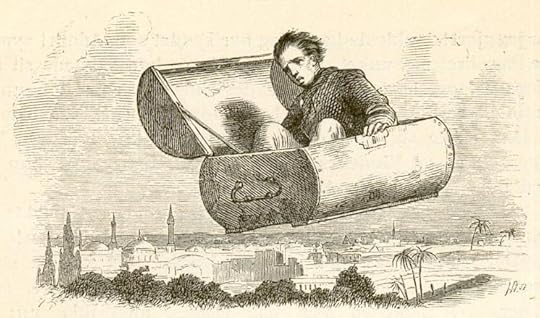
(The reader begins to realise at this point, that the story is tongue in cheek.) The trunk is a magic trunk, which takes off into the air as soon as he presses the lock. In fact it flies all the way to Turkey.
Illustration by Hans Christian Andersen's original illustrator, Vilhelm Pedersen
It seems, from several details in the story, as though Hans Christian Andersen has written himself into this tale. It is also obviously derived from the idea of the flying carpets in "The Arabian Nights", which the author knew very well, as he had read and loved them as a child. Although The Flying Trunk is droll, it does not really capture the reader's attention, apart from the image of the title. It is a rather inconsequential story.
This was a pretty good but sad story about a young man who goes to Turkey via a flying magical trunk and falls in love with a princess only to be separated from her forever. Be sure to find this story online and wherever books and ebooks are sold.
I gotta be honest here and say that after reading all of the stories written by Hans Christian Andersen, this one wasn’t the best.
This story doesn’t have any moral, reading it as an adult isn’t as fun as it would be for a child.
All of the characters here was pretty flat, but it is acceptable because it is a short story which means we don’t have a lot of time to get to know the characters in it
The writing style here was okay. But I can’t say a lot about it because it is a short story so of course we don’t get a lot here.
Other than the fact that you get to learn a little bit about Turkish culture through the story and illustrations, we didn't enjoy this one very much. The prince squanders his money, wins the love of a princess via a flying trunk that he lets burn through carelessness, and then wanders the earth when the trunk is lost even though the parents have already given permission for the wedding.
I have this story in a hard back 1877 copy of H.C. Andersens tales which also included The Tinderbox, The Emperors new clothes The Tin Soldier and The young Swineherd. Wonderful morality tales about why those with bad manners always get their comeuppance. In this tale the Follishness and arrogence of the merchants son is his undoing.
It is one of my favourites so far because of its depth.
It's a story, a fairy tale inside a fairy tale.
A rich man gets a flying trunk and visits a kingdom where he falls in love with a princess. He could win over the princess by telling a fairy tale to the king, which he does successfully. The king believes that the man in the flying trunk is a God, since no one in the kingdom could fly.
But the magic was being hidden in the trunk, not the essence of the man, so eventually he loses the trunk and the princess.
Un cuento corto pero lo sentí con un propósito un poco más claro de los que voy leyendo del autor. No me ha encantado del todo, creo que es porque el protagonista al ser tan oportunista, mentiroso e irresponsable me cayó mal. Y, efectivamente, la que me dio más pena es la prometida que se enamoró de una mentira y al final la predicción se cumplió porque no volvió a ver a su prometido. Sobre el significado, encuentro que podría tratarse de un relato sobre que la fortuna y la suerte son efímeras pero no creo que sea un cuento que volvería a leer o a pensar en él.
A cautionary tale about lying about ourselves to gain prestige and love. Ironic how the tale the hero tells the sultan and sultana reflects his own dishonesty, but he does not notice. The magical trunk is an unusual idea that I love, and I appreciate the poetic ways the hero describes the princess.
I'm impressed a Danish boy flies to Turkey with a Trunk and magically he can talk and understand a language such as Turkish, even being able to tell some tales to a beautiful princess to impress her and her parents xD But I didn't like the tale the boy told, to be honest, I didnt get the point. But I liked the end, because I think the guy was quite stupid :P
I took it upon myself recently to try and read as many Hans Christian Andersen tales as I can. The Flying Trunk is one of those cautionary tales that's a bit ridiculous, but has a decent message. As a story, though, it's sorely lacking. You just feel kind of let down by the tale overall. Though the point the story gets across is arguably one worth telling, you can't help but hate it.
And sure, we shouldn't lie and boast and this story kind of advocates for this whole "quit while you're ahead" mentality. At the same time, the main character never really learns his lesson and just ends his tale rather tragically.
Though, in all fairness, I'm glad that he did because he definitely didn't deserve a marriage to a beautiful princess that was all based on lies. At the same time, though, you'd hope that there would be room for character growth. Frankly, I'd rather watch Aladdin since it has the same themes, actual character growth, and ends much more happily.
A nifty old pop-up book from the 1960s with really beautiful illustrations done by famous Czech-Viennese artist Vojtěch Kubašta and original story by H. C. Anderson. The story itself is a little dated, being slightly creepy in a sexist way, but in a typical way most fairy tales from the 1800s and older are, nothing new. This edition is gorgeous and definitely worth the read if you can get your hands on it.