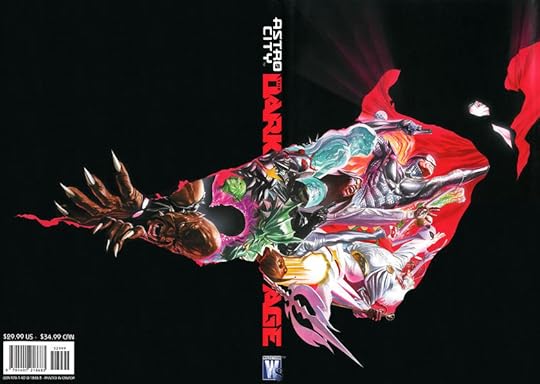
Today Astro City is a shining metropolis on a hill where super-heroes patrol the skies. However, things were not always as bright as they are today. In the early 1970's, in the wake of a global catastrophe, two brothers, one good and one evil must deal with family secrets and social upheaval, involving heroes from Jack-In-the-Box to the Blue Knight and the unsettling events leading to the final fate of the mysterious Silver Agent. Find out why this era was so troubled through the eyes of two men who survived the depths of it!
Kurt Busiek is an American comic book writer notable for his work on the Marvels limited series, his own title Astro City, and his four-year run on Avengers.
Busiek did not read comics as a youngster, as his parents disapproved of them. He began to read them regularly around the age of 14, when he picked up a copy of Daredevil #120. This was the first part of a continuity-heavy four-part story arc; Busiek was drawn to the copious history and cross-connections with other series. Throughout high school and college, he and future writer Scott McCloud practiced making comics. During this time, Busiek also had many letters published in comic book letter columns, and originated the theory that the Phoenix was a separate being who had impersonated Jean Grey, and that therefore Grey had not died—a premise which made its way from freelancer to freelancer, and which was eventually used in the comics.
During the last semester of his senior year, Busiek submitted some sample scripts to editor Dick Giordano at DC Comics. None of them sold, but they did get him invitations to pitch other material to DC editors, which led to his first professional work, a back-up story in Green Lantern #162 (Mar. 1983).
Busiek has worked on a number of different titles in his career, including Arrowsmith, The Avengers, Icon, Iron Man, The Liberty Project, Ninjak, The Power Company, Red Tornado, Shockrockets, Superman: Secret Identity, Thunderbolts, Untold Tales of Spider-Man, JLA, and the award-winning Marvels and the Homage Comics title Kurt Busiek's Astro City.
In 1997, Busiek began a stint as writer of Avengers alongside artist George Pérez. Pérez departed from the series in 2000, but Busiek continued as writer for two more years, collaborating with artists Alan Davis, Kieron Dwyer and others. Busiek's tenure culminated with the "Kang Dynasty" storyline. In 2003, Busiek re-teamed with Perez to create the JLA/Avengers limited series.
In 2003, Busiek began a new Conan series for Dark Horse Comics, which he wrote for four years.
In December 2005 Busiek signed a two-year exclusive contract with DC Comics. During DC's Infinite Crisis event, he teamed with Geoff Johns on a "One Year Later" eight-part story arc (called Up, Up and Away) that encompassed both Superman titles. In addition, he began writing the DC title Aquaman: Sword of Atlantis from issues 40-49. Busiek was the writer of Superman for two years, before followed by James Robinson starting from Superman #677. Busiek wrote a 52-issue weekly DC miniseries called Trinity, starring Batman, Superman and Wonder Woman. Each issue (except for issue #1) featured a 12-page main story by Busiek, with art by Mark Bagley, and a ten-page backup story co-written by Busiek and Fabian Nicieza, with art from various artists, including Tom Derenick, Mike Norton and Scott McDaniel.
Busiek's work has won him numerous awards in the comics industry, including the Harvey Award for Best Writer in 1998 and the Eisner Award for Best Writer in 1999. In 1994, with Marvels, he won Best Finite Series/Limited Series Eisner Award and the Best Continuing or Limited Series Harvey Award; as well as the Harvey Award for Best Single Issue or Story (for Marvels #4) in 1995. In 1996, with Astro City, Busiek won both the Eisner and Harvey awards for Best New Series. He won the Best Single Issue/Single Story Eisner three years in a row from 1996–1998, as well as in 2004. Busiek won the Best Continuing Series Eisner Award in 1997–1998, as well as the Best Serialized Story award in 1998. In addition, Astro City was awarded the 1996 Best Single Issue or Story Harvey Award, and the 1998 Harvey Award for Best Continuing or Limited Series.
Busiek was given the 1998 and 1999 Comics Buyer's Guide Awards for Favorite Writer, with additional nominations in 1997 and every year from 2000 to 2004. He has also received numerous Squiddy Awards, having been selected as favorite writer four years in a row from 1995 to 1998,
The harsh 1970s of Astro City are recounted through the lives of two African American brothers, one a cop, one a petty criminal. The unpredictability of this innovative series continues as one of the key Astro City eras is portrayed through the eyes of these Black brothers! One of the lynch pins of this series has to be the Silver Agent mythos - and that is one damn fine story. Re-imagining the dark tidings and happenings of America's Urban decay using Astro City is interesting and though provoking as the creators include Vietnam, Nixon, Watergate and all :) 7 out of 12.
You are now leaving Astro City, please drive carefully.
splendid tale of two brothers with divergent life paths (one to crime and the other to law) against a backdrop of much superheroic sturm und drang. as always, Busiek places the human element front and center, and all of the intergalactic battles and nefarious deeds and time travel etc are relegated to context - specifically for why life choices are sometimes made for us by outside factors, and why we must always struggle against such determinism. Busiek is surely one of the most humane comic book writers still working.
I loved the nonchalant diversity! also loved the pointed but still nuanced critique of group-think and political witch hunts in the story of the beloved Silver Agent's fall and subsequent rise (thank you, time travel).
I also want to just copy & paste Sesana's perspective on a key element of this story's success, because I couldn't say it any better: Neither brother particularly likes or trusts superheroes. I'm not a huge fan of this particular public reaction. It gets used a lot, to the point of becoming a cliche, and it just seems so ungrateful, you know? Busiek is one of the few writers that can make that reaction seem reasonable, and he does it by using the brothers' narration to explain their reactions.
the art by Brent Anderson works well. not particularly subtle but colorful and lively. the covers by the phenomenal Alex Ross are of course phenomenal, per usual.
The grim and gritty 70's era of comics seen through the eyes of two brothers on opposite sides of the law. However, both of them hate super-powered individuals due to something that happened to them as children. I like how Busiek expands on some of the stories he's told in the past, using the Silver Agent and Blue Knight to great effect. There's a lot of analogues to Marvel's characters from the 70's like Ghost Rider, Iron Fist, and the Punisher. By this point, Busiek has mastered telling small stories amidst a larger, epic backdrop.
This was quite ambitious. Like many of the Astro City short stories, The Dark Age looks at superheroes through the eyes of the normal people they're saving. Or not saving. It's the scope of the story that's really ambitious. Following two brothers over the course of years of their lives and 16 issues (an eternity for an Astro City story), The Dark Age is Busiek's take on Grim and Gritty heroes. Anybody could just pick this up without reading any of the other Astro City stories. But why would you want to? You'll get far more payoff if you go in knowing the background. Finally seeing what really happened to the Silver Agent, for example, is far more satisfying when you've seen all the hints and asides in previous books.
That said, Charles and Royal are strong enough characters to carry the story on their own. The brothers have both been shaped by a traumatic event in their childhood. Charles has become a cop, trying to stay clean. Royal, on the other hand, is a crook, trying to stay out of jail and away from the attention of superheroes. The narration alternates between the two, and their voices are distinctive enough that I had no problem keeping them separate. There are a lot of superheroic things happening around them, but it isn't the main focus of their lives. But they do react to them. Neither brother particularly likes or trusts superheroes. I'm not a huge fan of this particular public reaction. It gets used a lot, to the point of becoming a cliche, and it just seems so ungrateful, you know? Busiek is one of the few writers that can make that reaction seem reasonable, and he does it by using the brothers' narration to explain their reactions.
On the superhero side of things, the heroes are becoming darker and darker, and losing the public trust as a consequence. We see this happening gradually in this book, and it mirrors what's happened in comics. The idea that superheroes need to reflect the worst in humanity, not the best, is obviously not something that Busiek is a big fan of, and this is his chance to directly take it on. I suppose your reaction to it will depend, at least in part, on how you feel about where superheroes should fall: corrupted by absolute power, or still striving for noble ideas, despite their own flaws and shortcomings. I happen to fall in the latter camp, so Busiek's definitely speaking my language here.
This is just part of the story. I'm eager to pick up the second half of The Dark Age, so I can see where all of this will end. I've become pretty attached to Charles and Royal, and I want to see where they end up.
I knew the story reminded me of something. That something was "Marvels", also by Busiek. The little man, in this case two brothers who followed opposite paths in life (one a cop, one a small-time crook), lives in a world of monsters and heroes, and all he can do is watch. Unfortunately, it wasn't as good.
It wasn't as good not because "Marvels" was, well...about MU superheroes. It's just that "Astro City" didn't vibe well. The story was overwhelming with too many personas and superhero stereotypes, and even though "The Dark Age" is an autonomous story, it was confusing enough.
The contrast between simple people like you and me, and superheroes larger than life, read from our perspective, is always a mature theme to explore to the superhero genre, and tbh, it doesn't have many. Still, I don't think I'll return to this series.
There's more than one way to deconstruct comics. Moore's dark, cynical, political style has been very influential--partially because his own works are so well-respected, but also because many comic authors come from the same tradition of British black comedy comics, a la 2000AD.
But Busiek is definitely American, through and through, and his love for the four-color capes comics shines through. With Moore, there's always that sense that the heroism of these supermen is detached, self-serving, and just another representation of the self-justifying power structure.
And this story arc is, quite openly and deliberately, Busiek's attempt to come to terms with the affect that Moore has had on comics. In this first collection, we only get a few hints, but it's clear that Busiek's use of antiheroes and moral relativism in these books is an analysis of the dark, violent, sometimes absurdly amoral underbelly of comics.
For Moore, hope lies in the heart of the normal man, flawed as he may be, but Busiek sees in heroes something more uplifting. Even when their ideals are flawed, even when the heroes themselves fail to uphold them, they are inspired to keep going, to strive for something. It doesn't matter if it's naive, or how many times it is played false, that hope that things can be better is still there.
But he is by no means an idealist. As evidenced in this story, times of crushing darkness do come, when all is pressing and it seems inescapable. But we survive--not unscathed--but still here, still glad to be alive.
His character The Silver Agent is representative of this. He is the symbol of ultimate hope, coming to save the day, but he is usually absent, little more than a memory. People lament their fates and complain about how things 'were better before', but that's just nostalgia--things have always been different, and we have always needed help to persevere. The Agent shows up to stop us from being wiped out, but he doesn't stay to restructure our lives for us, we must continue to muddle through. All we get is a nudge.
But his love for the classic stories of American capes comics can sometimes be overwhelming. Most of Astro City is superb: a thoughtful psychological deconstruction of the superhero genre with equal parts loss and redemption. This collection, however, starts to feel more like an above-average four color adventure rather than the complex, purposeful storytelling I've come to expect from Busiek.
This arc has many asides, characters popping in and out for a bit of exposition, realities clashing, a constant succession of 'world ending' events, and a number of other bright, clashing cliches. Sometimes, these moments are clearly satire, lightly mocking the fact that the world is always ending and the super teams always seem to be lost in some alternate dimension or far-flung world. But Busiek also starts to play it straight, letting these elements become the plot, which usually makes for a rather unfocused story, losing the thrust of characters.
We keep returning to the central characters and their experiences, but the asides are numerous and divergent. It's not Busiek's normally precise and thoughtful style, and we sometimes lose the thread of the story or the individual characters in the many converging plots.
It's still a good book, and better than 95% of the capes comics I've ever read, but it's starting to resemble them more than it exceeds them.
As my old pal Joe would say, “ahh the duality of man!”
Two brothers find themselves on opposite sides of the law in a tumultuous couple of decades in Astro City. A great story about nature vs nurture and what humans are capable of. The superhero aspect is really unique in that most that really interact with the two brothers are (somewhat) regular, street level heroes while at the same time there are cosmic battles and time travelers.
One of the best Astro city stories. I see why this is a two parter!
I'm more into horror, fantasy and humorous graphic novels, but boy do I love this superhero series. I'd rather read Astro City than any other superhero books, except maybe PS238, which is also a sideways approach to the genre. The POV in this series is often a regular Joe, and the regular Joes in Dark Age are two brothers, one a cop and one a criminal who both resent the "Masks." The transition from one point of view to the other was seamless, thanks to the color-coded speech bubbles, and their motivations for choosing their different paths are conveyed sympathetically on both sides. If I knew more about comic book history, I would have proof of this, but I have a feeling that as the story moved over the course of about 20 years, the types of superheroes emerging in the 60s and 70s paralleled what was happening in comic books in reality during those decades. And that's pretty cool. I'm looking forward to Dark Age part 2.
I'm not sure I truly appreciated this book the first time I read it; I think it gains texture when read with the rest of Astro City, especially the previous volume which set up some of the characters and plots that are more fully realized here.
Overall, this is a rather magnificent take on a dark and gritty '70s heroscope, full of lots of hero tropes, gang warfare, and other noir-esque motifs. As is the case with the best Astro City, it's also offers a great personal story which gains weight as it goes on.
Overall a great read both for the depth of this setting that it reveals, the impressive width of its super cast, and the personal emotions of the characters it touches on.
This is the most epic Astro City story that I've read so far! This is the first part in a sprawling two-part story focused on the City during the turbulent 70's and 80's. It begins at the end of the Vietnam War when the world was filled with tumult, and to add to all of that, superheroes, powered villains, street vigilantes, and cosmic invaders seem to be popping up everyday.
But even with all of this going on, the heart of the story is focused on our two protagonists, Charles and Royal, brothers that find themselves on opposite sides of the law but both with a shared childhood trauma and love for each other that forever connects them. This might also be the Astro City story with the least focus on the heroes, as they are regulated to the background even more than usual, with Busiek refreshingly keeping the focus on the brothers and their relationship as it plays against the backdrop of big changes in the world and its relationship to costumed heroes and villains. This is definitely one of the best volumes of Astro City with some of the most enjoyable characters. It can be read stand-alone, but you’ll get much more reward reading it after reading the earlier Astro City stories, as it deepens and provides more context and backstory to characters introduced before. This is a key document in the history of Astro City.
Wow. I can't believe only a few short volumes ago I was ready to write this series off as mediocre and derivative. It seems to me that at some point, Busiek must've just had an epiphany and turned Astro City into one of the greatest comic book series of all time.
It's tough to say since everything in the past few volumes has been so top-notch, but this might be my favorite entry of the series yet. For the first time in the series, we really get a big, epic storyline in Astro City, spanning many years in the city's history, all seen through the eyes of two regular brothers.
Busiek's used the superheroes-as-seen-by-regular-joes style many times before, but I don't think it's ever been as effective. With the way the massive, cataclysmic superhero events play out in this book, with very little details being made available to the brothers (and thus the reader), it really hammers home just how helpless the masses are in the face of these catastrophe. I felt helpless myself just in reading about it.
There's one particular scene that really sold this for me. An all-powerful type arrives to tell all the humans how they will pay for kidnapping her son, and not a single person has any idea what she's talking about. Yet still their lives are threatened. This might seem like frivolous, as it can't happen in real life, but it's not. Because instead, it made me really feel the weight of wars fought on citizens' behalf. The fact that so many can hate an entire nation of people just because of the actions of its government (not just America, either, governments all over the world), really brought home the helplessness we all face in real life.
Beyond this incredibly effective device, I was thoroughly impressed with Busiek's grasp of the mood of the 70s. He transcribes it perfectly into the superhero genre, mirroring the public's shift in attitude along with the shift in the way comic books were written at this time. I mean, the departure of the Silver Agent (Get it? SILVER AGE-nt? You got it.) alone is a fantastic symbol for the move away from the Stan Lees into the Frank Millers of the comic book world. Busiek does a great job deconstructing this and presenting it from a narrative point of view, rather than an academic one. It's very clear that he absolutely loves comics history, and that comes through in the way he writes his characters.
All in all, I can't wait for the second half of this. Astro City is now ranking up there in my top series ever. I can only hope Busiek manages to keep this streak going, well, forever.
Out of the whole entire Internet, not one person told me that the 4th volume of Planetary was released. (It was released on my birthday, no less.) I had to find out it was released on my own while reading the AV Club on my iPhone in the middle of night when I couldn't sleep. That is not cool, entire Internet.
But the AV Club review I read also mentioned Astro City and the subset of Astro City called The Dark Age. So when Comic Relief in Berkeley was sold out of Planetary Vol 4, I bought the first book of Astro City: The Dark Age. As a genius it's hard for me to find suitable entertainment, so I wasn't sure what to expect.
I guess the most obvious comparison I could make is to The Watchmen because Nixon is president (only his first term, though), and there are a zillion superheroes to keep track of. Also it's a time of protesting, and people are sick of the authority that superheroes represent.
The series is told from the point of view of two non-superpowered brothers who grow up in what is basically a superhero war zone. It's pretty awesome because interdimensional battles are mentioned, and the world gets saved several times over. But each time the world is saved it barely merits a panel, and people get on with the real drama of their own lives as soon as possible.
One review I read put it best when he said imagine Spiderman if the only story was the death of Gwen Stacy.
Anyway, I'm quite taken with this series. It's too violent to share with my kids, unfortunately. I went to the library and checked out the rest of the Astro City series. (The 2nd half of The Dark Ages isn't out yet.)
It's a little embarrassing that the books I checked out have "Teen" and "Young Adult" stamped on them, but that's the price I pay for being a genius.
This covers volumes one and two of the complete Dark Age storyline.
Every single Astro City single issue and collection ranges from pretty good to really great, and this particular collection that spans a number of storyline decades is the longest story Busiek and his crew have ever done. It pays off a lot of threads Astro City establishes from early on in its run, most notably what ever happened to the Silver Agent and why the city's statue in his honor reads "To our eternal shame." But the focus is on Royal and Charles, two brothers on diverging paths in life following their parents death when they were very young at the hands of a Hydra-like grunt and how those paths intersect before they come together on a quest for revenge. The epilogue dovetailing nicely to where Astro City all begins is a very nice touch.
Of the two volumes this story encompasses, the second is the weaker one because it meanders its way to the conclusion, whereas the first feels intricate and more exciting. As a whole between the two, the entire story works very well and feels as sprawling as it is intended to be, taking heroes from an age of exploration to the grim and gritty period encompassed by stories like Watchmen or the Dark Knight Returns.
If ever anyone is curious about wanting to read superhero comics without all of the hang ups that come with the storied continuity of a Superman or Spider-Man, I always recommend Astro City. It's an excellent example of working through archetypes without ever making the reader feel overwhelmed because the point-of-view is almost always on the folks who have to live through the experience of superheroes instead of the caped figures themselves.
Busiek has really got this down - telling the stories of the every day people in a world where super heroes are a constant, and using both aspects to reflect upon each other. Although the main story, of two brothers on opposite sides of the law, is almost a cliche at this point, the way Busiek works the heroes (and villains) in is very effective. The telling of the Silver Agent's story, which I'm pretty sure I've read from a different perspective, still manages to highlight the people and the time well, as does everything else here - Busiek is capturing 70's era super heroes well, even as he creates them whole cloth (or builds pastiches of classic characters). Although the volume doesn't complete the entire story, it does give it a decent stopping point. Charles and Royal are both sympathetic characters, frustrated with their lives but in some ways trapped in them as well. The heroes are more a means of chronicling the times than real characters, but it still all works well.
What Kurt Busiek manages to pull off so beautifully is a superhero story told from a new perspective. The core of the book is centered around the perspectives of two brothers, one a cop one a criminal, as they live in a world with metahumans.
A lot of books have played with this concept to different levels of sucsess, this is the best I've read so far. If you think of how much of a cataclysmic event 9/11 was in our world, enough so that you can say nine eleven and people know what you are talking about, then compare it to a world that has what a world like DC or Marvel has you would see how frequently these world changing events would be happening.
Busiek also does a great job showing how little you would actually comprehend as a civillian. All of these vigillantes, superhuman turf wars, supernatural crisies and terrorist attacks going on and you can only understand as much as the media is able to figure out.
For some reason I don't want for The Dark Age to be the most compelling and interesting part of the Astro City series thus far, but I really think it is. The one-and-done stories seem to be where Busiek's heart is, but there's something to be said for a story that develops a little more depth. The morality and narrativity of his shorter stories are just sort of wearyingly formulaic at time, and while the Dark Age Cain & Abel story is somewhat equally obvious, the entire storyworld is ramped up in complexity -- we're finally seeing all the weird story threads pay off.
This contains two parts of the 4 parts story. As always Astro city is Busiek way of exploring how living in a superhero infested world will effect you, the world and politics, and as always, he tells a very human story.
Main difference between this story shows us Astro City in years past and about 20 years of it's history, which is a nice, but might frighten new readers.
If you like superheroes but never read Astro city, you should, Every story is a new surprise, and their all fun and consistant.
I couldn't find a copy of Astro City Vol. 2 so I figured I'd skip forward in the series (and back in time). Maybe that was a mistake, but regardless, I didn't enjoy Dark Age nearly as much as the original Astro City. I get that Busiek is doubling down on the contrast of a "regular Joe" narrative set around extraordinary events, but it just doesn't work here. Or maybe it works to well. Just like the citizens of Astro City, I glazed over at the activities of the Apollo 11, the First Family, Honor Guard, and the rest. So we're left with two interesting (but unlikable and boring) brothers and a bunch of super events that blur together. I don't know, the magic just wasn't there in this novel. There was tons of interest, including Watchmen-line alternative political history, but the end product was a bit boring. 5 out of 10 on my "can't put it down scale." I very nearly put it down and started on the next volume of Saga or Locke & Key in my queue.
The Dark Age follows two brothers in Astro City in the 70s, Charles and Royal Williams, who after witnessing a superhero fail to save their parents, have gone in two opposite directions. Charles is a cop, acting inside the law to be the hero he doesn't believe the superheroes can be. Royal has turned to a life of crime, trying to evade the superheroes and sometimes his brother. All around them, the tide seems to be turning against the heroes as regular civilians start to doubt if these so called heroes really to be trusted.
Usually I prefer these longer form stories but I was not particularly taken with this one. It felt like it dragged and I didn't really care that much for the characters. The Silver Agent's story felt convoluted and confusing, as did the villain's.
This is Astro City in the 70s, and just as comics turned darker in the 70s, so did Astro City. We see people becoming disillusioned with the heroes, who are turning darker and more violent. The idea being one begat the other, and who knows which came first. We follow the story of two brothers, one who ends up a criminal with the other is a straight arrow police officer. It's a dark story but very compelling and something you just can't put down. The art is the same great art that is always in Astro City.
This is the longest storyline so far in the Astro City comic, and it really makes an argument for long form stories in the series. Looking forward to volume two, as this is one of those comics that transcends most of the genre.
The Dark Age, Kurt Busiek's comic filled throwback to a less than ideal Astro City era is dark, gritty, and strangely realistic even though its filled with literal out of this world events. The story is actually about two brothers growing up in the dark age and how their different paths always seem to cross with each other and masks in Astro City. Its done incredibly well. Brent Anderson might have done his best work here as he shifts from street level to cosmic without missing a beat. Amazing work by the talented veteran. Overall, this is a great read that can be picked up by anyone. Fantastic!
In the interest of full disclosure: I am acquainted with Kurt Busiek and have positive opinions of him personally, so one should take this review with whatever dose of salt is necessary.
That said, I'm not *friends* with the man, and this is a freaking masterpiece. Look, at this point, if you're reading ASTRO CITY, this is not your first volume. You already know that it revolutionized the superhero genre by focusing on the civilians and/or the behind-the-scenes interpersonal drama, but not in a "EVERYONE IS CYNICAL AND HORRIBLE" Alan Moore way.
Go read volumes 1-5 of ASTRO CITY, then read this one.
This large-scale a story could have easily failed. Astro City has been mostly one-off stories, and the one serialized volume was relatively small and personal. Busiek and Co. double down on the superhero activity (notably the Silver Agent's story is finally told) but still keep it in the background, while the main storyline of two estranged brothers gets the spotlight.
Best new character design award goes to: Simon Magus, although the Apollo Eleven are awfully close
The first book to have one long, epic story, rather than several shorter ones. This is much heavier reading than previous books, in tone and in amount of stuff to to take in. However, it was interesting (and rather saddening) to see how clearly humanity is painted. People's good opinion can change very quickly based on their moods or circumstances, and we are very quick to make judgments without all the facts and excuses if we're wrong. As always, engaging storyline and beautiful art.
Busiek y anderson prueban en esta ocasión con una historia larga, con dos hermanos en una era del crepúsculo de los héroes, con más sombras que luces. Simplemente genial
DAE Superheroes but from the perspective of regular people???
Astro City is a boring indagation into the world and history of superheroes...and for the billionth time in this comic I see myself skipping the pages of exposition of new ones because they don't matter to me at all. It's trying so hard to be serious and have good characters... but no, it's boring, like an opening that never quite develops into a middlegame. Or maybe this is all there's too it. And I keep reading it because I can I guess, and because I'm curious to see it grow into something better, chasing that high of the good moments in The Tarnished Angel which reminded me more of Moore than this supposed reflection of the impact Watchmen had over comic books.
I'm going to be fair and say that character-wise, it did have the right idea: Royal and his brother are great. The problem is, half of the time it's either nonsense I'm not interested about, and the other half is repetitive squabble.
You know what? No. I don't think Astro City is good. Its superheroes are mostly boring, it remythologizes what Watchmen demythologized and it achieves nothing, except for The Tarnished Angel (only good angle to be found in any of these comics).
Read Alan Moore instead, and not just Watchmen. Read Top Ten, Tom Strong... I give up.
This was the first attempt to build a really epic story arc into Astro City, covering a lot of the setting's prominent characters and jumping back to an earlier point in history. Personally I thought it was a jumbled mess, I didn't really care much for the two lead 'brother' characters, and the writing and plot twists just sort of jump around senselessly and make it hard to take seriously. Besides that, I do still enjoy how it fills in the gaps of the world by showing us more of the Silver Agent, etc, characters we hadn't gotten to know very well, and some of the new concepts and characters introduced here were actually pretty sweet. This is also only the first half of The Dark Age.