Jump to ratings and reviews
Rate this book

City of Thorns: Nine Lives in the World's Largest Refugee Camp [Paperback] [Jan 21, 2016] Ben Rawlence

Rate this book
City-of-Thorns

400 pages, Paperback

First published January 5, 2016

355 people are currently reading
9592 people want to read

About the author

Ben Rawlence

9 books197 followers
Ben grew up in Wiltshire in the UK before studying in London, Tanzania and the USA. He worked for several years in New York and then in politics in the UK and in Tanzania before joining Human Rights Watch where he worked from 2006-2013.

He was an Open Society Foundations Fellow 2013.

He is represented by Sophie Lambert at Conville and Walsh in London.

Ratings & Reviews

What do you think?
Rate this book

Friends & Following

Create a free account to discover what your friends think of this book!

Community Reviews

5 stars
1,050 (30%)
4 stars
1,526 (44%)
3 stars
700 (20%)
2 stars
102 (2%)
1 star
33 (<1%)
Displaying 1 - 30 of 442 reviews
Profile Image for Melissa Lindsey.
131 reviews11 followers
February 11, 2016
This. book. wrecked. me. So much preventable suffering and death. Pointless and heartbreaking.

I can't stop thinking about it. I can't stop thinking about the families who have spent the majority (in some cases ALL) of their lives in a refugee camp. I can't stop thinking about the stories that my own students and friends could tell about their experiences with camp life and the events that drove them to flee to what they assumed would provide health and safety.

Rawlence tells the story of refugee camp through the lives of nine individuals. We hear directly from men and women, boys and girls. We hear from people whose only memories are from camp life and from more recent arrivals, who fled famine in 2010. We see people living, making do, learning, suffering, finding work in a shadow economy, waiting, arguing, falling in love, and even having some fun. We see the human stories behind those media blips that occasionally come across our internet or cable news sources.

But to me, this is more than just nine stories -- it is the story of a place that should not have to exist. A place that exists only because instead of peace, we see war and corruption. We see people benefiting off the chaos that comes with fighting and famine. I think I was most surprised (why I'm still surprised at this point in my life speaks to the rather innocent nature of my little peace loving heart) at how much and how many people benefit from prolonging the instability in Somalia. And that is what wrecked me.

I finished this book with these words on my lips, "Lord have mercy." Have mercy on them and have mercy on all of us. I don't know what to do with the knowledge I now have other than to pray. And to love my neighbors, many of whom came directly from refugee camps.

I don't know how you will respond to this book, but I do know that I want you to read it. I already bought a copy and mailed it to my son. I knew at the end of the year that I was planning to compile of list of must reads, but I can't wait. Please -- if you have refugees in your community, go to your library or your local bookstore and get the book. It will not be an easy, fun read. But I think you will be glad you did.
Profile Image for Kristy.
1,427 reviews181 followers
September 27, 2018
While I found his book informative and relevant, I felt that the emotional aspect of discussing refugees was missing. I never felt moved like I thought I would. These stories are tragic, resilient, and even hopeful at times, but the writing seemed to be very straight-forward and I wish we could have better felt what these people went and go through. Still, it was a good read.
Profile Image for Kavita.
846 reviews459 followers
September 25, 2018
I already knew a lot about Dadaab, since I had been fascinated by the idea of a refugee camp where people lived for generations and lived, worked, and died there. I was familiar with the horrors of the 1992 civil war which started in Somalia by reading Ayaan Hirsi Ali's book. And I also happened to watch a very interesting documentary on Dadaab. So I had a good idea about the basics. But Ben Rawlence really showed a deeper and much more intense side of the camp itself.

The civil war of 1992 in Somalia led to the fleeing of a large number of civilians into neighbouring Kenya. Kenyans created a refugee camp for them, which was Dadaab. Everyone believed that the conflict would be over in a few months and the refugees can then go back. With this in mind, governments around the world were generous in helping some of them resettle, while the UN response was handy as well. But as the years passed by and the war raged on, the refugees began to settle down in Dadaab. For many, it was the only home they had ever known. The world began to lose interest and was preoccupied with several other conflicts and the repercussions from those: Afghanistan, Iraq, Syria, and so on. Somalia and Dadaab were relegated to the back-burner.

In City of Thorns: Nine Lives in the World's Largest Refugee Camp, author and journalist Ben Rawlence follows the lives of a few selected refugees and sees the world they inhabit through their own eyes. Some wanted to be relocated to the Western countries, others wanted to go back to Somalia, but there were many who wanted to remain in Dadaab. The camp functioned as a big city in itself and indeed, it was bigger than many of the big Kenyan cities. Over the years, the camp ecosystem has become a huge contribution to the local economy, with even some Kenyan citizens stopping by for the benefits the camp has to offer in terms of free food and health care.

Rawlence has done extensive research and has shown life in the camp from all angles. He gives the stories of the refugees, but he also brings out the viewpoints of the governments involved. The Kenyan government is winning support by committing war crimes and humanitarian crimes on the displaced Somalis with the narrative of 'fighting against terror' - a narrative that has become frighteningly real and pervasive across the globe. Meanwhile, the UN grapples with a number of other conflicts, especially from Syria. The World Food Programme is completely crippled by the lack of funds. The European Union is struggling with the refugees from the Syrian crisis. The Americans are still moaning about 9/11. And everyone has forgotten the Somalis and Dadaab.

In May 2016, the hardline Kenyan government announced its plan to close down Dadaab and send the refugees back 'voluntarily' to a 'stable Somalia' by end of November 2016. It has not happened, but what will happen now is anybody's guess.
Profile Image for Mikey B..
1,136 reviews481 followers
March 6, 2019
This book describes life in what is likely one of the world’s largest refugee camps. It is in northern Kenya near the border to Somalia and called Dadaab. Most of the refugees are from war-torn Somalia, with some from Sudan and Ethiopia.

We come away with a portrayal of the day-to-day lives of the inhabitants. Many have spent their entire lives in Dadaab which was formed on 1991. Its’ population is around 400,000 but this fluctuates and Dadaab like any city is broken down into different areas. For example, there is a large market, several schools, mosques, police stations, U.N. facilities, hospitals, a bus station, safe areas…

In the last few years the influence of the Islamist extremist group al-Shabaab has become significant. Aid workers have been kidnapped prompting many NGO groups to curtail their many services.

The author gives us not only a view of the nine lives featured in the book, but also how they are intertwined with the various U.N. services, with branches of the Kenyan government, and their clans and families in Somalia. The level of corruption – and violence – is harrowing. In many cases the Kenyan police extract money at their many checkpoints and they especially focus on Somalians. If the money is not forthcoming incarcerations and beatings will likely result.

This book provides us with a view of another world. Many of the refugees contemplate going to Nairobi (Kenya’s capital), some returning to Somalia, some taking the long and dangerous migration as an illegal to Europe, and some have applied to immigrate to Australia, the U.S., Canada,… In fact, all these and other options are a part of their daily wish-list. We are also given the history of Kenya and Somalia with their constant and escalating wars. Aside from Afghanistan this is quite possible the most imperiled and impoverished region of our planet.

This is well-written, a powerful and disturbing portrayal of the dis-enfranchised.
Profile Image for Brenda.
1,516 reviews67 followers
January 16, 2016
Goodreads Giveaway. Yay!

I'm not sure how I feel about this. On the one hand, the author did exhaustive investigation into these people's lives. That much is obvious. The harder thing is that it doesn't seem to have any organization or direction, and it read pretty dryly.

This is a huge culture shock, and I think that was ultimately the point. I had no idea this refugee camp existed, let alone that it is the largest ever. I had no idea there were so many disadvantaged people, with limited resources and an expansive population boom. It is the sort of thing that makes you wonder how we can go along willy nilly-like here when there are people like Guled running from being a child soldier. The stories themselves are fascinating and upsetting. It is a totally foreign world from everything I've known and the author's research is commendable.

I just wish it had been compiled a little more smoothly. The best I can tell, it seems like it is supposed to be chronologically told. But the manner in which we jump from person to person makes no sense, and I had a hard time sometimes separating what was an overall review of current events and what was specific to one person's circumstances. It sort of read like an overly long Nat Geo article, which got a little tiring after a while. But overall, he did a good thing in recording these stories, although I wish he had done more for them in the end based on his own Epilogue.
Profile Image for Bettie.
9,977 reviews5 followers
February 12, 2016
BOTW

http://www.bbc.co.uk/programmes/b06zqn0x

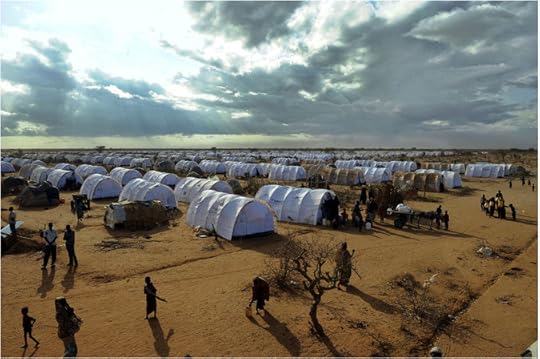
Description: Ben Rawlence tells the stories of just a few of the forgotten thousands who make up the half a million stateless citizens of Dadaab - the world's largest refugee camp, in the desert of northern Kenya, close to the Somali border, where only thorn bushes grow.

The author, a Swahili speaker, and former researcher for Human Rights Watch in the horn of Africa made several long visits to the camps over the course of four years. His account bears vivid witness to the lives of those who live in fear, poverty and limbo.


In the first episode, we meet seventeen year old Guled, as he struggles to survive on the outskirts of Mogadishu. He still tries to attend school as well as to earn a living, but the al-Shabaab militias are closing in.

2/5: After the deaths of his parents, Guled has been struggling to survive, together with his sister, in a makeshift camp on the edge of Mogadishu. But when al-Shabaab force him from the classroom he fears not just for his own life but also worries about his new bride, Maryam.

3/5: Nisho has only ever known life in Ifo - one of the camps in Dadaab. His job as a porter in the market enables him to scrape together a little extra to help his mother, whose failing mental health fills him with anxiety. But from his position, almost at the bottom of the pile, he harbours ambitions for the future.

4/5: The camp is a semi-permanent home (the inhabitants are not allowed to leave without permission) to people fleeing conflicts from all over Africa. And it's far from exclusive to people of one faith. So when Monday, a young Catholic man from Sudan. falls for the beautiful Muna - a Somali Muslim - tensions are bound to ensue.

5/5: Monday and Muna find their child, Christine, is being attacked by embittered Somali clan members. Guled threatens to make the long journey to Italy, and in Washington Ben Rawlence tries in vain to explain the nuances of Dadaab life to the National Security Council.
Profile Image for Lisa (NY).
2,138 reviews824 followers
unable-to-finish
January 13, 2019
I am stopping at page 175. As much as I am interested in learning more about the "world's largest refugee camp," I don't like the structure of the book and am finding it too much work to read. Rawlence jumps from profile to profile and I had trouble keeping track of all the various people. A review I read compared it to "Behind the Beautiful Forevers" - but I don't think it is in the same league at all.
Profile Image for Jeanette.
4,088 reviews836 followers
March 2, 2016
Dadaab is a city in Northern Kenya that has been a UN refugee "city of thorns". Only thorn bushes grow there. And structures are often mud/thorn construction.

It's a non-fiction book that reads like fiction. It's Ben Rawlence's "eyes" and experience with the individuals who core the nine real life stories. Sections with maps and lists of the residents that are included within the book precede the main copy.

And you will need them.

For all is the enemy and these lives often become seated in Dadaab for a decade or more. Enough time to grow up and become "another" or is it "the other". Divisions of such multitudes that going "home" may not be a cultural or an economic possibility. Many leave and get assigned for transport. More than that are coming in all the time. And since the drought years of 2010 and 2011- more and more sections added.

Food, family, work. More than relative to "then", most of those questions settled in the "now". With tomorrow mostly a question, especially for work and earning. Associations do combine for work and profits. And for the women! There is a tale here where a "hit" gets put on a couple just because they crossed a "clan" line in their marriage. In other words, their very marriage is equated a death sentence by majority of their "neighbors" that happen to be from the same place. Different parts of camp become separate and/or opposed for various crime or habits of culture reasons.

This book also has/ surveys immense interact with Somalia's history and the regional sensibilities, borders and such militants as al-Shabaab, al-Qaida and others within the Horn of Africa's "arc of instability".

Long years, generations of misery. Do not read this book if you are a cream puff to reality for the places and nations which truly have no "there" there.

The author gets 5 stars for giving these a voice and not his own.
Profile Image for Emma Deplores Goodreads Censorship.
1,419 reviews2,012 followers
July 10, 2016
This is a good book on an important topic. Dadaab is an enormous refugee camp with several hundred thousand residents, located in a desert area of Kenya near the border with Somalia. For nearly 25 years, Somalis fleeing civil war and famine at home have come to the camp – at this point, an entire generation has grown up there (and roughly 60% of the residents are children). Dadaab is mostly funded through foreign aid, but Kenya has always wanted rid of the refugees and made repeated attempts to repatriate them to the still war-torn Somalia. Refugees are not allowed to hold official jobs, for fear they’ll take them from Kenyans – the exception being “incentive” work, for tiny stipends – nor can they legally enter Kenya proper, so many spend their lives dreaming of being selected for resettlement abroad.

Rawlence followed a dozen or so camp residents for about five years, from 2010 to 2015, giving readers a window on how people make their lives in the camp and the impact of major events. Those we see the most of are young people who grew up there – Nisho, who works as a porter in the marketplace; Tawane, a youth leader aiming for a political future; and Kheyro, one of the few young people in Dadaab to pursue education – as well as Guled, who flees Somalia as a teenager after being briefly conscripted into al-Shabaab. Through their stories and others, the book provides a real sense of life in the camps, from the initial arrival to those who marry and start a family. (Which sounds like a terrible idea, but these are people whose lives have always been precarious.) One young man does make it to Nairobi, only to find life there no more secure than in Dadaab; meanwhile, a young couple faces death threats from both communities because she’s Somali and he’s a member of the camp’s tiny Sudanese minority.

This sort of material is almost guaranteed to keep readers’ interest, and though it’s certainly heavy I did not find it overwhelming; the individuals followed meet with successes as well as difficulties. For the most part it’s quite a readable book, written in a journalistic style, though the author could do with brushing up on his comma placement, which makes some sentences difficult to understand. And the story occasionally bogs down; over the course of several years, at times major events provide a common thread in everyone’s lives, while at other times the stories are quite disparate and the author focuses in on mundane events (presumably those he happened to witness). But he does a good job of weaving facts and statistics into the stories, and occasionally steps away from his subjects' experiences to document major events impacting the camps (such as the mass shooting at a Nairobi mall, which was wrongly blamed on refugees). Finally, while the author renders his subjects’ circumstances vividly, they aren’t completely fleshed-out as individuals, and I wondered how much language and cultural barriers (the author does not speak Somali) interfered. Rawlence also does not discuss how he selected his subjects; most of the book is spent with men, which does not reflect the camps as a whole, and I wondered what role Somali culture played in that choice.

Overall though, this is an important subject, and reading this book is a great way for those of us who live worlds away from Dadaab to get a sense of the human stories behind the headlines. I recommend it.
Profile Image for Jakub Horbów.
388 reviews177 followers
March 15, 2021
Książka Rawlence'a w dość prosty sposób przedstawia, co kryje się pod określeniami pomocy i obozów dla uchodźców. Oddając głos mieszkańcom obozu Dadaab w północnej Kenii, obrazuje rzeczywistość, która ich tam spotyka. Bohaterami są zarówno ludzie nie znający życia poza tym w obozie, żyjący w nim nawet po dwadzieścia lat, a także świeży imigranci z ogarniętej wojną domową Somalii. Pomiędzy zaś kolejnymi historiami tych kilku osób, autor przedstawia relacje z kolejnych szczytów i ustaleń międzynarodowych instytucji oraz pobliskich rządów, a także skale obozowego przemysłu na którym dorobić próbują się lokalni politycy i organizacje, nie wyłączając z nich Asz-Szabab, która jest głównym powodem do życia Somalijczyków na uchodźstwie. Skutkuje to tym, że prawie półmilionowa społeczność obozu żyje przez lata w zawieszeniu, próbując w jakikolwiek sposób poprawić swój los nie mając prawa do legalnej pracy, marząc o wyjeździe gdziekolwiek na wymarzony Zachód.

Sam reportaż nie należy do tych wybitnych, a raczej solidnych i rzetelnych. Minusem okazuje się porzucaniem historii niektórych z rozmówców w jednym rozdziale, po to aby kolejne rozpisywać niemal bez końca. Brakowało mi też trochę głębszego przedstawienia sytuacji w samej Somalii, która jest opisana raczej zdawkowo z punktu widzenia samych uchodźców. Mimo to, jest to książka, którą na pewno warto przeczytać, bo odkłamuje wiele mitów o obozach, które zapewne wyglądają bardzo podobnie, choć w mniejszej skali, w pozostałych miejscach na świecie, a same doświadczenia bohaterów potrafią być tyleż przygnębiające, co inspirujące.
Profile Image for Lars K Jensen.
170 reviews51 followers
March 16, 2016
I couldn't quite decide on whether I wanted to award this book with four or tree stars. I ended up with four of them; let me explain why.

First of all, you have to separate this book in two: 1) The subject it is covering (the history behind and life in the world's largest refugee camp, Dadaab) and the way it is written and telling you these things.

If it was only a matter of the first, it would be a solid five stars. We need to be told about places like this and the situations and crises behind it.

That being said, the book isn't that well written not structured. "Nine lives in the world's largest refugee camp", the subtitle reads. I can understand why you want to make this about the people trying to live in Dadaab. But nine is too many. At some point you can't remember who is who; who was born in the camp, who fled Mogadishu, who was a part of al-Shabaab? And those nine people have families and friends, so you end up with a longer list than that. The list of people at the beginning of the book is a good help but not enough.

Rawlence also wants to, and should, tell you more general things about Dadaab and its place in the world. But it gets mixed too much up with the story of the nine (again, too many) humans, we are following. I would have liked a clearer cut between the two. Some books shift focus for every chapter. Chapter A is general, chapter B is personal, chapter C is general, chapter D is personal and so on. This (and with a maximum of a handful of people) would have made more sense to me - and would have made the book a much better and easier read.

And at some places you really get the sense, that Rawlence wants to be an author. He should disregard this and instead focus on telling on about the camp and the inhabitants. We don't care what colour the cars are or how water trickles down a surface. If the visual impressions are that important, include photos. There isn't a single picture in the book, which I find weird.

But if you want to see how Dadaab (and life in it) looks and meet some of the people there, I recommend visiting Dadaab Stories.

So, why did I end up with four stars instead of three? Well, I guess the importance of the subject weighs more positive, than my issues with the book pull it down. If you are interested in the subject (or, more generally, subjects like Somalia (and Kenya, and their relation), regional conflicts, refugees or Africa) you should read this book. But don't read it for the superb use of metaphors and beautiful wording. When it comes to that there a better books out there.

But in a time when we are seeing more refugees than we have in many years, we need to start talking about those refugees that we so seldom hear about: Those that stays in the area and for whom the journey to Europe and other faraway places remain a dream.
Profile Image for Calzean.
2,770 reviews1 follower
June 26, 2018
A city of broken dreams. A city of broken promises. A city of outcasts. A city of forgotten people.

A sadly fascinating picture of life in Dadaab a massive refuge camp in Kenya. Populated mostly by Somalians, it also has Sudanese, Ethiopians, Eritreans and others fleeing from wars, famines or strangely enough a better life that can be found in the camp.

The author focuses on nine people. Some have been there since 1992. Some born there. Some are relative newcomers. They rely on aid and the grey market. The comparisons between the various groups is a strangely interesting insight into the human adaptation to their experiences.
Some dream of migration, others to return to their homes, others to make the best of what they have and some give up. They eke a living out of their tenacity, determination, muscles, contacts, families or plain skulduggery. Corruption, inequality, domestic violence and rape are rife. The author makes no judgements he records their lives and the events that shape them in the matter of factness of a man who has spent years writing of the abuse of human rights.

Unwanted by Kenya they are trapped faced with danger to their lives with any option they have.
Somalia has become a set of independent states some ruled by traditional clans, some by an invading Kenya, others by al-Shaabab and parts by a UN based peace keeping force.

Written between 2010 and 2014 the camp is threatened with closure and suffers from reduced aid caused by the increase in refugees in other parts of the world. In 2018 it still exists, Kenya still wants it to close, Somalia is still a mess.
Profile Image for Sophie Potter.
31 reviews
December 7, 2015
Please note: I received this book from a Goodreads Advance Giveaway.

I found this to be a gripping insight into the lives of people living in a refugee camp. It is largely unflinching and deals with the stark reality of resource shortages, and the fear that comes with never knowing where the enemy is. The author tells the stories of several different people and their families, and I feel portrays their experience with candour. In this time of world unrest, I think this book is particularly important, and have already passed on my copy to a friend. My only real criticism is that sometimes I felt there were almost too many stories as I found myself flipping back to remind me which person the book was currently talking about.
Profile Image for Liz Janet.
583 reviews465 followers
Read
May 3, 2024
It seems that with the recent “European Refugee Crisis” the issue of refugee camps has finally come to the front burner in Western news circles, and this book gives a pretty good depiction of what it is like being a refugee in Dadaab, which was the largest one until this year, when it was surpassed by Bidi Bidi, also in Africa.

“… it was the rhetorical question posed in the newsletter that had the biggest impact among Guled’s traumatized generation: ‘Why invade a country that has been fighting a civil war for a decade and a half the moment they have decided to live in peace?’ The Islamic Courts Union had brought peace. It had been wildly popular and Somalis resented the US-sponsored Ethiopian invasion. ‘The United States cannot abide a situation in which Islam is the solution,’ the newsletter argued. And to many that seemed like the truth.”

Besides the stories of how some individuals ended there and how they’re currently surviving in a place most of us would never even attempt to set foot in, there are snippets of the main cause of the existence of the camp, the how and why this horrendous situation came to be and the political forces and governments that are ensuring the survival or destruction of the camps and its people.
The question from the above quota has been plaguing me, as I knew it would when it came to American intervention in the conflict, because it showed me what most people spend their lives trying to ignore, how certain countries benefit from the instability of Somalia and the role of oil in it, behind the guise of religion.

A heartbreaking book that will lead you to anger as quickly as tears.
Profile Image for Georgiana 1792.
2,401 reviews161 followers
August 20, 2020
Un reportage storico-politico agghiacciante della situazione nel campo profughi di Dadaab, in Kenia al confine con la Somalia. Un limbo in cui approdano persone dalle situazioni più svariate, ma sempre disperate.

Nessuno vuole ammettere che Dadaab non è più un luogo temporaneo ma una struttura permanente: né il Governo del paese in cui si trova, il Kenya, né le Nazioni Unite che lo foraggiano e nemmeno i rifugiati che ci vivono. Questo paradosso rende instabili le sue fondamenta: stretti fra la guerra in Somalia e un mondo che non intende accoglierli, ai profughi non resta che sopravvivere immaginando una vita fuori dal campo. Non è facile, dal momento che la loro mente non può riparare né nel passato, né nel futuro e tantomeno nel presente. Vivere in questa città di spine equivale a vivere in una prigione non solo fisica ma anche ideale, in cui i pensieri oscillano fra sogni irrealistici e una realtà desolante. Solo chi è davvero disperato può scegliere di venire qui.

Attraverso le esperienze di alcuni profughi analizziamo la vita a Dadaab da diversi punti di vista.

Anche se si stava abituando al nuovo ambiente e aveva imparato a muoversi nel reticolo del campo, iniziando persino a usare la parola “casa” per riferirsi alle tende e alle capanne di fortuna, la mente di Idris si rifiutava di accettare la situazione e interiormente il suo spirito si ribellava. Quella ribellione interiore era per lui l’unico modo per sopportare la sua nuova vita.
– Ero un rifugiato ma senza la mentalità del rifugiato: non ho mai pensato davvero di stabilirmi qui – ricordava.


Alcune persone sono arrivate a Dadaab giovanissime e sono cresciute nel campo, ma non vedono l'ora di andarsene.

Diventare adulti nel campo non è stato facile per la generazione del 1992, dato che gli anziani non potevano più far loro da guida. Avevano ottenuto tutti i diplomi possibili e immaginabili, avevano raggiunto il massimo a cui potevano aspirare a Dadaab e volevano costruirsi una vita migliore lontano da lì. Molti dei loro amici erano stati ricollocati in Europa o nei paesi del Nord America, prima che l’11 settembre facesse crollare il numero di posti disponibili. I giovani uomini e le giovani donne che in quel momento si trovavano al centro giovanile erano quelli che erano rimasti indietro, ma che avevano seguito i successi dei loro conoscenti all’estero grazie a Facebook: auto di lusso, abiti firmati, donne senza il velo. Restavano a bocca aperta e il desiderio di andarsene li consumava. Bloccati nel campo e senza il permesso di lavorare, vivevano di sussidi e di qualche lavoro a incentivi sottopagato, passando la maggior parte del tempo ad applicare i paradigmi della politica e del vivere civile alle organizzazioni giovanili, preparandosi per la tanto agognata carriera che speravano li attendesse fuori di lì.

Una lettura dura, difficile, agghiacciante, che fa sentire impotenti e che dà una consapevolezza dolorosa della situazione in Africa.

Lo stato attuale dei campi a Dadaab dipende dal fatto che i rifugiati non sono percepiti come esseri umani, perché altrimenti sarebbe necessario riconoscere che hanno dei diritti. Ma riconoscere questi diritti significherebbe rivangare il passato e compiere un percorso di presa di coscienza storica che risulterebbe eccessivamente traumatico. Significherebbe riconoscere che il terreno su cui sorgono i campi era tradizionalmente terreno somalo. Significherebbe riconoscere che il confine che trasforma i rifugiati in stranieri è un atto di violenza storica. E soprattutto significherebbe riconoscere che le condizioni in cui i rifugiati vivono costituiscono un vero e proprio crimine. Ma prendere coscienza di tutto questo rischierebbe di lacerare lo stato stesso, perciò i rifugiati devono essere demonizzati a ogni costo.
Profile Image for Misha.
302 reviews7 followers
May 1, 2022
I learned quite a bit from this book, which was my purpose in reading it. I appreciated the honesty and details the author gave in the mix of explaining history and modern events. For anyone wanting to learn more about Somalia, refugees, or the failings of the modern world when it comes to aid in Africa, I would definitely recommend this book.

I had been hoping for more of a narrative non-fiction feel that really tracked with particular people (the "nine lives" part of the subtitle made me think this might be more the case). While it did live up to telling the story of nine people, there was a certain journalistic distance to the stories that lowered my star-total to three.
Profile Image for .•º°༺×Ṩสℛสℋ×༻°º•..
303 reviews17 followers
February 7, 2023
One day, I also want to write a book like this. This was amazing, real and shows a reality that you would never witness otherwise. You hear stories - me in my job in a humanitarian organization travelling to places such as Dadaab in this book firsthand - but you do not understand the layers and depth you only have a very narrow snippet of what a life in a refugee camp looks like - with this book you can feel it, you can listen to their thoughts, the ugly truth and the desperation and to some extent see behind the curtain.
Profile Image for Zak.
409 reviews32 followers
July 24, 2017
This is a bleak, eye-opening account of life in Dadaab, the world's largest refugee camp. I was not even aware of the existence of this camp (more like a town, with population estimates running between 400k to 800k, depending on who you believe, at the time of writing). It covers well the circumstances which lead many there, as well as the conditions which they undergo in their daily quests for survival. Hemmed in by religious militants on one side and a hostile foreign government on the other, with corrupt authorities and unscrupulous bandits in their midst, the overall feeling is one of utter despair and hopelessness.

I was interested to see if people who had undergone extreme suffering and deprivation would somehow develop a heightened sense of humanity and compassion for the sufferings of others (many, including children, suffer or die from starvation and disease either at the camp or on the long, hazardous journey there). Sadly, the feeling I got from reading the book is that people who have lost literally everything can still cling stubbornly to their narrow beliefs and prejudices. Imagine your own family (women included) trying to beat you (a pregnant woman) to death for marrying someone of another religion or clan. Or refusing to help your newborn because it is considered a "Christian baby". Even the generous assistance given among fellow refugees is restricted to those of the same religion or clan. As heartless as it sounds to say this, it is as if they have not collectively suffered enough already and have no qualms about perpetuating further suffering amongst themselves.

I wonder at the reasons for this. Is it as simple as due to a lack of education or exposure to other cultures and ways of life? Is it precisely because they have lost everything else (homes, dignity, family members, etc.) that they cling on to invisible things like religious and tribal taboos... because really that is all they have left to cling on to? I hope I can find a book that attempts to answer this question.
Profile Image for Karima.
750 reviews17 followers
May 20, 2016
After spending a very fitful night, tossing and turning with images of blown out buildings, dust, rubble, amputaions, bullets and lifeless terrain, I decided to put this book aside. Though we all need to educate ourselves about the atrocities going on in our world, this book, though very informative, lacked character grounding. Laden with one dismal situation after another, we didn't get a good enough sense of the real person. They seemed generic, fleshed out with circumstance but not self.
Also needed some serious editing. Many long sentences that needed commas to read coherently.
Profile Image for ambyr.
1,077 reviews100 followers
October 17, 2020
I am the granddaughter of refugees. Both my grandmother and grandfather lived (separately) in camps in Germany from 1945 to 1949. It was a tedious wait for both of them, but not, by any account, a particularly unpleasant one. They lived in buildings with walls and roofs and indoor plumbing; I've even seen the house where my grandmother spent her years as a refugee, which she asked to revisit once while on a family vacation.

A year after they left on their respective boats for America, UNHCR was established with, Rawlence notes, "a three-year mandate to help resettle the displaced in Europe after the Second World War." Seventy years later, it soldiers on, its mandate growing more and more fictional by the year. It can house the displaced (in tents, in shacks they build themselves); it can (with the assistance of the World Food Project) feed them starvation rations. But resettle them? The immigration permissions that my grandparents waited patiently for and eventually received are scarce on the ground. In Dadaab Camp, which Rawlence provides, perhaps 2,000 people a year receive permission to emigrate; the birthrate, never mind the rate of new arrivals, is 1,000 a month.

The alternatives to immigration are integration into Kenya (which Kenya vehemently refuses to allow) or repatriation to Somalia--a choice increasingly being forced on refugees even as drought worsens and violence continues. And so most of them struggle to remain in their desert camp, a "temporary" settlement decades old, with few prospects and little hope.

Little hope--but not no hope. I knew the rough outline of the picture Rawlence sketches (mostly, I'll admit, from watching the documentary One Life earlier this year, which shows the similar plight of the Rohingya refugees in Bangladesh), but the genius in this book is that it dips into facts and figures only occasionally, mostly focusing on the day-to-day lives of the residents of the camp. Few prospects doesn't mean no opportunities; little hope doesn't mean no dreams. In a landscape of destitution, they snatch what victories they can, form a tenuous economy, find love. In revealing the lives of nine individuals, City of Thorns reminds us that all the residents of the camps are human.

There is no solution here to the Problem of Refugee Camps. As One Life makes excruciatingly clear, the only real, durable solutions are political ones to end violence and discrimination, solutions far outside the mandate of UNHCR and the WFP--and in the case of Somalia, where climate change is part of the devastation, it's not clear even that will be enough. But it's still worth reading just to be reminded, yet again, that refugee camps aren't a solution, that warehousing pain and suffering out of sight does not end it.
Profile Image for Liam.
68 reviews
July 24, 2020
This book made me feel a lot of things, but most of all angry. I felt so angry reading about all the horrific, traumatizing things the residents of Dadaab have gone through. It is beautiful how some of these people have experienced so much hardship but still manage to dream, to work their very hardest, and above all, to hope. It puts into perspective how frivolous my problems really are. However, for many of the residents of Dadaab, their story is not a happy one. In such a soul crushing environment, the vast majority of people's lives are reduced to a landscape of poverty, pain, and hopelessness. I don't think anyone can say truthfully that they would prosper in such an environment. This book made me mad at the governments of the world, mad at beurocracy. They could have prevented and helped so much of this horrible situation. But to be able to sleep at night, world leaders must expel thoughts of people starving in refugee camps from their minds.
Now I want to talk to about the writing, which was amazing. Some of the reviews of this book were saying the writing was distant and impersonal but I couldn't disagree more. This book was as suspenseful as any thriller, filled with foreshadowing and climaxes. I do wish the different characters' perspectives were more organized, and that there was a better index to the cast.
The first thing I did after finishing this book was research the current situation in the Horn of Africa because this book ends with a cliffhanger that leaves you aching to know how these real people's stories end.
Profile Image for Melissa Stacy.
Author 5 books271 followers
January 28, 2022
DNF at roughly 40%

"City of Thorns: Nine Lives in the World's Largest Refugee Camp" (published in 2016) is a history biography nonfiction book by author and journalist Ben Rawlence.

From Wikipedia:
"Generally, the book follows the stories of nine people narratively through their respective journeys through Dadaab, the world's largest refugee camp, home to about 350,000 people (although the exact number is unknown and contentious)."

This is an excellent book, but listening to it on audiobook in January 2022, when I have so many personal challenges amidst the hospital spike of the COVID-19 pandemic, this book was just too depressing to continue. The content is horrifying to read. While it's absolutely necessary to read, it also left me feeling despair, and I don't have the emotional or mental bandwidth to finish this right now.

I do plan to finish it, at some point in the future. It's an excellent work of nonfiction, illuminating and profoundly educational. The writing is superb. I want to keep reading it. I just can't keep reading it right now.

Five stars.
Profile Image for David.
733 reviews366 followers
February 13, 2018
Available as a twelve-hour audiobook download.

I listened to part of this book while getting a root canal. It is excellent for this purpose. It put my root canal into perspective.

I sometimes run into people who refuse to read (or listen to) books because they are “too depressing”. This book might fit into this category. Grinding misery does not generally, contrary to myth, bring out the best in people, but instead often reduces them to a worn-out nub of a human, quarrelsome and grasping at drug addiction, extremism, or the wan hope that some Western government will pluck them out of their misery.

I understand people refusing to see the latest Hollywood dystopian blockbuster or to read a novel because it is “too depressing”. Life is hard, and every day somebody has to get a root canal. However, in the real world, the most wretched deserve your attention, and more, depressing or no. Consider listening to this book for that reason, if you can bear it.

Recommended in The Newcomers by Helen Thorpe.
Profile Image for Anne Chappel.
Author 5 books21 followers
June 8, 2017
This is a journey into a world that most of us can hardly imagine. The description of the desolation of Dadaab is mind blowing - the heat, dust and lack of what most of us think of essentail for reasonable life is staggering. Against this backdrop, Rawlence tells the story a just a few of the people who find themselves there - year after year - trying to establish an existence and trying to hope for a better future. Few countries wants these refugees - the Kenyan government vilifies them and only a trickle escape to other countries. The numbers that leave are less than the numbers being born into Dadaab. And the people or organisations that try and help struggle against the growing violence and control of Al-Shabaab. Yesterday on the news it was reported that an IED had killed 4 Aid workers. This book is well researched and well written. It is just hard to comprehend such suffering.
Profile Image for Susanne.
508 reviews19 followers
January 30, 2018
An astonishing read for someone whose New England town has just welcomed a family of Ethiopian refugees fresh from 12 years in a different Kenyan refugee camp. Those of us born into safe, secure communities couldn’t possibly imagine challenges like this. What an eye opener.
Profile Image for Magda Prz.
102 reviews7 followers
February 13, 2018
Straszna lektura. Ben Rawlence z ramienia Human Rights Watch podąża za beznadzieją życia bohaterów. Najciekawszy wątek to to, dlaczego przy stole podczas rozmów o Somalii przedstawicieli Somalii sadza się na n-tym miejscu za przedstawicielami innych krajów afrykańskich, i dlaczego społeczności międzynarodowej zależy na utrzymaniu obozów jak Dabaab. Kiedy poznacie odpowiedź na te pytania włosy staną wam dęba. Nikomu nie zależy na somalijskim pokoju, a wręcz można powiedzieć, że dla wielu wojna w Rogu Afryki jest zbawieniem.
Zbliżone do opowieści o krajach b. Jugosławii Ed Vulliamego, choć Rawlence zastaną rzeczywistość opisuje delikatniej. A szkoda.
Profile Image for Juniper.
1,039 reviews388 followers
March 31, 2016
reviewing a book like this can be a tricky prospect as there are two issues to consider: the importance of the material; and the quality of the writing.

on the first count, rawlence has given readers an important and necessary work. on the second count, i found the style inconsistent and, at times, difficult to follow. not because the language was hard or inaccessible (though he does, periodically, like to throw out $5 words which end up sticking out like sore thumbs, heh), but because of how the story jumps around from person to person, place to place. (and, usually, i don't have trouble with non-linear timelines, and multiple characters or people.) there is, of course, a chaos to the lives and situations, so in that sense the style of the book is an accurate reflection.

i am wondering about format. i read this as an e-pub (nook). there were a few maps at the beginning of the book which were great, but i couldn't zoom in or out on them. there were no other images included. and that may sound like a silly thing to criticize, but i do think it would have helped this book a lot with context and putting the reader in the camps. (i feel there could have been a way to do this while protecting the privacy and security of the 9 featured people.) and images are an aspect of nonfiction reading i always enjoy. i am going to investigate the paper edition at the bookshop.

i didn't learn a lot of new information from this book, so if you tend to have an interest in and concern about international politics and humanitarian crises, it may feel familiar to you. but i am glad i read this book. i think that by featuring specific individuals rawlence helps breakdown the overwhelming and heartbreaking problems of the refugee camps, and makes it all more relatable and accessible. i'm just bummed the reading didn't flow better. something i would have liked included in this book is an approach to solutions, or an examination of what needs to happen to offer hope and a safe, stable way out to the hundreds of thousands of people living in a dangerous and threatening limbo. (and i hope none of this sound flip. i have so much worry and empathy for refugees, and all they endure and survive. it is often frustrating to feel helpless and useless because of governments or NGOs, and their ingrained (corrupt and broken) systems prevent progress or solutions, under the guise of 'we are helping.')

so - this is an emotionally tough read at times and, understandably, hope is difficult to find. but it is there.

updated to add:

found this terrific interview with rawlence, that i wanted to link here for reference: https://www.opencanada.org/features/l...

Profile Image for Kamila Kunda.
430 reviews356 followers
September 26, 2021
“City of Thorns” by Ben Rawlence reads like a novel. The author, between 2006 and 2013 a researcher for Human Rights Watch, follows nine characters for years, often from the time they arrive to the Dadaab refugee complex. Dadaab, located outside Nairobi, with the population of nearly 300,000 refugees and asylum seekers mainly from Somalia and Sudan, used to be the largest refugee camp in the world and is still among the largest (the vastest one is now Kutupalong in Bangladesh’s Cox Bazar with over 800,000 refugees). For European readers, familiar with functional refugee complexes, in which human rights and dignity are respected, reading about Dadaab can be a shock and yet these semi-legal structures with their own economy and social norms are more prevalent in the world.

Rawlence resembles Proust in his attention to detail. No story, no gossip, no emotion escapes him. The people he describes come with nothing, escaping the decades-long Somali Civil War, and try to build their lives anew, wherever they can. Impermanence is their bread and butter. Their ethical dilemmas, their dreams and plans are always tinged with uncertainty and unpredictability of the future. But life must go on and thus weddings take place, children are born (causing swelling of the camp and depleting of valuable resources to the levels of near humanitarian crises), new businesses are established. Sadly, old clan animosities thrive, xenophobia, racism, misogyny flourish. Women are mistreated. Those who want to escape from Dadaab and try their luck in Nairobi, who take risks to improve their lot, inevitably lose. Kenya is an incredibly corrupt country, ranked 124th (out of 180) in the world corruption index, together with Pakistan, Bolivia, Kyrgyzstan and Mexico. Law is arbitrary, decided by the police on the spot. “This is Kenya, we can rape you if we want to”, heard one Somali refugee from a Kenyan policeman, and it is not an exception when it comes to the abuse of power. Rapes by authorities take place daily. Harassment and extortion are common.

“City of Thorns” doesn’t give answers as to how to solve refugee crises. The book highlights, however, their complexity, the links between politics, business and personal decisions regarding the determination of the fate of thousands of people. Rawlence brilliantly analyses personal decisions and the ways they help or hinder individuals. What I appreciate especially is how multidimensional portrayals of refugees Rawlence described - they are neither heroes nor villains. Simply human
Displaying 1 - 30 of 442 reviews

Can't find what you're looking for?

Get help and learn more about the design.