

What do you think?

Millennium: From Religion to Revolution: How Civilization Has Changed Over a Thousand Years
History’s greatest tour guide, Ian Mortimer, takes us on an eye-opening and expansive journey through the last millennium of human innovation.
In Millennium , bestselling historian Ian Mortimer takes the reader on a whirlwind tour of the last ten centuries of Western history. It is a journey into a past vividly brought to life and bursting with ideas, that pits one century against another in his quest to measure which century saw the greatest change.
We journey from a time when there was a fair chance of your village being burned to the ground by invaders—and dried human dung was a recommended cure for cancer—to a world in which explorers sailed into the unknown and civilizations came into conflict with each other on an epic scale. Here is a story of godly scientists, fearless adventurers, cold-hearted entrepreneurs, and strong-minded women—a story of discovery, invention, revolution, and cataclysmic shifts in perspective.
Millennium is a journey into the past like no other. Our understanding of human development will never be the same again, and the lessons we learn along the way are profound ones for us all.
In Millennium , bestselling historian Ian Mortimer takes the reader on a whirlwind tour of the last ten centuries of Western history. It is a journey into a past vividly brought to life and bursting with ideas, that pits one century against another in his quest to measure which century saw the greatest change.
We journey from a time when there was a fair chance of your village being burned to the ground by invaders—and dried human dung was a recommended cure for cancer—to a world in which explorers sailed into the unknown and civilizations came into conflict with each other on an epic scale. Here is a story of godly scientists, fearless adventurers, cold-hearted entrepreneurs, and strong-minded women—a story of discovery, invention, revolution, and cataclysmic shifts in perspective.
Millennium is a journey into the past like no other. Our understanding of human development will never be the same again, and the lessons we learn along the way are profound ones for us all.
403 pages, Hardcover
First published November 8, 2016
About the author
Ian Mortimer
35 books1,518 followersAKA James Forrester.
Dr Ian Mortimer is a historian and novelist, best known for his Time Traveller's Guides series. He has BA, MA, PhD and DLitt degrees from the University of Exeter and UCL. He is a Fellow of the Royal Historical Society and a Fellow of the Society of Antiquaries, and was awarded the Alexander Prize by the Royal Historical Society in 2004. Home is the small Dartmoor town of Moretonhampstead, which he occasioanlly introduces in his books. His most recet book, 'Medieval Horizons' looks at how life changed between the eleventh and sixteenth centuries.
He also writes in other genres: his fourth novel 'The Outcasts of Time' won the 2018 Winston Graham Prize for historical fiction. His earlier trilogy of novels set in the 1560s were published under his middle names, James Forrester. In 2017 he wrote 'Why Running Matters' - a memoir of running in the year he turned fifty.
At present he is concentrating on writing history books that have experimental perspectives on the past. One example is a study of England as it would have appeared to the people living in his house over the last thousand years. This is provisionally entitled 'The History of England through the Windows of an Ordinary House'. It is due for completion in December 2024 and publication in 2026.
Dr Ian Mortimer is a historian and novelist, best known for his Time Traveller's Guides series. He has BA, MA, PhD and DLitt degrees from the University of Exeter and UCL. He is a Fellow of the Royal Historical Society and a Fellow of the Society of Antiquaries, and was awarded the Alexander Prize by the Royal Historical Society in 2004. Home is the small Dartmoor town of Moretonhampstead, which he occasioanlly introduces in his books. His most recet book, 'Medieval Horizons' looks at how life changed between the eleventh and sixteenth centuries.
He also writes in other genres: his fourth novel 'The Outcasts of Time' won the 2018 Winston Graham Prize for historical fiction. His earlier trilogy of novels set in the 1560s were published under his middle names, James Forrester. In 2017 he wrote 'Why Running Matters' - a memoir of running in the year he turned fifty.
At present he is concentrating on writing history books that have experimental perspectives on the past. One example is a study of England as it would have appeared to the people living in his house over the last thousand years. This is provisionally entitled 'The History of England through the Windows of an Ordinary House'. It is due for completion in December 2024 and publication in 2026.
Ratings & Reviews
Friends & Following
Create a free account to discover what your friends think of this book!
Community Reviews
Displaying 1 - 30 of 52 reviews

April 21, 2017
This book's narrative could pass for the transcription of Ian Mortimer's response in a conversational setting to the question, "Which century of the second millennium experienced the most change?" Most people would simply respond with a quick answer that it must surely be the twentieth century. His response is a more thoughtful appraisal of fundamental change experienced by people in each century, and he concludes that it depends on the type and definition of change.
Ian Mortimer has spent his life studying and writing about what life was like for people in past eras of history, and his response to this question has the tone of a person fully informed about the subject being addressed. The focus of this book is on Western European history with an emphasis of English history. He is simply writing about what he knows, and is not intending to deny the significance of other parts of the world.
Each of the first ten chapters of the book are focused on a single century between the years 1000 and 2000. At the end of each chapter he offers a "Conclusion" in which he compares significant changed conditions between the beginning and end of that chapter's particular century. The focus of the book's narrative is on the living conditions of the people alive during the century—not the movements of armies and kings.
Also, at the end of each chapter he offers his opinion regarding "The Principal Agent of Change." His opinion about who or what was the principal agent of change for the century is generally unconventional in nature.
He ends the book with the most unconventional agent of all. Near the end of the book he offers his opinion on who the principal agent of change for whole millennium was, and it turns out to be an agent not previously mentioned as principal agent of change for any individual century. He awards the winning agent for the millennium to be God. Mortimer quickly states that he's an atheist and doesn't believe in God. But God doesn't need to exist to be a principal agent because changing perceptions of God can be a significant driver of change in the activities of people. And indeed the subtitle of the book, "From Religion to Revolution," is a tipoff to this conclusion.
The final chapter of the book offers a system of analysis and scoring to determine in an objective manner which century experienced the most change. The following are a few of the illustrations from the book that I have selected to show his evaluation of historical change.
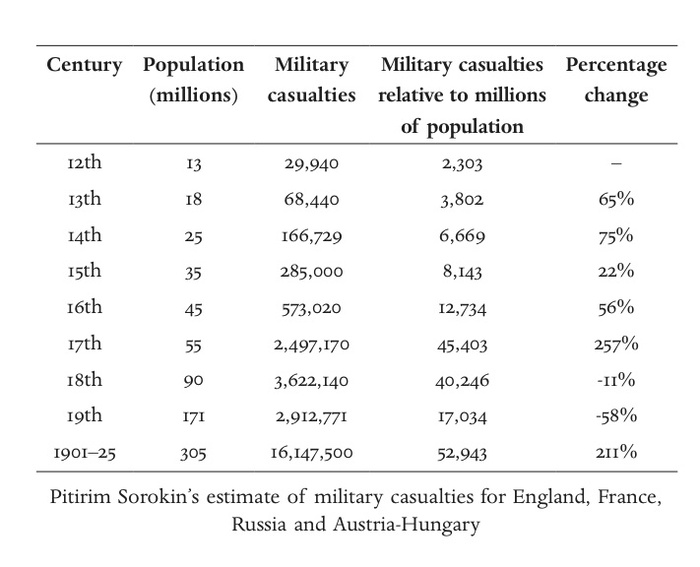
The following table shows military casualties by century. The numbers are not complete, however they are reasonably proportional to reality and can be used to provide a realistic indication of percentage change from century to century.
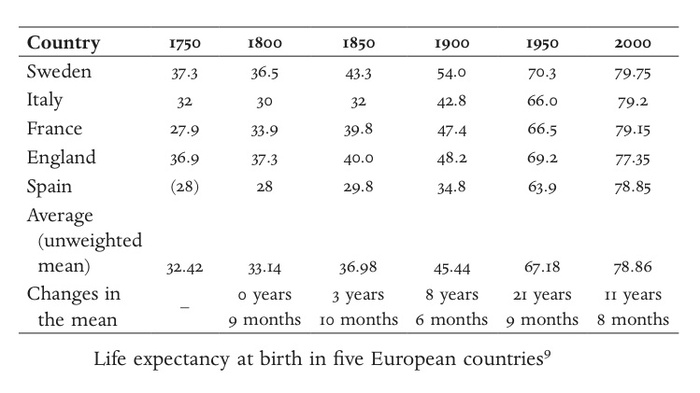
The following shows changes in life expectancy by century and percent change.
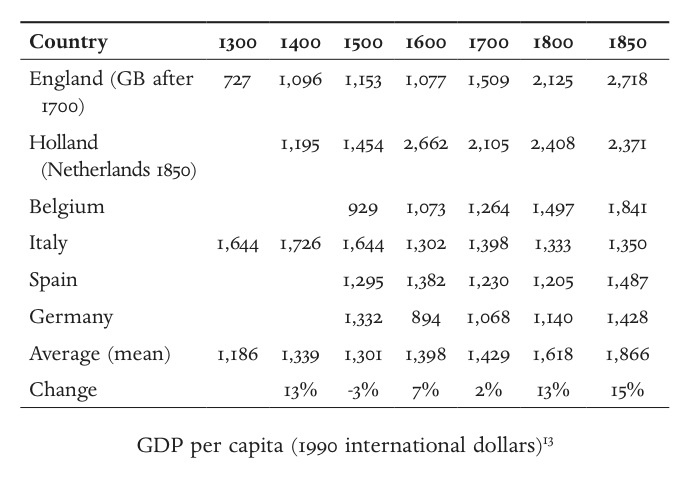
The following is a rough indicator of per capita wealth and percent change by century.
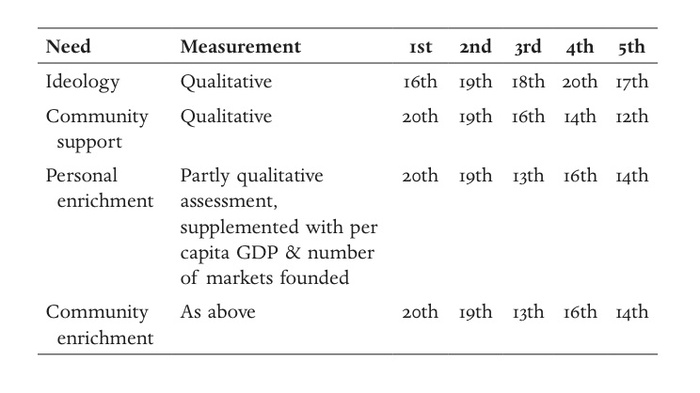
The following is a ranking of human needs and percent change by century.
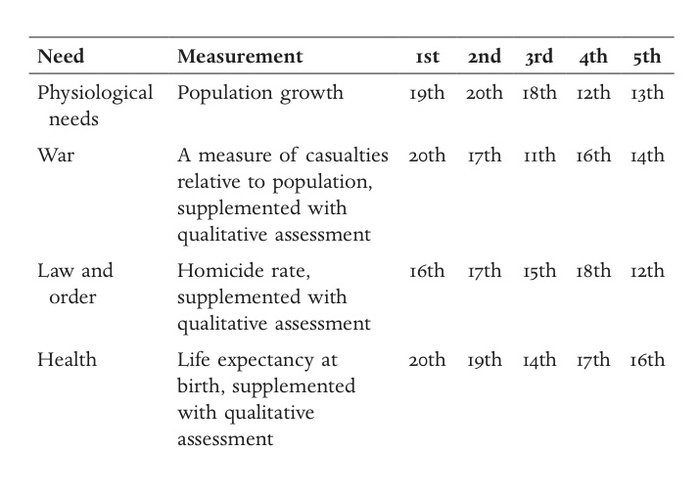
The following is a ranking of some additional human needs and percent change by century.
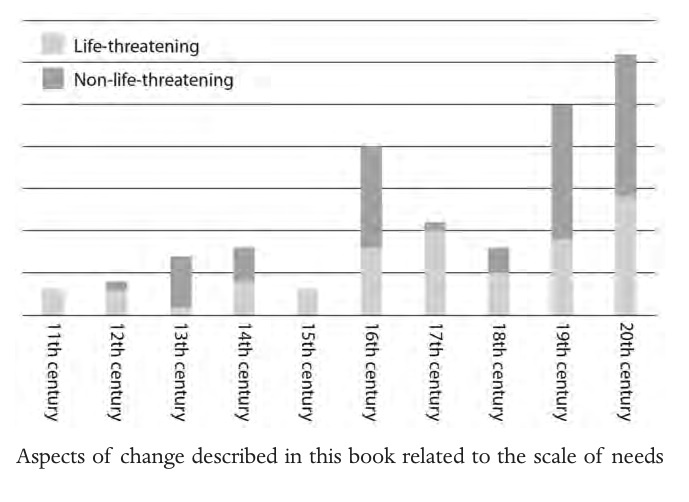
The following is a graphical representation of changes in human needs that also differentiates between life-threatening and nonlife-threatening needs.
The conclusion to all of the above is that
Ian Mortimer has spent his life studying and writing about what life was like for people in past eras of history, and his response to this question has the tone of a person fully informed about the subject being addressed. The focus of this book is on Western European history with an emphasis of English history. He is simply writing about what he knows, and is not intending to deny the significance of other parts of the world.
Each of the first ten chapters of the book are focused on a single century between the years 1000 and 2000. At the end of each chapter he offers a "Conclusion" in which he compares significant changed conditions between the beginning and end of that chapter's particular century. The focus of the book's narrative is on the living conditions of the people alive during the century—not the movements of armies and kings.
Also, at the end of each chapter he offers his opinion regarding "The Principal Agent of Change." His opinion about who or what was the principal agent of change for the century is generally unconventional in nature.
He ends the book with the most unconventional agent of all. Near the end of the book he offers his opinion on who the principal agent of change for whole millennium was, and it turns out to be an agent not previously mentioned as principal agent of change for any individual century. He awards the winning agent for the millennium to be God. Mortimer quickly states that he's an atheist and doesn't believe in God. But God doesn't need to exist to be a principal agent because changing perceptions of God can be a significant driver of change in the activities of people. And indeed the subtitle of the book, "From Religion to Revolution," is a tipoff to this conclusion.
The final chapter of the book offers a system of analysis and scoring to determine in an objective manner which century experienced the most change. The following are a few of the illustrations from the book that I have selected to show his evaluation of historical change.
The following table shows military casualties by century. The numbers are not complete, however they are reasonably proportional to reality and can be used to provide a realistic indication of percentage change from century to century.
The following shows changes in life expectancy by century and percent change.
The following is a rough indicator of per capita wealth and percent change by century.
The following is a ranking of human needs and percent change by century.
The following is a ranking of some additional human needs and percent change by century.
The following is a graphical representation of changes in human needs that also differentiates between life-threatening and nonlife-threatening needs.
The conclusion to all of the above is that
December 21, 2016
Have you ever found yourself involved in a discussion of the merits of Peyton Manning versus Tom Brady or which was the best movie franchise, Star Wars, Godfather, Despicable Me? Well, professor Mortimer has involved himself in a similar intellectual exercise by rating the last ten centuries with regard to which one witnessed the most change in Western Civilization. If you are one of the vast majority of the human population who thinks history is boring, you would probably label this tome as Exhibit A in supporting that position. (I would wager heavily that you will not find this book on Donald Trump's night stand).
However, if you are that rare person who finds big-picture history fascinating, you will find the author's thoughts on the various aspects of European history intriguing. Do not necessarily expect the obvious. Napoleon is mentioned only in passing while the availability of affordable glass mirrors rates a full page. Professor Mortimer's attempts to quantify various conditions for comparisons are more endearing (Look, how cute, he wants to make history a STEM discipline) than persuasive; however his view of what is important and what is not will make you question your own perspective.
Had he been content with providing his conclusions of where change has been most rampant and his rationale for those conclusions, I would have been satisfied to have the book end there. The last chapter is something of a bummer as Professor Mortimer sees us as having reached the pinnacle of human society with nowhere to go but down. He may be right, but it is still very depressing to contemplate.
However, if you are that rare person who finds big-picture history fascinating, you will find the author's thoughts on the various aspects of European history intriguing. Do not necessarily expect the obvious. Napoleon is mentioned only in passing while the availability of affordable glass mirrors rates a full page. Professor Mortimer's attempts to quantify various conditions for comparisons are more endearing (Look, how cute, he wants to make history a STEM discipline) than persuasive; however his view of what is important and what is not will make you question your own perspective.
Had he been content with providing his conclusions of where change has been most rampant and his rationale for those conclusions, I would have been satisfied to have the book end there. The last chapter is something of a bummer as Professor Mortimer sees us as having reached the pinnacle of human society with nowhere to go but down. He may be right, but it is still very depressing to contemplate.

December 29, 2022
I've often enjoyed Ian Mortimer's books. Millennium is one of his best. It is a look at the past millennium (1000 CE- 2000 CE) and then breakdown each period and shows the changes that occurred. At the end of this, he will find a "main agent of change" and this thing or person or concept will be the key motivator of change for that time period.
I shall not be a spoiler and tell you who/what these individuals were since I believe this is a book worth reading. To give some idea as to the structure and key concepts let us look at some sections as an example:
1001-1100
The Eleventh Century
This time period entails the growth of the Western Church, Peace (as opposed to the sustained violence of the Medieval Period), the discontinuation of slavery, and Structural Engineering.
Or as another example, let us look to:
1301-1400
The Fourteenth Century
The Black Death, Projectile Warfare, Nationalism, and Vernacular languages.
This continues all the way to our own time in the 21st Century. At the conclusion, Mortimer pick a very surprising "prime architect" of this millennium, and then we have a very interesting epilogue where he explains how this arc of history and change will affect our future. It is not optimistic (neither should it be) and was very well written. I agreed with quite a bit of it.
Finally, each subsection of the Century will have its individual "prime mover" such as Thirteenth Century's Pope Innocent III (with Genghis Khan coming in second). This was a very interesting and thought-provoking book. If you are a fan of history then you will enjoy this vast overview of humanity's development over the past millennium.
I shall not be a spoiler and tell you who/what these individuals were since I believe this is a book worth reading. To give some idea as to the structure and key concepts let us look at some sections as an example:
1001-1100
The Eleventh Century
This time period entails the growth of the Western Church, Peace (as opposed to the sustained violence of the Medieval Period), the discontinuation of slavery, and Structural Engineering.
Or as another example, let us look to:
1301-1400
The Fourteenth Century
The Black Death, Projectile Warfare, Nationalism, and Vernacular languages.
This continues all the way to our own time in the 21st Century. At the conclusion, Mortimer pick a very surprising "prime architect" of this millennium, and then we have a very interesting epilogue where he explains how this arc of history and change will affect our future. It is not optimistic (neither should it be) and was very well written. I agreed with quite a bit of it.
Finally, each subsection of the Century will have its individual "prime mover" such as Thirteenth Century's Pope Innocent III (with Genghis Khan coming in second). This was a very interesting and thought-provoking book. If you are a fan of history then you will enjoy this vast overview of humanity's development over the past millennium.

January 7, 2017
I don't know why I didn't like this book more - this is the kind of book (a broad view of major historical drivers) that I usually love. In this case, the author surveys the last ten centuries (the millennium) to try to get a handle on which ones had the biggest impact on the course of history. (As an add-on to each chapter, he adds a brief section on who he thought was the principal agent of the century.)
I learned a lot of specifics, and saw some new ways of linking events over centuries. Yet something still seemed to be missing. Perhaps it was that the concept of the book was too ambitious (or that the book should have been considerably longer to do better justice to each century. Or perhaps it was because it seemed too haphazard; there was no up-front survey of all the major events from which he selected his favorite candidates - one just has to trust that he has touched on the most important events.
Don't get me wrong - it's still a decent book that covers a lot of ground. It just loses a little oomph by spreading itself too thin.
I learned a lot of specifics, and saw some new ways of linking events over centuries. Yet something still seemed to be missing. Perhaps it was that the concept of the book was too ambitious (or that the book should have been considerably longer to do better justice to each century. Or perhaps it was because it seemed too haphazard; there was no up-front survey of all the major events from which he selected his favorite candidates - one just has to trust that he has touched on the most important events.
Don't get me wrong - it's still a decent book that covers a lot of ground. It just loses a little oomph by spreading itself too thin.

May 15, 2017
An interesting euro-centric perspective on the last 10 complete centuries highlighting how many well known and far lesser known events and people affected the development of civilization. Goes beyond just listing what happened to providing insights into many of the whys. History adds its most value when it provides context for the future, and this book achieves that without forcing its answers on its readers. Strong research and clear, concise writing.

October 22, 2020
Millennium starts with an interesting premise. Which century experienced the most change? Also, who was the principal architect of change? Historian Ian Mortimer focuses on western Europe with an English slant, so undoubtedly, he would reach different conclusions if he surveyed the whole wide world.
Still, it's an interesting idea to hang a book on, and Mortimer writes accessibly with clear prose and strong organization. He devotes a chapter to each century and details the handful of advancements that shaped life then and now. People who, centuries later, have name recognition like William the Conqueror are often less important than folks you've never heard of, such as Peter Abelard—a twelfth-century philosopher.
As I read, I couldn't help but play the game—when would I like to be alive? Later isn't better as I would infinitely prefer to be alive in the 12th and 13th centuries rather than, say, the 14th or the 17th century when the world was besieged with war, famine, and the plague.
Intentionally or not, Mortimer provides a frame to evaluate what makes life, if not good, at least more likely to be tolerable. Climate is the biggest factor, with the good weather of the twelfth and thirteenth centuries propelling a population surge. Compare this with the 17th century (the time of Newton, Louis XIV, and Rembrandt) when a mini Ice Age struck, ruining crops and causing widespread hunger. Avoiding illness, such as the ravages of the 14th century Black Death, also contributed to societal well-being. Obviously, war and pillage may have been great for the winners, but they were terrible for everyone else, so good leadership can stave off their horrors.
Reading this in the run up to the 2020 presidential election helped conceptualize the stakes in a new way. While we may be motivated by short-term desires, life is long and living a good one involves seeing beyond the end of one's nose.
Still, it's an interesting idea to hang a book on, and Mortimer writes accessibly with clear prose and strong organization. He devotes a chapter to each century and details the handful of advancements that shaped life then and now. People who, centuries later, have name recognition like William the Conqueror are often less important than folks you've never heard of, such as Peter Abelard—a twelfth-century philosopher.
As I read, I couldn't help but play the game—when would I like to be alive? Later isn't better as I would infinitely prefer to be alive in the 12th and 13th centuries rather than, say, the 14th or the 17th century when the world was besieged with war, famine, and the plague.
Intentionally or not, Mortimer provides a frame to evaluate what makes life, if not good, at least more likely to be tolerable. Climate is the biggest factor, with the good weather of the twelfth and thirteenth centuries propelling a population surge. Compare this with the 17th century (the time of Newton, Louis XIV, and Rembrandt) when a mini Ice Age struck, ruining crops and causing widespread hunger. Avoiding illness, such as the ravages of the 14th century Black Death, also contributed to societal well-being. Obviously, war and pillage may have been great for the winners, but they were terrible for everyone else, so good leadership can stave off their horrors.
Reading this in the run up to the 2020 presidential election helped conceptualize the stakes in a new way. While we may be motivated by short-term desires, life is long and living a good one involves seeing beyond the end of one's nose.
June 1, 2020
Dont take the 2 stars wrong, this book is a really good history lesson and does make you think about change throughout the centuries in a different manner than you're probably used to. The low rating is because the premise of the book is flawed. The title is how civilization has changed over the past 1000 years. However it focuses solely on the western world. The author does preface the book by saying that his specialty is the western world, so he is going to focus on that solely. A different part of the preface, where he talks about the whole point of the book, he says he wants to challenge the concept that the 20th century is universally accepted as the century that saw the most change for the human race. This has two problems (the first being that he does focus only on the western world). The second problem is that if I were asked "What century saw the most changes for humankind?" I would assume the question was meant in relation to all of history, not which century saw the most change from the beginning to end of that one century.
So again, a REALLY good history lesson and challenged my idea of how the human condition changed century to century... in the western world. But it gets a low rating since the title and the premise are flawed. I would still recommend reading it though.
So again, a REALLY good history lesson and challenged my idea of how the human condition changed century to century... in the western world. But it gets a low rating since the title and the premise are flawed. I would still recommend reading it though.

February 17, 2026
Mortimer does a good job of encapsulating the most pertinent events of the past millennium in this book, all while keeping the information approachably dense and not overwhelming. One could hold the Euro-centrism of this book against it, I will not as it becomes very explicitly stated early on that the book would be based around the western world. The one thing that I did not quite appreciate is how bleak the author's outlook on the future of humanity is, but it is his right to his own worldview. All in all, very informative book and one that is worthwhile to read.
April 15, 2020
Weird book... It started with Ian Mortimer questioning a statement, a BBC newsreader made during the news in december 1999, stating that the most innovative century of the last millennium was the 20th century and that century was going to end in 2000. Somehow Ian Mortimer did not exactly agree and made a competition between the centuries to find out which century was the most innovative and progressive century of them all... Really silly question if you think about it, little bit childlike. But still why not... Sometimes asking these kind of questions are fun and answering them is sometimes also fun.
The best thing about the book was just the summary of the history of the past millennium. The worst part is the conclusion at the end of each chapter where he somehow needs to pick a "winner" for most innovative person, or the biggest chance in that century. The biggest event. Sometimes it's just plainly obvious.
The last chapter, the conclusion where he analyses his findings and picks a winner is just plainly weird, because you just notice that the author finds the whole concept of the book itself a little bit silly. He even concludes that picking a winner in itself is not the point of the book, but the path we have traveled, the thought process behind it and everything we have learned while finding an answer to his question. But still... somehow, I don't know. Read Sapiens. It's not really about the last millenium, but it also covers these centuries and it's a little bit more pleasant to read.
Mixed bag for this book.
The best thing about the book was just the summary of the history of the past millennium. The worst part is the conclusion at the end of each chapter where he somehow needs to pick a "winner" for most innovative person, or the biggest chance in that century. The biggest event. Sometimes it's just plainly obvious.
The last chapter, the conclusion where he analyses his findings and picks a winner is just plainly weird, because you just notice that the author finds the whole concept of the book itself a little bit silly. He even concludes that picking a winner in itself is not the point of the book, but the path we have traveled, the thought process behind it and everything we have learned while finding an answer to his question. But still... somehow, I don't know. Read Sapiens. It's not really about the last millenium, but it also covers these centuries and it's a little bit more pleasant to read.
Mixed bag for this book.

February 7, 2017
A little heavy as it's written with a European perspective, but without getting bogged down on the details it interestingly shows how civilization has changed when looking at 100 year increments.
Starting with the 11th century, highlights of each century are identified and then summed up in the conclusion that describes critical changes of the period along with principal agents causing the change.
The last 50+pages then suggests how to measure the impact of change during the centuries and the author's view of what the next 100-1000 years might hold.
My biggest ah-ha moments occurred when comparing how life evolved to what would now be unrecognizable in the areas of religion, knowledge, warfare, food supply, population, health, mortality....
Not necessarily a casual read, but interesting enough to read again!
Starting with the 11th century, highlights of each century are identified and then summed up in the conclusion that describes critical changes of the period along with principal agents causing the change.
The last 50+pages then suggests how to measure the impact of change during the centuries and the author's view of what the next 100-1000 years might hold.
My biggest ah-ha moments occurred when comparing how life evolved to what would now be unrecognizable in the areas of religion, knowledge, warfare, food supply, population, health, mortality....
Not necessarily a casual read, but interesting enough to read again!

August 31, 2017
This was an interesting and accessible book for the lay person. If there is one negative, it is that the amount of subjects I would like to dig further into has grown significantly. I particularly enjoyed the authors candor about his own biases throughout the book. But because of that, I suspect that this book might not be as interesting to anyone who is well-versed in the history of the last millennium. However the book made a very solid case for its conclusion and for that alone, it was worth the read.

Read
December 19, 2019Ahh this author is a good writer. He thinks of fabulous things to tell us about and then proceeds to explain things so very well. This was a grand read - and some of the choices he made about what to include were surprising but thoughtful. Learnt alot, enjoyed the read.

Read
July 29, 2017read first half (11th-15th century). great and concise social history. self-professedly West-oriented. eschews famous names and dates with singular but individual achievements, for those who originated changes that reverberated down the social ladder and forked a decisively new road in the development of history. This book isn't a disengaged academic volume at all, rather its author takes great pains to recreate the environment and encase the reader into the circumstances of the century. He leads our perspective past spectatorship from the great height of progress to lively membership among societies of humans who really aren't any stupider than the average living person. We would not have done differently as an 11th-century Anglo-Saxon, constrained to carve even his own food bowls, or as a 12th-century French peasant setting on a walking spree from his village to Jerusalem during a crusade, or as a 14th-century villager viewing no end from the waves of the Black Death pandemic that cycled liked tsunamis roughly every 2 decades and diminished populations by 45%.
The summary of the author's selections of the greatest changes over the centuries are as follows.
11th century-- reforms by Gregory that insulated the power and independence of the papacy and the Church from secular meddling
12th century-- mushrooming of monasteries that preserved literacy, studied gardens and their medicinal properties, and spread local knowledge of simple technological innovations; borrowing and translation of Ancient Greek, Roman and Arabic knowledge; translation of Arabic medical manuscripts; spread of system of sheriffs and local law enforcement
13th century-- expansion of towns and markets, writing and record-keeping; the idea of royal accountability , through both treaty-making with vassal countries and contracts with subjects; consolidation of Church power by directing zeal inwards to traveling Franciscan and Dominican orders rather than outwards to hereticism
14th century-- resilience of rhythms of society during great famine and plague; rise of nationbuilding and preeminence of vernacular languages
The summary of the author's selections of the greatest changes over the centuries are as follows.
11th century-- reforms by Gregory that insulated the power and independence of the papacy and the Church from secular meddling
12th century-- mushrooming of monasteries that preserved literacy, studied gardens and their medicinal properties, and spread local knowledge of simple technological innovations; borrowing and translation of Ancient Greek, Roman and Arabic knowledge; translation of Arabic medical manuscripts; spread of system of sheriffs and local law enforcement
13th century-- expansion of towns and markets, writing and record-keeping; the idea of royal accountability , through both treaty-making with vassal countries and contracts with subjects; consolidation of Church power by directing zeal inwards to traveling Franciscan and Dominican orders rather than outwards to hereticism
14th century-- resilience of rhythms of society during great famine and plague; rise of nationbuilding and preeminence of vernacular languages

January 7, 2020
I enjoyed this book. It was readable and engaging. However, it wasn't a perfect book.
Mortimer is quick to point out that this isn't a global history of the past millennium, and the author is at least up front and honest about that. Mortimer's expertise is medieval history and the European medieval history described in this book is fairly enlightening. However, what was disappointing was as the world moved from the insular medieval world view, Mortimer's history continued to remain very Eurocentric. Yes, there is mention of the trade with the east and the exploration of the west, but the history continued to remain focused on the changes in the European world.
Despite this limitation, I had a good time reading this. It was well written, engaging, and actually a fun alternative perspective on world history. Rather than simply cataloging all historical events, this book takes a big picture perspective of the major events that resulted in change to the lives of the general public. Many historical accounts focus on historical figures, but the general premise of this book focused on how life changed overall as the centuries marched on.
The writing had a very conversational tone and if there was mention to a topic I was unfamiliar with, I found myself quickly turning to Wikipedia to get more detail. I didn't see this as a limitation, but rather as a jumping off point to learn more about the past and its connection to the lives we live.
Mortimer's conclusion chapter was the least engaging to me though. I enjoyed simply learning about each century from the big picture perspective, but the conclusion had to tie it all together to play with the general thought experiment to evaluate which century had the greatest change. Mortimer does a good job providing some measures of those change, but I felt that these ideas would have had more merit if he had introduced the measuring devices in the earlier chapters rather than creating them at the end.
Overall, this is a great thought experiment and fun read.
Mortimer is quick to point out that this isn't a global history of the past millennium, and the author is at least up front and honest about that. Mortimer's expertise is medieval history and the European medieval history described in this book is fairly enlightening. However, what was disappointing was as the world moved from the insular medieval world view, Mortimer's history continued to remain very Eurocentric. Yes, there is mention of the trade with the east and the exploration of the west, but the history continued to remain focused on the changes in the European world.
Despite this limitation, I had a good time reading this. It was well written, engaging, and actually a fun alternative perspective on world history. Rather than simply cataloging all historical events, this book takes a big picture perspective of the major events that resulted in change to the lives of the general public. Many historical accounts focus on historical figures, but the general premise of this book focused on how life changed overall as the centuries marched on.
The writing had a very conversational tone and if there was mention to a topic I was unfamiliar with, I found myself quickly turning to Wikipedia to get more detail. I didn't see this as a limitation, but rather as a jumping off point to learn more about the past and its connection to the lives we live.
Mortimer's conclusion chapter was the least engaging to me though. I enjoyed simply learning about each century from the big picture perspective, but the conclusion had to tie it all together to play with the general thought experiment to evaluate which century had the greatest change. Mortimer does a good job providing some measures of those change, but I felt that these ideas would have had more merit if he had introduced the measuring devices in the earlier chapters rather than creating them at the end.
Overall, this is a great thought experiment and fun read.

January 3, 2020
I enjoyed this book, but I think the concept is fundamentally flawed, because the question simply covers too vast of territory for any book of reasonable length to do it justice. The chapters often wind up being a Spark Notes of history, so to speak. I suppose the real value here is the analysis (most adults won't be amazed to learn about, say, Christopher Columbus), and Mortimer pulls that off well. He clearly and methodologically explains how he goes about choosing the different aspects of history that have caused the most change.
The best parts are in earlier chapters, at least for me, because I am less familiar with history the farther back it goes. There are so many agents of change that we take utterly for granted today, it's hard to imagine a world without them. It is also fascinating how one event--for example, the invention of the clock--causes a ripple effect of changes that alter everyday life.
The book takes an odd turn at the end when Mortimer takes a stab at predicting the future. I enjoyed this part more than I thought I would, though it's more political than the rest of the book. Mortimer seems to predict an apocalyptic wasteland at worst and a type of futuristic feudalism at best. It gives some interesting food for thought.
I previously read The Outcasts of Time by Mortimer, which is a bit like a novelization of this idea. It follows a character who travels forward through the centuries. I think I preferred that way of exploring change through the centuries to this one. At points this felt like reading a bunch of lists.
The best parts are in earlier chapters, at least for me, because I am less familiar with history the farther back it goes. There are so many agents of change that we take utterly for granted today, it's hard to imagine a world without them. It is also fascinating how one event--for example, the invention of the clock--causes a ripple effect of changes that alter everyday life.
The book takes an odd turn at the end when Mortimer takes a stab at predicting the future. I enjoyed this part more than I thought I would, though it's more political than the rest of the book. Mortimer seems to predict an apocalyptic wasteland at worst and a type of futuristic feudalism at best. It gives some interesting food for thought.
I previously read The Outcasts of Time by Mortimer, which is a bit like a novelization of this idea. It follows a character who travels forward through the centuries. I think I preferred that way of exploring change through the centuries to this one. At points this felt like reading a bunch of lists.

May 4, 2020
"While historical study has many purposes, from understanding how our modern world has evolved to learning how we entertain ourselves, the most profound purpose of all is to reveal something of the nature of humanity, in all its extremes."
This was an absurdly creative and ambitious book, and is probably my favorite history book ever, entertainment-wise. Mortimer surveys a handful of major changes to Western society within each century from the last millennium, and identifies the most significant change agent--ranging from Galileo to Luther to Hitler. For folks who enjoy history but don't want to dive too deep (me, frankly), this is perfect, as a foremost critique would probably be that it is too shallow/popular-level. Some of his final conclusions about the past millennium and predictions for this present millennium seem iffy and incredibly subjective, but how could that not be the case when one seeks to distill such large swaths of time.
"What doesn't change (about human history) is that we find so many things in life worthwhile--love, beauty, children, the comfort of friends, telling jokes, the joy of eating and drinking together, storytelling, wit, laughter, music, the sound of the sea, the warmth of the sun, looking at the Moon and stars, singing and dancing... What won't change? Everything that allows us to lose ourselves in the moment. Everything...that is without price."
This was an absurdly creative and ambitious book, and is probably my favorite history book ever, entertainment-wise. Mortimer surveys a handful of major changes to Western society within each century from the last millennium, and identifies the most significant change agent--ranging from Galileo to Luther to Hitler. For folks who enjoy history but don't want to dive too deep (me, frankly), this is perfect, as a foremost critique would probably be that it is too shallow/popular-level. Some of his final conclusions about the past millennium and predictions for this present millennium seem iffy and incredibly subjective, but how could that not be the case when one seeks to distill such large swaths of time.
"What doesn't change (about human history) is that we find so many things in life worthwhile--love, beauty, children, the comfort of friends, telling jokes, the joy of eating and drinking together, storytelling, wit, laughter, music, the sound of the sea, the warmth of the sun, looking at the Moon and stars, singing and dancing... What won't change? Everything that allows us to lose ourselves in the moment. Everything...that is without price."

December 26, 2016
Some readers took issue with the conclusion of the book (basically, it's all going downhill). The part I actually didn't like that much was his trying to turn history into an awards contest for best change, most change or whatever. This would have been compelling reading anyway, without the artificial classifications; and, as always, the most interesting bits are those on the 10th through the 16th century. With Elizabethan England, Locke and Louis XIV, it all starts to feel modern and familiar; it is the crusaders, the medieval townsfolk and the Renaissance that feel foreign. I read Mortimer's book on medieval England and it's probably better, if only because it is focused and deeper than a cursory glance at 10 centuries. And this part is better here too. We all know why the printing press or the railways were important factors of change, but not why affordable mirrors (or even public clocks) were a sign of the times.
All in all, I hovered in between 3 and 4 stars. Three, because it's a somewhat superficial endeavor. Four, because it's still a fascinating read.
As a side note, this book goes well with Bill Bryson's Home.
All in all, I hovered in between 3 and 4 stars. Three, because it's a somewhat superficial endeavor. Four, because it's still a fascinating read.
As a side note, this book goes well with Bill Bryson's Home.

February 15, 2018
I felt as if I was chatting with an old friend, albeit one that is far better educated than I in the humanities. In fact, it felt like a conversation with my father, who was quite the history scholar after a career as a chemist. I particularly enjoyed the effort the author put into creating analogies for people or entities (or even abstractions) having broad "impact" across societies. For example, I found the analysis of the Church as a network (with numerous examples given of it as a transfer node for information but also as a load balancer (essentially a throttle) on secular behavioral extremes) to be fascinating. The author covered a huge range of issues, including topics as diverse as canon law, to Adelard's contribution to engaging reason vs authority in the natural sciences, to the relative energy outputs of various fuels and the impact on sustainability. So - wow - yes, it truly makes you think broadly. In a world where we are bombarded by minutiae, reading this book allows one to step back and really consider "what will the next 100 years bring?" highly recommend.

November 19, 2017
Overall, it is a pretty brilliant survey of the last 1000 years of human history - albeit Western Civilization - in terms of the people, revolutions, inventions, and ideas which changed our history and direction as people. I enjoyed reading about landmarks which I hadn't even considered before - such as the invention of the mirror and how that contributed to an entirely different sense of self and individualism - and learning a great deal in the process about contributions to the daily world around me. I can't say the ending of the book left me with the greatest sense of hope for the future, but considering I teach about population and food production issues in my classroom, it was worth all the conjecture to talk to students about sustainability of our planet and our finite resources.

March 10, 2017
Thanks to recency bias, we tend to think the present and very-near-past is filled with far more influential innovations, breakthroughs, sweeping change, and rapid accelerations than ever before in our history. What discovery could be more impactful than the Internet? Well, when you actually analyze the history, as Ian Mortimer has done, several other centuries could make strong arguments for bringing more widespread change and advancement than the 20th century.
Take the 1600s, which saw the promulgation of printed books and literacy to the masses, the Reformation's demands of critical thinking and challenges to the authoritarian Catholic church, the transformation of firearms from unwieldy cannons to guns you could carry on your person, the paradoxical decline of private violence thanks to the promulgation of guns, and the birth of colonial European empires spanning most of the globe.
Or take the 1800s, which saw unprecedented tripling of population in Europe, the definite shift from rural living to cities, the ability to communicate instantly and travel quickly thanks to the telegraph, telephone, and railroad, dramatic improvements in public health and sanitation, transformation of how we document and preserve our world thanks to photography, and the rise of social reform for women and workers.
Comparatively, our iPhones - and even airplanes and television - don't seem to leave quite such a big legacy, do they?
The point isn't which century analytically had the most impact, though Mortimer does quantitatively perform such an analysis. The point is understanding all the changes of the past millennium in context, as well as the principal agents of those change. So this book may make you rethink how you view history.
(Note: you should know this book is written almost entirely from a Euro-centric point of view, so the advances made by other cultures around the world are only considered to the extent they impacted European / western civilization.)
Take the 1600s, which saw the promulgation of printed books and literacy to the masses, the Reformation's demands of critical thinking and challenges to the authoritarian Catholic church, the transformation of firearms from unwieldy cannons to guns you could carry on your person, the paradoxical decline of private violence thanks to the promulgation of guns, and the birth of colonial European empires spanning most of the globe.
Or take the 1800s, which saw unprecedented tripling of population in Europe, the definite shift from rural living to cities, the ability to communicate instantly and travel quickly thanks to the telegraph, telephone, and railroad, dramatic improvements in public health and sanitation, transformation of how we document and preserve our world thanks to photography, and the rise of social reform for women and workers.
Comparatively, our iPhones - and even airplanes and television - don't seem to leave quite such a big legacy, do they?
The point isn't which century analytically had the most impact, though Mortimer does quantitatively perform such an analysis. The point is understanding all the changes of the past millennium in context, as well as the principal agents of those change. So this book may make you rethink how you view history.
(Note: you should know this book is written almost entirely from a Euro-centric point of view, so the advances made by other cultures around the world are only considered to the extent they impacted European / western civilization.)
April 7, 2018
Aimed at history buffs as there is a lot of detail (a 1000 years worth) but the book isvery interesting, well researched and thought out. It lost my interest a bit in the last couple of chapters as it was a summing up of what had gone before, however and importantly, also a reminder of why the study of history is vital, and why the events and people we view as the most important often have only short term impact, while often other ostensibly lesser events or persons create a butterfly effect.
April 24, 2026
Ian Mortimer is always a fun read. I think his thesis that the nineteenth century saw the largest amount of change is probably correct, even though it's not obvious at first glance. Changes in the twentieth and twenty-first centuries are by large changes in quantity and intensity, not the sort of categorical shifts in production, communication, and transportation witnesses by the nineteenth century.

July 2, 2017
A thoughtful review of the past thousand years with an identification of the most fundamental changes in each century. I found most of the author's arguments persuasive, with only a few quibbles here and there. It ends with a totally depressing chapter predicting more inequality and hierarchy in the future, which also seems to be persuasive.

March 1, 2021
I have red a number of Ian Mortimer's books on some of the Monarch's of Medieval Britain which were excellent. This book is a departure in many ways. While he reviews changes in Western Europe over the past Millennium and tries to answer the question, which century had the greatest amount of change, he also delves into an analysis of what lies ahead which is where this book really shines.

January 3, 2022
Useful survey of the past 1,000 years - eleventh century to the twentieth century. The book covered fifty major changes affecting the course of mankind over this time. The Black Death stands out!
Looking at Ian Mortimer's conclusions - yes, it would be better if mankind got over the twentieth century's "windfall of energy" bubble (fossil fuels) and returned to more natural routines.
So many of the 1950s attitudes didn't make sense - cars, to the exclusion of public transportation and bicycle lanes, to mention just one of a myriad policies.
It is to be hoped that society doesn't return to religious, rigid hierarchies of the past though. Also that the nineteenth century's initial social reforms will hold on to their course.
In the future, it seems that human ingenuity will be redirected by both men and women. I can't imagine anything positive about Ian Mortimer's exclusion of males!
Elon Musk stands out today.
Maybe an educated public will help in ensuring a positive outlook in the coming years - despite peoples' long working hours.
Looking to the rest of the book, the religious middle ages was the most interesting sections of the book.
Useful remarks about how mankind moved away from prioritizing collective, tribal and religious organizations to individual and human rights, and equal recognition.
I especially liked the periodic references to literary works: Isaac Newton’s Philosophiae Naturalis Principia Mathematica, 1687, Aristotle, Jean-Jacques Rousseau, Moliere, Voltaire, E.M. Forster, Hegel, Karl Marx, George Orwell, H.G. Wells and many others.
Comparable books are also mentioned: Francis Fukuyama: The End of History and the Last Man (1992) liberal democracy, Edward Bellamy: Looking Backward 2000 - 1887, 1888 (socialist state), William Morris: News from Nowhere, 1890 socialist vision of a future society.
Highly recommend this book to school students and anyone interested in an overall historical perspective of the past millennium!
Happy New Year 2022!
.....................
Key points:
11.Pope Gregory II - Western Church.
Castles were harbingers of peace as well as war. Kings of territories not of tribes (Guardian October 30, 2014 article).
12.Peter Abelard - Population. Law and order.
"Compilation of law books, the development of jurisprudence, and, in England, the development of “justices in eyre” – the forerunners of circuit judges – together with the establishment of trial by jury (Guardian).
13.Innocent III - Commerce/Trade.
Markets, mercantile economy using coins, instead of bartering. Credit (Guardian).
14.Edward III - Nationalism.
Plague, feudal system dealt a blow, God's relationship with mankind and the nature of disease - death in a new light, religious started to abase themselves (Guardian).
15.Christopher Columbus. Discovery World/Self.
Socio-economic pressure, desire to become a wealthy landowner. Re-evaluation of received wisdom (from the ancient world who did not speak about today's America and Australia Guardian).
16.Martin Luther - Literacy/World Exploration.
Decline of personal violence. The cause was better communication, through a massive increase in literacy and writing, allowing governments to act more regularly and with greater certainty of finding the guilty party (Guardian).
17.Galileo - Rational approach - bourgeois/laid down their lives.
Scientific revolution. Superstitions (witchcraft) replaced by scientific queries (Guardian).
18.Jean-Jacques Rousseau - Agricultural Revolution.
The French Revolution. It was the first testing of the idea, nationally, that men should be equal in the eyes of the law.
It forced thinkers all across Europe to reassess the ideas of human rights, political equality, and the rights of women. Although many governments were initially cautious of encouraging change, without the French Revolution, it is difficult to see how the great social reforms of the 19th century – the abolition of slavery, universal education, the rights of women to act as independent property owners, public health, and the diminution of capital punishment – would have proceeded as they did (Guardian).
19.Karl Marx - Industrial, Social Reform.
Communications. Governments trying to control their own countries and those overseas could now require that all important decisions be referred back to the capital; previously they had had to place trusted men in positions of responsibility all over the world – and hope for the best (Guardian).
20. Adolf Hitler - Transport and its consequences.
Invention of the future. Today we predict almost everything (Guardian).
.................
These pointers below in commentaries:
1.
1.Industrial 2.Colonization, 3. Renaissance, 4. Christianity (prior), 5. Democracy, 6. University/Scientific Enquiry - medicine, agricultural.
Many of these ideas were bigger than any one person. Martin Luther was the name that stood out to the person in this review!
2.
This book seems to skirt over the rest of the world after 1776 ... it seems to overstate Europe's importance after 1776 and skips over the real things that EU was actually responsible for after 1776 - runaway colonialism and the infighting that caused dozens of wars including the two big ones (2014 (Guardian comment).
Review 10/12/24.
Looking at Ian Mortimer's conclusions - yes, it would be better if mankind got over the twentieth century's "windfall of energy" bubble (fossil fuels) and returned to more natural routines.
So many of the 1950s attitudes didn't make sense - cars, to the exclusion of public transportation and bicycle lanes, to mention just one of a myriad policies.
It is to be hoped that society doesn't return to religious, rigid hierarchies of the past though. Also that the nineteenth century's initial social reforms will hold on to their course.
In the future, it seems that human ingenuity will be redirected by both men and women. I can't imagine anything positive about Ian Mortimer's exclusion of males!
Elon Musk stands out today.
Maybe an educated public will help in ensuring a positive outlook in the coming years - despite peoples' long working hours.
Looking to the rest of the book, the religious middle ages was the most interesting sections of the book.
Useful remarks about how mankind moved away from prioritizing collective, tribal and religious organizations to individual and human rights, and equal recognition.
I especially liked the periodic references to literary works: Isaac Newton’s Philosophiae Naturalis Principia Mathematica, 1687, Aristotle, Jean-Jacques Rousseau, Moliere, Voltaire, E.M. Forster, Hegel, Karl Marx, George Orwell, H.G. Wells and many others.
Comparable books are also mentioned: Francis Fukuyama: The End of History and the Last Man (1992) liberal democracy, Edward Bellamy: Looking Backward 2000 - 1887, 1888 (socialist state), William Morris: News from Nowhere, 1890 socialist vision of a future society.
Highly recommend this book to school students and anyone interested in an overall historical perspective of the past millennium!
Happy New Year 2022!
.....................
Key points:
11.Pope Gregory II - Western Church.
Castles were harbingers of peace as well as war. Kings of territories not of tribes (Guardian October 30, 2014 article).
12.Peter Abelard - Population. Law and order.
"Compilation of law books, the development of jurisprudence, and, in England, the development of “justices in eyre” – the forerunners of circuit judges – together with the establishment of trial by jury (Guardian).
13.Innocent III - Commerce/Trade.
Markets, mercantile economy using coins, instead of bartering. Credit (Guardian).
14.Edward III - Nationalism.
Plague, feudal system dealt a blow, God's relationship with mankind and the nature of disease - death in a new light, religious started to abase themselves (Guardian).
15.Christopher Columbus. Discovery World/Self.
Socio-economic pressure, desire to become a wealthy landowner. Re-evaluation of received wisdom (from the ancient world who did not speak about today's America and Australia Guardian).
16.Martin Luther - Literacy/World Exploration.
Decline of personal violence. The cause was better communication, through a massive increase in literacy and writing, allowing governments to act more regularly and with greater certainty of finding the guilty party (Guardian).
17.Galileo - Rational approach - bourgeois/laid down their lives.
Scientific revolution. Superstitions (witchcraft) replaced by scientific queries (Guardian).
18.Jean-Jacques Rousseau - Agricultural Revolution.
The French Revolution. It was the first testing of the idea, nationally, that men should be equal in the eyes of the law.
It forced thinkers all across Europe to reassess the ideas of human rights, political equality, and the rights of women. Although many governments were initially cautious of encouraging change, without the French Revolution, it is difficult to see how the great social reforms of the 19th century – the abolition of slavery, universal education, the rights of women to act as independent property owners, public health, and the diminution of capital punishment – would have proceeded as they did (Guardian).
19.Karl Marx - Industrial, Social Reform.
Communications. Governments trying to control their own countries and those overseas could now require that all important decisions be referred back to the capital; previously they had had to place trusted men in positions of responsibility all over the world – and hope for the best (Guardian).
20. Adolf Hitler - Transport and its consequences.
Invention of the future. Today we predict almost everything (Guardian).
.................
These pointers below in commentaries:
1.
1.Industrial 2.Colonization, 3. Renaissance, 4. Christianity (prior), 5. Democracy, 6. University/Scientific Enquiry - medicine, agricultural.
Many of these ideas were bigger than any one person. Martin Luther was the name that stood out to the person in this review!
2.
This book seems to skirt over the rest of the world after 1776 ... it seems to overstate Europe's importance after 1776 and skips over the real things that EU was actually responsible for after 1776 - runaway colonialism and the infighting that caused dozens of wars including the two big ones (2014 (Guardian comment).
Review 10/12/24.
July 5, 2021
This book was in a 'Little Free Library' box in our neighborhood, where I have found many gems during the pandemic. Fascinating approach to 1000 - 2000 A.D., by century, which events, inventions and movements have been the most important.

June 2, 2025
This book was a really powerful read. I thoroughly enjoyed Mortimer’s voice narrating through centuries and his views and opinions on the matter. I think if you enjoy history and are willing to work on reading this book it will be very digestible.
October 12, 2017
Interesting book about the past and future. it was a bit slow for me.
January 15, 2018
This is a very interesting book, but I didn't care for the author's style of writing: too wordy and too much author intrusion.

January 29, 2018
Good overview. Easy Read. Interesting to see the social aspect of history and how it does follow Maslow's Hierarchy of Needs.
Displaying 1 - 30 of 52 reviews