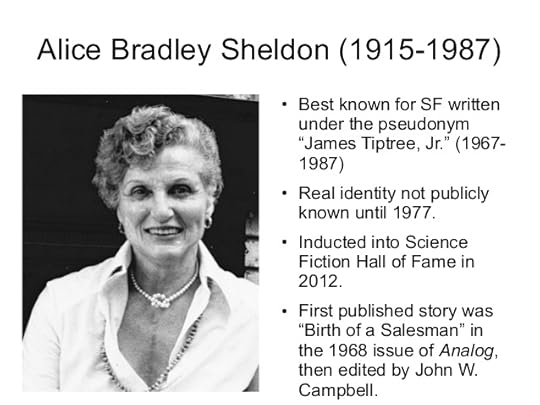
Alice James Tiptree Sheldon wasn't just a good science fiction writer, she was an excellent practitioner of short form fiction in general, who happened to work exclusively in the language of sci-fi. I usually prefer novels to short fiction whenever the choice is available, as many authors fail to develop ideas far as I'd like or enough to really have them stick without the weight of more pages, and I have trouble serially building a connection over short bursts of narrative. But Tiptree excels at constructing meaningful worlds in miniature, usually with a real feel for characters, even non-human or very very strange, that can create deep investment in spite of themselves. All the sadder, then, that Tiptree's bleak view of humanity and the cosmos means that few of them will ever find satisfaction, despite a universe of possibility.
As with a few other Tiptree collections, this one opens underwhelmingly, with a fine but one-note parable I'd expect of a lesser writer with fewer ideas to burn, then bare sketch of a scenario without the flesh to give it meaning. Oddly, these were stories Sheldon penned under her other, non-Tiptree pen-name, Raccoona Sheldon, which I'd always understood as her outlet for more directly angry feminist work. It's there a bit in the sad, gracefully spun dual reality of the third story, "Your Faces, O My Sisters! Your Faces Filled of Light!" but then we reach the Racoona story for which she received a Nebula, "The Screwfly Solution". Oh, yes, this is where that reputation came from. It's excoriating, but also just utterly terrifying. You can think of comparisons, but they just feel soft by comparison. And as with all her best work, it's highly layered, never doing only one thing, however effective any of those single threads might be. Biological control interventions, psychosexual horror, gender and religion, several flavors of apocalypse in the wings.
It's notable, in general, how Tiptree's PhD in psychology comes out in her frank portrayals of sexuality, in its many forms and dysfunctions. She shies from nothing that might advance her themes, and it gives her work a very different tone from the more adolescent level of a lot of what might be called "space adventure" fiction.
And when she writes, for once, something approaching, against all odds, a love story, it's of course tragic but also imbued with a rare warmth. The story I most needed not to end with a crushing reversal, for once, did not. And that piece, with all the novela-length work here, is distinctly worth the length and development.
Tiptree is interesting in that, as an excellent constructer of short narrative with a complicated range of experience to draw from, she never stepped beyond the tropes of science fiction. Yes, she does all kinds of unexpected thing with them, but she also tosses in all expected bits: space travel, unfamiliar future, alien species, sometimes time travel or parallel worlds. For many, she created all of her best work in a genre and universe they simply wouldn't be bothered to step into. For all her experimentation, intelligence, and purposeful direction, she remained clearly a sci-fi writer, never attempting to push beyond the limitations of genre into the upscale literature world. And in this, also, I find something to appreciate.