

What do you think?

Our Lady of the Ice
The Yiddish Policeman’s Union meets The Windup Girl when a female PI goes up against a ruthless gangster—just as both humans and robots agitate for independence in an Argentinian colony in Antarctica.
In Argentine Antarctica, Eliana Gomez is the only female PI in Hope City—a domed colony dependent on electricity (and maintenance robots) for heat, light, and survival in the icy deserts of the continent. At the center is an old amusement park—now home only to the androids once programmed to entertain—but Hope City’s days as a tourist destination are long over. Now the City produces atomic power for the mainland while local factions agitate for independence and a local mobster, Ignacio Cabrera, runs a brisk black market trade in illegally imported food.
Eliana doesn’t care about politics. She doesn’t even care much that her boyfriend, Diego, works as muscle for Cabrera. She just wants to save enough money to escape Hope City. But when an aristocrat hires Eliana to protect an explosive personal secret, Eliana finds herself caught up in the political tensions threatening to tear Hope City apart. In the clash of backstabbing politicians, violent freedom fighters, a gangster who will stop at nothing to protect his interests, and a newly sentient robot underclass intent on a very different independence, Eliana finds her job coming into deadly conflict with Diego’s—just as the electricity keeping Hope City from freezing begins to fail...
With the inner workings of the mob combined with the story of a revolution, “Clarke brings novelty and delight to steampunk Antarctica in this complex and lovely mystery” ( Publishers Weekly , starred review). Our Lady of the Ice questions what it means to be human, what it means to be free, and whether we’re ever able to transcend our pasts and our programming to find true independence.
In Argentine Antarctica, Eliana Gomez is the only female PI in Hope City—a domed colony dependent on electricity (and maintenance robots) for heat, light, and survival in the icy deserts of the continent. At the center is an old amusement park—now home only to the androids once programmed to entertain—but Hope City’s days as a tourist destination are long over. Now the City produces atomic power for the mainland while local factions agitate for independence and a local mobster, Ignacio Cabrera, runs a brisk black market trade in illegally imported food.
Eliana doesn’t care about politics. She doesn’t even care much that her boyfriend, Diego, works as muscle for Cabrera. She just wants to save enough money to escape Hope City. But when an aristocrat hires Eliana to protect an explosive personal secret, Eliana finds herself caught up in the political tensions threatening to tear Hope City apart. In the clash of backstabbing politicians, violent freedom fighters, a gangster who will stop at nothing to protect his interests, and a newly sentient robot underclass intent on a very different independence, Eliana finds her job coming into deadly conflict with Diego’s—just as the electricity keeping Hope City from freezing begins to fail...
With the inner workings of the mob combined with the story of a revolution, “Clarke brings novelty and delight to steampunk Antarctica in this complex and lovely mystery” ( Publishers Weekly , starred review). Our Lady of the Ice questions what it means to be human, what it means to be free, and whether we’re ever able to transcend our pasts and our programming to find true independence.
448 pages, Paperback
First published October 27, 2015
About the author
Cassandra Rose Clarke
59 books1,435 followersCassandra Rose Clarke is a speculative fiction writer living amongst the beige stucco and overgrown pecan trees of Houston, Texas. She graduated in 2006 from The University of St. Thomas with a bachelor’s degree in English, and in 2008 she completed her master’s degree in creative writing at The University of Texas at Austin. Both of these degrees have served her surprisingly well.
During the summer of 2010, she attended the Clarion West Writers Workshop in Seattle, where she enjoyed sixty-degree summer days. Having been born and raised in Texas, this was something of a big deal. She was also a recipient of the 2010 Susan C. Petrey Clarion Scholarship Fund.
During the summer of 2010, she attended the Clarion West Writers Workshop in Seattle, where she enjoyed sixty-degree summer days. Having been born and raised in Texas, this was something of a big deal. She was also a recipient of the 2010 Susan C. Petrey Clarion Scholarship Fund.
Ratings & Reviews
Friends & Following
Create a free account to discover what your friends think of this book!
Community Reviews
Displaying 1 - 30 of 180 reviews

July 29, 2015
DNF - 40%
I know some people don't like ratings/reviews for DNF books, but my general rule is that it's okay if I read at least a hundred pages. If that bothers you, look away now. But I am going to leave a review because I forced myself through the longest two-hundred pages of my life to try and love this book.
Everyone has been telling me I should read Clarke's The Assassin's Curse but, as it happens, her most recent release ended up in my hands before I had chance to check that one out. Now, I'm not so sure I want to.
Our Lady of the Ice is the perfect example of how to take a fascinating premise, an exciting setting, and many interesting subplots and completely drain everything fascinating, exciting or interesting out of it with sluggish pacing.
This is one of those books. I'm sure many of you know what I mean. The kind where the world/story promises to be so good that you convince yourself goodness is lurking on the next page. And the next. And the next. Until you've read half the book and you're trying not to fall asleep.
What does this book promise? An Argentinian colony in Antarctica where robots live alongside humans and power is failing. This colony tries to gain independence from the mainland. The MC - Eliana - is the only female private investigator in Hope City and she's sleeping with Diego, a muscle man for the city's mobster - Ignacio Cabrera.
Antarctica, robots, private investigators and gangsters... sounds freaking awesome to me.
But it's just not that interesting in action. I mean, when you break it down, how much do you really care about the failing power, the possibility of blackouts, and the status of the generator? Because, I swear, you're going to hear a lot about it.
And Eliana, at the heart of this story, is supposed to be solving a mystery for Lady Marianella Luna, a rich woman who has had some documents stolen from her house. Not only are "stolen documents" not the most exciting basis for a mystery, but Eliana goes over the most mundane details in her search for potential evidence. For all I know, this is probably the PI reality, but damn, it was boring to read.
The pace is mind-numbingly slow. Nothing of particular interest happened in those two-hundred pages I read. They were a long, dragged out look at lengthy descriptions, constant introspection as the characters examine their every thought (no matter how interesting) and pages-long conversations that added nothing.
Please tell me The Assassin's Curse is not like this?
Blog | Facebook | Twitter | Instagram | Youtube | Pinterest
I know some people don't like ratings/reviews for DNF books, but my general rule is that it's okay if I read at least a hundred pages. If that bothers you, look away now. But I am going to leave a review because I forced myself through the longest two-hundred pages of my life to try and love this book.
Everyone has been telling me I should read Clarke's The Assassin's Curse but, as it happens, her most recent release ended up in my hands before I had chance to check that one out. Now, I'm not so sure I want to.
Our Lady of the Ice is the perfect example of how to take a fascinating premise, an exciting setting, and many interesting subplots and completely drain everything fascinating, exciting or interesting out of it with sluggish pacing.
This is one of those books. I'm sure many of you know what I mean. The kind where the world/story promises to be so good that you convince yourself goodness is lurking on the next page. And the next. And the next. Until you've read half the book and you're trying not to fall asleep.
What does this book promise? An Argentinian colony in Antarctica where robots live alongside humans and power is failing. This colony tries to gain independence from the mainland. The MC - Eliana - is the only female private investigator in Hope City and she's sleeping with Diego, a muscle man for the city's mobster - Ignacio Cabrera.
Antarctica, robots, private investigators and gangsters... sounds freaking awesome to me.
But it's just not that interesting in action. I mean, when you break it down, how much do you really care about the failing power, the possibility of blackouts, and the status of the generator? Because, I swear, you're going to hear a lot about it.
“That was the phrase they used—“electrical troubles.” Everybody Diego knew was calling it what it was: blackout. The lights had been growing dimmer and dimmer, and flickering sometimes. You’d hear the hum of a heater, and then, for two or three seconds, you wouldn’t.”
And Eliana, at the heart of this story, is supposed to be solving a mystery for Lady Marianella Luna, a rich woman who has had some documents stolen from her house. Not only are "stolen documents" not the most exciting basis for a mystery, but Eliana goes over the most mundane details in her search for potential evidence. For all I know, this is probably the PI reality, but damn, it was boring to read.
The pace is mind-numbingly slow. Nothing of particular interest happened in those two-hundred pages I read. They were a long, dragged out look at lengthy descriptions, constant introspection as the characters examine their every thought (no matter how interesting) and pages-long conversations that added nothing.
Please tell me The Assassin's Curse is not like this?
Blog | Facebook | Twitter | Instagram | Youtube | Pinterest

September 3, 2014
4 of 5 stars at The BiblioSanctum http://bibliosanctum.com/2015/10/19/b...
Last year, I became a big fan of Cassandra Rose Clarke after reading her adult novel debut The Mad Scientist’s Daughter, an emotional tale about love, loss and androids that shattered my heart to pieces and left me pining for more. So ever since I learned about her new book Our Lady of the Ice, I have been counting the days. Its premise sounded captivating too, a mystery drama unfolding inside a city encapsulated by a glass dome, the only protection against the frigid darkness of an Antarctic winter raging outside.
The novel also features an intriguing cast. Eliana Gomez is a female PI, taking on as many jobs as she can in the hopes of scraping together enough money to get out of Hope City and head for the mainland. Her boyfriend Diego Amitrano is the adopted son of and right-hand man of Ignacio Cabrera, the city’s most notorious crime boss. Lady Marianella Luna is an Argentinian aristocrat and the celebrity face of an independence movement to build agricultural domes, a project which would help free Antarctica from the control of the mainland. Last but not least is Sofia, an android fighting for a different kind of freedom, envisioning Antarctica as a safe and human-free haven for all of robotkind.
Despite being a brand new story featuring all-new characters, I was thrilled that in some ways Our Lady of the Ice felt very much like the spiritual successor to The Mad Scientist’s Daughter. It explores some similar themes, such as: What does it mean to be human? How far would you go for love? What is the price of personal freedom? Still, The Mad Scientist’s Daughter was more of a character study, looking at these questions on a more personal and intimate level. Our Lady of the Ice, on the other hand, widens the scope. Here we get to see through the eyes of four very different characters who are all connected to each other in some way, weaving a rich narrative that readers get to experience from multiple angles.
All this also takes place at the bottom of the world, in Hope City, Antarctica – a settlement that grew out of the remnants of a failed amusement park built near the turn of the century in the coldest, most forbidding place on earth. Many of its citizens are descendants of the hundreds of workers who arrived decades ago to build and maintain the park. The city is also home to a great number of robots, from repair drones to fully sentient androids or “andies” that were left over when the park closed down.
Human or non-human, everyone is out for something. Eliana only has her eyes set on a ticket out of Hope City. Diego is torn between carrying out unsavory errands for Cabrera, who is like a father to him, and his love for Eliana, who makes him want to become a better person. Marianella has a huge secret, and she’s terrified of being found out. And Sofia…well, Sofia probably has the most astonishing story of them all. She has reasons to be more motivated than most. Programmed to be a “comfort girl” during the amusement park’s heyday, music is written into her code to trigger some very unpleasant reactions, making Sofia highly averse to any old song recorded before the 1930s. It’s frightening and it’s heartbreaking. I love how this book stirred up my emotions. Time after time the characters will do things to make you hate them, but then the story will always remind you again of their respective situations and why they made those choices. I felt much the same way reading about Cat in The Mad Scientist’s Daughter. Cassandra Rose Clarke’s characters are complex and multi-faceted; even when they are being frustrating, you can’t help but connect with them.
Furthermore, everywhere you look is another reminder of what Hope City once was, a bright and shining testament to humankind’s triumph over the elements, now reduced to a faltering system run by corrupt gangsters and two-faced politicians who are out only for themselves. If you have ever played Bioshock, Hope City reminded me a lot of where that game takes place, a beautiful-utopia-turned-crumbling-dystopia under the sea. There’s a feeling of isolation from the rest of the world and a sense of helplessness that emanates from the population, really complementing the dark mystery plot as well as the fatalistic and cynical attitudes of the protagonists.
The resulting effect of this eclectic hodgepodge is something truly amazing: A sci-fi novel infused with hard-boiled noir vibes featuring wonderfully flawed characters in one of the most mind-blowingly unique settings I’ve ever seen. I found this book simply irresistible.
Last year, I became a big fan of Cassandra Rose Clarke after reading her adult novel debut The Mad Scientist’s Daughter, an emotional tale about love, loss and androids that shattered my heart to pieces and left me pining for more. So ever since I learned about her new book Our Lady of the Ice, I have been counting the days. Its premise sounded captivating too, a mystery drama unfolding inside a city encapsulated by a glass dome, the only protection against the frigid darkness of an Antarctic winter raging outside.
The novel also features an intriguing cast. Eliana Gomez is a female PI, taking on as many jobs as she can in the hopes of scraping together enough money to get out of Hope City and head for the mainland. Her boyfriend Diego Amitrano is the adopted son of and right-hand man of Ignacio Cabrera, the city’s most notorious crime boss. Lady Marianella Luna is an Argentinian aristocrat and the celebrity face of an independence movement to build agricultural domes, a project which would help free Antarctica from the control of the mainland. Last but not least is Sofia, an android fighting for a different kind of freedom, envisioning Antarctica as a safe and human-free haven for all of robotkind.
Despite being a brand new story featuring all-new characters, I was thrilled that in some ways Our Lady of the Ice felt very much like the spiritual successor to The Mad Scientist’s Daughter. It explores some similar themes, such as: What does it mean to be human? How far would you go for love? What is the price of personal freedom? Still, The Mad Scientist’s Daughter was more of a character study, looking at these questions on a more personal and intimate level. Our Lady of the Ice, on the other hand, widens the scope. Here we get to see through the eyes of four very different characters who are all connected to each other in some way, weaving a rich narrative that readers get to experience from multiple angles.
All this also takes place at the bottom of the world, in Hope City, Antarctica – a settlement that grew out of the remnants of a failed amusement park built near the turn of the century in the coldest, most forbidding place on earth. Many of its citizens are descendants of the hundreds of workers who arrived decades ago to build and maintain the park. The city is also home to a great number of robots, from repair drones to fully sentient androids or “andies” that were left over when the park closed down.
Human or non-human, everyone is out for something. Eliana only has her eyes set on a ticket out of Hope City. Diego is torn between carrying out unsavory errands for Cabrera, who is like a father to him, and his love for Eliana, who makes him want to become a better person. Marianella has a huge secret, and she’s terrified of being found out. And Sofia…well, Sofia probably has the most astonishing story of them all. She has reasons to be more motivated than most. Programmed to be a “comfort girl” during the amusement park’s heyday, music is written into her code to trigger some very unpleasant reactions, making Sofia highly averse to any old song recorded before the 1930s. It’s frightening and it’s heartbreaking. I love how this book stirred up my emotions. Time after time the characters will do things to make you hate them, but then the story will always remind you again of their respective situations and why they made those choices. I felt much the same way reading about Cat in The Mad Scientist’s Daughter. Cassandra Rose Clarke’s characters are complex and multi-faceted; even when they are being frustrating, you can’t help but connect with them.
Furthermore, everywhere you look is another reminder of what Hope City once was, a bright and shining testament to humankind’s triumph over the elements, now reduced to a faltering system run by corrupt gangsters and two-faced politicians who are out only for themselves. If you have ever played Bioshock, Hope City reminded me a lot of where that game takes place, a beautiful-utopia-turned-crumbling-dystopia under the sea. There’s a feeling of isolation from the rest of the world and a sense of helplessness that emanates from the population, really complementing the dark mystery plot as well as the fatalistic and cynical attitudes of the protagonists.
The resulting effect of this eclectic hodgepodge is something truly amazing: A sci-fi novel infused with hard-boiled noir vibes featuring wonderfully flawed characters in one of the most mind-blowingly unique settings I’ve ever seen. I found this book simply irresistible.

January 14, 2015
Ok.
What an absolutely ****ing awesome novel. I'm a huge fan of Clarke's YA novels and this, her first foray into adult SF/F (as far as I know), knocked my socks off. I was trying to think of things to compare it to, and Blade Runner immediately comes to mind, as does the Bioshock series of video games (especially the abandoned amusement park bits).
Action-packed, character-driven, and featuring some really intriguing world-building, "Our Lady of the Ice" is the next level in artificial intelligence-themed novels, which have been all the rage for the last few years. Clarke has written what is essentially more readable, more enjoyable Philip K Dick.
This was told through four point-of-view characters, all compelling in their own ways, all flawed, all sympathetic. It was interesting to see how the four converged, came into conflict, and sometimes supported each other. There was a lot of female friendship here, which I'm a huge fan of seeing in the genre, and plenty of women looking out for themselves and each other in rough situations. I also found the setting wholly original. Hope City (an alternate world expansion on the real-world Esperanza Base) is a city in Antarctica, protected by domes, controlled by politicians and gangsters, and maintained by robots.
If I had to label this, I would call it dieselpunk retrofuturistic neo-noir/sci-fi, but that's a mouthful, so I'll stick with "absolutely amazing".
*EDIT: NOT HER FIRST ADULT NOVEL. SEE: MAD SCIENTIST'S DAUGHTER WHICH YOU SHOULD ALL ALSO READ BC IT WILL BREAK YOUR HEART.
What an absolutely ****ing awesome novel. I'm a huge fan of Clarke's YA novels and this, her first foray into adult SF/F (as far as I know), knocked my socks off. I was trying to think of things to compare it to, and Blade Runner immediately comes to mind, as does the Bioshock series of video games (especially the abandoned amusement park bits).
Action-packed, character-driven, and featuring some really intriguing world-building, "Our Lady of the Ice" is the next level in artificial intelligence-themed novels, which have been all the rage for the last few years. Clarke has written what is essentially more readable, more enjoyable Philip K Dick.
This was told through four point-of-view characters, all compelling in their own ways, all flawed, all sympathetic. It was interesting to see how the four converged, came into conflict, and sometimes supported each other. There was a lot of female friendship here, which I'm a huge fan of seeing in the genre, and plenty of women looking out for themselves and each other in rough situations. I also found the setting wholly original. Hope City (an alternate world expansion on the real-world Esperanza Base) is a city in Antarctica, protected by domes, controlled by politicians and gangsters, and maintained by robots.
If I had to label this, I would call it dieselpunk retrofuturistic neo-noir/sci-fi, but that's a mouthful, so I'll stick with "absolutely amazing".
*EDIT: NOT HER FIRST ADULT NOVEL. SEE: MAD SCIENTIST'S DAUGHTER WHICH YOU SHOULD ALL ALSO READ BC IT WILL BREAK YOUR HEART.

February 22, 2017
Our Lady Of The Ice is what you get when you take a noir-ish detective tale, some alternate history shenanigans, a smattering of artificial intelligence ruminations, and a few steampunk elements, and put them all in a blender for a while. And while it's all of those things, and more, it's also hard to just narrow it down into a specific genre. It's too violent and curse-friendly to be YA, the mystery aspects of it aren't at the forefront enough to so label it as a mystery/who-done-it, and the science-fiction elements are kept to a minimum. So...yeah. It's a book that straddles the genre lines. To be fair, I can see why it was in the Science Fiction section of the bookstore, since it does deal with cyborgs and artificial intelligence. But at the end of the day, I'd say it's a book about relationships, change, and what it means to be human (or more than human).
As always, I try to provide a spoiler-free review, keeping my details broad and as non-specific as I can. I always feel that delving into a book with a minimum of information heightens the experience.
Having never read Cassandra Rose Clarke's work before, I cannot compare this book to her YA efforts. I can say that I found Our Lady Of The Ice competently, if a little impersonally, written with some good concepts and interesting characters. And while I could have used a little more backstory into the dome city of New Hope, and the timeframe that the tale takes place in, I was generally just satisfied to follow the main characters and watch the drama unfold.
Speaking of characters, it's nice to get back to a book with more than just one (or two) main POV characters to follow. I generally find that the more viewpoints we have, the more the world and story feel fleshed out and enriched. And even though this story takes place in a domed city, there's quite a few goings-on, so the additional viewpoints were most welcome.
If there is a "main" main character, it would be Eliana, the city-sanctioned private investigator who is essentially the core of the tale. I'd say she is the moral center of the story, and is the best surrogate for the reader to learn about New Hope and the drama that unfolds there. And while she comes across as intrinsically "good", she occasionally finds herself in the ever-shifting moral "gray" area of life. She's generally competent, if a little awkward, and made for a likeable enough protagonist. She had the right mixture of vulnerability and resolve, and was smart in some areas, and woefully naïve in others. It made her relatable and believable.
From there, we have three other POV characters that we follow. There's Marianella, a wealthy socialite with a big and dangerous secret; Sofia, an android with an agenda & a barely disguised disdain for humans; and Diego, a gangster working for Hope City's crime lord who also happens to be Eliana's boyfriend. Of these three, Marianella, aka Lady Luna, is by far the most interesting. It's hard to explain why without going into spoiler territory, which I refuse to do. So let's just say that her arc is satisfying and not always predictable. Diego is also a fun character, though we don't spend as much time with him as we do with Eliana and Marianella. He's an interesting mix of danger and concern. He truly cares for Eliana, but can't quite escape the tendrils of the criminal underworld that took him in. His story is a great examination of morality, and is a different take on the "man with a duty" motif that defines many a hero. As for Sofia, she was my least favorite of the four main characters. There was nothing inherently wrong with her story, I just didn't find it as gripping or fulfilling as the others. The only part that really stood out was how she managed to update her programming, as the results were rather fun.
Ironically, there's no real "big bad" or clear-cut villain. Sure, there's a few people who fall into the "bad guy" category by default, but the decisions they make, and the actions they take, are rarely, if ever, personal. It's pretty much all business. The villains almost seem detached, in a way, from the city and the people within. It makes them less "villains" and more "people with opposing views". Some of the morally questionable decisions that are made are even last resort measures, and don't really represent some evil grand plan.
Sadly, the detachment of the villains carries over to some of the writing itself. I mentioned it above, and it bears repeating, that there are pieces of this book that just felt.impersonal. There's no doubt that Cassandra Rose Clarke can write, but like the environment of Hope City, a lot of it just felt kinda cold. Also, there are some strange editing choices and word/sentence choices that felt at odds with a polished book. Two or three sentences told a detail in a very clinical way, when one sentence would have sufficed. I only noticed it a few times, but it was jarring. There is humor in this book, and compassion, and genuine maturing of some of the characters. It's just a shame that there wasn't more passion in the writing.
One of the main themes of the story, even if it's buried a bit, seems to be evolution. I'd say that the artificial characters go through more growth than the human characters, which is an interesting concept. There are some interesting themes visited in Our Lady Of The Ice, but I kept wanting more. More on what happened to the park, more on how the machines are evolving, more on the politics and sociology of the dome. The city, the criminal underworld, and the revolutionaries.there's a lot of potential there. However, this is a very character driven tale, which means some details are just kinda left out, or inferred but never elaborated on. We pick some of them up as we go, but I never got a truly complete picture. What's frustrating is that I think Cassandra Rose Clarke is capable of more. She has the ideas, and the savvy to put them to page. Perhaps she just needs longer to shift gears from YA to adult fiction.
Stylistically, this book is very similar to The Windup Girl, just not as detailed, and the prose isn't quite at the same level. But if you enjoyed Paolo Bacigalupi's book on androids and humans, politics and power plays, then you'll probably like this one as well.
As always, I try to provide a spoiler-free review, keeping my details broad and as non-specific as I can. I always feel that delving into a book with a minimum of information heightens the experience.
Having never read Cassandra Rose Clarke's work before, I cannot compare this book to her YA efforts. I can say that I found Our Lady Of The Ice competently, if a little impersonally, written with some good concepts and interesting characters. And while I could have used a little more backstory into the dome city of New Hope, and the timeframe that the tale takes place in, I was generally just satisfied to follow the main characters and watch the drama unfold.
Speaking of characters, it's nice to get back to a book with more than just one (or two) main POV characters to follow. I generally find that the more viewpoints we have, the more the world and story feel fleshed out and enriched. And even though this story takes place in a domed city, there's quite a few goings-on, so the additional viewpoints were most welcome.
If there is a "main" main character, it would be Eliana, the city-sanctioned private investigator who is essentially the core of the tale. I'd say she is the moral center of the story, and is the best surrogate for the reader to learn about New Hope and the drama that unfolds there. And while she comes across as intrinsically "good", she occasionally finds herself in the ever-shifting moral "gray" area of life. She's generally competent, if a little awkward, and made for a likeable enough protagonist. She had the right mixture of vulnerability and resolve, and was smart in some areas, and woefully naïve in others. It made her relatable and believable.
From there, we have three other POV characters that we follow. There's Marianella, a wealthy socialite with a big and dangerous secret; Sofia, an android with an agenda & a barely disguised disdain for humans; and Diego, a gangster working for Hope City's crime lord who also happens to be Eliana's boyfriend. Of these three, Marianella, aka Lady Luna, is by far the most interesting. It's hard to explain why without going into spoiler territory, which I refuse to do. So let's just say that her arc is satisfying and not always predictable. Diego is also a fun character, though we don't spend as much time with him as we do with Eliana and Marianella. He's an interesting mix of danger and concern. He truly cares for Eliana, but can't quite escape the tendrils of the criminal underworld that took him in. His story is a great examination of morality, and is a different take on the "man with a duty" motif that defines many a hero. As for Sofia, she was my least favorite of the four main characters. There was nothing inherently wrong with her story, I just didn't find it as gripping or fulfilling as the others. The only part that really stood out was how she managed to update her programming, as the results were rather fun.
Ironically, there's no real "big bad" or clear-cut villain. Sure, there's a few people who fall into the "bad guy" category by default, but the decisions they make, and the actions they take, are rarely, if ever, personal. It's pretty much all business. The villains almost seem detached, in a way, from the city and the people within. It makes them less "villains" and more "people with opposing views". Some of the morally questionable decisions that are made are even last resort measures, and don't really represent some evil grand plan.
Sadly, the detachment of the villains carries over to some of the writing itself. I mentioned it above, and it bears repeating, that there are pieces of this book that just felt.impersonal. There's no doubt that Cassandra Rose Clarke can write, but like the environment of Hope City, a lot of it just felt kinda cold. Also, there are some strange editing choices and word/sentence choices that felt at odds with a polished book. Two or three sentences told a detail in a very clinical way, when one sentence would have sufficed. I only noticed it a few times, but it was jarring. There is humor in this book, and compassion, and genuine maturing of some of the characters. It's just a shame that there wasn't more passion in the writing.
One of the main themes of the story, even if it's buried a bit, seems to be evolution. I'd say that the artificial characters go through more growth than the human characters, which is an interesting concept. There are some interesting themes visited in Our Lady Of The Ice, but I kept wanting more. More on what happened to the park, more on how the machines are evolving, more on the politics and sociology of the dome. The city, the criminal underworld, and the revolutionaries.there's a lot of potential there. However, this is a very character driven tale, which means some details are just kinda left out, or inferred but never elaborated on. We pick some of them up as we go, but I never got a truly complete picture. What's frustrating is that I think Cassandra Rose Clarke is capable of more. She has the ideas, and the savvy to put them to page. Perhaps she just needs longer to shift gears from YA to adult fiction.
Stylistically, this book is very similar to The Windup Girl, just not as detailed, and the prose isn't quite at the same level. But if you enjoyed Paolo Bacigalupi's book on androids and humans, politics and power plays, then you'll probably like this one as well.

October 5, 2015
Dark, gritty and inventive, I was drawn to this book by it’s premise--robots and humans living together uneasily under Antarctic domes. Throw in a ruined amusement park, exploitation by “mainlanders” back in South America, and the fact that the robots are evolving and there was no way I could resist. The world-building is fantastic, but what kept me from loving this story more is the writing style. The author is known for her YA books, but for my taste she tried too hard to make this an “adult” book--though it may be that I just don’t enjoy noir fiction.There’s not a scrap of humor--no ironic self-reflection by any of the characters and no moments of comic relief--which for me gave it a sort of wooden melodramatic tone that kept me more disengaged from the characters than I would have liked.
I read an advanced review copy of this book supplied by the publisher. Review opinions are mine.
I read an advanced review copy of this book supplied by the publisher. Review opinions are mine.

January 31, 2016
Android noir set in Antarctica.
Oh? You're still here? I thought you'd have switched over to amazon to hit buy several times by now.
In an alternate 20th century Hope City is an Antarctic colony built around nuclear power plants which supply power to the Argentine mainland. It's a domed city which encloses a human settlement supported by sentient maintenance drones and an abandoned amusement park which houses a handful of sentient androids. The story is about a Eliana, a PI saving to leave for the mainland, her boyfriend, a gangster named Diego, the leader of the androids, a former pleasure android Sofia and a cyborg noblewoman Marianella. There's also the gangster boss Cabrera and Sofia's wonderful right-hand android Luciano.
All of these characters are beautifully realized, from Eliana's confusion around staying or leaving, Diego's love for Eliana and also his father-figure Cabrera, Marianella's one-foot-in-both-worlds issues and Sofia's desperate struggle to overcome her programming. Almost every main character is torn by their duality and it's just wonderfully played out.
However, I will say that this feels incomplete. It very much feels like a duology, and like when I read The Assassin's Curse there's absolutely no indication anywhere I can find that there's going to be a second volume. It's actually this incompleteness that makes me drop a star for an otherwise wonderful book.
For context these were the last three books I gave 4 star reviews to:


Oh? You're still here? I thought you'd have switched over to amazon to hit buy several times by now.
In an alternate 20th century Hope City is an Antarctic colony built around nuclear power plants which supply power to the Argentine mainland. It's a domed city which encloses a human settlement supported by sentient maintenance drones and an abandoned amusement park which houses a handful of sentient androids. The story is about a Eliana, a PI saving to leave for the mainland, her boyfriend, a gangster named Diego, the leader of the androids, a former pleasure android Sofia and a cyborg noblewoman Marianella. There's also the gangster boss Cabrera and Sofia's wonderful right-hand android Luciano.
All of these characters are beautifully realized, from Eliana's confusion around staying or leaving, Diego's love for Eliana and also his father-figure Cabrera, Marianella's one-foot-in-both-worlds issues and Sofia's desperate struggle to overcome her programming. Almost every main character is torn by their duality and it's just wonderfully played out.
However, I will say that this feels incomplete. It very much feels like a duology, and like when I read The Assassin's Curse there's absolutely no indication anywhere I can find that there's going to be a second volume. It's actually this incompleteness that makes me drop a star for an otherwise wonderful book.
For context these were the last three books I gave 4 star reviews to:

October 11, 2015
Antarctica! Androids! Gangsters! Drones! Politics! What isn't there to love in here, really? An enjoyable alternative universe tale of a South Pole colony and the strivings of its inhabitants.

August 19, 2014
I can sell Our Lady of the Ice with just two words: Antarctic noir.
Alas, it's not an Antarctica that's instantly familiar. The story takes place in Hope City, a domed colony in Argentine Antarctica, reliant on electricity and maintenance drones to keep from freezing to death. And recent power outages signal that the worst has a very real chance of occurring.
Private investigator Eliana Gomez is hired to retrieve important documents for wealthy Marianella Luna, but the city's gang boss will contract the murders of anyone who stands in his way to retrieve them. So Eliana's gangster boyfriend Diego may have to kill her.
Marianella is the most complex character, though, with a fascinating back-story - and present. I totally ship her with Sofia, whose ambitions could change Hope City forever.
Cassandra Rose Clarke's previous adult novel (The Mad Scientist's Daughter, which I adore and highly recommend to fans of science fiction and romance alike) explores human-android relations, and that theme continues in Our Lady of the Ice. With a private investigator, gangsters, city politics, and a wealthy woman with a major secret, the noir vibe is constant. Music is depicted as both a mind-control device and a symbol of freedom, and the Theremin is an instrument that hopefully readers will consider learning to play.
With an irresistible concept, Our Lady of the Ice captivates with secrets and betrayals, intriguing characters, and a deadly location. Cassandra Rose Clarke writes some of the best sci-fi currently on the market, and this latest addition is sure to gain new fans.
Alas, it's not an Antarctica that's instantly familiar. The story takes place in Hope City, a domed colony in Argentine Antarctica, reliant on electricity and maintenance drones to keep from freezing to death. And recent power outages signal that the worst has a very real chance of occurring.
Private investigator Eliana Gomez is hired to retrieve important documents for wealthy Marianella Luna, but the city's gang boss will contract the murders of anyone who stands in his way to retrieve them. So Eliana's gangster boyfriend Diego may have to kill her.
Marianella is the most complex character, though, with a fascinating back-story - and present. I totally ship her with Sofia, whose ambitions could change Hope City forever.
Cassandra Rose Clarke's previous adult novel (The Mad Scientist's Daughter, which I adore and highly recommend to fans of science fiction and romance alike) explores human-android relations, and that theme continues in Our Lady of the Ice. With a private investigator, gangsters, city politics, and a wealthy woman with a major secret, the noir vibe is constant. Music is depicted as both a mind-control device and a symbol of freedom, and the Theremin is an instrument that hopefully readers will consider learning to play.
With an irresistible concept, Our Lady of the Ice captivates with secrets and betrayals, intriguing characters, and a deadly location. Cassandra Rose Clarke writes some of the best sci-fi currently on the market, and this latest addition is sure to gain new fans.

September 22, 2015
4.5 stars. I really loved this story. You have robots and human and cyborgs living under a dome together in Antarctica what could possibly go wrong?? Really liked the relationship between the characters. Would love to see a sequel to this one.

Want to Read
June 12, 2015Because Cassandra Rose Clarke. I'm obsessed with The Mad Scientist's Daughter.

December 1, 2015
Our Lady of the Ice is my latest attempt at broadening my perspective and understanding of the 'Young Adult' genre. When I started out on this journey, after the Young Adult Literary Convention, a few years ago I thought that within a few books I'd easily be able to define what makes YA 'Young Adult' and not Urban Fantasy or Epic Fantasy, etc. I'm afraid to say that Our Lady of the Ice is another book that I struggle to define as a Young Adult novel, because by doing so I inevitably suggest that the book isn't for adults and that's untrue - this is a book for everyone, just like so many other 'Young Adult' novels hiding away on those shelves in bookshops that readers over the age of 16 rarely approach.
Our Lady of the Ice begins with some absolutely beautiful composition and the author really showcases her talent as she gives a tour of Hope City located within a dome inside Antarctica. When it was built in the early 1900s, Hope City promised a comfortable life for the people who moved there; the state of the art Amusement Park filled with Robots that vary in state from simple maintenance droids through to human-like Androids would provide tourism and subsequently work for a joyous livelihood. However, investments and dreams don't always pan out and when the amusement park was closed in the 1940s the people who had traveled to Hope City (and their children) found themselves stranded within a freezing cold domed city that had no infrastructure and that was costly to leave (due to the huge fees being charged by transport ships and the immigration office). Most of the androids have been deactivated, but others have began to evolve; some to the extent they've become sentient and have their own dreams and aspirations.
Back to the humans though: rather than the dream-like lifestyle they were promised, the majority of those living in Hope City are experiencing a nightmare that they wish to escape. One such character, that I guess is the protagonist, although the novel is multi-perspective, is Eliana Gomez, a female Private Investigator. Set in the mid-1900s, this isn't an easy job for a young woman - the majority of clients would prefer to hire more experienced, male PIs - but Eliana is just about getting by from the client-base and reputation of the employer she took over from. Her motivation to work her butt off on a daily basis is the same as everyone else's: earn enough to escape to the mainland.
Poppy takes a nap whilst I read Our Lady Of The Ice...
Poppy takes a nap whilst I read Our Lady Of The Ice...
Eliana's life is made complicated by the fact her boyfriend is under the employment of the city's notorious, brutal Crime Lord, Ignacio Cabrera. Eliana has always promised Diego that she wouldn't take on a case in which Ignacio would be involved... Diego feels indebted to Ignacio as he was saved from a live of poverty by him (although, it must be said, now forces him to lead a life of crime). At the point we meet Eliana she has been able to keep this promise, however, when Eliana runs into Marianella Luna, an aristocrat offering enough money to get her to the mainline should she take her case, Eliana is willing to break her promise to Diego in order to get out of Hope City once and for all.
I guess you could call Our Lady of the Ice a dystopian fantasy, but equally a Science-Fiction / Alternative History hybrid too. Others, I note, have called it Steam Punk. It's pretty hard to place neatly into a genre and I won't complain about that for even a second. The storyline is similarly hard to define, starts off as a Crime Thriller, but quickly gets Political and Philosophical with tints of a Romance and Revenge Thriller too. A murder investigation leads Eliana down a path that suggests someone is trying to throw the city into a state of panic. When we head down this path we meet all the players who are trying to lock down Hope City in a way that they benefit and others - Freedom Fighters - who look to liberate Hope City from the mainland and appointed politicians through means of terror attacks.
By far, for me, my favourite chapters were those where we were in the Androids viewpoints or spending time getting to know them through a foreign Point of View. Most of the time (more on that in a second) the Androids are very well done. I'm reminded of Philip K. Dick's Do Androids Dream of Electronic Sheep, I guess, but also Asimov's work too. We are forced to consider whether and how we would allow Androids to integrate into our society, whether they can have meaningful relationships, at what point they become dangerous to humans and how we should interact with them as humans too. That's all quite powerful stuff and we are forced to consider these things through numerous situations: robots taking an interest in human death, robots wondering about harming the city, robots being programmed by dangerous third parties, but also robots falling in love or making friends with humans and robots 'dying'... I imagine every reader will leave with a different feeling on each issue after they've been forced to confront them by the author.
This is quite a lengthy book that never keeps you going in one direction for very long. In many ways this is refreshing and I never expected many of the twists and turns that the novel provides (and that I'm avoiding going into too much details about in order not to rob you from the same experience). In other ways this can be quite frustrating. One thing I was struck by was just how in-love with her boyfriend Eliana is at the start of the novel. She is absolutely infatuated with him and every kiss, touch and sexual encounter is given to us viscerally. All of a sudden though this seems to end, almost as if the author got bored of writing about it or realised it was getting a bit much and needed to move on. It was quite jarring and because Eliana's character was defined by the intensity of her lust after Diego, seemed to change her character too. Similarly, as impressed as I was with the way Clarke investigates the question of what makes a human human, the Androids never quite feel 'not-human' enough for me and, like Eliana's relationship with Diego, there is sometimes a lack of concurrence with how an android acts in one chapter compared to another... Almost as if the author is making them more human or more android depending on her needs all the time.
That said, I'm being picky and trying hard to do my job as an honest reviewer, picking out the few faults I could find. Ignoring the inevitable traps the author falls into writing about Androids and a little bit too much and then not quite enough romance, this is a solid book and one that really impressed me. Clarke's biography says she is a tutor of composition and there is some really vivid and wonderful descriptions of people, places, emotions and experiences within. When you add this to the complex and hugely varied plot where there's a massive amount going on and plenty to experience, Our Lady of the Ice is a real achievement and there's certainly very little like it sitting on our shelves right now.
I will be amongst the first to pick up the sequel next year and see which direction Clarke takes us next, but I'm equally pushing for a prequel telling the history behind the Androids and the Park's downfall!
Our Lady of the Ice begins with some absolutely beautiful composition and the author really showcases her talent as she gives a tour of Hope City located within a dome inside Antarctica. When it was built in the early 1900s, Hope City promised a comfortable life for the people who moved there; the state of the art Amusement Park filled with Robots that vary in state from simple maintenance droids through to human-like Androids would provide tourism and subsequently work for a joyous livelihood. However, investments and dreams don't always pan out and when the amusement park was closed in the 1940s the people who had traveled to Hope City (and their children) found themselves stranded within a freezing cold domed city that had no infrastructure and that was costly to leave (due to the huge fees being charged by transport ships and the immigration office). Most of the androids have been deactivated, but others have began to evolve; some to the extent they've become sentient and have their own dreams and aspirations.
Back to the humans though: rather than the dream-like lifestyle they were promised, the majority of those living in Hope City are experiencing a nightmare that they wish to escape. One such character, that I guess is the protagonist, although the novel is multi-perspective, is Eliana Gomez, a female Private Investigator. Set in the mid-1900s, this isn't an easy job for a young woman - the majority of clients would prefer to hire more experienced, male PIs - but Eliana is just about getting by from the client-base and reputation of the employer she took over from. Her motivation to work her butt off on a daily basis is the same as everyone else's: earn enough to escape to the mainland.
Poppy takes a nap whilst I read Our Lady Of The Ice...
Poppy takes a nap whilst I read Our Lady Of The Ice...
Eliana's life is made complicated by the fact her boyfriend is under the employment of the city's notorious, brutal Crime Lord, Ignacio Cabrera. Eliana has always promised Diego that she wouldn't take on a case in which Ignacio would be involved... Diego feels indebted to Ignacio as he was saved from a live of poverty by him (although, it must be said, now forces him to lead a life of crime). At the point we meet Eliana she has been able to keep this promise, however, when Eliana runs into Marianella Luna, an aristocrat offering enough money to get her to the mainline should she take her case, Eliana is willing to break her promise to Diego in order to get out of Hope City once and for all.
I guess you could call Our Lady of the Ice a dystopian fantasy, but equally a Science-Fiction / Alternative History hybrid too. Others, I note, have called it Steam Punk. It's pretty hard to place neatly into a genre and I won't complain about that for even a second. The storyline is similarly hard to define, starts off as a Crime Thriller, but quickly gets Political and Philosophical with tints of a Romance and Revenge Thriller too. A murder investigation leads Eliana down a path that suggests someone is trying to throw the city into a state of panic. When we head down this path we meet all the players who are trying to lock down Hope City in a way that they benefit and others - Freedom Fighters - who look to liberate Hope City from the mainland and appointed politicians through means of terror attacks.
By far, for me, my favourite chapters were those where we were in the Androids viewpoints or spending time getting to know them through a foreign Point of View. Most of the time (more on that in a second) the Androids are very well done. I'm reminded of Philip K. Dick's Do Androids Dream of Electronic Sheep, I guess, but also Asimov's work too. We are forced to consider whether and how we would allow Androids to integrate into our society, whether they can have meaningful relationships, at what point they become dangerous to humans and how we should interact with them as humans too. That's all quite powerful stuff and we are forced to consider these things through numerous situations: robots taking an interest in human death, robots wondering about harming the city, robots being programmed by dangerous third parties, but also robots falling in love or making friends with humans and robots 'dying'... I imagine every reader will leave with a different feeling on each issue after they've been forced to confront them by the author.
This is quite a lengthy book that never keeps you going in one direction for very long. In many ways this is refreshing and I never expected many of the twists and turns that the novel provides (and that I'm avoiding going into too much details about in order not to rob you from the same experience). In other ways this can be quite frustrating. One thing I was struck by was just how in-love with her boyfriend Eliana is at the start of the novel. She is absolutely infatuated with him and every kiss, touch and sexual encounter is given to us viscerally. All of a sudden though this seems to end, almost as if the author got bored of writing about it or realised it was getting a bit much and needed to move on. It was quite jarring and because Eliana's character was defined by the intensity of her lust after Diego, seemed to change her character too. Similarly, as impressed as I was with the way Clarke investigates the question of what makes a human human, the Androids never quite feel 'not-human' enough for me and, like Eliana's relationship with Diego, there is sometimes a lack of concurrence with how an android acts in one chapter compared to another... Almost as if the author is making them more human or more android depending on her needs all the time.
That said, I'm being picky and trying hard to do my job as an honest reviewer, picking out the few faults I could find. Ignoring the inevitable traps the author falls into writing about Androids and a little bit too much and then not quite enough romance, this is a solid book and one that really impressed me. Clarke's biography says she is a tutor of composition and there is some really vivid and wonderful descriptions of people, places, emotions and experiences within. When you add this to the complex and hugely varied plot where there's a massive amount going on and plenty to experience, Our Lady of the Ice is a real achievement and there's certainly very little like it sitting on our shelves right now.
I will be amongst the first to pick up the sequel next year and see which direction Clarke takes us next, but I'm equally pushing for a prequel telling the history behind the Androids and the Park's downfall!

July 27, 2024
This is one of those books that simply caught my eye as I walked through the stacks at the library where I work, which is a definite perk of working at a library. It is also a curse of working at the library, because I have a stack of about fifteen books just to my left, that were all checked out from there, more than half of them simply on a whim.
Anyway, this Science Fiction novel was very nearly a five-star read for me. I'm not sure I can quite identify why it isn't quite, but there it is. Set in Antarctica, in a city called Hope City, this novel, in my opinion, has quite a "noir" feel. Eliana is a PI in Hope City, who is dating Diego, who keeps referring to her as a cop. The problem is, Diego works for the local gangster boss, Mr. Cabrera.
The story kicks off with Eliana getting a visit from Marianella (aka Lady Luna), a local socialite. Marianella has had some very important documents stolen from her. She won't divulge what is in those documents, but desperately needs them back, asap. So Eliana agrees to take the case, upon promise of quite a handsome payout. This gets Eliana involved in a caper that she will not be able to escape from.
The story involves robots, both sentient and otherwise, as well as cyborgs (part human, part robot), and, of course, normal humans. Hope City is under a dome, with some other scattered domes outside of the city. Marianella lives in one of those in her own private dome. There is also an abandoned amusement park, upon which the city was initially founded. The main robot, Sofia, lives there, along with a human Araceli, who is an excellent robot engineer/technician. Since I totally love stories about abandoned amusement parks (and abandoned places in general), when I discovered this piece of the plot, I was totally hooked.
Things are learned about pretty much all of the individuals in the story, with plot twists galore. Marianella is trying to develop agricultural domes to bring more food possibilities to the residents of Hope City. Sofia (robot) is trying to get humans out of the city completely and have a haven for robots. Eliana wants to get out of Hope City to the mainland and is trying to save up money for the visa and boat trip out of there. There is crossing and double-crossing, and, with the involvement of the PI, as I said, the book really has a fantastic noir vibe to me. That may or may not be intentional.
I said "It's complicated" on the question of whether the characters are lovable. It really is a mixed bag. Sofia is hard to like. She is very cold-natured and has a singular goal, and won't tolerate anyone messing with that. She has no care for human emotions. Eliana is probably the most lovable character, and, if there is any "innocent" in this tale, it is her, but even that is questionable.
The writing is very good, in my opinion, and the story moves along pretty well. The author kept me guessing about a lot of things. There was one point, where I really thought everything was going to end terribly for our "heroes." That's all I'm going to say about that, though.
Oh, and the title refers to a particular church in Hope City, based on a vision of Mother Mary that was had by someone many years ago. I think I got that right. Marianella frequently prays to her.
I recommend this book to anyone who likes Science Fiction, with a mix of noir and detective work, as well as the ongoing conflict between humans and robots. Oh, and the abandoned amusement park.
Anyway, this Science Fiction novel was very nearly a five-star read for me. I'm not sure I can quite identify why it isn't quite, but there it is. Set in Antarctica, in a city called Hope City, this novel, in my opinion, has quite a "noir" feel. Eliana is a PI in Hope City, who is dating Diego, who keeps referring to her as a cop. The problem is, Diego works for the local gangster boss, Mr. Cabrera.
The story kicks off with Eliana getting a visit from Marianella (aka Lady Luna), a local socialite. Marianella has had some very important documents stolen from her. She won't divulge what is in those documents, but desperately needs them back, asap. So Eliana agrees to take the case, upon promise of quite a handsome payout. This gets Eliana involved in a caper that she will not be able to escape from.
The story involves robots, both sentient and otherwise, as well as cyborgs (part human, part robot), and, of course, normal humans. Hope City is under a dome, with some other scattered domes outside of the city. Marianella lives in one of those in her own private dome. There is also an abandoned amusement park, upon which the city was initially founded. The main robot, Sofia, lives there, along with a human Araceli, who is an excellent robot engineer/technician. Since I totally love stories about abandoned amusement parks (and abandoned places in general), when I discovered this piece of the plot, I was totally hooked.
Things are learned about pretty much all of the individuals in the story, with plot twists galore. Marianella is trying to develop agricultural domes to bring more food possibilities to the residents of Hope City. Sofia (robot) is trying to get humans out of the city completely and have a haven for robots. Eliana wants to get out of Hope City to the mainland and is trying to save up money for the visa and boat trip out of there. There is crossing and double-crossing, and, with the involvement of the PI, as I said, the book really has a fantastic noir vibe to me. That may or may not be intentional.
I said "It's complicated" on the question of whether the characters are lovable. It really is a mixed bag. Sofia is hard to like. She is very cold-natured and has a singular goal, and won't tolerate anyone messing with that. She has no care for human emotions. Eliana is probably the most lovable character, and, if there is any "innocent" in this tale, it is her, but even that is questionable.
The writing is very good, in my opinion, and the story moves along pretty well. The author kept me guessing about a lot of things. There was one point, where I really thought everything was going to end terribly for our "heroes." That's all I'm going to say about that, though.
Oh, and the title refers to a particular church in Hope City, based on a vision of Mother Mary that was had by someone many years ago. I think I got that right. Marianella frequently prays to her.
I recommend this book to anyone who likes Science Fiction, with a mix of noir and detective work, as well as the ongoing conflict between humans and robots. Oh, and the abandoned amusement park.

dnf-lost-interest
April 8, 2019DNF
I've thought about it, and... yes, I could finish this, but why should I when I could spend that time watching the bees under a Wisteria tree or doing the homework I've ignored for weeks or, you know, reading something I actually care about that will end up being more than a three star read.
The reasons I'm DNFing, apart from my obvious not caring, is that: I was told about lesbians and so far there are none - I'm sure there are some later, I just don't care enough - an also, during the first chapter, the narrator said some things that were uncomfortable and kind of sexist and while he's not the only narrator and I probably wasn't supposed to agree with him, why give your readers that as a first impression? I didn't stop at the first chapter but so far the setting (wonderful, atmospheric, really unique) and the sexism were the only things that stood out to me.
I'm sad because this has one of my favorite titles ever and also it's a thriller set in a retro sci-fi Antarctica with a mostly-latinx cast and an f/f couple, but this wasn't worth it for me.
I've thought about it, and... yes, I could finish this, but why should I when I could spend that time watching the bees under a Wisteria tree or doing the homework I've ignored for weeks or, you know, reading something I actually care about that will end up being more than a three star read.
The reasons I'm DNFing, apart from my obvious not caring, is that: I was told about lesbians and so far there are none - I'm sure there are some later, I just don't care enough - an also, during the first chapter, the narrator said some things that were uncomfortable and kind of sexist and while he's not the only narrator and I probably wasn't supposed to agree with him, why give your readers that as a first impression? I didn't stop at the first chapter but so far the setting (wonderful, atmospheric, really unique) and the sexism were the only things that stood out to me.
I'm sad because this has one of my favorite titles ever and also it's a thriller set in a retro sci-fi Antarctica with a mostly-latinx cast and an f/f couple, but this wasn't worth it for me.

August 17, 2020
Theme park. Steam trains. Robots looking like humans develop consciousness. What is this? A part of Westworld universe???
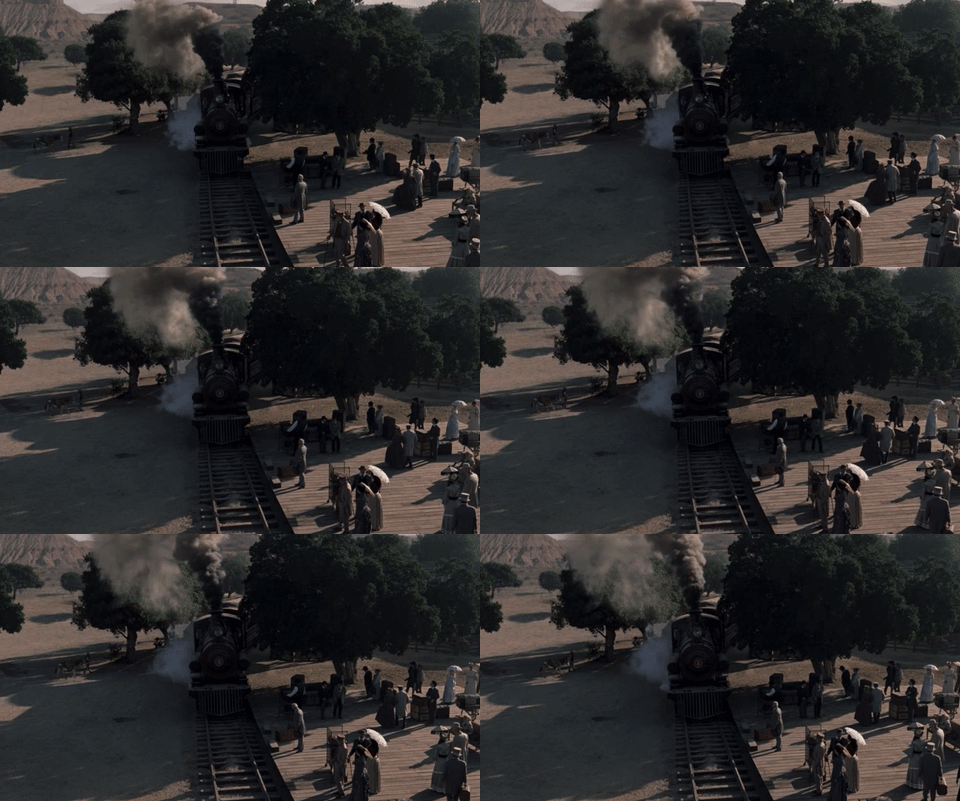 but instead of heat, it's Antarctica ice.
The answer is no. But how COOL would that be?! Although not as grand and violent, I keep comparing the novel to the TV show because Cassandra has elaborately created an original setting, with complicated history and politics. The mystery is logical, easy to follow but quite predictable. The slow-pace is not a big problem for I enjoy the atmosphere of Hope City and putting my imagination to use.
The set of characters is unique as well. I'm definitely rooting for the robots. By the way, Sofia is the OG Dolores but in my head she looks like Clementine :">
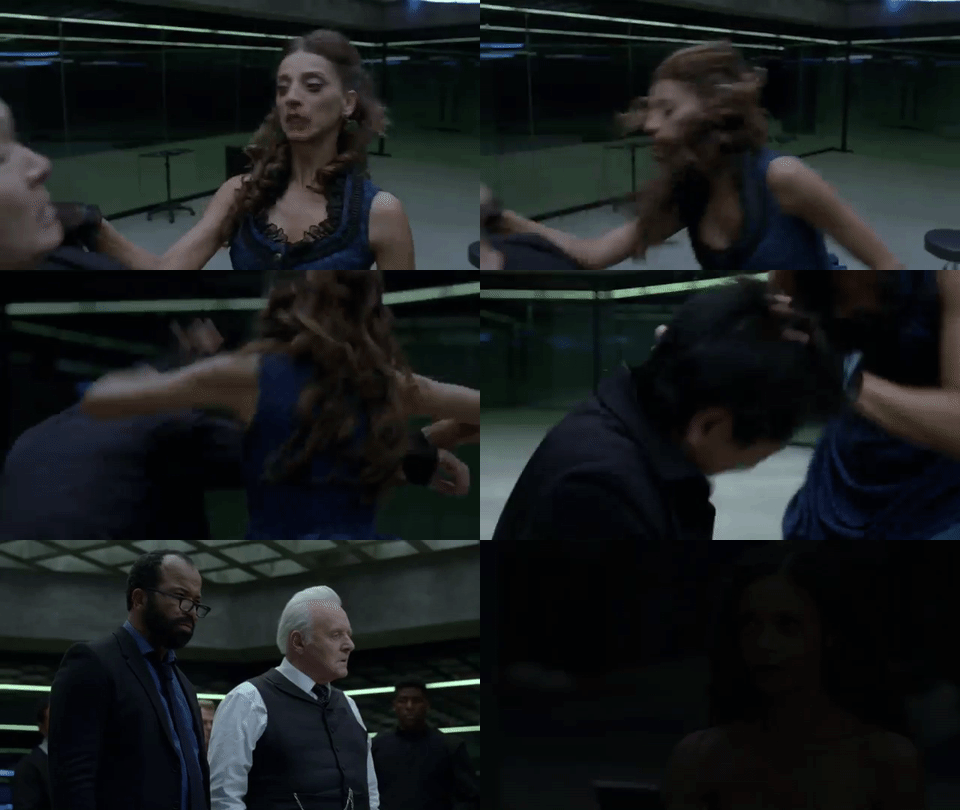
but instead of heat, it's Antarctica ice.The answer is no. But how COOL would that be?! Although not as grand and violent, I keep comparing the novel to the TV show because Cassandra has elaborately created an original setting, with complicated history and politics. The mystery is logical, easy to follow but quite predictable. The slow-pace is not a big problem for I enjoy the atmosphere of Hope City and putting my imagination to use.
The set of characters is unique as well. I'm definitely rooting for the robots. By the way, Sofia is the OG Dolores but in my head she looks like Clementine :">
July 24, 2019
Our Lady of the Ice is a book that I started a while ago and was enjoying but life stuff go in the way for a few weeks so it took me longer than anticipated to review it. This is a good Sci-fi involving advanced AI tech with some good action and suspense to it.
It takes place in Antarctica in the future where the main city exists under a protective dome. Recently, power outages have started to occur which have never been known to happen in recorded memory of the inhabitants. This is highly dangerous and life-threatening. I don't like to do long involved plot details in my reviews because I like the reader to experience it for themselves without too many pre-conceived ideas. It has a very interesting premise and the characters are well developed so I have no reservations recommending this to everyone who likes a good story.
It takes place in Antarctica in the future where the main city exists under a protective dome. Recently, power outages have started to occur which have never been known to happen in recorded memory of the inhabitants. This is highly dangerous and life-threatening. I don't like to do long involved plot details in my reviews because I like the reader to experience it for themselves without too many pre-conceived ideas. It has a very interesting premise and the characters are well developed so I have no reservations recommending this to everyone who likes a good story.

February 18, 2022
Now THAT'S what I call lesbian sci fi

April 22, 2022
2.75 but rounding up because im feeling generous
gentlewomen let me tell you this book was so fun and also so frustrating like you CANNOT give me robot lesbians and then keep derailing that with bland cop/gangster heterosexuality and christian guilt!!! drove me insaneeeeeeee
i can appreciate when books are trying to do pull a Men Ain't Shit Ladies Only Your Sisters Got Your Back but seeing as i have a PhD in Advanced Misandry, i already know this so it is not fun for me to read four hundred pages of two women naively putting their faith in men only for the plot twist to be Oh Gee Golly These Men Were Shit All Along Well Who Would Have Guessed! ME. i would have guessed. I DID GUESS. ON PAGE ONE. c'mon. it's not even like a Oh This Man is a Master Manipulator Boy I Am Stumped by This Revelation! No! one of them is openly working for the mafia! the other one is funding "extremists"! (this book's politics are corny but i was just here for the robot lesbians.) how is this a surprise to anyone with eyes.this is a metaphor for women in heterosexual relationships
moving over my compelling pepe silvia analysis of how sofia, marianella and eliana represent the relationship lesbians, bisexual and heterosexual women have with men respectively (im right) to do whats really important here: complain about marianella. i truly hate when fictional characters are pathetic little hand-wringing moralists who are fine with benefiting from all the violence they decry as long as its someone else who gets their hands dirty and the narrative just never acknowledges that hypocrisy. why is she at sofia's throat for no goddamn reason. wah wah lesbian sex and killing abusive men is sinful sadface GIRL GROW UP.
everyone is so fucking over the top about hurling COMPLETELY BASELESS accusations of murder and genocide at sofia SIMPLY BECAUSE she commits the CARDINAL SIN of being a woman who isn't RELENTLESS PLEASANT. it is INFURIATING especially since sofia does nothing expect protect all of them and strive to be free from the men who prostituted her but ok! cue marianella shaking and crying and throwing up about how that makes sofia just as evil as the men who used and raped her GOD WRITERS PLEASE STOP DOING THIS TO ME PERSONALLY I AM SICK I AM FEVERED I AM INCENSED im reverting to normal again. i enjoyed this book somewhat but so many parts had me like 😬😬😬
gentlewomen let me tell you this book was so fun and also so frustrating like you CANNOT give me robot lesbians and then keep derailing that with bland cop/gangster heterosexuality and christian guilt!!! drove me insaneeeeeeee
i can appreciate when books are trying to do pull a Men Ain't Shit Ladies Only Your Sisters Got Your Back but seeing as i have a PhD in Advanced Misandry, i already know this so it is not fun for me to read four hundred pages of two women naively putting their faith in men only for the plot twist to be Oh Gee Golly These Men Were Shit All Along Well Who Would Have Guessed! ME. i would have guessed. I DID GUESS. ON PAGE ONE. c'mon. it's not even like a Oh This Man is a Master Manipulator Boy I Am Stumped by This Revelation! No! one of them is openly working for the mafia! the other one is funding "extremists"! (this book's politics are corny but i was just here for the robot lesbians.) how is this a surprise to anyone with eyes.
moving over my compelling pepe silvia analysis of how sofia, marianella and eliana represent the relationship lesbians, bisexual and heterosexual women have with men respectively (im right) to do whats really important here: complain about marianella. i truly hate when fictional characters are pathetic little hand-wringing moralists who are fine with benefiting from all the violence they decry as long as its someone else who gets their hands dirty and the narrative just never acknowledges that hypocrisy. why is she at sofia's throat for no goddamn reason. wah wah lesbian sex and killing abusive men is sinful sadface GIRL GROW UP.
everyone is so fucking over the top about hurling COMPLETELY BASELESS accusations of murder and genocide at sofia SIMPLY BECAUSE she commits the CARDINAL SIN of being a woman who isn't RELENTLESS PLEASANT. it is INFURIATING especially since sofia does nothing expect protect all of them and strive to be free from the men who prostituted her but ok! cue marianella shaking and crying and throwing up about how that makes sofia just as evil as the men who used and raped her GOD WRITERS PLEASE STOP DOING THIS TO ME PERSONALLY I AM SICK I AM FEVERED I AM INCENSED im reverting to normal again. i enjoyed this book somewhat but so many parts had me like 😬😬😬

October 26, 2015
Take an intriguing concept and then water it down with an unexplained setting and central casting characters and you get something that might resemble Our Lady of the Ice. I'm one of those people who often doesn't notice setting except for when it becomes problematic and boy is it ever a problem in this novel, mainly because there is no reasoning for it. I think, had this been a short story, it might have been exciting. Instead the author has taken a concept with potential and watered it down with unnecessary scenes and dialogue and too many characters that feel too familiar to each other and to us. There are no real surprises, except maybe the part where it pretty much just ends. Ooops, potential spoiler alert? Much as I'd like to say nice things about Our Lady of the Ice, they're hard to find, buried as they are in the unexplained and unexplored. It's Sci-Fi very lite mixed with dystopia thriller that wasn't so thrilling. Can't recommend this one. Sorry.
Note: ARC received via Amazon Vine in exchange for review.
Note: ARC received via Amazon Vine in exchange for review.

Did Not Finish
December 22, 2014DNF @ 20%
I'm not feeling anything for these characters and whereas the plot started off as mildly intruiging, it's not doing anything for me now.
I'm not feeling anything for these characters and whereas the plot started off as mildly intruiging, it's not doing anything for me now.

August 5, 2015
Some great, some good and some okay things.
Review to come.
Review to come.

February 19, 2015
I have read everything by Clarke (and with the exception of The Wizard’s Promise) really enjoyed all of her books. This book was masterfully written and incredibly intriguing but also moved fairly slow. It’s a book that needs to be read slowly and carefully, but the description throughout and the creativity of the setting is amazing.
The book takes place in the Southernmost city in the world; Hope City, Antarctica. Hope City started out as a domed amusement park but when the amusement park shut down the residents were trapped there...only those who can afford an expensive mainland Visa ever get to leave.
The story follows four main characters and the story alternates POV between these four. The first character is Eliana, who is a PI desperately working toward saving for a visa to leave Hope City. The second is her boyfriend Diego, who is the right hand man to Hope City’s top gangster. The third is Marianella Luna who has a dangerous secret that she needs Eliana’s help to keep safe. And the fourth is Sofia, a pleasure android from Hope City's amusement park days that has begun to evolve.
Hope City is starting to wear at the seams. Power outages are becoming common and Eliana is desperate to leave. However to get the money to leave she needs to take on cases and Marianella is offering too much money to refuse. As Eliana works with Marianella she gets drawn into the dark underworld of factions and secrets that her boyfriend Diego has been part of from the beginning. Little does everyone know that Hope City may be at the whim of the androids that run it.
I absolutely loved the setting here; the idea of Hope City is unique and Clark’s absolutely phenomenal description makes it so that the reader can smell, taste, and hear the city around them.
The switching POV worked great for this novel. All of the characters are interestinng and I loved reading from all of their POVs; there were never any sections where I was bummed to be reading from one character's POV or another's.
The story is mainly a mystery and it was a mystery that was incredibly well woven and wonderfully unveiled. There is also quite a bit of science fiction in here because of all the robots and androids throughout the story. I really enjoyed the story as a whole.
My main complaint is that the story moved a bit too slowly and I found my attention wandering at points. I also felt like things weren’t wrapped up all that well.
Overall I really enjoyed this book. It’s a well done story about a domed city on a world of ice and cold. I really loved the setting and the unique set of characters that tell the story. There was some excellent mystery here as well. I would recommend to those who enjoy a good sci-fi mystery.
The book takes place in the Southernmost city in the world; Hope City, Antarctica. Hope City started out as a domed amusement park but when the amusement park shut down the residents were trapped there...only those who can afford an expensive mainland Visa ever get to leave.
The story follows four main characters and the story alternates POV between these four. The first character is Eliana, who is a PI desperately working toward saving for a visa to leave Hope City. The second is her boyfriend Diego, who is the right hand man to Hope City’s top gangster. The third is Marianella Luna who has a dangerous secret that she needs Eliana’s help to keep safe. And the fourth is Sofia, a pleasure android from Hope City's amusement park days that has begun to evolve.
Hope City is starting to wear at the seams. Power outages are becoming common and Eliana is desperate to leave. However to get the money to leave she needs to take on cases and Marianella is offering too much money to refuse. As Eliana works with Marianella she gets drawn into the dark underworld of factions and secrets that her boyfriend Diego has been part of from the beginning. Little does everyone know that Hope City may be at the whim of the androids that run it.
I absolutely loved the setting here; the idea of Hope City is unique and Clark’s absolutely phenomenal description makes it so that the reader can smell, taste, and hear the city around them.
The switching POV worked great for this novel. All of the characters are interestinng and I loved reading from all of their POVs; there were never any sections where I was bummed to be reading from one character's POV or another's.
The story is mainly a mystery and it was a mystery that was incredibly well woven and wonderfully unveiled. There is also quite a bit of science fiction in here because of all the robots and androids throughout the story. I really enjoyed the story as a whole.
My main complaint is that the story moved a bit too slowly and I found my attention wandering at points. I also felt like things weren’t wrapped up all that well.
Overall I really enjoyed this book. It’s a well done story about a domed city on a world of ice and cold. I really loved the setting and the unique set of characters that tell the story. There was some excellent mystery here as well. I would recommend to those who enjoy a good sci-fi mystery.

November 28, 2015
I have not read anything by this author before. Instantly I was transported to Hope City. I got a clear picture of what the city looked like and could feel the icy, cold of the Artic. I think I would go out of my mind living in a place like Hope City during the long winter months. One I don't like winter and two having to ration my supplies all winter and worry that if the power went out how long would it be before everything started to freeze, is not my idea of a good life.
Right from the beginning I connected with Eliana and her boyfriend, Diego. They are a good couple but at the same time they could be like fire and ice. Marianella and Sofia are another story altogether. It did take me a while to slowly build up to them. In fact for the first third of the story, it was a blur what I read about them. It really was not until Marianella's secret was revealed and this happened later in the story that I than became intrigued by her and Sofia.
As I was reading the story, however it did feel like there were two sides of the story...Eliana and Diego and Marianella and Sofia. Yet the second half of the story was stronger and where I felt that all four of these characters stories came together and became one.
Right from the beginning I connected with Eliana and her boyfriend, Diego. They are a good couple but at the same time they could be like fire and ice. Marianella and Sofia are another story altogether. It did take me a while to slowly build up to them. In fact for the first third of the story, it was a blur what I read about them. It really was not until Marianella's secret was revealed and this happened later in the story that I than became intrigued by her and Sofia.
As I was reading the story, however it did feel like there were two sides of the story...Eliana and Diego and Marianella and Sofia. Yet the second half of the story was stronger and where I felt that all four of these characters stories came together and became one.

January 20, 2015
3.5 stars. I did not expect this book to be an alternate history! The plot summary completely neglects to highlight that this book is in fact retro futurism combined with noir. Not knowing this off the bat actually threw me off for the first few chapters, because I was suddenly unsure of when the story was taking place.
Once I got over that, it became clear to me that this story was focusing a lot on the atmospheric quality of noir, so don't expect this to be fast-paced. It was fun to follow the central mystery, but it wasn't resolved by the end?? I'm unsure if this book is meant to be a stand-alone, because a sequel may be appreciated if only so I can see the full story through.
Once I got over that, it became clear to me that this story was focusing a lot on the atmospheric quality of noir, so don't expect this to be fast-paced. It was fun to follow the central mystery, but it wasn't resolved by the end?? I'm unsure if this book is meant to be a stand-alone, because a sequel may be appreciated if only so I can see the full story through.

October 27, 2015
I absolutely adored Mad Scientist's Daughter, but this one.... Eh. It touches on a lot of the same points as Daughter, to the point where I started to think the two books were set in the same world, but the time lines don't add up.
I will say it has a fantastic setting, very bioshock in the antarctic. But this book either has an intended sequel, or has the most unsatisfactory ending ever. Nothing about it suggests that it's part 1 of a series, so it was very frustrating when it ended, or rather didn't.
It was an enjoyable enough read, though very flawed.
I will say it has a fantastic setting, very bioshock in the antarctic. But this book either has an intended sequel, or has the most unsatisfactory ending ever. Nothing about it suggests that it's part 1 of a series, so it was very frustrating when it ended, or rather didn't.
It was an enjoyable enough read, though very flawed.

Want to Read
January 22, 20155 February 2016: $2.99 on Kindle
Read
July 9, 2018Hmmm ... what to say about this book? Interesting premise with enough absurdities that I had to shrug, though in the author's defence, we live in a world of absurdities. Case in point: cars driving around in a domed city belching pollution into the air ... I'd say no society smart enough to build domes in Antarctica would ever be stupid enough to allow such vehicles to drive around its streets, but when you think of it, that's precisely what we're doing in the here and now, belching noxious gasses into the only atmosphere we've got. So, I shrugged a lot and accepted robots feeling emotions, chain-smoking protagonists, and other quirks.
In the end, it wasn't the shrugging that did me in, it was the pacing of the book and the logic of the narrative. A big conflict was brewing that doesn't come to a resolution. The heroine overcomes obstacles only to capitulate in the end. It left me feeling disappointed. Is there a sequel brewing? If so it might make more sense. As it sits, it underwhelmed.
In the end, it wasn't the shrugging that did me in, it was the pacing of the book and the logic of the narrative. A big conflict was brewing that doesn't come to a resolution. The heroine overcomes obstacles only to capitulate in the end. It left me feeling disappointed. Is there a sequel brewing? If so it might make more sense. As it sits, it underwhelmed.
June 4, 2017
Excellent noir quasi-sci-fi mystery, but give me more. Show me Hope City as an amusement park in the 1890s, tell me how they built it and drew people down to the bottom of the world. Show me the evolution of the robots, of music as the enemy. Show me what the rest of the world thinks of Hope City, and what's different now that it exists. Show me Eliana's first real experiences with rain and the sun. Tell me everything.

August 9, 2020
Welp another one bites the dust 🙈 So I know some people say DNF books shouldn’t count, but if I get a good 100 pages into a book, than I see no problem as adding it as read. Hey I attempted at least! I set aside DarkDawn because it was going slow for me and want to read something else.. well I read 2 this morning and now I just find this one to be dragging and lacking. I didn’t connect to any characters and wish there was more going on. So on to the next!

Did Not Finish
October 21, 2020DNF 5%
Not really something for me.
Not really something for me.
March 24, 2017
You know.. it wasn't THAT bad. A few gripes because of the usual new chapter per character which threw me a bit off, but overall decent.
For something I picked up LITERALLY at random it was pretty good.
For something I picked up LITERALLY at random it was pretty good.
Displaying 1 - 30 of 180 reviews