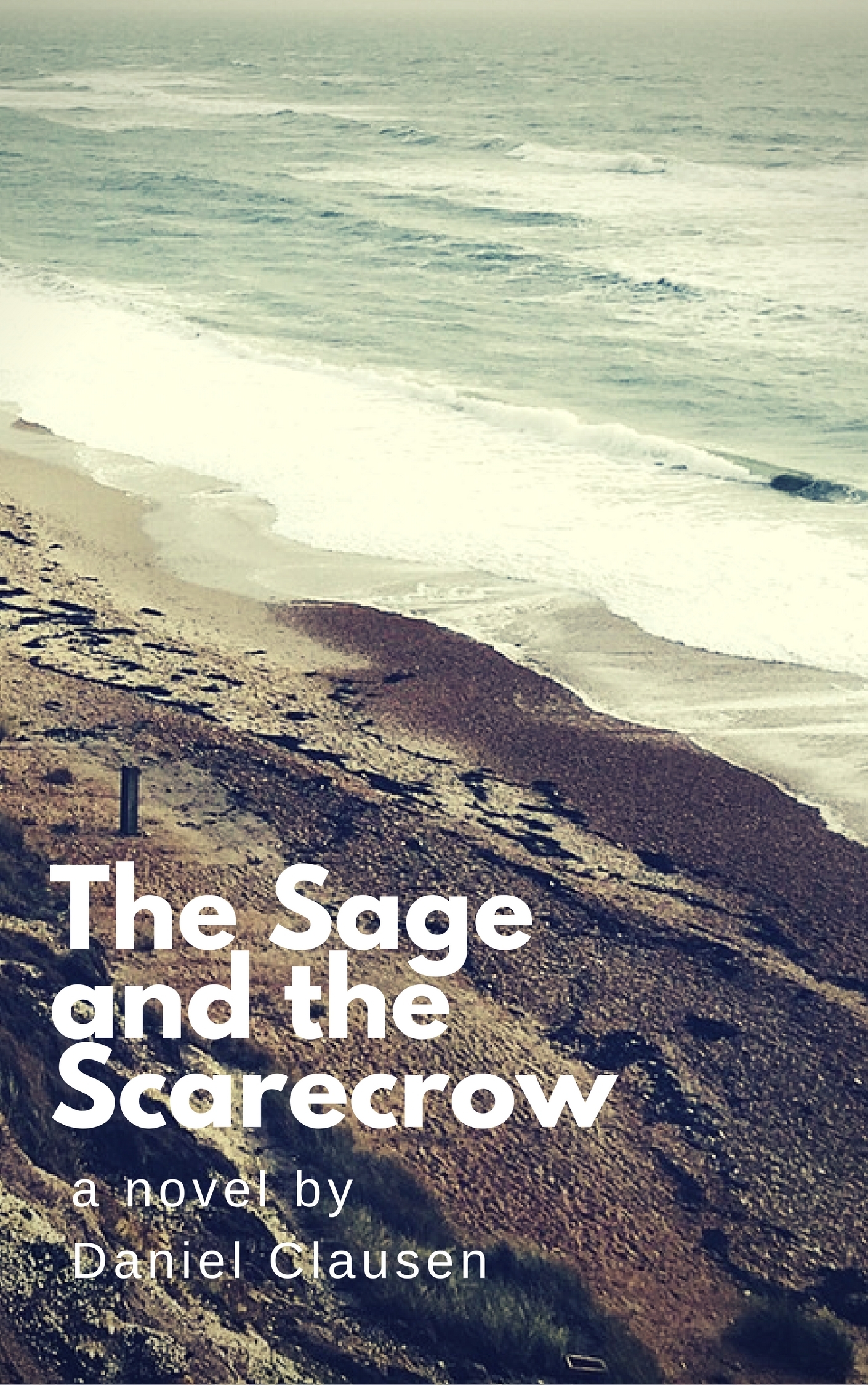
Six months after his father has died from cancer, Pierce finds himself in a state of anxiety and crisis. The book follows Pierce through a journey to find his best friend and the only person he thinks can "cure" him.
Daniel has wanted to be a writer ever since he was in elementary school. He has published stories and articles in such magazines as Slipstream, Black Petals, Ken*Again, Aphelion, Spindrift, Zygote in my Coffee, BlazeVox, Euphony Journal, and Leading Edge Science Fiction (among many others).
He has written many books: The Sage and the Scarecrow (a novel), the Lexical Funk (a short story collection), Reejecttion (short story/ essay collection), ReejecttIIon -- A Number Two, (short story /essay collection collaboration with Harry Whitewolf), Something to Stem the Diminishing (short story / essay collection), The Underground Novel (a novel / self-help book), Pure Writerly Moments (a Wattpad collection of essays and stories), They're Making it Up as They Go Along (a literary experiment with Harry Whitewolf), and the Ghosts of Nagasaki (a novel).
Thinking about Lao Tzu helps me understand my own situation: why I’m writing these words to you, why I feel the need to connect to someone else.
The introduction of the Tao Teh Ching says that Lao Tzu was a librarian during the Warring States period at a library in the Chou capital, and that the book was his way of expressing the accumulated lessons he’d learned throughout his lifetime, regarding such subjects as how a state should be run, human psychology, metaphysics, creation, and so forth. The book roughly translated means The Way and its Virtue. I suppose it’s a story about a general way and a general virtue. But I can’t help thinking about the book as something lonely and personal.
When I think about Lao Tzu writing these words carefully on ancient scrolls or pieces of silk paper, or whatever was the way of writing back then, it helps me understand why I’m writing these words to you. The lonely spaces and places of our existence compel us to search out others, whether it be by words or some other means.
Sometimes I think of Lao Tzu alone in a library working on this scroll, as if he could put his soul in a bottle and cast it out to sea. The bottle would drift and drift, and then finally the right person would find it years later. Magical properties of the bottle would draw it to the right person at the right time in a way that would heal and redeem that person.
Philosophy and wish fulfillment are sometimes so close that I think really any philosophy is nothing more than the expression of a desire.
What is this book?
Sage and the Scarecrow was my answer to Before Sunrise, Catcher in the Rye, Clerks.
I wrote it young. I wrote it personal.
I wanted to load the novel with my voice. I wanted the book to have my idiosyncrasies. I also wanted to finish the book before I was 21.
A simple novel with beautiful lines and scenes. I was convinced I could hustle the book around S. Florida. A hippy project. I sometimes felt like the poet in Before Sunrise. I will write you a poem and you pay me whatever you think it's worth.
Marketing a romantic hippy novel will teach you just how many ***holes there are in South Florida. It will also teach you how many genuinely nice people there are in the world. It's a minor miracle anyone said yes to 21-year-old selling books out of his backpack. But many did!
Reading Clausen is a treat, and this book was no exception. The Sage and the Scarecrow is split between two worlds. A realistic everyday mundane setting and an abstract imaginative dystopia. Both were fascinating in completely different ways.
The realistic side of the story is about a college student in his senior year who loses interest in his studies. He’s losing the thread of why it matters, why bother, what’s the point of it? And in his aimless mental state, his thoughts return to the only love of his life. They were best friends in high school (never quite dating) and for a time in college, but he abandoned writing her. In a fit of modest self-loathing, he decided she was better off not having to deal with his neediness and the death of his own father. So he brushed her off. Halfway through the novel, he decides to travel to the city where she was attending art school although not having the courage to directly seek her out. He wanted to be near her but avoid her at the same time. It was a blend of passivity and insecure wish-fulfillment. While there, he meets up with another old friend from high school who has turned into a spoiled womanizer. Disenchanted he wanders off, spends time with an unusual highly educated homeless man and then eventually bumps into his ex.
This half of the story is quite wonderful in the intimacy of the writing. Slice of life stories are difficult to pull off while keeping the work compelling. College settings are also hard to pull off because they can so easily fall into cliché. Clausen does so with subtlety and authenticity. Forget showy pyrotechnics and decisive outcomes and actions, Clausen kept my interest with writing that always felt honest and believable. The moments felt like real life with just enough forward momentum to keep me wanting to know what happens next. I felt as if I was eavesdropping on the inner thoughts of the main character.
At the same time, this mundane storyline is balanced by imaginative flights of weirdness as the main character envisions a decimated landscape in an apocalyptic future world with obsessive tribes such as the Thumb Twitchers who can’t stop twiddling their thumbs as if holding imaginary smartphones that no longer exist. And another tribe right out of Clockwork Orange. The main character searches for a meaning for his life that parallels his search for meaning in his real life. Without clearly knowing what they are seeking for, they run parallel paths in very different worlds.
Clausen manages profound pondering with a deft lightness of style. The Sage and the Scarecrow was a delightful read and comes recommended for anyone open to accessible experimentalism.
The author's youthful search to find meaning in a world that is empty because of the loss of his father is a reminder of the very human problems most of us face as we mature in a world that changes rapidly around us. Relatable.
My thanks to the author, Daniel Clausen, for my electronic copy of his book which I received through a Goodreads Giveaway
I’m a big fan of Daniel Clausen’s m0re recent work so I eagerly grabbed the chance to read this revised version of his first novel, originally written in 2003.
It wears its influences very openly on its sleeve but it’s none the worse for that as that the book is about books as much as it’s about any of its other themes of loss, grief, philosophy, the unreliability of memory, love, friendship, society, the sense of self and the nature of reality.
This book really got me where I live as I have quite a bit in common with the protagonist/unreliable narrator, not least of all his unreliability. I think most people will find something of themselves in this book, to some extent.
I’m grateful to the author for letting me get my hands on this book and very much look forward to reading his future works.
Reads like a good first book from a smart young author, starring a college-age character who could only have been written by someone at that age...
Tales of wayward youth, circa early-2000s, of being too smart and melancholic for one's good, as this man goes through life trying to figure it all out. There are literary references, philosophical treatises, and talk of various classic movies. Of course, there are also issues with women. Much sex around the periphery, even though it never seems to work out.
A bit stream-of-consciousness in that searchingly youthful intelligence way, it's not quite a novel with a plot but to sort out many thoughts by way of writing a whole book. A decent companion piece if you've read Ghosts of Nagasaki and want to read more by the writer. For modern fans of Haruki Murakami and classic readers of J.D. Salinger, but more 21st century.
Pierce's Dad has died and Pierce is unable to deal with his grief, his dad battled with cancer and Pierce feels guilt for grieving for somebody who had been suffering so much. He becomes disjointed from life, no longer able to deal with school work or his friends. Instead he becomes fixated on a book, "the one book", and the girl who once gave it too him. He ends up on a journey to find her and once there he can't face her. Instead he meets some odd characters, especially the very wise homeless philosopher Roger.
Whilst all this is happening there is a parallel dystopian story happening. At first this is odd until you realise that each story is influencing each other, gradually starting to merge as you get near the end of the book. My theory on this is that it is how Pierce is managing his nervous breakdown. The ending of the book is quite touching and I liked how everything worked out.
Daniel Clausen is one of my favourite authors and this was his first book, I have been after it for years and recently he has re-written/tidied up a lot of the book ready to be re-released, so I'm well glad to have got me hands on a copy. It was nice to read about Pierce and Roger who have been characters in other books by Clausen I think.
This book’s great. I loved it. But I always find it harder to review books I love more than books I want to criticise, so despite finishing The Sage and the Scarecrow some time ago, I’m only just now getting my arse into gear to review it.
Loosely based on The Catcher in the Rye, this novel is an attempt to capture the confused adolescence of university student Pierce, as he tries to deal with the grief of losing his father and find his place in the world. Pierce’s head is far too full of questions, ideas and philosophical stances, as well as anger, to fully engage with the normal university life of pulling women and drinking. So instead he runs away to find the only woman he’s ever loved, although his mission is much deeper than that. The story of his university life and road trip is mingled with a futuristic dystopian post-Armageddon parallel story about tribes of thumb-twitching zombies, which cleverly reflects the current elements of Pierce’s life. This is just one area which elevates The Sage and the Scarecrow to another level. It stresses the importance of reading books, and how one would always be better off reading no books than to only ever read one. You’ll also find plenty of other genuinely helpful philosophical thoughts, often inspired by Lao Tzu. This all comes together when Pierce meets a homeless philosopher called Roger: the sage of wisdom, who compliments Pierce’s fragile straw-man appearance.
The Sage and the Scarecrow moved me. It also made me laugh. It made me think. And it made me think of other great books like Sophie’s World, which the reader finds out was one inspiration for the story at the end. I also nearly had a tear for Pierce by the end of the novel.
It’s interesting to know that this book was first written when Clausen was much younger, and has been rewritten/edited several times to get to this fully-formed stage, as it reads more like a man reflecting on adolescence than being written by an adolescent. But I think this combination of the book being initially written by a young man, and then edited as an older man, is perhaps what’s made it so special.
Clausen has that rare gift of being able to present complex philosophical concepts in easily digestible ways, along with Pythonesque humour and a lot of heart. A very accomplished novel that made me reflect on my own youth, as I was also too wrapped up in my own philosophical thoughts as a young man, which made it difficult to embrace the “real world”. And I had a penchant for just upping and going somewhere for a week or two, too. It also reminded me of the many homeless people I’ve spoken to in my life, and the few who had more wisdom and a greater understanding of this thing called life than anyone I met with a nine-to-five job and a mortgage.
I knew my review wouldn’t do this book justice, but second to Clausen’s masterpiece The Ghosts of Nagasaki, this is his most accomplished prose. Yeah, this book’s great. I loved it.
This is a wildly creative and intelligent story about a young man in college who is navigating his way through love and grief, and learning to live in an imperfect, disappointing, frustrating, and sometimes hilariously funny world. It is a very personal journey, but all the time I was reading this book, I felt like it was my journey. I could relate in so many ways to both the main character’s strengths, as well as to his shortcomings. And I could especially relate to the confusion many of us feel during those years we are leave our childhoods behind and forge our ways into that seemingly phony, callous, absurd, and corny world we call adulthood. I loved this book, and I highly recommend it.
An old boyfriend from high school wrote this, and I am so proud of him. I have to say he is an incredibly talented writer and everyone should read his work, because one day he is going to be insanely famous.
An affecting novel where death and loss visit a college-age man named Pierce. Feeling somewhat disconnected from those around him, he sets out on a wander, with a book special to him tethered as if a talisman. Forefront in his thoughts is a young woman, Jennifer, who he recognises as the potential answer to questions he barely knows how to ask.
Clausen creates a touching recount of the lostness and confusion mostly particular to early adulthood, especially if a major bereavement or tragedy visits at that time. The prose is spare, and works incredibly well. Pierce’s state of mind is represented in the thoughtful and stripped down style, the minimalism suggestive of an internal world full of feeling not ready to be expressed but felt more acutely for that, even if not able to be fully consciously processed.
Running parallel to Pierce’s meander with the book is a dystopia thread, oblique at first, gradually revealing itself to be an account from a proposed future-time Pierce, where zombie-like beings exist and feral gangs take inspiration from Anthony Burgess. Pierce’s love of literature features dominantly throughout the short novel, with some particular titles acting as roadmaps to both his internal and external struggles.
Like many narratives that deal with being set adrift, the structure takes on that of a quest of the spirit or troubled pilgrimage. The novel includes well rendered intersecting characters encountered on the way. Pierce’s interactions with these figures invoke the lowkey wisdoms of counter culture road trips, the characters sharing their flawed enlightenments before moving on.
In The Sage and the Scarecrow Clausen demonstrates the best of what he does. According to the author the main novel was completed when he was at a similar age to the main protagonist, and has since been returned to over the years. There is a maturity to the execution that perhaps reflects this intervention, but not knowing where the original manuscript ends and where Clausen’s revisions start it’s difficult to come to any definite conclusion regarding this. Whatever the history, the result is a fine short novel which manages to reflect the disorientation of grief and the ineffable nature of connection. Recommended.
An important early novel by a talented and versatile writer. Its definitely an early novel, what might be called Juvenalia by an older writer and as such has a raw feel to it. It sketches and outlines rather than plunges deep into long and dense paragraphs so one gets the feeling almost of a screenplay where the essence is there but not fleshed out. The only point which became incarnate as it were for me was the latter part dealing with Pierces encounter with a homeless man on the beach. I wanted that part to be the depature for another novel almost. This is not to say that the novel is too ight or casual, there is clearly a lot of intense emotion and profound thought going on, possibly as a result of the books that inspired the author at the time of writing. There is much in this book that resonates with me and often took me back to my own youth in search of lost domains and the quest for meaning in the midst of lifes tragedies. Its also very funny in places with some excellent bathetic one liners. Highly recommended.
this book has to be one of my favorite books i’ve read this year, I love the alternate world with the imaginary apocalypse, and how Pierce saw things, and all the symbolic speech throughout the book 5 stars for me!
I am a big fan of Daniel Clausen's novel The Ghosts of Nagasaki and the short story collections of his I have read (which is all of them except for The Lexical Funk, I believe). Clausen wrote The Sage and the Scarecrow in 2003, but recently, in his own words, "significantly revised" it. Even still, I think it felt like a younger, less polished Clausen writing it (that's not necessarily a bad thing). It also helps that the novel's main character, Pierce, is in his early twenties. Pierce's father has recently passed away after a long fight with cancer, and Pierce finds himself apathetic towards his schoolwork, friends, and family. He has become obsessed with how to build the perfect (fundamentally better) society, Lao Tzu's Tao Teh Ching, and the girl who lent him the book, Jennifer, who he hasn't talked to in a year.
Believing that if he could see and talk to Jennifer again everything would be okay again, Pierce drives to the town where she is studying at college. This journey is told parallel to a post-apocalyptic future wherein Pierce navigates a barren landscape full of cannibalistic thumb-twitching zombies (Their mobile devices have run out of battery) and nomadic tribes (like the Shampoos and Nicolas Cage Mimickers) as he searches for the last library.
Apart from some clashes with tribes and thumb twitchers in the apocalyptic narrative, this is one of those books where nothing "happens," so if you need lots of external events in your plot you will most likely not enjoy this book. It's largely introspective; even the dialogue with other characters is basically just Pierce's thoughts bouncing off of another person. If you like moody protagonists and philosophical musings, you're much more likely to appreciate this homage to Catcher in the Rye.
Another thing I really enjoyed about it is the author's sense of humor. It's a bit absurdist, and very, very dry, which aligns perfectly with my own. There are even Monty Python-inspired hallucinations! Some of my favorite lines that elicited legitimate chuckles and/or smirks were:
"There is no reason to wear a suit in the apocalypse. As far as I can tell, the apocalypse is not a formal occasion."
"Religious fanatics always give me a strange look when I jokingly tell them that I'm forming a religion based on the revival of polytheism, the idea being that quantity over quality is the new direction in religion in this modern day of capitalist production.
(Of his therapist, who has received an offer to do research on pilots): "I could imagine this guy going to work every day in a suit and tie and asking pilots very seriously whether they were more scared of knobs or switches, whether automation made them feel inadequate, and how this was affecting their sex life."
I would say that Clausen wears his influences a little too much on his sleeves at times. He name drops a lot of books (Sputnik Sweetheart, VALIS, etc.) by having Pierce just straight up read and quote them; and in the beginning of the book tells you "this story is about... human psychology, how a state should be run, the impossibility of love, (no metaphysics), the problem of existences," so there's no way you could not catch the themes.
Roger the homeless man with a PhD was an interesting character, but there were a few large chunks of dialogue that felt like philosophical soapboxes; and they sort of bogged down their conversations. I think the main issue is that there was no subtlety; Clausen spells out very clearly everything that he wants the reader to take away from the story, which makes it less interesting, but if I'm being completely honesty I would probably do the same thing were I to write a book (I know because I've written [and abandoned] a couple chapters of a book, and I did do the exact same thing). The book also ends pretty much exactly like you'd expect it to. It may not be original in that sense but it has a really nice sentiment that manages to not be corny.
The book certainly isn't for everyone, but if you like quieter, reflective, philosophical, satirical, and at-the-same-time-silly books, then there's a good chance you'll enjoy this book quite a bit.
While I didn't win "The Sage and the Scarecrow" through a Goodreads competition, I did however win it when the author, Daniel Clausen, had it listed for free. I thoroughly enjoyed the book. It is written very different from other books I have read. It reads like a personal diary or a journal. Pierce was the main lead in this book. He had suffered a loss that affected him profoundly. This story is a mundane one, but the way it was written turned it into a work of art.
You would say this was like an autobiography. The conversations were deep at times and lighthearted at others. Many of the situations Pierce was in, I would say we have all been in. Think of all of those times you wish you had a camera going, recording a conversation, or could somehow preserve that one moment that you were hit with profundity, or hit with something so funny you wish you could laugh that way every day and that is what this book does. It gives you that flash of remembrance, just with different characters other than yourself.
I think many people would enjoy reading this book and one that I suggest reading. It's not so short that it's a short story, but it's not a long one either. If you like seeing how everyday life can be turned into entertainment, then this would be right up your alley.
I won this in a Goodreads giveaway and it was a nice, introspective read about how people process grief and the stages of healing. I enjoyed the alternative storyline showing the harsher side to his mental deterioration.
This is the second book by this author that I have won in a Goodreads giveaway. Thank you Daniel Clausen!!
It was such a breath of fresh air to read something as unique as this. This was a very real and raw story about the loss of a parent and all that comes with it.
I highly recommend this book and Statues in the Cloud by Clausen!
This is a very well written and thought provoking book. It is great coming of age story. The characters are well developed. I enjoyed the switching back and forth from what was happening in his life to what was happening in his mind at the same time, it was very smooth. Overall, very good book.
I went through the reviews on here and I wish I could feel as strongly as the others do for this book. It's good and a quick read, but there was one point in the story that really turned me off from the rest of the book. I didn't want to give this book three stars, but I didn't see it fair to base the review solely on an outburst of someone going through a mental breakdown. But, the author having someone lie and say someone died from cancer and using it to piss someone off, really turned me away from enjoying the rest of the book. The concept to the story was a good one and knowing that one of my favorite books, The Catcher in the Rye, influenced it I was eager to read it. Once you understood how the two worlds were feeding off of each other and slowly came closer together at the end you understood the dialogue more in the apocalyptic world and could bring that into the main story.
Writing a first-person novel whose narrator and main character is an alienated, profoundly cynical, post-adolescent faces numerous obstacles, not the least of which is Mount Catcher in the Rye, at whose base lie several generations of yellowing manuscripts, most derivative of Salinger’s novel to a greater or lesser degree.
Daniel Clausen’s The Sage and the Scarecrow tracks a few days in the life of Pierce Williams, an undergrad at an unnamed Florida university. The time is unspecified, but people still communicate with letters, and no one mentions the Internet or Facebook or texting.The narrator says that his father’s favorite song was Warren Zevon’s "Werewolves of London," “I saw a werewolf drinking a pina colada at Trader Vic’s...” The song came out in 1978. It’s not much of a surprise to see on the copyright page that the novel was published in 2003. Early new millennium.
We meet Pierce Williams, the narrator and main character, six months after his father died of cancer, and not many years after his mother’s early death. Caring for his father during his battle with the disease, Pierce experienced first hand the difficulties of obtaining adequate medicine and hospital care. Out of this struggle, Pierce develops a desire for a better society. The loss of his father has also left Pierce depressed and feeling without purpose or direction, for his father had become the center of his universe. Adding to this melancholy state are Pierce’s memories of Jennifer, his high school crush. Pierce carries around and constantly consults a copy of the Tao Te Ching, loaned to him by Jennifer, with a personal note from her on the inside cover. As the story unfolds, Pierce will focus on Jennifer as the one person who might rescue him from his bleak existence.
On the face of the above, we have a sympathetic character here, but not so fast. Pierce is one of the most self-centered, neurotic, manipulative (think The Prince), pedantic and just plain weird characters in contemporary fiction.
For example, not many pages into the book, Pierce is having a conversation with Professor Foster, “one of the few teachers I could stand.” Foster makes a suggestion that Pierce include a critique of Fitzgerald’s The Last Tycoon in the paper he’s writing for the class. “I told him that I thought I might add Fitzergerald’s text into my paper, but it was a complete lie, one of those things you say to make people think they’ve achieved a small victory. I really had no interest in The Tycoon. Really, I’d only read half of it.” A short while later, Pierce will tell his friend Brian (a well-wrought male pig), who casually leafs through the Tao Te Ching, an act that Pierce views as desecration, and feigns keeping it, that Jennifer died of cancer. Pierce’s outrageous but passionate lie is harrowing. Later, Pierce will intellectually bully a well-meaning older woman. Pierce is a deep well of deceit and insincerity. He is in fact a hipster: when you think he’s kidding, he tells you he’s serious and when you think he’s serious, he’ll tell you he’s kidding.
Nearby, Holden Caulfield may be murmuring phony, but Pierce Williams in the intensity of his attitudes and interactions is an original, and always interesting to follow. Even as a pedant, regularly dropping Hegel, Nietzsche and Lao Tzu into conversations, Pierce doesn’t bore. He’s passionate about his abstracts, so passionate that when an attractive woman tries to seduce him, his mind turns to Kant’s Metaphysics of Morals. It also doesn’t hurt if you’re a reader who values philosophy and lit crit. I like this stuff, so even when it gets ponderous, I’m never less than amused and frequently provoked.
The other characters in the Sage and the Scarecrow are also very well drawn. Pierce's encounters with Angie, Brian and Phil are captivating, and provide many witty and funny lines.
If you’re looking for action and romance, The Sage and the Scarecrow isn’t your book. Essentially, it’s the story of a guy who doesn't do much but think. Pierce is too reflective, but that's the problem at the heart of the novel. When he finally does something, nothing much comes of it. That's the payoff.
In an arena where many have tried and most have failed, Clausen succeeds.
This novel is highly original, it is written in an incredible way. It is a love story, but it is also more than that. It is a true tale of self-discovery, of the human psyche. It is written in first person told through the words of the main character, Pierce Williams, who is extremely loveable in an unusual way. He thinks far too much, is a very private, withdrawn individual, probably a little too serious for a guy of his privilege and age and definitely pessimistic. We come to know him through his ramblings about Nietzsche, Marx, Kant and other such theorists and his constant observations and detailed thought processes. Pierce certainly fits the profile for a disturbed individual on the outside, however by being given access to his internal thought processes we come to realise that Pierce is perhaps the most sane, or at least sensible, person in his immediate environment and his withdrawal comes as no surprise. He is brutally honest with himself and with those peers with whom he can truly be open, he does not try to fit in, he is wonderfully antisocial and refreshingly atypical; he is a wonder.
The language is very conversational and relaxed, with interjections and interruptions, just as you would expect from someone having an informal ‘chat’ or thinking out loud. However, it is lovely to read; considering the theoretical ideas that come up in this novel, the conversational and sometimes rambling style of Pierce makes the novel easy to read and connect with, even if you are not a fan of social sciences and philosophy as I am. But more than that, it makes you feel like you have connected with Pierce, that you have been able to enter into his private, closed off, world, and to explore his thought processes.
A result of the language style is the brutal honesty with which college life and the world in general is portrayed through Pierce’s words. We are given an insight into the superficiality of middle class American college life, the competitive nature, the pressures to conform, fit in and play a role, gender relations and questions of power, as well as the more deep-seated and disturbing psychological strains and issues that arise in college life. The reader is able to observe from the inside through Pierce. Peirce’s reflections on live, love, morality and politics are also profound, perhaps too much so for a typical person in Pierce’s position, but as stated above, Pierce is anything but typical, and for that reason he is all the more real.
The ending of the novel just makes the novel complete in such a beautiful way. You look back and you realise what an honest story this is, you see that it is about love without being a typical romance or the typical love story; perhaps it is a truer, selfless form of love. I read this book and I immediately liked Pierce, and all through his ramblings I continued to like him, despite the negativity and pessimism, but I didn’t realise how much I loved this novel until about 15 minutes ago when I completed it and I realised the journey that I had been on, Pierce’s journey, and I was touched. Who’d have thought Pierce could possibly teach us anything about love?
I absolutely believe that this book deserves more attention, because this is a beautifully constructed novel, and with the right agents and publishers this author can get the fame he deserves, because he is clearly capable of great things.
The Sage and The Scarecrow can be summarized in one word: thought-provoking. In this beautifully crafted narrative, our main character, Pierce, goes on both a physical and mental journey, which ended up teaching me a lot about humanity, more than philosophy.
The highlight of this work is the characterization of both Pierces: the physical Pierce and the one in his head. I don't know if there's a behavioral science behind the creation of these two personalities, but I am amazed by how the writer made them unique with their different experiences (one in the college world and another in a post-apocalypse) yet connected to each other by these same peculiar experiences. Maintaining such distinct yet connected voices should take a lot of sweat, but Daniel makes it look so effortless. I admire that.
The author might want to do more of showing than telling, though. Especially in the necessary places. Nevertheless, I enjoyed the rawness of this literary fiction. It really mirrors who we are as human beings in this age. With the realistic feel embedded in Pierce's ultimate journey to find love and perfection, it reminded me of the questions humanity stopped asking when we said, "Fuck All."
This entire review has been hidden because of spoilers.
Having read a short story version of this in The Lexical Funk, I was excited to read the whole thing. The Sage and the Scarecrow is a much more serious and philosophical story than the rest of the stories in The Lexical Funk.
The story relays the experiences of a young college student who has lost both of his parents and is struggling to find his way in the world. The story is told from his own (first person) perspective.
The Sage and the Scarecrow is riddled with intellectualism, though it's largely left up to the reader to interpret. Pierce, the main character, spends his time introspectively evaluating his relationships with all of the other characters, comparing each relationship to the others, seemingly in an attempt to define who he wants to be. I particularly enjoyed the dichotomy of Sean and Roger, two of Pierce's friends who are similar in many ways, but have taken drastically different paths in life and have ended up in completely different circumstances as a result. It seems to provoke some deep thoughts regarding quality in Pierce, although it isn't discussed directly in the book.
I guess that's what made The Sage and the Scarecrow such a good read. Daniel Clausen did an amazing job of illustrating Pierce through his words in such a way that he feels like a real person that you know and respect by the time you finish the book.
This book came in a rather difficult to read format on my kindle, and it was hard to get through it. This is the story of Pierce Williams, whose father recently died from cancer and who is trying to come to terms with this and with himself. The reader follows Pierce through many venues, and finally to Florida, where he hopes to find his once upon a time love Jennifer, who he is sure can solve his dilemma. A lot of the book was filled with intellectualism, which the reader must work through and figure out if the book is to make sense. I found that this constant introspection and deep thought processes lent very little to the book, which made it drag for me. I think the author would have been better off to create a story around some sort of active plot rather than around a disillusioned student’s thoughts. In fact, as I read it, I wondered just where the author was going with this work. Other reviewers found the book a good view of Pierce’s life and that of a regular college student, but I got rather bogged down with Pierce’s intellectual introspection and did not see this. This is not the action packed mystery thriller or beloved romance. I found it interesting that, even after all the reflection and philosophizing, there really is no big conclusion on his part. I received this book from Library Thing to read and review.
I won this on a First Reads Giveaway. This was very difficult for me to finish, but because I had won it, I felt I needed to give a fair review and read it through to the end. Pierce is a college age student who recently lost his father to cancer. He is very quirky- a bookworm with a an intellectual and philosophical edge who hapens to think often about Jennifer, a good friend he really loves, who is no longer in his life. The cohesiveness of the book is basically a string of converstations with various people Pierce knows at college and then meets as he travels to see Jennifer in the small town where she lives. I kept waiting for the story to happen all the while "listening" to these coversations and references to books and authors which I simply had no real interest in. It felt as if I were reading someone's journal-a work in progress- where the information has much more meaning and sense to the writer than to the person reading it. I agree with another reviewer, in that the last line was the best part of the book.
Thank you to Daniel Clausen for the honour of reading and reviewing Sage and Scarecrow. Sage and Scarecrow is centered around the life of Pierce, a strange young man who seems to have many odd issues including an obsession with the life of Orson Wells, doesn’t like being touched, likes to be alone and seems to have some form of social anxiety, maybe even a form of Asperger’s Syndrome. Throughout the book the reader follows Pierce and observes his relationship with various friends, professors, stalkers, and a girl he really likes but has trouble knowing how to express himself to her. The main theme of the book seems to be Pierce coming to a realization about how he handled his father’s fight with cancer and eventual dreadful death. It’s an interesting book as Pierce is such a complex character and at times you want to give up on the book but just at that point Clausen hooks you in again and you keep on reading.
I won this as a Good Reads First Reads Giveaway. The story is about a college student who suddenly finds himself very depressed since his father has recently died from cancer.He decides to leave his studies and take a trip to find his supposedly "best friend", Jennifer, with whom he has had no contact for quite some time. He thinks this girl will be able to help him . I have to say I can't give it a higher rating as I really didn't enjoy the book as much as I had hoped. It's only 139 pages and took me 2 weeks to read. I think with a little more editing, the story does hold promise however. I just had a little trouble following it and had to go back and re-read several passages since to me, things seemed out of sequence. The author might want to use a spell checker next time as well.