I was born in Camden, New Jersey in 1949 and lived in Oaklyn and Cherry Hill until the middle of sixth grade. Then we moved to Springfield, Illinois. My parents were avid readers and they gave that love of books and reading to me and to all my brothers and sisters. I didn’t think about being a writer at all back then, but I did love to read. I'm certain there's a link between reading good books and becoming a writer. I don't know a single writer who wasn’t a reader first. Before moving to Illinois, and even afterwards, our family spent summers at a cabin on a lake in Maine. There was no TV there, no phone, no doorbell—and email wasn’t even invented. All day there was time to swim and fish and mess around outside, and every night, there was time to read. I know those quiet summers helped me begin to think like a writer. During my senior year at Springfield High School my English teacher handed back a poem I’d written. Two things were amazing about that paper. First, I’d gotten an A—a rare event in this teacher’s class. And she’d also written in large, scrawly red writing, “Andrew—this poem is so funny. This should be published!” That praise sent me off to Northwestern University feeling like I was a pretty good writer, and occasionally professors there also encouraged me and complimented the essays I was required to write as a literature major. But I didn’t write much on my own—just some poetry now and then. I learned to play guitar and began writing songs, but again, only when I felt like it. Writing felt like hard work—something that’s still true today. After the songwriting came my first job in publishing. I worked for a small publisher who specialized in how-to books, the kind of books that have photos with informative captions below each one. The book in which my name first appeared in print is called A Country Christmas Treasury. I’d built a number of the projects featured in the book, and I was listed as one of the “craftspeople”on the acknowlegements page, in tiny, tiny type. In 1990 I began trying to write a story about a boy who makes up a new word. That book eventually became my first novel, Frindle, published in 1996, and you can read the whole story of how it developed on another web site, frindle.com. Frindle became popular, more popular than any of my books before or since—at least so far. And it had the eventual effect of turning me into a full-time writer. I’ve learned that I need time and a quiet place to think and write. These days, I spend a lot of my time sitting in a small shed about seventy feet from my back door at our home in Massachusetts. There’s a woodstove in there for the cold winters, and an air conditioner for the hot summers. There’s a desk and chair, and I carry a laptop computer back and forth. But there’s no TV, no phone, no doorbell, no email. And the woodstove and the pine board walls make the place smell just like that cabin in Maine where I spent my earliest summers. Sometimes kids ask how I've been able to write so many books. The answer is simple: one word at a time. Which is a good lesson, I think. You don't have to do everything at once. You don't have to know how every story is going to end. You just have to take that next step, look for that next idea, write that next word. And growing up, it's the same way. We just have to go to that next class, read that next chapter, help that next person. You simply have to do that next good thing, and before you know it, you're living a good life.
This was one of those books that created a lot of “wows” and oohs and ahhhs. It’s also a book that brings out the nerds in the family who like to add their facts. Ask how I know! 🤣
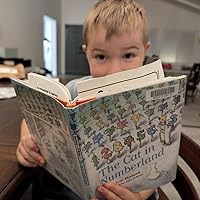
A visual representation of how big a number a million really is. It's a bit of a tongue twister with all the large numbers to read on each page, but this kindergartener really enjoyed listening to it and flipping through the pages on his own.
Clements gives the reader a fascinating look into what "a million" actually looks like. Each page has 23,808 dots. And each page includes a fun fact or two about one of the numbers represented on the page, for example, at dot #186,000 we learn that light travels through space at about 186,000 miles per second. Some of the facts are completely bizarre and I had to wonder who had bothered to calculate something like that. Nevertheless, it was quite fun.
One thing that I didn't enjoy too much was trying to find the selected dot on the page - for example, dot #186,000 is circled on that page. But the dots are so small and the circle sometimes blends into the background illustration. So that can make it very difficult or almost impossible to find the dots at times (I never did find one of them). This would be more fun if it were not verging on frustrating.
Still a very fun book that really does illustrate just how large a million is.
A cute book with many facts about interesting stuff, such as how many cars are taken to the junkyard and much more! I thought it was really fun. And has EXACTLY One Million Dots.
As a future math teacher I feel this book will be really useful. Sometimes it is hard for students to grasp just how many one million is. This book gives many interesting facts leading up to a million dots. Each page is filled with lots of dots and a fun fact about that number. I feel that student would really enjoy reading this book. It is long so many a page a day would be really helpful if I shared it with the class.
We love Clements's novels so I was excited when I read about this foray into math concepts. It did not disappoint. My son and I took in every beautifully illustrated page with delight and it sparked lots of conversation about relative size and other ideas. One quibble which, in fairness, applies to most books: we know gender is non-binary yet the author refers to men/women and boys/girls instead of using neutral terms such as adults and children.
Children's picture books are wonderful and incredibly creative. My kids are older now so I don't read them as often but working in a library allows me to indulge my reading hunger and I discover all kinds of amazing books. The idea behind this one is so simple yet thoroughly entertaining and educational with plenty of small titbits of fascinating information to tickle curious young minds.
A great book for a math lesson. It calculates different facts and dimensions about the world. Students would be fascinated about the claims that are made mathematically. The illustrations are all made of dots. In all, the book contains one million dots throughout the pictures.
Worst storytime book ever. DO NOT READ THIS ALOUD. The kids will swarm you to see the one single differently colored dot on each page. It will cause pandemonium when the other kids can't see. It takes forever to get through. This book is not suitable as a read aloud to a group.
This is a fun and creative way to demonstrate how much a million is. It is sure to be liked by fans of math and trivia. I can imagine children delving into it with enthusiasm.
Interesting book. Lots of facts and LOTS of dots. Would be good for a kid that likes information. But it's a little boring for kids that don't get the point.
This is not an original idea. See the book "One Million" by Henrik Hertzberg for the book for adults! This book by a favorite author is the kids' version of the book. Entrancing!
Citation: A Million Dots, by Andrew Clements. (Simon & Schuster Children’s, 2006). 48 p. Counting Picture Book.
Summary: Clements uses large number facts and images created with thousands of dots to illustrate for readers the vast number of 1,000,000.
Critique: a) Clements seems to have researched and calculated several extreme numbers to be able to come up with his content, which most readers can assume is accurate.
b) While some of the facts Clements uses to illustrate his counting are fascinating, a handful of them are extremely obscure, even to the point of being confusing for young readers. While certain students who may be uniquely interested in this type of calculation, I’m not sure this makes the numbers accessible to young readers, as I’m guessing was Clements’ purpose. Also, as more of a personal pet peeve, Clements uses the words “a million” seemingly interchangeably with the number 1,000,000, and as a math teacher, I would have preferred him to distinguish “one million.”
c) Several of Clements’ facts are unique, yet understandable and applicable for young readers, like three pencils could draw a line 554,000 feet long. The example of 800,000 Silly Putty eggs making a cube that is 7 ft, 4 inches square, which would weigh 23,408 lbs, which is as much as two large African elephants has several calculations going on, each one making it more removed for young readers. In the same way, the example using 416,000 words to tell 46 adventures of Sherlock Holmes, and still having 149,000 other words remaining left even this adult reader confused as to the true numeric fact related to counting to one million.
Curriculum Connection: As a large number math activity, students in 4th or 5th grade could select one of the facts to calculate in several forms of measurement. For example, transferring a fact given in minutes into hours, days, or weeks.
Textbook – The Joy of Children’s Literature – P. 73 Genre – Counting Book
Summary: Explore this book as it begins and ends with a single dot. In between be mesmerized by the illustrations made out of dots. Learn bits of information throughout on every page about what the illustration represents. Count and follow along with the amount of dots have been used and presented throughout the story.
A) The illustrations are vivid and the number that it is connected to is used wonderfully providing the reader with information about the picture. B) The illustrations are made with a set number of dots that represent the information in the picture. When looking at the book you not only are learning about numbers and counting and adding the number of dots that are consumed on every page, but facts about the pictures on the pages. C) For example we learn that it took 238,857 dots to draw a picture of a cow flying over the moon with a little bit of the Earth showing below. At the bottom of the page we learned that it is 238,857 miles from the Earth to the moon. On the opposite page there a many different colored butterflies shown. It took 265,00 dots to make them. We learn that there are 265,000 different kinds of moths and butterflies that live on Earth.
Curriculum Connection: Use this book to go along with your curriculum when you are teaching students how to pronounce long numbers. Use the information in the illustrations to show students how you can learn from a drawing. Challenge students to make their own dot picture. See if they can provide a fact to go along with their picture.
Genre: Counting Book Summary: Through fun and interesting facts, the reader views 1 million dots with illustrations included. Each page tells you how many dots that have been viewed since the beginning, teaching children about counting while learning silly number facts, such as how many shoe boxes it takes to get to the top of Mount Everest. Critique: a. The texture of the illustrations with the use of dots. b. The bright and colorful illustrations along with black dots cover more than half the page. The dots mixed with all the colors create an interesting texture that creates movement. The dots also seem to add an almost 3-d like effect that makes the pictures really stand out. c. The pictures were so fun to look at, I found myself just staring at the page, trying to comprehend how many dots were there. The dots created such a neat texture that just gave the reader so much more to look at and explore. On page 25, there is a clothes dryer full of clothes that actually looks like it is moving. I think it is the dots that give it the appearance of shaking. Also, on page 15, there is a page full of butterflies and it is as if they are fluttering around the page. Curriculum Connection: This book would be great for 1st or 2nd grade classes. One million is a hard number to grasp but seeing all these dots would show young students how big one million really is. I also think they would have a great time just looking at the pictures and reading the fun facts.
Counting Book for Picture Book Log Found in Classroom Textbook The book a Million Dots by Andrew Clements creatively portrays how numbers surround our lives! Many “counting” books mainly focus on 1,2,3 etc., but this book takes a chance with experiencing large numbers, and illustrates how we use numbers all around our planet. The story begins by enticing the reader about how they will view one million dots throughout the book. As pages are turned, Clements uses real life examples of numbers, such as explaining how a person blinks about 134,000 times a week. The illustrations were awesome, as they depict the numerical fact being told, with the equivalent amount of dots in the background of the picture. I like the idea of using this story in a math OR science class as it provides many different interesting facts, such as facts about the Earth and the speed of light. I like how Clements took the approach of the thousands, ten thousands, hundred thousands and eventually one million instead of simply 1-10 or 1-100. This broader spectrum allows the book to be enjoyed by more than just younger grades. Overall, I like this book of numerical facts and found it quite interesting. I think it could be enjoyed my all age groups and provides many fun ways of helping students understand that numbers are everywhere.
Citation: A Million Dots, by Andrew Clements. (Simon & Schuster Books for Young Readers, 2006.) 45p. Counting. Genre: Picture Book – Counting Summary: A Million Dots takes you on a fun fact filled adventure of dots. Each page is filled with interesting details about different places and things throughout the country. A. One of the strengths of the story is the knowledge that is gained from all of the fun facts throughout the story. B. The book contains numerous examples of facts about the world, insects, and animals to name a few. Each page is filled with dots and the author gives the number of dots through the illustration on the page. It is a great way for children to learn a lot of facts and understand how dots can make up a multitude of things. C. On pages 4 and 5 Andrew Clements has three different facts made up of different dots. For example, “The wings of a mosquito beat 600 times each second.” Clements then shows an illustration of a mosquito and 600 dots that represent how many times the wings of a mosquito beat. Curriculum Connection: I think this book would be a good read aloud for students who are learning how to count and a fun way to introduce fun facts about things in the world.
1. This book belongs in the counting picturebook genre.
2. We all know a million is a big number, but how big? In this book, Andrew Clements and Illustrator Mike Reeds show the reader how many dots is a million dots. Throughout the book number facts are given about various items.
3. The area for critique is content.
The content in this book is very interesting. Not only are the illustrations captivating, I particularly loved the number facts given about everyday items. To give scope to numbers, the author complied facts about everyday items such as:
"A person blinks about 134,000 times each week."
"A stack of 232,224 shoe boxes would be three times taller than Mount Everest, the tallest mountain on Earth."
Using these types of examples give kids an idea of how much is a lot. The content facts are very interesting and they are what kept me turning the pages.
This book is probably more suitable for children third grade and up.
4. This book could be integrated into the curriculum in the following ways:
Summary: Andrew Clements gives fun and interesting facts while exploring the counting of over a million dots.
Critique: A) illustrative- plot B)Clements gives examples of how different numbers of dots are connected to different facts. By illustrating this, Clements uses bright and colorful dots that capture the readers attention while conveying the interesting fact on the given page. Without these illustrations, the book would have no meaning. C) specifically, Clements uses the example of " dot 675,000 - "Like chocolate? To eat 675,000 Hershey's bars, you would have to eat one bar every two minutes, nonstop, for more than 234 days" His illustrations on this page enhance his fact by creating a wonderful illustration to match, creating a great visual for readers.
Curriculum connection: I would use this book when teaching fact families and multiplication. The multiplication facts are already listed, and it would be wonderful for students to create their own as well.
2. This book explains what a million dots look like. It gives multiple "numerical" views as well. Using different objects, it depicts what numbers really look like.
3. (A) The area for comment is content (B) The content in this book along with it's illustrations makes it great for teaching children how to count by using cool facts. Using number facts to help children learn how to count in genius. (C) The one fact that stood out to me was "A person blinks 134,000 a week". That sounds like a ridiculous amount of times, but it's also a very cool counting fact to have learned. I for one did not know that.
4. Curriculum connection: To use this book in the classroom, I would definitely use it for counting as well as placement. Showing the students the cool facts will help them understand place value as well as the use of "larger" numbers.