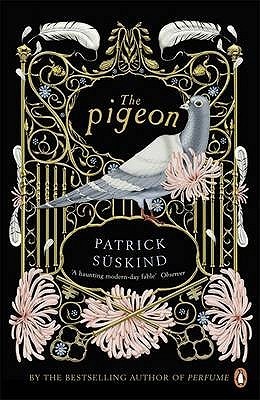
Among the few works of Patrick Süskind, if Perfume can be likened to a sharp, biting whiskey, then The Pigeon is more of a seemingly bland cocktail, whose taste reveals the flavor of loneliness, sadness, and fear when savored carefully.
Spoiler Alert!
Jonathan Noel is an unfortunate man. As a child, his parents were taken to a concentration camp, and he was raised by his uncle. After serving in the military, he married, but his wife ran off with another man. Alone, he moved to Paris, found a job as a bank guard, and settled into a small apartment. He led a solitary and secluded life with minimal interaction with others. His tumultuous past and isolated lifestyle nurtured a sensitive, suspicious, and pessimistic mindset. When a pigeon suddenly appeared at his door, he panicked and fled, triggering a massive psychological crisis.
Jonathan's psychological turmoil is meticulously recorded in a stream-of-consciousness style. Initially, he found the pigeon's eye terrifying but lacked the courage to chase it away, choosing instead to pack his bags and escape. While fleeing, he encountered the concierge and felt scrutinized by her, inexplicably wanting to lash out but ultimately feeling helpless when confronted directly.
At work, he engaged in his monotonous job as a bank guard, pacing the steps and contemplating his role, likening himself to the Sphinx and calculating how many hours he'd stand on the bank steps in his lifetime. Renting a small room at a hotel for the afternoon, he saw a homeless man defecating on the street and realized the importance of having his private space, no longer envying the carefree life of the homeless. This newfound inner peace was disrupted when he tore his pants on a park bench and couldn't get them repaired at the tailor, having to temporarily patch them with adhesive. As he stood guard at the bank again, he felt the world was ending, harboring a destructive urge to shoot everything in sight “to turn the world to rubble and ashes over a hole in his pants.”
Under this emotional turmoil, he spent a night at the hotel, during a stormy night, reliving his past in dreams and lamenting “I can’t live without others,” overwhelmed by the fear of loneliness. The next morning, he walked home, playfully splashing in puddles like a child, feeling momentarily at ease. When he fearfully approached his door, the pigeon was gone, not a single feather remaining.
These events transpired over just a little more than a day. On the surface, it might seem trivial - merely the delusions of a sensitive, suspicious, manic-depressive, autistic, and hysterical person. However, as the book's blurb suggests, it’s “an allegory of human existential fear” and “an in-depth exploration of the solitary individual’s spiritual dilemma in an alienated society.” When mocking Jonathan’s dramatic reaction to a pigeon, we might ask ourselves: doesn’t Jonathan’s sensitivity, suspicion, pessimism, and fear also exist, to some extent, within ourselves? Are we not also facing the same predicaments, perhaps to a lesser degree?
The Pigeon can be classified as a psychological novel, with its detailed and intricate description of Jonathan’s inner turmoil. The same situations, reflected through different people, can yield diverse interpretations, depending on one's psychology.
In Jonathan’s case, his troubled past, life at the bottom of society, and the conflict between isolation and communication molded his sensitive, suspicious, and depressive personality. Reality appeared to him through a dark, gray lens, closing off his connection to the world, leaving only a torrent of chaotic thoughts in his mind. This individual monologue, if one finds traces of themselves in Jonathan, signifies its universality, validating the book’s blurb: “an in-depth exploration of the solitary individual’s spiritual dilemma in an alienated society.” Exposing one’s loneliness allows those who relate to uncover their own alienation and work towards healing their spiritual dilemmas. This might be the therapeutic message the work aims to convey.
Apart from The Pigeon, the book includes four other short stories: “On the Emphasis of Depth”, “A Duel of Dragons and Tigers”, “The Will of Maitre Meissar”, and, “…A Thought - Memory Loss.” These stories also delve into psychological themes. “On the Emphasis of Depth” tells of a talented young female painter who, after a critic’s comment about her work's lack of depth, falls into a creative crisis and ultimately jumps to her death. “A Duel of Dragons and Tigers”narrates an old chess champion facing a seemingly profound young challenger, losing composure under the pressure of spectators hoping for his defeat, almost intimidated by the pretentious challenger. Although he eventually wins, he feels ashamed and quits chess. “The Will of Maitre Meissar” introduces the concept that “the world is a cruelly closed shell,” expressing humanity's unease with an increasingly shell-like world. “…A Thought - Memory Loss” discusses a protagonist struggling with memory issues, unable to retain what he reads, proposing that “perhaps reading is more an act of immersion,” conveying a spirited resolve to combat memory loss, “you must change your life.” This optimism is rare for Süskind, known for his generally somber tone.
Süskind is undoubtedly a sensitive and highly individualistic writer, evident in his psychological depth in Perfume and The Pigeon. In the preface to The Pigeon, he reveals his unique personality, saying, “I don’t know my favorite author or work, even if I did, I wouldn’t disclose it,” and “I have no expectations for readers - whether abroad or domestic - except that there will still be readers in the future.”
Such individuality is reflected in his works like Perfume and The Pigeon written when he was only in his twenties. Süskind’s youthful sensitivity and confusion coalesced into these classic works, leaving clear traces of his youthful thoughts long after his youth has passed.
4.1 / 5 stars