

What do you think?

David Martin #2
Tokyo Is My Garden
The title T?ky? Is My Garden is akin to the English idiom Like the back of my hand. When David Martin is sent as a sales representative to Japan for Heurault cognacs of France, he spends his time discovering Japanese culture and finding his way through the night-life of Tokyo. Then his boss announces an imminent visit to check up on his (lack of) progress. He must turn the situation around quickly or risk losing his job, his visa and the woman he loves. So starts an amusing and exciting chase as David attempts to chaperon his boss and seduce his lover through a bustling life that is Tokyo. By the creators of the cult titles Yukiko's Spinach, Cities of the Fantastic (NBM) and The Walking Man.
152 pages, Paperback
First published January 21, 1997
Ratings & Reviews
Friends & Following
Create a free account to discover what your friends think of this book!
Community Reviews
Displaying 1 - 15 of 15 reviews

July 26, 2012
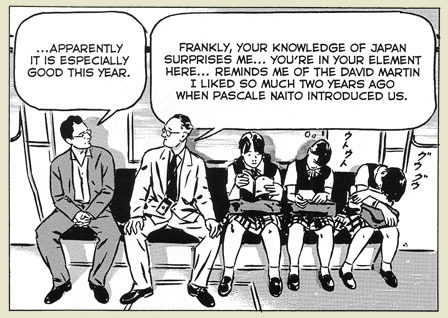
To say something is one's garden is to say that the thing is known like the back of one's hand. It's to presume a sort of easy familiarity, the kind that brings to mind a warm comfortability or provokes a sense of native intimacy. To a person who could say "Tokyo is my garden," the culture, language, people, and geography of that city must be known in a manner that surpasses mere acquaintance. To such a person, Tokyo itself must be family. For that person to be a Westerner? Well, that plays into a host of Western male fantasies and is therefore ripe for thought experiments and criticism.
Successful integration into Japanese society has at least for a few decades been an idle dream for many Caucasian Western males. The fantasy carries some of the romance of the early twentieth century ex-pats who made their beds in Europe and mixes liberally with the exoticism of a historically rich culture that remains, at best, only vaguely understood in the West. Throw in whatever mythologies surround the concept of geisha (for a demure yet ferocious sexuality mixed with what appears to many Caucasians to be an exotic kind of ageless beauty) and then add in the various honour codes associated with bushido and samurai ways. Stew these with a collection of visual delights from across the ages—sumi-e paintings, views of Mount Fuji, manga, anime, kanji, yukatas—and you've crafted something irresistibly delectable to a very particular kind of man. This is a recognizable social fantasy and there are off-colour* terms like "yellow fever" for a reason.

I myself, as a youngster, thought that nothing would be cooler than moving to Japan, embracing the culture, and being readily able to partake in life in that country. I would, of course, live in Tokyo. That was in junior high and I didn't have in mind Rivers Cuomo's fabled half-Asian cellist or any sort of erotic/romantic conquest. I just wanted to be where Nintendo games came out years before my American friends would get them. I was a man of simple pleasures. With age and wisdom, I began to realize that successful integration into such a foreign culture wouldn't be any facile sort of experience (this is expanded upon in my review of Love As a Foreign Language ). My grasp on reality was too firm for my dream to survive. It's probably a good thing that I hadn't read Tokyo Is My Garden while I was still young: I might have fooled myself into believing I could easily adapt to Tokyo life by simply possessing an earnest appreciation for kanji.
That's how it is for David Martin, Tokyo Is My Garden's protagonist. The people he works with at a fish market shout out his name in welcome. He wows Tokyoites with a knowledge of kanji that is daunting even to natives. He knows where all the best night spots are. And though he might have just been thrown out of his girlfriend's apartment (she was a model), he's quickly picked up a new one (a slick business professional who might as well be a model). He may have troubles, but none of them have to do with his reception by the people of Japan.
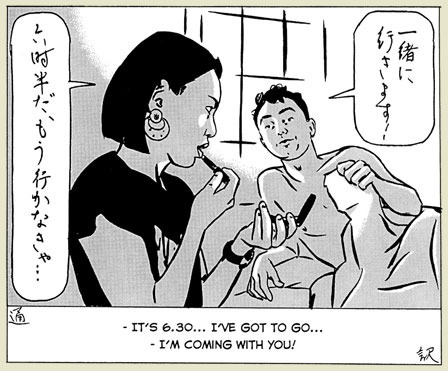
Playing to type, David's one constant thorn relates to his own native land. Generally, the Westerner who dreams of exotic success in Japan is someone whose life in the West isn't panning out glamourously. It's like the kind of dorky kid in junior high who's not even in the running for being considered popular—he imagines that if he'd only move to a new school, that'd be his big chance to rewrite his fortunes. When that kid grows up a little, he'll recognize that just changing schools isn't enough. He'll need to go somewhere where his novelty won't wear off in the space of a single day. He'll need to go somewhere where he'll naturally stand out. And if he's white, then Japan is a natural destination candidate. Sure, he could go to Kenya, but he's a little bit uncomfortable with all those black people. He could go to Peru, but he doesn't remember seeing any Peruvian comics that go out of their way to show off teenagers' panties, so... Japan it is. I mean, fraught with biases and misconceptions as he is, it might as well be Japan—which he doesn't actually understand any better than he does Kenya or Peru or even his own high school's cultural pool. And he'll be fine so long as his old school doesn't come back to haunt him.
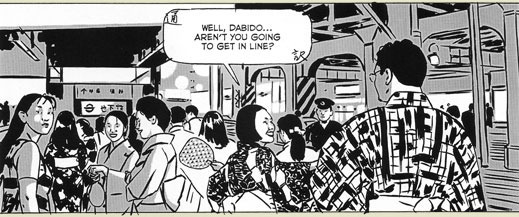
David is haunted by his real job and the ostensible reason he's in Tokyo to begin with. He's a sales rep for a small French firm that produces brandy. He's been in Tokyo for three years, supposedly learning the lay of the land and preparing contacts and hocking the company wares. Only: he's really only majored in girls, parties, and studying kanji. His boss is set to arrive in three weeks to evaluate his performance and he has yet to sell a single bottle of the product. He's worried that his dream could vanish, that his celebrity could be left behind while he's dragged back to France. It's a hard-knock life.
While Tokyo Is My Garden is the story of what will happen to David and how on earth will he pull out of this scrape, it's also the story of a dream. This book is the compiled navigation charts for a group fantasy. David is kind of really completely obnoxious in that he's living the life so many nerdy young white males would drain the blood of virgins for—and worse, he deserves it as much as they do. He's kind of losery, kind of a bum, kind of not the kind of person you'd expect to be rolling in models. Unless you're the very particular kind of person who could find Boilet and Peeters' story remotely believable.
It's a strange mix. Boilet has made it his goal to produce nothing that is not taken from reality. As we saw in Yukiko's Spinach , his images are drawn from video footage. His poses are realistic and his figures are believably proportioned. And yet, his story must take place in a dreamworld. David Martin is the envy of Tokyo and he does nothing to merit that goodwill save learn the language. It's preposterous. Then again Boilet, who is a cartoonist and not a rockstar, takes video of all sorts of things that the average joe probably couldn't imagine taping. All for his drawings, sure, but nonetheless: if a cartoonist can experience that degree of worldly hoo-hah, then perhaps David Martin's story isn't so wholly unbelievable after all. Score one for the white and nerdy.
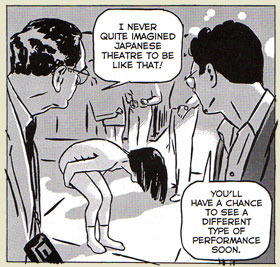
In any case, up until the halfway point, I was ready to think mediocre thoughts of the book. David did nothing for me, I didn't find his position very plausible, and I couldn't be concerned to know that his three years of fraud might be found out. I was, plainly, not invested in his problems. Then, strangely, I began to warm to his plight. With the arrival of his boss, I found myself taken in, charmed by this guy and his life. David never approached becoming a charismatic figure for me, but I did find that I came to care for him. Perhaps out of pity. Perhaps out of a sense of lost romanticism. I can't say whether my newfound good feeling toward Tokyo Is My Garden was due the creators' efforts or wholly some chemistry lodged internally within my heart. The end of the matter was that I enjoyed the book and was happy to have read it. How others will take to it, I cannot begin to know. I can only say that I thought it a good book—in the end.
Notes
* Punned!
** Boilet does this interesting thing that I hadn't caught on to until late in the game.
He'll set these two examples of kanji (what they mean, I do not know) in the corners of certain word balloons. Like so. These represent when a character is speaking Japanese and show that the text is being translated for us by some omniscient helper-spirit (or author).

It's not a big thing, but I thought I'd alert you to the technique early, so you won't have to puzzle over it like I did.
_____________________
[Review courtesy of Good Ok Bad]

March 3, 2024
Read this for a class on Japan’s influence in France .. first time ever reading manga (porn) and last time I do it on the library desktop computer for others to see 😁 fun to read something with pictures though as I am a child

March 5, 2017
Una petita història d'amor intercultural, de traç realista. Una delícia acompanyar els protagonistes pel Tokio dels noranta, molt en la línia de l'"Antes del amanecer" de Richard Linklater.

March 22, 2026
3.5 ⭐
Molt xules les expressions facials
Molt xules les expressions facials

November 27, 2021
Originally published in French in 1997, this English-language edition came out ten years later, and now some 25+ years on, it's taken on the patina of a historical document of the pre-cell phone era. At its center is David Martin, a Frenchman in his mid to late-20s who is living tenuously in Tokyo as the ostensible sales rep for a small French cognac firm, making ends meet with a side-job in the Tsukiji fish market. We meet him as his Japanese girlfriend is angrily breaking up with him and he faces a visit from the head of the cognac company he represents. A visit that seems likely to lead to the end of his job, and thus his visa and ability to stay in Japan.
David has spent two years in Tokyo, learning the language remarkably well, but failing as a brand-building salesman. Fortune does strike, however, as a buddy at the fish market invites him to a party where the gamine hostess invites him to bed -- and thus a new love affair commences. However, the impending arrival of his boss casts a shadow over their new relationship. When he does arrive though, he turns out to be a friendly, amenable guy, and David's shepherding him through various sights and sounds becomes an amusing and gentle journey. I had a number of Westen friends in Japan as English teachers at the same time this book takes place, and the expatriate vibe all rings rather true.
The cover boasts the line "With the collaboration of Jiro Taniguchi" -- and although what that means isn't clear, this book is reminiscent of the slice-of-life documentary style Taniguchi made famous in books like "The Walking Man." The American creator it reminds me most of, with its aimless young man and romantic plot, is Adriane Tomine. The artwork was a mixed bag for me -- the streetscapes and built environment comes alive, but the people are all over the place, with faces of the main characters being especially inconsistent. On the whole, readers with an interest in expatriates in Japan may find it worth checking out, but otherwise, I can't say it's particularly notable.
David has spent two years in Tokyo, learning the language remarkably well, but failing as a brand-building salesman. Fortune does strike, however, as a buddy at the fish market invites him to a party where the gamine hostess invites him to bed -- and thus a new love affair commences. However, the impending arrival of his boss casts a shadow over their new relationship. When he does arrive though, he turns out to be a friendly, amenable guy, and David's shepherding him through various sights and sounds becomes an amusing and gentle journey. I had a number of Westen friends in Japan as English teachers at the same time this book takes place, and the expatriate vibe all rings rather true.
The cover boasts the line "With the collaboration of Jiro Taniguchi" -- and although what that means isn't clear, this book is reminiscent of the slice-of-life documentary style Taniguchi made famous in books like "The Walking Man." The American creator it reminds me most of, with its aimless young man and romantic plot, is Adriane Tomine. The artwork was a mixed bag for me -- the streetscapes and built environment comes alive, but the people are all over the place, with faces of the main characters being especially inconsistent. On the whole, readers with an interest in expatriates in Japan may find it worth checking out, but otherwise, I can't say it's particularly notable.

December 18, 2023
Denne har haft så længe uden at læse den. Lige så længe, har jeg tænkt, at den var et fejlkøb. Den er nemlig købt under det indtryk, at Jiro Taniguchi havde noget med historien at gøre. Det viser sig, at han har arbejdet med det grafiske layout. Men bogen er en ganske fin, omend nok også lidt banal historie, om en dyrs pludselige held i både kærlighed og karriere. Tilsat erotik, som heldigvis aldrig bliver pornografisk. Det hele virker godt og troværdigt. Den røber desuden et indgående kendskab til Japan.

August 19, 2018
J'ai eu la chance de lire cette BD à l'institut français de Tokyo. Cela aide surement à apprécier l'ambiance du récit, qui, bien qu'un peu simple, n'en demeure pas moins engageant et authentique.
April 4, 2026
Nice quick read, wildly problematic with his love for Japanese people but the story telling is nice

August 2, 2012
It was really fun- a light comedy about a struggling brandy salesman, falling in and out of love, explaining his utter lack of sales to his visiting boss (a wonderful portrait of a middle aged and somewhat sad man in need of new life). The portrayal of Tokyo was intelligent and intimate- far from the usual foreigner travelogue. And the love scenes were passionate and moving. My main reservations concerned Peeters art which was a bit rough and, in its search for realism, was too dependent on redrawn photographs- especially of the main characters who sometimes looked stilted and posed. But thoroughly enjoyable nonetheless.

January 2, 2016
J'avais de la sympathie pour Dabido qui perd sa blonde et apprend la visite de son patron dans la même soirée...On est pas certain s'il travaille fort pour réussir ou s'il s'attache vraiment à ses petites amies mais finalement, les choses prennent une nouvelle tournure pour lui. La vie dans la ville qu'il connaît bien et qu'il fait découvrir à son patron est ancrée dans le quotidien et les préoccupations normales pour quiconque vit dans une méga métropole où tout coûte cher. Les dessins et les différents angles sont super mais parfois je trouvais les close-up de visages peu réussis à cause des larges points noirs. Les trames sont de Jirô Taniguchi.

June 23, 2010
Otra sorpresa. Me esperaba la típica novela gráfica japonesa, sentimental, tristona, pero es la historia de un francés enamorado de Japón (y las japonesas) y su empeño por permanecer en el país. No es una lucha triste ni penosa, es una historia de amor divertida y entretenida, con ilustraciones preciosas y el texto parte en japonés, lo que le da un toque muy original. El hecho de que los autores no sean japoneses, sino franceses en Japón, ofrece una visión casi desconocida (sobre todo si no has leído a Nothomb) del país, mucho más fresca y liviana que la que estamos acostumbrados.

January 23, 2012
I read it in one setting, kinda short and easy to read, 18+ because it has some sexual context. I'd only recommend it if you are bored and want something entertaining.


May 5, 2013
:') bonito
April 23, 2016
I had problem with the shadings. In many places they look like moles :-) Was this the work of Taniguchi Jiro? Didn't look like so to me.
Displaying 1 - 15 of 15 reviews