

What do you think?

Eye of The Beholder: Masterpieces from the Isabella Stewart Gardner Museum
The official companion book to the Isabella Stewart Gardner Museum’s hundredth anniversary celebration
During her lifetime (1840–1924) Isabella Stewart Gardner was at the heart of Victorian Boston’s liveliest salon. Henry and William James, Henry Adams, Oliver Wendell Holmes, John LaFarge, James McNeill Whistler, Bernard Berenson, and John Singer Sargent all gathered at Fenway Court, in the company of works by Giotto, Fra Angelico, Titian, Raphael, Rubens, and Rembrandt.
One hundred years after its completion, the Isabella Stewart Gardner Museum remains as intrepid and idiosyncratic as its creator. The embodiment of one woman’s vision, the Venetian palazzo turned inside out and its wildly eclectic collection of twenty-four centuries of paintings, sculpture, furnishings, and books nonetheless speak very personally to all who enter. At once grand and intimate, the garden courtyard and the terrazzo galleries invite discovery: every visitor (and there have been literally hundreds of thousands), it seems, has a secret corner of the Gardner.
In celebration of its centenary, the Gardner Museum has asked artists and thinkers of our own time to go public with their private visions of the Gardner. In this book, filled with 120 color plates, their voices are joined and juxtaposed with those of Mrs. Gardner’s contemporaries, allowing readers to see the Gardner’s most beloved works through the eyes of such nineteenth- and twentieth-century thinkers as William James and Bill T. Jones, T. S. Eliot and Henry Louis Gates Jr., Julia Ward Howe and Sister Wendy. Robert Campbell takes as his subject the museum’s architecture, while Wayne Koestenbaum offers a homoerotic reading of works in the collection. Beautifully designed and extravagantly illustrated, Eye of the Beholder offers a richly textured exploration of one of the world’s great art collections.
During her lifetime (1840–1924) Isabella Stewart Gardner was at the heart of Victorian Boston’s liveliest salon. Henry and William James, Henry Adams, Oliver Wendell Holmes, John LaFarge, James McNeill Whistler, Bernard Berenson, and John Singer Sargent all gathered at Fenway Court, in the company of works by Giotto, Fra Angelico, Titian, Raphael, Rubens, and Rembrandt.
One hundred years after its completion, the Isabella Stewart Gardner Museum remains as intrepid and idiosyncratic as its creator. The embodiment of one woman’s vision, the Venetian palazzo turned inside out and its wildly eclectic collection of twenty-four centuries of paintings, sculpture, furnishings, and books nonetheless speak very personally to all who enter. At once grand and intimate, the garden courtyard and the terrazzo galleries invite discovery: every visitor (and there have been literally hundreds of thousands), it seems, has a secret corner of the Gardner.
In celebration of its centenary, the Gardner Museum has asked artists and thinkers of our own time to go public with their private visions of the Gardner. In this book, filled with 120 color plates, their voices are joined and juxtaposed with those of Mrs. Gardner’s contemporaries, allowing readers to see the Gardner’s most beloved works through the eyes of such nineteenth- and twentieth-century thinkers as William James and Bill T. Jones, T. S. Eliot and Henry Louis Gates Jr., Julia Ward Howe and Sister Wendy. Robert Campbell takes as his subject the museum’s architecture, while Wayne Koestenbaum offers a homoerotic reading of works in the collection. Beautifully designed and extravagantly illustrated, Eye of the Beholder offers a richly textured exploration of one of the world’s great art collections.
- GenresArt
240 pages, Hardcover
First published June 15, 2003
Ratings & Reviews
Friends & Following
Create a free account to discover what your friends think of this book!
Community Reviews
Displaying 1 - 2 of 2 reviews

July 20, 2014
This beautiful book is a tribute to what was once one of my favorite museums in Boston, and one that ranked with the Henry Clay Frick mansion in New York City as a unique window on a particular place and time in American cultural history.
Isabella Stewart Gardener was one of the most flamboyant figures in Boston society in the late 19th century, giving grand parties, hosting famous musicians and filling her home with art objects collected from around the world. She had toured Europe's private museums as a girl of sixteen, and after her marriage to John Lowell "Jack" Gardner Jr. in 1860, set about formally educating herself in music, literature and the arts, taking courses at Harvard and traveling extensively with her husband, an East Indies shipping magnate.
In 1891, Isabella inherited a small fortune from her father that she and Jack agreed would be spent on art. And did she ever spend! With the help of art dealer Bernhard Berenson, Isabella began to assemble an intensely personal collection of art, furniture, fabrics, architectural elements--and a fair bit of junk as well. She and Jack ran out of room in their old Beacon Street home and decided to build a new mansion on the Fenway--an area that was then largely unpopulated.
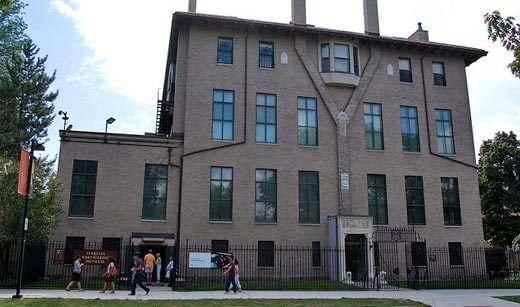
Here is how Robert Campbell describes it in The Eye of the Beholder: "The blankness of the exterior of the building [is] like the plain brown wrapper around a forbidden delight...
"...The low, dark, slightly claustrophobic entry...seems to compress you. And then the great upward explosion of light and color and space as you emerge into the atrium..."
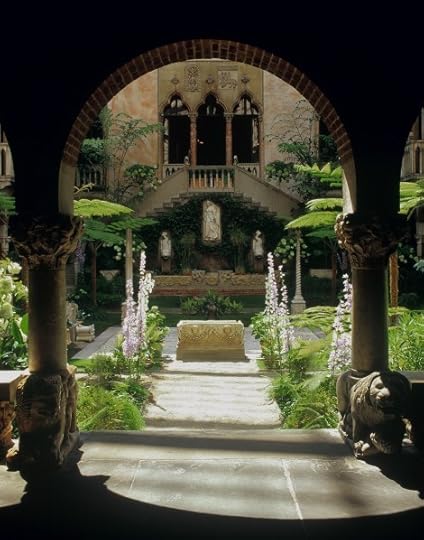
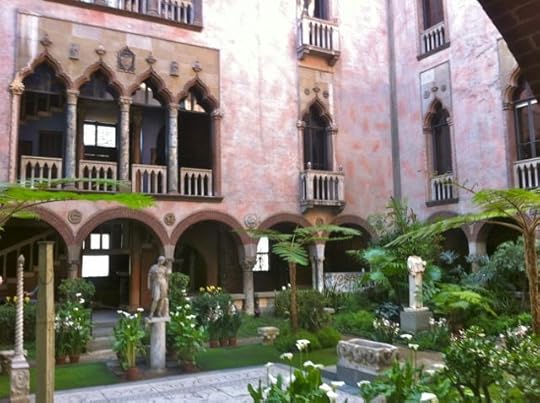
...Venetian palazzo facades turned inward to create a magical courtyard garden filled with art.
"Most museums foreground the art to the exclusion of all else....The Gardener...integrates art into the fullness of life. A painting is not celebrated or shoved in our faces, but takes its place among the rooms and flowers as simply one part of a well-furnished life."
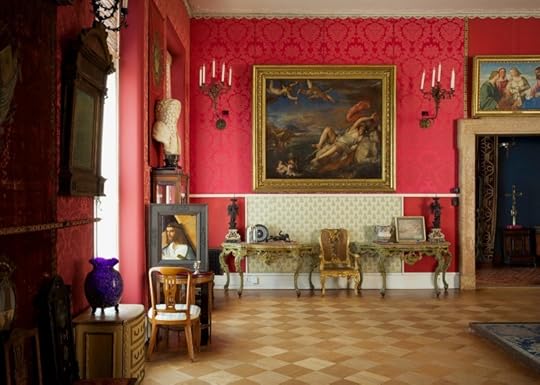
Everywhere you look there are hidden treasures integrated into the very walls and columns:
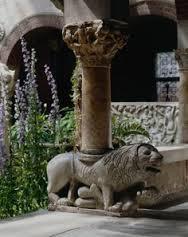
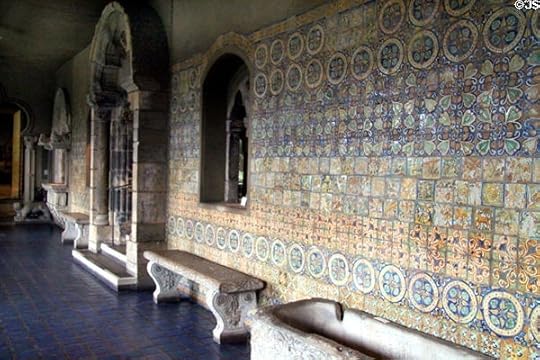
Alas, much of the sense of magic and mystery has been diluted by the addition of a hugely expensive, coldly corporate and intrusive new wing (and yes, that's the original museum crouching way, way back on the right hand side of the picture).

Check out this terrific post from the Left Bank art blog for a sense of what has been lost: http://leftbankartblog.blogspot.com/2...
Now, overambitious clueless directors and trustees are doing the same thing to the Frick Collection in New York--another small museum treasure that should have the sense to stay small and jewel-like. See this wonderful op-ed from Bloomberg: http://www.bloomberg.com/news/2014-07...
So hurry, hurry to New York's Frick before they replace this glorious little Russell Page garden gem with a glass cube full of food courts and lots of shopping.
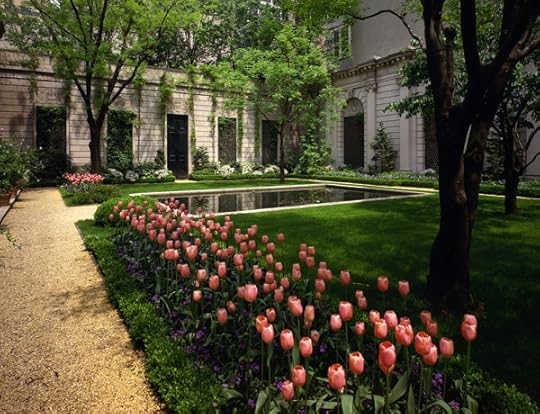
Both museums will still be worth a visit no matter how badly they are mangled, but it's so sad that the intense experience of the past that both museums once evoked is being sacrificed to the 'bigger, flashier and glassier is better' modernist ethos that infects the fast money crowd.
Isabella Stewart Gardener was one of the most flamboyant figures in Boston society in the late 19th century, giving grand parties, hosting famous musicians and filling her home with art objects collected from around the world. She had toured Europe's private museums as a girl of sixteen, and after her marriage to John Lowell "Jack" Gardner Jr. in 1860, set about formally educating herself in music, literature and the arts, taking courses at Harvard and traveling extensively with her husband, an East Indies shipping magnate.
In 1891, Isabella inherited a small fortune from her father that she and Jack agreed would be spent on art. And did she ever spend! With the help of art dealer Bernhard Berenson, Isabella began to assemble an intensely personal collection of art, furniture, fabrics, architectural elements--and a fair bit of junk as well. She and Jack ran out of room in their old Beacon Street home and decided to build a new mansion on the Fenway--an area that was then largely unpopulated.
Here is how Robert Campbell describes it in The Eye of the Beholder: "The blankness of the exterior of the building [is] like the plain brown wrapper around a forbidden delight...
"...The low, dark, slightly claustrophobic entry...seems to compress you. And then the great upward explosion of light and color and space as you emerge into the atrium..."
...Venetian palazzo facades turned inward to create a magical courtyard garden filled with art.
"Most museums foreground the art to the exclusion of all else....The Gardener...integrates art into the fullness of life. A painting is not celebrated or shoved in our faces, but takes its place among the rooms and flowers as simply one part of a well-furnished life."
Everywhere you look there are hidden treasures integrated into the very walls and columns:
Alas, much of the sense of magic and mystery has been diluted by the addition of a hugely expensive, coldly corporate and intrusive new wing (and yes, that's the original museum crouching way, way back on the right hand side of the picture).
Check out this terrific post from the Left Bank art blog for a sense of what has been lost: http://leftbankartblog.blogspot.com/2...
Now, overambitious clueless directors and trustees are doing the same thing to the Frick Collection in New York--another small museum treasure that should have the sense to stay small and jewel-like. See this wonderful op-ed from Bloomberg: http://www.bloomberg.com/news/2014-07...
So hurry, hurry to New York's Frick before they replace this glorious little Russell Page garden gem with a glass cube full of food courts and lots of shopping.
Both museums will still be worth a visit no matter how badly they are mangled, but it's so sad that the intense experience of the past that both museums once evoked is being sacrificed to the 'bigger, flashier and glassier is better' modernist ethos that infects the fast money crowd.

May 19, 2015
May 19, 2015 I wrote the following preluding impression.
Last week I was there, I was there, may 2015. A remarkable collection on view in a refined and impressive setting of this Venetian palazzo, built at the beginning of the 20th century in Boston. After a first visit in 1984, for me it was ‘Gardner revisited’; it was a great joy, be it with sour edges: not being able to see these two large Rembrandts which were stolen in 1990.
In this book is on paper is what I witnessed during several hours; I intend to devour devoutly this whole big book. I have started to do so already. JM
This is one of the most remarkable and best museums I have visited – I’ve been to quit a few! But I now must concentrate on the book …
The text contributors have achieved a lively reports on all of the depicted objects. Not only descriptions and analyses are given; the book also contains contemporary correspondence and comments. And what a variety of objects Mrs. Gardner has been collecting! The colours of the paintings’plates happily are very much like the real ones.
Although it’s the painting itself and not really belonging to a book review, I must say that one particular painting in the museum struck me: the self-portrait, aged 23, made in 1629 by Rembrandt Harmszn van Rijn. That’s a huge WOW to my feeling.
One last remark about the book: it would have been nice – yet they can’t be called ‘masterpieces’ – to include some specimen of the vast collection of autographs and notes; there are so many nice ones, by so many important people, not the least from the world of music – composers and performing artists. JM
Last week I was there, I was there, may 2015. A remarkable collection on view in a refined and impressive setting of this Venetian palazzo, built at the beginning of the 20th century in Boston. After a first visit in 1984, for me it was ‘Gardner revisited’; it was a great joy, be it with sour edges: not being able to see these two large Rembrandts which were stolen in 1990.
In this book is on paper is what I witnessed during several hours; I intend to devour devoutly this whole big book. I have started to do so already. JM
This is one of the most remarkable and best museums I have visited – I’ve been to quit a few! But I now must concentrate on the book …
The text contributors have achieved a lively reports on all of the depicted objects. Not only descriptions and analyses are given; the book also contains contemporary correspondence and comments. And what a variety of objects Mrs. Gardner has been collecting! The colours of the paintings’plates happily are very much like the real ones.
Although it’s the painting itself and not really belonging to a book review, I must say that one particular painting in the museum struck me: the self-portrait, aged 23, made in 1629 by Rembrandt Harmszn van Rijn. That’s a huge WOW to my feeling.
One last remark about the book: it would have been nice – yet they can’t be called ‘masterpieces’ – to include some specimen of the vast collection of autographs and notes; there are so many nice ones, by so many important people, not the least from the world of music – composers and performing artists. JM
Displaying 1 - 2 of 2 reviews