Jump to ratings and reviews
Rate this book

Gangster Warlords: Drug Dollars, Killing Fields, and the New Politics of Latin America

Rate this book
In a ranch south of Texas, the man known as The Executioner dumps five hundred body parts in metal barrels. In Brazil's biggest city, a mysterious prisoner orders hit-men to gun down forty-one police officers and prison guards in two days. In southern Mexico, a meth maker is venerated as a saint while enforcing Old Testament justice on his enemies.

A new kind of criminal kingpin has arisen: part CEO, part terrorist, and part rock star, unleashing guerrilla attacks, strong-arming governments, and taking over much of the world's trade in narcotics, guns, and humans. What they do affects you now--from the gas in your car, to the gold in your jewelry, to the tens of thousands of Latin Americans calling for refugee status in the U.S. Gangster Warlords is the first definitive account of the crime wars now wracking Central and South America and the Caribbean, regions largely abandoned by the U.S. after the Cold War. Author of the critically acclaimed El Narco, Ioan Grillo has covered Latin America since 2001 and gained access to every level of the cartel chain of command in what he calls the new battlefields of the Americas. Moving between militia-controlled ghettos and the halls of top policy-makers, Grillo provides a disturbing new understanding of a war that has spiraled out of control--one that people across the political spectrum need to confront now.

378 pages, Paperback

First published January 19, 2016

277 people are currently reading
3653 people want to read

About the author

Ioan Grillo

12 books211 followers
I’m a journalist, writer and TV producer based in Mexico City. I’ve been covering Latin America since 2001 for news media including Time Magazine, CNN, The Associated Press, Global Post, The Houston Chronicle, PBS NewsHour, Al Jazeera English, France 24, CBC, The Sunday Telegraph, The Sunday Times, Gatopardo, The San Francisco Chronicle and many others. El Narco: Inside Mexico’s Criminal Insurgency is my first book.

I started covering drug cartels from my early days here. I was always fascinated by the riddle of these ghost like figures who made $30 billion a year, were idolized in popular songs and miraculously escaped the Mexican army and DEA. Over the decade I followed the mystery to endless murder scenes on bullet-ridden streets, mountains where drugs are born as pretty flowers, and scarred criminals from prison cells to luxury condos.

During the same time, Mexico’s drug war morphed into a horrific conflict with brutal beheadings, massacres and mass graves. Journalists here found ourselves reporting on a human tragedy of epic proportions – with a never-ending trail of grieving parents and atrocities comparable to brutal civil wars. The need for better understanding to help find a way out of this hole has become more important than ever.

We foreign journalists all have to turn to our homelands for part of that solution. I grew up in sunny England, near the seaside city of Brighton – famous for its pink candy, pebble beaches, colleges and bubbling night clubs. It is also one of Britain’s top places for drug consumption, switching with the fashions from Moroccan hashish to Turkish heroin to Colombian cocaine. Few there ever think about where the mind-bending substances come from or what they might give or takeaway from those countries. In Europe and the United States a hard discussion on our drug habits and policy is long overdue.

As well as following drug trafficking empires, I cover the other major issues of Latin America such as natural disasters (including the Haiti earthquake), the battle between left and right (including the Honduras coup), and the vast human wave of emigration to El Norte. I also love music and cover it whenever I get a chance. I co-directed a series of three short films with John Dickie, which all include a good dose of Latin American hip hop. They are Barrios Beats and Blood, Bajamar Ballad, and The Gangsters’ Granny.

Ratings & Reviews

What do you think?
Rate this book

Friends & Following

Create a free account to discover what your friends think of this book!

Community Reviews

5 stars
532 (36%)
4 stars
647 (44%)
3 stars
251 (17%)
2 stars
28 (1%)
1 star
10 (<1%)
Displaying 1 - 30 of 120 reviews
Profile Image for Mikey B..
1,140 reviews487 followers
July 28, 2018
This is a piercing study of the fiefdoms run by drug warlords in different countries. The author has made a study of warlords in Brazil (Rio de Janeiro and Sao Paulo); Kingston, Jamaica; Honduras, Guatemala, and El Salvador; and Michoacan, Mexico.

In each a parallel government has been formed – or more specifically their own justice system in the land they control. They have their own enforcers – and woe to anyone who transgresses. They also have checkpoints on their territory monitoring who leaves and enters. Their tentacles control the local government and police forces – many times the corruption spreads up to the national level. They often publish their own manifesto with loyalty rules. This attracts the disillusioned and the young who are offered a quick alternative in a life that can seem meaningless on the city streets or the rural countryside. The money is quick and easy, you can get stoned or high on the plentiful drugs available, and feel part of a community.

As the author points out the warlords are not quite a parallel state in that they have no interest in running schools and maintaining utilities like electricity and roads.

In some cases, as in the example of Michoacan, the local people have formed vigilante groups that have overthrown the local warlord. This often happens when the local and national police forces have shown themselves inept at combating the warlords. This presents other problems – there is a lot of violence and retribution – and sometimes they are provided assistance from opposing warlords. This can rapidly complicate matters in the newly “liberated” zones.

At the end the author provides some hope of a solution. Marijuana is now legal in some U.S. states (it is to be legalized in Canada) – but what of the more destructive drugs like meth, cocaine...?

This book is superb journalism. The author has spoken to a wide variety of narco-state criminals. We get an extensive perspective of this persistent and it would seem expanding problem in these countries where the governments have bungled and proven corrupt in dealing with the emerging warlords.
124 reviews9 followers
February 9, 2016
Ioan Grillo is a brave dude.

I know this because, in his new book, Gangster Warlord: Drug Dollars, Killing Fields, and the New Politics of Latin America, he spends about 350 pages telling me that he's a brave dude. He doesn't overtly say "hey, Dimas, I'm a brave dude," of course. Rather, he makes it a habit of telling me, the reader, his process of gathering information. Which means, there's many tales of Ioan traveling to dangerous locations, risking his life to interview some drug lord. So, in this book, we don't just hear about, say, a MS13 prisoner in prison. No, we have to read about Ioan's process about how he got in contact with said gang member and how he found his way in the prison.

I found this narcissistic style of writing to be maddening. And, honestly, it took away a lot of the enjoyment I would have normally gotten from reading a book like this. Worst of all, this level of self involvement is completely unnecessary when talking about a topic as meaty and interesting as this.

The book is essentially a case study of the gang activity in four different countries in the Americas -- the Red Commandos in Brazil; the Shower Posse in Jamaica; the gangs in the Northern Triangle; and the Knights Templars in Mexico. There's a lot of good, interesting information here (I'll say this about Grillo: he's incredibly informed on the topic.) And props to the author for suggesting some ways to curve the almost phantasmagorical amounts of violence in the Americas. I just wish he would get out of his own way, and let the story cook.
Profile Image for Ginni.
442 reviews36 followers
October 23, 2016
This is an important, ground-breaking book, and I doubt there's another one like it in existence. I was already very interested in the Mexican drug wars, but it's captivating even if you don't have a special interest in the subject.

Ioan Grillo covers four different major Latin American crime hubs--the Red Commando in Brazil, the Shower Posse in Jamaica, Mara Salvatrucha in El Salvador (and others), and el Templarios in Mexico--from their origins up to 2014 (see what I mean about there not being another book like this?). Being a journalist, Mr. Grillo interviews primary sources whenever possible, going into prisons, meeting with government officials, and talking to hardened criminals. It's fascinating and sobering and feels way too exciting to be non-fiction.

Honestly, just read it.

(I received this book for free through a Goodreads giveaway.)
Profile Image for Sarah.
Author 34 books502 followers
July 1, 2020
http://www.bookwormblues.net/2020/07/...

I think part of the problem with the world today is that we all know a lot of stuff but we don’t really understand the things we know. What I mean by this is, I know there is an issue with immigration and people flocking to the Southern border of the United States. I know that countries below the US have problems I can’t even wrap my head around, and I know it takes a certain kind of desperation I’ve never felt, to uproot an entire family and move them somewhere you’ve never been, and travel fueled by a vague hope that maybe up there, things will be different.

I know the facts.

I do not understand.

And I think this book, Gangster Warlords, really is my first big step in trying to understand the dynamics in areas that I know the talking points about, on a much more in depth, human level. Ioan Grillo is an investigative journalist who has been reporting largely on the drug trade in Latin America since 2001. He knows his way around the industry, and has a birds eye view of the conflicts that so many of us just don’t. He’s watched this new kind of criminal rise up, and he’s watched them transform the social and political landscape of various Latin American countries. He knows how to write about all of this in a way that some bumbkin like myself can understand it, and not just understand it, but internalize it in a way I might not otherwise be able to.

Grillo focuses on a few different regions, namely Mexico, Jamaica, Guatemala, Brazil, and some others. Each of these areas is run a bit differently, but what binds the narrative together, really, is the business that drives them all: drugs. Specifically, cheap drugs that make a big profit once they make it north of the border, into the United States, where prices skyrocket. What goes for a dollar in a favela in Brazil, for example, will sell for $250 in New York. There are numerous factors that gave rise to this new kind of criminal organization, which he details nicely in the book.

“But as we look back on the last two decades, we can identify clear causes of the new conflicts. The collapse of military dictatorships and guerrilla armies left stockpiles of weapons and soldiers searching for a new payroll. Emerging democracies are plagued by weakness and corruption. A key element is the failure to build working justice systems. International policy focused on markets and elections but missed this third crucial element in making functional democracies: the rule of law. The omission has cost many lives.”
Essentially, these drug cartels and the wars they start and the turf they claim are all in on the business, so rather than just your typical criminal, you have an entire criminal class that has risen up and meshed CEO and gangster warlord together into this toxic stew that is tearing apart an entire region of the world, and leaving a bloody swath of destruction and sadness behind. Ultimately, this book shows the truth that there are no winners in war, regardless of what reasons that war is fought for.

The dynamic, however, was interesting to me, as many of these organizations have learned how to survive, or at least coexist, with the people who live on the land they claim as theirs. For example, in favelas in Brazil, the cartels will pay for things like roads, and electricity, protection and the like. In exchange, the people who live in their favela will not turn them over to the police when the police come knocking, and similar exchanges happen all over. You scratch my back, I scratch yours. The negative is that just about everyone takes part in the drugs. They are cheap and everywhere, and since there’s very few opportunities and you have to leave the favela to get a decent education and what have you, a lot of people end up working for the cartel/gang/whatever that is lording over their particular area, and most of them have seen firefights by the time they are in their teens. There aren’t enough opportunities elsewhere to make the easy money they find with the home crew worth the risk.

And with all this back and forth of loyalty and, in some cases, fear, it’s hard for officials to fight these criminals. Cartels, in essence, become their own law and their own police force. Their own mini-nations within nations and they can be nearly impossible to crack. How do you fight something that has become systemic? As the author succinctly puts it:

“This creates another paradox of Latin America’s crime wars. Prisons are meant to stop gangsters from committing crimes. But they became their headquarters.”
There are also manifestos, where entire criminal organizations have books and pamphlets written detailing the rules and style of their particular organization. A sort of criminal code of ethics, if you will. This manifesto is often what attracts young people to the industry. It gives them a sense of belonging, a feel like they exist in an organization that has rules and stipulations, that has a code of conduct. In exchange, they are always busy doing something, they make lots of money, and they can basically get high whenever they want.

This, of course, is not standard across all lines. Some organizations have no interest in maintaining roads, or protecting people. Some are more prone to marching people out to the middle of a field and dumping their bodies in a mysterious ditch somewhere. There are entire swaths cut across some areas, full of unnamed bodies. Parents who saw their children marched out for no real reason, knowing that they’d never see them again. The list of the missing, especially along certain cartel territories in Mexico, Honduras, el Salvatore and the like, are long indeed.

Ciudad Juárez, Mexico, has been known as the murder capital of the world, and there’s a reason for that. For a long time, it was where a war was taking place. There are other regions of Mexico where cartels have gone to war, and lots of people died. The reason I point this out is because, to my mind, I haven’t ever really thought of this as an actual war. Violent? Battles? Gang fights? Sure, but I never really conceptualized any of this as a “war” in my head. However, with the way Gallo describes the scene, all it’s lacking is the official declaration. If these hotspots were declared war zones, the entire way people could help sort these issues out would change. It would give nations power that they do not currently have. So why don’t they? Well, there are reasons for that, too.

There are intricacies, and parts of the social equation that I’d never really thought about before. For example, how does one fully combat these drug issues, when drugs make so much money for people who would likely not have anything without them? How do you keep people from running drugs, when the United States is the biggest buyer, and we pay so much for what they offer? It’s a problem that goes both ways, and there are no easy solutions, because without demand, there would be no reason to supply.

“Between the dawn of the new millennium and 2010, more than a million people across Latin America and the Caribbean were murdered. It’s a cocaine-fueled holocaust.”
What surprised me, mostly, was just how imbedded into the social structure of certain regions these organizations have become. In some areas, everyone is involved in some way, even if it’s just tangentially, because it’s literally impossible not to be connected somehow, and often, the only way to get away from all of it, is by running, which can put you in very real danger. Kids get conscripted as young as possible, which will keep parents in place. The government can be taking a piece of the pie. Loyalty may be a fraught topic, but sometimes it’s easier to just keep your head down and hope no one notices you.

Gallo’s reporting is really state of the art, and he goes out on a whole lot of limbs and risks everything to get the interviews he gets. Sometimes they are with people who refuse to be identified, but in a few cases he sits down with the head guy of huge organizations, and interviews them about how they operate. Or he’ll talk to assassins, or just kids manning the proverbial gate. Just about anyone, and while I bet it was an absolutely terrifying thing to do, it paid off because it gives readers an insider’s view of a topic that is so complex, and so multilayered and deep. I felt, by the time I ended this book, that nothing is what it seems. While this is a dark subject, and it often portrays dark deeds, it really does a great job at showing just how much I don’t understand, and how little I actually know.

I don’t have a clue.

We like to boil down immigration into good and bad, but this book shows that so much of what is pushing people north, is the very thing they are trying to get away from, and it’s all over up here, too. There are no easy answers, and there are none presented in these pages. The fact is, the cartels would not exist without the drugs the United States buys from them. I don’t have any solutions, but I did leave this book with a new understanding of just how two-sided this issue is. I fundamentally believe that we need more in-depth journalism like this to reach into the American consciousness.
Profile Image for Charles.
Author 26 books4 followers
June 11, 2016
Excellent account of four Latin American cases that present different mixes of "gangs, mafias, death squads, religious cults, and urban guerrillas" -- Red Commando in Brazil, Shower Posse in Jamaica, Mara Salvatrucha in El Salvador and Honduras, and Knights Templar in central Mexico. Grillo is a top-notch investigative reporter who has been working this beat now for a decade and a half. He is a master at gaining interviews with central figures in each case (indeed in the Brazilian case THE top figure). I also appreciated learning about how he gained some of these interviews. He explains the purpose behind the book as his desire to learn "how these gangsters wield power, how they wage war, how they operate as political and fighting forces. I am interested in what drives the insane level of violence." He did and so do we. The book ends with sound policy recommendations.
Profile Image for Cav.
908 reviews207 followers
July 29, 2021
"When you tally up the total body count, the numbers are staggering. Between the dawn of the new millennium and 2010, more than a million people across Latin America and the Caribbean were murdered. It’s a cocaine-fueled holocaust..."

I enjoyed this one. The author drops the above quote early on, giving the reader a sense of the magnitude of narco violence that has plagued Latin American countries in the last few decades.

Author Ioan Grillo is a journalist and writer based in Mexico City, working for outlets including the New York Times, France 24 and National Geographic. I’ve been covering Latin America since 2001 for news media such as Time Magazine, Esquire, CNN, Reuters, Al Jazeera, The Houston Chronicle, The Associated Press, GlobalPost, France 24, The Sunday Telegraph, Letras Libres and many others.

Ioan Grillo:
ioan-grillo-c9436fc232a87e802153738aeb2397dd85eb380a

Grillo opens the book with a bit of writing about narco violence in Mexico, including the 2014 mass kidnappings in Iguala, Guerrero, Mexico; where 43 students were disappeared and presumed dead. He writes:
"Mexico seemed to have gotten numb to murder. Between 2007 and 2014, drug cartels and the security forces fighting them had killed more than eighty-three thousand people, according to a count by Mexico’s government intelligence agency."
jm
He lays out the scope of the book early on:
"In this book, I attempt to make better sense of these hybrid criminal organizations by tracking a path through the new battlefields of the Americas. Traveling across the continent, I focus on four crime families: the Red Commando in Brazil, the Shower Posse in Jamaica, the Mara Salvatrucha in Central America, and the Knights Templar in Mexico. They are puzzling postmodern networks that mix gangs, mafias, death squads, religious cults, and urban guerrillas."
The author travels to Mexico, Brazil, Jamaica, Honduras, and El Salvador for the research of this book. Along his travels, he meets with and interviews cartel members, assassins, drug dealers, mules, and other figures central to this story.

Grillo writes with an engaging style here, effectively holding the reader's attention, and unfolding his writing in a manner that makes it easy to follow the plot. I always appreciate writing like this, as I have trudged through many, many books written in a dry and
arduous style. It is always a chore to motor through a book of that nature...

Much of the writing here details the absolute barbaric nature of this narco violence. Grillo recounts many gruesome murders here; including accounts of torture, head-choppings, people burning alive, and other horrific brutality...
Some of the regions Grillo visits and writes about here have higher murder rates than active war zones.
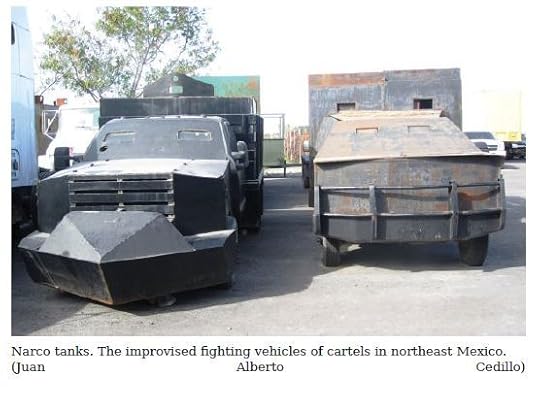
tanks
Some more of what Grillo covers in these pages includes:
• The socialist "Red Commando"
• The Columbian FARC
• Latin American Favelas and organized crime; the Elite Squads who fight them
• The Jamaican "One Love" concert; political rivals Michael Manley (PNP) and Edward Seaga (JLP)
• Jamaican gangster Christopher "Dudas" Coke; his exploits, eventual arrest, and trial.
• The narco wars between Mexican cartels
• Methamphetamine
Nazario Moreno González, AKA "The Maddest One"; the Knights Templar Cartel
• The rise of vigilante citizen groups that fought the cartels
• A discussion of the modern "war on drugs"

ca


*********************

Gangster Warlords was an interesting look into these troubled areas. The book should be an eye-opener to those who have not been following the situation in central and South America.
I would recommend it to anyone interested.
4 stars.
Profile Image for Mal Warwick.
Author 30 books491 followers
April 6, 2017
Americans who take their first trip from country to country in Latin America and the Caribbean are often astounded by the region’s diversity. From Argentina, which is more heavily influenced by Italy and Spain than by any country to its north; to the polyglot island-states of the Caribbean; to Mexico and Central America, with their rich native traditions, Latin America is a study in contrasts. After all, the Western Hemisphere south of the United States encompasses 32 nation-states speaking six official languages (Spanish, Portuguese, English, French, Dutch, and Creole). So it should be no surprise when British journalist Ioan Grillo makes clear in Gangster Warlords, his fascinating in-depth treatment of the drug trade, that the same is true of the drug cartels that have sprouted throughout the region.

Four dissimilar drug cartels

Grillo tells the tale of drug trafficking in the Western Hemisphere through the lens of four criminal enterprises grounded in the drug trade: Brazil’s Red Commando, Mara Salvatrucha in Honduras and El Salvador, the Shower Posse in Jamaica, and Mexico’s Knights Templar. Each is a product of the culture from which it emerged, shaped by the personality of a charismatic leader. Though their business practices and the scope of their operations vary widely, they all have three things in common: they are thugs who prey upon human weakness, they mobilize armies of assassins that sometimes number in the thousands, and they commit murder indiscriminately and on an enormous scale. The “super villains” who run these bloated gangs, Grillo writes, “are no longer just drug traffickers, but a weird hybrid of criminal CEO, gangster rock star, and paramilitary general. They fill the popular imagination as demonic antiheroes.” The result is that “[e]ight of the ten countries with the highest homicide rates [in the world] are now in the region, as are forty-three of the world’s fifty most violent cities. . . Between the dawn of the new millennium and 2010, more than a million people across Latin America and the Caribbean were murdered. It’s a cocaine-fueled holocaust.” A million murders! Most wars throughout human history have been less destructive.

Varying origins and practices

In Gangster Warlords, Grillo looks at “the class-based ghetto warfare of the Red Commando in Brazil, the political power of the don [boss] in Jamaica, the immigrant street gang of the Mara in Central America, and the religious cult and guerrilla tactics of the Knights Templar in Michoacan.”

The Red Commando sprouted in the favelas and jails of Rio de Janeiro in the early 1990s but has spread to cities through the vast expanses of Brazil. There, Grillo reports, “the crime ‘commandos’ are in close urban combat with police and rivals, a conflict that has killed even more than in Mexico — and which U.S. Navy seals go to train in.”

The Mara Salvatrucha grew from a U.S. prison gang in Southern California into an international criminal enterprise that has turned urban neighborhoods in Honduras, El Salvador, and Guatemala into killing fields. Mara is primarily responsible for the flood of juvenile refugees that overwhelmed U.S. immigration officials in 2014.

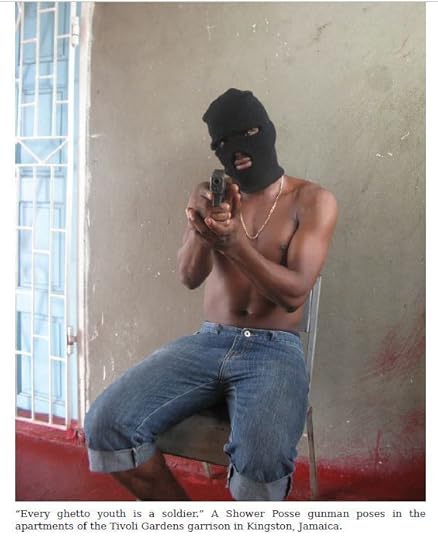
The Shower Posse, a product of the slums of Kingston, was for several years a leading reason why murder rates in many U.S. cities spiked so dramatically. The group’s name derives from its original members’ fondness for Western films and for their practice of “showering” their rivals with bullets from automatic weapons.

Mexico’s Knights Templar is in many ways the strangest of the four groups Grillo studied. The gang was the creature of a narcissistic self-styled saint who wrote his own version of the Bible (in the style of Mao’s Little Red Book) and personally took part in the gruesome torture and murder of competing gangsters.

Why? Why do these organizations come into being — and why do they flourish?

Having read Gangster Warlords (as well as books about urban crime in the U.S.), I’ve concluded that there are four principal reasons for the pervasive hard drug use and attendant violence that plagues our societies today:

(1) Demand. If Americans, Europeans, and, for that matter, Latin Americans, lived rewarding lives and didn’t feel the need to escape through drug use, it’s unlikely that the criminal gangs Grillo describes could ever have attained the proportions they have. Poverty, unemployment, and the alienation of modern life all contribute to the hopelessness that leads to widespread drug use.

(2) Guns. Nearly all the murders Grillo describes are committed with guns — and nearly all the guns in the hands of the drug cartels come from . . . you guessed it: the land of the Second Amendment. In fact, some if not all the drug traffickers derive additional profits by smuggling guns from the United States to their home countries.

(3) The adolescent brain. With few exceptions, the gangsters who organize the sort of drug trafficking operations described in Gangster Warlords set out on lives of crime as early as age eleven, as do the overwhelming majority of their “soldiers.” Most drug traffickers acquire the habit of killing indiscriminately and without compunction when they are teenagers. Modern neurological science tells us that our brains do not reach adult maturity until around the age of twenty-five — and habits acquired before then are difficult to break.

(4) Poverty (again). Not all the drug traffickers Grillo writes about were born poor. In fact, some of the leaders — in Jamaica and in Mexico, in particular — were raised by middle-class families and obtained some education, even including college. But the same isn’t true of their followers. Unquestionably, the grinding poverty that is experienced by so many millions in the crowded cities of Latin America and the Caribbean helps motivate young people to turn to the drug trade. Although the promises of friendship and protection also play a part, it’s unlikely that young people motivated by hope and opportunity would find those promises as attractive.

About the author

Ioan Grillo is an award-winning British journalist who has lived in Mexico since 2001 and reported from there, principally on drug trafficking, for a long list of prestigious publications in the United States, Great Britain, and France. Gangster Warlords is his second book on the drug trade.
Profile Image for Sheryl.
427 reviews115 followers
March 16, 2016
Mr. Ioan Grillo has broke new ground in regards to investigative reporting in his latest book “Gangster Warlords”. This book is full of information regarding these kingpins and how they affect us all economically. We are spending millions of dollars to fight these cartels to stop the flow of drugs into the United States, not the mention the millions of dollars spent on the Humanitarian effort which is a direct result of the what these warlords are doing to their own countries.

Mr. Grillo makes an excellent point when he quotes Mao-Tse-tung,"The guerrilla must move amongst the people as a fish swims in the sea.” They have integrated themselves so deep into the communities that the counter- insurgents who try to fight these cartels end up killing innocent civilians and children thus making the cartels even stronger and gain more followers.

Mr. Grillo also points out some very interesting facts regarding the Jamaican and Brazilian warlords. He also provides some insight on some prominent Mexican officials.

This book is truly an eye-opener for anyone who lives in a state that borders Mexico. Mr. Grillo covers the warlords of South, Central America as well as the Caribbean, but my main interest was the Mexican Cartels. What I read was just astounding, do they really think a wall is going to keep these people out of North America?

Mr. Grillo is an excellent investigative reporter, it goes without saying that this man has accomplished something that so few have been able to do. The way he works himself in to get the story on these warlords is a story unto itself. He has definitely won my respect. I’m looking forward to reading his first book. “El Narco: Inside Mexico’s Criminal Insurgency”. I highly recommend this book to anyone that has questions regarding why we can't win the war on drugs.

I would like to thank Bloomsbury Publisher and NetGalley for providing me with an e-galley of this book for my honest review.
Profile Image for Mehrsa.
2,245 reviews3,579 followers
August 9, 2020
At a couple of points in this story, Grillo analogizes the devastating violence of the drug wars in South America with middle eastern terrorism and it seemed to me like there is a lot more there. There is a whole literature on how corruption and the absence of state power breeds violent gang warfare. You can analogize a bunch of different cultures from Naples, to the Middle East, to certain US frontier lands, etc. Vigilantes fill the void and that seems to be what is happening in South and Central America. I think it's important to note the circumstances that lead to this climate so we do not risk gawking at the brutal and violent "other." The other thing that contextualization does is it reveals how this sort of horrible violence can stop--legitimate, accountable, and non-corrupt state power. Max Weber's monopoly of violence thesis hinted at this long ago--as did Hobbs--only one group can enforce laws with violence--and there have to be rules to it. The problem with South and Central America is that the history of these countries has been one crony US puppet after another and there has not been earned legitimacy.
Profile Image for Leftbanker.
1,001 reviews471 followers
November 7, 2018
Although the author never says this directly in the book, I’ll do that here: the USA needs to view this book as a cautionary tale. As America’s income inequality reaches alarming levels; as we see countless examples of how our elite are turning their back on the poor; as prospects for the future seem dimmer by the moment for the lower classes; and while we continue to include firearms as the prizes in Cracker Jack (or almost that ridiculous), we seem headed for anarchy on a scale with the Brazilian favelas.

I suppose you could already compare neighborhoods in Philadelphia and Chicago with the slums of Rio, we haven’t lost all hope of changing course, if we were at all inclined to change course—and I’m not sure that we are. The same sort of dynastic arrogance that created the ruling classes in countries to the south seems to be prevalent among our masters here at home. It hardly takes a Che Guevara to see the writing on the wall as our president oozed out of the over-privileged muck that has been festering for centuries and now is stronger and more influential than ever.
Profile Image for Steven Jr..
Author 13 books92 followers
December 5, 2022
Ioan Grillo's book El Narco: Inside Mexico's Criminal Insurgency is essential reading for anyone looking to get a peek into the Mexican Drug War. His second work, Gangster Warlords: Drug Dollars, Killing Fields, and the New Politics of Latin America, expands the scope from Mexico specifically to the Western Hemisphere.

In this book, Grillo covers four entities: the Red Commando in Brazil, the Shower Posse in Jamaica, MS-13 in El Salvador and Honduras, and the now-defunct Knights Templar Cartel in Mexico. While each group was born of different nations with a different set of problems, all four of these groups bear commonalities.

These groups are born of conditions where the government has failed its people. Often, leftist political ideology finds its way into these groups. Each of them is, to some degree, a result of the Cold War and the policies enacted to contain communism. Oftentimes, the leaders of these groups end up developing a cult of personality amongst their compatriots and those over whom they govern (and "govern" is the best term, as they often form a shadow/parallel government where they operate). Most importantly, each group started off smaller and was fueled by the drug trade.

While the section on Knights Templar was the most in-depth (due to Grillo's professional focus largely being Mexico), each chapter is educational and delves into the history of these groups. Grillo is an investigative journalist in the old school fashion, traveling to dangerous places and getting down to the nitty gritty.

Anyone looking to research the drug trade would do well to pick this book up and give it a read.
Profile Image for Pallavi Bichu.
128 reviews19 followers
February 2, 2021
A fantastic and painstakingly well researched treatise on the rise of favela violence in Brazil, Dudu and his gang in Jamaica, MS13 in Central America and USA, and the Knights Templar in Mexico. Ioan Grillo is an expert and a brave brave journalist who has risked his life trying to understand the nature of organized crime in Latin America. The book was insightful, moving, and hopeful in some parts, and is essential reading for anyone interested in organized crime in this part of the world. The journalistic style of writing makes fact seem stranger than fiction, and it is easy to pass it off as just another thrilling read, until you realize the extent of the depraved violence and deaths that these narco conflicts have brought with them. Stunning work.
Profile Image for Ian.
984 reviews60 followers
June 22, 2017
Anyone who watches TV news bulletins, or even TV drama series, will have some idea of the power and influence of the drug cartels, but I was startled by some of the statistics quoted in this book. In Mexico, official figures suggest that 83,000 people were killed between 2007 and 2014, either by the cartels or by the security forces battling them. In Jamaica, in 1962 (the year of the country’s independence), there were 63 recorded murders. In 2009 the figure was 1,682. Taking Latin America and the Caribbean as a whole, the decade 2000-2010 saw more than a million drug related killings. More than a million?? The author aptly describes that as “a cocaine fuelled holocaust”. These figures certainly put Europe’s current concerns about terrorism into perspective (although that perspective doesn’t help if you happen to have family or friends that have been among the victims of terrorism, and the author actually states in this book that ISIS/Al-Qaeda are actually a bigger long-term threat than the cartels, since their aim is world domination. The cartels have no ideology beyond making money).

The book is entitled “Gangster Warlords” and the author explains that he uses the term to describe cartel leaders who are something bigger than “ordinary” gangsters but not quite “warlords” in the sense of those who have carved out de facto states in places like Somalia, DR Congo, Afghanistan etc. In some ways, the cartels behave like states: they guard and defend their territories and collect extortion “taxes”. Some even build facilities like community centres and sports fields, and/or provide a form of policing that controls “ordinary” crime. However the government still provides services like electricity, schools and bin collection. The cartels are selective in the aspects of the state they take over.

The book is in 4 sections and looks at 5 countries, or more accurately at parts of them – Rio and Sao Paulo in Brazil; Kingston, Jamaica; El Salvador and Honduras; and Michoacán, Mexico. There is some interesting stuff about the historical relationship between Jamaica’s two main political parties and the gangster bosses of Kingston; also about the birth and development of the MS-13 and Barrio 18 organisations; and the rise and fall of the “Knights Templar” cartel. At one stage the latter were so powerful that they ceased bothering to pay corrupt politicians. In Michoacán, politicians who wanted to stay alive had to pay extortion money to the Knights Templar. Such was the greed and brutality of this cartel that they provoked an uprising against them, and were eventually destroyed by vigilantes. The latter though may have become a new crime organisation.

A compelling but depressing book, but in fairness to the author, he finishes by offering a few suggestions for tentative steps towards solutions.


Profile Image for Ellen.
1,101 reviews52 followers
February 28, 2016
In this carefully compiled and thoughtfully researched book, Grillo casts a critical lens over the narco violence devastating the Americas.

Should the spiralling murder rates and civil unrest be re-classified as war, opening up legal avenues for asylum, protection and prosecution? And where does hope lie – in drug decriminalisation, poverty reduction or justice?

It's this analysis, woven in amongst the stories of despots and gangsters, that elevates this book from crime beat to think piece. Bravo, Grillo.
Profile Image for Jennifer Nelson.
452 reviews35 followers
February 20, 2017
Received from GoodReads giveaway...
This was not a bad book, but I didn't particularly enjoy it. It felt like a very long magazine article, so I think that kind of made it drag a bit for me. It is interesting, and the author has a great deal of knowledge on the subject, but this wasn't a book I found hard to put down. The last 50 pages were the best, it was the only time I felt drawn in. I think my main complaint is that I didn't find any of the people in this book memorable, and with a subject this intense, I think I should.
Profile Image for Ronit.
126 reviews9 followers
October 15, 2020
Takes up four different types of criminal organizations from Latin America, each a unique example of the wider criminal networks impacting the region. Comando Vermelho (Red Commando) from Brazil, The Shower Posse from Jamaica, the Maras from Honduras but also Guatemala and El Salvador, and the Knights Templar from Mexico.

Each one of these gangs is highly violent in orientation but there were some common themes the author explores, while giving a chronological history of their rise. One, the inability of host countries to deal effectively with these criminal networks due to the transnational networks utilised by these organizations. Two, the way many of them have managed to not only create a criminal enterprise but operate an alternative justice system which gives them legitimacy in the eyes of the public. Three, the massive entrenchment of criminal tentacles within the political system, for the pressures of elections have created fractures within democracies strengthening organized crime. (the Knights Templar were the most extreme example. From bribing politicians they evolved to collecting up to 10% of the yearly budget as tax from mayors and politicians in their territory). Four, as a rule of thumb, the higher up the criminal chain you go the better educated they seem to be. Five, unlike previous guerilla warriors or contemporary Islamic militants these criminals have no wish to take over the state wholesale. They secure roads and control the police, but let the government run the schools and collect the garbage. They instead want a weak state which they can live off. Six, the need for the state to assert its authority. There has been a zeal for market reforms without a commensurate focus on the need to strengthen the justice system which has played havoc in these countries.

As a form of investigative journalism the book is superb in taking us into the heart of these criminal networks in Latin America. He also pushes for legalization of certain drugs, rehabilitation of drug addicts, increase in social services as effective measures to starve these networks of money and manpower to allow states to reassert their control.
Profile Image for Michael David Cobb.
256 reviews7 followers
March 12, 2019
Informative in the best kind of 'journalism for the good folks at home' way. The book is full of fascinating dramatic stories and eyewitness accounts of a horror in progress. The details are at a personal level which makes for a good story but a poor history. The perspective is about what one would expect from a battlefield journalist - an accounting that is light on the strategic perspectives of government leaders but heavy in the tales of the streets. Because of this one gains no insight from other thought leaders and expert analysts on the geopolitical situation in the Northern Triangle or the Caribbean. I can't recall that the Organization of American States was mentioned once. Not that OAS might have a solution, but the author suggests that the War on Drugs was all Nixon's idea. Nor was Manuel Noriega or Hugo Chavez mentioned. One might think, given this account, that almost nobody thinks about drug trafficking but 8 or 9 countries. Granted, it's a huge issue that could never be covered in one volume, and this book will no doubt be cited in the future - for good reason. Nevertheless, the concluding chapters fall rather flat.
Profile Image for Jennifer deBie.
Author 4 books29 followers
October 20, 2021
Grillo's years spent in country, interviewing hundreds if not thousands of people on all sides of the various Latin American drug wars show in this absolute monster of a book on the rise of the "gangster warlord" as a phenomena. How we got to where we are today, why these men (and all of the ones he talks about are men, though I think recent years have seen the rise of a few women in this bloody game) maintain the holds they have on their respective territories, why certain groups specialize in certain drugs, and why governments have been effective (or more frequently, not effective) in combatting the spread are all explored.

Harrowing to listen to, as I'm sure it was harrowing to write, there are no easy solutions to this issue. No silver bullets or magic pills, and Grillo shows the conflict as such. This is a big messy problem, one that has effected generations in Latin America and the rest of the world, and Grillo's work reads like a call to action.
Profile Image for Ashley.
816 reviews51 followers
April 13, 2022
*Listened to audiobook*

Why they chose a bland British man to narrate this book I don't know but everytime he said cocaine, which is a lot, he pronounced it like k-kane and I wanted to scream. Other than the narration it's a great book. Sad, but informative.
Profile Image for Daniel Morgan.
724 reviews26 followers
July 5, 2023
This is an incredible sequel to “El Narco: Inside Mexico's Criminal Insurgency”. Here, Ioan Grillo expands his focus and on-the-ground research to the entire Americas. He begins with the US as an intro, and then in the four main parts of the book examines Brazil, Jamaica, the Northern Triangle (but mainly Honduras, El Salvador, and LA), and Mexico (mainly the rise and fall of La Familia Michoacana and Los Templarios in Michoacán). Every page is gripping, the author formed contacts and conducted interviews over the course of years, the author did a lot of reading and research. There are 51 chapters, each about 6 pages, which cover one aspect or vignette - so this is very accessible. I highly recommend this book.
Profile Image for Jonathan.
137 reviews1 follower
November 29, 2020
Perfect reading for the global traveler stuck at home due to COVID. A strong mix of travelogue, true crime and world history.

Author Ioan Grillo recounts the impact of the global drug trade across four distinct areas: Brazil, Jamaica, Central America and Mexico. He connects major events in these countries with the key players involved in the drug trade.

Underlying his narrative is a message of hope. One we need in this world more than ever.
Profile Image for Iván.
458 reviews22 followers
July 23, 2024
Extraordinario libro sobre los caudillos de la droga en varios países. Periodismo de primera.
Profile Image for Larry Hostetler.
399 reviews4 followers
November 22, 2015
Very interesting book. The author looks at the various types of drug-related criminal organizations in Central and South America and the Caribbean, delving deep into history and structure. Focusing on four places (Brazil, Jamaica, the triangle of Honduras, Nicaragua, and El Salvador, and Mexico) he presents a reportorial perspective on criminal organizations. And while Colombia and northern Mexico are more familiar zones of drug violence to me, I found the four areas to be more informative; Colombia and northern Mexico were referenced and the inspection of other lesser known (to me) areas was good and still informed my limited knowledge of the higher-profile drug cartel strongholds.

The book is interesting, informative, and reads easily, although I was several times distracted by the use of slang ("ganja" and "weed" for marijuana, "balls" for fortitude, strength or pertinacity, etc.) The extent to which local flavor affects the type of criminal organization developed and political system trying to respond (or not), the reader cannot help but understand how such situations are created and the frustration and fear that results.

The stories are told not only from a reporter's perspective but through the words and accounts of participants on both sides - law and crime. Consequently it is understandable how the "Gangster Warlords" (the author even gives the etymology of the word "warlord") grow and develop. While there may be psychosis there is also the environment that nurtures and encourages (and sometimes celebrates and venerates) strength and violence.

At the end, based on the observations and years of reporting, the author provides three recommendations for how to more effectively counter the culture that produces such criminal systems. The conclusion is welcome and appropriate and appreciated.

This should be required reading for politicians in every country that participates in the "War on Drugs." Understanding how the prohibition and criminalization of drug use is a contributing factor to undermining law and order in other areas should be part of each informed political decision. For those interested in learning about other cultures and how lawlessness can fester, this is also a good read. What would have made it a five star review? Maps and photos; perhaps that will come when it is released in January 2016. I wish I could give it the 4.6 average showing on Goodreads. It's that good. Unfortunately I had to choose four or five stars.
Profile Image for Elliard Shimaala.
188 reviews
November 23, 2021
There are different perspectives one can take to understand the drug cartels of the Americas. Felipe Andres Cornel commonly known as Immortal Technique summarised the underlining problem well when he said, “….we need to understand that classism is the real issue…”. Ioan’s book, to some extent, reflects a class struggle. It reflects how people seek an alternative when they feel marginalized and neglected by those they elect to govern them. 

From what I read, people in countries where gangs and gang violence is rampant want the basic necessities of life i.e. clean water, proper housing, a good education, electricity and protection by state institutions. The failure of governments to provide these essentials results in an alternative governance system springing up in the ghettos or favela as they call them in Brazil. An example is that of Jamaica’s Dudus Coke of Tivoli Gardens. From Ioan’s narration, Dudus provided the people of Tivoli Gardens with what the state was not providing them with. This was on the backdrop of countless murders and intimidation of the locals. 

Government failure is only one side of the story. The other side relates to the “American dream” which the United States has sold to the world. People interviewed in this book come from poor backgrounds and broken homes. They watch American movies like Scarface and listen to American rappers brag about “bling-bling” and how much money they have. Gang members want a test of the American dream. They join gangs with Scarface fantasies only to end up dead or, if they are lucky, in jail. But gangs do not only help members realize the American dream through bloodbaths, they also provide them with a sense of belonging. Maybe we need to rehabilitate broken homes and strengthen family ties to deter would-be gang members from joining. This also means the United States cannot close its borders because they have created this vicious cycle.  

It is sad that the problem of drug cartels has not been given the due attention it deserves despite the millions of innocent people who continue to die. It makes you wonder who profits from the narcotics business. Ioan Grillo has done a great job of bringing awareness of how deep the problem of drug cartels and gangsterism is in the world.
888 reviews2 followers
June 21, 2017
"One alarming development is the extent to which gangsters control their won justice systems. From Mexican mountains to Jamaican ghettos, crime bosses try those accused of robbing or raping and sentence them to beatings, exile, or death. It's jungle law. But many residents find it more effective than any justice the police and courts offer." (20)

"This is a paradox of Latin America's crime wars. Having a single strong mafia means less violence than if there were several weaker groups. This lack of opposition, however, makes PCC [First Commando of the Capital] a more forbidding opponent for the government. Ot has murdered hundreds of police officers, prison guards, and judges." (95)

"The gangster militias guard the borders of their domains, kill enemy gunmen who enter, collect extortion 'taxes,' conduct trials, strong-arm politicians, and carry out social work. But the government still provides electricity and runs the schools and other services. The gangster warlords control selective aspects of the turf." (166)

"[T]he name Mara has nothing to do with Mayas. Bizarrely it comes from a Charlton Heston movie. Back in the 1950s, the film The Naked Jungle was a hit in El Salvador with the weird translation of 'Cuando Ruge la Marabunta' or 'When the Ants Roar.' Following this, Salvadorians took the name Mara to mean group of friends, who, like ants, protect each other." (200)

"They [gangster warlords] are a shadow power rather than a shadow government. They want a weak and corrupt government, which they can live off, like a tapeworm feeds off a host. This differentiates the crime militias of the Americas with Islamic militants or old-school communist guerillas." (331)
637 reviews177 followers
February 27, 2017
Excellent, breezily written quasi-ethnographic account of the rise of professionalized, politicized gangsters across the New World, with lots of hairy reporting from the favelas of Rio, the slums of Kingston, the prisons of Honduras, and the villages of Michoacán, Mexico. The sum is a compelling portrait of how the efforts to fight the left during the Cold War in Latin America spawned cultures of brutality, which then scaled up into transnational trafficking networks capable of challenging local states for authority within certain limits. Brillo emphasizes that these are post-revolutionary insurgencies: they seek to carve out zones of autonomy for themselves, providing certain kinds of social services (security, justice, social support), but still relying on the state for things like health care services, major infrastructure and so on. The leaders have a certain political consciousness, hatred for established elites, but don't really have the ambition to take over the state in order to institute a program of social reform.
Profile Image for Shane Kiely.
550 reviews2 followers
September 11, 2016
Very interesting & well researched into the various organised crime organisations & mega gangs that have taken hold throughout Latin America & the Caribbean. Provides a good balance of background on the history of these groups & how the sociopolitical situation often informed their creation while also providing a personal insight into what life is like in the areas they dominate. The writing occasionally opts for an informal slang style which comes off a bit clunky but by & large it's highly readable. Fans of true crime genre, especially of the organised variety should definitely give it a read.
229 reviews
August 24, 2016
Phenomenal piece of journalism, and a sweeping look at the crime wars and cartel insurgencies that are engulfing Brazil, Jamaica, Central American, and Mexico. The author is very good at blending historical narrative with intimate interviews and personalized accounts of how Cold War politics slowly mutated into nihilistic crime wars.
Profile Image for Maureen.
238 reviews86 followers
January 11, 2016
I read EL Narco prior to reading gangster warlords. Ioan Grillo does a marvelous job of getting his point across. And the hug variety of drug lords is covered also. I highly recommend this book and thank you to Bloomsbury who supplied me with this book in exchange for an honest review.
Displaying 1 - 30 of 120 reviews

Can't find what you're looking for?

Get help and learn more about the design.