"There is much repetition in the Morte d'Arthur as Malory left it. How often Sir Breuse sans Pitie played his ugly tricks, or Tristram rescued Palomides, or minor knights met at adventure and emulated their betters, it is not easy to count. I have tried to clear away some of the underwoods that the great trees may be better seen, and though I know that I have cleared away some small timber that is fine stuff in itself, if the great trees stand out the better, the experiment may be forgiven. In attempting it I have introduced, I think, not more than a hundred words of my own, but in certain places I have taken over the readings devised half a century ago for the well-known Globe edition by Sir Edward Strachey, which has justified itself by passing through some twenty editions, and has probably brought Malory more readers than all other texts put together."
From French sources, Sir Thomas Malory, English writer in floruit in 1470, adapted Le Morte d'Arthur, a collection of romances, which William Caxton published in 1485.
From original tales such as the Vulgate Cycle, Sir Thomas Malory, an imprisoned knight in the fifteenth century, meanwhile compiled and translated the tales, which we know as the legend of king.
The Romance of King Arthur and his Knights of the Round Table is a Chivalric romance; an abridgement by Alfred W. Pollard in 1917. It is based on the prose reworking of legends and folklore written by Sir Thomas Malory in the 15th century, in Middle English. They feature King Arthur, Guinevere, Lancelot, Merlin and the Knights of the Round Table. Malory used material from various sources to write his “Le Morte d’Arthur” (The Death of Arthur) using the Anglo-Norman French dialect of Old Norman that was used in England. Nowadays it is usually Malory’s tales which are themselves used as source material for Arthurian literature.
It is impossible to know how Arthurian literature first began. Malory did not invent the stories we know; he translated and compiled many of them from 13th-century French prose as well as various English sources and poems. In fact one source might have gone back as far as a 5th century Roman military manual!
Chrétien de Troyes is thought to be a main source too, writing about Arthur in the late 12th century. Malory himself, in his text, refers to drawing it from a singular “Freynshe booke”, in addition to also unspecified “other bookis”, but then stories about Arthur and his court had been popular in Wales before the 11th century. Most of the many retellings of the Arthurian legends are now based on Malory’s “Le Morte D’Arthur”, perhaps because he wrote in Middle English, rather than Old English. In the main this formed the basis for Modern English spelling, although our pronunciation has changed considerably since that time. Nevertheless, the language is similar enough to modern day English for more people to understand.
“Le Morte D’Arthur” was apparently written in prison at the end of the medieval English era, and was completed in 1469 or 1470 (“the ninth year of the reign of King Edward IV”), according to a note at the end of the book. Malory’s original title seemed to be “The hoole booke of kyng Arthur & of his noble knyghtes of the rounde table”; with “Le Morte D’Arthur” just being the title of the end section. William Caxton was the first to publish it, in 1485, and it was one of the first books ever to be printed. Yet Sir Thomas Malory’s identity has never been established; there were at least six historical figures with the name of “Sir Thomas Malory” (in various spellings) during the late 15th century.
This all adds to the romance and mystery, of course.
Many scholarly studies and history books have been written about this, but generally people are more interested in the stories themselves - and wonder which edition to read. Arthur W. Pollard’s text from 1917 is straightforward and enjoyable. This edition from 1977 has over 500 pages and includes a glossary at the end. The language is quaint but readable. The author says:
“There is much repetition in “Le Morte D’Arthur” as Malory left it … I have tried to clear away some of the underwoods that the great trees may be better seen … In attempting it I have introduced, I think, not more than a hundred words of my own, but in certain places I have taken over the readings devised half a century ago for the well-known Globe edition by Edward Strachey, which has [had] some twenty editions and has probably brought Malory more readers than all other texts put together.”
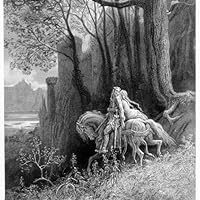
I am not sure how many editions Alfred W. Pollard’s ran to; perhaps about the same. However this one is a nice one; a solid hardback illustrated with 16 full page watercolour plates and 16 black and white pen and ink drawings. They are all by Arthur Rackham, the doyen of golden age book illustrations of folk and fairy tales. The book is larger than the average hardback novel, and the print size is also larger than a normal font size (although not enough to qualify as “Clear” or “Large” Print.)
"How Galahad drew out the sword from the floating stone at Camelot."
However, there may be better ones to try, if these two features are not relevant to you. The reason for this is that The Romance of King Arthur and his Knights of the Round Table was published before the groundbreaking discovery of the famous “Winchester Manuscript”.
At Winchester College in June 1934, during the cataloguing of the college’s library, assistant headmaster Walter Fraser Oakeshott discovered a previously unknown manuscript copy of “Le Morte D’Arthur”. It looked as though what Caxton had published in 1485 was not exactly what Malory had written! The “Winchester Manuscript” is now in the British Library. Walter Fraser Oakeshott was to write about this in his “The Finding of the Manuscript” in 1963, describing his realisation that “this indeed was Malory [and there was] startling evidence of revision” in the Caxton edition.
The Malory scholar Eugène Vinaver also examined the manuscript shortly after its discovery and reached similar conclusions. The manuscript is now generally believed to be closer to Malory’s original and does not have the book and chapter divisions for which Caxton takes credit in his preface. It also uses red ink quite extensively.
However for the purposes of authenticity, it is the fact that the chapter and individual long page headings used in this abridgement are not by Malory, but almost certainly inserted by Caxton. The overall sections are titled:
Of King Arthur Of Sir Gareth Of Sir Tristram Of Sir Launcelot and Dame Elaine Of Sir Galahad and the Quest of the Holy Grail Of Launcelot, Guenever, and King Arthur
Bearing this in mind, I think this is a perfectly acceptable and comprehensive rendering of the Arthurian legends, for those who wish to read a good edition but are not purists.
A book for book-lovers. Malory and Rackham. Excalibur! Originally published in 1917 as an abridgement of the classic MORTE D'ARTHUR, this is the 1979 reprint featuring those gorgeous illustrations of Merlin and Arthur and Launcelot and Galahad. You will believe.
Given the number of knights it is sometimes hard to weed out the forest, but my favorite is Sir Tristram. If he lived today, he would be a beach dude...with a deadly sword. So cool, so easy-going (Launcelot tends to veer on the moody side). By the time the Queen of Orkney pays her visit to the King, you just KNOW these legends lived, right? Surely in the ruins of Glastonbury Abbey a fragment of Avalon is hidden, remembered only by a Yorkist criminal.
Book Season = Year Round (don't let it be forgot that once there was a spot)
Buena recopilación de la historia de Arturo, Lanzarote y sus caballeros que se lee muy rápido y es muy entretenida aunque peca de aglutinar mucho las historias en pocas palabras. La mejor hazaña es la Muerte de Arturo y la de Sir Tristán, quedando la del Santo Grial con Sir Galahad, la cual tenía muchas expectativas, en último lugar debido a que se basa mucho en milagros y misticismo más que en "hechos" de los caballeros como las otras.
Ahora entiendo porqué se escribió el Quijote: mucha justa, mucho honor, muchas damas y caballeros y aventuras...
This book was an easy read in terms of writing style, super simple and quick; at the same time, the narration was so plain that it made the reading experience quite boring and dull. My advise is to think about this book not as a novel, but more as an encyclopedic work about everything you need to know about Arthurian legends, and I'm really happy to have discovered this book because now I have a more broader knowledge of these legends and these characters. It was really an amazing esperience to read the source book that inspired so many rewritings, novels and movies, and it's crazy to think how these stories are so loved even in modern and contemporary times.
Aunque conocía superficialmente la figura del Rey Arturo, ha sido muy enriquecedor conocer mejor sus orígenes, su historia y los caballeros más importantes de la mesa redonda. Es verdad que la primera mitad aproximadamente se me acabó haciendo un tanto repetitiva ya que seguían las aventuras de los caballeros ciertos patrones de manera repetitiva.
Sin embargo la segunda mitad atrajo completamente mi interés con Lanzarote, Ginebra, Galahad y el Santo Grial. Sin lugar a dudas han sido los personajes e historias que más me han gustado de este libro. No quiero desvelar nada pero si os llama la atención las historias de alguno de los personajes que he mencionado o leer sobre el Santo Grial, puede ser una lectura a tener muy en cuenta.
Para terminar, la edición tan preciosa y cuidada de Reino de Cornelia es digna de alabar, por no mencionar las ilustraciones tan acertadas de Arthur Rackham que acompañan a las historias relatadas hacen que por parte de la editorial no pueda poner pega alguna en ambos aspectos. Respecto a la traducción admito haber encontrado alguna errata suelta pero nada especialmente grave (tengo la primera edición, probal¡blemente se corrijan en las posteriores).
En resumidas cuentas: mi primera incursión a los mitos artúricos ha sido muy satisfactoria con El Rey Arturo y los Caballeros de la Tabla Redonda y la verdad sea dicha: me he quedado con ganas de más.
I'm so glad I finally read the Romance of King Arthur and His Knights of the Round Table (even though it took a while!). I love the musicals Camelot and Spamalot and the movie Monty Python and the Holy Grail so it was fun to read their source material (I had no idea the song "The Lusty Month of May" was lifted directly from one of the chapters!). I was also surprised at how vested I became in each knight; I kind of thought the archaic language might keep me at arm's length but by the end I was sad to see them all go..."don't let it be forgot, that once there was a spot, for one brief shining moment that was known as Camelot."
Really excellent, I can see why these stories are so loved. The language was tough and the story felt old, which I could see putting some people off, but I always left this book inspired.
This book is in line with such works as the works by Homer and the Aeneid. As a child I heard a few tales of the Knights of the Round table but I didn't realize how tragic the ending of these tales was going to be. Really a great book and definitely glad I picked it up for a dollar at library. What a steel!
As I try to write this review I am just so sad.. Like really sad. I just finished so the emotions are still strong.
I think the tales give a very interesting insight to the culture that was medieval Europe. It's a very weird mix of two very different influences that have found a weird and precarious balance. On the one hand you have the Barbarian nobles who are the descendants of those who overthrew Rome and probably some Norse blood in their too. An extremely warlike people. And then on the other hand you have the restraining influence of Christianity that has pretty much failed to fully pacify the barbarians and has compromised on setting limits to the violence.
So you have knights you decide to look for adventure and make a name for themselves and they only have to ride down the road a mile or two and they happen upon another knight and before they can determine if they even know the other knight they both gallop full speed towards each other with spears lowered and slam into each other. It's really wild. These guys are just wild. Also heroic. They have to be suffering from some serious CTE and a massive list of other disorders with how much brain damage they accrue. You can tell too because there is very little cleverness displayed throughout these tales.
For instance Lancelot loses his mind and takes off naked through the forest so some of his friends go looking for him. They are looking for two years when they hear about a night with a weird name who just defeated 500 knights. When they ask about the knight the damsel says they found him mad running naked through the forest. When his friends encounter Lancelot do they ask "hey man is that you?" No! One of them gets into a massive fight with Lancelot for two hours before it comes to light!! hahahah
I am not trying to detract from these stories. I say this lovingly. And what happened above was probably for dramatic effect but still. I highly enjoyed reading these tales and they are pretty awesome I just some find some aspects rather amusing but also enlightening.
PS I think we should bring back jousting as a professional sport. I think this is probably the greatest sport ever devised of by man. I don't think we are ready for that thought hahahah
Malory's Le Morte d'Arthur pales in comparison to the epics which preceded it. There is a lack of meaningful character or plot development, and the fragmented image of chivalry seemed more representative of the thuggery of a modern East London gang. Despite Pollard's abridgement, the archaic language was painful to decipher and the glossary was woefully insufficient.
Kind of a slog at times. I would have probably only given it 3 stars, but the ending really pulled through for me. Why don't we ever see anything about the rivalry between Lancelot's family and Gawain's family in other adaptations?
I first came to King Arthur with a small book with the tales retold by Charles Kingsley. That sold me...for good.
Then I saw the MGM movie with Robert Taylor as Sir Lancelot, Ava Gardner as Guinivere and Mel Ferrer, unkindly described as " a wet charge of powder " by one critic,as an idealistic but whimpy King Arthur. (But Stanley Baker made a superb villan.) Who cared!! In 1953 this was MGM's first Cinemascope production, even shot in England (with American accents.)
Years later I saw the Round Table itself in Winchester. (Cromwell's soldiers had taken potshots at it.) And visited the ruins on the English coast at Tintagel purported to be the remains of Camelot.
CAMELOT!!!Even Jackie Kennedy and her President were supposed to have recreated this mythical spot in Washington. Jack certainly did, screwing everything in a dress except a Scotsman. For there is a dark side. As the humanist educator Roger Ascham,(1515-1568) tutor to Elizabeth I, said in a more realistic fashion when referring to Sir Thomas Malory's "La Morte d'Arthur":"those be accounted the noblest knights that do kill the most men without any quarrel and commit foulest adulteries by subtlest shifts."(After all, the noblest knight did commit adultery with his King's Queen.) However Lerner and Loewe put that sordid tale to music and so to rest with their version of Camelot.
So, Unread, I have given this Malory abridgement 5 stars. Kingsley won me as a child and so NOTHING will UNconvince me that these are not the Very Best of Tales and I take only the Best from all those who offer their version. Washington was a travesty and a Total Make-believe. Arthur Rackham was a flawless illustrator. L and L's music is super. MGM was in colour and Cinemascope. Tintagel was windy, brooding and consequently suitably atmospheric. And these days adultery is OK if you're sincere, as I have absolutely no doubt Lancelot and Guinivere were. And anyway that story is more about Lancelot being unfaithful to ARTHUR!!!(Is there a mythical Gay Club undercurrent here as well!!???) Layers upon layers,methinks! Egad!!
I read this book completely for the illustrations, ad as per usual with Rackham's work I was not disappointed. The large colour panels are what most people are drawn to with his work, but I was just as appreciative of the b&w line drawings scattered throughout the text. Many were simply decorative and didn't depict a specific scene from the tales, but Rackham's mastery of line is still clearly showcased in each illustration.
I couldn't actually choose a favourite colour piece, as there are two that stand out for very opposite reasons: Queen Guenevere goes a-Maying and How Mordred was slain by Arthur. One is light and romantic while the other is dark and harshly realistic, which I feel exemplifies the dual nature of the Arthurian legends.
What a treat to read Thomas Malory's 1485 translation, although sometimes unfortunately abridged, of the seminal tales of Western Europe's mythic soul. The language rang with the adventures of knightly heroes - Sir Tristan, Sir Galahad, Sir Gawaine - the Sangreal quest and the eternal tragic triangle of Arthur, Lancelot, and Guinevere. New to me was Sir Bors who seems much the most dependable friend any knight, king, or queen could have. Over 1,600 years later, the dream of the once and future king still lives - Rex Quondam, Rexque Futurus.
One gets a bit tired of the same stories told over and over . . . only the names changing, basically. And seriously, how lame was the kind of chivalry the Romance celebrates? Still, it bears reading, even before the final section, which inspired "Camelot." I have to say that I did enjoy reading such archaic English, for such a long story!
Más o menos por la página 100 ya estaba más que cansado de tanta floresta, venganza y espadazo. De tanta dama virtuosa y tanto caballero valeroso. De tantos honores y duelos absurdos. De tanta repetición y ridiculez. De todo, prácticamente, salvo de la preciosa edición de Reino de Cordelia.
The dialogue in the book is old English and sometimes hard to follow. It's also repetitive with tournaments and jousts in every chapter. Lots of violence too. Still, the book gives all the details to the stories I've heard and read about King Arthur.