

What do you think?

The Ghosts of Birds
A new collection from “one of the world’s great essayists” ( The New York Times ) The Ghosts of Birds offers thirty-five essays by Eliot the first section of the book continues his linked serial-essay, An Elemental Thing , which pulls the reader into “a vortex for the entire universe” ( Boston Review ). Here, Weinberger chronicles a nineteenth-century journey down the Colorado River, records the dreams of people named Chang, and shares other factually verifiable discoveries that seem too fabulous to possibly be true. The second section collects Weinberger’s essays on a wide range of subjects―some of which have been published in Harper’s , New York Review of Books , and London Review of Books ―including his notorious review of George W. Bush’s memoir Decision Points and writings about Mongolian art and poetry, different versions of the Buddha, American Indophilia (“There is a line, however jagged, from pseudo-Hinduism to Malcolm X”), Béla Balázs, Herbert Read, and Charles Reznikoff. This collection proves once again that Weinberger is “one of the bravest and sharpest minds in the United States” (Javier Marías).
212 pages, Paperback
First published October 11, 2016
About the author
Eliot Weinberger
101 books177 followersEliot Weinberger is a contemporary American writer, essayist, editor, and translator. His work regularly appears in translation and has been published in some thirty languages.
Weinberger first gained recognition for his translations of the Nobel Prize winning writer and poet Octavio Paz. His many translations of the work of Paz include the Collected Poems 1957-1987, In Light of India, and Sunstone. Among Weinberger's other translations are Vicente Huidobro's Altazor, Xavier Villaurrutia's Nostalgia for Death, and Jorge Luis Borges' Seven Nights. His edition of Borges’ Selected Non-Fictions received the National Book Critics Circle Award for criticism.
Weinberger first gained recognition for his translations of the Nobel Prize winning writer and poet Octavio Paz. His many translations of the work of Paz include the Collected Poems 1957-1987, In Light of India, and Sunstone. Among Weinberger's other translations are Vicente Huidobro's Altazor, Xavier Villaurrutia's Nostalgia for Death, and Jorge Luis Borges' Seven Nights. His edition of Borges’ Selected Non-Fictions received the National Book Critics Circle Award for criticism.
Ratings & Reviews
Friends & Following
Create a free account to discover what your friends think of this book!
Community Reviews
Displaying 1 - 30 of 46 reviews

June 22, 2026
I had just finished the stellar piece That Imposter Known as the Buddha when a half dozen Buddhist monks entered the cafe. Was I unsettled? Did I fear their objections to this learned if somewhat sardonic approach his this faith was reconciled or understood by myriad civilizations?
No, not really.
It just highlighted how amazing this book is in its juxtaposition and esoteric mastery. There are glosses on classical Indian poetry and the autobiography of G W Bush as well as stunning prose poems on the Great Wall of China and the Berlin Wall.
I can exclaim loud enough how shockingly good this is and EVERYONE needs to read this immediately. Any questions?
No, not really.
It just highlighted how amazing this book is in its juxtaposition and esoteric mastery. There are glosses on classical Indian poetry and the autobiography of G W Bush as well as stunning prose poems on the Great Wall of China and the Berlin Wall.
I can exclaim loud enough how shockingly good this is and EVERYONE needs to read this immediately. Any questions?

July 11, 2020
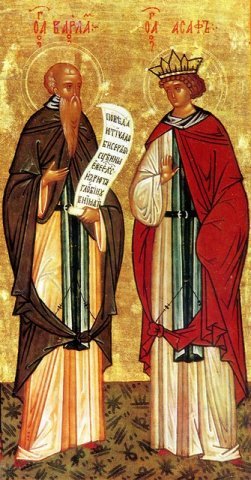
From left to right: St Barlaam and St Josaphat.
I never knew that Buddha had metamorphosed into a Christian saint by the medieval period!
In the chapter "That imposter named Buddha", Weinberger goes on in detail about how western world were introduced to Buddha and Buddhism. Quite surprisingly the narrative of Buddha being an Asian and an Indian is a very recent understanding for the westerners.
According to Guy Tachard, a 17th-century French Jesuit, Buddhism was a “monstrous mixture of Christianity and the most ridiculous fables.” Both religions had heavens and hells (though the Buddhist ones were multiple and not eternal — merely way-stations on the path to the next incarnation). Both had monks who were celibate, dressed in robes, and collected alms. Both the Buddha (in some versions of the story) and Jesus were born from a virgin birth. The Japanese names for the Buddha’s parents, Jōbon Dai Ō and Magabonin were apparent corruptions of Joseph and Mary. Buddhist prayer chants, said Matteo Ricci, sound like Gregorian, and they chant the name Tolome, not knowing that it clearly means that “they wish to honor their cult with the authority of the Apostle Bartholomew.” Others thought the Buddha a decayed memory of Thomas the Apostle, who was said to have gone to India after the Resurrection.
The narrative changed its origin to Africa and Egypt around 18th century, that Buddha was from Egypt, who got expelled from egypt by persians and landed on India. Around this time the theory of a double Buddha was floated.
But how did Buddha ended up as a christian saint?
The middle portion of the journey starts with the Arabic translation (Possibly from a persian text) of the story of Buddha titled, The book of Bilawar and Budhasaf. According to this, the father of Buddha is against what his son believes (which Buddha learns from his teacher Bilawar), but later accepts his son's religion. This ended up as a perfect dish for christians. They changed the persecuted religion of Buddha to Christianity and when the latin version came out, Pope Gregory XIII included St Barlaam (Bilawar) and St Josaphat in his Roman Martyrology.
The irony achieves a beautiful climax when the jesuits bring the printing press to Japan and they print a book called Compendium of the acts of Saints, which includes Buddha and his teacher as Christian saints.
Quite a story!

Eliot Weinberger book's styles range from poems, essays, prose and many others.
However fantastic and fabulous they may sound, they are all factual.
He is one of the few scholars --- who I have come across --- who does extensive reading for his writing.
First part of the book (there are no definite thematic markers, these are just my feelings) has anecdotes, poems, and historical accounts surronding nature. Be it islands, lakes, birds, winter, autumn etc.
The one that actually made me more interested in reading the book is about autumn, from a chinese text of 11th century. The writer Ou-Yang Hsiu quite beautifully muses on autumn being a natural personification of all that is sadness and tragic.
"Once there were the delicate patterns of thick grass.
Once there was green shade lying under the trees.
“Autumn touches the grass and its color fades. Autumn touches the trees and the leaves fall.
It cannot help but destroy. Its nature is corrosive.
Its occupation is executioner. Its badge is darkness.
Its color may be gold, but its sword is steel.
It is the pitiless justice of heaven and earth: to kill with cold.
“The sound of autumn is a flute sound, a sad song, the sound of things being hurt, the sound of things past their prime that will soon be put to death.
The second part mostly concerns various figures, from Junior Bush, Kubilai Khan to Balacs and Herbert Read.
But the second part starts with a triptych on architecture theme. We have the chapter on Big wall of China (How various American presidents made a visit to it and what they had to say. The one by Bush is particularly remarkable - "Let's go home."), on the German wall ( a collection of newspaper articles on trespassing by public, east berlin's repressive code for Border guards, killing of trespassers) , on city ( interestingly starts from a tribe in India called Santals and how they are close to the nature and then starts from Mesopotamian cities and goes through china, Cambodia, and how eastern idea of a city is different from the western idea, namely the western concept of modernity associated with cities is in exact opposite for the eastern view of antiquity for the cities)
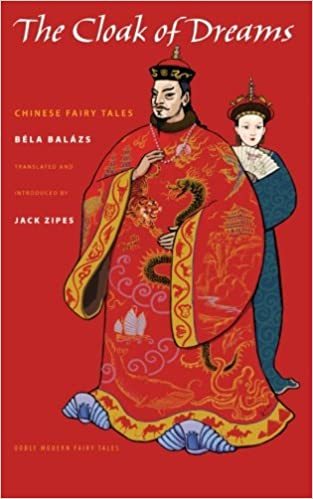
On the chapter Balacs's Chinese dreams, I never knew or expected that Balacs also wrote stories. He is mostly known for his Film criticism. Tales that are reminiscent of E.T.A Hoffman or Brothers Grimm were published as chinese in the name of The cloak of dreams. And when he later wrote "The book of Wan Hu-Chen" he comes more close to a chinese story.
"A penniless man is in love with the governor’s daughter. She rebuffs him, so he decides to write a book about her, making her even more beautiful and elegant than she is in life. Eventually she comes out of the book to visit him, but Wan has made, out of modesty, a terrible authorial mistake. In the book she is in love with the dashing Prince Wang. Wan then has to write a chapter killing off Prince Wang. The maiden turns to Wan for solace, and they live on happily for many years — he, writing the book all day, giving her ever finer jewels and clothes; she, coming out of the book at night. But he grows older and poorer, having no other occupation, and she remains young and beautiful. They have a son who remains in the real world, and is the reincarnation of Prince Wang. Wan, penniless, finally gives the boy to the governor’s family, discovers that the real daughter had died the day he began writing, and goes off into the pages of his own book to live in eternal springtime with his true love."
In the chapter on Charles Reznikoff's, he mentions the method by which Reznikoff worked:
His research for Testimony was almost unimaginable. The known source for merely one of the short poems is a court transcript that runs to a hundred pages. As Reznikoff said in an interview: “I might go through a volume of a thousand pages and find just one case from which to take the facts and rearrange them so as to be interesting. . . . I don’t know how many thousands of volumes I went through, and all I could manage to get out of it were these poems.” (Characteristically, he adds: “And in looking through the book I might throw out some of them.”)
Interestingly, this is the same way Weinberger himself works and has openly acknowledged the same.
I personally owe him for introducing the name of Guy Davenport years back. In one of his interviews he had mentioned Guy Davenport as one of the best american essayist working (I am not sure when he had given that interview, but I had read it on the now defunct The Quaterly conversation)
In my humble opinion, people like Eliot Weinberger are rare breed of intellect and I believe he needs to be read more than just his "What I heard about Iraq"

June 11, 2016
the latest essay collection from wundermensch eliot weinberger, the ghosts of birds collects nearly three dozen disparate pieces (including further entries in his serial essay, an elemental thing) into another literary achievement. weinberger's erudition is breathtaking to behold and he so effortlessly makes each of his subjects seem like the most interesting thing in the world. read, reflect, and repeat.
from "american indias"
but beyond literary history, beyond the many pleasures of the individual poems, it could serve the function of translation at its best—that is, as inspiration. here are ways of writing poetry that do not exist in our language, but, transformed, could.

January 23, 2022
The literature of the neighbourhood is still being written in the last neighbourhoods—the penthouses or the slums. But what will be the literature of the megalopolis? Already late modernism, so-called postmodernism, is perhaps pointing the way: the novel that is short on memorable characters or compelling narrative, long on pyrotechnical wordplay and a glut of information; the poem that is a string of disconnected ironies and pastiches of appropriated language. A literature with everyone and no one, a literature where—as is said of the slightly crazed—“there’s nobody home.” I suspect that those of us raised in the modern city, and raised in modernism, won’t understand it at all. [96–7]

Read
October 8, 2025Formatted Folktales + bush diss track + wikipedia time

November 29, 2016
If you know me, you know that I ask strangers, friends, family, and anyone else I encounter whether or not a crow or a seagull would win in a fight. Now I have literature backing me up -
For the cormorants of the open sea and the cormorants of the rivers and the lakes started a war of all the birds over whose fishing grounds were superior. The sea birds were stronger, the land birds more clever, and the land birds won.
For the cormorants of the open sea and the cormorants of the rivers and the lakes started a war of all the birds over whose fishing grounds were superior. The sea birds were stronger, the land birds more clever, and the land birds won.
November 29, 2025
coś wspaniałego

October 17, 2016
The first essay – "The Story of Adam and Eve" – summed up everything I knew about the Hebrew myth in a couple pages then astonished me with a book I didn't know existed:
Weinberger explores the variations from translation to translation, each of which brought something unexpected to the story – "the Armenian, Georgian, and Latin versions open with Adam and Eve starving" – a horrifying premise, although it's implied in the original. ("In the sweat of thy face shalt thou eat bread, till thou return unto the ground; for out of it wast thou taken: for dust thou art, and unto dust shalt thou return.") I'm deeply familiar with the first three chapters of Genesis; my grandmother had me memorizing Scripture when I was 8. Weinberger makes the myth strange again, and weirdly specific. "Most of the sources say that Adam and Eve spent a total of three hours in paradise, though some say six."
The Ghosts of Birds, like Weinberger's earlier collections, enacts a kind of scholarly magic, part erudition and part poetry. Some chapters are improbable lists, extracts or summaries of books from the ancient East or the pre-Columbian Americas. A few pages from John Wesley Powell's 1869 exploration of the Colorado River capture the naturalists' amazement at what they "discover" as well as their hubris: like American Adams, the explorers bestow names on a landscape that has been inhabited for thousands of years: Beehive Point, Ashley Falls, Whirlpool Canyon, the Canyon of Desolation. It's how the West was won.
The collection concludes with a Bibliography ("The Cloud Bookcase") that has nothing to do with the book, books which themselves seem to appear, morph and disappear.
There's also a Glossary – with, again, no obvious relation to the book before it.
I love these aleatoric catalogs, a compound of Whitman, Borges and Dada. But it's the essays I prize most. My favorites in this book include the review of two recent translations of the I Ching and "American Indias" which explores the Western fascination with (and ignorance of) India. In an interview from 2005, Weinberger was asked how translation might energize English. He answered, "There’s interesting prose being written in English, and it’s not all imitation Carver (or, more exactly, Carver-Lish). I’ll avoid a list, but one could start with the writers in India and the Indian diaspora—collectively, more or less, the source of the best novels in English these days." The last paragraph of "American Indias" picks up this thread.
Weinberger is an ideal guide to the Library of Babel: all the books ever written, all that can be imagined. A reader's euphoria.
In the 1st century CE, The Life of Adam and Eve may or may not have been written in Hebrew or an undetermined Semitic language. It survives in Greek, Latin, Slavonic, Georgian, and Armenian versions, and was translated or adapted scores of times throughout the Middle Ages.
Weinberger explores the variations from translation to translation, each of which brought something unexpected to the story – "the Armenian, Georgian, and Latin versions open with Adam and Eve starving" – a horrifying premise, although it's implied in the original. ("In the sweat of thy face shalt thou eat bread, till thou return unto the ground; for out of it wast thou taken: for dust thou art, and unto dust shalt thou return.") I'm deeply familiar with the first three chapters of Genesis; my grandmother had me memorizing Scripture when I was 8. Weinberger makes the myth strange again, and weirdly specific. "Most of the sources say that Adam and Eve spent a total of three hours in paradise, though some say six."
The Ghosts of Birds, like Weinberger's earlier collections, enacts a kind of scholarly magic, part erudition and part poetry. Some chapters are improbable lists, extracts or summaries of books from the ancient East or the pre-Columbian Americas. A few pages from John Wesley Powell's 1869 exploration of the Colorado River capture the naturalists' amazement at what they "discover" as well as their hubris: like American Adams, the explorers bestow names on a landscape that has been inhabited for thousands of years: Beehive Point, Ashley Falls, Whirlpool Canyon, the Canyon of Desolation. It's how the West was won.
The collection concludes with a Bibliography ("The Cloud Bookcase") that has nothing to do with the book, books which themselves seem to appear, morph and disappear.
Diagrams Illustrating the Mystery of the Cultivation of Truth, the Mystery of the Supreme Pole, and the Mystery of the Primordial Chaos
by Anonymous (12th century)
Contains only diagrams with no explanations.
Gradual Enlightenment
by Ma Tan-yang (1123-1184)
Contains poems where the first character is deliberately omitted.
There's also a Glossary – with, again, no obvious relation to the book before it.
Panglukhu. Cloth to cover the head, payable to a cuckold by the man who has slept with the wife.
I love these aleatoric catalogs, a compound of Whitman, Borges and Dada. But it's the essays I prize most. My favorites in this book include the review of two recent translations of the I Ching and "American Indias" which explores the Western fascination with (and ignorance of) India. In an interview from 2005, Weinberger was asked how translation might energize English. He answered, "There’s interesting prose being written in English, and it’s not all imitation Carver (or, more exactly, Carver-Lish). I’ll avoid a list, but one could start with the writers in India and the Indian diaspora—collectively, more or less, the source of the best novels in English these days." The last paragraph of "American Indias" picks up this thread.
Classical Indian poetry, with its millennia of texts, its many languages, its oceanic vastness, remains the largest blank on the Western map of world literature. But beyond literary history, beyond the many pleasures of the individual poems, it could serve the function of translation at its best – that is, as inspiration. Here are ways of writing poetry that do not exist in our language, but, transformed, could.
Weinberger is an ideal guide to the Library of Babel: all the books ever written, all that can be imagined. A reader's euphoria.
April 16, 2019
A collection of essays, poems and some book reviews, admirable in its erudition and cataloging, but really nothing worth mentioning. Joyless, smug, never entertaining, mildly interesting at times. I'd say the poems are the best part, very creative and interesting, and perhaps a little enlightening, but the "laundry lists" are nothing more than that. The overarching anti-religious anti-Western sentiment is perfunctory. These are all things we know - but why is life so mysterious?

July 9, 2024
I can't see what's the draw to this book, frankly. It seems like a bit of a con.
Read
July 5, 2024Astounding archival work from Weinberger; stories plucked from the warbles of Aotearoa, the dreams of Chang, torrents of a marbled canyon -- stones, trees and wind; the voices that carry us along.

November 3, 2020
Superb collection of essays, some free-form, on a wide variety of topics, including literature, of course.
December 26, 2025
nie tak znakomite jak Z rzeczy pierwszych, ale wciąż kojące i dające potrzebną perspektywę. oraz 2025 rokiem bugonii!

January 4, 2020
Geez, this guy is so erudite! Kind of like Ezra Pound, but with good politics.
First half of the book is a continuation of his ongoing "serial essay" begun in "An Elemental Thing" (2007). Not quite as breathtaking as the "essays" there, but he always digs up some nugget of cultural history that interests us.
The second half is made up of essays and introductions he has done for art show catalogs, books and various magazines (not surprising that many of them read like essays for the London or NY Review of Books).
The culture of India, China and Japan take up most of his interest (less Mexico/Central and South America here than in the past). His essays on Reznikoff (who he has written about before - this is an Intro to "Testimony"), the now little known Bela Balaz (what a life - and already writing film criticism in the days of silent films!), and "American Indias" (an odd pastiche, but informative, on the lack of Asian Indian poetry in English translation) were my favorite. Post 9/11 he, as a New Yorker, became very outspoken about W's admin, and there is a wonderful review of "Junior's" memoir here. His essays on the "I Ching" and Khubilai Khan show off his ability to give a complete history of events in a short amount of space.
And then his "Bibliography/Cloud Library" at the end. Since I could not find any of the authors or titles online, aand since he translated Borges "Complete Prose", I am thinking that this is a Borgian made up library, complete with humorous titles and descriptions.
Always interesting and informative, and love the quirky and odd that he brings to our attention.
First half of the book is a continuation of his ongoing "serial essay" begun in "An Elemental Thing" (2007). Not quite as breathtaking as the "essays" there, but he always digs up some nugget of cultural history that interests us.
The second half is made up of essays and introductions he has done for art show catalogs, books and various magazines (not surprising that many of them read like essays for the London or NY Review of Books).
The culture of India, China and Japan take up most of his interest (less Mexico/Central and South America here than in the past). His essays on Reznikoff (who he has written about before - this is an Intro to "Testimony"), the now little known Bela Balaz (what a life - and already writing film criticism in the days of silent films!), and "American Indias" (an odd pastiche, but informative, on the lack of Asian Indian poetry in English translation) were my favorite. Post 9/11 he, as a New Yorker, became very outspoken about W's admin, and there is a wonderful review of "Junior's" memoir here. His essays on the "I Ching" and Khubilai Khan show off his ability to give a complete history of events in a short amount of space.
And then his "Bibliography/Cloud Library" at the end. Since I could not find any of the authors or titles online, aand since he translated Borges "Complete Prose", I am thinking that this is a Borgian made up library, complete with humorous titles and descriptions.
Always interesting and informative, and love the quirky and odd that he brings to our attention.

March 20, 2018
This is a tough one to rate. The first half is largely translations of authors, poems, journals, and mythologies. The second half is mainly book reviews. Weinberger spans large swaths of history, religions, ideological systems, and artistic movements, and he has intensive knowledge of several facets of society. I usually find history dry, but his book reviews are mostly interesting, so this book didn't pick up steam from me until the second half, but I'm glad I stuck with it. his exploration of the I Ching and review of George W Bush's autobiography as a postmodern work really sung. The poetry translations in the first half are hit and miss for me as far as art, but I'm sure they're done masterfully because Weinberger exemplifies masterfulness is everything else he does.
one issue with this book is the fact that Weinberger seems to bemoan the lack of authorship from, for example, Indian poets in the US... but he is writing and published (heavily!) as an old, white, American man. I realize it's not his fault that he's ironically become canonized for his work that hopes for the canonization of more non-Americans; that is the fault of publishers. Weinberger's vast knowledge of Indian poets and authors makes him qualified to speak about them, but the fact that he, a non-Indian author, gained fame for speaking about their lack of publication, itself seems problematic.
one issue with this book is the fact that Weinberger seems to bemoan the lack of authorship from, for example, Indian poets in the US... but he is writing and published (heavily!) as an old, white, American man. I realize it's not his fault that he's ironically become canonized for his work that hopes for the canonization of more non-Americans; that is the fault of publishers. Weinberger's vast knowledge of Indian poets and authors makes him qualified to speak about them, but the fact that he, a non-Indian author, gained fame for speaking about their lack of publication, itself seems problematic.

August 30, 2025
The front page says "Essays", but it is just as much articles and collections of historical anecdotes. Initially I was sceptical, as some of the texts did not resonate with me. Short translations of ancient Chinese poems, gathered fragments of Zoroastrian texts, I feared that this would be the type of writing that is so vague that you can fill it with any meaning you want. Luckily I read on.
Weinberger covers a variety of topics, from life in the city to George W. Bush to the influence of Chinese poetry on American modernism, and I gradually found myself impressed with his erudition and ability to see lines of interwoven history.
For the most part, Weinberger does not get directly political, and he mostly talks about culture, art and literature. The exception to this is perhaps the most enjoyable essay in the collection: a scathing review of George W. Bush's ghostwritten autobiography, and by that man's disasterous political legacy in large.
I am in awe of how well read Weinberger is, and impressed by his ability to, in the span of ten pages, conjure up an elaborate tale of cultural metamorphosis, as in his essay on the Buddha and the fascinating way in which Buddhist tales were brought to Europe, through Persia, then transformed into stories about saints, got integrated into Christianity as such, then centuries later were brought back to their origin as part of Christian proseletyzing. In a few pages Weinberger shows us a lot about the history of religious studies.
Weinberger covers a variety of topics, from life in the city to George W. Bush to the influence of Chinese poetry on American modernism, and I gradually found myself impressed with his erudition and ability to see lines of interwoven history.
But the modern city is, or was, as is less often said, a collection of neighborhoods. In the neighborhood, not all the names are known, but the faces are familiar. The stereotypical anonymity of the modern city is in its mercantile districts, or on its transportation, or in someone else's neighborhood. Even speech was once narrowly local: In my city, New York, neighborhoods-except for the very poor-tended to be organized more by ethnicity than class. In my childhood, each still retained an identifiable way of speaking. Air-conditioning erased that sense of community, keeping everyone indoors in the summer, off the streets and in their own apartments-watching television, that overwhelming homogenizer of language.
For the most part, Weinberger does not get directly political, and he mostly talks about culture, art and literature. The exception to this is perhaps the most enjoyable essay in the collection: a scathing review of George W. Bush's ghostwritten autobiography, and by that man's disasterous political legacy in large.
This is a chronicle of the Bush Era with no colored-coded Terror Alerts; no Freedom Fries; no Halliburton; no Healthy Forest Initiative (which opened up wilderness areas to logging); no Clear Skies Act (which reduced air pollution standards); no New Freedom Initiative (which proposed testing all Americans, beginning with school children, for mental illness); no pamphlets sold by the National Parks Service explaining that the Grand Canyon was created by the Flood; no research by the National Institutes of Health on whether prayer can cure cancer ("imperative," because poor people have limited access to health care); no cover-up of the death of football star Pat Tillman by "friendly fire" in Afghanistan; no "Total Information Awareness" from the Information Awareness Office; no Project for the New American Century; no invented heroic rescue of Pvt. Jessica Lynch; no Fox News; no hundreds of millions spent on "abstinence education." It does not deal with the Cheney theory of the "unitary executive"-essentially that neither the Congress nor the courts can tell the president what to do-or Bush's frequent use of "signing statements" to indicate that he would completely ignore a bill that the Congress had just passed.
(...)
The book states that, for him, the worst moment of his presidency was-not 9/11, or the hundreds of thousands he killed or maimed, or the millions he made homeless in Iraq and jobless in the United States-but when the rapper Kanye West said, in a fundraiser for Katrina victims, that Bush didn't care about black people.
West was only half right. Bush is not particularly racist. He never portrayed Hispanics as hordes of scary invaders; Condi was his workout buddy and virtually his second wife; he was in awe of Colin Powell; and he was most comfortable in the two most integrated sectors of American society, the military and professional sports. It wasn't that he didn't care about black people. Outside of his family, he didn't care about people, and Billy Graham taught him that "we cannot earn God's love through good deeds"-only through His grace, which Bush knew he had already received.
I am in awe of how well read Weinberger is, and impressed by his ability to, in the span of ten pages, conjure up an elaborate tale of cultural metamorphosis, as in his essay on the Buddha and the fascinating way in which Buddhist tales were brought to Europe, through Persia, then transformed into stories about saints, got integrated into Christianity as such, then centuries later were brought back to their origin as part of Christian proseletyzing. In a few pages Weinberger shows us a lot about the history of religious studies.
Francis Xavier-whose source was an accommodating, illiterate, renegade Japanese wanted for murder, whom he met in Malacca in 1547-initially believed that the Buddha was not an idol but, like Moses, had ordered the smashing of idols in the name of the One God. Two years later, when he arrived in Japan, Xavier changed his mind, calling the Buddha "the pure invention of demons." Trying to teach the Japanese the truth, he transformed the Latin deus into the Japanese daiusu, which unfortunately sounded like dai uso, a big lie.
For their part, the Asians also looked for the familiar in these mys terious visitors. Some thought the Jesuits were Buddhist monks from India, but they couldn't understand why these men would wear an image of Devadatta around their necks. (Devadatta was the Buddha's evil nemesis, who tried to assassinate him on various occasions, and ended up in the worst of the sixteen hells, impaled on stakes.) It must mean that these men in robes were some sort of anti-Buddhist cult-in Western terms, Satanists.
October 21, 2016
Weinberger’s pieces are billed as “essays” but I hardly think they count. They’re more often prose poems, catalogs of trivia, miscellaneous observations. His prior collection, An Elemental Thing, I enjoyed quite a lot. The Ghosts of Birds not so much. Weinberger needs to quit trying so hard to be fancy and intellectual.

January 6, 2017
I bought this book for Weinberger's essay on the I Ching and was not disappointed. There are other fascinating essays here. For example, his treatment of history of the Western interpretation of the Buddha. Some few of these essays are, however, too esoteric even for me.

December 27, 2021
Erudition, knowlege for knowledge's sake, is why I love Weinberger essays.
There's anthropology, poetry, and in this particular case, unusually bit of modern politics (a hilariously negative review of George Bush Jr's post-presidency autobiography), lots of ancient China with an amazing essay on the history of the I Ching, Indian and South American history, an essay on the influence of the image of India on intellectuals and poets of the US ("Classical Indian poetry, with its millennia of texts, its many languages, its oceanic vastness, remains the largest blank on the Western map of world literature. But beyond literary history, beyond the many pleasures of the individual poems, it could serve the function of translation at its best — that is, as inspiration"), a wonderful bucket of things that make mandkind so interesting.
For example, from an essays named Changs Dreaming,
and why not! you should know this
There's anthropology, poetry, and in this particular case, unusually bit of modern politics (a hilariously negative review of George Bush Jr's post-presidency autobiography), lots of ancient China with an amazing essay on the history of the I Ching, Indian and South American history, an essay on the influence of the image of India on intellectuals and poets of the US ("Classical Indian poetry, with its millennia of texts, its many languages, its oceanic vastness, remains the largest blank on the Western map of world literature. But beyond literary history, beyond the many pleasures of the individual poems, it could serve the function of translation at its best — that is, as inspiration"), a wonderful bucket of things that make mandkind so interesting.
For example, from an essays named Changs Dreaming,
It was recorded in the 14th century, in the History of the Sung Dynasty, that the Empress Chang-i dreamed that there were two suns in the sky, that one of them fell and that she caught it with the front of her gown. It was also recorded that she dreamed that someone barefoot, dressed in feathers, came through her window.
It was recorded in the 10th century, in Elegant Chats from a Commandery Studio, that Chang Chiung was unable to write poetry. He dreamed that a many-colored cloud came down from the sky, and that he grabbed a piece and ate it. It was noted that he became a master poet.
It was recorded in the 7th century, in the History of the Chin Dynasty, that Mistress Chang dreamed that the sun entered her body. It was noted that she was pregnant for fifteen months.
and why not! you should know this

July 30, 2024
(somewhere between 3 and 4 stars). The first half of this book is full of beautiful stories, poems, essays and excerpts from other documents, some formatted in unique and intriguing ways (presumably as they were translated), some as short as a few sentences but evocative and rich with ideas. I loved it. The second half of the book is made up of longer form essays, some of which became very dry very quickly. There are a few that caught my interest, the essay on the I Ching in particular, but for the most part, frankly they were over my head. Full of dense references to people and places I’ve never heard of. Might not be smart enough for the second half of this book, but it was worth the read! Also, the opening poem is one of the most beautiful I’ve ever read.
January 26, 2019
I read this book while my little sister visited. She's painting some pots as I write.
It's sunny for the first time in a long time, but that's Seattle in January. I couldn't expect it earlier.
Parts of this book went right over my head. I couldn't tell if his poem of bird sounds is his translation of the Conference of Birds (coincidentally I just picked up a nice edition simultaneously with Fitzcarldo Editions coming out with one of their own) or his take on it or some sort of homage or (unofficial) sequel.
For the essays that did make sense (in this category I group just about all the prose in here, down to the last sentence) I loved them unconditionally.
It's sunny for the first time in a long time, but that's Seattle in January. I couldn't expect it earlier.
Parts of this book went right over my head. I couldn't tell if his poem of bird sounds is his translation of the Conference of Birds (coincidentally I just picked up a nice edition simultaneously with Fitzcarldo Editions coming out with one of their own) or his take on it or some sort of homage or (unofficial) sequel.
For the essays that did make sense (in this category I group just about all the prose in here, down to the last sentence) I loved them unconditionally.
January 9, 2025
Really great collection of research. Entertaining and lighthearted writing style that at times almost seemed a bit sarcastic. It’s still very factual and relatively objective. I was trying to find a connection between all of the subjects chosen to research and write about.. some went together very closely while others were seemingly completely different subject matter. Alas, always interesting to read about people, places, and things that you never knew existed and find them interesting and capturing.
I really like the one about observations at the Wall Of China/Berlin Wall on a random day at random times pertaining to random people.
I really like the one about observations at the Wall Of China/Berlin Wall on a random day at random times pertaining to random people.

November 29, 2017
The almost unclassifiable Weinberger is back and stronger than ever. Almost essays, Almost poems, he is one of the very few writers who leave me searching for the words to talk about what he does- which is, by the way, his own searching for words, looking beyond the word.
The few truly great essayists, like William Gass, Guy Davenport, Anne Carson -are a good starting point to reference when thinking of Weinberger's work, but I feel he often transcends them, and the essay itself.
Stephen Spera
The few truly great essayists, like William Gass, Guy Davenport, Anne Carson -are a good starting point to reference when thinking of Weinberger's work, but I feel he often transcends them, and the essay itself.
Stephen Spera

September 26, 2023
Relentlessly fascinating; the sort of book that seems to grant access to a trove of well-guarded secrets, which is not especially surprising when dealing with variations and mutations of the story of Adam and Eve, but is almost shocking when dealing with, say, the presidency of George W. Bush; a library unto itself.

February 14, 2017
"A young man spends all of his time reading, but he's not very bright and cannot understand what he reads."
A few parts of a few of the essays in part II sour things a bit, I think. Part I is *****.
A few parts of a few of the essays in part II sour things a bit, I think. Part I is *****.

May 27, 2017
Half of this book its not essays -- it's short stories. They're OK.
The essays are pretty good, though the one that is a mock review of a book ghostwritten by George W. Bush is the only one that truly stuck with me, as of this this writing about a month after reading.
The essays are pretty good, though the one that is a mock review of a book ghostwritten by George W. Bush is the only one that truly stuck with me, as of this this writing about a month after reading.

December 8, 2017
A few different times in my life I tried to read "The Golden Bough" straight through, I wish I'd known then about Eliot Weinberger. How can every sentence of an essay on STONES be better than the one before it? Like the blurb on the back says: "who is this guy and how does he know all this stuff??"
March 5, 2023
A wonderful assortment of essays, poems, and stories. Weinberger covers topics I have never heard of with insight and wit. It makes me think of all the hidden knowledge out there. I love that quirky bibliography at the end.

March 24, 2017
a blink of escapism

January 1, 2020
The essays in the second half didn't always mix comfortably with the 'essays' in the first half. Somewhat of a disappointment for that reason (ie it wasn't what I wanted).
Displaying 1 - 30 of 46 reviews