Jump to ratings and reviews
Rate this book

Black Dog: The Dreams of Paul Nash

Rate this book
Best known for his collaborations with Neil Gaiman, McKean defied expectations with his stunning debut as writer and artist in Cages , winner of multiple awards for Best Graphic Album. Dark Horse proudly presents a new original graphic novel by the legendary artist based on the life of Paul Nash, a surrealist painter during World War 1. The Dreams of Paul Nash deals with real soldier's memoirs, and all the stories will add up to be a moving piece about how war and extreme situations change us, how we deal with that pain, and, in Nash's case, by turning his landscapes into powerful and fantastical psycho-scapes.

Praise for one of Dave McKean's previous graphic novels, Cages :
"One of the most important works of comic art in the last decade." -The Comics Journal
"It is compulsively readable, with a lyrical tone that moves the reader through the rougher, more elusive passages as it strives at the very edge of the form's limitation." -Comic Foundry Magazine
"The finest comic being created today. Get it and see what heights narrative graphic art can achieve." -The Fine Print

120 pages, Paperback

First published October 18, 2016

16 people are currently reading
850 people want to read

About the author

Dave McKean

448 books691 followers
Dave McKean is a world-renowned artist, designer, and film director who has illustrated several books for children, including The Savage by David Almond, and Coraline, The Day I Swapped My Dad for Two Goldfish, and The Wolves in the Wall, all by Neil Gaiman. Dave McKean lives in England.

Ratings & Reviews

What do you think?
Rate this book

Friends & Following

Create a free account to discover what your friends think of this book!

Community Reviews

5 stars
345 (44%)
4 stars
284 (36%)
3 stars
128 (16%)
2 stars
19 (2%)
1 star
7 (<1%)
Displaying 1 - 30 of 120 reviews
Profile Image for J. Kent Messum.
Author 5 books245 followers
November 1, 2016
*Review originally published in the New York Journal Of Books: http://www.nyjournalofbooks.com/book-...

“I’m a room without a door. A war artist, without a war.”

War is a terrible thing. With brutal indiscrimination it carves up victims and separates survivors. Those that live through it can often teach us more than any historian ever could. With art and prose, some even do it in a way that transcends.

Paul Nash was one such individual: an English WWI soldier, official war artist, and poet. With his words and paintbrush he revealed the battlefield for what it really was, both during and after the Great War. As one of the most influential and important artists of his era, a graphic novel recounting his life and delving into his fractured psyche is a more than fitting tribute.

Acclaimed illustrator David McKean draws the story for us in the rich alternating styles of Nash, doing the old artist proud and then some. The result is 'Black Dog', named after the visitant canine that plagued Nash’s dreams and visions from his childhood to his post-war years. Neither malevolent nor benign, this specter skulked in his periphery through sickness and in health, war and peace. It acted as an omen, messenger, foe, and friend.

The writing in Black Dog is sparse, and while largely effective, it isn’t the focus of this work. A picture paints a thousand words, but under the influence of Nash, McKean’s creations have the ability to double, even triple that.

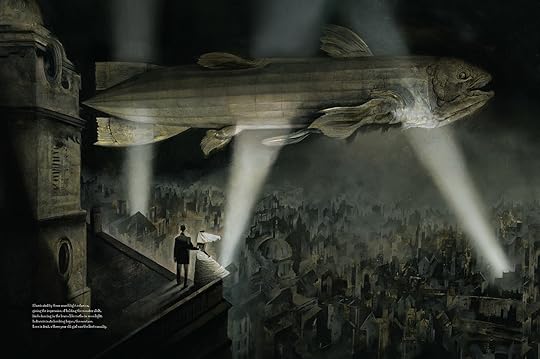
There are several different surrealist styles in play, and the shifting artwork reminded me often of the Hellraiser graphic novels, a series renowned for its incongruously frightening art and stories (which McKean himself actually contributed to at one point). But where Hellraiser reveled in abstract fantastical horror, Black Dog wallows in our earth-borne war-torn nightmares and sleepwalks through the dreams dredged from such. This book has the ability to build a sense of wonder in the reader, but also shock and awe. For instance, the incredible two-page illustration of a German zeppelin over London imagined as a massive airborne coelancanth-type creature will stick with you for days.

It’s hard to be critical of a work based on a celebrated artist, writer, and soldier. Thankfully, blessedly little misses its mark in Black Dog. There are times, far and few between, where the poetry strains at its weakest links or the prose can come off heavy-handed. As a record of one man’s life experience there is an absence of pretentiousness, but the writing can still seem didactic in places. Whenever this occurs it isn’t long before a striking or breathtaking piece of art balances the book back out.

Surrealism is a tricky thing, and isn’t for everyone. But in the context of the stressed and strained mind of a surviving solider coming to terms with the warfare he witnessed, it is a near perfect fit. Damaged souls can give a commanding voice to both beautiful and harrowing stories. Paul Nash is the embodiment of it and Dave McKean harnesses his power, channeling it into a superior graphic novel that everyone should experience.
Profile Image for Trish.
2,393 reviews3,748 followers
October 25, 2016
I had never heard the name Paul Nash before (unless we're talking about a certain Goodreads friend here ;P) but I do know of Dave McKean through his work with Neil Gaiman. It was the latter showing sneak peeks or reporting about the progress of the upcoming work on Twitter to endorse it which made me look at it.

Both World Wars are difficult topics for me as a German (you wouldn't believe how many people have called me a Nazi in my life) but I regard them as very important too. One of my favourite books (Erich Maria Remarque's All Quiet At The Western Front) is about World War I. Moreover, I have the same opinion about the education of any topic, but especially "difficult" ones, as Paul Nash seems to have had himself: burying your head in the sand isn't going to cut it, we have a duty to educate ourselves and others.

Before getting to the book, I'd like to take the time to give you a little overview on Paul Nash's life since this is paramount to understanding the book itself and many motives for Nash's art pieces:

He was born in 1889 as the son of a lawyer and had a Captain of the Royal Navy as his maternal grandfather. He also had two younger siblings (a brother and a sister). Since his mother was showing signs of mental illness, the family moved to the countryside. Unfortunately, the mother died in a mental institution when she was only 49.
Despite all efforts and plans by his father/grandfather, Paul Nash failed to become a Navy officer. However, motivated by a fellow student, he considered a career in the arts, went to several schools (although such institutions don't seem to have suited him) and soon after started writing poetry and plays and befriended many people in the art scene of the time, who all praised him and his talent highly. Interesting is that his brother, John Nash, was a fellow artist with whom Paul even had a show.
By 1914, Paul Nash enjoyed quite some success, but in September 1914 he reluctantly enlisted as a guard at the Tower of London so he still had time for his paintings while doing his duty to his country as he seems to have seen it. In December of the same year he got married to a campaigner of the Women's Suffrage movement.
In 1916 he began officer training and was sent to the Western Front at the beginning of 1917. The place he was sent to was relatively quiet at the time so he saw no major engagement. However, a few months later he fell into a trench and broke a rib, resulting in him being sent back to London - only a few days before almost everyone in his unit was killed in an assault on their position.
He always considered himself lucky and apparently tried to see the bright side of things (like nature reclaiming trenches - green vs. brown). While recuperating from his injury, he made several paintings which were later shown in two exhibitions. It was these exhibitions that resulted in him working for the government's War Propaganda Bureau.
At the end of 1917 he returned to his former post, but in his capacity as a uniformed observer. This time he came under fire quite often and lived through the true horrors of the war (also because this time he was deployed during dreary winter instead of optimistical spring). He seems to have been shocked about this and very angry too about the war apparently resulting in the area being utterly destroyed to a point where not even nature could reclaim it. Thus, he became disillusioned within about two weeks, leading to him writing to his wife the following lines:
I have just returned, last night from a visit to Brigade Headquarters up the line and I shall not forget it as long as I live. I have seen the most frightful nightmere of a country more conceived by Dante or Poe than by nature, unspeakable, utterly indescribable. In the fifteen drawings I have made I may give you some idea of its horror, but only being in it and of it can ever make you sensible of its dreadful nature and of what our men in France have to face. We all have a vague notion of the terrors of a battle, and can conjure up with the aid of some of the more inspired war correspondents and the pictures in the Daily Mirror some vision of battlefield; but no pen or drawing can convey this country—the normal setting of the battles taking place day and night, month after month. Evil and the incarnate fiend alone can be master of this war, and no glimmer of God's hand is seen anywhere. Sunset and sunrise are blasphemous, they are mockeries to man, only the black rain out of the bruised and swollen clouds all though the bitter black night is fit atmosphere in such a land. The rain drives on, the stinking mud becomes more evilly yellow, the shell holes fill up with green-white water, the roads and tracks are covered in inches of slime, the black dying trees ooze and sweat and the shells never cease. They alone plunge overhead, tearing away the rotting tree stumps, breaking the plank roads, striking down horses and mules, annihilating, maining, maddening, they plunge into the grave, and cast up on it the poor dead. It is unspeakable, godless, hopeless. I am no longer an artist interested and curious, I am a messenger who will bring back word from the men who are fighting to those who want the war to go on for ever. Feeble, inarticulate, will be my message, but it will have a bitter truth, and may it burn their lousy souls.
In May 1918 there was another show of the pieces he had created in the meantime many of which can be seen until March 2017 at the Tate in London (more about that later).
After the war, he was determined to continue his career but struggled with depression and financial problems. He lived in Buckinghamshire and in London where he made theatre designs for a play by J.M. Barrie (author of Peter Pan for those of you who don't know). From 1920 until 1923 Nash taught, on an occasional basis, at the Cornmarket School of Art in Oxford.
In 1921, after visiting his sick father, Nash collapsed and, after a week during which he repeatedly lost consciousness, was diagnosed as suffering from what was then called 'emotional shock' arising from the war. He and his wife therefore moved and, after a successful exhibition in 1924, spent the winter near Nice and visited Pisa and Florence even.
In 1930 Paul Nash worked as an art critic.
Nash became a pioneer of modernism in Britain, promoting the avant-garde European styles of abstraction and surrealism throughout the 1930s. In 1933 he co-founded the influential modern art movement "Unit One" with fellow artists. It was a short-lived but important move towards the revitalisation of British art in the inter-war period.
Between 1934 and 1936 Nash lived near Swanage in Dorset, hoping the sea air would ease his asthma. He produced a considerable number of paintings and photographs during this period.
After two years, Nash had come to dislike Swanage and in mid-1936 moved to a large house in Hampstead where he wrote articles on "seaside surrealism", created collages and assemblages, began his autobiography and organised a large show at the Redfern Gallery in April 1937.
In 1939, shortly after World War 2 began, the Nashes left Hampstead and moved to Oxford.
At the start of WWII, Nash was appointed by the War Artists' Advisory Committee to a full-time war artist post. Since his style had changed, it was demanded after some time that this full-time contract was terminated (which then happened in December 1940). In January 1941 the Committee agreed to purchase works from Nash on the theme of aerial conflict. Nash worked intermittently under this arrangement until 1944.
After completing The Battle of Britain, an imaginative representation of an aerial battle in progress over a wide landscape of land and sea, Nash found himself creatively blocked and again sick with asthma.
Nash's final painting was an extraordinary imagined scene of a bombing raid on a city, called Battle of Germany, which is one of my favourites of all that I've seen so far.
From 1942 onwards, Nash often visited the artist Hilda Harrisson at her home to convalesce after new bouts of illness.
During the final ten days of his life, Nash returned to Dorset and visited several places he had previously lived at or which held meaning for other reasons. Nash died in his sleep of heart failure (a long-term result of his asthma) on 11th July 1946. The Egyptian stone carving of a hawk, that Nash had painted in Landscape from a Dream, was placed on his grave.

As mentioned further above, the Tate in London will have an event about this book, Black Dog, on 13th November 2016 as well as an exhibition of Nash's work until March 2017 (I am very tempted to try and get to London in that time just to see it in fact).

Now, for the book itself.
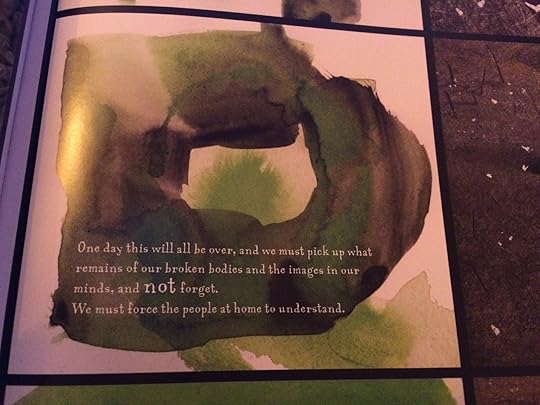
The book recounts war stories and experiences, apparently not only limited to Nash's. Dave McKean managed to brilliantly capture the tone of the stories and Nash's reflections while still express himself. Below are three of my favourite pages:


The last picture fails to appropriately captivate the vividness of the green patches which I found especially gorgeous and moving.

I'd also like to mention the format of the book. It is quite large, probably also in order to be an apt coffee table book, but mostly in order to give the artist more canvas to work on and impress the reader with. Which it does. The back cover shows Nash's memorial plaque, but that is not the only time I felt the profound respect Dave McKean must feel towards Paul Nash.

As any true war story, the memories/experiences are hard to read, utterly haunting but also utterly beautiful (the text as much as the art).
The story tells of the beginning of WWI, how people regarded it as their duty to join and fight, of the reality in the trenches and the horrors of war (first hope, then disillusionment) and of the end - the global one as well as the personal one. Nature is a recurring theme, very important as it was for Paul Nash, symbolizing a multitude of things. But the book also uses the titular black dog as the symbol for many themes from depression and lack of energy to nightmares, war itself and death.
A wonderful tribute to a great artist, a horrible war, anyone who fought and all those who have died in it.
Profile Image for Dave Schaafsma.
Author 6 books32.2k followers
December 7, 2016
One of my favorite books of the year, a fictional biography or historical fiction of the surrealist artist Paul Nash, who survived WWI but was plagued all of his life by the "black dog" of depression. This is a stunning artifact, 12 x 16, 124 pages, lovingly produced, with a multitude of art styles, some of them honoring Nash's surrealistic approach. Some of the writing is in verse, some of it prose, much of it from Nash. The book also includes reproductions of Nash's work, so this is great art in dialogue with great art, and dark, and often exhilarating. The quality of the writing not surprisingly from either of them does not match the art, but that doesn't matter much because the art is of course front and center for both of them. McKean sort of channels Nash's madness and surrealism with some emphasis on his experiences with the war. It's dark genius. I'm not saying it is easy to read, for a variety of reasons, but it is amazing to look at and experience.

Here's some images of Nash's work:

https://www.google.com/search?q=paul+...

Here's Nash's Battle of Britain:

https://www.youtube.com/watch?v=xtMlw...

Here's an hour of McKean talking about his work and showing some of it.

https://www.youtube.com/watch?v=xjWFn...
Profile Image for Drew Canole.
3,179 reviews44 followers
February 18, 2024
I wasn't a big fan of McKean's Cages but the artwork here and storytelling is much improved.

Each page nearly feels like it could have been used as a cover for Sandman. Just incredible quality throughout. Some of the best color work in comics.

The story is pretty elusive, it's a sort of biography Paul Nash but elliptical, poetic, and a focus on dreams.
Profile Image for Hosein.
300 reviews120 followers
June 3, 2025
این کمیک رو نمیتونم درست قضاوت کنم، به نظرم چیز پیچیده‌ایه و در کل من هنوز هم نفهمیدم آثار سورئال رو بر چه اساسی باید رده بندیشون کرد. این کمیک می‌تونه یک چیزی از "خیلی خوب" تا "افتضاح" و "غیرقابل فهم" بره و برگرده. مشخصا خیلی جالبه اگه به پال نش و آثارش علاقه داشته باشین، نویسنده/طراح این کمیک خوب بهشون نزدیک شده و هر کدوم از پنل‌ها مربوط میشن به یکی از آثار نش و در کل، داستان هم یک خطی رو دنبال می‌کنه که تهش می‌رسه به کل نقاشی‌های نش در طول کریرش.

احتمالا برای هر کسی نیست، حتی منم نمی‌دونم خوشم اومد یا نه، ولی حداقلش اینه که جالبه.
Profile Image for Mel.
3,519 reviews213 followers
July 18, 2016
I saw Dave McKean talk about this book on Thursday and was able to pick up a limited edition copy. It is one of the most beautiful books I own. The art work is just incredible. While talking about such issues as war and mental illness it does so with beautiful and intricate images. The story of one man's life and how it was destroyed by war, even though he managed to miss the worst of it. The book is presented as a selection of dreams from his earliest to his last. Very very highly recommended. One I will be reading over and over.
Profile Image for Cintia Andrade.
487 reviews50 followers
June 15, 2018
Já falei que o Dave McKean é meu artista contemporâneo favorito. Nesse trabalho comissionado, ele visita a obra e as notas autobiográficas de Paul Nash, pintor britânico que serviu durante a Primeira Guerra Mundial e tornou-se pintor de guerra depois. Os capítulos são divididos por sonhos, cada um pontuando um momento e um local na vida de Nash. Para cada capítulo, McKean faz uso de expressões artísticas diferentes (e aí eu recomendo que você não folheie o livro antes de ler, que se deixe surpreender pela beleza que cada virada de página guarda). A arte aqui (como não poderia deixar de ser) é o que conduz a narrativa, e a arte não poderia ser mais bonita e comovente. O uso de materiais, cores, texturas, traços e meios que McKean faz é absolutamente único. O livro todo guarda uma atmosfera onírica, seja no texto, seja nas representações metafóricas feitas através de personagens como o cão negro, o caminho de espinhos, o peixe, etc. Pode não ser tão agradável para quem espera uma narrativa linear, é um livro para perder-se. O único porém para mim é que o texto é pequeno demais e a leitura fica um pouco difícil.

Para ver parte da arte comentada pelo Dave McKean: https://www.theguardian.com/books/gal...
Profile Image for Luis Diaz.
104 reviews8 followers
December 25, 2016
I'm coming to this book from an artist standpoint whose been turned on to comics for the balance and clarity of the medium. That to me is the most important thing.

I've been collecting and reading what I call "fine art comics" since the 90's. I was a teenager and my first painted comic was "Judgement in Gotham" by Alan Grant, John Wagner and art by Simon Bisley. I was in love with painted comics from that point on. I read works painted by Kent Williams, Jon J Muth, Sienkiewicz, Dave McKean and a slew of others. I think it works so nicely in this visual medium. I enjoyed the covers by these guys and Dave McKean was an exceptional cover artist for many Vertigo Books. I was always immediately drawn to them. Their design and mixed media approach was uncontested. I bought many just for that.

Years later I began to analyze comics more and more mostly by really taking a look at the great books ever written and illustrated and started to try and decipher why they are so good. I realized that it was the simplicity of the art and the balance between a good story and that "seemingly" simply drawn art. So this takes me "Black Dog" by Dave McKean who "draws" from the life of Paul Nash (another artist). From the first look the work is definitely a more labored approach than his usually comic panel work. (I haven't seen anything like this since his work on Arkham Asylum with Grant Morrison.) He works in many different approaches, but I wouldn't say they are a different style although the book clearly has a unique vision that is a little different from McKean's previous work. Because of the different approaches I found the book to feel more like an anthology of different stories broken up by chapters. I actually went around and read the book sporadically while jumping around and not consecutively for a few weeks. I could not get into it and I don't recall any particular story that really engrossed me much. The art is divine. I almost want to buy the hardback version to keep as a treasure, but I had too many issues with it. I thought it was trying to hard to break from the comic book form and the choice of font was too small although clear to read. There were a couple of chapters where the pen and ink with watercolor/ink as tone was powerful and I would rather have read a book with that look throughout. 100-200 pages of that sort of art would've work better for me so I can really get into that world, but instead you are given these lush paintings, drawings and manipulated digital artwork that tries to do the same in a quicker way and I think it works for some who will read this book. For me I'm over it. I really want my mind to make the images now. (Although it is hard for me to just read a picture less novel.) 15 years ago I and maybe most of the comic book world would be flipped on it's head, but I have since moved on from this approach in comics. I think it really tries to open the landscape to other readers and perhaps this works for them. I for one don't like when comics are made for that audience. I think readers need to embrace the language of comics as its own unique voice. If you have too many hangups with comics I think it's too bad.
Profile Image for Guilherme Smee.
Author 27 books190 followers
July 8, 2018
Ouso dizer que esse é o MELHOR trabalho do Dave McKean seja em arte, mas principalmente em texto. A qualidade poética dos textos de McKean nessa edição aumentaram exponencialmente do experimentalismo de Cenas Marcantes para um existencialismo influenciado pela obra de Paul Nash e suas vivências cruas da Primeira Guerra Mundial. Eu havia falado que o trabalho de McKean nas ilustrações guardava um efeito anos 90, mas preciso dar o braço a torcer. A arte é atualíssima. A vivacidade das cores são perfeitas, saltam aos olhos. Um exemplo é a sequência em que Paul Nash entra dentro do seu coração e precisa se desvencilhar das veias e artérias cheias de espinho em um vermelho encarnado. Ou as pinceladas verdes da natureza de esbravejante selvageria instintiva em outro capítulo. McKean também emula o traço "enquadradado" das pessoas de Paul Nash. Porém, parece que eles ganham uma dimensão mais esculpida e ao mesmo tempo mais maleável. Outra cena estupefante é o Leviatan mesclado com um Zeppelin sobre a Londres em um clima art-déco do Metrópolis de Fritz Lang. Enfim, Black Dog, é um deleite para a imaginação e para a realidade, enquanto em suas palavras revela a crueldade inimaginável e irreal de uma das maiores feridas da história da humanidade.
Profile Image for Ilana (illi69).
630 reviews188 followers
January 23, 2019
Incredibly powerful whether you are familiar with the artist and poet Paul Nash or not. It speaks of all the horror or WWI and of living with depression, aka the Black Dog, primarily in images, and here Dave McKean uses a range of highly expressive styles that cannot fail to grab you by the guts. Now I need to familiarize myself with Paul Nash’s original work so I can better appreciate what McKean’s references were. 4.5
Profile Image for Jéssica.
67 reviews
February 10, 2019
Concebido por encomenda pelo evento 14-18 Now, realizado no Reino Unido por ocasião do centenário da Primeira Guerra Mundial, Black Dog (2018) mal acabou de nascer e já é um exponencial exemplo do quadrinho-arte. Nesta obra intensa e instigante, Dave McKean - multiartista bastante prolífico que já emprestou suas tintas às capas da lendária série Sandman - faz um apanhado biográfico de Paul Nash, artista britânico famoso por suas retratações da referida guerra, na qual lutou e com a qual muito sofreu.

Memórias da infância, dos pais e do casamento; o alvorecer da guerra e seus percursos mais inóspitos; momentos de medo, mistério, dor e morte: todas essas cenas são construídas pelas tintas e traços de McKean com a genialidade de um grande artista. Cada capítulo nos oferece um estilo, um humor, uma experiência gráfica.

A imersão de quem lê nos quadros ora fechados, ora dotados de total amplitude é intensa e completa. McKean nos leva a entrar pelos sonhos de Paul Nash, boquiabertos e atônitos. Meu primeiro quadrinho do ano e, com certeza, um dos melhores da vida! Uma excelente escolha da @darksidebooks, e que venham as próximas!
Profile Image for Alex Sarll.
7,061 reviews363 followers
Read
May 8, 2017
A gorgeous, intense and fractured graphic biography of war artist Paul Nash, never merely pastiching his style but capturing a kindred sense of trauma and of the Great War as a fundamental disjunction in the world. As ever, McKean bends multiple media to his task, yet always in pursuit if not of the story then certainly of the mood, never as a mere exercise in virtuosity. It's not all trenches, of course; there are childhood idylls, a brutal school, chats with the smart set in a glamorous London cafe...but none of it can altogether escape the spectre of that eponymous dog. Co-commissioned by 14-18 Now, too, who as with the poppies at the Tower seem to have done a very good job of supporting meaningful responses to a very difficult brief of commemorating without either celebrating or railing against.
Profile Image for vonblubba.
229 reviews3 followers
August 15, 2017
Dave McKean is probably my favorite living artist. His drawings/pictures/paintings (don't know exactly how to call them) never fail to touch something inside my soul. This time that's even easier, considering the subject: the experience during WWI of painter John Nash. I admit to having no idea who Nash was before reading this, but that didn't make enjoying black dog any harder. The general mood is very dark and gloomy, something that McKean's style has no trouble at all representing effectively. Text is well crafted too and nicely complements the visuals. I see no reason at all why you shouldn't read this.
Profile Image for ReadBecca.
860 reviews100 followers
August 10, 2018
An AMAZING sort of surrealism meets biography, graphic novel about the experiences, trauma, and PTSD/shellshock of WWI war artist Paul Nash.
3 reviews
December 20, 2019
Visualmente, de lo mejor que he leído este año, eso sí, no he entendido nada, hulio. Aunque creo que se da un caso de "no eres tú, soy yo".
Profile Image for Rinaldo.
279 reviews50 followers
May 29, 2019
5/5

A masterpiece. Dave McKean has always been one of my favourite visual artists of all time. I'm a big fan of his works in Sandman graphic novel covers, Mirormask movie, and The Magic of Reality illustration. With projects ranging from album cover to full featured films, McKean body of work is incredibly diverse and visually versatile.

In this project, McKean was commissioned to create a biography/response to Paul Nash's dreams. Paul Nash (1889-1946) was a renowned British war painter. His work combined the traditional landscape painting with surreal warscapes of World War I. In a way, this graphic novel is McKean's attempt to emulate Nash's paintings while capturing/visualising his fever dreams. The result is a truly bizarre chimaera: profoundly beautiful at times, and hauntingly horrible at others.

McKean once again proved his versatility as an visual artist, employing his full arsenal of artistic flairs, from distorted Cubist figures drawn with ink to textural multimedia collage, from macabre still life photographs to earthy brushstrokes emulating Nash's style. These strong visuals accompany Nash's text depicting his musings of his childhood, his uneasy relationship with his father, the horror of war, his anger and trauma after the war, his survivor guilt, his attempt to making sense of everything about the war and his identity as a war artist. The juxtaposition of the feverish visual and the equally delirious text is a greater sum than its parts, guaranteeing layered narrative on reread.

This graphic novel is a must have for aficionados out there: from history buffs, visual artists, illustrators, surrealists, poets, and everyone in between.

I am no longer an artist interested and curious, I am a messenger who will bring back word from the men who are fighting to those who want the war to go on for ever. Feeble, inarticulate, will be my message, but it will have a bitter truth, and may it burn their lousy souls.
Profile Image for Derek.
1,076 reviews81 followers
August 14, 2019
Paul Nash was a British surrealist painter and war artist, as well as a photographer, writer and designer of applied art. Nash was among the most important landscape artists of the first half of the twentieth century. He played a key role in the development of Modernism in English art.

The Dreams of Paul Nash is an amazing, jarring adventure into the mindscape of the painter. Dave does such a good job and holding back and giving us the basics without much commentary, especially about war. We make all the assumptions for ourselves. Still, it's a great contrast seeing these two forces art and war/destruction tussle it out. Lots of great quotes, but the below stand out as pure genius insight.

"In war, and in peace, life is a sniper's alley."

&

"Every time I return to my private landscape, I understand more deeply that our sense of the natural world as a constant, benign equilibrium is far too simplistic. Nature is a dynamic, constantly changing, fpuxijg, complex chaos, and we are only leaves blown about by these forces - a minor component, an infestation, a virus. And when I'm not here, when I'm out there in the conscious world, I realise that so long as there are two people remaining in this world, there will be war. So what can I do?"

&

"Art is an empathy machine. Art allows one to look through a fellow human's eyes. That is all I can do. That is our only hope. I will bring back words and bitter truths to those who want these wars to carry on forever. I hope my ochres and umbers and oxides will burn their bitter souls."
Profile Image for Michael.
3,385 reviews
February 19, 2024
Vivid, visually stunning, hallucinatory visions of life and war, building an image in your mind that's greater than the sum of the individual moments. Terrific.
++++++++
Reread, still a masterpiece. Best to spend a little time Googling Nash's work to see how vividly McKean incorporates it into his own telling.
Profile Image for Chad.
10.4k reviews1,062 followers
November 2, 2016
A terribly boring book with beautiful Dave McKean art. Paul Nash was an artist and soldier in WWI. McKean has taken his writings and illustrated them. I found it a struggle to get through as there's no real story here, just Nash's musings.

Received an advance copy from Dark Horse and Edelweiss in exchange for an honest review.
Profile Image for Juan Fuentes.
Author 7 books76 followers
April 10, 2022
Tendría que estar prohibido escribir y dibujar -pintar- tan bien. No es un cómic, es una obra maestra.
Profile Image for David.
Author 5 books38 followers
February 26, 2020
I confess to not knowing who Paul Nash was. However, I know Dave McKean from his artwork on Sandman and various album covers and consider myself a fan. The book jacket informed me that Nash was surrealist painter that served in World War 1. As I'd recently seen 1917, I was intrigued.

Nash made notes of his dreams, which are included in the text, and are arranged in a mostly chronological fashion among the events that shaped his life. Even before experiencing the horrors of war, Nash grew up having to cope with his mother's mental illness. And boarding school with its sadistic and liberal application of physical discipline for failure only made matters worse. Of it, he wrote that it:

"...was ideal training for an infantryman's life in the trenches. It taught me nothing worth speaking of, it answered none of my questions, it required only a kind of desperate obedience, and a stoic acceptance of the constant threat of sudden and terrible violence."

The book is heavy on observation, interpretation, and introspection. One passage that really resonated with me was this:
Peel away the layers
Strip away the nerves and the synapses and senses
Cut away the skin and these paper-thin defenses
Underneath the son is the father
I'm defined by him
And in opposition to him.
I've tried to make judicious changes
Cut down the anger, add a little patience
I've tried to wash some colour through his pages
Swimming against his genes
His influence in my bloodstream.

The artwork is fantastic. Comparing McKean's previous work to Nash's, I can see the influence. In this collection, McKean pays homage to Nash's work, but takes on a darker tone as befitting the subject matter. The sketches range from hyper-real to abstract to surrealistic. Most of the color palette is dominated by earth tones, both dark and bright, to convey scenes ranging from ominous dread to natural tranquility. McKean saves sharp color contrast—most notably his use of red—to draw the eye in to evoke heightened emotional response to danger, violence, and horror.

Recommended for McKean fans and introspective types.
Profile Image for Joshua.
Author 2 books38 followers
April 14, 2021
Paul Nash is an artist whose work I'm only briefly aware of, and would have most likely missed if it were not for this book. I'm a fan of McKean, not solely because I've read just about every Sandman book I can get my hands on, but because the man's body of work constantly pushes the boundary of what is possible in Visual art, and what happens when limitless imagination, and a bit of multi-media, can just run free.

Black Dog follows the dreams and diaries of Paul Nash as he reconciles his time fighting in the First World War and recognizing the impact it has had upon his life, his country, his friends and loved ones, upon his art, and ultimately his own humanity. This book is filled with stunning, beautiful imagery that, even at its most horrific, made me pause and take my time as I followed Paul through this hell and his attempt to get back into the world.

Black Dog is a book that any fan of Dave McKean will appreciate. I can't recommend it enough.
Profile Image for Rich Stoehr.
269 reviews43 followers
March 8, 2020
"I am a war artist without a war."

A strange, wandering meditation on art and war - 'Black Dog: The Dreams of Paul Nash' is one of the most unique graphic novels I've ever read.

Dave McKean brings his multifaceted style to the thoughts and memories and nightmares of another artist - Paul Nash, who was also a soldier in World War I. Through terrifying, strange, beautiful imagery, he brings the words and experiences to life from a century ago. I'm not sure McKean is the first artist I would have thought of for a project like this - but now that I've read it, I don't think anyone else could have done it justice as he did.

Art and war are often seen as opposite ends of a spectrum of human experience - one expresses beautiful fantasy, the other terrible reality. In 'Black Dog,' Dave McKean shows us that art can also terrify, and war can also inspire.

"You find beauty in the details, even here, they are everywhere."
Profile Image for Maricruz.
528 reviews68 followers
December 31, 2018
Hay cómics bonitos y luego están los de Dave McKean, que hace obras de arte que rebasan el formato viñetil. Cuando piensas que lo que hace en una página es impresionante, pasas a la siguiente y te encuentras con algo que parece aun más cautivador. Las últimas páginas dan fe de lo minuciosa que ha sido la documentación llevada a cabo por McKean sobre la vida de Paul Nash y sobre la Primera Guerra Mundial, así como de su alta exigencia consigo mismo a la hora de plasmar lo que tenía en mente ("intentos fallidos", dice el tío, pa matarlo). El resultado puede verse como un homenaje no solo a Paul Nash, sino también a la capacidad del arte de aportar un poco de cordura a un mundo lleno de sinsentido.
Profile Image for Jason Bootle.
263 reviews10 followers
August 4, 2019
Dave McKean is an incredible artist and his work always feels part of dreams so this paring is perfect. When he draws people and 'still-life' perspective his skills shine through. Couple this with the harrowing narrative of Nash's dreams dealing with the effects of WW1 and we have a remarkable novel.
Profile Image for Jeff.
1,353 reviews27 followers
December 30, 2024
“Black Dog” is tribute to WWI veteran and war artist, Paul Nash. The “story” (really a series of non-linear memories and dreams) is a bit hard to follow here, but the primary focus is the art here. Gorgeous, disturbing watercolor paints of war and the ever-present black dog of Nash’s dreams.
Displaying 1 - 30 of 120 reviews

Can't find what you're looking for?

Get help and learn more about the design.