They are the favorite foes of many a party of adventurers. In these pages, the drow come to life, their culture and powers detailed fully for the first time. This guide presents new rules new spells, new magical items, insight into the mysteries of Lolth, Monstrous Compendium entries for related monsters of the Underdark - and much, much more.
Ed Greenwood is the creator of the Forgotten Realms fantasy world, which became the setting for his home D&D game in 1975. Play still continues in this long-running campaign, and Ed also keeps busy producing Realmslore for various TSR publications.
Ed has published over two hundred articles in Dragon magazine and Polyhedron newszine, is a lifetime charter member of the Role Playing Game Associaton (RPGA) network, has written over thirty books and modules for TSR, and been Gen Con Game Fair guest of honor several times.
In addition to all these activities, Ed works as a library clerk and has edited over a dozen small press magazines.
Invented the character Elminster from the popular Forgotten Realms RPG series. Currently resides in an old farmhouse in the countryside of Ontario, Canada.
This is an odd book. I mean, right there in the title it should be about the dark elves, but much of the book (~50 pages) is devoted to three topics: spells, magical items, and monsters. The chapter on religion describes the gods in terms of divine slot machines dispensing winnings to their worshippers, including percentage chances of successfully calling on divine aid, and a comparatively small number of pages is about the actual culture, practices or history of the drow.
In fact, it's mostly set up like a monster book. There's a bunch of focus on spells, magic items, and monsters, because that's that way the PCs are likely to be interacting with the drow. The cultural focus is on how the drow are weird and creepy, and how they're super paranoid and spend all their time fighting each other and sending patrols to patrol the areas near their cities, and also matriarchal in a kind of insulting way (I mean, D&D's most famous matriarchy is ruled by psycho dominatrices? Uh...). Drow wizards and priests are better--a.k.a. can get to higher level--than surface-elven wizards and priests for no obvious reason other than to make them scarier. There's a lot about architecture.
I suppose this isn't that surprising. Nowadays the lone good drow who hates the ways of their people and wishes only to feel the sunlight on their face and turn their back on their evil upbringing and blah blah blah is a stock stereotype among D&D players, but back when this book was published that wasn't the case. Drow were much more likely to be antagonists than protagonists, so it makes sense that temples to Ghaunadaur are described more like dungeons that the PCs will be looting instead of legitimate houses of worship, albeit worship of a blood god who demands sacrifice.
The gamey reasons for a lot of setting fluff that has accumulated around the dark elves are also obvious here. So the drow send out tons of patrols, because that gives the PCs a relatively equal group of opponents to fight who will also have fighters, wizards, and so on. But to really be an equal opponent for anyone who's willing to go into the Underdark, those dark elven patrols need to have magical items, but then the PCs can loot the bodies if they win and greatly increase their magical power. What to do? Well, see, the Underdark has "radiation" all over, and that's why drow gear is magical! It's not enchanted, it's irradiated. And if you take it back to the surface and out of the radiation, it stops working. It sounds silly, but not too silly, and it's a good in-world reason that has ramifications that aren't nonsensical. Some places have stronger radiation, and that's where cities tend to be built, but they also attract monsters, so there's a constant tension between the Underdark races and the various hyperpredators over territory.
Also, the radiation occasionally mutates monsters so you get two-headed purple worms or other crazy horrors, which is awesome. I've always thought D&D was low on the horrible chimeric monsters coming out of the wild places scale, and anything that increases it is a net plus in my mind.
Anyway, as a guide to how dangerous the Underdark is and how to use the drow as opponents, Drow of the Underdark is top notch. The spells are sufficiently weird and scary, with examples like Acid Bolt or a spell to grow big bat wings or a spell to traverse webs safely or a spell that turns someone's arm into a spider that starts to eat them alive. Magical items like the rod of tentacles or a ring that protects against poison or giant jade spider statues that animate to fight intruders. Descriptions of temples of the drow gods sufficiently detailed enough that it would be easy to build a dungeon, either literal or metaphorical, and put them in as locations. Acid-spitting lizards. Telepathic lightning bats. Spiders that can kill dragons in single combat. Underground dragons. There's plenty here to provide a challenge for PCs who want to delve into the depths of the earth.
However, if you're looking for an in-depth source on drow culture because you want to play members of a drow merchant or noble house, or participate in drow political machinations, Drow of the Underdark is a lot less useful. Other than noting how the drow are a nest of vipers and the priestesses run everything, but unpredictable because Lolth changes her mind all the time, all of which you probably knew before you read this book, there isn't that much that's useful for games where the drow are the protagonists. There's no indication of how their society maintains itself other than "because Lolth," and that's fine if the drow are the sinister monsters underground who eat babies and raid for slaves, but it can break verisimilitude pretty quickly if the PCs are part of that society. It's still useful for the crunch, but the fluff won't be that helpful.
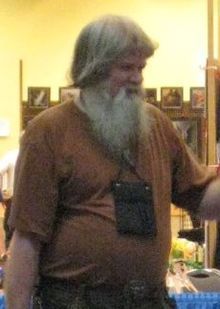
Another of those obsolete books that I'm only adding and commenting on to push up the number of comments that I have on Goodreads. Okay, I probably have read this book, and I know that I did own it (and probably still do, though it may, if I still own it, be sitting in a crate up at my parents house not gathering dust, namely because the crates are sealed). This is the second of the monster resource books, the first one being the Draconomicon, though I am not sure if they released any more after this one. I do know that when 3rd Edition came along, a whole plethora of books were released, including a book on humanoids was released as a player accessory (actually, they had one for 2nd Edition as well). I'm not really sure what to make of this book, though I can say that it was written by Ed Greenwood, and seriously I never knew Ed Greenwood looked like this:
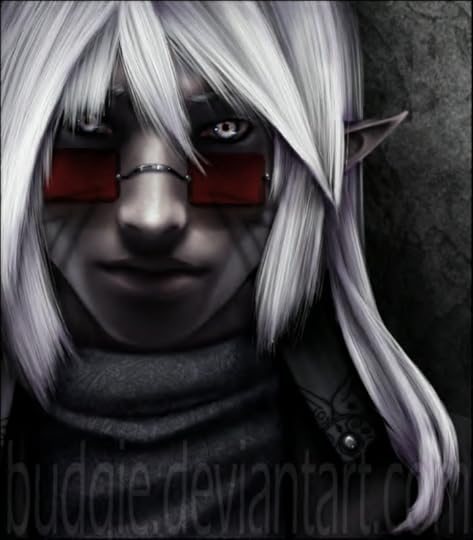
Man, it seems like this guy has taken his career as a fantasy writer a little too far. In fact it seems that he is trying, and failing, to grow an Elminster beard because, well, hair only grows so long before it ceases to grow and simply develops split ends. I ought to know because I get my hair cut when, well, I feel like it, but there was a time when I simply did not actually get my hair cut and let it grow as long as I liked (which was a form of rebellion against my school who would penalise you if you had your hair too long). However I am not going to go down the track of the over strict private school here because this is about a book about drow, and about a writer who seems to want to be a magic user in a fantasy world, but instead is trapped in the real world as a successful writer of fantasy materials. I know what I would prefer to be (a successful writer of fantasy materials, not a magic user in a fantasy world – get off the drugs). As for the drow, well I have written a lot about the drow elsewhere and really do not need to repeat myself here. As for this book, well I guess it is because drow are really popular (because they are elves and that are, well, incredibly evil) that they produced this book. Mind you, I prefer dragons, but here's a picture of a drow anyway.
Though this is also pretty cool, except that I think that sunglasses underground may be a little redundant.