This booklet presents the Old Empires for DMs and players alike. Descriptions of all the major cities and towns, maps of the most important ones, information on the people places economics, geography, and cultures of these countries are within these pages.
Prepare, then, to enter the realms of god-kings and pharaohs, of strange magic unknown even to the likes of the Red Wizards of Thay. These are the Old Empires.
The tenth FR-series book kept with the general geographical format of the series, but the book is 96 pages instead of the usual 64. The detached cover is only two panels, and gives a cutaway view of a pyramid and a diagrammic map of a chariot racetrack (both in service of the suggested adventures section) on the interior. And for the first time, when the cover says '2nd Edition', it's actually true; there's even a selection of new monsters in the back in AD&D 2E format, that you could photocopy and stick in the Monstrous Manual. (Otherwise you're cutting up the book, which would make the first few pages fall out. And they're not arranged so you could stick them all where needed, though they do stick with the one monster per page format.)
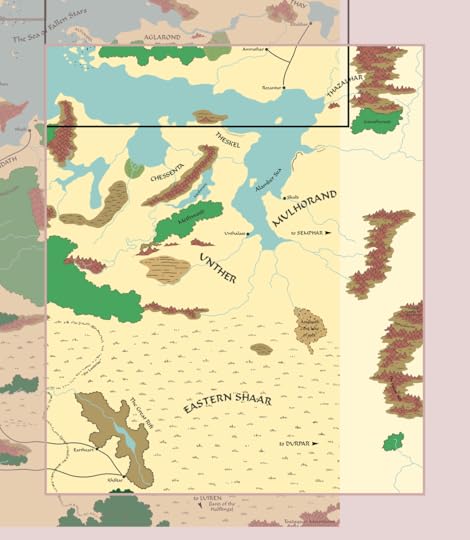
However, the general format has been for each new poster map to be full bleed, and in 30-mile/inch scale, so that you can tile it with all the others from the series. In this case, the main map only takes up a little over half the sheet, and has the standard Forgotten Realms border around it. The rest of the sheet has maps for two cities (other than this and the inside cover, there are no other location maps). The reason for the border disrupting the ability to tile the maps is that this one is 72 miles/inch, so it fits with no other previous map. The area covered here is much larger (despite not being a full sheet), and about a third of it is off the east edge of the original grey box map.
Region the FR10 map covers, showing its overlap with FR6's detail map.
Part of the background of the Forgotten Realms was that while the time of Man was still just beginning, it had been long enough since the elvish kingdoms faded for human empires have already come and gone. Old Empires deals with the remnants of the age of the first human empires, dealing with three survivors of that period. As such, the book roughly breaks down into four sections: Mulhorand, Unther, Chessenta, and various things common to the area as a whole (spells, items, monsters, etc).
Mulhorand gets top billing in the module, being presented first, and is the easiest to come to grips with. Some of that is because it is very thematically presented as an Ancient Egypt analogue. This is the type of thing that the Realms had avoided, though this is apparently how Greenwood conceived of this area: the surviving empires resemble older Earth civilizations, and the seepage of Earth deities seen in the grey box (Loviatar, Mielikki, Oghma, Silvanus, Talona, and Tyr) is a full flood here. Looking closer, this is New Kingdom Egypt, still powerful, but has lost much of its former power and reach (Thay used to be part of Mulhorand until about four hundred years ago).
Unther is harder to place until you look at its gods, which come out of the Babylonian chapter of Legends & Lore (aka Deities & Demigods). The two countries are presented as having been at peace for ages, and generally cooperative... which okay, is partially true of later Earth history when they're having to deal with Hittites and such. They were also much further separated than Unther and Mulhorand, which makes collisions much more likely between this pair.
Chessenta is supposed to be more like Ancient Greece, and the parallels are there. It's not a real country, but a collection of city states of wildly different character constantly fighting with each other. There are obvious Athens and Sparta analogues. On the other hand, the terrain isn't nearly as broken up as it should be for such a concept, and the various cities were supposedly colonized by Unther and broke away some seven hundred years ago.
Naturally, the gods are more personally involved here, and the pharaoh of Mulhorand is literally an incarnation of Horus. It is explained that while the gods here actually live in the outer planes, like other AD&D gods, they have a manifestation which dwells in a holy place in the prime material plane, and may have a fully-mortal incarnation as well. Both of these are well below the power of the actual gods as given in Deities & Demigods, and the incarnations are stated to be more equivalent to a high level character. Better, they get a look from the 2E viewpoint of the new optional rules for clerics of particular gods. The end of the Mulhorand section notes that the manifestations of the gods became the equivalent to incarnations, and the incarnations went into a coma during the Avatar trilogy. Whether the manifestations take the part of the avatars is not said, but likely. And what they do afterwards in the wake of this experience is handwaved off for the DM to decide.
The break up of the book into sections for the three countries also means that there are good, separate, sections to describe the overall population and society of the country, and callouts on languages and ethnic background, in addition to the normal geographical survey. Even better, there are things happening in each of these places. In Mulhorand, the pharaoh Akonhorus II has just been assassinated by the cult of Set, leaving a boy-king(-god) on the throne. There is palace intrigue to go with this, and the cult is trying to overthrow the country.... Unther is ruled by Gilgeam (a Gilgamesh stand in) for the last two thousand years, and has become increasingly unstable and repressive. Rebellion is coming, if not already here. Chessenta is at war. Again. Worse, the leaders of one city, Luthceq, are madly trying to kill every mage they can, including sending assassins after prominent high-level magic users across the Realms.
All of this and more, is developed in the main text, and then carried forward in the adventures section. There's six pages of suggestions that almost all tie directly into the various large-scale happenings outlined in the module. The last one is nearly a mini-campaign in itself, with a tournament to determine the successor to the king of Mourktar, one of the cities of Chessenta. Despite starting with a field of 64 contestants, the tournament is well organized to bring it down to a manageable 16 (including any involved PCs) fast. I still like several of the other ideas more, but this is a good look at a recurring "tournament arc" idea.
Lore-wise there is a lot here not covered before. The history of some of the earliest human empires is covered (from which these are descended), and the 'lands surrounding the Old Empires' section mentions Semphar, Murghorn, Raurin, Durpar, Veldorn and the Plains of Purple Dust, which all lie to the east or south of this map, which is already at the south edge of the original map, and goes off the east edge. These would see more attention in The Horde and FR16 The Shining South, but were largely new here. And this book is still the primary source for the area; since this product, Mulhorand and Unther got part of a chapter in Lost Empires of Faerun, and Chessenta was the subject of an article in Dungeon #178, but there's been nothing this extensive.
Maybe it's not necessary for another product to focus on the area. This module already does a great job outlining an interesting setting, and has everything you really need to get going with it. I'd say this is one of the better books in the FR series, and the extra page count was put to real good use. The biggest problem is the fact that you have ancient-style societies alongside the European medieval style of a normal D&D setting, but ignoring the incongruity seems to work just fine.
Also, the area is far enough away that ties to the main part of the Realms are relatively weak, and a DM could drop this into a section of his own world without having to rework major parts of the book. A DM wanting to get a better feel for Chessenta in AD&D might also want to look at HR6 Age of Heroes that came out three years later.
An attempt to bring Greece, Egypt, and Babylon into the Forgotten Realms 27 August 2013
Actually, now that I think about it, and also looking at the dates of publication of these sourcebooks, I actually think they were originally written for the 1st Edition of Dungeons and Dragons, and it was only when 2nd Edition came about that they adopted the new model. I believe by the time this one was produced 1st Edition had simply become a collectors item, or played by people who simply did not like change, or simply preferred the more clunky and restrictive version of the game (the one where if you wanted to be a bard you had to advance as a fighter and then a thief).
This particular resource (if I can call it a resource because it deals with fantasy nations in a fantasy world) focuses on some empires on the southern side of the Inner Sea in the Forgotten Realms. However this is one of the aspects of the Realms that simply rubbed me up the wrong way. Basically these three kingdoms are next to each other, and one of them is Greece, another Egypt, and the third I believe is supposed to be Ancient Babylon. To me it seemed as if they simply wanted to create some fantasy kingdoms where people for to play the Greeks, or the Egyptians (though I notice that there is no Rome), or to have campaigns with a similar flavour but still be in the Forgotten Realms.
To me it felt as this was somewhat tacked on and did not really add to the consistency of the setting as a whole. There have actually been products released that provide information on gaming in these real world cultures, such as Ancient Greece and Ancient Rome, and I believe that there even was one that involved campaigning on a pirate ship in the Caribbean.
Another thing, totally off topic, is the use of guns in the fantasy world. Second edition had brought in the arquebus, which was a precursor to the blunderbus, and they also had a cannon as a siege weapon. However that was the extent of the guns that went with the game at that time. Further rules revisions where brought in to deal with other guns, and even modern guns, and people have been writing up such rules since 1st edition. With 3rd edition you had d20 Modern and d20 Future, which gave you rules for spaceships and machine guns, however in the Forgotten Realms, guns simply did not exist.
There is always the ongoing debate as to whether gunpower would work or not. Some say it does, others say it doesn't. One of the reasons is that smart alec players like to use player knowledge to create gunpowder. However, simply saying 'this is a fantasy world – gun powder does not work' is a bit lame. I guess the question that should be asked is 'so, how did your character work that out, and if your character does want to work it out, are you happy to have him resign from adventuring for a couple of years, and then run the risk not not actually discovering it?' Mind you, I have never really had that happen to me, and when it does, I either ignore it, or simply say 'don't be stupid'. No need to write entire articles on whether gunpowder works in a fantasy world or not.
Before I had bought this book the only Dungeons and Dragons books I had used were borrowed from the library. I remember purchasing this book from a comic store a short distance from my childhood home and then burying myself in it, enthralled by the worlds described within. I am sure that if I went back and read it again it wouldn't be so amazing, but at the time it affected me to the point that teachers in school noticed I had a different writing style after I had read that book and decided that was how everything should be written.