

What do you think?
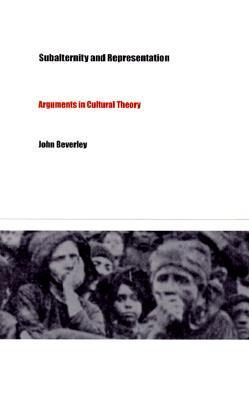
Subalternity and Representation: Arguments in Cultural Theory
The term “subalternity” refers to a condition of subordination brought about by colonization or other forms of economic, social, racial, linguistic, and/or cultural dominance. Subaltern studies is, therefore, a study of power. Who has it and who does not. Who is gaining it and who is losing it. Power is intimately related to questions of representation—to which representations have cognitive authority and can secure hegemony and which do not and cannot. In this book John Beverley examines the relationship between subalternity and representation by analyzing the ways in which that relationship has been played out in the domain of Latin American studies.Dismissed by some as simply another new fashion in the critique of culture and by others as a postmarxist heresy, subaltern studies began with the work of Ranajit Guha and the South Asian Subaltern Studies collective in the 1980s. Beverley’s focus on Latin America, however, is evidence of the growing province of this field. In assessing subaltern studies’ purposes and methods, the potential dangers it presents, and its interactions with deconstruction, poststructuralism, cultural studies, Marxism, and political theory, Beverley builds his discussion around a single, provocative question: How can academic knowledge seek to represent the subaltern when that knowledge is itself implicated in the practices that construct the subaltern as such? In his search for answers, he grapples with a number of issues, notably the 1998 debate between David Stoll and Rigoberta Menchú over her award-winning testimonial narrative, I, Rigoberta Menchú. Other topics explored include the concept of civil society, Florencia Mallon’s influential Peasant and Nation, the relationship between the Latin American “lettered city” and the Túpac Amaru rebellion of 1780–1783, the ideas of transculturation and hybridity in postcolonial studies and Latin American cultural studies, multiculturalism, and the relationship between populism, popular culture, and the “national-popular” in conditions of globalization.
This critique and defense of subaltern studies offers a compendium of insights into a new form of knowledge and knowledge production. It will interest those studying postcolonialism, political science, cultural studies, and Latin American culture, history, and literature.
This critique and defense of subaltern studies offers a compendium of insights into a new form of knowledge and knowledge production. It will interest those studying postcolonialism, political science, cultural studies, and Latin American culture, history, and literature.
224 pages, Paperback
First published December 1, 1999
Ratings & Reviews
Friends & Following
Create a free account to discover what your friends think of this book!
Community Reviews
Displaying 1 - 2 of 2 reviews

April 7, 2022
A key text in Latin American Subaltern Studies. The first three chapters were the strongest for me and demonstrated for me subaltern studies’ relevance for a LatAm context. For the latter half of the book, it became a little difficult for me to track a sustained argument but rather what unfolded was a series of challenges on how the left can reanimate a new political project in the wake of the failures of communism. My sense is that the last three chapters were probably the most important in its contribution to subaltern studies and political theory more generally, and I intend to re-read these a little more slowly and with more careful annotation.

May 31, 2017
Note from Thesis I paper:
Beverley (1999) affirms that instead of getting stuck on defining the ‘other’ as a subject/object, to see, instead, the state of the ‘other’ as a living condition.
Beverley (1999) affirms that instead of getting stuck on defining the ‘other’ as a subject/object, to see, instead, the state of the ‘other’ as a living condition.
Displaying 1 - 2 of 2 reviews