Jump to ratings and reviews
Rate this book

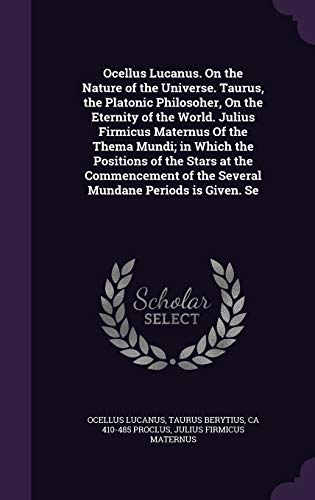
Ocellus Lucanus. On the Nature of the Universe. Taurus, the Platonic Philosoher, On the Eternity of the World. Julius Firmicus Maternus Of the Thema ... of the Several Mundane Periods is Given. Se

Rate this book
This work has been selected by scholars as being culturally important, and is part of the knowledge base of civilization as we know it. This work was reproduced from the original artifact, and remains as true to the original work as possible. Therefore, you will see the original copyright references, library stamps (as most of these works have been housed in our most important libraries around the world), and other notations in the work.

This work is in the public domain in the United States of America, and possibly other nations. Within the United States, you may freely copy and distribute this work, as no entity (individual or corporate) has a copyright on the body of the work.

As a reproduction of a historical artifact, this work may contain missing or blurred pages, poor pictures, errant marks, etc. Scholars believe, and we concur, that this work is important enough to be preserved, reproduced, and made generally available to the public. We appreciate your support of the preservation process, and thank you for being an important part of keeping this knowledge alive and relevant.

118 pages, Hardcover

First published January 1, 1831

29 people want to read

About the author

Ocellus Lucanus

10 books1 follower

Ratings & Reviews

What do you think?
Rate this book

Friends & Following

Create a free account to discover what your friends think of this book!

Community Reviews

5 stars
1 (16%)
4 stars
2 (33%)
3 stars
1 (16%)
2 stars
2 (33%)
1 star
0 (0%)
Displaying 1 of 1 review
Profile Image for Per.
1,238 reviews13 followers
March 11, 2021
https://www.biodiversitylibrary.org/i...
https://universaltheosophy.com/pdf-li...

This collection of translations and notes by Thomas Taylor includes the full text of On the Nature of the Universe by Ocellus Lucanus as well as extracts from On the Eternity of the World by Taurus the Platonic Philosopher, Of the Thema Mundi by Julius Firmicus Maternus, Select Theorems of the Perpetuity of Time by Proclus and copious notes from Thomas Taylor with quotes from further ancient philosophers.

The focus is on the eternal question of whether the world and the universe has been created, or if it was always existing.

For science, truly so called, is, as Aristotle accurately defines it to be, the knowledge of things eternal, and which have a necessary existence. Hence it has for its basis universals, and not particulars; since the former are definite, immutable, and real; but the latter are indefinite, are so incessantly changing, that they are not for a moment the same, and are so destitute of reality, that, in the language of the great Plotinus, they may be said to be "shadows falling upon shadow, like images in water, or in a mirror, or a dream."


Besides giving the answer to the eternal question, the cosmology leading to hot/cold/dry/moist and fire/air/water/earth is explained.

In that part of the world, however, in which nature and generation predominate, it is necessary that the three following things should be present. In the first place, the body which yields to the touch, and which is the subject of all generated natures. [...] Hence matter (or a universal recipient) is necessary to the existence of generation.
The second thing which is necessary, is the existence of contrarieties, in order that mutations and changes in quality may be effected, matter for this purpose receiving passive qualities, and an aptitude to the participation of forms. [...] these powers are the hot and the cold, the dry and the moist.
Essences rank in the third place; and these are fire and water, air and earth, of which the hot and the cold, the dry and the moist, are powers.


N.B. According to https://en.wikipedia.org/wiki/Ocellus..., a pseudepigraphic work, "On the Nature of the Universe", was attributed to him, and the citation of its author nowadays appears as Pseudo-Ocellus Lucanus. Make of that what you will, Thomas Taylor makes a good case for the work to be authentic; either which way, the text is interesting in its own right.

My clippings: https://www.evernote.com/shard/s2/sh/...
Displaying 1 of 1 review

Can't find what you're looking for?

Get help and learn more about the design.