In hospital Dr Sam Parnia faces life and death issues every day. Through his work in critical care, he became very interested by some of his patients' accounts of the experiences that they had while clinically at the point of death. He started to collect these stories and read all the latest research on the subject. He then decided to conduct his own experiments, and his work has culminated in this extraordinary book. Picking up where Raymond Moody's "Life After Life" left off, this new, updated edition of Dr Parnia's ground-breaking study explores the answer to the ultimate what really happens when we die?
Plato, century IV, BC, in his Republic, spoke of a "trip in the darkness accompanied by guides”.
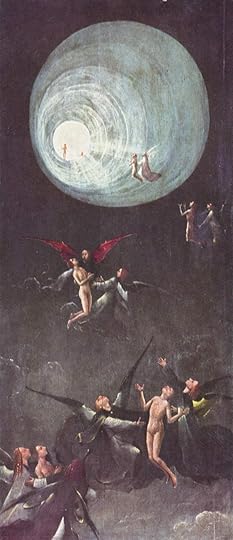
Dutch painter J. Bosch made the famous painting “Ascension to heaven" in the 15th century.
In 1892, the Swiss geologist Heim published his account on near-death-experience: “a sudden revision of the past…time is much expanded”.
In the 1980’s, there were “reports of negative experiences of near death, involving “demons and zombie-like creatures, tortures….or due to an excess of carbon in the blood”.
Expert Sam Parnia writes that both in Religion and Culture there are common aspects when dealing with the near-death experience; it’s (1) an extracorporeal experience; (2) may imply contact with ancestors or diseased ones, (3) with light and peace experiences and (4) there are distinct frontiers between the dead and the living ones.
Very interesting, the psychologist Kenneth Ring index and the Greyson scale of NDE. Dec 6, 2011.
The largest world-study on NDE has been published; next, some of the conclusions:
"-The themes relating to the experience of death appear far broader than what has been understood so far, or what has been described as so called near-death experiences.
- In some cases of cardiac arrest, memories of visual awareness compatible with so called out-of-body experiences may correspond with actual events.
- A higher proportion of people may have vivid death experiences, but do not recall them due to the effects of brain injury or sedative drugs on memory circuits.
- Widely used yet scientifically imprecise terms such as near-death and out-of-body experiences may not be sufficient to describe the actual experience of death. Future studies should focus on cardiac arrest, which is biologically synonymous with death, rather than ill-defined medical states sometimes referred to as ‘near-death’.
-The recalled experience surrounding death merits a genuine investigation without prejudice".
Question n % (1) Did you have the impression that everything happened faster or slower than usual? 27 27 (2) Were your thoughts speeded up? 7 7 (3) Did scenes from your past come back to you? 5 5 (4) Did you suddenly seem to understand everything? 6 6 (5) Did you have a feeling of peace or pleasantness? 22 22 (6) Did you have a feeling of joy? 9 9 (7) Did you feel a sense of harmony or unity with the universe? 5 5 (8) Did you see, or feel surrounded by, a brilliant light? 7 7 (9) Were your senses more vivid than usual? 13 13 (10) Did you seem to be aware of things going on that normally should have been out of sight from your actual point of view as if by extrasensory perception? 7 7 (11) Did scenes from the future come to you? 0 0 (12) Did you feel separated from your body? 13 13 (13) Did you seem to enter some other, unearthly world? 7 7 (14) Did you seem to encounter a mystical being or presence, or hear an unidentifiable voice? 8 8 (15) Did you see deceased or religious spirits? 3 3 (16) Did you come to a border or point of no return? 8 8
n = 101. Mean Greyson score ± SD = 2.02 ± 3.71. Score range = 0–22.
Sam Parnia is interesting. What this man has accomplished is unusual. While he was still in the early years of his medical training he was asking the same questions I was only thinking about. He completed his medical education, got his MD, completed his residencies, fellowships, etc, in internal medicine and pulmonology, pursued and received an additional Ph.D. in cellular biology, all the time while pursuing the research that interested him but annoyed his colleagues, namely what is this NDE (Near Death Experience) stuff all about? Why is it that some people in cardiac arrest, who are not breathing, whose EEG’s are flatlined, who are clinically dead, and who are resuscitated, report this beyond remarkably consistent set of non-explainable experiences? Could consciousness be existing without a functioning brain? Pim Van Lommel in Holland was pursuing the same subject. Van Lommel had published his results. 18% of resuscitated patients had consistently similar NDE’s. Hallucinations are a mark of psychosis. They are not consistent to a common event. There are clusters of common hallucinations associated with psychosis. But they never act consistently like this, i.e., random people, common event, completely similar hallucinations. This could only happen in a cult situation or folie a deux. None of which was happening here, i.e., completely diverse people who are technically dead and experience the same hallucinatory phenomona. There is of course, ICU psychosis, ER psychosis, all the hallucinations that occur with our privelege of being patients. But these hallucinations vary from person to person. People are awaiting for Parnias final, delayed, results. It is interesting because at this point what these physicians are onto is potentially valid and if so, paradigm shifting, but the rigorous requirements of the research may obviate the results. I think you ought to read this book. Maybe the rational pragmatists, like me, don't have the whole picture? But then, who does? Maybe Sam Parnia and Pim Van Lommel
I really like the idea that a doctor is doing empirical research into the nature of near death experiences and my very positive disposition is why I give the book two stars and not one. As others have pointed out the book would have been more interesting if a study had actually been completed. As it stands its a very odd mix of personal and emotional self promotion, a description of the kind of study the author would like to conduct and a simplistic philosophical consideration of the nature of the mind and self.
I first saw the author on the Dr. Oz show. His methods of trying to scientifically prove that near death experiences are real prompted me into reading the book. I liked the personal stories of the near death experiences and found it fascinating. The book got to be a little too scientific at times but I still enjoyed it.
This book seems to me to be a bit of a mess, though my opinion has been, perhaps, to some degree influenced by the expectations I had before reading it. I was expecting a fairly straight-up work of popular science aimed at covering current theories that attempt to explain the phenomena of near death experiences (NDEs). I was expecting, in other words, a book that explored NDEs from some perspective other than that usually found on basic cable channels, wedged between documentaries on bigfoot and spontaneous human combustion. And, while this book does generally rise above pseudo-science and the accompanying parade of dubious "experts," it also doesn't quite hold to the standards most readers of popular science would expect for such a work.
My concerns were raised before I even opened the book. The book's subtitle (A Groundbreaking Study into the Nature of Life and Death) sounds more like a jacket blurb - and is not even an accurate one (but more about that below). The author's name on the cover is accompanied by his academic credentials (M.D., Ph.D.), something that one often leaves me to suspect that the book's intrinsic genius and display of scholarship may not adequately serve as their own credentials. Then again, this display probably should not be surprising, given that the book is published by Hay House, a publisher of books on self-help and spirituality, two genres in which book covers are routinely slathered with such "proofs" of academic authenticity.
The book is largely an account of a failed study into the objectivity of NDEs (had the study actually been concluded and had it actually revealed anything groundbreaking, the book's subtitle would have been at least remotely accurate). A good part of the book is memoir mixed liberally with anecdotal accounts of NDEs (always interesting, but not quite as much so here in written form as on TV with the requisite cheesy re-enactments and gauzy-lensed scenes of the afterlife or, at least, its front porch). Unfortunately, Parnia is not a gifted memoirist or anecdotalist. His selection of details often seems a bit arbitrary - he'll devote too much attention to seemingly irrelevant details and then gloss over others which seem to cry out for elucidation. He's also a serial abuser of the exclamation point! Indeed, the author seems unable to trust his own ability to convey significance or surprise without constantly prodding the reader with punctuation!
Parnia is, fortunately, more adept when conveying medical and scientific information. The parts of the book - which are disappointingly rare for a work titled What Happens When We Die - devoted to what actually happens to the human body and the brain during cardiac arrest are lucid and interesting. Had most of the book been written in this mode, I suspect it would have been quite good. Instead, the book spends most of the time providing an account of why the author is not yet actually able to tell us what actually, you know, happens when we die.
Finally, for an ostensibly science-oriented work, Parnia's book suffers a woeful dearth of footnotes or endnotes. A bibliography is provided for each chapter, but these are generally inadequate when attempting to source some of the assertions made in the chapters themselves. When, for example, Parnia says, "In fact, many scientists have argued that brain-based theories cannot fully explain the observed features of consciousness," one would normally expect to be able to turn to the back of the book and find a few cites to back this up. As it is, we simply have to take Parnia's word for it that this is actually the case.
What Happens When We Die doesn't seem quite able to decide what it wants to be - a scientific exploration of NDEs or a memoir of a doctor's attempt to conduct a potentially controversial medical study of the same. The result is a book which does neither very well.
I read this because it was positioned as a follow-up to Life After Life with a research study that explores the scientific theories behind NDEs. While it does discuss many potential explanations and they’re very interesting, the new pilot experiment has major execution flaws (and not many findings as a result) and then they never actually conduct the full study! Very strange considering the front cover literally says “a groundbreaking study.” I also found a lot of the content repetitive, and there are pages and pages and pages of details about the author’s professional life that I would consider irrelevant.
This was a good book, but it left me with more questions than I had when I started it. I also felt a bit misled by the subtitle A Ground-Breaking Study into the Nature of Life and Death, because by the end of the book you find out that the study has not actually taken place, and in fact they don't even have funding for it yet. Thankfully, with a bit of internet research after reading the book I found out that they did eventually receive funding and now are actually 4 years into the study, with results to possibly be released this year.
Never finished it -- purportedly a scientific examination of near-death experiences, but really doesn't shed much light on the phenomenon; more of a grandstand by the author, who injects his excitement and other feelings far too often.
What Happens When We Die purports to provide and summarize new scientific findings and research about Near Death Experiences (NDEs).
While the text at first seems promising, it becomes apparent midway through that author Sam Parnia has relatively little to say. Instead of substance and fresh objective research about NDEs, Parnia provides little more than summaries of previous NDE studies, anecdotes, and his own speculations about future NDE and consciousness experiments. As an example, the book is so thin on content that the author resorts to devoting nearly an entire chapter to his difficulties securing funding for an NDE study.
Ein sehr lesenswertes Buch, mit sehr vielen neuen wissenschaftlichen Erkenntnissen. Es zeigt mal wieder auf, dass es immer noch eine sehr große Spanne zwischen Erkenntnissen und der Umsetzung in den einzelnen Krankenhäusern weltweit gibt. Es stellt sich unweigerlich die Frage: „Warum werden diese Methoden der Reanimationswissenschaft nicht überall angewendet oder warum gibt es so gravierende Unterschiede innerhalb eines Landes? „ Ich kann dieses Buch nur weiterempfehlen, auch wenn man sonst nur wenig von der Struktur im Krankenhaus weiß, ist es wichtig, sich über dieses Thema Gedanken zu machen.
I got really disappointed by this book. I had to read through tons of pages waiting when he will mention the results of his experiment. But in the end he was like I am still collecting funds and will hopefully do the experiment in the near future! It was interesting and all but disappointing and contained lots of details mentioning very basic knowledge everyone knows. Not to mention he kept repeating the same points over and over again...
He worked to answer philosophical questions scientifically. Still an unfinished job both for him as-well-as the scientific community at large. Results of his supposedly larger study yet to be published. Not sure if he ever got the funding he hoped for. His horizon foundation fund raising website is down at the time of this review.
All said, we all are conscious and therefore we are who we are. Glad that consciousness is relatively serious study in scientific community today compared to a decade or two before. Sam Parnia is definitely one of the important doctors who worked to take this research to next level. His study methodology, sampling, things he theoretically ruled out like hallucinations etc., rationally makes sense
As one of the pioneers in this field of research, his is an important voice to be heard on this topic. You will learn a lot about mind, brain, heart, cells, how they communicate, their relationship with blood pressure etc., All those explained in layman terms (and so the case for consciousness with an open mind)
Foarte interesantă. Mie mi-a plăcut. Atrage atenția asupra unor fenomene care într-adevăr, sunt prea puțin studiate. Da, nu afli mari grozăvii din carte așa că nu așteptați minuni de la ea insa merită citită dacă vă pasionează subiectul și sunteți curioși despre morțile clinice din perspectiva specialiștilor. *Cel mai mult și cel mai mult mi-a plăcut sinceritatea debordantă cu care povestește domnul doctor. Pur și simplu pune cărțile pe față, mult am apreciat că și-a prezentat perspectiva chit că nu "dă bine" în anumite situații. Thumb up! :)
It is well-written, but more of a Part 1, as he does not secure funding for the research by the time the book ends. Thus, he is only able to conduct a pilot study, which was quite small (though still interesting). After the conclusion of the pilot study, I continued reading the book eager to find out the results of the larger study and was very disappointed when it was not conducted. I thought to myself, “Why not wait to write the book after the larger study is complete?” Again, well-written, but it provides only half of what the reader expects.
Despite the promise of the subtitle, the "groundbreaking study" is yet to be done, so there aren't any concrete results reported in this book. There are interesting anecdotes from people who have had near death experiences, and a description of an experiment to test if out of body experiences are real, but it seems that the experiment hasn't actually been done. It's an enjoyable read, but ultimately frustrating due to the lack of any conclusions.
If you are looking at some conclusions or outcomes this will disappoint you. This book is an extended research journal published with no results. Apart from some of the patients experience published there is nothing interesting ON NDE. majority of the book is about medical functioning of brain for which this book is not the right one.
Another book by Parnia on the subject of Near Death experiences. I found this book to be less convicing. He seems so eager.to.believe that these are real. It seems to me that he is grasping at straws.
Extremely helpful and comforting book when thrust into sudden grief. It is worth checking out his lecture on YouTube as he comes across as a genuine human being and scientist.
After finishing the book I can see a bit why people are so perplexed by Dr. Parnia's book. It seems to me that the book in and of itself was a story about how challenging it was just to be able to propose and get funding for the research in a climate of scientific intolerance despite the fact that there appears to be strong evidence for survival.
Along the way he tries to take us on a personal journey, but that doesn't seem to appeal to any of the readers because I don't think we learn anything from Dr. Parnia's personal journey. He doesn't seem to go through any powerful personal transformation like in Peter Russell's From Science to God. So I think that other readers are a bit perplexed as to why Dr. Parnia is sharing those details with us when they don't seem to lead anywhere.
Ultimately I don't think that Dr. Parnia's research will pan out in the short term. It seems a bit odd to expect someone to be able to identify random images in a room where so much activity would be going on. And I can't help but think that a person on the edge of death realizing that they do in fact go on would be so wrapped up in the moment of that experience that I can't believe that, without fore knowledge, that they could identify random images placed randomly in a room. It just seems like the wrong approach. It's like putting a picture on the side of a fire truck and asking after the truck returns to the fire station from putting out my burning house and rescuing my family, if I saw the picture on the side of the truck. I would never remember seeing it, even if I looked directly at it.
I still somehow managed to enjoy the book enough to finish it. The idea that there's a scientist somewhere who has the courage to take up the challenge of studying these phenomena is heartening to me and I hope that Dr. Parnia has the courage to move forward despite the obstacles and adapt his methods as he learns more.
I found some of the ideas in this book quite challenging.
The author argues that people can be successfully resuscitated for extended periods of time, over an hour, after cardiac arrest. He discusses ways that delivery of cardio pulmonary resuscitation (CPR) can be improved, such as cooling the person who has had the cardiac arrest to slow down brain damage and ICU management to reduce damage from ongoing processes of cellular death in the subsequent hours. Another way discussed was to use oximetry on the forehead to evaluate how effective CPR is.
I have no problem with the science or the author's credentials in this area. Where I do struggle, however, is the lack of discussion on where, in already cash strapped health services, the extra resources will come from, personnel, equipment and hospital time/beds. Also while the author discusses the benefits of successful extended resuscitation, where someone recovers with no brain damage, he fails to discuss the inevitable "failures" where someone may survive but have significant impairment from brain damage. That is not to say, of course, that their life is not worth living but that they may require significant resources to support them for the rest of their lives.
A small point, finally, I found the chapter with the philosophical discussions about what the soul is and what the great philosophers thought about death didn't fit with the rest of the book. Possibly just me.
Excellent and readable analysis of how the ability to resuscitate people has enabled some people to be revived intact mentally and physically nearly an hour after their hearts stop beating, though hospitals have not yet been required to implement these procedures in the U.S. After detailing those advances the author describes scientific endeavors to understand "near-death experiences"-- technically after death experiences--reported internationally since the time of Plato. Takes on questions such as "what is conciousness or the self?" how are they different from the brain activity that correlates with them?
Nah. The big experiment he wanted to do, the experiment that would have shed most light on his topic, never gets done! Wikipedia could easily serve as a similar and much quicker read resource. Don't bother