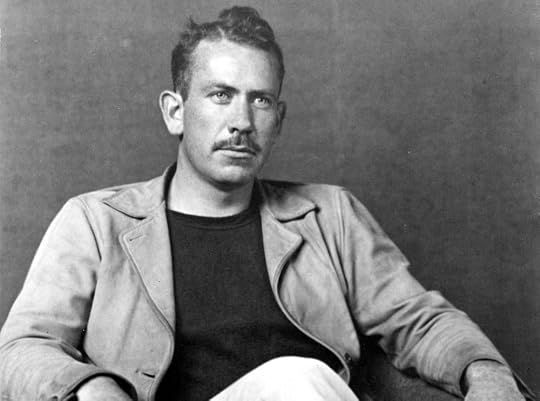
This is a deceptively simple Mexican fable. It's written by Steinbeck, so of course, it's written beautifully. The story is pretty straightforward--poor, uneducated peasant finds monster pearl and now has everything previously denied to him within his grasp. Or does he?
*** SPOILERS AHEAD ***
Kino is happy despite his poverty and his low position on the social scale. He and the other natives in his village are under the control of the wealthy Spanish people who have taken up residence in the nicer part of town. The wealthy Spanish people live comfortably in their brick and plaster houses, exercising an iron control over the laws and economics of the town, while Kino and his ilk live in brush huts. Kino, however, is happily married to Juana, and they are both content in their relationship and with their beloved first-born son, Coyotito. The serpent enters their tropical Eden in the form of a scorpion that stings the baby--a possible death sentence. When the Spanish doctor refuses to treat him because of their poverty, Kino goes pearl-diving, laboring under tremendous emotional agony. He finds a large, obviously old oyster, and it yields a magnificent pearl--the pearl of the world. It is at this moment, when Fate drops a fortune into Kino's hands, that his real troubles begin.
Okay, so as we follow Kino through the increasing complexity of the problems that develop as a result of his ownership of this pearl, many issues are raised. What, exactly, is Steinbeck saying? The old adage, "Be careful what you wish for," comes to mind, and is certainly apropos. I have read that some see this as a critique of capitalism and the American Dream. Certainly Kino seems to have achieved the American Dream when that pearl drops into his hand. But that dream, his good fortune, is ruthlessly hunted and destroyed, piece by piece, by faceless individuals who could be anyone--his friends, his neighbors, or the greedy members of the wealthy community. So Steinbeck could be saying that the American Dream is a myth, that the system is stacked against those who need it the most. What about capitalism? Under the principles of capitalism, Kino should have been rewarded for bringing such a rare, desirable object into the marketplace. Instead, it is treated with contempt by those who should have been most interested in acquiring it. In reality, true capitalism was never really at play. There was no competition; the market was controlled by one person. So is Steinbeck saying that capitalism, too, is a myth? That human corruption will always interfere with the free and unimpeded flow of the marketplace?
Greed is condemned in all forms, and everyone seems to feel it. After the news of Kino's find circulates, various people all start calculating how his profits can personally affect them. The doctor belatedly hurries to the side of the baby, eager to charge exorbitant fees for his assistance; the priest begins to mull pressuring Kino to donate to the church for repairs; and even the town beggars begin to anticipate Kino's generosity to them. But is Kino guilty of greed, as well? Is he reaching for too much, demanding too much, of life? He is certainly punished for attempting to have more.
I teach my students that in order to determine the themes of a text, you look at what happens to the main characters. By any interpretation, the themes of this story are bleak. Either Kino allows the pearl to give him delusions of grandeur that cause him to attempt to fly too close to the sun, and, like Icarus, tumble to his doom, or Kino is an example of how a poor, uneducated person has no chance of prevailing against the system and bettering his life in any way. Not only will he not be permitted to move up, but he will be severely punished for the attempt.
I personally believe it is the latter theme that is best supported by the text, but I don't believe it is a true statement about the condition of the American Dream in our country today. While breaking free of poverty is difficult to do and is a complex issue, I do not believe that people attempting to do so are faced with certain defeat, as Kino was. There are people who accomplish it, so it is doable.
Steinbeck, like Charles Dickens, used his writing to fight fiercely for the rights of the poor and downtrodden, and I think that the enduring nature of their works is a testament to how very effective they were.