

What do you think?

King Dragon
A journey to a planet which has been terraformed in order to observe evolution.
277 pages, Mass Market Paperback
First published January 1, 1980
About the author
Andrew J. Offutt
216 books76 followersAndrew Jefferson Offutt was an American science fiction and fantasy author. He wrote as Andrew J. Offutt, A.J. Offutt, and Andy Offut. His normal byline, andrew j. offutt, had his name in all lower-case letters. His son is the author Chris Offutt.
Offutt began publishing in 1954 with the story And Gone Tomorrow in If. Despite this early sale, he didn't consider his professional life to have begun until he sold the story Blacksword to Galaxy in 1959. His first novel was Evil Is Live Spelled Backwards in 1970.
Offutt published numerous novels and short stories, including many in the Thieves World series edited by Robert Lynn Asprin and Lynn Abbey, which featured his best known character, the thief Hanse, also known as Shadowspawn (and, later, Chance). His Iron Lords series likewise was popular. He also wrote two series of books based on characters by Robert E. Howard, one on Howard's best known character, Conan, and one on a lesser known character, Cormac mac Art.
As an editor Offutt produced a series of five anthologies entitled Swords Against Darkness, which included the first professional sale by Charles de Lint.
Offutt also wrote a large number of pornographic works under twelve different pseudonyms, not all of them identified. Those known include John Cleve, J.X. Williams, and Jeff Douglas. His main works in this area are the science fiction Spaceways series, most of whose volumes were written in collaboration, and the historical Crusader series.
Offutt began publishing in 1954 with the story And Gone Tomorrow in If. Despite this early sale, he didn't consider his professional life to have begun until he sold the story Blacksword to Galaxy in 1959. His first novel was Evil Is Live Spelled Backwards in 1970.
Offutt published numerous novels and short stories, including many in the Thieves World series edited by Robert Lynn Asprin and Lynn Abbey, which featured his best known character, the thief Hanse, also known as Shadowspawn (and, later, Chance). His Iron Lords series likewise was popular. He also wrote two series of books based on characters by Robert E. Howard, one on Howard's best known character, Conan, and one on a lesser known character, Cormac mac Art.
As an editor Offutt produced a series of five anthologies entitled Swords Against Darkness, which included the first professional sale by Charles de Lint.
Offutt also wrote a large number of pornographic works under twelve different pseudonyms, not all of them identified. Those known include John Cleve, J.X. Williams, and Jeff Douglas. His main works in this area are the science fiction Spaceways series, most of whose volumes were written in collaboration, and the historical Crusader series.
Ratings & Reviews
Friends & Following
Create a free account to discover what your friends think of this book!
Community Reviews
Displaying 1 - 10 of 10 reviews

April 5, 2020
A very good sword & planet adventure which was, according to the cover, inspired by Burroughs, Howard, Doyle, and Haggard. Heady company, and I would have gone more with Otis Adelbart Kline, but it was a very fun book, nonetheless, though not a great one. It concerns a lost planet where terraforming has produced a very unusual and primitive society and unique fauna after a thousand years of isolation. When contact is re-established fascinating adventure ensues, of course. The introductory science fiction section is not as well presented as the subsequent fantastic adventure. There are some rather sexist bits which will put off more sensitive modern readers, but I don't think the attitudes are too far out of line to spoil the enjoyment of the story. The highlight is the gorgeous illustrations, a nice Rowena cover and many great interior illustrations by Esteban Maroto channeling his best Roy Krenkel. (Though the one on page three will have you wondering why Han Solo is arguing with Dr. Zarkov.) Altogether a terrific volume; it's a shame we see so few with this format anymore.

January 6, 2026
Sword and Planet fare that's heavy on the sword. Skillfully illustrated, but with obvious reuse of some of the illustrations and some of them are out of place from where they would make sense in the story. There's an interesting milieu to be had here: Islamic planetary colonists on a lost world that feels like Burroughs's Pellucidar with a narrative that leans into Gnostic elements... this could have been something wonderfully unique, but it's like it's aiming to be the most generic delivery of that premise.
May 29, 2017
A fun variation of a sword and sorcery book. The sorcerer is a genetic scientist. The swords are bronze age weaponry.

December 4, 2017
Space travellers make it to another planet and discover savages and dinosaurs.

February 24, 2020
This is an incredibly sexist view of the output of it's time. Yeah this book should never have been written, but at least we have such items to show us what NOT to do.

November 17, 2024
Generally, I really like Offutt's work but this one just didn't do it for me. I found it confusing and hard to follow in places.
Read
October 23, 2025Illustrated SF adventure novel; an illustrated paperback original (two printings). A journey to a planet which has been terraformed in order to observe evolution.

December 27, 2008
It's never a good sign when the cover name-drops authors. This one drops Doyle, Haggard, Burroughs, and Howard on the front, the back--with the context that 'science took [the lost world novel] away', and 'NOW SCIENCE GIVES IT BACK'--and in the dedication.
The premise is kind of a mess. In some future society, a group of religious extremists(?) undertake the terraformation of a distant planet. Their recorded transmissions have only started to be received on Earth, many centuries after the fact, and a very small group of scientists travel out to their space station to examine this strange isolated society. They find a planet whose ecology has been manipulated into resembling Pellucidar or the Land That Time Forgot (or Skull Island or etc., etc., etc.), with dinosaurs and everything.
I don't particularly care for the framing device--Offutt struggled through an achingly bad introductory chapter establishing all of it-- nor for its execution. The point of view is split between the adventuring scientists and a group of caveman-style humans inhabiting this fantastically dangerous environment. I didn't stick around to see what sort of lampshade would be necessary to justify the scientists landing on the planet, instead of very reasonably turning around and going home, and didn't care to read on about the mopy cavewoman and her miserable love life.
And, frankly, the Maroto illustrations were barely related to the story and sections of them were heavily reused.
On the up side, the dominant culture of this future history appears to be Islamic or Arabic, with the native cavepeople praising Allah and observing Ramadan, and the names and constructed words having a heavily Arabic influence. I never got to the point of determining if there's a point to it, or if it's used as a cheap stunt. Either way, it would be nice to encounter the idea in a better book.
The premise is kind of a mess. In some future society, a group of religious extremists(?) undertake the terraformation of a distant planet. Their recorded transmissions have only started to be received on Earth, many centuries after the fact, and a very small group of scientists travel out to their space station to examine this strange isolated society. They find a planet whose ecology has been manipulated into resembling Pellucidar or the Land That Time Forgot (or Skull Island or etc., etc., etc.), with dinosaurs and everything.
I don't particularly care for the framing device--Offutt struggled through an achingly bad introductory chapter establishing all of it-- nor for its execution. The point of view is split between the adventuring scientists and a group of caveman-style humans inhabiting this fantastically dangerous environment. I didn't stick around to see what sort of lampshade would be necessary to justify the scientists landing on the planet, instead of very reasonably turning around and going home, and didn't care to read on about the mopy cavewoman and her miserable love life.
And, frankly, the Maroto illustrations were barely related to the story and sections of them were heavily reused.
On the up side, the dominant culture of this future history appears to be Islamic or Arabic, with the native cavepeople praising Allah and observing Ramadan, and the names and constructed words having a heavily Arabic influence. I never got to the point of determining if there's a point to it, or if it's used as a cheap stunt. Either way, it would be nice to encounter the idea in a better book.
May 13, 2025
A hidden sword-and-planet classic from the 1970s. The novel is engaging, with an interesting premise, but the ending cuts off perhaps a little prematurely. Clearly it was intended to be the first novel in a series but was never continued. I would have enjoyed reading more. The characters are a lot more thoughtfully constructed than it seems at first glance. The relationship between the two mains has a mix of pragmatism, sex and romance that reads as honest, particularly when Allayth, the male lead, emerges from the lust-scrambled fog over his senses to contemplate the vast cultural gulf that separates him from Johara. The world itself, the distant planet Ajjer, is a vast menagerie of awesome beasts and a kaleidoscope of colorful megaflora (not to mention invariably lethal).
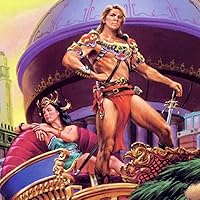
The novel is lavishly illustrated by Spanish SF and fantasy artistic legend Esteban Maroto, and can be unequivocally recommended for that fact alone. The cover is based on a sketch by Maroto and painted by the late, great Rowena Morrill, and is notorious because the original canvas was supposedly discovered in one of the palaces of Saddam Hussein during the second Iraq War in 2003.
The novel is lavishly illustrated by Spanish SF and fantasy artistic legend Esteban Maroto, and can be unequivocally recommended for that fact alone. The cover is based on a sketch by Maroto and painted by the late, great Rowena Morrill, and is notorious because the original canvas was supposedly discovered in one of the palaces of Saddam Hussein during the second Iraq War in 2003.

July 11, 2009
Not outstanding but decent. I like his more sword & planet stuff better.
Displaying 1 - 10 of 10 reviews