

What do you think?
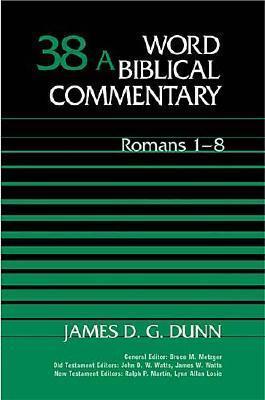
Word Biblical Commentary #38A
Romans 1-8
The Word Biblical Commentary delivers the best in biblical scholarship, from the leading scholars of our day who share a commitment to Scripture as divine revelation. This series emphasizes a thorough analysis of textual, linguistic, structural, and theological evidence. The result is judicious and balanced insight into the meanings of the text in the framework of biblical theology. These widely acclaimed commentaries serve as exceptional resources for the professional theologian and instructor, the seminary or university student, the working minister, and everyone concerned with building theological understanding from a solid base of biblical scholarship.
513 pages, Hardcover
First published October 26, 1988
About the author
James D.G. Dunn
133 books92 followersJames D. G. ("Jimmy") Dunn (born 1939) was for many years the Lightfoot Professor of Divinity in the Department of Theology at the University of Durham. Since his retirement he has been made Emeritus Lightfoot Professor. He is a leading British New Testament scholar, broadly in the Protestant tradition. Dunn is especially associated with the New Perspective on Paul, along with N. T. (Tom) Wright and E. P. Sanders. He is credited with coining this phrase during his 1982 Manson Memorial Lecture.
Dunn has an MA and BD from the University of Glasgow and a PhD and DD from the University of Cambridge. For 2002, Dunn was the President of the Studiorum Novi Testamenti Societas, the leading international body for New Testament study. Only three other British scholars had been made President in the preceding 25 years.
In 2005 a festschrift was published dedicated to Dunn, comprising articles by 27 New Testament scholars, examining early Christian communities and their beliefs about the Holy Spirit. (edited by Graham N. Stanton, Bruce W. Longenecker & Stephen Barton (2004). The Holy Spirit and Christian origins: essays in honor of James D. G. Dunn. Grand Rapids, MI: W.B. Eerdmans Pub. Co. ISBN 0-8028-2822-1.)
Dunn has taken up E. P. Sanders' project of redefining Palestinian Judaism in order to correct the Christian view of Judaism as a religion of works-righteousness. One of the most important differences to Sanders is that Dunn perceives a fundamental coherence and consistency to Paul's thought. He furthermore criticizes Sanders' understanding of the term "justification", arguing that Sanders' understanding suffers from an "individualizing exegesis".
Dunn has an MA and BD from the University of Glasgow and a PhD and DD from the University of Cambridge. For 2002, Dunn was the President of the Studiorum Novi Testamenti Societas, the leading international body for New Testament study. Only three other British scholars had been made President in the preceding 25 years.
In 2005 a festschrift was published dedicated to Dunn, comprising articles by 27 New Testament scholars, examining early Christian communities and their beliefs about the Holy Spirit. (edited by Graham N. Stanton, Bruce W. Longenecker & Stephen Barton (2004). The Holy Spirit and Christian origins: essays in honor of James D. G. Dunn. Grand Rapids, MI: W.B. Eerdmans Pub. Co. ISBN 0-8028-2822-1.)
Dunn has taken up E. P. Sanders' project of redefining Palestinian Judaism in order to correct the Christian view of Judaism as a religion of works-righteousness. One of the most important differences to Sanders is that Dunn perceives a fundamental coherence and consistency to Paul's thought. He furthermore criticizes Sanders' understanding of the term "justification", arguing that Sanders' understanding suffers from an "individualizing exegesis".
Ratings & Reviews
Friends & Following
Create a free account to discover what your friends think of this book!
Community Reviews
Displaying 1 - 7 of 7 reviews

October 3, 2026
[6/4/2023] The commentary is excellent, of course, but I didnt enjoy this one as much as Dunn's commentary on Galatians. While the commentary was consistently scholarly it did slip into churchy pronouncements occasionally.
[update 10/3/2026] I read this book in tandem with N. T. Wright’s commentary on Romans in the *New Interpreter’s Bible,* two commentaries that have different goals and different expected audiences. Although the NIB claims to be usable by scholars, Dunn's commentary is more suitable for scholarly use. This makes Dunn's commentary less readable as it has frequent cross references in the text and technical notes on the Greek. I bought the Dunn commentaries some months ago in preparation for rereading Max King's books, in particular *The Cross and the Parousia of Christ*, which has particularly difficult discussions of some of the texts in Romans. That is one reason I appreciated Dunn’s notice that in a review of Romans research one impression which could easily be given is that Romans *lacks* coherence. That is an impression I still have, although Dunn rejects it. When I was a young Christian, my impression of Romans was that here was a treatise in which the greatest theological mind tangles with the most knotty theological problems and fails to solve them. My viewpoint has changed over the years, of course, especially now that I am no longer a Christian.
I decided to move Dunn up on my reading schedule after reading Jason DeCosta's book *Jesus and the Promise: How the Promise to Abraham unlocks the New Testament*, a book that promotes a view called Israel Only Preterism. DeCosta spends a lot of time examining Romans 9, and so I started by reading the second volume of this two-volume work: *Romans 9-16.* That probably wasn’t the best way to go, because there are certain themes Paul develops in the first eight chapters which are developed further in the rest of the book, in particular the role of the law and how that relates to Israel. Nonetheless, it worked out ok.
A particular challenge for IO is reinterpreting verses that have traditionally been taken as universalist. N. T. Wright makes an interesting point about the word ἁμαρτωλός concerning Romans 5.8 ("while we were sinners"), "a word that technically described 'those outside the law,' the pagans who, not possessing the law, were inevitably sinners (cf. Gal 2.15 where the word is used in this technical sense)." I don’t think Wright chose the best verse to demonstrate this, as the "we" of this verse no doubt includes Jews.
Dunn also examines this word when commenting on 3.7: "Why am I still judged a sinner?" "ἁμαρτωλός is a particularly Jewish word, denoting those who are lawbreakers, either as knowing but disobeying the law, or as ignorant of the law in the first place (= Gentiles; e.g, Ps 119 [118 LXX].53, 155; 1 Macc 2.44, 48, *Pss. Sol.* 2.1-2, Matt 5.47//Luke 6.33; Mark 2.15-17 pars.; Gal 2.15; see further on 4.5 and *Introduction §5.3.1)." Not many of these references referenced Gentiles, only 1 Maccabees 2.44 "So they joined their forces, and smote sinful men in their anger, and wicked men in their wrath: but the rest fled to the heathen for succor (cf. 2.48: So they recovered the law out of the hand of the Gentiles, and out of the hand of kings, neither suffered they the sinner to triumph," and *Pss. Sol.* 2.1-2 "I cried unto the Lord when I was in distress, unto God when sinners attacked. Suddenly the alarm of war was heard before me; I said, He will listen to me for I am full of righteousness."
Related to the universality of sin is a concept Dunn examines when he comments on 5.13: "ἐλλογέω is a commercial t.t., 'charge to someone's account' (BGD; cf. its only other NT use, Philem 18). Paul here draws on the idea of the heavenly tablets or books in which the sins (and righteousness) of humanity are recorded—an idea already current in Judaism (see particularly *Jub.* 30.17-23; *1 Enoch* 104.7; *2 Apoc. Bar. 24.1)" Here *Jub.* 30.17-23 doesn’t really apply. It speaks of the writing of the righteousness of the two Israelites who slew the Shechemites and says nothing about a universal book. The other two passages are more apropos, although 1 Enoch 104.7 has to be put in context with v 3: "And in your cry, cry for judgement, and it shall appear to you; for all your tribulation shall be visited on the rulers, and on all who helped those who plundered you. … 7 And, although ye sinners say: 'All our sins shall not be searched out and be written down,' nevertheless they shall write down all your sins every day."
*2 Apoc. Bar.* 24.1 also needs to be put into context, in this case with the immediately preceding verse 23.4: "Because when Adam sinned and death was decreed against those who should be born, then the multitude of those who should be born was numbered, and for that number a place was prepared where the living might dwell and the dead might be guarded. 24.1 For behold! the days come and the books will be opened in which are written the sins of all those who have sinned, and again also the treasuries in which the righteousness of all those who have been righteous in creation is gathered."
If 1st century Judaism had the concept of a book recording all the acts of humankind (cf. Revelation 20:11–15), this is a universalist challenge to IO.
Another verse Dunn sees in universalist terms is 7.9 "Once I was alive apart from the law; but when the commandment came, sin sprang to life and I died." "Paul is almost certainly speaking in typical terms, using the Adam narrative to characterize what is true of man (*adam*) in general, *every*man—somewhat as *2 Apoc. Bar.* 54.19, "Each of us has been the Adam of his own soul"; so already 1.18-32; 3.23; 5.12-19 (see particularly 1.22; 3.23; 5.12-21, passim)." Wright also sees an allusion to Adam here. Back when I was a Christian (it seems like ages ago) we used to see this passage as autobiographical and discussed whether Paul was talking about himself in his pre-Christian state or after his conversion. But if the "I" of 7.9 really means "everyman," then the verse indeed presents a problem for IO. But I’m not convinced of this interpretation. Can Paul really mean that when the law came, "everyman" died? Is "everyman" under the law?
A further verse that Dunn (and Wright) see as universalist is 4.13 "that he [Abraham] should be heir of the world (κόσμου). Many IO people see (κόσμος) as a technical term referring to Israel's covenant world, rather than the whole earth, as Dunn and nearly every other commentator takes it: "Already before Paul the concept had been broadened out from Canaan to embrace the whole earth (Sir 44.21; *Jub.* 17.3; 22.14; 32.19; *1 Enoch* 5.7; Philo, *Som.* 1.175; *Mos.* 1.155; cf. 4 Ezra 6.59; *Ap. Const.* 8.12.23; rabbinic references in Str-B, 3.209; the world to come—*2 Apoc. Bar. 14.13; 51.3)."
Sir 44.21 "and give them an inheritance from sea to sea and from the Euphrates to the ends of the earth." According to Google, "In some contexts, [the ends of the earth] carries a dual meaning—referring both literally/locally to the distant borders of the promised land or immediate empires, and symbolically to the entire scope of creation." *Jub* 17.3 "And he [Isaac] remembered the words which He had spoken to him on the day on which Lot had parted from him, and he rejoiced because the Lord had given him seed upon the earth to inherit the earth …" *Jub* 22.14 "And mayest thou [Jacob] inherit the whole earth," Jub* 32.19 " And I will give to thy [Jacob's] seed all the earth which is under heaven, and they shall judge all the nations according to their desires, and after that they shall get possession of the whole earth and inherit it for ever.' 1 Enoch 5.7 "But for the elect there shall be light and joy and peace, and they shall inherit the earth" etc.
Yet another universalist verse is 3.29-30, God of the Jews and the Gentiles, for God is one. "The appeal in fact is to God as Creator, from one arm of the twofold dogma (God as Israel's Lord) to the other (God as Lord of all)." Many IO advocates have gone so far as to deny that Adam does not represent all of humanity, but rather just Israel. This seems unlikely, since the Hebrew word *adam*, besides being a name is also a word meaning "mankind," e.g. Psalm 8.4 "What is *adam* [man/mankind] that you are mindful of him, and a son of man (enosh) that you care for him?" and Psalm 90.3 "You turn *adam* [man/mankind] back to dust, saying, 'Return to dust, you sons of men.'"
The final possibly universalist verse Dunn made me aware of was 8.22 "the whole creation has been groaning," which Dunn sees as a reflection of the concept of "The birth pangs of the Messiah," e.g., "the contortion of the earth in an earthquake, the devastation of flood and fire, the desolation caused by warfare or famine." He references Tractate Sanhedrin (folios 97a–98b), with additional insights in Tractate Sotah (folio 49b). However the lengthy passage Sanhedrin 97a-98b had only one brief reference to physical upheavals (And I will cause it to rain upon one city and not to rain upon another city [Amos 4.7]). Rather, both passages spoke of social upheavals. However, Paul may have a tradition in mind like that found in Matthew 24.7: "There will be famines and earthquakes in various places." Can Jesus's words be expanded to encompass the whole earth? I suspect IO would say no.
Particularly important in Romans is the role of the law, which also plays an important role in IO. Some see other laws in play in Romans other than the Mosaic law, which would weaken the IO argument. If humanity were under a universal law of sin, then the importance of the Mosaic law would be lessened. However, the arguments that the various other laws mentioned in Romans refer to something other than the Mosaic law are difficult to sustain. Both Dunn and Wright see the "law of faith" referenced in 3.27 as the Mosaic law understood in terms of faith. Dunn understands "another law" of 7.23 as the "law of sin" and links to v 11: "For sin, seizing the opportunity afforded by the commandment, deceived me, and through the commandment put me to death." So the other law Paul speaks of still ends up being tied to the Mosaic law.
When I first read this book I gave it 3/5 stars which seems low to me. I’m going to upgrade it to 5/5 stars. I am overjoyed to have it in my library so I can reference it as often as I like.
[update 10/3/2026] I read this book in tandem with N. T. Wright’s commentary on Romans in the *New Interpreter’s Bible,* two commentaries that have different goals and different expected audiences. Although the NIB claims to be usable by scholars, Dunn's commentary is more suitable for scholarly use. This makes Dunn's commentary less readable as it has frequent cross references in the text and technical notes on the Greek. I bought the Dunn commentaries some months ago in preparation for rereading Max King's books, in particular *The Cross and the Parousia of Christ*, which has particularly difficult discussions of some of the texts in Romans. That is one reason I appreciated Dunn’s notice that in a review of Romans research one impression which could easily be given is that Romans *lacks* coherence. That is an impression I still have, although Dunn rejects it. When I was a young Christian, my impression of Romans was that here was a treatise in which the greatest theological mind tangles with the most knotty theological problems and fails to solve them. My viewpoint has changed over the years, of course, especially now that I am no longer a Christian.
I decided to move Dunn up on my reading schedule after reading Jason DeCosta's book *Jesus and the Promise: How the Promise to Abraham unlocks the New Testament*, a book that promotes a view called Israel Only Preterism. DeCosta spends a lot of time examining Romans 9, and so I started by reading the second volume of this two-volume work: *Romans 9-16.* That probably wasn’t the best way to go, because there are certain themes Paul develops in the first eight chapters which are developed further in the rest of the book, in particular the role of the law and how that relates to Israel. Nonetheless, it worked out ok.
A particular challenge for IO is reinterpreting verses that have traditionally been taken as universalist. N. T. Wright makes an interesting point about the word ἁμαρτωλός concerning Romans 5.8 ("while we were sinners"), "a word that technically described 'those outside the law,' the pagans who, not possessing the law, were inevitably sinners (cf. Gal 2.15 where the word is used in this technical sense)." I don’t think Wright chose the best verse to demonstrate this, as the "we" of this verse no doubt includes Jews.
Dunn also examines this word when commenting on 3.7: "Why am I still judged a sinner?" "ἁμαρτωλός is a particularly Jewish word, denoting those who are lawbreakers, either as knowing but disobeying the law, or as ignorant of the law in the first place (= Gentiles; e.g, Ps 119 [118 LXX].53, 155; 1 Macc 2.44, 48, *Pss. Sol.* 2.1-2, Matt 5.47//Luke 6.33; Mark 2.15-17 pars.; Gal 2.15; see further on 4.5 and *Introduction §5.3.1)." Not many of these references referenced Gentiles, only 1 Maccabees 2.44 "So they joined their forces, and smote sinful men in their anger, and wicked men in their wrath: but the rest fled to the heathen for succor (cf. 2.48: So they recovered the law out of the hand of the Gentiles, and out of the hand of kings, neither suffered they the sinner to triumph," and *Pss. Sol.* 2.1-2 "I cried unto the Lord when I was in distress, unto God when sinners attacked. Suddenly the alarm of war was heard before me; I said, He will listen to me for I am full of righteousness."
Related to the universality of sin is a concept Dunn examines when he comments on 5.13: "ἐλλογέω is a commercial t.t., 'charge to someone's account' (BGD; cf. its only other NT use, Philem 18). Paul here draws on the idea of the heavenly tablets or books in which the sins (and righteousness) of humanity are recorded—an idea already current in Judaism (see particularly *Jub.* 30.17-23; *1 Enoch* 104.7; *2 Apoc. Bar. 24.1)" Here *Jub.* 30.17-23 doesn’t really apply. It speaks of the writing of the righteousness of the two Israelites who slew the Shechemites and says nothing about a universal book. The other two passages are more apropos, although 1 Enoch 104.7 has to be put in context with v 3: "And in your cry, cry for judgement, and it shall appear to you; for all your tribulation shall be visited on the rulers, and on all who helped those who plundered you. … 7 And, although ye sinners say: 'All our sins shall not be searched out and be written down,' nevertheless they shall write down all your sins every day."
*2 Apoc. Bar.* 24.1 also needs to be put into context, in this case with the immediately preceding verse 23.4: "Because when Adam sinned and death was decreed against those who should be born, then the multitude of those who should be born was numbered, and for that number a place was prepared where the living might dwell and the dead might be guarded. 24.1 For behold! the days come and the books will be opened in which are written the sins of all those who have sinned, and again also the treasuries in which the righteousness of all those who have been righteous in creation is gathered."
If 1st century Judaism had the concept of a book recording all the acts of humankind (cf. Revelation 20:11–15), this is a universalist challenge to IO.
Another verse Dunn sees in universalist terms is 7.9 "Once I was alive apart from the law; but when the commandment came, sin sprang to life and I died." "Paul is almost certainly speaking in typical terms, using the Adam narrative to characterize what is true of man (*adam*) in general, *every*man—somewhat as *2 Apoc. Bar.* 54.19, "Each of us has been the Adam of his own soul"; so already 1.18-32; 3.23; 5.12-19 (see particularly 1.22; 3.23; 5.12-21, passim)." Wright also sees an allusion to Adam here. Back when I was a Christian (it seems like ages ago) we used to see this passage as autobiographical and discussed whether Paul was talking about himself in his pre-Christian state or after his conversion. But if the "I" of 7.9 really means "everyman," then the verse indeed presents a problem for IO. But I’m not convinced of this interpretation. Can Paul really mean that when the law came, "everyman" died? Is "everyman" under the law?
A further verse that Dunn (and Wright) see as universalist is 4.13 "that he [Abraham] should be heir of the world (κόσμου). Many IO people see (κόσμος) as a technical term referring to Israel's covenant world, rather than the whole earth, as Dunn and nearly every other commentator takes it: "Already before Paul the concept had been broadened out from Canaan to embrace the whole earth (Sir 44.21; *Jub.* 17.3; 22.14; 32.19; *1 Enoch* 5.7; Philo, *Som.* 1.175; *Mos.* 1.155; cf. 4 Ezra 6.59; *Ap. Const.* 8.12.23; rabbinic references in Str-B, 3.209; the world to come—*2 Apoc. Bar. 14.13; 51.3)."
Sir 44.21 "and give them an inheritance from sea to sea and from the Euphrates to the ends of the earth." According to Google, "In some contexts, [the ends of the earth] carries a dual meaning—referring both literally/locally to the distant borders of the promised land or immediate empires, and symbolically to the entire scope of creation." *Jub* 17.3 "And he [Isaac] remembered the words which He had spoken to him on the day on which Lot had parted from him, and he rejoiced because the Lord had given him seed upon the earth to inherit the earth …" *Jub* 22.14 "And mayest thou [Jacob] inherit the whole earth," Jub* 32.19 " And I will give to thy [Jacob's] seed all the earth which is under heaven, and they shall judge all the nations according to their desires, and after that they shall get possession of the whole earth and inherit it for ever.' 1 Enoch 5.7 "But for the elect there shall be light and joy and peace, and they shall inherit the earth" etc.
Yet another universalist verse is 3.29-30, God of the Jews and the Gentiles, for God is one. "The appeal in fact is to God as Creator, from one arm of the twofold dogma (God as Israel's Lord) to the other (God as Lord of all)." Many IO advocates have gone so far as to deny that Adam does not represent all of humanity, but rather just Israel. This seems unlikely, since the Hebrew word *adam*, besides being a name is also a word meaning "mankind," e.g. Psalm 8.4 "What is *adam* [man/mankind] that you are mindful of him, and a son of man (enosh) that you care for him?" and Psalm 90.3 "You turn *adam* [man/mankind] back to dust, saying, 'Return to dust, you sons of men.'"
The final possibly universalist verse Dunn made me aware of was 8.22 "the whole creation has been groaning," which Dunn sees as a reflection of the concept of "The birth pangs of the Messiah," e.g., "the contortion of the earth in an earthquake, the devastation of flood and fire, the desolation caused by warfare or famine." He references Tractate Sanhedrin (folios 97a–98b), with additional insights in Tractate Sotah (folio 49b). However the lengthy passage Sanhedrin 97a-98b had only one brief reference to physical upheavals (And I will cause it to rain upon one city and not to rain upon another city [Amos 4.7]). Rather, both passages spoke of social upheavals. However, Paul may have a tradition in mind like that found in Matthew 24.7: "There will be famines and earthquakes in various places." Can Jesus's words be expanded to encompass the whole earth? I suspect IO would say no.
Particularly important in Romans is the role of the law, which also plays an important role in IO. Some see other laws in play in Romans other than the Mosaic law, which would weaken the IO argument. If humanity were under a universal law of sin, then the importance of the Mosaic law would be lessened. However, the arguments that the various other laws mentioned in Romans refer to something other than the Mosaic law are difficult to sustain. Both Dunn and Wright see the "law of faith" referenced in 3.27 as the Mosaic law understood in terms of faith. Dunn understands "another law" of 7.23 as the "law of sin" and links to v 11: "For sin, seizing the opportunity afforded by the commandment, deceived me, and through the commandment put me to death." So the other law Paul speaks of still ends up being tied to the Mosaic law.
When I first read this book I gave it 3/5 stars which seems low to me. I’m going to upgrade it to 5/5 stars. I am overjoyed to have it in my library so I can reference it as often as I like.

February 14, 2010
The book was a slog, but worth it. I had never read James Dunn before this, but I had heard of him (all bad), and I assumed that he and Ed Sanders, unlike N. T. Wright who was pretty cool, were the "Sith Lords" of the New Perspective on Paul. But once I got into the book itself I kept going "well, duh" to most of his points. I don't agree with everything he says, but I think in terms of the narrative of Romans, and the ongoing theme of "Jew and Gentile," it was extremely helpful. It's a highly technical commentary with lots of Greek and sections like "[long string of Greek letters:] . . . and this is an obvious pun;" which leaves me yelling "what's so funny?" Because he doesn't tell you. He expects you to see the punning in the Greek. Guess I'm a pleb. But still, its worth the time to wade through it. Your efforts will be rewarded.
----
There's been a lot of controversy about the "New Perspective on Paul," and there are various accusations floating around Reformed and Presbyterian circles that it teaches justification by works and undermines Sola Fide. Here's some of Dunn's comments to the contrary:
"Faith is both the initial and the continuing access point for the saving power of God into human life, the common denominator which God looks for in every case" (40)
"This understanding of Paul's language largely removes two issues which have troubled Christian theology for centuries: (1) Is 'the righteousness of God' subjective genitive or objective genitive; is it an attitude of God or something He does? Seen as God's meeting of the claims of his covenant relationship, the answer is not strictly either-or, but both-and, with emphasis on the later" (41)
". . . man's righteousness is always to be understood as faith which explains why man's righteousness is nothing other than God's righteousness. . . . And it is his fellow Jews' forgetfulness of this fact which, in Paul's view, has resulted in a distorted understanding of their part within the covenant . . . . For Paul justification is always by faith in the sense that the correlative of God's creative and sustaining is always the human creature's dependent trust (faith), of which justification (of Jew and Gentile equally) by faith is a specific expression, and which indeed provides the existential context in and through which Paul's understanding of God's righteousness comes to clarity and focus" (42)
"[faith:] for Paul has the twofold sense: both of belief that--acceptance of the truth/reliability of what has been said . . . but also of consequent trust in, reliance upon" (43)
"Paul will go on to analyze the plight of man as his failure to accept this status of complete dependence on God . . . including his fellow Jews whose narrower definition of covenantal righteousness in terms of ethnic identity and 'works' (9:6-13) in Paul's view involved a departure from the fundamental recognition that faith on man's side is the only possible and sufficient basis to sustain a relation with God, as exemplified above all in Abraham's unconditional trust and total dependence on God and his promise" (43)
"for Paul the counterpart to God's faithfulness is not man's faithfulness . . . but faith, his trust in and total reliance upon God. If man's faithfulness is a consistent expression of that faith, good and well. But Paul's charge against Israel will be that the definition of faithfulness as observance of the law amounts to a serious misunderstanding of faith--and so of righteousness (both God's and man's), and so also of the life which follows from it" (46)
"Paul does not see the gospel as something which merely begins someone on the way to salvation, but as something which embraces the totality of the process toward and into salvation. The gospel is not merely the initial proclamation of Christ which wins converts, but is the whole Christian message and claim . . . Paul here is talking not just about the initial acceptance of the proclamation of the crucified and risen Christ, but about that together with the life which follows from it as the whole process which leads into final wholeness. This is the point of the present tense--'to all who believe and go on believing'; namely, to all who not only come to a decision of faith, but whose whole life is characterized as a trustful acceptance of and commitment to the gospel which is God's power to salvation" (47)
"He who is maintained within or has been brought into the relationship with God which brings about salvation, by the outreach of God's faithfulness to his own faith, shall experience the fullness of life which God intended for humankind as he lives in the dependence of faith on the continuing faithfulness of God" (49).
----
There's been a lot of controversy about the "New Perspective on Paul," and there are various accusations floating around Reformed and Presbyterian circles that it teaches justification by works and undermines Sola Fide. Here's some of Dunn's comments to the contrary:
"Faith is both the initial and the continuing access point for the saving power of God into human life, the common denominator which God looks for in every case" (40)
"This understanding of Paul's language largely removes two issues which have troubled Christian theology for centuries: (1) Is 'the righteousness of God' subjective genitive or objective genitive; is it an attitude of God or something He does? Seen as God's meeting of the claims of his covenant relationship, the answer is not strictly either-or, but both-and, with emphasis on the later" (41)
". . . man's righteousness is always to be understood as faith which explains why man's righteousness is nothing other than God's righteousness. . . . And it is his fellow Jews' forgetfulness of this fact which, in Paul's view, has resulted in a distorted understanding of their part within the covenant . . . . For Paul justification is always by faith in the sense that the correlative of God's creative and sustaining is always the human creature's dependent trust (faith), of which justification (of Jew and Gentile equally) by faith is a specific expression, and which indeed provides the existential context in and through which Paul's understanding of God's righteousness comes to clarity and focus" (42)
"[faith:] for Paul has the twofold sense: both of belief that--acceptance of the truth/reliability of what has been said . . . but also of consequent trust in, reliance upon" (43)
"Paul will go on to analyze the plight of man as his failure to accept this status of complete dependence on God . . . including his fellow Jews whose narrower definition of covenantal righteousness in terms of ethnic identity and 'works' (9:6-13) in Paul's view involved a departure from the fundamental recognition that faith on man's side is the only possible and sufficient basis to sustain a relation with God, as exemplified above all in Abraham's unconditional trust and total dependence on God and his promise" (43)
"for Paul the counterpart to God's faithfulness is not man's faithfulness . . . but faith, his trust in and total reliance upon God. If man's faithfulness is a consistent expression of that faith, good and well. But Paul's charge against Israel will be that the definition of faithfulness as observance of the law amounts to a serious misunderstanding of faith--and so of righteousness (both God's and man's), and so also of the life which follows from it" (46)
"Paul does not see the gospel as something which merely begins someone on the way to salvation, but as something which embraces the totality of the process toward and into salvation. The gospel is not merely the initial proclamation of Christ which wins converts, but is the whole Christian message and claim . . . Paul here is talking not just about the initial acceptance of the proclamation of the crucified and risen Christ, but about that together with the life which follows from it as the whole process which leads into final wholeness. This is the point of the present tense--'to all who believe and go on believing'; namely, to all who not only come to a decision of faith, but whose whole life is characterized as a trustful acceptance of and commitment to the gospel which is God's power to salvation" (47)
"He who is maintained within or has been brought into the relationship with God which brings about salvation, by the outreach of God's faithfulness to his own faith, shall experience the fullness of life which God intended for humankind as he lives in the dependence of faith on the continuing faithfulness of God" (49).
June 4, 2023
The commentary is excellent, of course, but I didnt enjoy this one as much as Dunn's commentary on Galatians. While the commentary was consistently scholarly it did slip into churchy pronouncements occasionally.
March 22, 2021
This is an amazing commentary.
James Dunn is a superb exegete.
I read this alongside Douglas Moo; they disagree a lot.
T H O U G H R O U G H.
James Dunn is a superb exegete.
I read this alongside Douglas Moo; they disagree a lot.
T H O U G H R O U G H.
January 31, 2011
This is the classic New Perspective work on Romans. Throughout Romans Dunn seeks to apply E.P. Sanders model of covenant nomism. The main contribution of Dunn to the New Perspective is his view of "works of the law."
I gave Dunn three stars since I am not a proponent of the New Perspective. However, some portions of this commentary are quite helpful, such as his work on Romans 8. While I would not recommend this commentary to a member in my church, a pastor preaching through Romans should consider consulting Dunn.
CB
I gave Dunn three stars since I am not a proponent of the New Perspective. However, some portions of this commentary are quite helpful, such as his work on Romans 8. While I would not recommend this commentary to a member in my church, a pastor preaching through Romans should consider consulting Dunn.
CB

February 3, 2016
Have been reading this in conjunction with teaching a Bible study on Romans. As far as commentaries go, this one is excellent and offers a different perspective on the traditional so-called reformed take on the Apostle Paul's important letter.

February 11, 2016
Truly an important set of commentaries. The exegetical work is phenomenal, and the commentary layout forces him to clarify and summarize.
Displaying 1 - 7 of 7 reviews