

What do you think?

Warfare and History
The Balkan Wars 1912-1913: Prelude to the First World War
The Balkan Wars of 1912-1913 opened an era of conflict in Europe at the beginning of the 20th century, which lasted until 1918, and which established a basis for problems which tormented Europe until the end of the century.
In The Balkan Wars 1912-1913, Richard Hall examines the origins, the enactment and the resolution of the Balkan Wars, during which the Ottoman Empire fought a Balkan coalition of Bulgaria, Greece, Montenegro and Serbia. In 1913 the Balkan coalition collapsed as Bulgaria confronted its erstwhile allies Greece, Montenegro and Serbia and also came under attack by the Ottoman Empire and Romania. The resolution of these wars in the Treaty of Bucharest proved ephemeral. The embers remaining from these conflagrations soon ignited again to engulf Europe in the First World War.
Based on archival as well as published diplomatic and military sources, this book provides the first comprehensive perspective on the diplomatic and military aspects of the Balkan Wars. It demonstrates that, because of the diplomatic problems raised and the military strategies and tactics pursued to resolve those problems, The Balkan Wars of 1912-1913 were the first phase of the greater and wider conflict of the First World War.
In The Balkan Wars 1912-1913, Richard Hall examines the origins, the enactment and the resolution of the Balkan Wars, during which the Ottoman Empire fought a Balkan coalition of Bulgaria, Greece, Montenegro and Serbia. In 1913 the Balkan coalition collapsed as Bulgaria confronted its erstwhile allies Greece, Montenegro and Serbia and also came under attack by the Ottoman Empire and Romania. The resolution of these wars in the Treaty of Bucharest proved ephemeral. The embers remaining from these conflagrations soon ignited again to engulf Europe in the First World War.
Based on archival as well as published diplomatic and military sources, this book provides the first comprehensive perspective on the diplomatic and military aspects of the Balkan Wars. It demonstrates that, because of the diplomatic problems raised and the military strategies and tactics pursued to resolve those problems, The Balkan Wars of 1912-1913 were the first phase of the greater and wider conflict of the First World War.
196 pages, Paperback
First published August 24, 2000
Ratings & Reviews
Friends & Following
Create a free account to discover what your friends think of this book!
Community Reviews
Displaying 1 - 12 of 12 reviews

Read
June 28, 2014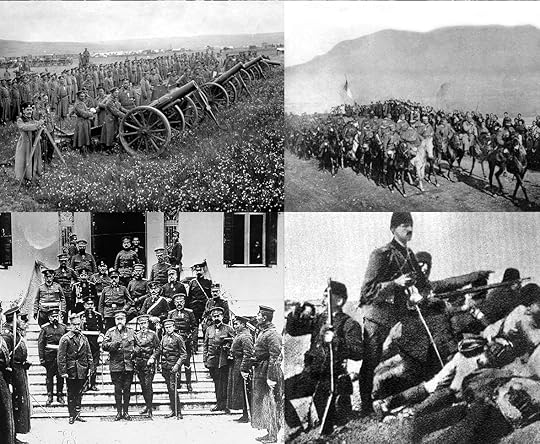
My primary motivation for reading Richard C. Hall's The Balkan Wars, 1912 - 1913, (2000) was to understand how Greece came to its current borders (after its ineptly carried out War of Independence against the Ottoman Empire in the years 1821-1830, the new state of Greece was a small fraction of the Greece we know today). The Greeks dreamed of regaining their long past glories and in 1897 commenced a war with the Ottoman Empire which resulted in a traumatic defeat that overturned the Greek government and seriously roiled the political and cultural waters in Greece. What happened next?
But Hall's subtitle, Prelude to the First World War, is completely justified - it becomes evident in this book that the First World War was an extension of the Balkan Wars, and the Eastern Front of WW I was partially a renewal of the Balkan Wars with battles re-fought on many of the same battlefields.
Hall's book is a diplomatic and military history of the first two Balkan Wars. The first was fought between the Autumn of 1912 and the late Spring of 1913, with Bulgaria, Serbia, Montenegro and Greece allied against the Ottoman Empire. The Ottomans were badly defeated, but the territorial ambitions of the victorious allies were incompatible. The Second Balkan War was fought in July 1913, with Bulgaria facing Serbia, Montenegro and Greece, who wanted to keep the portions of Macedonia they had occupied during the first war, while the Bulgarians wanted the portions they thought were assured to them by their allies prior to the first conflict. Then the Romanians and the Ottomans opportunistically fell upon the Bulgarians, as well; hence, the short duration of the war.
All the while the Great Powers were sticking their fingers in the pie and becoming increasingly involved in matters which barely concerned them. Less than a year after the end of the Second Balkan War, all of Europe was at war, directly due to the occurrences in the Balkans; the famous assassination in Sarajevo of the Austrian archduke shrinks into insignificance in light of the developments described by Hall. By the summer of 1913 and as a direct result of these wars, the Bulgarians hated all of their neighbors and had re-aligned themselves with the Germans (instead of the Russians); the Serbs and Montenegrens seriously resented the Austrians, since the Austrians were doing everything they could to get in the Serbians' way, including forming a fragile Albanian state which lasted about three seconds with yet another hapless German prince set upon the Albanian throne. (The Great Powers had earlier imposed Danish and German princes upon the Greeks.) To get their way, the Austrians had actually threatened the Serbians with war. Otherwise busy, the Serbians backed down - for a short while.
Hall uses original Bulgarian and Serbian sources in this book, but for the Greek and Ottoman sides he employs sources in English, French and German. The reader therefore gets a closer view of the internal workings of the Bulgarian and Serbian minds than those of the other parties to these conflicts. Somewhat repetitive and written in a less than felicitous style, Hall's book is nonetheless well worth reading.
Rating
http://leopard.booklikes.com/post/991...

August 18, 2012
World War I really started in the Balkans, and the decline of the Ottoman Empire, along with the birth of new nations in that region, produced particularly vicious forms of irredentist nationalisms. These new countries both cooperated and fought amongst themselves to settle border and ethnic issues, resulting in much misery, financial losses, puffed-up national pride or a sense of wounded grievance, which would lead inevitably to future conflicts as the 20th century wore on. Professor Hall ably describes the opening conflicts of 1912-13, which ended a mere 10 months before another Balkan crisis spread out of control. The various armies and countries are suitably portrayed, as are the various diplomatic manoeuvrings. But the book is primarily a military history, and the book is simply the best account and source of information on the battles, campaigns and sieges of these forgotten but important conflicts. Any students of the First World War needs to acquaint themselves with the Balkan Wars, and this book is the place to start.

February 5, 2015
Still the best Balkan Wars book in English, compared to centennial fare like Prelude to the First World War: The Balkan Wars 1912-1913. It covers a lot of ground next to sheer battle narratives : origins, diplomacy, politics and the relative strength of the armies. The aftermath is relatively substantial, since here the 'prelude to WWI' dimension is easy to add to the facts. A lot of objective military history tends to focus one side of a conflict and Defeat In Detail: The Ottoman Army in the Balkans, 1912-1913 made up for this a few years after Hall was released. Still, sheer numbers demand a doorstop of a book on these twin wars. There were 6 participants currently evolved into 8 different countries, who hold very different views of the past century. How would their academic opinions combine ?

December 23, 2025
This is exactly what military history books should be: perfectly organized both cronologically and thematically; perfectly balanced in presenting everything essential and nothing useless; presenting all the factors involved (political, historical, logistical, economical, cultural, doctrinal, ethnic) and how they combined into wartime effects; a good read for those already familiar with the subject, but also perfectly accesibile to novices. Even the rhythm is perfect: it's fast and quite short, yet nothing relevant feels hurried or left behind.
May 17, 2020
I wanted to read this because so many histories of WWI and its origins refers to the Balkan Wars so briefly that it is complicated. This little book helped solve the riddle a little. I did find the writing somewhat plebian and overly focused on factoids than analysis. However, I did accomplish my goal to learn more about this war and how it played a role in WWI. After having Prit Buttar's 4-volume work on the WWI Eastern Front, this gave me insights that I had previously missed.

April 16, 2024
Good book, but not the best written. Poor editing at the very least. A lot of grammatical errors.
A lot of information in a concise volume. It also did a good job of setting the stage for WWI.
Great explanation of the military and political aspects of the conflict.
A lot of information in a concise volume. It also did a good job of setting the stage for WWI.
Great explanation of the military and political aspects of the conflict.
April 8, 2020
Presentazione lineare e precisa, ottimo epr capire l'argomento.
September 29, 2026
Yakın dönem Osmanlı askeri tarihine, modern Balkan coğrafyasının sınırlarının nasıl çizildiğine ve 1914'e giden yola ilgi duyan herkesin kütüphanesinde bulunması gereken derli toplu, berrak bir çalışma. Savaşın arkasında bıraktığı devasa insani trajediyi, kitlesel göçleri, etnik temizlik boyutuna varan sivil kıyımları ve muhacirlerin psikolojisini biraz daha görmek isterdim.
July 13, 2015
Great compromise concerning the content detail and number of pages. Each topic has a retrospective "what better could have been done on behalf of the X party" paragraph at the end.
For those who would like more illustrations, better read along with Armies of the Balkan Wars 1912-13: The priming charge for the Great War which has a lot more detail on the equipment, armament, ammunition, etc.
For those who would like more illustrations, better read along with Armies of the Balkan Wars 1912-13: The priming charge for the Great War which has a lot more detail on the equipment, armament, ammunition, etc.

April 28, 2014
A good -- albeit short -- overview of the Balkan Wars. My only complaint is that it is somewhat Bulgaro-centric, but this does not detract from the quality of the writing, research, or analysis. A must-read.

September 1, 2012
A re-read from a few years ago. A solid work on a complex topic on which it's difficult to find serious treatments. Not perfect, but good.
January 10, 2013
Χρησιμοποιήθηκε, μεταξύ άλλων, για τη σύνταξη του άρθρου: Μικρασιατική Εκστρατεία: Βαθύτερα Αίτια της Στρατιωτικής μας Ήττας
Displaying 1 - 12 of 12 reviews