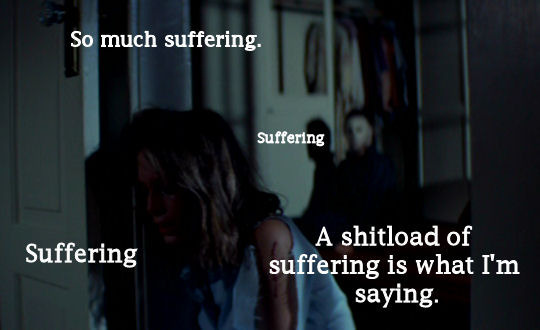
Do the pleasures of horror movies really begin and end in sadism? So the public discussion of film assumes, and so film theory claims. Carol Clover argues, however, that these films work mainly to engage the viewer in the plight of the victim-hero - the figure, often a female, who suffers pain and fright but eventually rises to vanquish the forces of oppression.
Okay, so at the moment, I'm actually halfway through it, but I'm enjoying it immensely, not least because it combines my love of horror movies with my love of analyzing the crap out of everything for its feminist implications. The writing is crisp and succinct and a bit less dry than reading, say, Laura Mulvey, but still dense with ideas and academic enough to satisfy the snob in me. Not too facile, I guess is what I mean to say. I also enjoy Clover's willingness to ask more questions than she has answers for. She's clearly interested in mining the material for what's actually there rather than starting with an immovable thesis and tailoring her research and observations to fit.
Iconic indeed. Though too much Freud gives me a headache and some things I don't understand from today's perspective, like you really need to look from a 50s or earlier pov to call the final girl, and the actresses who played them "masculine". Interestingly I preferred reading the analyses not about gender, like the city-country comparison or the importance of gaze in horror cinema. Nevertheless a very worthwhile read for anyone interested.
I may have seriously overestimated my appetite for Freudian psychoanalysis! Some real mixed feelings about this thing. I’m thankful that this book gave us the term “Final Girl” and made a serious attempt at analyzing the tropes of the genre. But it’s weighed down by dated views on gender, some truly baffling takes, and just way too much Freud.
I have no idea how harshly to judge a 28-year-old book when it comes to our modern understanding of gender. I’ll be generous and chalk most of these issues up to it just being dated. But regardless, most of it is from a bio-essentialist perspective, which severely tainted my experience and made me wish for a modern, more progressive version.
The analysis and criticism itself is also a mixed bag. There are several good points that I had never considered, but there are probably just as many Bad Takes. And a lot of times, even the Good Takes become Bad Takes by sliding down a subconscious slippery slope.
For a quick example of the Good, there’s a segment about how critics would find it disturbing when theater audiences cheer on Jason Voorhees as he kills his victims. But those same critics would often fail to acknowledge the even-louder uproar of support for the Final Girl during the climactic confrontation. This unique turning of the tables is something that outsiders to the genre don’t always understand or even consider. The fact that horror deals with sensitive and disturbing subjects, while also often being pretty fun, is one of the most unique and compelling aspects of the genre. The exploration of this apparent contradiction make up my favorite pieces of this book.
But an example of a Good Take going Bad is the analysis of Ms. 45, a rape revenge movie. The story follows a woman who, after being raped multiple times, enacts her revenge with a gun. Her killings escalate from would-be attackers to casually-sexist men, eventually culminating in a massacre of men of all kinds. It’s a complicated movie, in a complicated genre — all extremely ripe for analysis. And Clover makes some good points about the story and its themes, before abruptly going off the rails.
Her criticism culminates in a claim that the message of Ms. 45 is that if women would just arm themselves, they would no longer be victimized by men. Essentially letting the potential rapists in the audience off the hook by moving the blame from the rapist to the victim for not “manning up” and protecting herself.
There are a lot of valid criticisms to be made of Ms. 45. It’s an imperfect and abrasive movie about one of the most sensitive subjects. But the conclusion reached above is absolutely bonkers and is completely at odds with the climax (and honestly, most) of the movie. I won’t spoil it for you, but getting a gun definitely does not protect the character or make her ending a happy one. There’s a lot about the movie that’s open to interpretation, but who should be blamed for a rape is not a question that it poses.
And yeah, the Freudian stuff is completely exhausting. Of course there’s a lot to be said about the sexual subtext of many horror films. But wow, I never knew there were so many ways to subconsciously symbolize genitalia. Penises and vaginas and metaphorical sex as far as the eye can see! And this focus on phalluses really brings the bio-essentialist perspective to the forefront, which makes it all even worse.
So yeah, it was an interesting read. I’m glad to have read it — as it’s an iconic book — but I’m definitely more happy to be finished with it. I’ll repeat my praise for it taking the genre seriously and diving very deep, but I just want better takes from a better perspective. Recommendations welcome!
This book struggles in part (I think) because the author has trouble truly embracing horror. She seems to feel the need to authenticate the horror films she discusses by aligning them with mainstream Hollywood movies. This wouldn't be as distracting if she did not go into such detail about these non-horror films. Unfortunately, she winds up making them the focus at many points, losing her readers. For example, she spends the better part of the third essay talking about Deliverance in explicit detail, while name-dropping other actual horror films with nary a description. She also has a bad habit of relying on the same few films throughout all four essays. Her heavy, heavy, heavy reliance on Freud is quite tiring & irritating by the end. The worst part, though, is when she tries to force a terrible connection between "Indians" [sic] and rapists/evil-doers. That moment was just atrocious.
It wasn't all terrible, of course. She did provide us with the idea of the Final Girl, and there are other moments where she highlights quite intriguing ideas about horror films (her analysis of Peeping Tom is notable). If only she had fully embraced horror as horror & given up trying to authenticate it with its mainstream cousin.
10/2017 This book, from 1992, while being real film theory, is culturally notorious, for the first use of term Final Girl which took on a life of its own, especially in recent years ( I have seen it become much more popular). I enjoyed the introduction in this newer reprint, where Clover writes about the misinterpretation of the term. She was actually writing about identification (there Is a reason Final Girls are virgins with boy names, because boys Identify with them). It is a good term, though, for a real thing, and sometimes culture needs a phrase.
This book is responsible for igniting my horror obsession.
Various genres are covered (slasher, possession, haunting, revenge-I Spit On Your Grave gets a lot of attention), as well as films that influenced horror, like the Alien movies, Deliverance, and even The Accused.
The "last girl" trope, male gaze, and other common elements are discussed, their place in the history of horror cinema, their origin and purpose. The book also delves into why we enjoy being frightened. Why are we so attracted to stories about monsters, violence, murder, and rape? Because we're sickos? Sadists? There are other reasons. That primal rush you get from fear, for example.
One criticism, perhaps unfair, is that the content is a bit dated, since this was published in 1992. For that reason, many excellent recent horror films are not covered. Time for an updated edition maybe??
On the flipside, all those classic horror movies you do get to read about are to die for. Sorry...I know, but I had to say it. Speaking of cheese, comedic horror gets mostly left out. No Army of Darkness? Evil Dead does get a mention, but I would argue that movie wasn't really trying to be funny. It just was.
Men, Womem, and Chainsaws is a little too academic at times. It needs to have more fun! But for the most part I liked it. I was entertained, and I learned more about horror classics, especially those from the 70s and 80s.
I never know what to rate nonfiction, and I feel especially torn up about this one. This book offered so many interesting insights into gender in horror films, the final girl phenomena and the tale-revenge sub genre of horror. I loved learning more about the genre, the author is obviously a very distinguished scholar in her own right and this is a foundational book to read on the subject. On the other side of the coin, this is also a bit of an outdated read and far too much time was spent on Freud for comfort. I am also far too dumb and know nothing about film studies, so I don’t think I fully understand everything that was discussed. Nonetheless, I keep thinking about this book even over a week after I finished it. I don’t think I’ll be able to watch another horror film the same, and it has definitely ignited a passion in me about the subject.
This book was hard to understand. I expected to learn much more than I did. The author was more focused on sounding smart and reciting plots than explaining their logic.
When I saw that Men, Women, and Chain Saws came out in 1992, I thought perhaps that Ms. Clover had become interested in horror after the mainstream horror blockbuster The Silence of the Lambs, which came out the year before. But while she references that film several times, she says the whole project got started when friends dared her to come see The (original) Texas Chain Saw Massacre in 1985. She became fascinated by the politics of horror movies, and watched just about everything she could get her hands on. Her interest, as a film professor, lies in the ways in which viewers interact with, are affected by and attracted to horror movies, which of course is clearly related to the way they are constructed by their directors. When all is said and done, this seems to turn out to have less to do with psychological (interpersonal) precepts and more to do with sociological (intergroup) ones.
Obviously, from the title, we can see that one of her main focuses is on the role that gender plays in the creation of and reaction to horror films. Clover introduces the work as one that "explores the relationship of the "majority viewer" (the younger male) to the female victim / heroine ...". After critically watching many horror movies, she decided that the majority of critical responses to horror films were missing some very important insights: "... the standard critique of horror as straightforward sadistic misogny ... needs ... critical (and) political interrogation."
"The 'Final Girl' (the character who survives) is the only character to be developed in any psychological detail. ... hers is the main story line. She is intelligent, watchful, levelheaded; the first character to sense something amiss ... the only one ... whose perspective approaches our own privileged understanding of the situation. ... she is the undisputed 'I' on which horror frankly trades. When she downs the killer, we are triumphant. She is by any measure the slasher film's hero. ... An analysis of the camerawork bears this out ... the use of the I camera to represent the killer's point of view. ... We see through his eyes ... we are linked, in this way, with the killer in the early part of the film ... Our closeness to him wanes as our closeness to the Final Girl waxes. By the end, point of view is hers - we are in the closet with her, watching with her eyes as the knife blade pierces the door ... (and) with her, we become ... the agent of (the killer's) expulsion."
The way I understand Clover, her belief is that the violence perpetrated on women in slasher films is largely NOT misogynistic because the audience identifies with and roots for the Final Girl. One of her other main points is that because of that very identification with the victim, masochistic thrills are actually a more important feature of horror films and audience involvement than sadistic thrills.
If, as their detractors would have it, horror films offer satisfaction of sadistic desires then they offer as much to the masochistic ones or more. Put pithily as it is, this is a crucial point from Clover that tears apart a prevailing view of horror. You are thereafter in possession of a fine thread and, though this book can at a cursory glance seem a haystack, it’s a worthwhile task to search for the needle: Clover does the sewing and leaves you with a tidy stitch.
Though they will be familiar to the experienced horror audience by now, the author takes us through the tropes and traditions of horror films and from the commonalities of a broad survey we emerge with three separate subgenres that will be relevant to her treatment of gender: the slasher film, the possession film, and the rape-revenge film. Whilst Clover’s treatment of possession films is thoughtful and of rape-revenge films daring and refreshing, it’s her rescuing of the slasher film from the jaws of critics that is the heroic act here -or rather how she throws the film into the predicament of its own “final girl” and allows it to fend for itself. The devoted horror buff will probably enjoy Clover’s initial analysis of horror films for its own sake, but reaching past this there is something more significant on offer.
For Clover, the horror audience is uniquely gender-neutral. Indeed, she commends it as a virtue of the horror approach that it reaches through gender brazenly and, though a point of no little contention, plucks out and holds in bare palms what later “serious” films will only attempt to do with thick gloves. Horror films manage to have a largely male audience identify with a female survivor; the viewer goes with her into the bad place, cheers on her escape and empathises with her suffering.
Of course, it’s been quite a few years since Clover wrote this book and horror has undergone some interesting changes in the between time. The decline of slasher films, which the author laments here, would see a dramatic increase in the years following: Scream and its iconic self-awareness would be nearly as influential as Halloween was all those years ago, horror remakes would become a veritable class of their own (even Scream 4 is in on this), and documentary-styled shockers would bring a frightening clarity of realism to an otherwise mythic form.
This was certainly an interesting book, if a little dated (especially in its use of transphobic terms). It was definitely fascinating to read feminist criticism of horror and all its subgenres, though I wish it wasn't so overly focused on Freud, who I find to be kind of a hack. I was most interested in the chapter on possession films, as it's super relevant to a short story I've been writing, and I found a lot of great quotes in that chapter. I appreciate that this book put into words so many of my conflicted feelings regarding horror as a genre, especially in regards to using women as vehicles for men's stories (i.e. The Exorcist is more about the priest than the poor possessed girl), or the way it turns femininity itself into horror (a la Carrie). I also appreciate that Clover points out homoeroticism where she sees it.
Overall, 3/5 stars. The language was a little pedantic, and I think the author used a lot of words to basically say, "Horror can be sexist and homophobic, but it also has its feminist moments." Still, I learned a lot!
There are some really interesting and vital points about the relationship between the audience and horror movies but rather than plumbing that particular depth; the reader is instead treated to an endless stream of psychoanalytic recursion (which weirdly is very much about Carol J Clover's relationship to horror films and less about the relationship between horror films and their actual audiences because most audience members are not Carol J Clover). This isn't to say the book is entirely wretched, the 3rd and 1st chapters have some really strong components but they are often thatched together with long digressions into psychoanalytic theory that simply lose me (not in the sense that i do not comprehend what the theory is saying but, rather, i do not comprehend *why* i would in any way be convinced of the theory). Her predictions come across as somewhat cute (such as the lack of zombie films [could i live in this time line?]) and also looking at the reification of the slasher genre into the mainstream assuming indie horror would die (the short answer: the relationship between the audience and the film [i.e. that you go in *knowing* how the film will progress, wish for a good series of well executed but expected tropes *or* a really clever reversal, and eventually leave] gets super meta (Scream, for example, or Funny Games or You're Next), found footage and torture become major genres (Blair Witch --> Paranormal Activity & SAW), classics get remade (Texas Chainsaw Massacre, House of Wax, the Wicker Man, Dawn of the Dead, etc.) and Zombies become an almost overwhelming presence in the horror scene. This is an enormous digression to point out: better understanding the nature of horror films would have lead to *some* more accurate predictions (including the cautious nature of the movie industry regarding horror and the tendency to mine a vein until it collapses making what will become the next hit more whim and newness based although still rooted in horror in some sense))
Quotations from this book were showing up constantly in various fan works and discussions surrounding the idea of the "Final Girl" in horror media, specifically in regards to the fact that the author of this book of essays was the one responsible for coining the term, and my curiosity was piqued to the point I wanted to check this out and see what she had to say in this book.
For what it's worth, I enjoyed this book for the most part. It certainly gave me a lot to think about and analyze, and while it did take me quite some time to read, I attribute that more to my own desire to take my time digesting the topics in this book. There was a lot to take in and think about, especially when accounting for the fact that this book is dated and it prompts a lot of questions about the understanding of gender, coming from a decades-older viewpoint.
The one thing that majorly bothered me was the essay-chapter "The Eye of Horror." I felt like Clover got rather repetitive and beat her points in that chapter over and over again. Additionally, I took issue with a lot of her analysis of Carrie and Firestarter. My issues with her approach to Carrie started in chapter two, but she grossly misunderstood and skewed the knowledge of Firestarter to the point I felt like she was really reaching for an excuse to include it and force it like a square peg into a round hole for the "Eye of Horror" chapter. Even knowing she didn't read any of the books any of these films she watched were based on, with the exception of The Exorcist, I still don't understand how it is she so horribly misunderstood Firestarter and tried to force it to fit the point of her essay.
But my complaints aside, I still enjoyed this book, I appreciated that it gave me things to think about, and I'd make the argument that it's something anyone interested in horror media should really consider reading and using for points of discussion.
Even though this was written in the 80s and published in 1992, leaving a huge gap between then and the current display of horror films, it is still an important work that for the most part refutes the viewer identification with sadism thesis. The "Final Girl" is in our lexicon because of Clover and she makes a powerful argument that the popularity of horror films, even among its mostly male viewers, is rooted in identification with the victim and from a perspective of masochism. Although horror films are broadly discussed, three main threads are examined in detail: slasher films, satanic possession films, and rape-revenge films.
Scrupulously researched with extensive footnotes and references, so a gold mine for readers like me who like to chase down rabbit holes. Although academic, Clovers style is smooth enough for even non-academic readers to follow, as long as there's a willingness to learn some terminology in the process.
An incredibly interesting, if dated, read. Some elements of this analysis are probably fairly timeless (the Freudian readings of slasher movies, the inevitable gendering of characters based on their function in a film, etc.) though I'd be interested to see an updated version of this. It was published in 1992, right before horror films were relegated to direct-to-video sequels of 80's hits and Scream's reinvigoration of the genre later in the decade. Since then I think there's been a lot of shift in the role gender plays in horror. On top of that, Clover keeps to a binary gender reading (and uses some outdated words for transgender folks). I'd be interested to see takes dealing with genders outside men and women and the role transgender and other queer readings play into films. But, overall, a very insightful and very informative set of essays that definitely have me even looking at contemporary horror a bit differently.
men, women, and chainsaws is an incisive piece of psychoanalytic film scholarship that codifies and interprets three sub-genres of "low" horror: slasher, possession, and rape-revenge movies. clover also uses her interpretation of these three sub-genres to push back against the dominant feminist ideology of the time (late 80s/early 90s) that exploitation horror is categorically offensive schlock produced by and for male sadistic pleasure. while i like clover for challenging this assumption, the way she goes about it is at times iffy due to an over-reliance on freud. for me, the strongest aspect of the book is the way she traces the origins of these sub-genres and their influence on later "high-brow" films that garnered more critical acclaim. however, clover's argument about what audiences get out of horror--the main project of the book, according to her--ultimately falters.
the gist of clover's argument is this: critics and feminists assume that young men like slasher and rape revenge movies because they get sadistic pleasure from watching women suffer, when in reality they get a masochistic pleasure from identifying with the woman (final girl of the slasher or victim/hero of the rape revenge). if you're willing to suspend your disbelief and accept that freudian theory is descriptive of the way the human brain works, clover does an excellent job supporting this argument. however if you are, like most people nowadays, skeptical of the accuracy of freudian theory, this idea just comes across as a very intricate hypothetical. i actually don't mind clover using a psychoanalytic lens to discuss popular symbolism in horror films because there's definitely a lot there, but IMO she should have quit while she was ahead and provided her analysis of these films without trying to argue that the young men who flock to horror movies do so to experience some kind of oedipal transference. this over-reach, and the fact that clover is herself not a fan of horror cinema, makes her ideas about their audiences seem slightly tone-deaf and hollow.
(not to mention that she establishes young, heterosexual men as the primary audience for low-brow horror through anecdotal evidence from movie-theatre employees and video store clerks, which is weirdly weak evidence on which to support such an academic book. but we'll keep it pushing.)
that being said though there's a lot of stuff worth getting into in this book. obviously the coining of the term final girl is iconic, and i also enjoyed the rape-revenge chapter's argument that the genre was a natural progression from the westerns of the 30s and 40s. very cool! and finally, it seems like she was on the cutting-edge of celebrating the literary merit of exploitation films that went on to become critically-acclaimed classics. so good for her! but i would only recommend this book to people that have serious interest in psychoanalytic film theory and horror, because otherwise it's pretty dense and a little dated.
I heard about Men, Women, and Chainsaws on the Dead Meat podcast. Co-host Chelsea had great things to say about it, and since it was free on Spotify, I gave it a listen. This was my first venture into film theory ever, and as I was unaware of beforehand, my first exposure to Freud.
It’s easy to see why this book was so groundbreaking. It gave attention to the previously unexamined horror genre, and read a gender-breaking subtext into the genre that was more transgressive than what the films are usually given credit for.
The first two essays are easily the best. The first is about the gender dynamics in the slasher film, and the second is about the gender dynamics in the possession film. The second essay is by far the most coherent. I found the first essay the most relatable because I had actually seen many of the movies. The third essay was uncomfortable but still interesting, although somewhat all over the place. The fourth one, disappointing. There’s a reason why the first two essays are the only ones still talked about, seemingly.
The book’s best virtue is definitely its affinity for complication and uncertainty rather than strict delineation. For example, the second essay makes the claim that the supernatural possession films are essentially films about feminizing a man. Keep in mind this book was written over 20 years ago. While it is usually a woman being possessed, the focal point is a man’s spiritual journey, in which he generally becomes more “open” and “emotional”. She is sympathetic towards this, as its obviously a breakdown of traditional gender dynamics, but she adds a further caveat. This is only accomplished by moving the woman in the film, always possessed, into “hysterical” territory. They push the woman to the extreme to make room for the man. Instead of being a truly progressive, egalitarian shift for the man, it ends up being a re-territorialization. This is just one example, but it highlights that the book is less interested in expounding some grand theory or overarching hypothesis; rather, it aims to be curious and ask questions.
As for what is less likable - If you’re not familiar with Freud or don’t buy into it, a lot of this book may go over your head. I can’t say anything as I haven’t read any psychoanalysis, but I can say that many of the theses and examinations will be hard to accept.
Also, and I should have foreseen this, she discusses a LOT of movies. I thought I had seen many, but yeah she has seen almost every one, it seems like. This works when she uses films as quick examples, but when she dedicates long lengths to the examination of one movie, dissecting it scene-by-scene, its hard to stay focused.
Obviously, only mega-fans of horror should read this book, and they should probably read some Freud first. Still, I definitely liked the book and learned a lot. Also got some good recommendations!
Huh! I was a naive reader to go in expecting fewer “aggghhhh” moments in this, considering its publication date and subject matter. Author’s focus on horror movie imagery and action existing in a pointedly Freudian “phallicized/castrated” dichotomy seemed dated and reductive . A lotttt of time the author spent taking Freud seriously enough to engage with some of his whackadoodle theories would’ve been better spent expanding on her way more interesting thoughts on stuff like gender theatricality or the trope of the “ hysterical possessed woman” used as a kind of metric to allow male characters to evolve emotionally without appearing too feminine/irrational. In general, there’s a lot of meat here and it’s hard not to appreciate the effort , but any exploration of gender through an early 90s lens is gonna come with some tiresome assumptions based in biological determinism. So, a cool starting point with some obviously antiquated ideas. Had to skip a few parts of the book. I wanna read some modern takes!
3.5 stars rounded down, primarily because I've only seen a handful of the films examined in the text (of note, Carrie and the original I Spit On Your Grave), so it was a bit difficult to really get into it. I also generally disagree with the author's takeaways, but found her analysis to be interesting/worthy of consideration.
"['The death of a beautiful women is the most poetical topic in the world.' - Poe.] As horror director Dario Argento puts it, 'I like women, especially beautiful ones. If they have a good face and figure, I would much prefer to watch them being murdered than an ugly girl or man.'"
This was just great. I would LOVE a modern re-evaluation of a lot of the gender concepts in this as a nonbinary reader in 2022, but it was excellent for its time and mostly now too, really interesting and riveting to listen to. Eva Wilhelm was a fabulous narrator.
Este libro tiene ideas valiosas y también pioneras pero a día de hoy está desactualizadísimo. Es un tema lo suficientemente interesante como para beneficiarse de un análisis más actual.
So parts about this were really interesting, and other parts made me go like what…? And other parts were super boring.
The good stuff: as far as I know, the author coined the term “final girl”, which today is an iconic trope in horror movies, and something everyone knows and talks about. So props to her for doing that in the early 90s for horror movie culture. I also liked parts of the chapter on possession movies, and the rape revenge chapter was really interesting too, especially because that is a subgenre I have not really watched (except maybe the odd “classic”) and certainly not enjoyed, with the exception of Revenge (2017) by female director Coralie Fargeat, which is an awesome and badass movie. It was also fun to see some of the tropes explored that are widely known and discussed today, such as the country vs. urban thing.
However! Some of the authors takes and theories were WILD, and the constant reference to Freud just really got on my nerves. Freud is such a hack in my opinion but even putting my personal opinion aside, I just don’t think and don’t accept that everything (and I mean… everything lol) is supposed to be a reference to vagina, anus, phallus and whatever. According to the book, even the eye can be a phallus penetrating someone by… looking at them 😂 although I now think I might have misunderstood that one because it’s just so wild?
Some takes on feminism and gender were cool, especially when it comes to identification of the audience to the characters in the movie. I feel like nowadays, it’s common knowledge that horror movie lovers are not all psycho sadists who love seeing women getting murdered. But this was probably different in the 80s and early 90s, so I love that the author dove into that stuff.
All in all, there is some really great stuff in here, but other things just made me eye roll or tune out. So my feelings are middle of the road but I’m really glad I finally read this. But I’m lucky I had the audiobook and some hours of house cleaning to get through it, otherwise I might have dnf’ed again.
I haven’t read anything having to do with Freudian psychoanalysis so this book was a bit of an introduction for that. Also learned this book gave us the term “Final Girl” so that’s iconic. As a huge film nerd and someone who likes reading about gender and sexuality this book gave me everything I could have wanted. Great read.