Jump to ratings and reviews
Rate this book

The Defender: How the Legendary Black Newspaper Changed America

Rate this book
[Read by William Hughes]

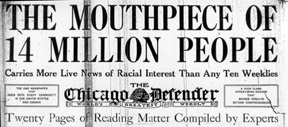
Giving voice to the voiceless, the  Chicago Defender  condemned Jim Crow, catalyzed the Great Migration, and focused the electoral power of black America. Robert S. Abbott founded the  Defender  in 1905, smuggled hundreds of thousands of copies into the most isolated communities in the segregated South, and was dubbed a ''Modern Moses,'' becoming one of the first black millionaires in the process. His successor wielded the newspaper's clout to elect mayors and presidents, including Harry S. Truman and John F. Kennedy, who would have lost in 1960 if not for the  Defender 's support. Along the way, its pages were filled with columns by legends like Ida B. Wells, Langston Hughes, and Martin Luther King.

Drawing on dozens of interviews and extensive archival research, Ethan Michaeli constructs a revelatory narrative of race in America from the age of Teddy Roosevelt to the age of Barack Obama and brings to life the reporters who braved lynch mobs and policemen's clubs to do their jobs.

1 pages, Audio CD

First published February 4, 2014

133 people are currently reading
2549 people want to read

About the author

Ethan Michaeli

3 books37 followers
Ethan Michaeli, the author of “Twelve Tribes: Promise and Peril in the New Israel,” (Custom House Books, 2021), was praised by National Book Award-winner Evan Osnos as a “master portraitist—of lives, places, and cultures. His rendering of contemporary Israel crackles with energy, fueled by a historian’s vision and a journalist’s unrelenting curiosity.”
Brent Staples, Pulitzer-Prize winner and member of The New York Times Editorial Board, described Ethan’s previous book, “The Defender: How the Legendary Black Newspaper Changed America,” (Houghton Mifflin Harcourt, 2016) as “An extraordinary history…Deeply researched, elegantly written…a towering achievement that will not be soon forgotten.” “The Defender” won Best Non Fiction of 2016 prizes from the Midland Authors Association as well as the Chicago Writers Association, was named as a Notable Book of 2016 by The New York Times as well as the Washington Post and Amazon, and to the short list of the Mark Lynton Prize.
A native of Rochester, NY, Ethan graduated from the University of Chicago with a degree in English Literature. He was a copy editor and investigative reporter at The Chicago Daily Defender from 1991 to 1996, and left The Defender to found the Residents’ Journal, a magazine written and produced by the tenants of Chicago’s public housing developments. Ethan served as executive director of Residents’ Journal’s affiliated not-for-profit organization, and under his leadership, the magazine won national awards for its journalism and for its programs training youths and adults in the skills of modern journalism, including the 2006 Studs Terkel Award for its investigative reporting.
Ethan currently is a lecturer at the Harris School of Public Policy of the University of Chicago, and a senior adviser for communications and development at the Goldin Institute, an international not-for-profit organization collaborating with grassroots social change activists in 40 different countries. He has served as a judge in prestigious literary contests including as chair of the 2020 Lynton Prize, and at the National Endowment for the Humanities in 2021. In addition to his books, his writing also has been published by Oxford University Press, the Washington Post, Atlantic Magazine, the Chicago Tribune and other venues.

Ratings & Reviews

What do you think?
Rate this book

Friends & Following

Create a free account to discover what your friends think of this book!

Community Reviews

5 stars
230 (50%)
4 stars
163 (35%)
3 stars
57 (12%)
2 stars
3 (<1%)
1 star
6 (1%)
Displaying 1 - 30 of 100 reviews
Profile Image for Monica.
780 reviews690 followers
February 26, 2018
There is something emblematic of American culture that a former white, male reporter who worked for The Defender in the 90s is chronicling its contribution. Please don't mistake that as criticism. Michaeli has written a wonderful, affecting, meticulously researched, and rich history told with admiration and tremendous respect. Listening to The Defender: How the Legendary Black Newspaper Changed America was like taking a tour of 20th Century American history from a different and unique vantage point. History through the lens of African-Americans. But The Defender was much more than merely a chronicle of observation with a Black-eyed (no double entendre intended--though I can see how you'd get that) view. The Defender publication was a key resource and trusted voice for an African-Americans for more than a century.

This is the story of the most successful black newspaper publisher and the trials and tribulations associated with that. Along with its coverage of American history, there are a myriad of stories and points of view that are unique to The Defender. For example, the lack of skilled labor for printing and the fact that no white folks would work for a black man in 1905. Abbott was literally a one man operation for the first three years. Abbott discovered a niche that white people hadn't considered because they didn't see the market for Negroes, assuming most were uneducated. The Defender was around early enough to have covered the appearances and speeches of Fredrick Douglass and Booker T Washington. It was key in recruiting and informing negroes from the South about the improved conditions and promises of prosperity in the North. The Defender was the first widely distributed publication to recognize that the violence against Black people and the lack of consequences for rape and lynching and economic injustices in the South were key motivators for the Great Migration. There was an obtuseness/obliviousness in mainstream publications, which were simply not outraged by the rampant, indiscriminate lynching. They were very matter of fact and until the huge labor shortages in the South caused them to notice great numbers of population movement and they began to look deeper at the conditions in the South and found them intolerable (also writing about the labor movements/shortages and conditions in the South got them fined and jailed or worse). I enjoyed reading The Defender coverage of Jack Johnson, the boxer from the south who openly cavorted with white women flouting racist laws and the perception of him in the Black community. Johnson was so dominant that white men couldn't win the bouts against him; so there was a strong consideration to segregate boxing. That idea dissipated once Johnson aged and became beatable. The strange political bedfellows that Abbott and later Sengstacke made like Woodrow Wilson and Herbert Hoover, Truman, Roosevelt whom The Defender endorsed but the politicians would not be photographed with a Black person. The story of Bessie Coleman, the first black female aviator who had to travel to France to be taught to fly planes. The difficulty of black journalists to cover the trial of the murders of Emmett Till because of court ordered segregation of black journalists to sit in the back of the courtroom where they couldn't adequately hear the proceedings. The story of Ethel Payne, the first black female journalist to cover the Vietnam war. The huge role of The Defender in the mayoral politics in Chicago with the Daley's and Harold Washington.

Once Michaeli hires on in the 90s, the story somewhat loses some of its finesse. There is a loss of perspective as he becomes part of the story. Throwaways stories like the time Michael Jackson personally calls the publisher and he thought it was a hoax. But he had some compelling stories too like him being one of the few white reporters covering "Saviors Day" a Black Muslim annual gathering featuring Louis Farrakhan. It was interesting that Farrakhan initially hesitant admitted that Michaeli was fair in his portrayal of events. The prestige and influence of The Defender started to ebb in the 90s nationwide; however in Illinois (specifically Chicago), it still carried much sway. Barrack Obama credits it's influence as an invaluable resource to reach African American community during his bid to run for the US Senate. Roland Martin (yes that Roland Martin) was brought in to try to revive the Defender and launched it's website. He tried to go back to its roots as a trusted resource for African-Americans. He changed the masthead to "Honest. Balance. Truthful. Unapologetically Black". The latter term also associated with the Black Lives Matter movement (and yes I have an "Unapologetically Black" t-shirt, why do you ask?). With numerous offers for the archives, the Sengstacke family chose the University of Chicago for safe keeping and protection. Located in the Chicago Public Library, are priceless editions, photographs and family papers forever accessible to the public.

I found myself wondering about The Defender's slow deterioration. Michaeli didn't really cover this as thoroughly as the rest of the book. His was a labor of love and as so frequently happens, he glossed some of the "not so favorable" issues. In the later years, The Defender had some major issues with quality and professionalism. It had been sustained based more on its historical reputation and legacy customers, than its content. It's plunging revenue caused it to downsize to at one point not having a single reporter on the payroll. The paper was in effect reprinting articles from the AP. Print press on the whole had taken a huge hit. The Defender was no exception. It catered to a very niche group and was never able to expand beyond the African-American community. Talented African-Americans were siphoned off to publications with wider readership and higher pay. America has become much more diverse with other large, minority communities with their own media sources. The availability and variety of media sources is huge. In today's world, everyone has the potential to be a reporter and publish their content. Today The Chicago Defender is a weekly regional publication and a professional web presence.

I picked up this book in celebration of Black History month. It was an excellent choice. Michaeli has written an significant work with admiration and respect for the paper filled with meticulous historical accounts of American history, its own history and the legions of hardworking people who helped to build the legacy. Yet there is this very small dink in the back of my mind that goes back to my opening statement. We are living in an age where 111 years after its inception, a white man is recording and writing a definitive narrative of the history of a Black newspaper. Conceptually it feels a little disparate. Intellectually and truly by presentation and performance; this book is excellent. The audio version narrated by William Hughes is superb and I also recommend readers to have the book/e-book for highlights and clearer understanding. This book is long, but very engaging. Just be advised that this is a significant time commitment. Highly recommended.

4+ Stars

Listened to the audio book
Profile Image for Porter Broyles.
452 reviews59 followers
June 28, 2020
This may well be my favorite history book ever and I tackle a lot of history. What makes the book so good is a subtle genius that is probably under appreciated. This is probably the longest review I have written, but I hope you read it through.

Before I go on, I think it is important to share something about myself. I am a middle-aged, white moderate conservative. A few years ago, I started reading Civil War history as it was a pivotal moment in America. From there I started reading more about the causes of the Civil War and the consequences of the war. This has lead me to an interest in Black History and an appreciation for the fact that we seem to gloss over it.

So I picked this book up.

Immediately, the book starts talking about Obama and the role the Defender played in his election as President. In my first Good Reads note about the book I wrote, “What a phenomenal book. I wish it didn't start off with Obama because I think that will turn off some people, but those aren't the target audience.” The target audience was clearly the black community and liberals interested in black history.

The story about the Chicago Defender was fascinating. Robert Abbott, the founder, saw a niche and started the paper with a quarter (about $7.00 today). He took the stories of the day and gave them a black spin. The spread of the paper was intriguing-- railroad porters would smuggle his newspaper to other states---including the Deep South.

The story of the Defender and the story told captured me.

One of the stories that I found intriguing was the way he talked about the “Great White Hope.” I remember watching the movie when I was a kid and did not really think anything about it. Michaeli discusses how the Defender and Chicago Tribune covered the real life Jack Johnson. Michaeli does not weigh in on the coverage; he simply contrasted how these two great papers covered the same event. He lets the readers take from them what they will.

He also talked about the Thomas Dixon film “Birth of a Nation.” For those not familiar with the film, it is considered by many historians to mark the rebirth of the KKK. Woodrow Wilson had a private screening of the film in the White House--- Wilson was without a doubt a racist. Most history books only give these incidents a cursory mention. Michaeli discusses Wilson’s history with Dixon and the film itself. He talks about the contents of the film and the message. Again, he contrasted the Defender and the Tribune’s coverage (a common thread in the book). He also talks about the reception and opposition to it. Again, I was riveted. (He also talks about how Wilson had a change of heart and became a champion for the African American when he compared the KKK to the Germans during WW I and condemned lynching. The Defender praised Wilson for doing so.)

The news reports on the Rise of Unionized labor and the black scabs who crossed the line takes on a different tone. The Defender encouraged blacks to cross the line. Not to break the strikes, but to break the unions! If the unions were not going to allow blacks, then they could not expect blacks to recognize the strike. Again, stories that I was familiar with, but as reported by the Defender had a different take.

There were also stories that I did not know. Stories such as the Great Migration and the Great Northern Drive. These stories are an important part of American history, but prior to a year ago when I purchase “The Warmth of Other Suns” (which I have not read) I had never heard of them.

Then there were obscure stories that I can't imagine many are familiar with (the black woman who moved to France to learn how to fly) that were covered in the paper.

It did not take me long to realize that the book was not just about the Defender, but a book about black history.

I LOVED the stories and the way they were told. Let me stress that, I LOVED this book.

And I started to think about “Why do *I* enjoy this book so much?” Then it dawned on me. The book is telling me a story that is part of *MY* legacy. It may be a dark part of my legacy which as a white guy sometimes makes me a little uncomfortable, but it is told in a way that got me to listen.

While I read a fair amount of black history, this one reached me in a way others had not. Again, I asked why? I realized it was because Michaeli does not judge the actions. He is simply telling the story about HOW the Defender reported the events.

The stories captured me and drew me in. They slipped pass any barriers I might have had because Michaeli is not evaluating history or saying “what a tragedy”, he is simply reporting what the Defender did.

Before long, I started thinking this book is one that more white people should read, if only it was not for that introduction talking about Obama. I mean, some of the people I know who should read this book have some reservations about Obama.

Therein lies the genius of this book, by talking about the story that might make conservative white guys the most uncomfortable early on, he sets the tone. The books isn't going to go radical when talking about Obama, he's going to present the story. I did not realize it at first, but by doing so, I lowered my guard.

By the time I finished this book, I realized that the target audience is not who I thought it was. It is really a book for the middle-aged white moderate conservative.
Profile Image for Skip.
3,845 reviews582 followers
August 28, 2020
As Ethan Michaeli writes in his last paragraph: “The Defender allowed me to see the truth about America, that “race” is a pernicious lie that permeates our laws and customs, revived in each generation by entrenched interests that threaten to undermine the entire national enterprise, just as it is challenged in each generation by a courageous few who believe that this can truly become a bastion of justice and equality.”

A must-read book about the history of civil rights for African-Americans in the U.S., starting with Frederick Douglass’ address at the World’s Columbian Exposition. Michaeli writes this history from the perspective of the successful black-owned and managed newspaper, The Defender, founded in 1905 by Robert Abbott and passed along to John Sengstacke. The book tracks the Great Migration as Southern blacks flocked north to avoid persecution and find opportunities in Chicago, especially during WWI when immigration came to a halt, requiring people to work in factories. The book also follows the topsy-turvy political climate in Chicago, including the profound role played by the Southside in making its votes highly sought as black population growth and white flight provided real political power. Important issues segregation vs. desegregation in schools, neighborhoods, sports, military service are treated evenly. The Bud Billiken parade, created for newspaper carriers and sponsored by The Defender became an important event for the city, socially and politically, attracting famous actors, singers, sportsmen. The sad decline of this publication into obscurity and bankruptcy is chronicled too. Long but very rewarding.
Profile Image for Carly.
456 reviews198 followers
March 5, 2016
"When you face prejudice, fight it and fight it hard."
I have to admit that before reading this book, I don't remember ever really hearing about the Chicago Defender, and yet throughout the last century, The Defender has acted as more than simply a voice for a marginalized group. Robert Abbott created the newspaper with a mission in mind: particularly after the Atlanta riots of 1906, he saw that a new voice was needed to act as "Defender of his race,". For over a century, The Defender has been a staunch combatant against racism and promoter of integration.

The book opens with Frederick Douglass's visit to the World Fair in 1893. Although the Civil War was over, prejudice, racism, and inequality was just moving into high gear. As he put it:
"There is no negro problem. The problem is whether the American people have honesty enough, loyalty enough, honor enough, patriotism enough to live up to their own constitution."
Inspired by Douglass, Abbott set out to create a newspaper that could continue to advocate such honesty. It was a rocky beginning: Abbott started by running the newspaper out of his boardinghouse, subsisting off limited community support rather than advertising, and even being forced to rely on money from Teenan Jones, an infamous gangster. Despite its message of racial pride, it routinely carried advertising for skin lighteners and hair straighteners. Without full-time journalists on the payroll, Abbott and his crew started by pulling stories out of other papers and rewriting them for their audience. The Defender also faced an impressive level of hostility: Southern "gentry" and law enforcement ridiculed the paper and sent taunting telegrams suggesting Defenders come and report on lynchings that had yet to happen. Abbott was repeatedly investigated by the FBI and related organizations, and various Southern states even made attempts to extradite him for libel charges.
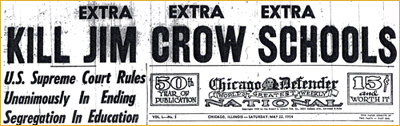

In the early twentieth century, Chicago was a comparative bastion of liberty and freedom: while lynchings and attacks certainly happened, police usually attempted to stop them instead of joining in, and although Chicago's race riot of 1919 was one of the bloodiest seen, it still indicated that Blacks in Chicago could fight back. The Defender sought keep a spotlight on racist violence, reporting continuously and vividly on lynchings and other atrocities of Jim Crow. Although a firm supporter of integration, the Defender wasn't always conciliatory. Often fiercely emotional and moralistic, it occasionally stooped to publishing clearly apocryphal stories or using aggressive rhetoric, such as the time it insisted that anyone who failed to vote against Hanrahan was "a traitor to the black cause". But perhaps a strident voice is necessary to actuate social change. As a Defender editorial put it:
"We are a watchdog and to many bigots in Chicago, an irritation, a Socratic gadfly, a pain in the neck or even a 'black hysterical voice,' but we proudly accept this role at this critical juncture in American history and will jealously cling to it until we can become 'just another daily newspaper.'"
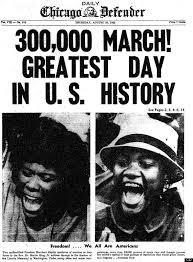
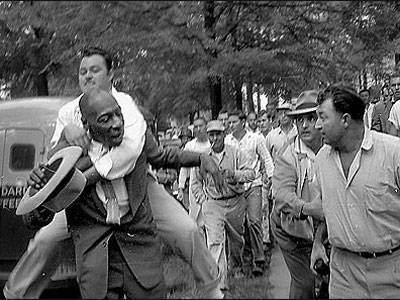
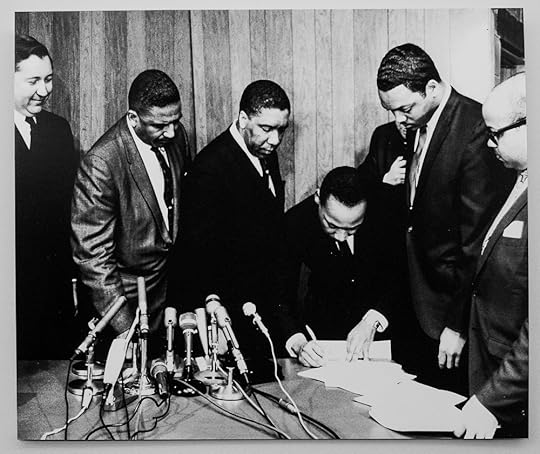
The Defender and its editors played significant roles in actually influencing and guiding public policy. The newspaper was a critical catalyst for the Great Migration. It lobbied tirelessly--and eventually successfully--for an integrated military. It was a Defender reporter who was beaten during the Little Rock Nine's entrance into the school. As the paper gained greater influence, Abbott and Sengstacke directly interacted with more and more powerful political figures, including many presidents-- even if most refused to be photographed with a black man. A true believer in unity, the Defender was internally integrated, hiring white reporters throughout its history.


The story of the Defender is fascinating, and Michaeli's writing style is vivid and moving. My biggest complaint is a certain lack of scholarly disinterest, which makes sense, given that Michaeli worked at the Defender and met many of the people whose lives he documents. Throughout, Michaeli's protagonists are described ias "brilliant,""charismatic," etc, often without supporting evidence, and he tends to ignore flaws intrinsic to rounded portraits. For example, he simplifies the complex relationship between King and Jesse Jackson, lauding Jackson as King's successor and later portraying him as an august "elder statesman".He is also uniformly negative towards enemies of the Defender such as Marcus Garvey. Throughout, figures such as Abbott and Sengstacke are treated almost hagiographically. For example, when Sengestacke fires every reporter on the paper who won't tow his pro-Truman line, Michaeli phrases it as a dismissal of those who crossed "Sengstacke's red line of explicit political work." I found it an amusing description, given that under Sengstacke's direction, the Defender vigorously endorsed Truman, spearheaded a huge fundraising effort for him, and actually characterized the election as "A crusade, not a political campaign." Michaeli is also clearly a fan of Obama and describes even his questionable actions in glowing terms. For example, when describing how Obama snakes the nomination out from under Palmer by challenging Palmer's petition to get proof that each signer had the right to vote, Michaeli characterizes him--unironically-- as being "gracious in victory."


There is so much to this book that I can't even begin to describe it all. The book provides a vivid, visceral history of the last century, It's the minutiae that highlights the insidiousness of racism and the courage of those who fought it; Jack Johnson's world championship, the century-old conflict over segregated real estate, Brown versus the Board of Education, the Freedom Riders, King's efforts in Chicago and his slow fade during the rise of Black Power, Clinton's reaction to Dantrell Davis... the Defender reported it all. More than that: it was instrumental in all of it. As one reporter said of Robert Abbott:
"When he sought to raise the black man to the level of the white man, he was branded a radical. The radical of today is the conservative of tomorrow and other martyrs take up the work through other nights."
And there is plenty of work left to be done. If you're interested in learning more about Chicago, or reading twentieth century history through a distinctive lens, The Defender is absolutely worth a read.
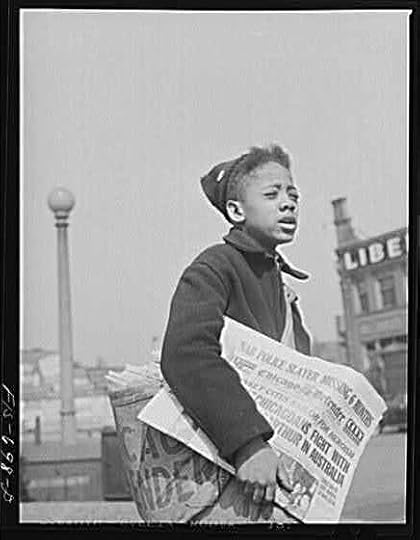

~~I received an advanced reader copy of this book through Netgalley from the publisher, Houghton Mifflin Harcourt, in exchange for my honest review. Quotes are taken from an advanced reader copy; typos are all mine.~~
Profile Image for Marlene.
3,439 reviews241 followers
February 26, 2016
Originally published at Reading Reality

The story of The Defender is really multiple stories. It is a history of America in the 20th century, as seen through a slightly different lens than the one many of us were taught in the history books. And because of that lens, because of the audience that The Chicago Defender was built by and for, it is also the history of Black America in the 20th century. And all of that from the focal point of Chicago, where The Chicago Defender was based and from which it drew so many of its stories.

And it is also the history of the rise and fall of one newspaper, and in some ways newspapers in general, in the 20th century. The Chicago Defender began publishing in 1905, saw its own rise and the rise of the community it served, and it now survives reduced in size and influence, as so many newspapers have been reduced in size and influence.

February is Black History Month, and The Defender is a marvelous book for this month, as it tells its story from Bronzeville, that part of Chicago that became the heart of the Black community in the city.

But the story of The Chicago Defender begins earlier, at the Chicago World’s Fair and Columbian Exposition in 1893, as so many Chicago stories do. It was in the White City that a very young Robert Sengstacke Abbott met the already elder statesman Frederick Douglass, and began to conceive of the idea of a newspaper for African-Americans based in Chicago. Abbott had trained to be a newspaper man at college, and he just plain wanted to move to Chicago from his home in the rural, segregated and downright dangerous, South.

Much of the early chapters of the book are also Abbott’s story, as he begins his newspaper on the thinnest of shoe-string margins, at first not only doing all the work himself but also relying on the kindness of his landlady to house the fledgeling enterprise in her dining room.

Abbott was smart. He was lucky. And mostly, he had a dream that he diligently pursued for the rest of his life. His dream was to provide news, education, exhortation and uplift to the African-American community, not just in Chicago but around the world. His goal was to break the back of Jim Crow in the South and tacit segregation in the North. And while he did not succeed in his lifetime, he is certainly one of the giants on whose shoulders the mayoralty of Harold Washington and the presidency of Barack Obama stand.

So this is history, from the very late 1800s and the birth of the idea, to the sale of the paper from the family to an outside company in 2003 after nearly a century of ownership by the founding family. By 2003 The Defender wasn’t what it was in its heyday, but no newspaper is what it was. Even The Chicago Defender’s long-time rivals in the Chicago mainstream press, The Chicago Sun Times and The Chicago Tribune, have shrunk from their glory years.

But what fascinates about the story of The Chicago Defender is the way that it in its time, and it in its history, shine a different light on events that mainstream audiences are familiar with – from the corrupt administrations of “Big Bill” Thompson to the machine politics of Richard J. Daley to the ascendancy of Harold Washington. The Chicago Defender was one of the great sparking motivations for the “Great Migration” of African Americans from the rural South to the industrial North in the first half of the 20th century.

The power of the voting block mobilized by The Chicago Defender held the fate of congressional representatives, Chicago mayors and even presidents in its collective hands on Election Day. And the principals of The Chicago Defender pressed for, and eventually achieved, among other notable successes, complete integration in the U.S. Armed Forces.

This book is a captivating look at 20th century America, and a marvelous study of the power of the press to achieve greatness.

Reality Rating A-: I both enjoyed this book and was fascinated by the view of history that it illuminates. I love reading narrative history, where the story, while true, also has a beginning, middle and end, which the history of The Chicago Defender certainly does. The paper began as one man’s dream, and its history with his family ends in the 21st century as newspapers around the country struggle with finding a foothold on the future.

But The Chicago Defender still has a real voice and force in Chicago and U.S. politics. Its annual Bud Billiken Day Parade is still one of the places for up and coming politicians to see and be seen, and for sitting political leaders to get in touch with their constituents and the African American community.

The history in this book was most interesting the further away it was from the present. Reading about the early years, one can almost see the initial small staff laboring away in Mrs. Lee’s dining room, surviving those lean years on hope and her homecooked meals.

It was ironic that the parts of this history that the author witnessed as a member of the staff in the late 1990s felt like a much barer recitation of names and dates, while the early years are almost luminous.

As someone who lived in the Chicago metro area during the Harold Washington years, I remember the way that the mainstream news outlets covered his campaign and his running battle with the Chicago City Council. In reading this account of The Defender’s coverage I get a much more balanced view of that period, seeing much from sides that the mainstream newspapers chose not to cover because it interfered with their narrative.

I would highly recommend this book to anyone interested in differing perspectives on 20th century America, or in the history of 20th century newspapers in general and the Black press in specific. And for anyone who wants to sink their teeth into a solid chunk of fascinating Chicago history.
Profile Image for Sean O.
880 reviews32 followers
July 8, 2016
The story of the Chicago Defender is really the story of the civil rights movement in Chicago. Robert Abbott and John Sengstacke built the Chicago Defender to document the destruction of race hatred. I'm not sure race hatred is destroyed, but the changes that occurred go far beyond the modern accepted narrative of Jackie Robinson, Rosa Parks, and Martin Luther King Jr.

The story goes all the way to the 1893 Columbian Exposition and on the way we meet Frederick Douglas, Ida B. Wells, Mary McLeod Bethune, MLK, Harold Washington, and a young community organizer named Barack Obama.

With a story this extensive, you could expect a lot of hand-waving and detail-fudging, but the author is meticulous with his sources and his explanations. You seldom feel lost or get the sense you're missing something.

The book is not short, and the scope of the story expects you to have some historical knowledge, but if you're interested in Race, Chicago, and how a family creates an institution, this book is for you.


Profile Image for Mary.
337 reviews
February 7, 2016
Despite a few issues I have with the editing of this book -- Louis Armstrong did not play the "coronet;" the word "obdurate," if used at all, should not be used more than once -- I was thoroughly engrossed by the contents. Having previously read "The Warmth of Other Suns," I was interested to learn what an important role the "Chicago Defender" newspaper played in inspiring the migration of African Americans from the South to the North. In fact, beginning with its foundation in 1905, there was hardly any event of interest to African Americans and/or the city of Chicago, on which the "Defender" newspaper did not have an impact.
Profile Image for Shakeia.
98 reviews50 followers
February 4, 2016
Whew. This book was super long. I would say it was a comprehensive history and it is quite interesting and informative. I would not recommend reading it straight through; reading it in between other less meaty books was ideal for me.
Profile Image for Leah Rachel von Essen.
1,416 reviews179 followers
September 18, 2019
The Defender: How the Legendary Black Newspaper Changed America by Ethan Michaeli is a hefty book to take on. A crucial history text, it chronicles the history of black newspaper The Defender and in doing so, chronicles as well the histories of many black historical figures (from boxer Jack Johnson to pilot Bessie Coleman) and their relationship with the paper; the presidential and mayoral elections; civil rights movement events; and much of the history of black Chicago.

I think the expansiveness which makes it so intriguing did make it strange to see particular things left out. Why is there so little about the Brotherhood (mentioned for the first time after Malcolm X has been killed); about Mayor Daley’s election; about Harold Washington’s actual time in office? I found some omissions strange, as I’m sure The Defender covered Malcolm X and took a side in the Daley polls. More understandably, coverage of the civil rights movement is sporadic: Michaeli is primarily concerned in telling us where the Defender had a marked presence, interest, or sway, and so it makes sense that he might skip over some events such as MLK’s "Letter from Birmingham Jail” for example, but it also makes it stranger when he dives into events without telling us the role of the newspaper.

I found it jarring when the final two chapters took on a first person perspective due to Michaeli joining the newspaper, particularly as his own privileged introduction to the city peeks through, being a white man who first came to the city to study at the University of Chicago; but ultimately, I think that while the shift does pull back on more omniscient narratives, it also helps to maintain a high level of journalistic transparency as well as a clearer, more personal look into the day-to-day and character of the paper.

Overall this was a tremendous tome worth the large time commitment (536 pages, not including the notes, and in small text, the book was thick enough that reading and walking with it made my thumb ache). I had never heard the name of Richard Abbott, the man who had an incredible influence and impact on Chicago and America through his foundation and work on The Defender. I learned more about the politics between Daley and other politicians, and about the impact of the paper on the Great Migration and of the African American vote on many major elections. It’s a fascinating history with much to tell, and an especially vital read given that The Defender ceased its print publication this past July, which was part of my impetus for picking this book up. I’ve very glad to have read this informative and easy-to-read book packed full of the history of journalism, Chicago, and African Americans both in the Midwest and nationally.
Profile Image for judy.
947 reviews28 followers
April 5, 2016
This is as close as anyone will get to chronicling the birth, life and impact of Chicago's unparalleled Black newspaper--The Defender. I've read many recent books on Chicago history but this is the missing piece . You can marvel at Chicago's architecture, music, politics and all the other things that put Chicago in the first rank of great cities. Without the story of the Defender, its role in the Great Migration, its visionary founder (Robert Abbott) and its coverage of over 100 years of Chicago happenings written specifically for the large African-American population, any description of the city would be incomplete. I particularly enjoyed the details about founder Robert Abbott. Through him I was reminded of how things were for Black people long before the civil rights movement. It's easy to forget--or perhaps ignore. The middle of the book loses some momentum but that's present in every newspaper history. What newspaper has not had financial troubles and serious disputes with printers and typesetters? By the time we get to what history I remember, I can't really differentiate between the Defender and other sources. The author tries not to say tv but, of course, that changed how much the community relied on its daily paper. The author, who is white, Jewish and spent many years at the Defender is a delight to accompany. He wasn't a journalist and certain never intended to write for a Black newspaper--but his story and learning curve is fascinating. Finally, if nothing else, after 18 years in the Chicago burbs I know what the Bud Billiken Parade is.
Profile Image for Gary Sosniecki.
Author 1 book16 followers
November 10, 2020
I read in journalism media this summer about the Chicago Defender successfully navigating its first year as a digital-only product, which reminded me that I still hadn’t read the two-inch-thick hardcover copy of “The Defender: How the Legendary Black Newspaper Changed America” that I picked up several years ago at a library surplus-book sale. As a retired newspaperman and a Chicago-area native, it was past due for me to learn more about the paper I knew only as Chicago’s No. 5 daily when I was growing up in the 1960s, a paper that never reached my nearly all-white suburb. The first thing I learned is that the bedtime reading of “The Defender” is not a short-term project. It took 45 days to navigate the 536 pages. (The back matter brings the total page count to 633.) But the journey was worth it. Not only is “The Defender” the proud story of the premier Black newspaper in America, founded in 1905, but it’s also a history of the “Great Migration” of African Americans from the Jim Crow South to the industrial north, a movement largely led by the Defender through its wide distribution in southern states. It’s the story of the Abbott/Sengstacke family, which owned and operated the Defender from 1905 until 2002, often at a financial loss, “with the familial mission of liberating African Americans through the vehicle of the black press.” And it’s a history of America’s civil-rights movement as reported by the Defender. This is a comprehensive work not without its quirks: occasional words that drive you to a dictionary (for example, “inculcated” on Page 355 and “quotidian” on Page 532) and rare but unnecessary fact errors (the Illinois governor in the 1950s was “William” Stratton, not “Richard.”) But my nitpicks didn’t deter from my enjoyment of author Ethan Michaeli’s excellent research and writing. (One final note: “The Defender” is a good companion piece to “The Race Beat: The Press, the Civil Rights Struggle and the Awakening of a Nation” by Gene Roberts and Hank Klibanoff.)
Profile Image for Jarred Goodall.
293 reviews3 followers
March 19, 2023
An outstanding, well-researched read, for which Mr. Michaeli conveys a unique medium that covered, along with representing, change for the better in the country in its last 100 plus years.
317 reviews1 follower
December 24, 2020
This dense, rich, detailed American story should be required reading in high school history. Every person in the country should know the news that white papers refused to print. A cohesive documentation of lynchings, the great migration north, and the rampant and constant discrimination -- The Defender, America's legendary Black Newspaper, documented it all. This is the history white America doesn't learn in school and should, as it places the current struggle for freedom from brutality in the larger history. Remember that moment the Party of Lincoln turned into a mouthpiece for the KKK? The Defender did. Remember the hundreds of times rampaging white men destroyed black businesses for the sole crime of being successful? The Defender reported on them all.
Profile Image for SundayAtDusk.
751 reviews33 followers
January 13, 2016
I’ve never read a book over 400 pages that I didn’t think was too long, and this book is no exception. Not that a reader should have any problem making it to the end, although I would not recommend trying to read it straight through. Contents wise, it’s a conscientious look at both the most influential black newspaper of the 20th century and the lives of black Americans during that century. For those who like to read about newspapers, it’s a thorough study of a paper that started off in a landlady’s dining room and ended up employing thousands of individuals in its heyday.

Robert S. Abbott, who started the Chicago Defender, saw his newspaper as being for all blacks in the United States, not just in Chicago, and paid Pullman porters, as well as others with traveling jobs, to sell subscriptions throughout the country, including down South. His paper was one of the biggest advocates of the Great Migration, convincing blacks the North provided a better life with better jobs and less discrimination. Of course, there was no shortage of discrimination and prejudice against blacks in Chicago, but the city was still seen as one where lynchings were less likely to occur. It’s very much a story of the North, so don’t expect to read about those who couldn’t stand cities like Chicago and went back home to the South, including the thousands who started migrating back in the 1970s, after the death of Jim Crow.

It was the Great Migration part I found most interesting, which surprised me, because I though the Civil Rights period would be my main interest. But so much of that was nothing new, except what was specifically about the Chicago Defender. (For those who want to see much of what was discussed in the book of that time period, including the planned march to Cicero, do watch the PBS DVD Eyes on the Prize: America's Civil Rights Movement.) The book at times gets pretty political, especially about Chicago politics, which I found less interesting than the newspaper and neighborhood talk. Also, towards the end of the book, author Ethan Michaeli, who is Jewish, describes his 5 years with the paper in the 1990s, which I thought was an interesting addition to this very long look at the Chicago Defender.

P.S. The newspaper is still alive and well, and you can read it online.

(Note: I received a free copy of this book from Amazon Vine in exchange for an honest review.)
Profile Image for Josh Brown.
204 reviews10 followers
March 21, 2016
The last paragraph of the book: "Working at The Defender allowed me to see the truth about America, that 'race' is a pernicious lie that permeates our laws and customs, revived in each generation by entrenched interests that threaten to undermine the entire national enterprise, just as it is challenged in each generation by a courageous few who believe that this nation can truly become a bastion of justice and equality. And now that I know the truth, I am compelled to try to correct our mutual story. That is the mission to which Robert Abbott committed himself when he first pressed his fingers against the keys of a battered typewriter, inspired by the sounds of the people in the street below and the roar of the El train on the next block."
Profile Image for Vannessa Anderson.
Author 0 books224 followers
April 24, 2017
I grew-up reading The Defender newspaper. The Defender (unlike the Times and the Tribune that focused on news that happened in non-minority communities) was the go to newspaper that kept us informed on what was going on in Black communities. The Defender How The Legendary Black Newspaper Changed American provided a chronological event-by-event of History. Thank you author Ethan Michaeli for providing us with a book that we can use for learning and a book we can use for research.
Profile Image for Cwelshhans.
1,251 reviews1 follower
February 13, 2016
Such an interesting story, and I learned a lot. My only complaint is that some big events were skimmed (or not covered at all), and I was really interested in knowing how the Defender covered them.
Profile Image for Amy.
115 reviews2 followers
June 29, 2019
This outstanding, thoroughly researched and superbly written book recounts a century of the lives of black Americans through its history of The Defender, the influential and iconic Chicago black newspaper that encouraged the Great Migration, chronicled and supported the Civil Rights Movement, and demanded the equality for black citizens guaranteed by the Constitution.

Michaeli tells this broader American history primarily through the story of Robert S. Abbott, who founded The Defender in 1905 at his landlady’s kitchen table, and through John H. Sengstacke, who succeeded Abbott as publisher. He demonstrates the bravery of reporters such as Alex Wilson, who was beaten by a white mob while covering school integration in Little Rock, Arkansas, and Ethel Payne, who covered the White House and the Vietnam War. At the end of the book, Michaeli recounts his own experience in the 1990s as a Defender reporter and editor, and shows how the newspaper supported Barack Obama's historic campaign for president.

I grew up in the Chicago area, as did my parents, and this book showed me how limited my understanding of Chicago politics and history had been. I didn’t know that it was Abbott who founded the Bud Billiken parade (it originally honored Defender delivery boys), or that the newspaper was so influential in presidential elections, pushing Truman and Kennedy to do more to protect the rights of black citizens. I was fascinated to learn that the newspaper gained a national audience, and was able to speak directly to black Southerners hoping to escape the violence and lynchings of Jim Crow, because Pullman porters sold subscriptions on cross-country railroad trips.

While the book, at more than 500 pages, is certainly comprehensive—at times it went deeper into local early 20th-century politics than I was interested to read about—it also moves quickly. Michaeli has a lot of ground to cover; he opens with Frederick Douglass’s speech at the 1893 World’s Fair, and details the unrest in Chicago in 1919 that followed the murder of Eugene Williams; Emmett Till’s murder; the March on Washington; and Dr. Martin Luther King, Jr.’s activism, particularly in Chicago. Figures such as Ida B. Wells-Barnett, Marcus Garvey, Bessie Coleman and Muhammad Ali are just a few of the many others who appear as they engage with The Defender and its mission. This book is a vital record of American history and a reminder of the power of journalism to chronicle and promote change.
Profile Image for Dreamybee.
212 reviews4 followers
February 14, 2017
I didn’t intend for the reading of this book to coincide with Black History Month, but it ended up being an entirely timely read, in more ways than one. This was a good, if extremely broad, history of the struggle for equal rights as seen through the political orchestrations as well as the personal stories from 1905 to the modern day. One of the reasons I picked this up was because I was curious about what role The Defender had played in Obama’s election—the front flap says that the author “constructs a revelatory narrative of race in America and brings to life the reporters who braved lynch mobs and policemen’s clubs to do their jobs, from the age of Teddy Roosevelt to the age of Barack Obama.” That is…technically true, but by 2008, the paper had kind of fizzled out. There is brief mention of Obama appearing on the scene as an up-and-coming community leader, but that’s about it. So, if you slog through 500+ pages waiting for that, you might be disappointed. It’s certainly still worth reading; I’m just saying, adjust your expectations accordingly; don’t let the front flap fool you. Given that Kennedy only won by about 112,000 votes, (which he almost certainly would not have gotten if it hadn’t been for The Defender) and given our most recent election, a book delving into the power of the press to elicit change sounded interesting.

The Defender, a Chicago newspaper started in 1905 by Robert Abbott, played a big part in shaping much of Chicago’s and America’s political history. Being in Chicago allowed the paper to take advantage of the rail line that ran all the way to the South, where Pullman Company porters would deliver the paper to readers in the South. Southern blacks were able to read stories about black people, written by black people, in a paper owned and operated by a black man, stories that highlighted the opportunities available in the north to people who were largely free of the terrors regularly visited on blacks in the South. The paper was instrumental in The Great Migration, which saw millions of people from the South move north, seeking a better life. Many settled in Chicago, and as the black population there grew, the city had to contend with issues of education, housing, and employment, often in the face of discrimination; although attitudes in the north were better, at the end of the day, there were still plenty of whites who resented all the blacks moving into "their" territory. Meanwhile, lynchings in the South were being largely ignored by the broader public, and The Defender began running articles about these atrocities. Not only did it bring to light what was happening in the South, but it highlighted to Southerners that this was not a commonly accepted practice everywhere, that better opportunities existed elsewhere. While lynchings did take place in nearly every state, the South certainly had the worst record. One of the stories that stood out to me was about a black man in Arkansas who had been tied to the railroad tracks by a group of drunk white men as the mail train approached. He was decapitated, and, as could be expected, The Defender called this out as an atrocity under the headline, “Southern Stunts Surpass Huns”. This was 1918, and certain officials found this article tantamount to treason because it might make black people feel that they were being treated as badly by white Americans as they would be by white Germans, a sentiment that was considered unpatriotic. The Defender was also criticized because it didn’t always say what the victims had done to provoke their attackers. Because, you know, the lynchings might have been justified, and this obviously biased reporting made it sound like they weren’t (90). Part of the reason this stayed with me is because it sounds so much like the victim blaming that often goes on today…Well, what was she wearing? What did she say to make him so angry? If they don’t want to be harassed, they shouldn’t wear those things in public…etc.

The other thing that stood out to me was the common narrative of just how pissed off white people got when they were threatened with the idea of having to treat black people equally. In 1954, when Brown v. Board of Education of Topeka ruling came back saying “separate but equal” laws were not constitutional, S. Carolina’s governor threatened to eliminate the public school system all together rather than integrate (312). Because better that your entire state remains uneducated than having to educate black kids and white kids together, am I right? In 1957 when the Little Rock Nine were famously escorted to the all-white Central High School, where the law said they had a right to be, the result was 800 angry white people at the school and white supremacists with dynamite, knives, clubs, and bottles heading toward the home of a local woman who was housing one of the students (348-349). All because their precious white children were being subjected to black children. Alex Wilson, a Defender reporter, died three years later while undergoing treatment for the neurological condition brought on by the beating he received while covering the story (362). In 1961, a bus full of freedom riders, both black and white, was “surrounded by a hundred drunken, gun-toting white men” in Alabama. The driver tried to proceed, but “the mob slashed the tires, and those in automobiles ran the bus off the road” where they “picked up rocks and began shattering the windows, finally tossing a firebomb inside.” (368-9). Because there were black people sitting in the front of the bus. In 1962, the Supreme Court ordered the University of Mississippi to admit James Meredith, a black man. Marshals had to be sent in and were met with sniper fire, Molotov cocktails, rocks, and bottles (375-6). Because that’s a prestigious white school. Only classy people, like the ones in this here mob, are allowed.

This was a timely read, given the current administration’s attitude toward the press as “the opposition party.” It really highlighted how effective a free press can be on public opinion and, thus, policy and how people will try to shut it down when they don't like it. It also highlighted the vigilance required to continue shining a light on what is really happening and to keep pressure on public officials when they fail to live up to their promises. I would recommend this, but if reading the whole thing seems daunting (all the local political machinations can get a little dry and started to run together a bit in my mind as I read this book over the course of about three months), I think you could dip into it if there is a particular timeline you are interested in reading about to see what the coverage of the day was like.
Profile Image for Jim.
3,094 reviews155 followers
February 23, 2018
i enjoyed the "unscholarly" writing style of this book, and that is not meant in any way as a demeaning commentary, just an opinion that reflects the book's casual air and comfortable reportage... i would argue with the base tenet of the book, that it changed America... maybe from SUPERRacist to MOSTLY Racist, but that is a distinction not worthy of note... surely, The Defender speaks much more loudly to black America than White America, since White America had thousands of newspapers to support its racist government and racist citizens... so while black people found a voice for their subjugation, the fact remains America is still undeniably racist and still treats black people like subhumans AND is unapologetic about it, even denying the country is racist in any appreciable way... The Defender brought black issues and important black people to the front pages, which surely helped in ways to mitigate the racist intentions of the US government, so in that sense Ameria might be less racist than would have been had The Defender not been published... admirable for those involved, digusting for America that even after abolishing slavery, all three branches of government AND the oft-labeled Foruth Estate continued the practice of overt and covert racism eve n up to current times... not sure the history of lynching, Black Codes, forced segregation, institutionalized discrimination via the FHA and VA, outpsoken racist commentary from US presidents and legislators was in a meaningful way softened by The Defender... props for The Defender for doing what it did, but i would disagree with its transformative claims... it may have helped individuals, but the core racist system of government rule still stands tall and proud...
Profile Image for Brian Fagan.
415 reviews127 followers
June 18, 2025
This book is a loving and wonderfully researched look at the history of The Defender, a Black newspaper that was begun by African American Robert Abbott in 1905. It primarily serves the Black population of our 3rd largest metropolitan area, but has always had a distribution far beyond Chicago. Abbott was dubbed the Moses of Black America for the role The Defender played in mobilizing many thousands to leave the segregated South and come to northern cities for the potential of better jobs. I learned that the sharp reduction in U. S. immigrants during WWI was the main factor that forced northern labor unions to admit Blacks, and helped create the great migration of southern Blacks to the north. By 1921 The Defender had a brand new printing office, a circulation of nearly 300,000, featured color printing, and ran 22 pages per weekly issue. The office had grown to a staff of 68.

In 1940 the paper was taken over by Abbott's nephew John Sengstacke. It became a daily, and continued to educate and influence its readers on political and racial issues. Politicians found that as the ratio of Blacks in Chicago grew, while never voting as a unified bloc, they became a very significant force.

While The Defender does contain some medical inaccuracies in its story, it is an excellent chronicle of the Black press and the civil rights movement. If one had no knowledge of the struggle for civil rights in the U. S. going into the book, one would come away with a very good understanding of the history of issues, movements and progress made over more than a century.

In the last 10 percent of the book, author Ethan Michaeli enters the picture as a young newly hired copy editor for The Defender, which changes the perspective of the final section to a personal and even more engaging one.
Profile Image for Neal Hunter.
43 reviews2 followers
February 13, 2020
I really appreciate just how much of the African American story, and really the American story is embedded into this book. Countless stories and figures that are well known come up regularly, but there are real gems of individuals within its pages that really don't garner the attention that they likely did in their time.

There is a degree of appropriateness that this was written by a former employee of this newspaper. It seems almost universal that the employees here viewed their role as something which transcended a typical career. I don't know if anyone writing from an outside perspective would be able to appreciate fully the sentiment and sense of duty that many of these employees appeared to approach their work with.

It is worthwhile for anyone to spend some time reading about the first decades of The Defender. Knowing something about the early 20th century history, it's particularly awesome to see just how much influence and circulation The Defender garnered throughout the country during these periods. It really creates a narrative of a well-connected and informed African American population that found this newspaper as a major contributor to the sentiment and decisions of their readers when it came to ballots and individuals.

I wish there were more images of stories and headlines incorporated into this work. The images section was insightful, but I found myself wondering at multiple points what the headline looked like or the first page of an issue looked like. A particularly interesting edition I would have loved to see an image of was the issue during World War II featuring the contributions of hundreds of figures including Langston Hughes and FDR. Perhaps these are hard to come by?

I'm glad I picked up this book. After grinding through Don Quixote at 900 pages, this was a nice light read.
Profile Image for Linda Gartz.
Author 1 book27 followers
April 16, 2018
A deeply researched book on the role that the legendary black-owned and read newspaper, "The Defender" had in speaking out for African Americans and against the injustices they suffered. Written with a story-teller's voice, the incidents described are chilling. I loved learning more about Ida B. Wells (after whom was named high-rise public housing in Chicago. And that's about all most people, at least whites, know of her). Michaeli describes Well's escaper from slavery to become a reporter on the cruelties of the Jim Crow South, and especially her heroic efforts to save black men from lynching, once racing to a train platform with judge's order to stop a southern sheriff from taking a black man south to be lynched.
"The Defender" became a central propellent to encourage blacks to flee the South in The Great Migration to the North, hoping to find less torture and unpunished criminal acts against the black person. The North certainly wasn't free of racism, but at least it wasn't codified into law and the book describes the millions of blacks who followed the paper's call. An excellent and riveting book.
273 reviews25 followers
November 3, 2017
Ethan Michaeli gives the Chicago Defender the biography it deserves. Well-written and definitive, this book chronicles the founding by Robert Abbott and it's rise to prominence in American-American communities throughout the country. Abbott used his platform to encourage the Great Migration, becoming "Black Moses" in the process. The Defender pushed for the desegregation of the military and was part of the process in switching the African-American electorate from Republican to Democrat.

I had previously read Isabel Wilkerson's The Warmth of Other Suns and this coincides nicely. I highly recommend, despite a few glitches (e.g. Harry Truman was part of the Kansas City machine, not St. Louis, etc.). I also wished Michaeli would have spent more time covering the 1980s-2000's. Seemed rushed in comparison to the pace of the first 80%. Again, highly recommend... 4.5 stars
80 reviews2 followers
March 14, 2021
I highly recommend this to anyone wanting to know more about the following topics: African-American history, American journalism history, the Great Migration, American Civil Rights history, and American political history. Or if you just want a good story about how a newspaper can transform a country, honestly. Both are accurate - it's a history book, but it's also a story of how access to a well-written newspaper can help to transform society, one article at a time.

Yes, that's right. This book covers a huge amount of ideas all centered around one newspaper, the Chicago Defender, which is still publishing online at https://chicagodefender.com/.

This book deserves a place on your shelf.
29 reviews7 followers
May 27, 2023
It's worth the 500 pages! Yes, this is about a newspaper, but it's also about race in the US as well as the history of Chicago and how it fits into national politics. My favorite aspect of the book is the way the author slides in personal, little-known anecdotes from famous political figures' early lives. Over and over I thought, "oh I'd heard of that person, but I didn't know *that*!" Reading this book feels like you are in a room with every legendary Black Chicagoan from the past 100 years and listening to all their stories like Robert Abbott and John Sengstacke did.

The only thing I would've liked is more details on the early Nation of Islam, the Chicago 8 trial (Bobby Seale), and the beginnings of the housing projects, but at over 500 pages I can imagine the author had his work cut out for him choosing what to include. At least now I know I should be tracking down Defender articles about those events to know how Black Chicago was talking about them.

As a Chicago transplant myself I can't wait to take a trip to Bronzeville to see where this all unfolded. I'm ashamed that as a UChicago student I, like the author in his college years, mainly thought of it as a somewhat sketchy neighborhood to the north of us. Thank you to the author for this important and beautifully narrated work.
Profile Image for Homerun2.
2,697 reviews17 followers
July 29, 2018
This book is a treasure, but at 536 pages, not to be undertaken lightly. The story of the Chicago Defender, the legendary black newspaper which spanned most of the 20th century, is really a course in American and particularly black American history.

What a story -- peopled with strong and visionary men and women who chronicled and called out injustice and outrage and reported on the shattering events of Jim Crow segregation and the Great Migration from the South to the industrial North. The Defender was recording happenings often ignored or skimped on by the conventional press.

This is a fascinating and at times, searing book. Highly recommended.
Profile Image for Linda.
36 reviews1 follower
Read
March 5, 2019
Solid history that weaves local Chicago history with national events as viewed by one of the most influential black newspapers in the country. It provided a critical balance to mainstream news reporting allowing readers to better understand how these events affected the African American community.
Profile Image for Jake.
49 reviews
September 5, 2022
Amazing! Well researched and I learned a lot. Racism has been with us since the very beginning, but there has always been resistance and hope for change. How the Chicago Defender was intertwined with that history was fascinating to read about.

Author 7 books5 followers
Read
January 12, 2018
Terrific book. This book not only tells the story of a great black newspaper; it's also a good introduction to African American history in the 20th c.
Displaying 1 - 30 of 100 reviews

Can't find what you're looking for?

Get help and learn more about the design.