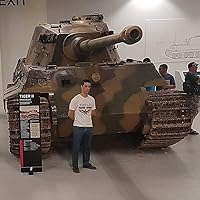
From an internationally acclaimed expert in the field comes a detailed, analytical and comprehensive account of the worldwide evolution of tanks, from their inception a century ago to the present day. With new ideas stemming from the latest academic research, this study presents a reappraisal of the development of tanks and their evolution during World War I and how the surge in technological development during World War II and the subsequent Cold War drove developments in armour in Europe and America, transforming tanks into fast, resilient and powerful fighting machines.
From the primitive, bizarre-looking Mark V to the Matilda and from the menacing King Tiger to the superlative M1 Abrams, Professor Ogorkiewicz shows how tanks gradually acquired the enhanced capabilities that enabled them to become what they are today – the core of combined-arms, mechanized warfare.
A bit disappointed with this book. Even though it covers 100 years of tanks, I think too much was dedicated to the first 39 years. It would have been helpful if there were pictures of these early AFVs. The strongest parts of the book were chapters 9-11. They covered the post-WWII period.
Tanks: 100 Years of Evolution (2015) by Richard Ogorkiewicz provides an excellent history of tanks. Ogorkiewicz was a Polish born mechanical engineer who was a Professor at Imperial College on armoured fighting vehicles and was a curator of the Bovington Tank Museum.
There is an excellent video overview of Ogorkiewicz’s contributions to Tank history and a review of this book on YouTube from the German Tank Museum.
The book has chapters on the development of armoured vehicles before World War One, their development during the war and their early employment. The book then has a number of chapters on tank development between the wars. There is then a lengthy chapter on the development and use of tanks during World War Two. Following this there are chapters on tank developments by the US, USSR, Britain, France and Germany during the Cold War. Then there are chapters on tank development from various other nations with a chapter on Asian nation’s tank development.
The book then has three Appendices that following the development of tank armament, armour and mobility.
The book is very much one tank after another and the tanks appear with dizzying speed. But all the major and many, many minor tanks are mentioned. For anyone interested in the history of tanks the book provides a lot. It’s interesting to read about just how many times tanks have been declared obsolete. This was done after WWI. Interestingly Nikita Krushchev thought anti-tank missiles made tanks obsolete and scaled back many Soviet projects. The book finishes well before the Russia – Ukraine war where tanks are facing a new threat in Unmanned Aerial Vehicles.
For anyone interested in tanks, perhaps after a visit to a tank museum or military museum the book is very much worth reading. Ogorkiewicz was one of the world’s leading experts on tanks and provides and an excellent history of these remarkable vehicles.
A well written book on the evolution of tanks. Unfortunately, the author died before the current Ukrainian war and its use of drones and top-attack munitions as antitank weapons. The tank may be slowly disappearing as a weapon on the battlefield.
I like tanks and so found this book really interesting. However, its extensive technical detail is probably not for the casual reader.
"The writer" (as he likes to refer to himself in the text) starts with the early pre-WWI prototypes of military tracked vehicles based on agricultural tractors. It was fascinating to read that every army dismissed the concept of such a vehicle and universally preferred horses instead. It made me wonder what was being dismissed by conservative militaries in the present day.
He then follows the development of tanks through WWI, the inter-war period, WWII and the Cold War, finishing with the latest tanks; these chapters focus on the main European powers, Russia and the USA. Strangely, the book then has two chapters to wrap up tank development by other countries. The first of these covers countries like Israel, Brazil, Sweden and Switzerland. Then tank development in Asia is covered in a single chapter, from WWI to the present. This separation seemed a little odd.
Throughout these chapters, he covers the features of the tanks of that period, the rationale for their development, including the rationale for certain features, who was involved, and a brief insight into operational use - mainly to explain why tanks developed in a certain way. He includes some very obscure tanks in his text, and the book would have benefitted from more illustrations to help understand the descriptions.
I was interested to note how tank numbers in the West really wax and wane (depending whether they are still seen as useful), from countries having thousands or even tens of thousands, to just a couple of hundred. By contrast, tank numbers in Russia have remained consistently high, with a consistently high reliance on them in their doctrine (that applied pre-WWII as well as post-WWII). Hence new tanks haven't really been developed for a couple of decades in the West, as it is presently a waning period (as was post-WWII).
While he doesn't set out to identify the "best" tanks, I couldn't help but pick out those that stood out in each period (combining good mobility, armament and protection):
WWII: the Panther from Germany (no surprise) 1950s: the Centurion from Britain (excellent gun, good all-rounder) 1960s: the T62 or T64 from the Soviet Union (revolutionary automatic loader for the gun, smoothbore gun and good protection, good engine) 1980s/1990s: the Leopard 2 from Germany (this surprised me, as I thought the M1 Abrams, Challenger 2 or Leclerc might be better - especially the M1 - but the Leopard 2's diesel engine and fire control system are both much superior to the M1) 2000s: the Type 90 from Japan (surprisingly, probably the most advanced tank in the world at the moment, with excellent fire control system, automatic loader, good protection and good engine - but Japan is forbidden from exporting it)
Jak w tytule, ta pozycja to historia czołgów od samego początku. Dużo informacji, momentami może nawet za dużo. Mnie pewnie zadowoliłby tylko wycinek tej historii, autor podszedł jednak do tematu bardzo profesjonalnie.
A superlative volume that traces the origins of the tank to the modern day. Richard Ogorkiewicz was the foremost luminary when it comes to tanks and armoured fighting vehicles and he had written several highly influential volumes decades back.
In this volume, he traced the origins of the tank, from the earliest armed tractor to early tanks in the Great War. Each significant tank producing nation is examined in this treatise, the earliest years in the Great War, the interwar years, the Second World and the postwar period.
The three appendices are especially illuminating as Ogorkiewicz examined armour, firepower and mobility in terms of engines, transmissions and more.
It is a nice book for tank nerds. Still, it misses more pictures, schematics, and infographics because the amount of info is quite overwhelming and contains many technical details that are much easier to understand when presented more interactive. As well it needs a revision currently with the new war going on in Ukraine and the ramp-up of investments in the military sectors and combat tests of some tanks mentioned in the book.
Como dice otro lector el libro es un océano de información sobre la historia de los tanques pero uno en el que, a menos que tengas interés en conocer hasta el último modelo de carro de combate de cada país, te puedes ahogar. Es probablemente el libro que más he tardado en leer de manera medianamente constante en toda mi vida.
A great book on the history of tanks right from the early development up to the modern day. Could have done with pictures more frequently as the tanks were mentioned.
Author is a leading expert on the subject and the book is well structured and easy to read. A must read for those interested in the history and technological development of tanks.