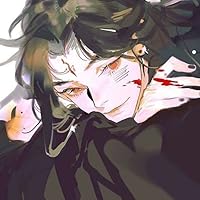
Manabu, lo scienziato responsabile della Trapanazione, crede di aver trovato una teoria che spiega le grottesche visioni di Susumu. Secondo i suoi studi, le mostruosità osservate dal senzatetto sarebbero una trasfigurazione dovuta ai disturbi psicologici della gente, visibili solo a Susumu in virtù dell’affinamento dei suoi cinque sensi. Ora Manabu vuole analizzare di persona una di queste psico-deformazioni: una bella liceale la cui mostruosa controparte è un mutevole essere di sabbia. Quando Manabu perde il controllo e scappa impaurito, Susumu è costretto suo malgrado ad avvicinarsi alla ragazza e a scrutarla da vicino.
山本英夫 Yamamoto Hideo , is a Japanese manga artist best known for the manga series "Ichi the Killer" (which was adapted into a live-action film in 2001) and the series, Homunculus (manga). Recurring themes in his manga are crime, sexual deviations, and psychology.
Wow. I'm so lost right now. This is too heavy to digest in one go. I think I need a couple of minutes to breathe. What the hell?
So, in the end, it wasn't transparency; that he used the girl to his advantage, and lost a few inches of this water in his form because he wasn't being transparent anymore. Pierced boy was softer than I took him for. And virgin! Lol, so it can only mean that the water/transparency of his form actually means purity. Lol, he's got holes that made the water pour out of his body once the intimacy kicked in. And the sand girl completely consumed his transparent form when she made her moves.
Boy, this is nasty, disturbing, and pure insanity in one volume. Excellent, nonetheless.
These volumes followed the aimless psychological investigations of the man with a hole in his skull, along with his shady punk employer. After his trepanation he discovered that if he focused with his left eye, he could see "monsters": people morphed into bizarre forms that even behaved unlike the real form. Shortly after it became clear that these things he was seeing, which his more knowledgeable pal named as homunculi, were the traumas trapped deep inside those people, traumas they were no longer even aware of. Some of those people were able to cope in some ways, but often by engaging in self-destruction or even hurting others. After a chaotic encounter with a Yakuza boss, the protagonist was able to bring out the boss' homunculus to the surface, not only saving his own life, but bringing peace to the guy and saving him from a future of cutting even more pinky fingers.
After that, the protagonist, despite his general disinterest in people, finds value, something redeeming, in being able to interact with these humunculi and improving others' lives. The punk guy who had offered him the job intends to help him along the way. He brings him to the psychiatric office of one of the punk guy's friends from college; there the protagonist fails to see any humunculi in the patients, but sees one in the psychiatrist. After that, the punk guy leads our protagonist through the underbelly of Japan to one of those niche businesses where high school girls, posing behind a one way glass, sell their used panties to unseen men. There the protagonist identifies the second most important humunculus so far: a high school girl who seems to be made out of sand. In a tremendous scene, as the girl poses behind a one way glass, the protagonist studies the changing forms of her homunculus: her genitals morph into a face, and afterwards she seems to give birth to a previously contained, monstrous form of herself. The protagonist is disturbed and wants to quit dealing with her, but his punk pal reveals that he doesn't just seem shady: he's into meeting troubled high school girls, saving them from their traumas and then fucking them. He enlists the protagonist to help him from a distance; the protagonist would be able to see when the girl's homunculus crumbles, leaving an opening for the punk guy to ram her through with some psychological insights. Given that high school girls seem to be Japan's most prized possession, he might as well have dragged the protagonist into robbing the national bank.
In any case, the punk guy artfully lures the girl into a cafe, where he exposes her brokenness somewhat subtly: her sandy form was a result of her not knowing herself and having lived through adapting to whatever container others, or society in general, put her in. She's a 17 year old high school girl, but behind those labels, along with her name and being a human being, she's a void. The girl realizes that she doesn't understand anything about her real self and is terrified of meeting her. When the punk guy suggests that her first action should be breaking the pattern through allowing herself to be fucked by him, she's not so abysmally dumb to miss the manipulation, but she goes along with it and follows him to a karaoke box. Although she's moving towards breaking through her homunculus, she manages to turn the tables on the punk guy punching through his own unconscious construct: the punk guy has a homunculus as well, that looks to the protagonist as a transparent, human-shaped contained filled with water. The girl feminizes the punk guy further through applying lipstick to him, and breaks his persona enough that he ends up fleeing.
However, the girl is crumbling: she feels the tremors of having had a peek at her unresolved traumas. The protagonist drives her home in his car. This girl is wary of these two guys and believes that they simply want to get in their panties, which to be fair isn't very far from the truth. The protagonist is curious enough to peek at her home life when her mother receives her at the door. The mother's homunculus suggests a spider: she's the one that had been molding the girl's entire life so she wouldn't be able to think or behave outside of what was allowed and proper.
The protagonist drives back to the city as he's trying to contact the punk guy, who isn't answering his phone. Along the way, though, the protagonist begins seeing the city differently: suddenly sights like people, buildings, the scrolling numbers in some screens, coalesce in his mind like patterns he couldn't see before. He gets weirded out and flees to his place of solitude and safety along some isolated dock, but there he finds out that he can calculate every property of the waves he sees in the water. Seems like the hole in his school has turned him into a savant of some sort.
This series reminds me of Satoshi Kon's masterpiece "Paprika" (link for its trailer), a brilliant classic of anime in which a team of psychologists used technological devices to enter people's dreams and solve their deep-seated problems. If that reminds you of Nolan's "Memento", I doubt that's a concidence, and "Paprika" came first. The protagonist of "Homunculus" is able to see the distorted forms of human beings while awake, and the rest of the world remains solid, but the idea is essentially the same. This series also touches on how modern society forces human beings to hide behind fakeness, and to bury deep into ourselves any semblance of real feelings, to smile and put on a happy face even as the world is crumbling around us; however, instead of staying buried, those feelings resurface in damaging ways. Kon's only anime series, "Paranoia Agent" (link for its opening), also dealt with that in surprising ways. I loved its heartbreaking, subdued climax. [Unfortunately, Satoshi Kon, maybe the second most important figure in anime after Miyazaki, pulled off a Kobe and died in his forties, from pancreatic cancer I believe, with his best work probably ahead of him. Who are the remaining masters? I love Makoto Shinkai's stuff, but he never strays from heartfelt romances about people who for one reason or another cannot be together. The other director I followed was the one behind the movie that finished Haruhi Suzumiya's story, but that director ended up burning to death along with half of Kyoto Animation. I try not to think about that].
I would have rated parts of this span of volumes a four and a half. The art definitely deserves five, but I felt a weird disconnect in the pace of some scenes: he could have showed what was happening with far fewer panels. I don't know how to explain it properly, but it was the main thing that came to mind to lower the rating half a star. In any case, this series is fantastic, and everyone interested in manga should read it.
Okay, so things are not that simple, and the "sand chameleon" case is still unsolved...
It's much much weirder, there's a noticeable pattern maybe, but that doesn't change the fact that there's still work to be done to fully understand the girl's issue... and from what I saw in the last couple of pages, to fully establish the freedom the girl needs from the social and family "manual", to fully give the girl the clarity of her identity, one has to take care of her family as well; whatever part of the girl changed, even it's tiny as a sand molecule, it reverted to its old weird shape...
Itoh started handling the situation pretty well, and I thought "this is it", but no....
I liked him. The guy is a genius, and brave, but we all have issues, and when it comes to something personal, maybe a touchy subject, and you feel and see or are afraid that some part of your subconcious is being glanced at or guessed, you have to give up for now...
Mr. Nakoshi drove the girl back to her place. His eyes saw and showed, again, more confusing things, but also the most obvious one that I've stated in the second paragraph...
Her mom basically fixed her up, to her old self again!
It's kinda caring and cute if you think it the other way- mom taking care of her child after the child returned home from the harsh reality outside...
In a sane and normal eye, yeah that's cute...
Nakoshi's eyes said otherwise...
But who knows. It may as well all be relative...
And Mr. Nakoshi has some interesting development of his own as well...
So, of course, the next volume/s is/are gonna be much more perplexing...
i have a few theories to maintain my sanity, so here it is
1. i think ito's homunculus (transparent or watery thingy) has something to do with his relationship with his father. for example, when the professor asks about his father, he seems a little off and tries to change the topic.
2. the girl is being pushed by her mother. it seems like the family appears perfect, and i don't think she needs money to the point of engaging in prostitution. rather, it's more like a typical asian household that puts pressure on their children. however, i think the girl is trying to break through and escape from her family.
honestly the first two volumes started off so well, got me really into it and i was really really looking forward to finish reading all the volumes, but well now things are seemingly spiraling in a way to evidently go in worse directions. Saddens me lwk this could've turned out in so many better ways (literally any possible *better* way) instead of completely inclining towards such awful perversion and ruining the appeal to finish reading it.
i don’t fully understand what is going on but it is so interesting. bald dude and sand girl and what they were all doing and how in a moment their power shifted. everything about the water and how that is getting shifted and the sand taking over and moving around. and then her family and her mother and the “manual” its all so good. idk what was happening at the end but… sure
Mi sto innamorando: anche questo volume ti lascia in parte a bocca aperta, in parte con la fame di scavare ancora di più nei personaggi. E il tratto è assurdo!
This is actually so much deeper than what I expected. The girl who they are currently investigating has a homunculus that we think is just made out of sand but learn that she is a “symbols monster” so her whole unconsciousness is made up of all the labels a 17 year old girl is supposed to be. We see this “sand/labels” dissolve when the guy with all the piercings tries to pry open who she really is. But at the same time, we see the guy with all the piercings become less and less transparent as this girl pries into his life. And this is all through the right eye of the main who watches from the side. Such a crazy concept but love the deeper meaning.
The storey, art, and characters are all wonderful in their own right, yet I have to give it a 4 due of the slow start. Some people may enjoy the pace at first, but I quickly became disinterested towards the end but i will continue reading this hoping the pace improves in upcoming volumes.
So I'm really confused because the predator is now the predated and the victim is actually the aggressor?? I am not really sure what to make of this... The characters are getting more and more complex I don't really understand much but I'm hooked
Almost nothing of significance happens here. The sand lady arc is left unresolved, the main plot is almost not advanced at all and we are stuck in this limbo of philosophical questions which end with "YOU ARE YOU." Hardly impressive. Please god please get better.
This manga series is about Nakoshi, a homeless man who underwent a surgical procedure by Ito, a young medical student, to unlock his sixth sense. Now, he can see homunculi, which are symbolic representations of a person's repressed unconscious. So far, the story has largely been about experimenting with the sixth sense and discussing the philosophy and psychology of the homunculi.
In Volume 4, Nakoshi and Ito explore and investigate a "sand chameleon" homunculi hidden within a teenage girl. The overall tone is much creepier, as they follow her around lure her into a coffee shop to break down her sand form. Ito then attempts to manipulate her, with undesirable consequences. The homunculi in this volume - Ito, the sand chameleon, and the mother, are all pretty fascinating interpretations of their inner selves. It's a great way to allow the reader to speculate on the hidden depths of characters without revealing too much too soon.
The sand girl thing threw me off. I knew it was going to get dark as soon as they introduced her and her line of work. I think the “fantasy” that she has that is alluded to refers to her romanticizing sex work and rebelling. But then that kind of contradicts the whole letter and symbols thing. I think the symbols represent her conforming to given expectations, like from her mother, or assimilating with her environment because she can’t make decisions for herself, like her friends also going into sex work(not sure if that’s accurate actually). But then the rape scene is was really grossed me out. How does one do that to someone expecting that to teach them some sort of “lesson” that is just disgusting. I would think the lesson is to “get your shit together and realize you don’t want this stop catering to old men” but even then that didn’t even really work. It wasn’t until the sock thing, which was alluded to early on. So the rape scene was just unnecessary and gross.
This entire review has been hidden because of spoilers.
Remember the girl from last volume? She is 17 and Manabu, who is a student, so also an adult, manipulates her into sleeping with him. Yeah, it's a spoiler, so sue me. I just thought people would like to know. Sure, it doesn't really happen, but it's suggested.
Another great volume though I do say some parts were kinda creepy like I still enjoyed it but it was creepy at times but still overall very good and I liked it and the girl Yukari's homunculus was really interesting and I am still interested to see how it concludes and I wonder what happened to the other dude I forgot his name but he got scared suddenly and ran so I don't know. Overall good volume it had really good moments but also weird ones.
Semakin lama semakin menarik dan mendalam (plus semakin mikir tentunya hmmm), betapa cara Yamamoto sensei untuk menceritakan sebuah cerita tidak hanya menarik tetapi untuk menganalisis dan mengkritik hubungan interpersonal dan peran sosial dan bagaimana mereka membentuk para tokoh sebagai manusia :))
حاول مانبو انه يخلي البنت تكتشف ذاتها الحقيقيه وتكون "هي" وما تكون مجرد شخصيه او ذات كونوها اهلها وتمشي على نمطهم فوق لدرجه انها ما تعرف ذاتها بعد ذاك الوقت في نهايه المطاف ترجع لبيتها وترجع للذات المزيفه اللي بانينها اهلها وترجع للنمط اللي هم راسمينه لها
اللي جذب انتباهي انه كل ما ناظر لمانبو يشوفه زي المويه وذا شي ما ادري وش تفسيره
In this volume alone, the main character eats his own cum, sexually assaults a minor, and then we get a flashback showing that he used to be an even bigger asshole than he already is.
This feels shocking and uncomfortable for its own sake. It's edgy just to be edgy.
Cada vez se va poniendo más interesante y profundo, ¡qué manera del autor de contar una historia no sólo interesante sino de analizar y criticar las relaciones interpersonales y los roles sociales y cómo es que nos van moldeando como seres humanos!