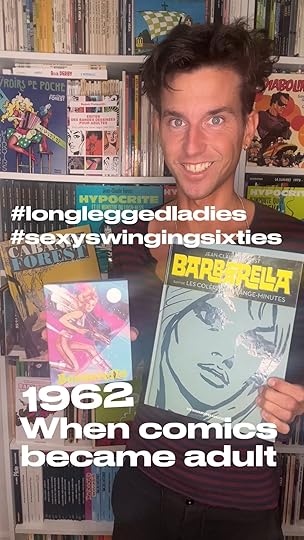
In Book 1 (first collected in 1964), Barbarella's spaceship breaks down, she finds herself trapped on the planet Lythion. There, she has a series of adventurous, and bawdy, encounters with a variety of strange beings, from robots to angels. In Book 2, "Wrath of the Minute-Eater" (first published in 1974), Barbarella's traveling Circus Delirium enters another dimension, led by the mysterious and alluring aquaman, Narval, whose machinations catapult Barbarella & Co. into a complex battle for the planet Spectra. Featuring a brand new, contemporary English-language adaptation by writer Kelly Sue DeConnick (Marvel's "Captain Marvel," "Avengers Assemble," Dark Horse's "Ghost," Image's "Pretty Deadly").
Jean-Claude Forest, né le 11 septembre 1930 au Perreux-sur-Marne et mort le 30 décembre 1998 à Lagny-sur-Marne, est un auteur de bandes dessinées français. Célèbre pour son imagination débordante, l'élégance de son trait et le sex-appeal de ses héroïnes (Marie Mathématique, Bébé Cyanure, Hypocrite et Barbarella, portée à l'écran par Roger Vadim, avec Jane Fonda dans le rôle-titre), Jean-Claude Forest a participé au chamboulement de la bande dessinée francophone, et notamment de la bande dessinée dite « adulte ».
I only read this because I saw it was free on Hoopla! I have no interest in seeing some semi-clad woman in a futuristic fantasy created in 1964! (Okay, Wrath of the Minute-Eater is even crazier and came out in France a decade later). Ah, but the things I do for literature! Jean-Claude Forest had in mind a campy comic set of encounters between a super-model in some future setting, another planet, with strange creatures and robots. It's no porn; it is 1964 so almost everything happens off screen. It's convoluted and goofy and encourages the male gaze (I suppose!).
This comic was the "inspiration" for a 1968 film starring Jane Fonda, a romp of a movie where she parades around in various costumes (or as little as the censor would let her get away with in 1968). It's mainly a silly comedy produced by Dino de Laurentiis and written by the great satirist Terry Southern.
Here's a trailer (watch it for its literary depth, comics scholars who don't recall Jane starring in this movie:
There's not an easy way to summarize this one so I'll just say Barbarella crashes her ship and goes on a series of sexy misadventures.
I remember watching the Barbarella movie starring Jane Fonda on Showtime late at night a couple times as a horny teenager. At the time, I didn't know it was based on a French comic. When Humanoids reprinted this with a new translation by Kelly Sue DeConnick, I had pre-ordered it.
First published in 1962, Jean-Claude Forest's art reminds me more of Wally Wood's 1950s SF stuff more than what was going on in American comics at the time. The art has a sketchier feel than Wood but Forest knew his way around both a space ship and a scantily clad woman.
While there's a fair amount of T&A, most of the sexual content is in the form of innuendo. Barbarella feels more like Flash Gordon than anything else. The movie has more of a plot than the book, the two Barberella stories within being more of a string of sexual encounters with some science fiction plot hastily wrapped around it. Born out of the freewheeling, free-lovin' 1960s, Barbarella both feels of that time period and somehow timeless. 3.5 out of 5 stars.
While quite obviously a product of the late 60's, Barbarella has aged fairly well. I’m not familiar with the original English translation, so I can't say what nuances Kelly Sue Deconnick brought to the table for this version. My French is pretty much nonexistent. All I can say is that the book is entertaining, and Barbarella is a strong, independent woman, not just a fantasy figure for the male gaze.
Yes, I did use the word “just” in there, because there is most certainly a male fantasy component to her creation. She does a fair amount of parading around nude and semi-nude, and there are a fair number of situations where the reader is encouraged to imagine salacious goings on off-panel--for example: Barbarella has captured the Black Queen, and tells her, “... have the Black Guards hand over their weapons to my friends here. Then I'll join you on the caravel. I want to be there to give you a good sound spanking whenever the need arises, “ to which the Queen replies, “Fair enough. I’ll agree to the weapons turn over … and the spanking …” That said, Barbarella is definitely empowered. Even on occasions where she's captured and imprisoned, she retains a certain amount of dignity and control of the situation. She's the heroine after all, and we know she'll come out on top.
There are two volumes of the original series in this book. Of the two, the first is more … coherent. Jean-Claude Forest has a wild imagination, well-suited to science fiction. There's a definite camp factor to these stories. He’s not worried about the science behind it all so much as about what will make for a cool visual. So the influence isn't Asimov and Clarke so much as Buck Rogers and Flash Gordon. There are ray guns and rockets and winged men and mole machines and space pirates and all kinds of cool stuff. If this comic were being created today, it would probably be written by Matt Fraction and drawn by Paul Pope.
Approached in the right spirit, this is a fun book. It's definitely a classic, well-deserving of this handsome reprint volume from Humanoids. In his introduction, Paul Gravett points out Barbarella’s place in the history of 60's strong female protagonists like Phoebe Zeit-Geist and Modesty Blaise. Those who have seen the movie with Jane Fonda will recognize some of the characters and scenes from the first storyline. The second storyline, “The Wrath of the Minute-Eater,” is decidedly crazier, getting perhaps a bit too imaginative for its own good.
Who wants a "contemporary English translation"? Was 1972 the Dark Ages? I really liked the art in this book--Barbarella is sexy!--but it was difficult to make out with just lines, no colors. The first story confused me a bit, but I liked it; the second one confused me completely. I was totally lost for most of it, and the contemporary jargon didn't help much. Barbarella is an okay girl. She's intelligent and caring, and never has to be chased--except by the occasional woman. She has a unique problem: her clothes keep falling off or being taken off, then disappearing completely, then being replaced with entirely different clothes. Barb takes it all in stride.
WHAT? * * FOUR STARS? * * Four Stars for this french comic book from 1962?
The story is a series of incomprehensible events -- did something get lost in translation? The plot is convoluted. Scenes and cartoon story panels in this action-adventure comic are set forth in a disjointed manner. The whole thing looks like a 1962 illustration of what society, back then, thought the future would look like. So, why 4 stars?
The book gets 2 stars simply for being a unique story-line idea. The book tells the tale of a woman superhero, in an oppressively sexist society, who is on a mission to make the world (the entire galaxy, really) safer and more equitable through the use of unrestrained love, nudity, erotic flirtations, nudity, and . . . Did I mention nudity?
This story, in 1962, was a bold feminist manifesto of independence and power over men. Perceptively -- who will deny that the following is TOTALLY true, be honest -- the cartoonist depicts the male characters as unthinking morons who can be easily manipulated by a woman through sexual flirtation, and all the actual sex that follows from flirtation. Again, how can anyone argue with that notion -- the idea that men are on sexual-stimulation autopilot? But, unlike the popularly depicted women in the 1960s, who manipulated men discretely, Barbarella openly manipulates men and flat out says so. She is dedicated to the combat of evil through love, not through violence like all the other male Superheroes of that time (this means you, Batman).
The book gets an additional star (cumulative star total so far: 3 stars) for being a cultural artifact. If you want to see now the sort of mid-century modern future that was depicted back then (in the 1960s), start here. If you are interested in seeing how illustrations / cartoons depicted the "feminine ideal" of the late 1950s / early 1960s (think: Julie Newmar as the Catwoman), start looking in this book. The cultural dynamic, social mores, and double entendres of that time are encapsulated here.
And, lastly, the book GETS ITS FINAL, 4th STAR because I had no idea that the "Jane Fonda version" of Barbarella in the movies actually sprang from a french comic book! And, if you thought the Jane Fonda version of Barbarella was hot (and showed some skin), the Barbarella in this comic is a supercharged, unrestrained, aggressively exhibitionist version of Jane Fonda (in the comic, she's a very naughty Barbarella who shows lots and lots of skin -- much more than in the Fonda movies). Wow. Did I mention the nudity?
DISCLAIMER: The reviewer is a 62 year old, cis-gendered, regular old white guy. Any sexism, objectification of women, or any other offensive observation is strictly intentional because it was strictly intentional in this Barbarella graphic novel. If you hate the approach the reviewer has taken in this write-up, you'll hate the book even more. Enjoy
Oddly disjointed story. Jumped quickly from place to place like it was written for a newspaper (Maybe it was). Influential but still tough to get through.
In my videos, I will try to cover the most iconic characters after this exciting schism from mainstream comics, from the infamous comic book store section: "BD érotique pour adultes avertis". https://youtu.be/HzpBnpKiMVA
This classic SciFi graphic novel still packs a punch after 60 years. The new English translation from industry maven Kelly Sue DeConnick ensures that the book comes across in a crisp and accessible manner.
To address the elephant in the room, this book has a lot of S-E-X- in it. However, it is not a pornographic book or even a remarkably titillating one. From the the standards of the current day it barely clocks in at PG-13. Notably though, what is revolutionary about this book is that the titular character enjoys her various proclivities and trysts without guilt or repercussions.
As when Ghibli got Gaiman in to do English dialogue, this takes advantage of the latitude translation allows by featuring English text from Kelly Sue deConnick - a brilliant choice when you're dealing with a character who's been hailed as a feminist icon but whom it would be hard not to describe as 'problematic'. So this is Swinging Sixties' France's take on Golden Age Anglophone SF, further refracted through a sensibility that's both 21st century and, unlike the original creator, female. Not knowing the original strips, I have no idea to what degree the sillier bits here are detournement and to what extent it was always somewhat self-aware, but from knowing the film I'd guess it was a bit of both. And even compared to the film, you have to assume a strip featuring a giant carnivorous ear mustn't have been taking itself entirely seriously. If it stops short of being wholly farcical, the plot is nonetheless picaresque at best, and the characterisation's flimsier still, with sudden reversals of motivation all over the shop (and not exclusively when the heroine flashes her tits, though there is a fair bit of that). Notwithstanding all of which, it's hard entirely to resist the innocent charm, the sinuous linework (more so in the first story than the sequel) and the weird world of caterpillar-back carriages and robots unsure of their intimate prowess.
To be precise, I would give 4 stars to Barbarella and 2 stars to The Wrath of the Minute-Eater.
I really enjoyed the original Barbarella story. Here was a bold, self-assured woman who lived life on her own terms. I wondered if Peter O'Donnell was influenced by this comic. I could see some of Modesty Blaise in this version of Barbarella.
Sadly, the second story just didn't grab me. The original story seemed to follow a natural progression from one part to the next. The Wrath of the Minute-Eater felt like an attempt to outweird the first story.
This second arc of the original Barbarella is as strange as the first and, perhaps, even more disjointed: Barberella enters the Circus Delirium and jumps dimensions to end up in a war on the planet Spectra. Kelly Sue deConnick's updates don't seem to take too much of the swinging 60s out of the book. The speculations on boredom and freedom and the attempts to go "even stranger" with things like giant carnivorous ears or Narval and his carp. Many have noticed that the book is slightly more progressive than the film, but it's hard to say if this due deConnick's adaption or if it is in the original French strips. One thing to note is Jean-Claude Forest's art doesn't have the visual cues of American comic books and are more static pen-drawings akin to comic strips. This, plus the lack of color, can make the visual story a little more difficult to follow.
A period curio, and worth studying for that reason, but it has not aged well. The heroine is little more than Little Annie Fanny with a ray gun, and the story is a bunch of make-it-up-as-we-go gibberish. Intermittently charming in an adult-fairytale way, but we've grown past stuff like this in multiple ways.
Originally published in short adventure arcs to be read alone but with a continuing story, these are all collected here. I remember the movie with Jane Fonda and how bonkers the whole thing was. I remember when I got older reading more about what it meant for Jane to do that film. Even later, I heard Jane Fonda talk about the character and how the movie was about a strong female and represented feminism. (or something like that). So, this book brings a lot.
It is sexy, morally ambiguous, and an adventure of the grand sort. Barbarella uses sex for a variety of things; pleasure, problem solving, boredom and curiosity. There is something incredibly well rounded about this space opera character in a way that most male characters do not have. I am surprised to see it written by a man. And this is where the crux of the problem lies... is this a male fantasy of an enlightened and a liberated woman or just another jerk off fantasy comic book?
I would like to think that something that spawned Duran Duran would have some good left to it. The book is more progressive than the movie and has slightly more cohesion. It still suffers from issues that pulpy sci fi does. But some of those issues are also endearing. There is a reason that there is a resurgence of science fiction. It allows us to dream as an 8 year old. It allows us to believe in science as magic to solve our problems. Barbarella throws in sex to the mix as well. Maybe there is something in all of us that believe that using our heads and our bodies is enough to solve large problems or maybe we just like the sex and playing games.
Barbarellu se mi úplně náhodou podařilo sehnat v limitovaném vydání. Cestou do Prahy vlakem jsem si maličko zaprokrastinovala na Facebooku a o půl hodiny později měla zadanou objednávku na Kosmasu. Dobře já! Ale teď už k samotnému komiksu. Je to totální blbost, ovšem podobně geniální a zábavná jako Muriel a další. Barbarella je vesmírná cestovatelka s pořádným sexuálním apetitem (dokonce rozbije i orgasmotron) a většinu času je velmi málo oblečená. Do toho jede akce a schovávačky, záchranné operace, divní tvorové a bestie… jízda. Svazek, který teď se vší pompou představilo Argo, obsahuje navíc i Hněv minutožroutů, Barbarellu si tak užijete hned ve dvou příbězích. A ta obálka od Saudka je prostě nejvíc.
I'm glad I read this because I'm such a huge fan of the movie and sexy sci-fi in general and because I know what an influence this book has had on the genre but it wasn't easy to get through. The ideas are wild and high concept and the character of Barbarella is campy and delightfully femininst but the narrative here is clunky and disjointed. Again, glad I read it, won't need to read it again.
I've been a fan of the Barbarella movie since childhood (yes, some of us watched Barbarella as kids), so I was hyped to get my hands on the original comic. And yes, Barbarella delivers the campy, puzzling, psychedelic trip also in comic form. Reading it, I especially at first found the story/stories confusing, chaotic and somewhat difficult to follow. This caused me to put the book aside for several months before I had the energy to give it another try. Re-reading it, I realized what had made me puzzled: Forest doesn't use at all many of the visual conventions of comics, such as speed or direction lines, sound effects or almost anything that would give the image a sense of dynamic. Images are static but the story moves forward very fast, so I found it challenging to follow sometimes. There are also no narrator's voice or visual clues for passage of time, which probably added to my sensation of everything happening immediately after one another.
Having said this, I did find the book an interesting read (the shorter stories of the first half more so than the at parts dadaistic Wrath of the Minute-Eater), visually pleasing and a nice reminder of the fact that French sci-fi comics have their own special look and feel. I don't know about the original but the translation was funny and lively.
Most importantly for me, the comic Barbarella was the same Barbarella as the movie one. Even feistier.
Whenever I run across a book that I've seen the movie for, I am curious about the source material. Most of the time the book is better, though there are some exceptions. In this case the source material is a french comic, and I was intrigued enough to buy it as a splurge.
It's interesting that the spin is that Barbarella is somehow sexually emancipated, as my take is that she is actually exploited. Regardless, I like that she solves problems using "love" instead of physical force whenever possible. But let's be real - this is 100% male fantasy, as women are much more than their sexuality, and can solve problems without getting naked.
The protagonist is extremely likable - fun, full of love, quick-witted, and jumps headlong into danger to save lives. I enjoyed reading of her wild exploits, and thought the worlds she visited were creative and the characters' zany. The art style is detailed enough to hold one's interest, but quite basic.
This is an interesting piece of history in the world of fiction, and is definitely a product of its time. If one is able to look past the exploitation, or wants to judge for themselves whether this stands for sexual emancipation or exploitation, then I recommend this as it was a wild romp.
Beautifully illustrated, endlessly inventive, and exquisitely funny. Often relegated dismissively as nymphomaniac spacewoman, Barbarella is so much more than just mere titillation. And, whilst she has sex with a lot of people, it’s her heart that almost always leads the way for good and ill. Sex is a favourite pastime, a tool, and even a weapon for our hero but she is always in control of who she decides to do it with. And that’s the limit of it: sure she has sex, but that’s completely secondary to the adventures and relationships she has on the way. This is not pornographic in the least. Instead there are some quite deep explorations on morality, race relations, politics, space, time, art, and a wonderfish from Antibel. A sexy sexy wonderfish!
I wanted to like this a lot more than I did. The playful dialogue that winks at the reader occasionally is offset by cumbersome passages of exposition in service to disjointed, incoherent plots that ramble on seemingly forever. Forest's pen and ink illustrations have a very stark and sexy appeal, although many pages (particularly in the second story) look rushed or unfinished.
In short, the obvious surface appeal can't possibly compensate for the unwieldy and meaningless stories full of dull and empty characters that surround Barbarella.
I have to admit, I'm a little torn on this one. The extremely trippy, psychedelic-inspired plot of time dilation and time personified is pretty damn cool. But the shift in art style to very generic black and white robs the Barbarella series of some of its visual punch. The whole "semi-erotic sci-fi psychedelia" genre is hard to pull off, and I'll give Jean-Claude Forest credit for making a much more cohesive and less disjointed plot this time around. Still, it lacks the cool, chic European feel that made Volume One so snappy.
Famous French comic of the 1960s, on which the cult film of 1968 was based. Barbarella is a leader of men and women who biffs as much as she bonks. Her clothes do have a tendency to come off, voluntarily as often as not. Kelly Sue DeConnick has now given us an updated translation, which reads a lot more smoothly and wittily than the long-standing text by Richard Seaver. It's not deep, but it is fun.
Groundbreaking? If you say so. I can acknowledge the impact of something without needing to fully consume it myself, so DNF at 10% or so. It's the golden-child trope at best and uneventful at worst. We jump straight into action with no exposition and no character focus. Barbarella feels campy in a try-hard way that was made worse by the disjointed structure. Either panels skipped huge amounts of information, or these were meant to be separated but had no indicators.
"...it wouldn't be the first time I've disrobed just to see what happens next..." No, thank you.
"Could this be some sort of strange dream? The jellyfish has people living inside it - like a giant gelatinous city!" A somewhat different animal than the movie which compelled me to search for its origins, this comic book is somewhat more haphazard, but I consider that a strength - not to mention Barbarella is little bit more bi-friendly, definitely more strategic, deliberately fucking her way out of all situations, those situations being even more wild.
I waited this to be amazing because I really love comics and art of Jean-Claude Forest. But this was confusing to read. There were no deep narrative in stories. They appeared to me just like Barbarella jumping and going through different areas and worlds. The art was great but the lack on narrative made these really thin books for me. I am so happy there are so many amazing books from Jean-Claude.
V době svého vydání to byl odvážný komiks, dnes by se dalo říci že je velmi střízlivý, decentní a mírný. Barbarella se snaží vše vyřešit láskou a jako dnešní hrdinové, kteří po sobě střílí a vražní se navzájem. Kresba odpovídá době vzniku komiksu ale i myšlenka ta je nadčasová. A budu velice rád, když uvidím v budoucnu další komiksy, kde se problémy budou řešit láskou místo války.
A 1960s Barbarella, and times have changed for the better. Modern readers will find some of the themes in this comic difficult - especially that Barbarella solves almost all situations by taking her clothes off. It is a interesting look at the 1960s and one of the few female leads from that time, but definitely a comic of its time.