Jump to ratings and reviews
Rate this book

Het andere Parijs

Rate this book
Als we denken aan Parijs, dan denken we aan de Eiffeltoren, het Louvre, het lieflijke Montmartre, de Lichtstad. Luc Sante haalt in Het andere Parijs alle clichés onderuit en vertelt de verborgen geschiedenis van een stad die werd bevolkt door schilderachtige personages, revolutionairen, lichtekooien, onruststokers, bohemiens en straatzangers. Het was een stad van de arbeiders, de criminelen en de populaire cultuur, een stad die aan het zicht onttrokken was en vandaag zogoed als volledig is verdwenen. Dit rijkelijk geïllustreerde boek schetst het adembenemende verhaal van twee eeuwen leven aan de onderkant.

In Het andere Parijs gaat Luc Sante op zoek naar de ziel van de stad. Hij toont hoe Parijs symbool staat voor de steden waarin we leven: het is een labyrint van straten, wijken en mensen, waarin we elk onze weg zoeken.

400 pages, Paperback

First published October 27, 2015

95 people are currently reading
2083 people want to read

About the author

Lucy Sante

102 books237 followers
Lucy Sante was born in Verviers Belgium and emigrated to the United States in the early 1960s. Since 1984, she has been a teacher and writer, and frequent contributor to the New York Review of Books. Her publications include Low Life: Lures and Snares of Old New York, and The Factory of Facts and Folk Photography. She currently teaches creative writing and the history of photography at Bard College in New York State.

Ratings & Reviews

What do you think?
Rate this book

Friends & Following

Create a free account to discover what your friends think of this book!

Community Reviews

5 stars
169 (31%)
4 stars
226 (41%)
3 stars
116 (21%)
2 stars
24 (4%)
1 star
4 (<1%)
Displaying 1 - 30 of 97 reviews
Profile Image for Madeline.
840 reviews47.9k followers
April 1, 2019
Is it basic of me to say that I love Paris? Fuck it, I love Paris. And I especially love histories like this one, that look at other sides of the famous city, sides that maybe the French tourism board would prefer you not see.

The format of Sante’s book can be best described as “meandering.” He’s not presenting us with a straightforward, chronological history of the city of Paris (for one thing, that book would probably have to be a few thousand pages long). Instead, he tells us that he’s going to present the city through the lens of a flaneur - a kind of loose term that, basically, means a person who walks all over Paris, observing all they can and talking to everyone who will talk back.

To be frank, it’s a kind of convoluted structure that Sante only sticks to about half the time anyway, but it allows him to divide his book into easily separated sections, so the reader doesn’t get too lost. Each section is essentially a mini-history, focusing on the topic of that particular chapter. There are sections on thieves, prostitutes, the homeless, the dance halls – basically the elements of Paris that are less-than-picture-perfect.

It’s definitely not a complete or contemporary history – even though the book was published in 2015, Sante isn’t really concerned with anything that happens after the 1960’s – and if you go into this without at least a basic knowledge of French history you will find yourself getting frequently lost in Sante’s many digressions and allusions. But it’s an interesting look at the underbelly of one of the most famous and glamorous cities in the world, an inside look at how the sausage gets made. And Sante’s argument, that the Paris of the past will never exist again because the city has become too disconnected and sanitized, is certainly an interesting one to consider. It can’t function as a guidebook, because most of the streets Sante describes no longer exist, thanks to Baron Hausmann, but it’s nevertheless a good introduction to Paris, both as a city and as a population.

It’s definitely not perfect, but at least Sante gives us passages like these, when he’s describing artists’ communities in the 19th century and how they were their own particular brand of ridiculous:

“On occasion, they drank wine from human skulls, sometimes dispensed with clothing, gave recitals on instruments they did not know how to play. Nerval occasionally pitched a tent in his room, or slept on the floor next to a carved Renaissance bed he claimed to be in thrall to. Most famously, he had a pet lobster named Thibault, rescued from a fishmonger’s, which he, at least once, walked on a leash. Most of the Jeanes-France went on to respectable careers, although Borel took up an administrative post in Algeria but was driven by shifting political tides to subsistence farming, refusing to wear a hat because ‘nature knows what it’s doing,’ and died of sunstroke. Nerval, of course, was found hanged with the belt of a woman’s apron from the grille of a cabinetmaker’s stall on Rue de le Vielle-Lanterne in 1855, wearing a hat, two shirts, two vests, and no coat, and with a tetragrammaton drawn in ink on the left side of his chest.”
Profile Image for Sketchbook.
698 reviews269 followers
November 20, 2016
This is not a good book ~~ A gift fr those who know I love Paris. Many are impressed by publisher FSG and author. Don't be. The essay is a laundry list of names, titles, locations, brands with esoteric details here and there. There are too many blah photos, of postage stamp size, all repetitive, and you wonder Why? Blurb whores : the always dull Paul Auster calls it "finest book I've ever read about Paris" (what were the others?) and Hilton Als (yes, that one!) smooches, "an epic work." Revealed is how the NYC lit claque works. Pathetic.
Profile Image for Alan (the Lone Librarian rides again) Teder.
2,721 reviews259 followers
June 12, 2025
The Forgotten Paris
A review of the Farrar, Straus and Giroux hardcover (October 27, 2015).
Yes, our literature is etched in acid. Yes, we use blood and fire as others employ tears and warmth. But we were nursed on alcohol, not milk. We have seen in our streets things more terrible and scenes more awful than we could ever describe. We haven't initiated twenty revolutions in forty or fifty years in order to stand where our grandfathers were. If we deal in the terrible, it's because everything around us is terrible. If we are anxious, and ill at ease in our society, it's because the future is there, more terrible and maybe more bloody than the past. - from an 1843 letter by Alexandre Privat d'Anglemont.
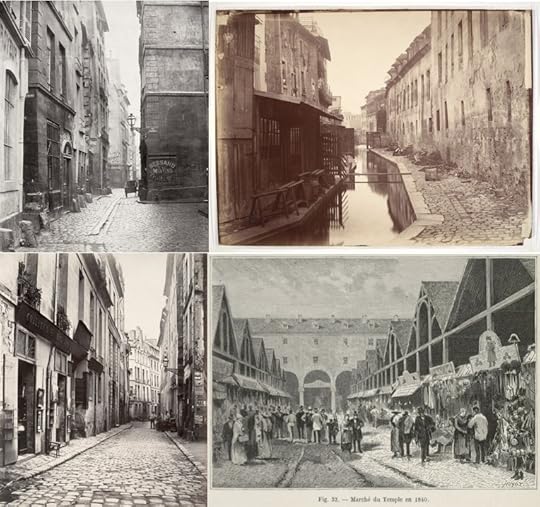
The Other Paris is a sweeping elegy to the Paris that was mostly demolished by the city renovations of Georges-Eugène Haussmann (1809-1891), initially in 1853-1870 but continuing until 1927. The old narrow streets of the medieval town were swept away and wide boulevards took their place. Along the way, Sante documents the underclass that inhabited those same alleys and byways. The various chapters cover the street workers, the ragpickers, the market vendors, the artists, the singers and musicians, the writers and poets, the criminals and the revolutionaries. The research work and the amount of references cited here is immense.


Views of Paris streets, a river and a market before the Haussmann demolitions 1853-1870. Images sourced from Wikipedia.

I wanted to read further work by writer Luc/Lucy Sante after rediscovering them through Six Sermons for Bob Dylan (2024) and I Heard Her Call My Name: A Memoir of Transition (2024). I had previously only known them through their essay for photographer James Nachtwey's Inferno by Luc Sante (1999). My read of The Other Paris was from a Toronto Public Library loan.

Soundtrack
Chapter 7 "Show People" documents various entertainers working in 19th to early 20th century Paris, particularly those singing in the Chanson réaliste [Realist Song] style. A selection of Chanson réaliste songs can be heard at a YouTube playlist here or a Spotify playlist here.

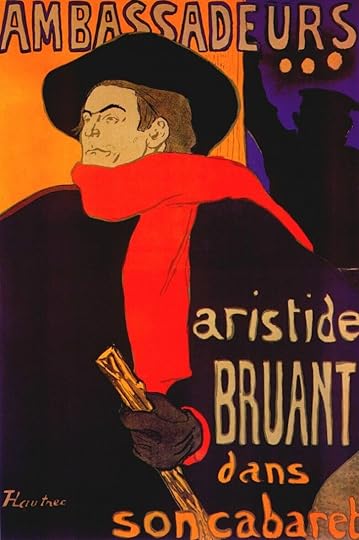
Poster of Aristide Bruant by Toulouse-Lautrec, Henri de - Matthias, A.: Henri de Toulouse-Lautrec, Taschen 1987, s. 33., Public Domain, Link.
The inventor of the Chanson réaliste genre is generally accepted to be Aristide Bruant (1851-1925) whose recordings were made circa 1907-1909 and are thus of rather poorer quality than those above, but you can hear a selection at a YouTube playlist here.
Profile Image for Andrew.
2,262 reviews937 followers
Read
May 21, 2022
God, I love shit like this. Here Sante – who is Lucy now, so update your stuff, Goodreads – explores all the forgotten worlds of Paris, a city that has become fashionable to hate, but which I truly love with all my goddamn sad American heart. And Sante tells all of these stories of bohemians and demimondaines and lowlives with love and passion, and goddamn it's a hell of a portrait of a city that, as gentrification sets in, is fading into memory.
Profile Image for Patrick.
303 reviews12 followers
June 2, 2016
Luc Sante's Other Paris is the Paris of the non-respectable - the working class, the homeless, prostitutes, criminals, artists, bohemians, entertainers, revolutionaries, immigrants, con men, and the flaneurs and urban explorers with the time and interest to describe it all. The facts and anecdotes strung together by Sante are interesting, and sometimes fascinating, but without an overarching story or thesis, it becomes "this happened, and then that happened." The author tries to pull it all together in the last chapter, where he notes that freedom and beauty and life happen where the authorities do not or cannot exercise control, but the overall effect of his writing is less than captivating.
Profile Image for Marc Lamot.
3,474 reviews1,995 followers
May 22, 2019
For years now, in the French guide book production there is a whole new branch: you will find dozens of titles that begin with "L'insolite ...", literally translated as "the unusual", focusing on the backside of things, behind the scenes, that what lies outside the traditional tourist highlights, often also with the undertone of "marginal" and even "spicy".
This book by Luc Sante Paris is something like that: no trodden paths, at least not the tourist paths, but an evocation of the lesser known aspects of the daily life in the French capital, especially the "popular" culture. Sante presents himself consciously as a "flaneur", a walker with no intended target, and he takes the reader on a tour "reading of the city." Especially in the first chapters the architecture of the city is put in focus (This is Paris of course, architecturally one of the most homogenous major cities in the world), with marked blows against the modernist policies of the 1960s and 1970s (De Gaulle, Pompidou and especially Andre Malraux are pilloried). That already says something about the nostalgic content of this book.
Sante then zooms in on various aspects of popular culture: the horrible life of ordinary workers and the marginalized, the poor living conditions (housing, sanitation, health ...), crime and prostitution, alcohol abuse, escapism in the entertainment industry, and finally, the many revolutionary movements. All very interesting and illustrated with captivating life stories of known criminals, prostitutes and revolutionaries.
But- while reading, you ask yourself what Sante actually is trying to say with this incessant enumeration: is it pure nostalgia, to revive what has been irretrievably lost? Is it an outburst against the technocratic policy of recent decades, that has eliminated this popular culture? And what is he yearning for exactly: the Paris of 1820, or that of 1850, 1890, 1930....? It is not clear to me, and I do not think it was clear for Sante himself.
On top of that there is no real system in his references: for some aspects (marginalization, prostitution, crime, rebellion) he draws them mainly from the 19th century, for others (such as the chanson culture) from the first half of the 20th century. Markedly, the second half of the 20th century is almost completely missing; even the notorious May 1968 episode remains virtually unmentioned (but maybe for Sante that only is a pseudo-rebellion of elite students). So there are big gaps in his story, which also lacks a clear finality.
For me this book, apart from some remarkable stories and aspects (the bohemien-culture for instance), is a missed opportunity. Much of what Sante brings is treated much better elsewhere. To name but a few: Lorant Deutsch in "Metronome" or Eric Hazan in "The Invention of Paris". And I'm afraid the much too small illustrations do not really help to bring to life the rich Parisian past.
Profile Image for Bettie.
9,976 reviews5 followers
February 26, 2016


http://www.bbc.co.uk/programmes/b071x0gp

Description: Paris, City of Light, the city of fine dining and seductive couture and intellectual hauteur, was until fairly recently always accompanied by its shadow - the city of the poor, the outcast, the criminal, the eccentric, the wilfully nonconforming.

In The Other Paris, Luc Sante gives us a panoramic view of that alternative metropolis, which has all but vanished but whose traces are in the bricks and stones of the contemporary city, in the culture of France itself and, by extension, throughout the world.

He draws on testimony from a great range of witnesses - from Balzac and Hugo to assorted boulevardiers, rabble-rousers, and flaneurs - whose research is matched only by the vividness of Sante's narration.


Whilst it must be stated this is just a potted history, nothing new brought to the table, I enjoyed the segments lifted from 'The Other Paris'.

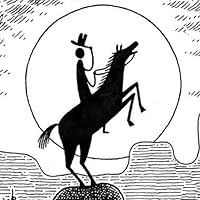
And talking about Ragpickers
Profile Image for Laurent De Maertelaer.
804 reviews167 followers
May 26, 2017
Een meesterverteller aan het woord over de mooiste stad ter wereld, maar bekeken door een bril van armoede, misdaad en anarchisme. Het eeuwige licht van Parijs, verduisterd, verbloemd en versomberd. Het 'Paris insolite', de hoofdstad gezien vanuit de onderbuik, de zelfkant, de goot, de nor en de kroeg. De flaneur is het leidmotief, de stad als labyrintisch spel het grondplan. Leerrijke, meeslepende, originele en bij vlagen briljante mentaliteitsgeschiedenis.
Profile Image for Tosh.
Author 15 books778 followers
January 15, 2016
Of all the cities in the world, Paris has a mythical hold on me. I don't know why? Los Angeles and Tokyo are my two other favorite cities, but somehow Paris has captured my imagination, and this book by Luc Sante, pretty much describes my imaginary Paris as a factual place. I have been there at least six times in my life, and yet, it never disappoints, just gives me a thrill whenever I'm confined in Paris. Sante's "The Other Paris" pretty much describes my fascination, as there is only my imagination that is the French city, and then there is there "real" Paris.

Sante uncovers a Paris that is exposed in certain works of literature, such as "Fantomas" and the film works by Louis Feuillade. This is Paris history as if it was written by The Situationists International and the Surrealists. Crime, vice, a little bit of decadence here and there - it is what I imagine being in Paris, and therefore, clearly is.

The book often reads and looks like a school textbook, and one wonder if "The Other Paris" will serve that role in a classroom. It should be. As well as being, without a doubt, one of the great books in English on the great city of my imagination and therefore known as Paris. I also realize by reading this book that Paris always had a great deal of street violence with respect to murders and bombs. What happened a few months ago in the city of light, is common, when compared to the Paris of the 19th century.
Profile Image for Steve.
98 reviews5 followers
January 3, 2016
Brilliant history of the underground Paris, the city in the centuries before it got cleaned up, its streets straightened and widened by Haussmann, before it pushed its poor and problematic populations to the banlieues postwar and evolved into today's familiar capital of international tourism. This is a challenging read, each dense but accessible chapter focused on a topic, the writing sometimes thick with trivial anecdotes and lists, as well as references to numerous unfamiliar places, events and people, but as you get further into the book it slowly congeals as the author eventually introduces most of the important references, each in their proper chapter.

The book is abundantly, deliciously illustrated, like an annotated edition of a classic, with historical photos and cartoons on every single page. At the very least, it's worth spending a little time browsing. If you're up for a challenging read, the text is deeply rewarding. Chapter 2 (Ghosts), on flaneurs and Debord's concept of drift is a highlight. Other standouts: chapter 6 (Archipelago) on self-contained communities of the poor, chapter 8 (Saint Monday) on Bohemian Paris, and chapter 10 (Mort aux Vaches) on crime throughout Paris history (yes, including the guillotine, which, Sante informs us, Celine called "the Prix Goncourt for murderers").

Today's Paris is a wonderful place, too, but the Paris of history was weirder, more dangerous and altogether fascinating.
Profile Image for Owen Hatherley.
Author 43 books555 followers
January 13, 2026
I will never quite understand why intelligent people will repeat the notion that all things that happened to the built fabric of Paris and France after 1945 were bad and lamentable, but once that's over with, a fascinating and fabulously illustrated bestiary of what the city and its outskirts were like for those at the shitty end of the 19th century.
Profile Image for Paul.
1,194 reviews75 followers
December 8, 2015
The Other Paris

As a historian I love social history and cities as it means we can be surrounded with historic themes that mean we can dig down and get our teeth in to something meaty. In The Other Paris, Luc Sante has written what can be considered a wonderful essay illustrated by some wonderful pictures and illustrations. Here Sante looks at the rougher edges of Paris rather than the refined Paris that is often portrayed in books and on film.

This is a wonderfully rich book, well written and researched written so it evokes the past harder edges of Paris that are now disappearing. This is no romantic view of the French capital, this lifts up those stones people would rather not let you disturb. This Paris is a city packed to the seams, seedy, criminal and alive, a city where hard knocks are just round the corner or up that alley now gone.

One has to remember Dickens’s Tale of Two Cities, where he describes the deprivation, the slums, people living on top of each other. The social deprivation the poor and the marginalised some of the strange trades that poor Parisians undertook, who has ever heard of an indoor goat farmer?

One thing that connects all the classes of Paris are the brothels, and Sante discusses the various refinements not forgetting the brothel for priests on rue Saint-Sulpice. Sante talks about the women who work in the brothels and is fascinated by them; especially as well as being a hard life it could also be quite revealing life of the dark heart of Paris.

One can see why Sante has examined the Other Paris, as the monied Paris of old is the same today as it ever was. In those parts of Paris the money and power has never left, the bistros and cafes are the same as they have always been. It must be remembered that the Gestapo and SS were based on the richer side of Paris during the occupation years, clearly not wanting to provoke the poor too much.

The Other Paris is part historical discourse and part a long lost travelogue, a love letter to a lost part of the City that is disappearing fast. One has to remember that with property prices and redevelopment work the poor are being moved from the centre out to the edges of Paris so they are no longer shoulder to shoulder with the rich. The modern Paris is for the rich and connected and the poor watch from outside rather like a Polo Mint. Sante notes that yes the poor Paris lived in poorly built buildings, but now there are endlessly bad buildings being thrown up around central Paris.

This is truly a wonderful book, not quite a love letter of the lost, but a reminder that you can try and forget the poor but they are there and part of Paris’ rich heritage.
Profile Image for Mary.
305 reviews17 followers
June 26, 2016
Hmmm. I have mixed feelings about Sante. He writes that he has no intention of glamorizing poverty but I think he does a bit. He includes some facts about how hard life used to be then he waxes on about how much cooler Paris was in the 19th century. He refers to prostitutes as the girls and points out that prostitution was part of the fabric of Paris. He laments the sterile gloss of contemporary Paris and the monotony of the suburbs, the places where workers went to when Paris got too expensive. Same applies to Manhattan, my previous borough, and my current city, San Francisco. There is no going back and people like their mod cons, desk jobs and single family houses. Most Western women do not have to rely on men or prostitution to survive. Infectious diseases are much rarer. We can't have it all. Manhattan is out of reach for young people and families, including my own. Then Brooklyn was next. Cool people are still here they just create new cool places. Rich, expensive cities do lose much of their essence and it hurts. But then it bubbles up elsewhere. My original city, Detroit, is a new cool place! Whoda thunk?
Profile Image for Ariel.
1,918 reviews41 followers
July 30, 2018
No better book about the history of Paris has ever been written. Sante brings the same irresistible mix of vision, irreverence, rigor, wit, and passion to this book as he did to the inimitable LOW LIFE, about New York. It's a dense book and it took me even longer to finish because I was listening to it. I'd like to actually read it with my eyes now that I'm done. I was a French lit major in college and while I was reading the book, I constantly had the sense that my islands of knowledge were being connected into continents. For example, who knew that Haussman was allowed/encouraged to blaze his boulevards and etoiles through the crowded center of Paris dating back to the middle ages because Napoleon III wanted to make it impossible to block the streets with barricades for civil insurrection as in the short-lived Paris Commune of 1830. These are also the barricades that were immortalized by Victor Hugo in Les Miserables. And they prefigure all guerrilla street-fighting. Etc. etc. I wish I could give it 6 stars.
Profile Image for Laura.
7,135 reviews608 followers
February 26, 2016
From BBC Radio 4 - Book of the Week:
Paris, City of Light, the city of fine dining and seductive couture and intellectual hauteur, was until fairly recently always accompanied by its shadow - the city of the poor, the outcast, the criminal, the eccentric, the wilfully nonconforming.

In The Other Paris, Luc Sante gives us a panoramic view of that alternative metropolis, which has all but vanished but whose traces are in the bricks and stones of the contemporary city, in the culture of France itself and, by extension, throughout the world.

He draws on testimony from a great range of witnesses - from Balzac and Hugo to assorted boulevardiers, rabble-rousers, and flaneurs - whose research is matched only by the vividness of Sante's narration.

"Paris, a city so beautiful that people would rather be poor there than rich somewhere else." Guy Debord.
"This brilliant, beautifully written essay is the finest I've ever read about Paris. Ever. " Paul Auster.

Luc Sante was born in Verviers Belgium and emigrated to the United States in the early 1960s. Since 1984, he has been a teacher and writer, and frequent contributor to the New York Review of Books. His publications include Low Life: Lures and Snares of Old New York, The Factory of Facts and Folk Photography. He currently teaches creative writing and the history of photography at Bard College in New York State.

Writer: Luc Sante
Abridger: Pete Nichols
Reader: Simon Russell Beale

Producer: Karen Rose
A Sweet Talk production for BBC Radio 4.


http://www.bbc.co.uk/programmes/b0713zf3
Profile Image for Gaylord Dold.
Author 30 books21 followers
January 19, 2016
Sante, Luc. The Other Paris, Farrar, Straus and Giroux, New York, 2015 (306pp. $28)

It is of no little interest that Paris contains some 3,195 streets, 330 passages (encompassing both arcades and alleys), 314 avenues, 2923 impasses, 189 villas (enclosed mansions, or house groupings like a mews), 142 cites (sometimes developed, sometimes a slum), 139 squares, 108 boulevards, 64 courts, 52 quays, 30 bridges, 27 ports, 22 galeries (arcades), 13 allees, 7 hameaux (quite literally, “hamlets”), 7 lanes, 7 paths, 5 ways, 5 peristyles, 5 roundabouts, 3 courses, three sentes (a kind of “path” or “way”) and…1 chemin de ronde, this latter being a raised walkway behind the battlement of a castle. In the mid-nineteenth century it puzzled and delighted one chronicler of the city that certain squares or intersections, through “mysterious forces”, always seemed devoted to a “single specialty”, an instinct that impelled the same classes or professions towards the same places. Thieves, pickpockets, beggars, street walkers, and street performers still inhabit the same haunts they did in the Middle Ages, in this case the Rue Pierre-Lescot, somewhere in the tangle of streets east of the Louvre, though sadly the tangle was nearly erased the infamous Baron Hausmann’s “makeover of Paris” during mid-century at the behest of a flummoxed old clod named Napoleon III.

In Luc Sante’s marvelously perverse, beautifully written, and gorgeously illustrated (some photos are rare glimpses indeed of unthinkably cockeyed scenes) new book we discover the inner secrets of the Rue Saint-Denis (one of the city’s oldest streets), where, ten thousand years ago a wooly mammoth wandered down from what is now the Belleville heights to the lowland swamps and marshes around the River Seine (then a meandering stream) and met its end, the skeleton and a few rags of dried skin uncovered by workers digging the Metro in 1903. Interestingly, under Roman rule, the street was a cour de miracles, the name given in the Middle Ages to an encampment of beggars whores and thieves. Even though today Rue Saint-Denis is rather clean and neutral, there are still filles publiques on display at all hours on its side streets. And before the King moved his palace to Versailles (suburban flight), royals regularly proceeded from the basilica of St. Denis north of Paris to their residence in the Louvre, following roughly the same path as the wooly mammoth.

Sante, born in Belgium and the author of gleaming gems like “Low Life: Lures and Snares of Old New York”, recipient of numerous writing awards and a former Guggenheim Fellow, is the ultimate urban flaneur, whose quarry is the intimate world of Paris, its dens, warrens, milieus, neighborhoods, banlieus and zones; his story is one of intimate observation, psychological geology and architectural archaeology, each related in an adroit and penetrating style that results in a book much more dense, exciting, inspiring and mystical than any mere “portrait of a city”.

Instead, Sante’s Paris is one of profuse human interaction before the coming of the pan-optic of modern bustle. City dwellers take note that before the 1920s there were no commuters in Paris. Everybody on the streets tended to live and work in their own neighborhoods and each parish had its eccentrics, indigents, clerics, savants, brawlers, widows, fixers, elders, hustlers and busybodies. Before Hausmann configured the center into broad avenues and demolished Medieval Paris, every single house tended to have a shop on the ground floor, a shopkeeper’s dwelling on the mezzanine, a bourgeois family upstairs from the mezzanine on the “noble floor”, and then on up (without stairs) a succession of poorer and poorer families. At the top was the artist or student, the poorest of the poor. The geography and topography of the city was both material and human—the walls of the city were successive; Philippe-August’s wall in the thirteenth century, the Farmers-General just before the Revolution; Adolphe Thiers in the 1840’s, and finally the Peripherique highway completed in 1973.

Everyone and everybody in Paris is in Sante’s fabulous book: Gangsters and their lairs, nightclubs, nightclub singers and crooners, poets like Baudelaire and flaneurs like Walter Benjamin, police detectives, and criminals like Pierre Loutrel (a.k.a. Pierrot le Fou), great torch singers like Frehel, movie stars and courtesans, as well as prostitutes and courtesans (divided into classes from insoumises, horizontals and amazons (this latter a particularly glorious invention) all the way to grand cocottes and the chilling “man eaters”, all further subdivided into registered, unregistered, high class and low. Breweries, pubs and cafés all appear, along with their social histories. Wine dives had their own special provenance—the tapis franc, for example, a cavern where all the customers could be assumed to be criminals. Cabarets, theaters, movie houses, prisons, public execution venues and bookstores all share space in Sante’s book, as do revolutionists, the insane, and poets like Gerard de Nerval, doomed to suicide. Even laundresses do not escape his notice: In the nineteenth century there were 94,000 of them, according to an 1880 count.

In all this, Sante has a larger point. He writes, “The game may not be over, but its rules have irrevocably changed. The small have been consumed by the big, the poor have been evicted by the rich, the drifters are behind glass in museums. Everything that was once directly lived has moved away into representation.” With its engaging illustrations and penetrating insights, Luc Sante’s “The Other Paris” is an investigation into the fate of urban society in an age of Democratic Totalitarianism. His grand book suggests that it will be a long time before things get real again.


971 reviews37 followers
July 18, 2025
I'm giving this 4 stars because Lucy Sante did a really impressive job with this book. I'm not giving it 5 stars because when it is good, it is brilliant, but sometimes it got to be too much detail even for me, so I must admit to having skipped big chunks of some chapters. Really, that might be on me, trying to read too late at night, so my apologies to the author.

The parts of this that are good are SO good that I might have to buy a copy after I return this to the library. There's just so much information packed in amidst the great storytelling, I can imagine wanting to have it in my books-about-Paris library (if I lived there, I wouldn't need all these books, but since I don't, how can I resist reading every and any book that might tell me something new?). This book reminds me that I'm overdue for a visit.
Profile Image for Lance Grabmiller.
594 reviews24 followers
October 21, 2018
Slow to really get going. At first the text is hard to navigate without a map, but it slowly opens up by about a third of the way in as he begins to leave the city as geography and begins to depict its inhabitants. By two-thirds of the way in, it is almost impossible to put down. Covers Paris from about the middle of the eighteenth century until World War 2. Given the deep history of the city, it can occasionally make leaps hundreds of years before this and occasionally moves into the latter half of the 20th century.
Profile Image for Garrett Zecker.
Author 10 books68 followers
March 6, 2016
A collection of essays on the various aspects of the Parisian underbelly of society over the past two hundred and fifty years, Sante's book is an engaging and exploratory walk through the byways of underground society as it has existed and continues to exist in Franco culture. I learned about this book in a selection from my Delancey Place daily email, and was excited to check it out.

The book's essays are organized by underground movement – infrastructure, crime, prostitution, drugs, punishment, politics, entertainment, etc, and each presents historically relevant anecdotes with names, photos, advertisements, and an exploration of what was happening and why it was happening. Each chapter is enlightening and strong, mirroring today's worldwide events in the context of humanity's behaviors in the microcosm of Paris.

The best part of the book, perhaps, is Sante's diction. The essays waver between journalistic reporting to affirming prose to playful syntax to stolid and serious sentences. The engaging writing helps to weave through the events in a fun and approachable manner while treating the subjects with the respect they all deserve no matter what strata they come from.

While I have read many books about Paris, this particular one seems to present its history and people over the past few centuries in an engaging and magnetic manner. It is simply one of my favorites on the subject. The hardcover was a quality product, and the large format with the illustrations and photos occurring in the margins seemed somewhat wasteful for the size of the book, but then on the other hand it was appropriate in-line with where each essay was presenting it. A great book all around, and an easy primer into the culture of revolution in Paris.
Profile Image for Lee Paris.
52 reviews2 followers
July 7, 2016
While reading this book I recalled a scene from the documentary "Le Joli Mai" (aka "The Jolly Month of May") in which Parisians from all ranks of society are interviewed about their lives, cares and dreams during the spring of 1962 when France was finally at peace post-Algeria. A newly re-housed poor family are clearly enjoying the panoramic view through the window of their high rise apartment block and looking down at the tiny people wandering below. This is in contrast with the quartier where they lived before: each resident's door opening directly to the same dark, dank alleyway. On the surface, the material improvement in their lives seems indisputable but Luc Sante reminds us that much was lost with the tearing apart of long established neighbourhoods where Parisians were born, toiled and died among people with whom they had lived their entire lives. Sante offers a vivid account of what it was like to live on the edge before gentrification turned the City into what he refers to as "trade name Paris" and the poor were displaced to the periphery. Sante reviews in turn many familiar signposts of 19th and early 20th century history and culture: the various revolutions and insurrections, Baron Haussmann's transformation of the medieval city to the city we know today, the siege of Paris and the Commune of 1870. Much was unfamiliar, at least to me: the gradations of those involved in "Le Business" (prostitution), and the major figures involved in crime, Anarchism and popular culture. I agree with the comments about the illustrations. They are numerous, but many of the old photos are so murky as to defy appreciation even with captions. Although less convenient for the reader, I'd like to see an edition with the key images printed as a group on better quality paper.
Profile Image for Nancy.
311 reviews
March 14, 2016
There seems to be a wide variation of opinion of this book by Goodreads readers. Either they really like it or really hate it. I am in the former camp..I found this book to be fascinating and an engrossing read. Sante explores the seemy underbelly of Paris from it's beginnings to modern times. The hustlers, the whores, the cons, the street singers and much more. He highlights the milieux that has been 'lost' or tossed aside in the gentrification of Paris. I am a devoted reader of arcane information about people, places and things historical and although I can't say I agree with his thesis, it makes for compelling reading. I began by listening to him read on an Audible edition but quickly decided that I needed to have the book as well, not only for the photos and drawings which were discussed, but because there were parts that I wanted to review as I moved further along in the book. I don't think it's for everyone but I would recommend it for dyed in the wool Francophiles and fanciers of lurid historical detail.
Profile Image for Irving.
28 reviews1 follower
August 8, 2016
Frenetic and enthralling account of a Paris that no longer exists. As Sante puts it, "People would rather live poor in Paris than live anywhere else." Sante takes us through the underbelly of a Paris whose people thrived and hustled, ebbed and flowed. It was the people and the neighborhoods no longer in existence that gave Paris that veneer of the magical. Still, it goes in detail when describing the debauchery, the starvation, the filth. Sante does not leave a stone unturned. The read transports you to the Paris of Les Miserables. When people collected bones, hair, cigarette butts and anything else they could gather to sell and make ends meet. The Paris of today, though much more commercialized, still has its charms, and around some corners and alleywas, you can still find glimpses of the Paris of yesteryear; the ghosts of its past.
Profile Image for Peter Landau.
1,104 reviews75 followers
November 26, 2015
Luc Sante has followed up LOW LIFE, his decadent tour of old New York City, with THE OTHER PARIS, a similarly themed look at the past of a great city. Unlike the first book, which debunked the adage of the “good old days” (they weren’t better, and often far worse), now he writes with a similar love for the rough edges smoothed out by modernity, but in a more revolutionary tone. His prose is not mere nostalgic reflection as much as a battle cry to stop the madness of progress which leaves much of our humanity in its wake. I hope Sante continues his Frommer-esque travelogues to a time that has left its place long ago. Every city could use his skills at research, language and perspective.
Profile Image for Oneiriad.
81 reviews4 followers
March 4, 2018
This is a very interesting book. It tells of the Paris that isn't shiny, pretty, touristy - it's the history of the lower classes, of criminals, prostitutes, revolutionaries, vagrants, of the slums and so on and so forth.

I do feel that the book deserved - ironically - a shinier layout. All the illustrations are tiny and in black-and-white, and a book like this deserves more. The text itself is very dense, the chapters rambling on without pause, and it made for a fairly dry and slow read for me. An interesting read, but slow and a bit dry.
Profile Image for Michael.
673 reviews16 followers
November 20, 2018
After the first chapter, I thought that maybe it would get better. I was sorely mistaken and contrary to my usual nature, I stopped reading it after the second chapter.
There didn’t seem to be any theme, purpose, or message. It was just an incessant, nostalgic enumeration of people, events, locations, things, and street names with little or no narrative to connect them. Reading a history book would have been much more enjoyable.
Profile Image for Kris McCracken.
1,895 reviews63 followers
March 2, 2016
An entertaining little tour through the darker side of Parisian history. Sante clearly prefers the obscure, overlooked, discarded, hidden and marginalised.

I really enjoyed it, particularly the exploration between urban design and revolutionary uprisings. Highly recommended!
Profile Image for John.
497 reviews3 followers
May 24, 2016
very in depth reading
Profile Image for Richard.
731 reviews11 followers
December 23, 2016
Stories and topics of interest about the other side of Paris, the grittier side of the City of Light. Topics included prostitution, drugs and homosexuality.
Profile Image for Mieke Richart.
117 reviews1 follower
April 27, 2025
Ik kreeg dit boek kado van mijn vader voor mijn verjaardag in 2018. Het verjaardagskaartje zat er nog in. Want hij wist dat ik van Parijs hield en hij had ergens gelezen dat dit het beste boek was ooit over Parijs geschreven.
Ik ben er toen snel in begonnen maar legde het ook snel weer neer: het boek leek me een boek vol feiten en geschiedkundige weetjes, verwijzingen naar allerlei dingen waar in geen kaas van had gegeten, een opsomming van jaargetallen en gebeurtenissen, kortom: behoorlijk saai en oninteressant en echt een boek wat je moest doorkauwen om uitgelezen te krijgen.
Vervelend wel als je dat van iemand kreeg die vol enthousiasme dacht je een perfect kado te hebben gegeven..

Maar onlangs besloot ik het toch nog eens te proberen en nam ik het weer ter hand. En binnen de kortste keren was ik tot mijn eigen verrassing verkocht.

Ik denk dat het verschil met toen is dat ik toen nog niet zo vaak in Parijs was geweest. Maar we zijn nu 7 jaar later en aan een minimum van 2 Parijsreisjes per jaar waarvan een paar langer dan een week is de stad me nu een pak bekender geworden en kan ik volgen als de auteur (ondertussen Lucy en niet meer Luc) beschrijvingen doet van dingen die op bepaalde plekken voorvielen. Ik herken gebouwen waar zij het over heeft en kan me de straten voor de geest halen waar de gebeurtenissen waar ze zo gepassioneerd over verteld hebben plaatsgevonden.

Parijs heeft een rijke geschiedenis - maakt die nog elke dag wat langer trouwens - en er zijn veel belangrijke notabelen of beroemdheden die verbonden zijn met de stad. Het is niet moeilijk om informatie te vinden over hoe zij er leefden.

Maar wat Lucy Sante doet, is vetellen over de verschoppelingen, de onderkant van de Parijse bevolking door de eeuwen heen. Hoe ze woonden, werkten, trachten te overleven, de verschillende stadia van het leven doorbrachten. Ook over hoe de stad er uit zag. En dan niet de paleizen maar de woningen van de gewone mensen, de straten van voor de grote herontwikkeling van de stad door Haussman en vervolgens over hoe de stad transformeerde tot hoe ze er nu voor een groot stuk nog altijd uitziet.

Er waren nog altijd hier en daar stukken die ik wat lastiger te lezen vond, maar het overgrote deel was zo boeiend dat ik er dat met plezier bijpakte. Het heeft me een blik gegeven op de geschiedenis van de stad die ik nog nergens eerder las, tenzij misschien ik het boek "de mysteriën van Parijs" van Eugene Sue dat ik ooit eens impulsief - want ik had er nog nooit van gehoord - op de kop tikte op een rommelmarkt en met veel plezier las voor ik actief was op dit platform. Lucy Sante verwees trouwens regelmatig naar dit boek .

Als ik denk aan mijn rootouders en de generaties die ervoor in mijn stamboom horen en waar ik niks van weet, denk ik soms aan het leven dat ze leidden: een leven dat ik ken uit de filmen van vroeger: "de witte van Zichem" en zo . Of van de verhalen van mijn ouders. Een uitgestippeld leven onder de kerktoren waarin ieder zijn vaste plek had en er weinig ruimte leek te zijn voor eigen keuzes en echte vrijheid. Na het lezen van dit boek zou ik in die tijd liever in Parijs hebben rondgelopen dacht ik tijdens het lezen. Maar eigenlijk zou me dat in realiteit natuurlijk ook moeilijk zijn gevallen. Het was een tijd met grote kans op extreme armoede, met alle gevolgen vandien. Met zo hard werken en zo weinig tijd dat ik wellicht niet veel meer van Parijs gezien zou hebben dan mijn eigen kleine wijk. Maar ik zou er als tijdreiziger met plezier eens een tijdje hebben in rondgedwaald.

Soit: soms is de eerste indruk fout en loont het om door te zetten of om in dit geval later nog eens een poging te doen. Ik heb enorm van dit boek genoten en kan het elke Parijsliefhebber van harte aanraden!
170 reviews4 followers
January 13, 2020
A very interesting book--I love books that dispel myths with historical facts. Sante does a good job of it. The book is to Parisian history what Howard Zinn's book is to American history. Sante challenges the romantic myth about Paris and gives us the story of the lives of the ordinary people who populated it. He explains how they were affected by the grand turns of history with which we are more familiar.

I gave the book 3 stars because the writing, and the narrative, is uneven. There are parts he narrates brilliantly, but the chapters are often disjointed. He has an unusual organizational structure, which is interesting, but it's hard to follow if you don't have the right background. There were points that I wished I had read more history before picking up this book. He can also dive too far into the weeds and there were times when I got lost in minutia.

If you love Paris, and I love Paris, and you love history told from the "bottom" rather than the top, which I do, you will enjoy this book. If you have no background in French, or Parisian, history, you might find this book frustrating.
Displaying 1 - 30 of 97 reviews

Can't find what you're looking for?

Get help and learn more about the design.