

What do you think?
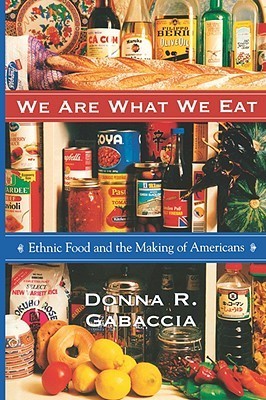
We Are What We Eat: Ethnic Food and the Making of Americans
Ghulam Bombaywala sells bagels in Houston. Demetrios dishes up pizza in Connecticut. The Wangs serve tacos in Los Angeles. How ethnicity has influenced American eating habits―and thus, the make-up and direction of the American cultural mainstream―is the story told in We Are What We Eat . It is a complex tale of ethnic mingling and borrowing, of entrepreneurship and connoisseurship, of food as a social and political symbol and weapon―and a thoroughly entertaining history of our culinary tradition of multiculturalism.
The story of successive generations of Americans experimenting with their new neighbors’ foods highlights the marketplace as an important arena for defining and expressing ethnic identities and relationships. We Are What We Eat follows the fortunes of dozens of enterprising immigrant cooks and grocers, street hawkers and restaurateurs who have cultivated and changed the tastes of native-born Americans from the seventeenth century to the present. It also tells of the mass corporate production of foods like spaghetti, bagels, corn chips, and salsa, obliterating their ethnic identities. The book draws a surprisingly peaceful picture of American ethnic relations, in which “Americanized” foods like Spaghetti-Os happily coexist with painstakingly pure ethnic dishes and creative hybrids.
Donna Gabaccia invites us to If we are what we eat, who are we? Americans’ multi-ethnic eating is a constant reminder of how widespread, and mutually enjoyable, ethnic interaction has sometimes been in the United States. Amid our wrangling over immigration and tribal differences, it reveals that on a basic level, in the way we sustain life and seek pleasure, we are all multicultural.
The story of successive generations of Americans experimenting with their new neighbors’ foods highlights the marketplace as an important arena for defining and expressing ethnic identities and relationships. We Are What We Eat follows the fortunes of dozens of enterprising immigrant cooks and grocers, street hawkers and restaurateurs who have cultivated and changed the tastes of native-born Americans from the seventeenth century to the present. It also tells of the mass corporate production of foods like spaghetti, bagels, corn chips, and salsa, obliterating their ethnic identities. The book draws a surprisingly peaceful picture of American ethnic relations, in which “Americanized” foods like Spaghetti-Os happily coexist with painstakingly pure ethnic dishes and creative hybrids.
Donna Gabaccia invites us to If we are what we eat, who are we? Americans’ multi-ethnic eating is a constant reminder of how widespread, and mutually enjoyable, ethnic interaction has sometimes been in the United States. Amid our wrangling over immigration and tribal differences, it reveals that on a basic level, in the way we sustain life and seek pleasure, we are all multicultural.
288 pages, Paperback
First published May 19, 1998
Ratings & Reviews
Friends & Following
Create a free account to discover what your friends think of this book!
Community Reviews
Displaying 1 - 8 of 8 reviews

February 27, 2017
While the book was interesting it felt more like a long essay than a book. I wish it were more detailed and focused more on the ideas associated with food over time and less on changes in numbers over time. I understand though that this is a wide topic so it's harder to cover everything sufficiently but I felt kind of let down because I didn't get that much new information. It's good for getting a general idea in the change of eating habits over time in the U.S. though. Probably a good read for someone who doesn't otherwise know much about US history.
February 13, 2019
HOT TAKE: This text is super-comprehensive, both in its citations (MANY to mine) and its coverage of how immigrant cuisine went from being a siloed part of the American food culture to deeply integrated into everyday American life. Gabaccia weaves together extensive historical research with five key case studies of New York, Charleston, San Antonio, San Francisco, and Minneapolis-St. Paul, to show how different immigrant communities have innovated upon and expanded upon the American palate. While her earliest chapters on American colonial appetites are not particularly innovative (James McWilliams does a lot more meaningful work here), her chapters about the expansion of immigrant diets into mainstream American food (including processed food) are especially interesting, as they give credence to the rise of the ethnic entrepreneur as a force within the broader food system, and to the evolution of the American appetite. Even as she notes the occasional nativist backlashes (did she ever remark on Calvin Trillin's provincial take on Szechuan food?), she also notes that by the late 20th century Americans have had foreign flavors so embedded in their diets that they have ceased to be a threat. Moreover, she talks about the fact that ethnic entrepeneurs have not always made foods directly expressive of their own heritages, but have mixed and matched over time, just as Americans have mixed origin stories on their plates. The one critique I have is that there is not very much discussion of African-American foodways throughout the text, and that the text might have benefitted from a different structure that would make her field studies more present/central to her analysis. Nevertheless, a great volume, and in particular Chapters 3, 4 and 6 are especially great.

November 14, 2016
"In the cultural dynamics of the food marketplace, ethnicity seemed never to die. It continually assumed new forms, and generated new conflicts between corporate and more communal ways of doing business" (199). Gabaccia strings together a long history of multicultural/multiethnic food consumption and consumerism in the United States. While I appreciate the new information she shares, she waits to make her argument until her last chapter, making the preceding chapters a bit dry.

January 8, 2025
Too detailed!

March 22, 2026
3.5
Cool history of food in the United States. Pretty expansive—good reference text. My main complaint is that the chronological structure gets much looser after the colonial section.
Cool history of food in the United States. Pretty expansive—good reference text. My main complaint is that the chronological structure gets much looser after the colonial section.

April 25, 2014
This is a fascinating book, broken into chapters which consider themes around the diversity of American food. The predominant view from outside of America is of the multinational corporation producing highly manufactured product, where consistency is more important than flavour or quality, and corporate profit is paramount. However, Gabaccia argues that this is just one strand of American food, and explains how this came out of particular historical situations that occurred in America around industry, capitalism and the domestic science movements.
However, she argues that there are also strong regional cuisines which vary considerably and are deeply rooted in the immigrant history of the US. Gabaccia's key concept, and a very important one, is that of the 'creole' - that regional cuisines were not brought by a single immigrant community and have a pure 'authenticity', but that they are unique fusions of traditions generated from more than one ethnic tradition. Indeed, one element from a particular ethic group may be common to several regional US cuisines; the thing that makes one regional cuisine unique is the particular combination of elements from two or more ethnic groups.
It portrays consumers not as simply flotsam floating on corporate supply (as perhaps Michael Pollan emphasises), but as active consumers, picking from foods of regional character or corporate conformity as they like in a continued interplay. Importantly for Gabaccia, food was, and still is, an area of acceptable multi-ethnic mixing within America.
For anyone wanting to read or write about American food and food cultures, this is a 'must read'. The middle chapters are more individual essays on aspects of food history and culture; the first and last chapters are the most interesting for history and cultural theory.
However, she argues that there are also strong regional cuisines which vary considerably and are deeply rooted in the immigrant history of the US. Gabaccia's key concept, and a very important one, is that of the 'creole' - that regional cuisines were not brought by a single immigrant community and have a pure 'authenticity', but that they are unique fusions of traditions generated from more than one ethnic tradition. Indeed, one element from a particular ethic group may be common to several regional US cuisines; the thing that makes one regional cuisine unique is the particular combination of elements from two or more ethnic groups.
It portrays consumers not as simply flotsam floating on corporate supply (as perhaps Michael Pollan emphasises), but as active consumers, picking from foods of regional character or corporate conformity as they like in a continued interplay. Importantly for Gabaccia, food was, and still is, an area of acceptable multi-ethnic mixing within America.
For anyone wanting to read or write about American food and food cultures, this is a 'must read'. The middle chapters are more individual essays on aspects of food history and culture; the first and last chapters are the most interesting for history and cultural theory.

July 23, 2011
I really found this book interesting. It was very text bookish so many might not enjoy it due to that, but it gave a lot of details about the history of what we eat and where certain things came from and how they evolved. For example, in NYC Italians all grew their own tomatoes in tiny little gardens even in the middle of the city and that is how they were obviously different from other people. Black slaves in the South grew a lot of their own vegetables on their free time and sold back some of their produce to their owner. People that had less money had to eat their own produce and rarely to never consumed processed food. It shows the early beginnings of the major food processing corporations and how they evolved. It talks about how a quick way for immigrants to enter a prosperous field of labor was to open a restaurant and cater their menus to the gringos etc. I only finished about 1/2 of the book, but it was a worthwhile book. A perspective of history that probably gets overlooked.
June 4, 2012
This book is a little ridiculous: not only is it full of misunderstandings, misspellings, and cultural misappropriation, but it also failed to make a salient point.
Displaying 1 - 8 of 8 reviews