Jump to ratings and reviews
Rate this book

Thirst

Rate this book
On a searing summer Friday, Eddie Chapman has been stuck for hours in a traffic jam. There are accidents along the highway, but ambulances and police are conspicuously absent. When he decides to abandon his car and run home, he sees that the trees along the edge of a stream have been burnt, and the water in the streambed is gone. Something is very wrong.

When he arrives home, the power is out and there is no running water. The pipes everywhere, it seems, have gone dry. Eddie and his wife, Laura, find themselves thrust together with their neighbors while a sense of unease thickens in the stifling night air.

Thirst takes place in the immediate aftermath of a mysterious disaster--the Chapmans and their neighbors suffer the effects of the heat, their thirst, and the terrifying realization that no one is coming to help. As violence rips through the community, Eddie and Laura are forced to recall secrets from their past and question their present humanity. In crisp and convincing prose, Ben Warner compels readers to do the same. What might you do to survive?

291 pages, Kindle Edition

First published April 12, 2016

16 people are currently reading
1019 people want to read

About the author

Benjamin Warner

6 books6 followers

Ratings & Reviews

What do you think?
Rate this book

Friends & Following

Create a free account to discover what your friends think of this book!

Community Reviews

5 stars
49 (6%)
4 stars
109 (14%)
3 stars
275 (36%)
2 stars
218 (29%)
1 star
97 (12%)
Displaying 1 - 30 of 153 reviews
Profile Image for Maureen .
1,713 reviews7,512 followers
January 28, 2024
This is the debut novel from American writer Benjamin Warner.

The storyline opens with our protagonist Eddie Chapman, abandoning his car in the middle of gridlocked traffic on a freeway, to run the 12 miles back home.
From this abrupt opening, neither Eddie nor the reader knows anything, other than there was an accident on the freeway. However, as Eddie begins running, he notices that the stream and local reservoir have dried up, and all the trees and greenery have been burnt. He suspects that there may have been a chemical spillage in the reservoir. Arriving home he begins to be aware that things aren’t as they should be.
There are groups of men gathered threateningly in the streets; and his wife isn’t home yet. Panic begins to mount. There is suddenly no mobile phone reception, and no electricity. Most concerning is the lack of water anywhere.
His wife Laura eventually arrives home, much to his relief, and his neighbours Mike Senior, Mike Jr and Patty are all thankfully accounted for. Things quickly begin to go wrong with the continual lack of water, resulting in deaths, either through dehydration, or murder over precious bottles of the liquid. The narrative all takes place during a hot summer in the American south, with Eddie and Laura making half-hearted plans to go to her parents in Virginia, where they hope there is water. 
I found the characters interesting and their concerns real and valid with Eddie and Laura particularly well drawn. Whilst reading, I found myself wondering how long I’d survive without water, and what I’d do to keep hold of my supplies.

Disaster novels, of which this is one, have made a comeback this decade, and even more so with the present pandemic. Apocalyptic novels, although differing in tone and location, all have lots in common with Disaster novels, and THIRST is no exception, with no electricity, resulting in no mobile phone coverage, or social media access, society starts to crumble. Looting takes place almost immediately, along with vigilantism as everyone seeks to protect their family and property, revealing just how thin is the protective veneer that coats our society.
I am familiar with the conventions that this genre follows, and how they manage to carry the reader through such dark narratives.
Thirst is distinguished by an element of the supernatural, of which to say more would spoil it for other readers. I enjoyed parts of the novel and was intrigued to see how the author would end it, given that a happy ending would appear doubtful, but not one of the best of its type.
Profile Image for Shelby *trains flying monkeys*.
1,748 reviews6,572 followers
July 8, 2016
This guy Eddie is coming home from work and realizes that the traffic isn't moving. He has no clue why, sees no sign of a wreck or anything else at the time. He decides he is tired of waiting and walks home.

On the way home he passes by a stream that is strangely dry with ashes in it. Their is a young boy there but he runs from him. (I hate not knowing why a character is used in a book-argghh)

Once home he starts worrying about his wife getting home. There is no phone service, power or water though...but wife shows up later.

At first they and the neighbors that they speak with are not too worried. The power once went out for six days before and they fixed it..so no biggie.

But then they realize that no one is showing up to fix anything. They are getting thirsty.
Palm Springs commercial photography

Now do they do something sensible like going to look for help at a hospital or even a police station? Nope. Eddie scopes out the neighborhood though, including that old lady down the street who just happens to have an extra water bottle for her cooler.
Palm Springs commercial photography

She had one anyways.

This book never really tells what happens to the water, so don't go into it expecting many answers. I did hope for some relief from the characters being dumb. They were all set to kill and hurt each other for something to drink and not help someone that was really suffering. But search out answers or help? That was over their heads.

So I got frustrated and ended up thinking the book was just stupid. It happens. I ain't even sad.

One thing about this book is the fact that you will drink all kinds of water when reading it. I think I ended up peeing about fifty gallons out because...thirsty.
Palm Springs commercial photography

Booksource: Netgalley in exchange for review
Profile Image for Jennifer.
350 reviews447 followers
May 11, 2016
Traffic is crawling on the highway on your evening commute, then comes to a complete stop. You sit there for 10 minutes, 20 minutes, an hour, and haven't budged an inch. There are nothing but cars ahead of you as far as the eye can see. You figure there must be an accident, but hear no sirens, and see no emergency vehicles. Turning to the radio for an update, you get nothing but static on every station. Although you're more than 10 miles from home, you abandon your car on the highway and make your way home on foot.

On your journey home, things become more strange. You pass by known streams and ponds, but they are completely dry. Not so much of a drop of water remains. Along the way home you notice that the power is out everywhere, and when you arrive home you are faced not only with a lack of electricity, but a lack of water, too.

Such is the set-up in Benjamin Warner's new novel "Thirst". Readers aren't told exactly what happened. We're as "in the dark" (see how I did that?) as the characters in Warner's book. All we know is that there's no electricity, all the water has mysteriously vanished, and it's insanely HOT outside. There's a total vacuum for official information from any sort of media or government officials, and emergency services are AWOL. I don't think I need to include a spoiler alert for you to guess that things are about to get real very quickly. Long after folks have ransacked the grocery stores and have finished drinking juice from the cans of beans to stay alive, suburban niceties have been left by the wayside in favor of Lord of the Flies- style behavior (albeit slow-moving behavior because people are weak and it's so darn hot).

This isn't my favorite genre, but Warner captured my interest with the human behavior side of the story. He makes us ponder at what point in our struggle for survival do we start doing things we would consider unimaginable under normal circumstances (whether that be theft, murder, or drinking salsa juice). He also explores the cross-over from "it'll be okay, we just need to wait it out" to "I'm going crazy, what am I doing to do!?" The middle part of the story was fascinating in this regard.

He lost me a bit at the end as the main character starts seriously hallucinating (I had the same problem with the end of Sweetland) and the book has some serious plot holes that perhaps a more experienced novelist would have closed.

I'd recommend this for those who like post-apocalyptic fiction or even those who like to ponder questions of morality.

3 stars

Thank you to NetGalley and Bloomsbury USA for a galley of this book in exchange for an honest review.


7,003 reviews83 followers
August 19, 2019
Should have listen to the reviews... This was really bad. I will be short. Everything was bad, there's a single good things about it, except the premise, but the worst was the characters and the way they're behaving. What kind of man try to knock down his front down before breaking a windows to enter his house without even knocking to check if his wife is home? What kind of man is scared shit less (abandoning his car on the highway, running over ten miles to get home, breaking a window to get in, etc.) and finally check out the neighbors, random chat here and there with them «Hey how is your son?». And that is all in the first 30 pages. Seriously this book is a joke, it look like the author never have any contact with humans being to think they behave like that.
529 reviews7 followers
August 26, 2016
Freshwater disappears from the world. Ed and Laura are a young married couple who try and figure out what to do. Hijinks ensue.

That's pretty much all I'm going to remember about "Thirst", an apocalypse novel that doesn't quite work. There are parts that aspire to detail the collapse of suburban society, similar to Stephen King's "The Stand" or "Cell". There are other parts that aspire to soulfulness and a deeper meaning, similar to Cormac McCarthy's "The Road". Unfortunately the author has issues communicating either. Characters are flat and unsympathetic, situations are contrived and illogical, and the writing is unclear and indecipherable.

I don't really have much else to say, so I'll throw in some random childhood memories. When I was a kid we took a family vacation to the Grand Canyon. I was really thirsty, but all my parents bought was sour-tasting canned orange juice. We went to a crater and my sister and I each picked a geode to be cracked open: hers had purple crystals and mine was solid all the way through, just greys and browns. And I insisted on being a T-Rex in every single photo.
Profile Image for Laura.
626 reviews19 followers
February 18, 2021
"You didn't know me when I was different. You didn't know who I was when I was young. This is who you fell in love with."
"But who will you be after all this is over?"
"Who will you be?"
He thought about that question. "I don't know yet," he said. It's impossible to tell."
"Just let it happen," she said. "Then we'll go from there."


description

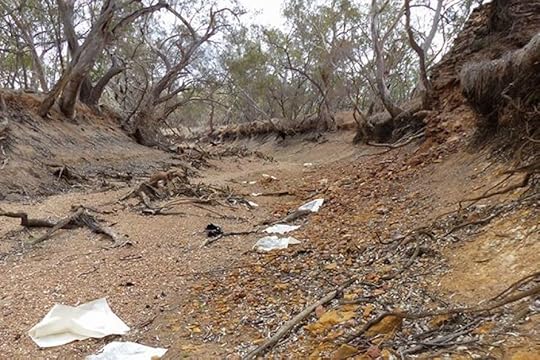
~~A dry creek bed. I pictured the dried up creek in the park near Eddie's house as looking very similar to this.

Synapse: Eddie is on his way home from work, yet another day in a string of commuter days, when traffic grinds to a halt behind a massive pile-up. Hours go by, and there's no sign of any improvement in the traffic jam anytime soon. People get out of their cars, and stand dazed on the side of the road. Help is glaringly absent. There isn't a siren to be heard. Eddie decides that it would be quicker to run the 10-15 miles home. For all he knows, the jam will still be there in the morning. And he's worried about his wife. As he runs home, he notices that power seems to be out everywhere. He continues to have no cell phone reception. Then he gets to the creek in the park down the street from his house. The water is completely and totally dried up. The trees along the edge of the stream look like they were singed by a fast moving inferno. The creek bed is covered in a fine ash.

When he finally gets home, connects with his neighbors, and then is reunited with his wife, they find out that an unexplainable disaster has befallen the entire area. No one has power, phone service, and most crucially--water. There's a run on the grocery stores. People are selling bottles of water for $20. THIRST descends on everyone, and begins to cloud judgements. As the book progresses, the reader is left wondering how much (if anything) of the story is actually happening, and how much is hallucinations. The narrative takes on a dream-like quality. It's an interesting take on the standard apocalyptic novel.

My two cents: Warner had an excellent plot idea in Thirst . I was excited to see where he would go with the story. Unfortunately, what could have been an excellent character study into the de-evolution of our minds in the throes of dehydration, was thrown off by how crazy
Eddie acted from the very beginning. Hour one, he decides to abandon his car on the street and run home.....but he leaves his freaking car keys in the ignition! This serious lapse in judgement continues to snowball as he takes ever more illogical actions. I just couldn't buy into his character. And don't get me started on how passive his wife, Laura, is. The last few chapters of the book went off the deep end, and I found the ending unsatisfactory. Given 1.5 stars or a rating of "below average". By all means pick it up from the library if you are interested in a new apocalyptic tale, but know that there are better options in that genre.

Profile Image for Mandy.
3,623 reviews333 followers
August 24, 2018
This started off so well. There’s nothing I like more than a good post-apocalyptic tale, but unfortunately although the premise was intriguing enough the execution left much to be desired. The beginning is indeed compelling and I was suitably hooked and even a little scared. Eddie Chapman finds himself stuck in traffic. Nothing’s moving and he assumes a major incident up ahead. He decides to abandon his car and run home. By the time he gets there, it’s obvious there’s more than a road traffic accident to deal with. The power’s out, the water’s off. There’s been some sort of disaster. As the community starts to deal with the situation, moral dilemmas come into play, as you would expect, and as the food and drink begins to run out, panic sets in. But then it all seems to get out of hand and there are far too many unanswered questions. In such post-apocalyptic novels it’s not necessary to have everything explained and all the loose ends tied up but there must be some sort of reality-based scenario. For example, we’re in American suburbia – but the food and drink runs out almost immediately. With those big American fridges? Eddie seems to have some sort of mental breakdown – or is he just dehydrated? Is he hallucinating or are we expected to believe in what he sees? By the end the book seems to have lost its grip on reality and I became increasingly bemused. It all becomes a bit melodramatic. A shame, because the writing shows promise, and the narrative engages the reader from the first page. Pity it couldn’t be sustained.
Profile Image for Figgy.
678 reviews215 followers
Read
June 4, 2017
Full review to come.

A bleak look at a slow and meandering death and destruction of society without liquid. A lot here that feels surreal, and it was often hard to see where it was going and what the point was... but then, this kind of situation doesn't have a point for those who are on the suffering end and don't know what's going on.

Questions left unanswered in terms of what and how, but again, these wouldn't be answered for the people affected by but on the outside of this kind of situation.

I think perhaps I was hoping for more, but not sure what.
2 reviews
June 1, 2016
Didn't any of these people go shopping at some point?
Started great, falters early then just loses interest. I wonder if the author got bored with the story and just wanted to finish it. High hopes but this authors style made this story confusing and the characters were mostly just annoying, especially the wife, Lara. I kept thinking that my annoyance and confusion were purposeful to reflect the disorientation of the situation. But some things just didn't make sense. Most of these people didn't have hardly anything in their houses. No one thought to go to the nearest hospital or clinic or police station. What the hell is happening? What is the author trying very poorly to describing? He spends three sentences on something and your wonder, did he find bones? Did he figure out what happened? Did he find a pot of gold? What the hell are you trying to tell us?
Loose ends, confused, pointless threads, rushed and then it's over and you wish you had just reread The Road. Good premise, just poorly written.
Profile Image for Helen Marquis.
584 reviews10 followers
December 6, 2015
I'm a huge fan of post-apocalyptic fiction, so was intrigued with the premise of this book, imagining what would happen if suddenly there was no fresh water. Following an unexplained cataclysmic event which causes rivers to flame and turn to ash, the known world is left without fresh water.
Stuck in an unmoving traffic jam on a Californian highway, our main protagonist Eddie is unaware of what's going on, and just thinks it's really bad traffic. Abandoning his car in the jam, he runs home to find his wife hasn't yet made it home yet either, all the power has gone off, his mobile no longer works and there's no water when he turns on the taps. His growing sense of unease escalates the longer the power, water and mobile signal stay down, combined with the fact that the authorities are decidedly conspicuous by their absence.
While the first section of this book is the epitome of the phrase "well that escalated quickly" and loses a little credibility in the process, things really get interesting once our protagonist and his nearest and dearest start to feel the full-on effects of dehydration, and Eddie becomes the embodiment of the unreliable narrator, hallucinating, paranoid, delirious and in and out of consciousness. In this hazy narrative, what is true, what is imagined and what inhabits the blur between the real world and the hallucinatory depths of Eddie's mind.
A great premise, well handled, it just felt like the narrative rushed into the world unravelling a little too quickly for my liking. That said, this comes highly recommended. Just make sure you have plenty of bottles of water in your garage before you start. Just in case....
Profile Image for Leslie Stokes.
434 reviews10 followers
March 5, 2016
I liked the idea of this story - that all the water suddenly disappeared one day and people had to find a way to survive. But the execution of the story was pretty bad. Characters were barely fleshed out and the narration was very disjointed. This was more like an outline of a book rather than a fully finished novel.
Profile Image for Althea Ann.
2,255 reviews1,210 followers
April 21, 2016
I've belonged to a post-apocalyptic book club for quite a few years now, so I've become quite familiar with this genre. (Although, I read this one all on my own, unaffiliated with any club meetings!) And, I have to admit, after a while it begins to feel like many of the books in this genre (post-apocalyptic literary fiction) have more similarities than differences.

For me, 'Thirst' reminded me in tone most of Edan Lepucki's 'California' (https://www.goodreads.com/review/show...) and Karen Walker's 'Age of Miracles.' (https://www.goodreads.com/review/show...). I think what it has in common with those (and, perhaps more obviously, with McCarthy's 'The Road' (https://www.goodreads.com/review/show...) and the superior melancholy of Shute's 'On The Beach' (https://www.goodreads.com/review/show...)) is that the apocalyptic event is a phenomenon which isn't of primary concern to the book. They're not the stories where man has to figure out solutions and triumph over adversity. The real focus is on the quotidian details of survival (or the failure to survive). It's about the slow decay of the characters' lives and relationships, paralleling the decay of the world around them.

(The extended descriptions of the physical and mental effects of thirst also brought to mind parts of Monica Byrne's 'Girl in the Road' (https://www.goodreads.com/review/show...)).

Of course, each of these books is almost required to come up with at least a slightly-new twist on what the trigger for the final disaster might be. In 'Thirst,' one day, inexplicably (and it will remain unexplained, so don't wait for that), open bodies of fresh water combust and disappear, leaving behind a hot, dry and dusty land. When it happens, Eddie is stuck in a traffic jam and ends up having to run home, concerned about his wife, Laura. The couple are reunited, but everything is far from OK, and they - and their neighbors - begin to realize the true scope of the disaster. Anything drinkable is suddenly the one and only desperately-needed commodity, and ethics and morals erode in the face of duress.

Many thanks to Bloomsbury and NetGalley for the opportunity to read. I'll definitely be recommending this one to my aforementioned book club. As always, my opinions are solely my own.
Profile Image for Laura Lacey.
148 reviews25 followers
July 26, 2016
I found this novel incredibly frustrating. The premise is great - what would happen if the water supply stopped? How would people in towns, cities and suburban areas react? It sounds like Doomsday Preppers come true. However if this is what would really happen then God help the USA.
The characters in this book just never do anything sensible - do they set off for town to get some answers? No! A hospital, a civic centre, a police station, the water plant maybe? No! They just immediately start hating one another.
I was really disappointed to never get an explanation of what happened to the water - I carried on reading it basically for that very thing. How are water, telephone lines and radio connected? Why would they all stop at the same time?
That said it is a quick read with some exciting twists - it's just a shame the characters were so insipid.

Thanks to Netgalley and the publisher for the ARC in return for an honest review.
Profile Image for Sean Goh.
1,525 reviews89 followers
May 17, 2016
2.5 stars. 3 for premise, 2 for execution.

Do note, dear potential reader, that you will never find out why all the water disappeared. Just accept it as necessary background for the story that you'll read.

The writing captures the paranoia and psychosis that accompanies a sudden shortage of drinkable water. The shift in narrative style does make it hard to follow the story though, as the unreliable narrator beings hallucinating and the reader is left confused as to what actually happened. The ending is just 'huh' and the book loses steam somewhere after the 2/3 mark, and that's after it brings things to a head with various desperate people reaching their breaking point.
Profile Image for Dash.
242 reviews12 followers
July 1, 2017
Listened to eBook version... I held on through the whole thing in case the premise, which was intriguing and promising, overcame obstacles in characterisation. I really don't mind a lack of explanation of why there was suddenly no water. There was so much potential. I found the main character problematic. Eddie was so flat I thought he might be a sociopath (which would have been a great development). His behaviour toward his wife - in Every interaction, whether it was insisting she drink water, or not talk to someone - was either quasi-abusive or downright condescending.
4 reviews
April 14, 2016
Eh. It starts off very promising but it kind of falls flat and then tries to pick the climax back up but ends up all over the place. It really had potential but it really fell flat. I got to the point where I was hoping it was almost over just to get it over with.
Profile Image for John Millikan.
6 reviews
June 1, 2017
The only thing this book accomplished was making me very, very thirsty. It was an interesting idea for a novel, but very poorly executed.
Profile Image for Anna Scott.
46 reviews
October 27, 2017
I smashed through this book like it was a bag of Doritos! Was it profound or thought-provoking? No, not even a bit. And the characters were annoying. But I just wanted more and more and more... and so I read 300pages over 3 nights. I wouldn't call this a nourishing read, but very very bingeworthy.
41 reviews1 follower
Read
September 29, 2017
Dystopian story about a mysterious disaster. Protagonist copes with disaster by seeing his community through a lens of danger or potential sources of nurture. A bit masculine and predictable.
Profile Image for Alaina.
35 reviews4 followers
July 13, 2017
Intriguing premise, but one of the poorest executions I've ever read. I thought that there'd be a reveal at the end to explain why the characters were acting so dimwitted (before the thirst even set in).
At the beginning, when it just seems like the power is out:
Eddie looked down at himself. His clothes and arms were streaked with ash. “I was looking for you.” “Oh no,” she said. “I spent the night outside, but it’s okay. We’re okay now.” “What’s happening?” “I don’t know,” he said. “I heard helicopters, though. We’ll have the power back on soon.” “Will you clean yourself up, please,” she said. “I can’t look at you like this.” “How long have you been back?” “Just now,” she said. “I sat in my car until four in the morning."

As if sleeping outside and sitting in a car until 4am are normal behaviors during a power outage in the DC metro area in 2016.
Profile Image for Becca.
376 reviews31 followers
May 3, 2016
Deeply disturbing, utterly atmospheric, and quite engaging. This short novel reads like a dreamy novella mixed with the pilot episode of Showtime's newest post-apocalyptic drama. The descriptions of thirst were-- as you might expect-- visceral. Warner has titled his book aptly; it is truly an exegesis on human thirst. May this stay firmly in the realm of fiction. I kinda want to buy a ton of water bottles right now.

I received this book from NetGalley in exchange for my honest review.
Profile Image for Travis.
838 reviews210 followers
July 15, 2016
Thirst is agonizing and exhausting. It will leave you literally physically thirsty as you follow the tribulations of Eddie, his wife Laura, and their neighbors as they struggle to survive when the water supply is completely cut off.

Thirst is dark and brutal and, in many ways, reminiscent of Cormac McCarthy's The Road.

Reading this novel was quite an uncomfortable experience, but it is a fascinating story and is very well written.

45 reviews14 followers
February 14, 2023
It is a good study of the impacts of dehydration both on the human mind and a community. It also deals with how people and communities deal with crisis situations.
As a part of the recently growing genre of cli-fi, it's narrative is good but the book as a whole lacks something perhaps especially in the second half. For me personally, I thought the characterisation possibly could have been it as it seemed to wander a little.
Did I enjoy reading it? Yes
Would I read it again? Probably not
Profile Image for Kate.
1,632 reviews395 followers
January 3, 2018
An intriguing premise and a great start but the rest of this (very) short novel didn't deliver for me, in fact I found it rather frustrating.

Profile Image for Misty.
126 reviews3 followers
June 4, 2018
Awesome until the end.... hope there is a sequel on the way. It feels completely unresolved.
Profile Image for Brett Milam.
463 reviews23 followers
January 20, 2023
I’m always game for a book with an apocalyptic premise, as is the case with Benjamin Warner’s 2016 novel, Thirst. The premise is that Eddie and his wife, Laura, are stuck in a suburban neighborhood, a few miles just outside of a major city, with no electricity, running water, and seemingly no help on the way. But it’s not only that … there is also something unexplained going on because nearby streambeds have turned to ash, as if some fire washed through every possible body of water in the vicinity.

Eddie is not much in the way of being a likeable character. He bosses Laura around, withholds information (like about the ashen streambed), and worse yet, he steals a jug of water from an elderly woman in the neighborhood and stashes it in the woods for later. Laura, for her part, mostly exists as a passive, sleeping wife for the first three-thirds of the book.

The suburban neighborhood they are in breaks down fairly quickly, going from the general sentiment being, “Help will be on the way; this happened in 2008, and it was fine within six days.” Well, within less than six days, neighbors are stealing water from each other, hoarding water, and quite literally dying of thirst (and hunger because of the aforementioned issue with electricity). And with thirst, hunger, and desperation comes the usual pitfall of humanity: Turning on each other. Eddie gets into a scuffle with a gentleman he thinks is trying to con him out of his water by claiming it’s for a sick kid; later, Eddie stabs the man to death, arguably inadvertently and/or in self-defense. But he then hides the body.

Eddie and Laura also befriend the family across the street, Mike Sr., Pam, and Mike Jr. Eventually, though, Mike dies of thirst, Pam shoots herself, and Mike Sr. seeks Eddie and Laura out for revenge, primarily because he knows they absconded with his water jug.

As the story develops, Eddie and Laura devolve further into dehydration (grossly drinking their own pee, for example, which, don’t do that!), dreariness, headaches, and so on, Laura reveals to her husband (emphasis because I don’t see how this only now came out!) that she was previously pregnant at the age of 15 and had the kid, but the kid was killed in a tragic car accident. Which itself is a set-up for Laura to tell Eddie she’s pregnant now. I feel like the pregnancy angle is overdone in post-apocalyptic stories to up the stakes. As far as I can tell, it also didn’t lead anywhere here.

Nonetheless, the last third of the book is largely, I believe, Warner trying to capture the hallucinatory effects Eddie and Laura are experiencing from the lack of water and food, and he does a commendable job of doing it, even if it can be hard to follow exactly what is occurring. The gist of it is that in a bid to get away from dangerous water hoarders, Eddie and Laura end up in an ash pit, and Eddie kills her in his hallucinatory state. Then, he emerges from the ash with the thought of journeying to her parents’ house because they have well water. Along the way, he thinks he’s with a little boy he saw earlier in the book covered in ash. I think we’re supposed to understand the boy to be something of a mirage.

At the end of the book, Eddie reaches a group of “survivors,” if you will, who have figured out how to turn salt water into drinkable water, and they further explain that they think whatever caused other bodies of water to vanish left the salt water alone because of its saltiness.

Overall, I would put Thirst up there with those B-level horror films I loved seeking out at Blockbuster. They’re a fun evening watch, without being overly taxing, and not exactly something I’d go out of my way to recommend. But also, not a time-waster! Just fun, which in a way, is a recommendation.

Plus, whatever I think of some of the plot holes I could identify, or the weakness of the dialogue in parts, I always appreciate even one good sentence within a book (not saying there aren’t more than one good sentences within) that resonates with me. Laura, in her descent into hallucination, is acting suicidal and nihilistic. She ruminates on a bit of moss she sees, “Everything is set up to fit inside everything else. It just makes me so sad, sometimes, to see it.”

She then implores Eddie to come over and see it. He doesn’t want to feel it, being the jerk he’s been the entire book. But she responds, “It’s perfect and it doesn’t even try. Nothing else has to try.”

That is some great existential crisis rumination based on a little thing of moss. I dig it.
This entire review has been hidden because of spoilers.
2 reviews
November 17, 2024
Fantastic premise.

Strong start. Then you discover the main character Eddie is an ignorant man of very weak moral fibre. Which could intensify the drama, because it makes you think "this could be the sort of neighbour I might have in a crisis" which is a scary thought. Only, because there aren't any likable or interesting characters, you're stuck with Eddie and his passive wife Laura the whole book, which makes for tedious company.

Eddie is a pathological liar, who has no friends, and spends 90% of his communication with his wife Laura simply bossing her around. She apparently doesn't eat or drink anything unless Eddie slaps it down in front of her and says "Drink this" (seriously, he did this so many times in the book it was actually funny). He also perpetually lies and hides the truth from her, for no reason whatsoever. Oh, and has sex with her like a blow up doll, even though she's not in the mood, without one word on her pleasure. It's a painfully cringey dynamic. We also get an inside view of his thoughts justifying , but it's early on before the scale of the crisis is known so it's not even a 'usually good person driven to bad deeds from desperation' type situation. He's just a lowlife. He seems to think his wife is a saint because she wouldn't be okay with stolen goods in the house, and spares a thought for the people around her. I wondered if the un-neighbourly portrait of Eddie was deliberate, but we don't get a redemption arc. His selfishness, disinterest in friendship, lack of partnership with wife, and general unlikable nature, is compounded by his ignorance. His bizarre lack of knowledge of basic human reproduction goes uncorrected by his wife (, and he drinks his own urine when it's already heavily concentrated (and of course, orders his wife to so the same).

I really only kept reading because I was waiting for him to die.

Also, and I think this is the weirdest thing, not once - not ONCE - does anyone mention or even temporarily think about the existence of RAIN. Surely, at some point, someone would have spoken about when it was likely to rain next, or even just fantasise about it raining, make a joke about doing a rain dance, something.

Multiple characters think about the water in their toilet cistern (but we conveniently forget about this when breaking into empty houses), but no one thinks about rainwater tanks, swimming pools, backyard ponds etc.

We also don't hear Eddie actually think about how thirsty he is, or mention thinking about or fantasising about tall cold glasses of sparkling water, etc, like you normally get in descriptions of the thoughts of thirsty people. There's descriptions of some of the physiology you get with dehydration, but nothing that steps up the psychological side of increasing thirst, other than the behavioural effects of delirium when it gets to that point. So weird in a book that's literally called Thirst.

And then it just ends.

Someone should take this premise, do some actual research, inject characters with interest and knowledge, and write something compelling.
Profile Image for Sarah B.
1,335 reviews29 followers
May 22, 2019
This is one of the most interesting man versus nature books I've read in a long time. The plot in a way is very simple: what would you do if suddenly there was no water? You take water for granted, don't you? Turn on the tap and it comes gushing out. But what if it stopped working? And along with the water, so did the electricity? The police and firemen were nowhere in sight? You and everyone around you were left to fend for themselves. How would you fare? To make it even more difficult, something odd happened that burned up all the water in a nearby stream. The trees are even burnt. Days go by and no help arrives. That is the story in "Thirst".

It shows people at their best and worst. It's not only a natural disaster but also very much person versus person. What would you do to survive? The main character, Eddie, faces very difficult choices. He falls into madness and delusions. He sees things that half the time you're not sure if they are real, a dream or some dream-like mirage created by his state of slowly dying. Sometimes I had to shake my head at his bad decisions, like him stupidly drinking alcohol or sugary drinks in high heat situation when his poor kidneys are already strained. But I could also understand his desperation for any liquid. But caffeine and alcohol will only make the dehydration worse.

I would classify this as light horror. People do die but it's not too graphic. It's basically a natural disaster story. The story moves very smoothly and logically. I read the entire book in a day. It kept my attention throughout and I admit I was trying to think up ways on how he could get water. Like certain devices can pull water out of the air, like a dehumidifier. Boiling that water would make it drinkable. Now if he had a power generator... Alas the characters did not.

The ending was good too. Often books don't end well with a satisfying ending but this one does. All of the questions were not really answered but in this case that was ok. I was ok with it.
3 reviews
January 19, 2020
“thirst”

Imagine you’re coming home on a hot summer Friday and traffic is crawling on the highway. Then all the cars come to a complete stop. This was Freddie, he waited in the car for 10-20 minutes and could not bear more. He abandons his car and runs home, passing dried up streams, lakes and rivers. Once he gets home, he tries to call his wife there is no service nor Wi-Fi. In the meantime, he thinks just the power is out. But then he reaches for the faucet, flips it up and down. Again and again, there’s nothing. His stomach is like a tin bucket in the middle of a desert. At first they suspect nothing is wrong and it will get fixed. However, instead of going to a hospital of grocery store, Eddie is ready to kill for water. He scopes out the neborhood and finds out an old lady happens to have a water cooler. The book never explains a lot of things, like what happened to all the water or the smaller questions, does the rest of the city have water. Overall the book is really confusing at some points but the storyline is a creative one.

Some things I liked about the books were the analogies or the metaphors. I thought that they were interesting. However, why did the author create such dumb characters, who leaves their car in the middle of a highway and never picks it up again? What kind of person wouldn’t look around the town or state for a solution? What character would bust down their own door before checking if his wife is home or crawling through a window.

I thought that this book made me sick, I won’t spoil but the things Eddie though of doing to get water is just a horrible thing to do. The book kept me turning the pages at some points but at others I would latterly fall asleep.

I would recommend this book for someone who is into cheesy thrillers or disaster books. I would put it this way, if you’re a person who likes to drink coffee from a place that says “world’s best cup of coffie” this book is for you. It’s not the best but it’s interesting enough to read. I would give this book a 5/10 stars.

Profile Image for Craig DiLouie.
Author 62 books1,523 followers
August 28, 2017
THIRST by Benjamin Warner imagines life in a suburban community after a strange event destroys all water in nearby rivers and reservoirs. Uncleared traffic accidents and the power going out create an immediate sense of isolation and hardship. Eddie Gardner and his wife bunker down and negotiate how much they need to help themselves versus others in the community, believing help is on the way. Any day now, the power will return and they will have water again.

What follows is an interesting apocalyptic story whose idea meshes originally into the genre, though the story overall didn’t stand out for me. I enjoyed it, but it didn’t make a heavy emotional impression like the best apocalyptic books do. Warner captures the steadily mounting isolation, tension, and hardship of thirst well. In his book, he provides an interesting meditation on what people will do to survive. However, the characters often grate with their decisions until at times they seem to be actively working against their best self interest, and they don’t consider many sources of water such as car radiators. While a nice meditation on survival, nothing really struck me as poignant or original in a genre packed with such meditations (note I’ve read so much of this genre I’m a bit jaded). The narrative becomes increasingly unreliable due to Eddie steadily going mad with thirst, which effectively portrays his suffering, though at times it was confusing for this reader. The ending concludes well but may leave some readers unsatisfied, as the source of the water being eliminated isn’t explained (nor the power going out or all the accidents).

I liked the novel and recommend it to apocalyptic fiction fans looking for an original premise as well as newcomers to the genre. Warner writes well and I hope to read more of him in the future. While I enjoyed THIRST, however, it didn’t deliver the gut punches (nor the action) I like to see in apocalyptic fiction.
Displaying 1 - 30 of 153 reviews

Can't find what you're looking for?

Get help and learn more about the design.