Jump to ratings and reviews
Rate this book

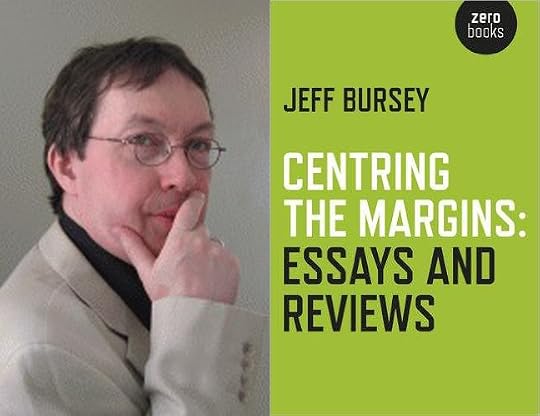
Centring the Margins: Essays and Reviews

Rate this book
Centring the Margins is a collection of reviews and essays written between 2001 and 2014 of writers from Canada, the United States, the UK, and Europe. Most are neglected, obscure, or considered difficult, and include Mati Unt, Ornela Vorpsi, S.D. Chrostowska, Blaise Cendrars and Joseph McElroy, among others.

200 pages, Paperback

Published July 29, 2016

Loading...
Loading...

About the author

Jeff Bursey

13 books203 followers
Jeff Bursey is a Canadian novelist, short story writer, playwright and literary critic.

His books: Verbatim: A Novel (hardcover, October 2010; paperback, February 2018); Mirrors on which dust has fallen (June 2015); Centring the Margins: Essays and Reviews (July 2016); Unidentified man at left of photo (September 2020); an impalpable certain rest (June 2021); Assume A Position: Considerations and Interviews (July 2022).

His webpage is:

www.jeffbursey.ca

Ratings & Reviews

What do you think?
Rate this book

Friends & Following

Create a free account to discover what your friends think of this book!

Community Reviews

5 stars
5 (55%)
4 stars
3 (33%)
3 stars
1 (11%)
2 stars
0 (0%)
1 star
0 (0%)
Displaying 1 - 12 of 12 reviews
Profile Image for Glenn Russell.
1,575 reviews13.7k followers
April 25, 2018


Literary criticism and long scholarly essays about literature are not at all to my taste. What I most enjoy are intelligent, insightful book reviews written by someone whose approach is off the mainstream and a bit quirky. Thus I picked up this collection by Jeff Bersey. Bulls-eye! Exactly what I was after. Thank you, Jeff! Rather than making general comments, as a way of sharing a taste of what a reader will encounter, here are some author quotes taken from the Preface and then some from the book reviews themselves. I've also included my own modest comments.

"Research led to Lawrence Durrell, the Powys family, Wyndham Lewis, Louis-Ferdinand Céline, Anaïs Nin, and from there to the Surrealists, Raymond Queneau, Blaise Cendras, and so on. . . . I gravitated to obscure works, and that they became the most important for me relatively early on."

Jeff Bursey possessed the good sense to follow his own light, even at an early age. Lucky man! I can personally appreciate since I much more favor writers like Russell Edson, Barry Yourgrau, Jean Richepin, Donald Barthelme and Adolfo Bioy Casares than Dante, Milton, Flaubert or Austen.

"There is no theoretical apparatus underlying the approach taken here, as each book, to my way of thinking, requires its own approach, if you want to treat them as artworks and not treat them as exemplars of this or that critical discourse."

I couldn't agree more. A work of literature is best approached on its own terms; we should open ourselves to the voice and vision of the author. None of that nonsense of fitting books into predetermined categories, schools like Marxist, Freudian, Feminist, Postmodern, etc. etc..

"There are many ways to teach writing; I know of only one that worked for me, and that is to read writers who, it turns out, do things that delight."

I follow a similar approach to book reviewing. I only take the time to write reviews of books that inspire and expand. I never tire of repeating - life is too short to spend time reading what one finds boring and tedious.

"There is a belief out there in some quarters that experimental/exploratory fiction is made "difficult" by authors out of orneriness or to show how smart they are, and that what's present in the work of, for example, McElroy could have been conveyed in a more reader-friendly way, as if the style and structure got in the way of the only important thing: the story."

As a seasoned literary critic, Jeff knows there are many elements of style and structure, frequently unique and original, deserving consideration beyond the boundaries of convention and standardized storytelling. Come to think of it, I've always run the other way when I hear terms like "conventional" or "normal" - smacks of the death of imagination and creativity.

On Herb Wyile, author of Anne of Time Hortons: Globalization and the Reshaping of Atlantic-Canadian Literature
"By leaving out the aesthetic qualities of the books under consideration, and concentrating on class, race, gender issues, and consumerism, Wyile leaves untouched a pertinent question: If the books aren't artful, how will they do whatever he wants them to do? They might as well be tracts to molder on the doorstep. Wyile's earnestness, coupled with his thesis, tells the reader little about the literary aspect of literature."

Go get 'em, Jeff! A literary critic, so called, who treats works of literature as if they were no more than papers on sociology or reports for their own political agenda should be taken to task.

On The Big Dream, by Rebecca Rosenblum
"Inertia and sadness reside on almost every page of this collection, highlighted by flashes or humor, and we close the book no wiser as to why workers return to a hostile, unforgiving space every day. The Big Dream isn't interested in such a topic. For all its entertaining charms, that lack of engagement makes it less satisfying as an arbeitsroman than its individual parts."

The Big Dream is a story cycle set in a magazine company outside Toronto, an office filled with people who are, in turn, creepy, insecure or workaholics. Jeff gives a clear overview of what a reader will find in this book's pages. Strikes me as a tale of employees trapped in a nightmare with a paycheck.

On Double-Blind, by Michelle Butler-Hallett
"We often engage in self-deception, and in these particular times we may be too complacent to protest against state-sanctioned brutality. Yet Hallett's particular kind of realism - good things rarely happen, few people are kind, the lives of people are invariably sordid, and corruption is normal - is objectionable because it clearly overlooks the more tender aspects of life, and relegates much of the world's artwork to the ashbin."

I enjoy Jeff's take on the author's "realism." If a story sticks with nothing but the negative, chances are much of "reality" is missed. Even the harshest works of Zola (The Gin Palace comes immediately to mind) have their lighter scenes.

On Chris Eaton, a Biography by Chris Eaton
"The book would not be impressive if the prose didn't work on the level of language, and Eaton's sentences stand out for their sharpness. One woman, regarded with affection, has "an extended neck that lolled like a dying vulture. Her eyes drooped adorably like turkey wattles." The "parasitic hospitality industry" is in "the business of competitive pampering"; someone's handwriting is "more like letters dying of some debilitating disease," one Chris Eaton's job is safe as 'no one was likely to fire the company cripple.'"

Now that's a reviewer who is doing the job. If the strength of the novel is language on the sentence level, then share actual examples of those sentences and language. With the several quotes included here, the reader is empowered to make their own judgement on the quality of the author's writing. Actually, I find Chris Eaton's words really pop.

On Fish, Soup and Bonds by Larry Foundation
"Fish, Soup and Bonds is written in prose that has a jazzy feel. The narrative voice sounds ragged at times, smooth at others, breathless occasionally due to events, and street-smart but not condescending (to characters or readers). Dialogue feels true to the characters, a sign of hard imaginative work, not tape-recorder fidelity. At times there are news reports and quotations from source books, as well as passages dealing with Los Angeles, that provide a sociological bird's-eye view."

And Jeff includes a number of direct quotes supporting his view. What I pick up here is how Jeff highlights the novel's dialogue - "true to the characters," recognizing the novelist's ability to catch his characters through creatively selecting their speech rather than running around town with a tape recorder.

On Gold, Dan Yack, Confessions of Dan Yack by Blaise Cendrars
"Short quotations don't adequately convey the momentum of Cendrar's prose, whether in the cascade of short sentences or in the pile-up of clauses in one-sentence paragraphs that span pages. Nor can a review do justice to the intricate plots, the exuberant imagination, and delight in language, the intelligence and the geniality of the work, and its varieties of humour."

Excellent. Rather than attempting to summarize, simply acknowledging the impossibility of such; rather than trying to corral first-rate literature into categories, letting the reader know the book is a feast of imagination, language, humour and many other wonders.

On The Abyss of Human Illusion by Gilbert Sorrentino
"Every story, and all of Sorrentino's work, rebuts what we were endlessly taught: Literature contains singular imagery, the perfect word lodged in its perfect spot, rounded characters, believable settings, a confident narrative (if not a confident narrator). This demolition liberates readers,and writers, from stale expectations, and stylistic and aesthetic molds."

This quote could be taken for the overall theme of Jeff Bursey's book - demolish the stale; breathe in invigorating, innovative voices such as Gilbert Sorrentino.
Profile Image for Nathan "N.R." Gaddis.
1,342 reviews1,770 followers
Read
March 10, 2016
My reading choices don't so much go against the popular taste as pass it by. --Jeff Bursey
So immediately you see the affinity.

Jeff Bursey is a gr=Friend of mine and I've read both his two novels and loved them*. So everything that follows, you'll know, is a lie.

What's convenient here is that if any little thing interests you in even the slightest regarding what I say about Bursey and his book reviewing and book commentatoring, you can head off into the vast range of the internetz, via this link :: Jeff Bursey ;; and click into his gr=reviews where you'll likely be linked to the on-line publication of some of his thoughts on books. And there's good reason to do so ; you've never even heard of most of these things he reviews. [I had fun these past few days Liking his Reviews into your Feeds, so you know you'll have seen these titles and names at least once in your life].

Just listen (I mean to say, this is the kind of issue Bursey's reviews are likely to address ; it's not about some nit's feelings being hurt when a critic disparages her favorite YA novel, but rather addresses the question of a POVERTY OF LITERARY KNOWLEDGE) ::
But there is a bottomless chasm . . . no, that's not a very nice image . . . An endless horizon? A galaxy of literary stars? All these influential books and writers I've not only never read, I've NEVER HEARD OF. And when I do learn of someone, I'm all WHY has no one mentioned him/her before? Was I just not listening? --an innocent=anonymous gr'r
Because really who needs to "debate" whether the latest breast=seller, noble=winner, N=Basketcase=A winner is good or not and whether 'good' is subjective or not when we are faced with the very real and very objective question whether Reader X has even had the opportunity to have heard the name Rikki Ducornet (my example) even once in her life? Frankly, Donna Tartt and her ilk can continue to take flying=friggin' leaps so long as millions of voracious readers have not even once in their lifetime even had the chance to have heard the names Marguerite Young and Dorothy Richardson (again, my examples).

So then this is where Bursey comes in. He's doing what I think any serious book reviewer ought to do. Talk about books that deserve to be spoken of, to be read, to be dissemination but which are ignored almost entirely by the machine. Today, right now on gr among this little Corner Collective of readers of the experimental and exploratory (Bursey's better term) it sounds out=right damn'd silly to speak of no one never having heard the names William T. Vollmann or William Gaddis or Joseph McElroy or Blaise Cendrars or Gilbert Sorrentino or Cesar Aira. But truly folks, in the spirit of Bearing Honest Witness, this was my state a mere ten years ago ; and I came from a literary education, from a clique that read books, serious books, and literary books. What any serious book reviewer ought to do is WIELD that mighty SPADE in the name of righteous indignation that so many longing and lovely readers are being denied the knowledge of the existence of books they're gunna fall in love with and spend their life with. And, folks, I've seen it happen again and again and again and again.

At any rate, let's do the list -- I challenge you to look at the numbers and you'll see what I'm talking about. [Bursey doesn't advocate on behalf of each and every author/book listed below because too he's astute and evenhanded of a reviewer for that ;; but when he does advocate you'll want to pay attention because his aesthetics=dar is well tuned as witness those names in the previous paragraph] ::
Davis Schneiderman
John Domini (he's here around these gr=parts)
Herb Wyile
Bill
Solzhenitsyn (the only name here I'd expect a general readership to have acquaintance with)
[followed by some Canadian names that are not Munro or Atwood because Canada's bigger than that]
Rebecca Rosenblum
Steven Galloway
Jessica Westhead
Chris Benjamin
Michelle Butler Hallett
S.D. Chrostowska (again in the spirit of Bearing Honest Witness I can Testify to the value and accuracy of Bursey's recommendations. Permission should not be missed and I'm looking forward to Matches: A Light Book)
Chris Easton
[some more stuff follows the ToC heading "Realism and Suffering"]
Marja-Liisa Vartio
Robert Newman
Larry Fondation
Hans Erich Nossack
Joseph Roth
Ornela Vorpsi
Sam Savage
Michelle Latiolais
[and the last section where it really kicks into Pay=Attention=Bursey=Is=Speaking territory ;; ie, "Outliers, Innovators, and Explorers"]
Blaise Cendrars (a Bursey staple)
William Gaddis (I think this is where Bursey and I first met due to an amazon rec that went from Gaddis ---> Verbatim: A Novel)
John Cowper Powys & Dorothy Richardson, their letters
Gilbert Sorrentino (seeing this name in a context like this means that the person speaking/etc is serious)
Mat Unt -- Estonian stuff, if you can believe it.
Joseph McElroy (should be named every time you make a list like Joyce, Proust, Woolf)
Jean-Philippe Toussaint
Alexandra Chasin
Marek Waldorf
Cesar Aira

For your pleasure ::
Bursey's interview with Steven Moore
http://www.musicandliterature.org/fea...

Lots more Bursey at http://www.jeffbursey.com/ which provides, among however many more reviews, a youtube of a reading that'll bind-your-spell.

And here's where to get the book presently under consideration ::
http://www.zero-books.net/books/centr...


* He's about as good as Evan Dara and even twice as obscure/unread. Hell, he's Gaddis=good!
Profile Image for Jeff Bursey.
Author 13 books203 followers
July 6, 2016
Hard for me not to like it. ;~]

Looking forward to anything anyone else has to say: positive, negative, and in between.

July 2020: Noted canadian literary critic Alex Good reviewed it here:

http://notesandqueries.ca/reviews/jef...
Profile Image for Chris.
Author 17 books89 followers
Read
May 3, 2017
I love the way Bursey reviews these books. There are many writers he expresses a certain reverence for, even as he points out the occasional flaw. William T. Vollmann stands out in my mind, what with Bursey's in-depth review of a Vollmann reader.

But what is even more resonant with me than Bursey's passion, is that much of his analysis hones in, intentionally or not, on theme, on the ideas a work raises or deals with, the very things that make the stories matter. To me, it's less the obscurity or even originality of a work that gets me, it's what it says. And to say something, anything, a book has to have a good way with words. Its structure may be unusual, daring and innovative. But it succeeds most when it has some insight on the world, perhaps an ability to instill in me sympathy for those I hadn't considered before.

Bursey's criticism covers that thematic ground very well, to the point I feel I've read some of the books I actually haven't. The downside: my already cumbersome to-read list has gotten considerably longer. But whether I ever get to them all or not (surely I won't, because it always grows), this kind of review and analysis of books is in itself a pleasurable read, itself saturated with ideas and perspectives about the world we live in, the people who inhabit it, and the way we have been, are and may be in the future. It is an homage to reading itself, and why it is such a privilege and delight to have this power.

And I should note that there are other kinds of literary criticism that don't accomplish this. They either move too quickly to conclusions, remain mired in plot summary, or obsess over details of technique without moving to the bigger picture. I found CtM nicely balanced discussions of technique without forgetting why technique (and a willingness to break formula) matters.
Profile Image for John.
Author 17 books186 followers
January 8, 2017
By any fair standard, Bursey's selection of reviews & criticism must be counted insightful, wide-ranging, & humane -- a winner, really. Still, I suppose I must own up to being the recipient of his enlightened reading myself. My own SEA-GOD'S HERB is one of the books he considers here. So, there's full disclosure, & it doesn't in any way lessen Bursey's accomplishment. The first word in the book's title alone, CENTRING, conveys something of the book's special qualities: idiosyncratic & yet entirely correct. For example, the long & brainy essay on William Vollman, nothing less than an essential overview, has a scope few critics would risk, looking over a wide range of work in prose, perhaps twenty titles all told, & yet it never loses sight of Vollman's bedrock values: his commitment to "important human problems" & to writing that does more than merely make him famous. The same sense of how literature can matter infuses Bursey's series pf briefer reviews of fiction out of his own homeland, Canada. I've never read Chris Eaton, for instance, but Bursey's treatment of his BIOGRAPHY has prompted me to seek out the man's "much-needed light on the lighthearted North." As for writers out of cultures far different, see, especially, his perspicacious review of César Aria. In claiming "our complacency is rebutted" in Aria, actually Bursey might be speaking of his own sharp yet sensitive interpretations -- booting us out of comfy mindsets, waking us to more challenging pleasures of the text.
Profile Image for Michelle Hallett.
Author 7 books45 followers
February 3, 2017
These thoughtful and meaty essays introduced me to many writers and got me thinking, sometimes in new ways, about how fiction can work. Bursey is a careful and thorough reader, and his passion and intelligence shine in this collection. Like others, I wish he'd reviewed more obscure women writers, not because I feel we need to fill a quota, but because, as VIDA and CWILA numbers show, women writers still have trouble getting reviewed at all, and I would expect women who write exploratory fiction have an even harder time.

Bursey's review of my first novel, Double-blind, is reproduced in Centring the Margins. While I don't agree with everything he writes about my fiction, particularly how I employed realism in that novel, I do want to acknowledge how his writing gets me thinking. Reading a Bursey essay is never a passive experience, never one of simple consumption.

Whatever I think of a book discussed by Bursey, or of the discussion itself, Bursey's vigorous and intelligent prose is a delight to read.
Profile Image for Chris Via.
491 reviews2,209 followers
Read
November 10, 2017
Jeff Bursey is definitely a kindred spirit and I’m glad to have made his acquaintance this year. Like Michael Dirda and Steven Moore, Bursey reinvigorates my love for reading and drives me to make lists of books to procure (I am a chronic listmaker)! His writing on William T. Vollmann is particularly poignant—I immediately sought out anything else he had written on WTV—and old favorites like Cendrars and McElroy are given Bursey’s capable treatment. I have to admit, however, that the bulk of the books reviewed here were new to me. I am woefully out of touch with Canadian writing. And this was the biggest treat of the book, making it well worth the nominal price. Plus, thanks to the afterword, I now have a brilliant way to respond to people who ask why I don’t read, say, the latest Patterson novel. I look forward to checking out Bursey’s fiction writing soon!
Profile Image for flowerville.
57 reviews1 follower
September 28, 2016
disclaimer 1.: i’m a continental academic foreigner not primarily operating in english, who is almost all the time well baffled by the stuff that goes on in the anglosaxian literary world; & as someone who’s always indiscriminately read everything i have a hard time getting my head round all those positions, genres and things. those books like bursey’s are written in a culturally different background and as an outsider to those debates the literary crusades going on in there aren’t mine. re the great modernism vs third person omniscient divide bursey is firmly on the josipovici kind of side.
that said, i got something out of the book, i like the stuff underneath the crusades.

problem/bafflement 1.: where’s the obscure stuff? book is announced as containing crazy difficult and obscure writers with the goal of bringing the margins/marginalized writers to the centre. yet none of the writers reviewed was unknown to me (as in i heard the name before) and i’ve probably read about 2 thirds of them.
that said, the principle of the insights coming from the margins is one i heartily agree with.

problem 2.: the number of books by female writers (not quite a third) reviewed is nothing to write home about.

the book is embraced by a preface and postface outlining the ! author’s intentions ! - methodically the book is in the szondi tradition (although szondi is not invoked by bursey), immanent criticism, in bursey’s very own words:
“There is no theoretical apparatus underlying the approach taken herein, as each book, to my way of thinking, requires its own approach, if you want to view them as artworks and not treat them as exemplars of this or that critical discourse.”

in the postface bursey writes the following: "The opinions expressed may be agreed with or termed uninteresting or rebarbative, but in any event they are meant to spark discussion as to what the author meant, what he or she achieved, and what transpired within me on first reading. Never perceived as the final word, they invite a long and wide-ranging conversation. Nor were the reviews written with the daft notion of capturing everything that resides in a work of art. As Eric Ormsby wrote, “if the work is truly good, something will always elude our analysis.” In a sense, these reviews incorporate my failures, and hopefully a fruitful kind that encourages other critics to be more successful.”

i entirely concur with those reviewing principles outlined by bursey, i’ve always thought this is how it should be done and this is also how it is done by bursey, the book is in the foreground, it is looked at according to its own merits, there is lots close reading of the book (within whatever space allows), accompanied by ‘secondary literature’, a good mixture of detail and ‘grand overview’ - balanced viewpoints, calm reasoning, the books are read in good faith and discussed fairly.
there’s always stuff that escapes, some due to space constraints, some due to the very nature of art itself and that means that the conversation is never finished. bursey’s insistence on there being no final word in those reviews is a sign of theoretical humbleness, and also necessary humbleness that is at the same time a kind of generosity. one could say there are two worldviews, one assumes to know everything and that everything can be known and another worldview that allows some space for something else, whatever that is. this openness is the thing, for the books to come alive again in reading, in reviewing and in escaping again, just for it, the book (and bursey’s reviews, in this case), to welcome you on a different page all the same.

bursey’s reviews are nice to read, friendly, sincere, engaging and make one think. his reviews approachable not in the sense as in cringy, but as in: hang on, i need to look this up and there one goes, starts reading and is immediately drawn into the longlong unending conversation of literature. approaching as in looking: what is this book really, what is it about. like, walking round it and looking at it from all angles with wonder and depth, and the aim to do justice to it, to its failings and achievements, approaching them in equal measure. in this sense, the last paragraph of the last review (aira) is very apt.

all in all i prefer the longer reviews, especially the one about the letters between cowper powys & dorothy richardson.

disclaimer 2.: mr bursey positively reviewed a book (mr mitchelmore’s this space of writing) to which i supplied the coverimage.
Profile Image for JPD.
89 reviews
October 17, 2026
“For those who want good manners, there’s no shortage of books to choose from” (9).

I like Jeff Bursey, and if anyone tries to praise Steven Moore, I bring up his name in the conversation, since he reads what everyone else admits they don't have. He reads, he writes, he corresponded with William Gaddis, etc. The more I read his works, including this, the more I feel unequipped to approach or engage him in conversation. This should not be interpreted negatively, but as a way of saying I have so much to learn from him. There are many familiar names here, Chris Benjamin, William Gaddis, and Joseph McElroy, and some names from his more recent collection, such as Sam Savage and S.D. Chrostowska, and names I’ve never heard of.

“As to sloppiness, nowadays few publishers seem to employ proofreaders” (39).

This book is pretty dangerous, as anyone likes to say when there is a collection of unheard-of works of literature, but I have officially run out of money; that being said, the works laced between the covers will be at the top of my list whenever something changes in my life. I would argue it would be much more dangerous if people decided to read what they purchased.

Anyway, this is excellent. I want to say more, but the Eric Ormsby quote will keep me from taking another step forward. It’s for the best.
I guess you’ll have to purchase it to find out.
Profile Image for Andrew Sare.
301 reviews
June 13, 2022
Bursey has done some deep reading of some great authors: Miller, Vollman, Solzhenitsyn, Sorentino and a number of rising Canadian stars. What unites these authors, and Bursey's readings, is that they are not willing to compromise or play nice to please the reader. More often they do the opposite, break molds, build new forms, and push forward, not looking back to see if the reader is able to keep up. For all this they form a class of author which is often on the margin (see title of the book). Lesser read because they defy trends and friendly conversation. If you asks what any of the essayed books are about, for the most part it requires the essays to explain, and to walk up to a friend and tell them about one is to babble incoherently about things that most care nothing about- at least for me.

For me Bursey defines the centre of what I'm looking to read, and not the margins. If I feel an urgent need to read many of the titles he mentions, and maybe some sense of jealousy that I've not yet packed theses titles in, then at least the titles are not fully foreign to me, I've got a start, so reading Bursey's takes feeds my inner dialogue on literature. When you watch an over the top cooking video, but also have a passion for the kitchen its not total despair. There is still the dream of eating it all.


Profile Image for John Madera.
Author 4 books68 followers
May 3, 2017
Addressing widespread resistance to William Gaddis’s books, to his so-called difficult fiction, Jeff Bursey writes: “[A]ll that’s required is patience and an active participation of a reader.” Bursey is just such a patient and actively participating reader, repeatedly demonstrating these qualities to marvelous effect in his criticism. Centring the Margins is the perfect title for this smart, generous, empathetic book, Bursey privileging writers writing against convention, against the mainstream, writers like César Aira, Alexandra Chasin, Joseph McElroy, Sam Savage, Davis Schneiderman, Gilbert Sorrentino, Jean-Philippe Toussaint, Mati Unt, William T. Vollmann, and many more besides. Bursey also engages a number of fellow critics, like Marcelo Ballvé, John Domini, and Scott Esposito, whose thoughts largely align with his own, as well as critics with whom he disagrees, that is, disparate voices, not to mention the voice of the author of whichever text or texts are under scrutiny, all of which makes for an expansive, almost democratic conversation. That said, Bursey’s analyses and conclusions set him apart, distinguish him as a singular critic, one who balances aesthetics and politics, one as equally enamored of artful sentences as of playful disruptions of narrative form. Over and over again, Bursey succeeds in bringing deserving but largely unknown writers to greater visibility, effectively demonstrating that, as he writes, “we need these authors who explore new terrain with equipment of their own devising.” Concomitantly, we need critics like Jeff Bursey, who seek out and engagingly write about writers outside of the margins: writers from small presses, writers-in-translation, the many un- and under-recognized “Outliers, Innovators, and Explorers” (the title of one of the book’s sections).
Displaying 1 - 12 of 12 reviews