
What do you think?
Rate this book

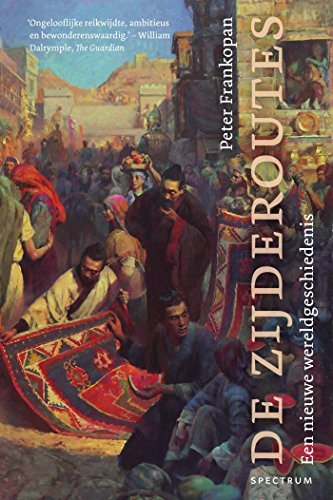
De zijderoutes is een schitterende verkenning van de elementen die de stuwende kracht waren achter de opkomst en de ondergang van wereldrijken, die de stroom van ideeën en goederen bepaalden en nu een nieuw tijdperk inluiden in de internationale politiek.
Het gebied ten oosten van de Middellandse en de Zwarte Zee tot aan de Himalaya, dwars door Centraal-Azië tot diep in China en India, was duizenden jaren het middelpunt van de aarde. Het is de bakermat van onze beschaving, waar meer dan 2500 jaar v.Chr. metropolen ontstonden als Harappa en Mohenjodaro met een bevolking die in de tienduizenden liep en met straten die waren aangesloten op een geavanceerd rioleringssysteem. Het is ook het gebied van de zijderoutes – handelsroutes maar ook verbindingswegen waarlangs opvattingen, religies, ideeën, cultuur én ziektes zich konden verspreiden.
Hier begint Peter Frankopan zijn nieuwe wereldgeschiedenis. Na de eerste zijderoutes ontstonden er andere: de slavenroute, de goudroute, de route naar het zwarte goud. Maar in onze eenentwintigste eeuw zijn nieuwe routes aan het ontstaan die een grote gelijkenis vertonen met die allereerste, die Centraal-Azië doorkruisten. De zijderoutes komen terug!
Peter Frankopan studeerde geschiedenis in Cambridge. Hij is sinds 2000 Senior Research Fellow en directeur van The Centre for Byzantine Research aan de universiteit van Oxford. Eerder schreef hij De eerste kruistocht.
1091 pages, Kindle Edition
First published January 1, 2015


Remarkably a copy of the khagan's reply to this letter survives with the Kazar ruler explaining his tribes conversation to Judaism. The decision to convert, wrote the Khagan was the result of the great wisdom of the one of his predecessors, who had brought delegations representing different faiths to present the case for each. Having pondered how best to establish the facts the rule had asked the Christians whether Islam or Judaism was the better faith. When they replied that the former was certainly worse than the later, he asked the Muslims whether Judaism or Christianity was preferable. When they lambasted Christianity and also replied that Judaism was the less bad of the two, the Khazar ruler announced that he had reached a conclusion: both had admitted that "the religion of the Israelites was better," he declared, so "trusting in the mercies of God and the power of the Almighty, I choose the religion of Israel, that is, the religion of Abraham. (p109)Slavery was endemic in Islamic society during the zenith of its culture in the medieval years—much the same as it had been in the Roman Empire during its heyday. The following excerpt from the book provides a discussion of the extent of slavery in Islamic lands:
Recent research suggests that at the height of its power the Roman Empire required 250,000—400,000 new slaves each year to maintain slave population. The size of the market in the Islamic lands was considerably larger—assuming the demand for slaves was analogous—stretching from Spain through to Afghanistan, which would suggest that the number of slaves being sold may have been far greater even than those for Rome. Although the limitations of the source material are frustrating, some idea of the likely scale comes from the fact that one account talks of a caliph and his wife owning a thousand slave girls each, while another was said to own no fewer than four thousand. Slaves in the Muslim world were as ubiquitous—and silent—as they were in Rome. (p116)The book mentions that much of the gold and silver taken by Spain from the newly found mines of North and South America ended up in the far east in payment for luxury goods such things as spices, silks and fine china. China in particular had a preference for silver relative to gold, thus a large portion of the silver ended up in China. The following excerpt discusses the economic consequences of such an accumulation of silver in China:
Much of the silver that flooded into China was spent in a series of major reforms, not the least of which were the monetisation of the economy, the encouragement of free labour markets and a deliberate program to stimulate foreign trade. Ironically, China's love of silver and the premium it placed on this particular precious metal became its Achilles heel. With such great quantities of silver reaching China, above all through Manila, it was inevitable that its value would start to fall, which over time caused price inflation. the net result was that the value of silver, and above all its value in relation to gold, was forced into line with other regions and continents. Unlike India, where the impact of the opening up of the world produced new wonder of the world, in China it was to lead to a serious economic and political crisis in the seventeenth century. Globalisation was no less problematic five centuries ago than it is today. (p235)This book provides a history written from an intentionally non-Western point of view. This difference in perspective is what makes it unique and worth reading.


