Giles Stannus Cooper, OBE was an Anglo-Irish playwright and prolific radio dramatist, writing over sixty scripts for BBC Radio and television. He was awarded the OBE in 1960 for "Services to Broadcasting". A dozen years after his death at only 48 the Giles Cooper Awards for Radio Drama were instituted in his honour, jointly by the BBC and the publishers Eyre Methuen.
Review follows of the first play, Happy Family by Giles Cooper:
Giles Cooper was an Anglo-Irish playwright; a pioneer of both radio and television drama. He adapted and wrote over sixty scripts for the BBC, both adaptations of famous novels, plus his own original works. Many of his plays were later adapted for both stage and television. He was awarded the OBE in 1960 for "Services to Broadcasting", but tragically died at the premature age of 48, after falling from a train, returning from a "Guild of Dramatists'" Christmas dinner in December 1966. Happy Family was his final play.
Happy Family is a domestic comedy, with a small cast and a slightly claustrophobic feel. The play is set in an English cottage in Huntingdonshire, across the afternoon and evening of a Spring Day in 1963. The ironically named "Solstice" family seems to live in a time-warp. Their Englishness is propped up by insecurity and outrageous childishness. Not one of the characters appears to have grown up. Suddenly an outsider arrives, and threatens to disrupt their games-playing. He certainly makes things happen, but he himself is arrested in his development. Everyone wants to play by their own set of rules, and everyone speaks their mind. But of course such frankness, and refusal to behave as adults, leads to the others' open revelations of feelings they might in retrospect have preferred to hide. Maria Aitken in her director's note observed,
"Characters with the outward appearance of adults, but the nature of children, can be used with vivid dramatic effect. Giles Cooper's family threesome have the kind of candid reactions that reveal not just themselves but others...it spontaneously elicits the basic desires and fears of others...Cooper observed, through the Solstices, the sort of fossilised Englishness we can still laugh at as "the Establishment": that big other Happy Family, with its ludicrousness, desirability and danger, all at the same time."
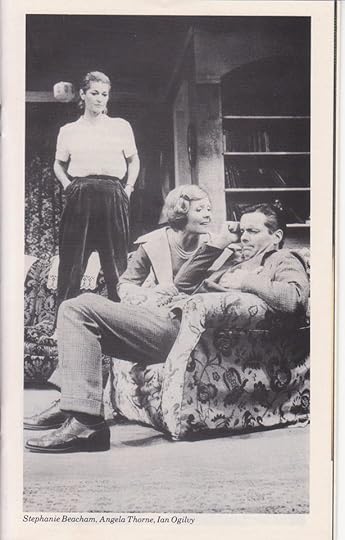
The play does not read exceptionally well on the page, but can be brought to life by a good cast. I read this a decade after it was set, and saw a production 20 years later, in September 1983. I then found it to be a light, entertaining domestic comedy, with a hidden edge. It was Maria Aitken's directorial debut. The trio were Stephanie Beacham as Deborah Solstice, Ian Ogilvy, superb as her spoilt little boy of a brother, Mark, Angela Throne as her icily bossy sister, Susan, and James Laurenson as the catalyst of an interloper, Gregory Butler.