Studio of the South tells the story of Van Gogh's period in Arles in 1888-1889, when his powers were at their height. Based on original research, the book reveals discoveries that throw new light on the legendary artist and give a definitive account of his fifteen months spent in Arles, including his collaboration with Gauguin.
Van Gogh headed to Arles believing that the landscape of Provence would have parallels with Japan, whose art he greatly admired. The south of France was an exciting new land, bursting with life. He loved walking the 5 kilometres up into the hills with the ruined abbey of Montmajour and in late spring he drew and painted over a dozen landscapes there. He went on an excursion to Saintes-Maries-de-la-Mer, a fishing village on the far side of the Camargue, where he saw the Mediterranean for the first time, energetically capturing it in paint. He painted portraits of friends and locals, and embarked on his flower still life paintings, culminating in the Sunflowers. During the heat of the Provencal summer, Van Gogh painted harvest scenes. He rented the Yellow House from May, and gradually did it up, calling it "an artist's house", inviting Paul Gauguin to join him there. This encounter was to have a profound impact on both of the artists. They painted side by side in the Alyscamps, an ancient necropolis on the outskirts of town, their collaboration coming to a dramatic end in December.
The difficulties Van Gogh faced living by himself led to his eventual decision in May 1889 to retreat to the asylum at Saint-Remy. One of his final tasks at the Yellow House was to pack up two crates with his last eight months' of paintings. Unsold in his lifetime, the pictures have since been recognized as some of the greatest works of art ever created.
From February 1888 through May of 1889, Vincent Van Gogh lived and worked in Arles. Some of his best known works came from this point in his career as an artist. Martin Bailey takes a deep dive into the art and the life of Van Gogh during his time there. We get to see who Van Gogh was leading up to, during, and following his brief time in Arles.
Being a big fan of Van Gogh's work, I was very excited to read this book. There is a ton of known and unknown information presented in 196 pages, but it's done in a way that the reader doesn't get lost. I really enjoyed the analysis of the paintings and comparisons to other artists who had painted landscapes at the same place.
I also liked that Bailey includes Van Gogh's own words to detail what's going on in his life and describing his own works. The author talks about Van Gogh's mental health without romanticizing it like others have done. This would definitely be a great addition to any art lover's bookshelf.
Thank you to Quarto Publishing Group-White Lion, author Martin Bailey, and NetGalley for gifting me a digital copy of this book in exchange for my honest review.
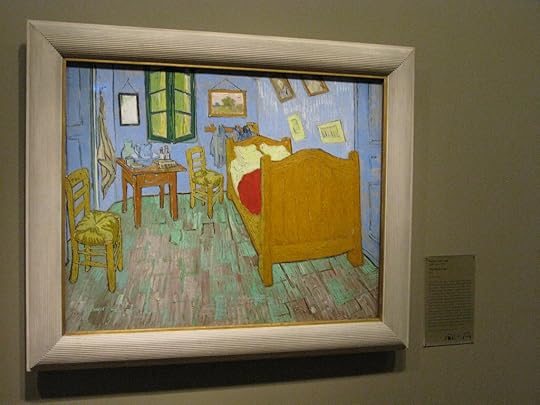
This beautifully produced book covers the time Vincent Van Gogh spent in the town of Arles, in Provence, 1888-89. In just two years he produced several iconic paintings, including Cafe Terrace at Night and The Night Cafe - a glimpse of the down side of night-life in Arles. Martin Bailey has researched his subject thoroughly and offers a sort of running commentary of the life of Van Gogh along with accounts of the paintings - both the circumstances and the artistic details of their composition. He points out, for example, that the famous painting of Vincent's bedroom in the "Yellow House" (a rented property he lived in) does not look the same now as it would have done when he painted it: the blue walls were originally pale violet and the doors lilac, according to Vincent himself in one of his letters to his brother Theo; the cochineal in the paint he used deteriorated, however, leaving only the blue colour. This deterioration of pigments is unfortunately common in his work.
Vincent's life in Arles is notable for several events: the general lightening of his palette and brilliance of his colours; the time he shared his home with Paul Gauguin and the traumatic mutilating of his ear. Vincent had dreamed of a community of painters living in the south of France and Gauguin was to have been only the first of many. Alas, Vincent's mental instability and peculiar personality made this vision exceptionally difficult to realise. Gauguin only stayed about three months towards the end of 1888, leaving after Vincent slashed his ear and was hospitalised. In addition, Vincent was financially dependent on his brother Theo and his worsening mental health coincided with Theo's decision to marry, with its implied threat of losing Theo's support when his family responsibilities grew. Under this pressure, Vincent's mental stability broke down and he eventually had to leave Arles for the asylum in Saint-Rémy and, ultimately, Auvers-sur-Oise, where he died.
Bailey has presented his material chronologically, with chapters devoted to paintings completed in Arles and its surrounding territory during the course of the year, showing sketches and drawings done before the paintings, as well. Although he had difficulty finding cooperative subjects, Vincent also managed a number of outstanding portraits of the people he met and befriended, including the postmaster Roulin and his wife and his doctors. The quality of reproductions is very high, bringing out the impact of Vincent's blues and golds as well as the more delicate whites and pinks of blossoming trees. In May and June of 1888, he visited the Saintes-Maries-de-la-Mer, a fishing village on the Mediterranean coast 40 miles south of Arles, painting views, cottages and boats at sea. The Saintes-Maries-de-la-Mer is also a pilgrimage destination for gypsies, who hold a yearly festival there.
Bailey has flanked his chapters on the paintings with an introductory Prologue about Vincent's life in Paris, where he stayed with Theo and studied painting at Cormon's studio and an account of the fate of Vincent's bed and other possessions after his death. There is also a chapter on the town of Arles itself, much of which (including Vincent's house) was destroyed by Allied bombing in 1944, but which has been partially rebuilt. Bailey includes a chronology of the years in Arles, substantial endnotes, a bibliography and index. I would strongly recommend this book to anyone wanting a thoughtful, factual but sympathetic review of Van Gogh's Arles years.
Like so many others I can never see enough of paintings by Vincent Van Gogh. I have been to the Van Gogh Museum in Amsterdam and see his works at most major and some minor museums in Europe, England and the USA. This book focuses on his prolific days in Arles, France. In only 444 days he completes around 200 paintings or about three a week. Martin Bailey tells what is going on with Vincent personally, timeframes for works and critiques them for composition. He quotes from letters to and from Van Gogh and interviews by others to document the time period. I especially enjoyed seeing early photos of Arles as it would have been seen by the artist.
The book is broken downing to sections like The Artists House, Seascapes, Harvest Time, Portraits etc. I like that writer includes sketches occasionally side by side with the finished painting. He also includes photos of people along side their portrait if it exists. I found paintings I've never seen which adds to my list of museums to visit. I've been to Over-sur-Oise where Van Gogh spent his last days and is buried. Arles and Provence continue to be on my bucket list.
The writing is knowledgeable and well documented. I've read two detailed biographies on Van Gogh and this meshes with what I know from them. It might be a bit too detailed for a casual reader. I think this is a beautiful coffee table book or gift for an art lover. Thank you to NetGalley and Quarto Publishing Group-White Lion for temporary ARC ebook in exchange for a honest review.
In art, to separate the life from the work is almost impossible, and with some artist is unimaginable, that is the case of Van Gogh. All the sorrow and conflicts in his mind and heart were deeply connected with the way he saw the world and the way he painted. But, sometimes people tend to concentrate in the most sadness times of him, forgettign the magic, the power, and the wonder he has. This book is a wonderful, moving oncoming to his times in Arles, in the memorable Yellow house and in this reality that was always mixed with dreams. For sure, one of the best books about him I have read. With amazing photos, postcards, and paints that have not been published before, filled with texts from his letters and with a very lovely, respectful and beautiful approach to his work, life, and pain. The way Martin Bailey have to talk about him is really cozy, beautiful, you feel as if a conversation flows, as a hot cup of chocolate in a rainy day. Thanks to netgalley for this copy!
This is a most marvelous of books! Here's a peek at it...
Some of the most pleasant of days of Vincent Van Gogh's life were spent in the "Studio of the South" (1888-1889 in Arles). It was a most idyllic time for him despite its being short-lived. When the canvas of good times rolled up, however, the highways and byways that once comforted and inspired him to paint a prolific plethora of paintings as seasons morphed into each other, became his crucible. His works were considered of little worth at the time, especially by the inhabitants of "the South," and sadly, those folks eventually came to think little of the man himself, as well.
Nowadays, these same paintings have had a momentus transformation of perspective from art collectors and enthusiaists the world over, and now command the great respect and honor they deserve. It's a far cry from those days of mean things to his worth and work's value, today.
The book, Studio of the South, written by Martin Bailey, paints a word picture of Van Gogh's life and masterpieces, as encapsulated above. Those unfamiliar with Van Gogh and his work will gain much insight and be impressed by the abundance of his work colorfully portrayed within the book's pages. Most, if not all the paintings are explained as to: of what they are composed, or why Van Gogh was madly spurred on to their creation (as much as can be concluded from collaboration from letters, documents and so on, to which the author had had access).
Those readers already familiar with Van Gogh's work will be delighted once again, especially since there are some "first-time-to-be-seen" works included among those of which they may already admire. It's quite possible these readers would learn new things about the man and his work, and in their eyes, propel Van Gogh to further 'in-Vincent-ability' and posterity.
Anyone who would purchase or be gifted this comprehensive biography with its outlay of paintings generously pictured, will not be disappointed. Slowly turn the pages, drink them in, savor the moods and seasons, and realize, especially, what it must have meant to the man behind the brush and palette.
Enjoy your 'virtual' "visite de museum du Vincent Van Gogh".
~Eunice C. - Reviewer/Blogger~
Disclaimer: This is my honest opinion based on the review copy I recieved from the publishers. (Eunice C.)
This is an excellent book about Vincent van Gogh’s time in Provence in which he produced many of his critically acclaimed works. The author takes us through this time period chronologically, talking about Vincent, his life, his surroundings, his writings to Theo and Wil, his siblings, and his time spent with Gauguin.
It is in Provence that he discovers that he wants to do series of works on the same subject like other artists such as Monet, Cezanne, and Katsushika Hokusai. His orchard series was completed from March 24 to April 20, 1888. It was van Gogh’s first exploration of Provence. The beauty of springtime in the countryside fired his imagination and motivated him into the belief of new beginnings.
The author has divided this book into sections relating to van Gogh’s subject matter, which also correlates to a chronological timeline of his painting Provence and events leading up to his death. Each section is beautifully illustrated with fine examples of that particular subject matter. There are both paintings and pen and ink drawings by van Gogh, as well as paintings by Gauguin. Also reproduced for the text are postcards of locations, photos, and drawings by other artists.
The author’s writing style is clear and concise, so reading is easy. The Timeline at the end of the book helps to re-state the facts in short form for the reader, and the map of Arles with points of interest is also helpful.
Definitely a good book and one I can recommend. A big thank you to Quarto Publishing Group - White Lion, Martin Bailey, and NetGalley for allowing me to read the eGalley of this book. I am posting an honest review and have not received anything in return.
This book has marvelous reproductions of Vincent Van Gogh’s paintings from the time he spent in Arles in the south of France from February, 1888 to 1889. There are several landscape and portrait paintings. The self-portraits are stunning.
Van Gogh had his problems. He was unable to sell his paintings and was supported by his brother Theo, an art dealer who lived in Paris. The painter Gauguin went to live with Vincent for a time – so he too was being supported by Theo. They were frequenting bars and brothels, which Theo also subsidized.
It was during the latter phase of his stay in Arles that Van Gogh sliced off his ear, wrapped it in newspaper, then walked to a brothel and presented it to a woman there. After this, he was institutionalized. He was released for brief period of time, but sadly he committed suicide in 1890.
Page 177 my book when departing Arles in May 1889
Vincent packed most of the pictures into crates, preparing the first major shipment to Theo… The paintings were simply rolled up, to reduce shipping costs… he took the boxes the very short distance to the train station, for dispatch by freight to Paris. Inside the crates were over thirty pictures… he could not sell these pictures – and neither could Theo… Today the contents of those two wooden crates would be worth billions of dollars.
I could not put this down. Apart from the subject matter, whose life has bewitched the world since his death the book makes some great links across complimentary works from other artists Van Gogh knew and who were working in Arles at the same time. The reproductions are sumptuous, even if some of them are small as full frame compositional photographs the details are great. Martin Bailey's style is very readable while including accurate detail his recounting of Van Gogh's time in Arles is not dry nor too imaginative as some recent dramatisations have been especially regarding his relationship with Gauguin.
The brief for the book is very specific so the end of Van Gogh's life is not included in any detail. What we do get is a good deal of conjecture about his mental state at a very specific and key moment in the artist's life while producing a body of work that remains a defining force of human vision through whatever forces enabled this moment of history to unfold. It does acknowledge the power Theo had in his brother's life although I believe there is still more that could be told in terms of what is a most unique brotherly relationship where Theo had such influence as a dealer and collector in Parisian artistic circles through his position at Goupil & Cie (Holland, London, Paris).
For anyone who enjoys being taken for a romantic art trail this book is a must :)
I received a copy of this book from the publisher through NetGalley to read and review.
STUDIO OF THE SOUTH by Martin Bailey is an account of the artist Van Gogh’s life in France which includes beautiful photo reproductions of his well known and lesser known paintings and drawings, along with those of his friends and contemporaries, most importantly Paul Gauguin whom Vincent had a productive but strained relationship with during this period of time.
Excellent descriptions of the circumstances surrounding his most important works and the known details of the artist’s life at the time they were created gives a new appreciation to each one of them, and a better understanding of the technique and development of Van Gogh’s unique and immediately recognizable style that has given a timeless quality and appreciation to the works of his lifetime.
Pleasant read, though not incredibly informative. More of a lookbook, coffee table book with many of Van Gogh's works from Arles - wish it provided more background and exposition into letters written by Van Gogh at this time / to Van Gogh, and perhaps dive more into the relationship and rivalry/companionship with Gauguin.
If you're looking for a quick summary of his time in Arles, however, this is a good find and a beautiful, calming work to peruse.
Studio of the South: Van Gogh in Provence by Martin Bailey if you love Van Gogh's beautiful paintings and long to learn more about them as well as see illustrations of so many not seen anywhere else, this book is for you.
Good read if you’re headed to Provence or want to know more about Van Gogh’s time there. Enjoyed the writing and the quality of the photos, and I thought it was well-researched. Gave context to some of the paintings and places I saw in the last few weeks.
Thanks to NetGalley and Quarto/White Lion for the gifted copy of this title in return for an honest review.
I have always adored art and even think of myself as somewhat of an art aficionado - regardless of the fact I scraped through GCSE level with a C grade about 13 years ago, and my own artistic abilities are yet to be unearthed. Having said that, I feel a level of peace, calm, and comfort when reading about, watching about, talking about, and viewing artwork. If there’s a museum or art gallery about, I’m there! Especially if there happens to be any Van Gogh artwork present. His work is beautiful, not just in the literal sense of his brushstrokes, but in what his work does to us and means to us and makes us feel.
I draw your attention to the Doctor Who episode “Vincent and the Doctor” (series 5, episode 10 - new who). In this classic episode, Bill Night’s character - a Van Gogh art expert - is asked to sum up, in one hundred words, where he thinks Van Gogh rates in the history of art. His response is as follows:
“To me, Van Gogh is the finest painter of them all. Certainly the most popular, great painter of all time. The most beloved, his command of colour most magnificent. He transformed the pain of this tormented life into ecstatic beauty. Pain is easy to portray, but to use your passion and pain to portray to ecstasy and joy and magnificence of our world, no one had ever done it before. Perhaps no one ever will again. To my mind, that strange, wild man who roamed the fields of Provence was not only the world’s greatest artist, but also one of the greatest men who ever lived.”
We all know the horrors of Van Gogh’s life and career, but is there more to the man other than his depression and the fact he cut off his own ear? Martin Bailey dived into uncharted territory with this book, providing us with tons of unknown (at least to me) information on Van Gogh. He presents us with background information we already know, but furnishes it with new findings. This makes the book approachable and friendly, but informative.
I love how Van Gogh uses a lot of yellow in his art work. I know this isn’t a comment on Bailey’s book as such, but he has chosen the most gorgeous pictures to portray this. It is amazing how many of Van Gogh’s most famous paintings were done in the last year or so of his life. It’s a shame to think of the brilliance we lost so early.
It is thoroughly researched and expertly written so not to simply regurgitate fact after fact, it is informative but entertaining. It is clear to anyone, even after reading just one page, that Van Gogh is not just Bailey’s interest but also his passion.
This is an excellent book about Vincent van Gogh’s time in Provence in which he produced many of his critically acclaimed works. The author takes us through this time period chronologically, talking about Vincent, his life, his surroundings, his writings to Theo and Wil, his siblings, and his time spent with Gauguin.
It is in Provence that he discovers that he wants to do series of works on the same subject like other artists such as Monet, Cezanne, and Katsushika Hokusai. His orchard series was completed from March 24 to April 20, 1888. It was van Gogh’s first exploration of Provence. The beauty of springtime in the countryside fired his imagination and motivated him into the belief of new beginnings.
The author has divided this book into sections relating to van Gogh’s subject matter, which also correlates to a chronological timeline of his painting Provence and events leading up to his death. Each section is beautifully illustrated with fine examples of that particular subject matter. There are both paintings and pen and ink drawings by van Gogh, as well as paintings by Gauguin. Also reproduced for the text are postcards of locations, photos, and drawings by other artists.
The author’s writing style is clear and concise, so reading is easy. The Timeline at the end of the book helps to re-state the facts in short form for the reader, and the map of Arles with points of interest is also helpful.
Definitely a good book and one I can recommend. A big thank you to Quarto Publishing Group - White Lion, Martin Bailey, and NetGalley for allowing me to read the eGalley of this book. I am posting an honest review and have not received anything in return.
I adore Vincent Van Gogh. I’ve been to the Van Gogh Museum in Amsterdam and insisted on visiting his grave in Auver-sur-Oise on a trip to France a couple years ago. I have not however been to Arles. This book is focused on Van Gogh’s 15 months in Provence during which he produced about 200 paintings. I believe that Martin Bailey works at the Van Gogh Museum in Amsterdam so his knowledge of Van Gogh is extensive. The book is extremely well researched including quotes from both Vincent’s writings as well as interviews from people who knew him. The book itself is broken down into themes like the artists house, flowers, portraits of friends, fields, Gauguin, etc. Within each theme is an explanation of the artists inspiration and a discussion of the major works within the theme accompanied by a full color image of the work. I particularly enjoyed seeing the ink sketches and studies side by side with the paintings they would become. I had seen most of the paintings at the various museums I’ve been to, but many of the sketches were new. I also appreciated that photos of the people / areas near from near the same time period or other artist’s depictions of the same thing were included as a comparison to Van Gogh’s work. I do think the book was a bit wordy for the casual reader, but I found it all very interesting. This book would be a wonderful coffee table book.
Thank you to NetGalley, Quarto Publishing Group, and Frances Lincoln Publishing for the ARC in exchange for an honest review.
I really enjoy books that can be considered coffee table books. I read enough books that make me think so it is nice to have some that, while still engaging my mind, allows me to simply enjoy the beauty of the images. Like so many others, I like Van Gogh and also like so many others I have been to the museum in Amsterdam (people seem to think visiting the museum makes a difference in reading/reviewing the book so I included it, though it really has little to no importance).
The thing that makes this book so interesting is that it is more focused than many others. This is not a look at the body of his work but a close look at both his life and his work from a very specific fifteen months in Provence. Unless you're an art historian who has studied Van Gogh extensively you will probably learn some new biographical information as well as gain a new appreciation for some of his lesser known works.
All in all this is an engaging read while also being an attractive book. Highly recommended for art lovers and people who like beautiful books to display around the house.
Reviewed from a copy made available by the publisher via NetGalley.
Another exemplary book from this author on the topic of van Gogh, this one appears to be a reprint (or revision, I cannot be sure) of a 2016 effort that came before his 'Starry Night'. This acts as a straight prequel, then, as it takes the Dutchman from Montmartre and Paris down to Arles and his Yellow House, the studio-cum-residence he took up near the Camargue – until a shocking act, apparently inspired by news he took as personally bad if not threatening. Seemingly brilliant in its research and background, excellent in reproducing the artworks (even ones lost in WW2), and written for any level of art appreciation and knowledge, this is clearly another five star product from a writer who is perfect for this subject. Rare seascapes, the portraits he deemed good enough to sleep with – there is a wealth of van Gogh's creativity on display, only matching in quality the treatment it gets.
This book’s title is derived from Van Gogh’s description of his home in Arles. He lived there for 444 artistically productive days, leaving after the notorious incident with his ear. Intriguingly, the book’s author has a theory about why that happened when it did.
This work is well-researched and engaging. It can be enjoyed by both serious art scholars and those who simply adore Van Gogh. The number of reproduced paintings is impressive and readers will enjoy studying them at leisure and learning more about them, the artist and those who knew him.
This title is highly recommended. It offers readers an immersive and involving reading experience.
Many thanks to NetGalley and the publisher . All opinions are my own.